What is agentic AI in telecom? (Short answer)
Agentic AI in telecom is AI that pursues an operational goal across several steps and systems. The goal might be clearing a network fault, resolving a billing dispute or activating an enterprise order. The agent works inside permissions and policies that humans define. It detects the situation, gathers context, decides within policy, acts through approved systems, verifies the result and records every step.
Generative AI drafts answers. Agentic AI performs and closes the work.
This guide covers 30 agentic AI use cases in telecom across six domains: network assurance, customer care, revenue and fraud, B2B sales, field operations, and regulatory and finance. Each use case lists what the agent does, the systems it touches, a recommended starting autonomy level, the human checkpoint and the KPI that proves value. Where we have built the same pattern for enterprises in other industries, we say so, without naming clients.
Key takeaways
- Telecom is moving fast, but most operators are still early. In 2025, 44% of communications service providers reported AI agents running in customer-facing interactions. Yet an Accenture study found 79% of telcos are still at Level 0/Level 1 autonomy. ConcentrixFierce Network
- The ambition is clear. TM Forum reports that 75% of operators plan to increase autonomous-network investment and 81% aim to reach Level 4 or above by 2030. TM Forum
- The biggest near-term value is often outside the radio network. It sits in billing, care, orders, collections, fraud triage, field dispatch and regulatory reporting, where work crosses OSS, BSS, CRM and ERP systems.
- Autonomy should be earned, not switched on. Start agents in assist or co-work mode, prove accuracy and business outcomes, then expand to exception-managed operation one workflow at a time.
- Governance is the deciding factor. Every state-changing action should pass through deterministic rules, permission checks, human approvals where required, and a full audit trail.
1. Agentic AI vs generative AI vs AIOps in telecom
Telecom operators have automated for decades: SON, rule-based OSS workflows, RPA bots in back offices and machine-learning models for churn and fraud. Agentic AI does not replace these. It coordinates them.
| Approach | What it does well | Where it stops | Typical telecom example |
|---|---|---|---|
| Rule-based automation / RPA | Executes a known path on structured data | Breaks when inputs are ambiguous or the path changes | Bulk SIM activation scripts |
| Traditional AI / AIOps | Predicts, scores and detects anomalies | Usually stops at a recommendation; a human does the rest | Churn score, alarm anomaly flag |
| Generative AI | Reads and writes language: summaries, drafts, answers | Does not own a task end-to-end or act in systems | Drafting a reply to a billing complaint |
| Agentic AI | Plans multi-step work, calls tools, coordinates systems and people, verifies outcomes | Must be bounded by permissions, rules and approvals | Investigating a dispute, applying a policy-approved adjustment, updating CRM and confirming with the customer |
The practical rule: use RPA and deterministic workflows where the path is fixed. Use agents where work depends on documents, free text, cross-system investigation or judgement within policy.
For a deeper comparison, see our guide to AI agents vs RPA. Infosys makes a similar point, advising operators to separate use cases where RPA is sufficient from those where agentic AI adds value (Infosys Knowledge Institute).
2. Where AI agents should not act on their own
A credible agentic AI programme in telecom starts by deciding where agents must not act autonomously. In our view, these stay under human or network-vendor control:
- Live radio and core parameter changes outside a vendor's validated closed-loop tooling. Agents can investigate and recommend; execution belongs to engineered systems with rollback.
- Emergency and lawful-intercept services. These carry safety and regulatory obligations.
- Irreversible customer actions, such as number porting, account termination or large goodwill credits, unless an approved policy explicitly permits them.
- Credit and fraud blocks with customer impact. The agent assembles evidence; a human confirms the block.
- Changes to the agent's own permissions, rules or prompts. Improvements are proposed and reviewed, never self-applied.
Ericsson makes a related point about grounding. Telecom ontology-assisted reasoning reduces hallucinations by grounding AI outputs in a structured model of network entities, KPIs and causal relationships (Ericsson white paper). Ericsson
3. The telecom autonomy ladder: TM Forum levels mapped to human–agent operating modes
TM Forum's Autonomous Networks framework grades network operations from Level 0 (manual) to Level 5 (fully autonomous). At Level 3 the system senses, decides and acts within specific domains while humans intervene by exception; at Level 4 it self-configures, self-heals and self-optimises across a domain with minimal human involvement. Openmind Networks
The same logic applies beyond the network, to billing, care, orders and finance. We use this mapping to set the starting mode for every use case in this guide:
| TM Forum level | Human–agent operating mode | Human role | Agent role |
|---|---|---|---|
| L0 Manual | Digitised | Performs all work | None |
| L1 Assisted | Assist | Initiates, validates and acts | Prepares analysis, drafts, evidence |
| L2 Partial | Co-work | Owns the work item, approves key steps | Performs bounded steps |
| L3 Conditional | Delegate | Sets objectives, handles escalations | Owns bounded tasks end-to-end |
| L4 High | Exception-managed | Defines policy, manages exceptions | Runs the normal path |
| L5 Full | Adaptive | Approves goals, policy and releases | Proposes process improvements under controlled release |
Two principles follow from this ladder:
- Autonomy is per workflow, not per company. An operator can be at Delegate for outage notifications and at Assist for fraud blocks at the same time.
- Autonomy is a contract, not a switch. It specifies scope, value limits, escalation triggers, required evidence and an expiry date.
Our AI agent governance playbook covers how to define these contracts.
4. 30 agentic AI use cases in telecom
Each use case follows the same format:
- What the agent does
- Systems: what it reads from and acts through
- Starting mode: where to begin on the ladder above
- Human checkpoint: where a person must decide
- KPI: how to prove value
- Proof: either a pattern we have built for enterprises in other industries, or a public industry signal
A. Network and service assurance (use cases 1–7)
1. Alarm correlation and root-cause triage
What the agent does: Groups related alarms across RAN, transport and core using topology, inventory and incident history. It drafts a probable root cause with supporting evidence, then opens or updates a single incident instead of dozens of duplicate tickets.
Systems: Fault management/NMS, network inventory, ITSM or ticketing, change calendar.
Starting mode: Assist, moving to Co-work.
Human checkpoint: A NOC engineer confirms the root cause before any network change.
KPI: MTTR, alarm-to-incident ratio, duplicate tickets per event.
Proof: We built an agentic analytics and automated operational-alerting layer for a city-scale smart-infrastructure operator running multiple command centres. It is the same sense–correlate–alert–route loop a NOC needs. In the industry, a TM Forum Catalyst demonstrated intelligent fault correlation across RAN and transport on real operator data, linking technical events to business outcomes in a single view (TM Forum Agentic NOC). TM Forum
2. Validating customer complaints against network faults
What the agent does: Reads a complaint in free text, maps it to location and serving cells, and checks active faults and KPIs. It classifies the issue as network, device, billing or configuration, then routes it to the right team with evidence attached.
Systems: CRM, ticketing, fault and performance management, geolocation data.
Starting mode: Delegate for classification and routing.
Human checkpoint: An engineer reviews high-severity complaints attributed to the network.
KPI: Misrouted tickets, time-to-validate, repeat complaints.
Proof: RADCOM describes agents that validate whether a complaint is reasonable and network-related, correlate it with similar complaints and suggest a resolution (RADCOM). RADCOM
3. Predictive maintenance for sites and towers
What the agent does: Monitors power, battery, generator, cooling and link telemetry and detects degradation patterns. It creates a maintenance work order with the likely fault, required parts and site-access details.
Systems: Site telemetry/IoT, EAM or field-service system, inventory, site-access records.
Starting mode: Delegate (work-order creation).
Human checkpoint: A dispatch manager approves visits above a cost threshold.
KPI: Site outage minutes, avoidable truck rolls, fuel and energy cost per site.
Proof: We built transmission KPI monitoring, anomaly detection, loss and outage analytics, predictive-maintenance indicators and automated field alerts for a state power-transmission utility. Site-power operations run on the same pattern. See also our energy and utilities solutions.
4. RAN energy-saving recommendations
What the agent does: Analyses traffic, power consumption and time-of-day patterns per site. It proposes energy-saving policies such as carrier sleep windows, then tracks whether customer experience KPIs held after changes.
Systems: Performance management, energy metering, network vendor energy tooling.
Starting mode: Assist. Execution stays inside the network vendor's validated energy features.
Human checkpoint: RAN engineering approves every policy.
KPI: kWh per GB, energy cost per site, QoE guardrail metrics.
Proof: We built energy monitoring, forecasting and optimisation recommendations for a national research campus, the same observe–forecast–recommend loop applied at site level.
5. Change and maintenance-window risk review
What the agent does: Reads a change request or method of procedure (MOP). It identifies affected services and enterprise customers with SLAs, overlapping changes and past incidents from similar changes, then produces a risk note for the change advisory board.
Systems: Change management, service inventory, SLA contracts, incident history.
Starting mode: Assist.
Human checkpoint: The change advisory board decides.
KPI: Change-induced incidents, CAB preparation time.
Proof: Our document AI work includes revision and change detection across complex technical documents, which is the core of MOP review.
6. Enterprise SLA breach detection and service credits
What the agent does: Monitors availability, latency and repair-time SLAs per enterprise contract and detects breaches. It calculates credits using deterministic contract rules and drafts the customer notification.
Systems: Performance data, contract repository, billing, CRM.
Starting mode: Co-work.
Human checkpoint: The account manager approves credits and outbound communication.
KPI: Credit accuracy, SLA disputes, time-to-notify.
Proof: We built cross-entity KPI standardisation and automated exception alerts for a diversified business group with more than 30 companies. Credits are calculated by a rules engine, not by a language model.
7. Capacity-planning insight packs
What the agent does: Produces weekly packs of congestion hotspots, utilisation forecasts and plain-language explanations. Planners can then ask follow-up questions in natural language against certified metrics.
Systems: Performance management, data warehouse, planning tools.
Starting mode: Assist.
Human checkpoint: Network planning owns investment decisions.
KPI: Congestion hours, planning cycle time.
Proof: We built an insights-to-action layer for a retail holding group that turns dashboard insights into governed tasks and tracks completion. Read more in Agentic BI for data analysis.
B. Customer care and CX (use cases 8–13)
8. Multilingual voice care agent and IVR replacement
What the agent does: Answers calls in the customer's language. It authenticates, checks account and network status, resolves routine requests such as balance, plan details, recharge issues and outage status, and hands off to a human with full context when needed.
Systems: Telephony/CCaaS, CRM, billing, network status, knowledge base.
Starting mode: Delegate for routine intents.
Human checkpoint: Automatic handoff on negative sentiment, porting requests, complaints or low confidence.
KPI: Containment rate, average handle time, CSAT, call-centre load.
Proof: We built a Hindi and English voice support agent (speech-to-text, LLM, text-to-speech) for a national retail chain operating hundreds of stores. It included store-level inventory and knowledge agents, an admin console and ticketing integration. In the industry, Telefónica's Aura handles over 400 million interactions annually across 30+ channels (IFS). Learn more about Voice AI and voice AI for enterprise. IFS Blog
9. Billing dispute resolution
What the agent does: Reads the dispute and pulls invoices, usage records, plan terms and prior adjustments. It identifies the cause, such as a mis-rated charge, an unapplied discount, a roaming charge or a duplicate. It then applies adjustments within policy limits or prepares a case for approval.
Systems: Billing/rating, CRM, usage records, adjustment policy.
Starting mode: Co-work.
Human checkpoint: Adjustments above a set value, or any goodwill credit, need human approval.
KPI: Dispute cycle time, repeat contacts, adjustment leakage.
Proof: We built omnichannel support agents with auditable workflow routing, agent-assist summaries and SLA monitoring for a global fintech serving banks and credit unions, in a disputes environment similar to telecom billing. See AI agents for customer support.
10. Plan changes executed consistently across CRM, billing and provisioning
What the agent does: Validates eligibility for a plan change, bundle, add-on or suspension. It applies the change across every system, verifies each downstream update and informs the customer. Partial failures are routed with full context.
Systems: CRM, product catalogue, billing, provisioning/activation.
Starting mode: Delegate, with post-execution verification.
Human checkpoint: Exception queue for failed or inconsistent changes.
KPI: Order fallout rate, repeat contacts after plan changes.
Proof: Concentrix notes that plan and account updates frequently fail across CRM, billing and provisioning, and partial changes create service issues, billing errors and repeat contacts (Concentrix). We built validated, rule-governed SAP sales-order creation with exception approvals and reconciliation reporting for a UAE engineering group. Concentrix
11. Proactive outage notification
What the agent does: When a fault is confirmed, it identifies impacted customers and enterprise sites. It sends approved notifications, suppresses duplicate tickets, updates restoration estimates and confirms restoration afterwards.
Systems: Fault management, service inventory, CRM, messaging channels.
Starting mode: Exception-managed for standard templated messages.
Human checkpoint: Communications approval for major or regional incidents.
KPI: Inbound call spike during outages, duplicate tickets, customer complaints.
Proof: GSMA describes how agentic AI can detect a drop in service quality, reroute traffic proactively and notify the user in real time (GSMA). Our grid outage-analytics and tenant-service agent work covers the detection and communication halves of this loop. GSMA
12. Churn-save next-best-action
What the agent does: Watches churn signals such as network experience, bill shock, competitor offers, usage decline and complaints. It selects an eligible retention action using deterministic offer rules and routes it to the best channel or a human retention specialist.
Systems: CRM, usage and experience data, offer catalogue, rules engine.
Starting mode: Co-work.
Human checkpoint: Offers above budget limits, and any contract change.
KPI: Incremental retention measured against a holdout group, net of offer cost. Do not count saves from customers who would have stayed anyway.
Proof: We built multi-signal account monitoring and rule-governed next-best-action for an enterprise sales team. The same governance applies to retention offers.
13. Agent-assist for human representatives
What the agent does: While a representative is on a call or chat, it summarises the account, shows network status, answers policy questions with cited sources and suggests the next step.
Systems: CRM, knowledge base, network status, billing.
Starting mode: Assist.
Human checkpoint: The representative decides and acts.
KPI: Average handle time, first-contact resolution, time-to-proficiency for new hires.
Proof: We built a knowledge and training agent over POS and SOP documents for a national retail chain, reducing helpdesk burden and speeding onboarding.
C. Revenue, billing and fraud (use cases 14–18)
14. Revenue-leakage investigation
What the agent does: Reconciles usage records, rating, billing and provisioning. It spots services active but not billed, rating anomalies and discount misuse, investigates each one and opens a case with evidence and an estimated value.
Systems: Mediation, rating, billing, provisioning, revenue assurance tools.
Starting mode: Co-work.
Human checkpoint: A revenue assurance analyst confirms before any correction.
KPI: Leakage recovered, time-to-detect.
Proof: We built analytics consolidation with data-quality checks and a governance layer across multi-entity operations for an enterprise logistics company.
15. Fraud case triage: SIM swap, subscription fraud and IRSF
What the agent does: When a fraud alert fires, it assembles evidence (recent SIM changes, device changes, usage anomalies, KYC data) and classifies risk. It recommends an action and prepares the case file.
Systems: Fraud management, CRM, KYC, usage data, network events.
Starting mode: Assist, moving to Co-work.
Human checkpoint: A fraud analyst confirms any block that affects the customer.
KPI: Fraud losses, false-positive rate, time-to-action.
Proof: IFS reports that operators including AT&T and Telefónica are deploying autonomous assistants that orchestrate multiple agents to act on fraud alerts and coordinate customer care offers. We built transaction screening with risk classification, evidence collection and explainability notes for a tax-technology product, the same evidence-first pattern. IFS Blog
16. Postpaid and enterprise collections
What the agent does: Prioritises overdue accounts, sends policy-compliant reminders, makes or logs calls, records promises to pay, monitors whether they are kept and escalates disputes. Credits and waivers are proposed, never self-issued.
Systems: Billing, CRM, payments, messaging and voice.
Starting mode: Exception-managed for standard low-value follow-ups; Co-work for disputes.
Human checkpoint: Payment plans, waivers and high-value accounts.
KPI: Cash collected, promise-to-pay kept rate, DSO, complaint rate.
Proof: Receivables follow-up is a pattern we have built and refined. We also built an AI CFO agent for continuous cash-flow monitoring and risk alerts. See AI agents for finance.
17. Interconnect and roaming reconciliation
What the agent does: Compares partner invoices and settlement files against internal records, flags discrepancies, drafts dispute packs with evidence and tracks the disputes to closure.
Systems: Interconnect billing, roaming clearing data, ERP, document repository.
Starting mode: Co-work.
Human checkpoint: A finance manager approves disputes before they are sent.
KPI: Disputed amounts recovered, reconciliation cycle time.
Proof: We built vision-LLM extraction from complex PDFs, synchronised into core systems with audit logs, for a building-services specialist handling complex tenders.
18. Competitive tariff and offer monitoring
What the agent does: Continuously monitors competitor plans, prices, offers and app-store ratings. It answers leadership questions in natural language and sends alerts when a competitor makes a material move.
Systems: Public web sources, internal catalogue, BI.
Starting mode: Exception-managed for monitoring and alerts; humans own pricing decisions.
Human checkpoint: The pricing committee.
KPI: Time-to-respond to competitor launches, manual monitoring hours saved.
Proof: We built continuous e-commerce and channel monitoring of pricing, discounts, offers, availability and ratings for a major consumer-appliance manufacturer in a price-sensitive market. It replaced manual checks across portals with proactive alerts.
D. B2B and enterprise sales (use cases 19–22)
19. Enterprise RFP and tender response
What the agent does: Ingests RFPs and tender documents and extracts requirements, deadlines and compliance clauses. It detects revisions between tender versions, drafts responses from approved content and flags gaps.
Systems: Document repository, CRM, product catalogue, pricing tools.
Starting mode: Co-work.
Human checkpoint: Bid manager and legal approve every submission.
KPI: Bid preparation time, compliance gaps caught before submission.
Proof: We built an intelligent document workbench for tenders for a building-services specialist. It uses multi-agent orchestration, revision analysis, vision-LLM extraction and deep integration into core operational systems, with quote locking and audit logs.
20. B2B order-to-activation
What the agent does: Validates enterprise orders (sites, feasibility, pricing, contract terms), creates orders in OSS and ERP systems and chases dependencies such as site surveys and customer premises equipment. It keeps the customer informed.
Systems: CRM/CPQ, OSS order management, ERP, field service.
Starting mode: Delegate, with maker-checker on system writes.
Human checkpoint: Non-standard orders and pricing exceptions.
KPI: Order-to-activate cycle time, order fallout, data-entry errors.
Proof: We built agentic automation that interprets order triggers, validates them and creates SAP sales orders for a UAE engineering group. It replaced a legacy order-capture tool with rules, approvals, audit logs and reconciliation reporting.
21. Enterprise account expansion and renewals
What the agent does: Monitors enterprise accounts for renewal windows, usage growth, service issues and expansion signals. It recommends next-best actions and creates follow-up tasks in CRM.
Systems: CRM, billing, usage data, service tickets.
Starting mode: Co-work.
Human checkpoint: Account managers own every customer conversation.
KPI: Account coverage per rep, on-time renewals, expansion pipeline.
Proof: We built an always-on sales agent with rule-governed opportunity identification and follow-up orchestration for an engineering and technology solutions provider.
22. Voice assistant for retail and channel partners
What the agent does: Lets retailers, distributors and field sales staff ask by voice about schemes, stock, targets, commissions and order status, and log visits and orders.
Systems: Distributor management, ERP, CRM, scheme rules.
Starting mode: Delegate for information and logging.
Human checkpoint: Scheme exceptions and credit limits.
KPI: Partner query resolution time, visit compliance, sell-through.
Proof: Voice-based field-sales assistance is a pattern we have built. So is a store-level inventory intelligence agent covering pricing, stock and promotions per store for a national retail chain.
E. Field service and supply chain (use cases 23–26)
23. Technician dispatch and first-time fix
What the agent does: Matches jobs to technicians by skill, certification, location and parts availability. Before the visit, it assembles site history, likely fault and procedures, then guides troubleshooting on site.
Systems: Field-service management, workforce scheduling, inventory, knowledge base.
Starting mode: Co-work.
Human checkpoint: A dispatcher approves schedule changes that affect SLAs.
KPI: First-time fix rate, repeat visits, MTTR.
Proof: Teradata reports that some telcos report a 25% reduction in repeat site visits and a 29% faster mean time to repair (Teradata). We built matching, scheduling and compliance workflows for a healthcare staffing platform, the same skill-and-availability matching problem. Teradata
24. Spares and inventory for network sites
What the agent does: Forecasts spares demand by region, monitors critical stock levels, proposes transfers or purchase requests and chases delayed deliveries.
Systems: ERP, warehouse management, field service, supplier portals.
Starting mode: Delegate for monitoring and requisition drafts.
Human checkpoint: Purchase approvals under delegation-of-authority limits.
KPI: Stockouts of critical spares, inventory carrying cost.
Proof: See 27 inventory management AI agent use cases.
25. Vendor and procurement KPI alerts
What the agent does: Tracks purchase-price trends, vendor delivery and quality performance, contract compliance and early-payment economics. It alerts procurement and finance before margins or schedules slip.
Systems: ERP, procurement, contracts, AP.
Starting mode: Exception-managed for monitoring; humans decide actions.
Human checkpoint: Category managers and finance.
KPI: Price variance, vendor on-time delivery, working capital.
Proof: We built automated alerts on purchase-price trends, gross-margin impact, early-payment analysis and vendor performance across group entities for a diversified business group with more than 30 companies.
26. Tower and site lease contract management
What the agent does: Extracts renewal dates, escalation clauses, access terms and obligations from thousands of lease agreements. It alerts owners ahead of deadlines and checks invoices against contract terms.
Systems: Contract repository, ERP/AP, property management.
Starting mode: Delegate for extraction and alerts.
Human checkpoint: Lease renewals and renegotiations.
KPI: Missed renewals, lease overpayments recovered.
Proof: We built a knowledge base over tenancy documents, policies and SOPs, with tenant query triage and escalation, for a real estate portfolio manager.
F. Regulatory, finance and leadership (use cases 27–30)
27. Regulatory QoS reporting and evidence
What the agent does: Assembles quality-of-service KPIs, calculations and evidence for regulator submissions, such as TRAI QoS reporting in India. It highlights anomalies and drafts the report for sign-off.
Systems: Performance management, data warehouse, document repository.
Starting mode: Co-work.
Human checkpoint: The regulatory affairs head signs off every submission.
KPI: Report preparation hours, late or corrected filings.
Proof: See our AI agent use cases in banking, where continuous evidence collection for regulatory reporting follows the same pattern.
28. Data-protection and consent compliance monitoring
What the agent does: Continuously checks that customer data processing, marketing outreach and data sharing match recorded consent and policy, including India's DPDP Act obligations. It flags gaps and opens remediation tasks.
Systems: Consent management, CRM, marketing platforms, data catalogue.
Starting mode: Assist, moving to Co-work.
Human checkpoint: The data protection officer decides remediation.
KPI: Open compliance gaps, time-to-remediate.
Proof: See compliance and risk agents.
29. Conversational analytics across circles and operating companies
What the agent does: Lets leaders ask questions in plain language, such as "Which circles lost the most postpaid subscribers last month, and why?" Answers come from certified metric definitions with row-level security, so a circle head sees only their circle.
Systems: Data warehouse, semantic layer, BI.
Starting mode: Assist.
Human checkpoint: None for read-only analysis; metric definitions are owned by data governance.
KPI: Time-to-answer, BI backlog, consistency of reported numbers.
Proof: We built a governed natural-language analytics agent for a real-time business analytics company, and cross-entity KPI consolidation for an enterprise logistics group. See our Data Analyst Agent.
30. Capex tracking and finance close support
What the agent does: Tracks capex commitments against budget by project and region, explains variances, chases missing accruals and coordinates close tasks.
Systems: ERP, project systems, procurement, close checklist.
Starting mode: Co-work.
Human checkpoint: Finance controllers approve all journal entries.
KPI: Days to close, capex variance surprises.
Proof: We built forecasting and scenario-modelling agents with alerts for cash-flow risks for an AI CFO platform, and group-wide finance KPI monitoring for a diversified business group.
5. All 30 agentic AI use cases in telecom at a glance
| # | Domain | Use case | Starting mode | Human checkpoint | Primary KPI |
|---|---|---|---|---|---|
| 1 | Network | Alarm correlation and RCA triage | Assist → Co-work | Engineer confirms RCA | MTTR |
| 2 | Network | Complaint-to-network validation | Delegate | High-severity review | Misrouted tickets |
| 3 | Network | Predictive site maintenance | Delegate | Costly dispatches | Site outage minutes |
| 4 | Network | RAN energy-saving recommendations | Assist | RAN engineering | kWh per GB |
| 5 | Network | Change risk review | Assist | CAB | Change-induced incidents |
| 6 | Network | SLA breach and service credits | Co-work | Account manager | Credit accuracy |
| 7 | Network | Capacity insight packs | Assist | Planning | Congestion hours |
| 8 | Care | Multilingual voice care | Delegate | Sentiment/complex handoff | Containment, CSAT |
| 9 | Care | Billing dispute resolution | Co-work | Adjustments above limit | Dispute cycle time |
| 10 | Care | Cross-system plan changes | Delegate | Exception queue | Order fallout |
| 11 | Care | Proactive outage notification | Exception-managed | Major incident comms | Inbound spike |
| 12 | Care | Churn-save next-best-action | Co-work | Offers above budget | Incremental retention |
| 13 | Care | Agent-assist | Assist | Representative | AHT, FCR |
| 14 | Revenue | Revenue-leakage investigation | Co-work | RA analyst | Leakage recovered |
| 15 | Revenue | Fraud case triage | Assist → Co-work | Fraud analyst | Fraud loss, false positives |
| 16 | Revenue | Collections | Exception-managed / Co-work | Waivers, high value | Cash collected, DSO |
| 17 | Revenue | Interconnect and roaming reconciliation | Co-work | Finance manager | Amount recovered |
| 18 | Revenue | Competitive tariff monitoring | Exception-managed | Pricing committee | Response time |
| 19 | B2B | RFP and tender response | Co-work | Bid manager, legal | Bid prep time |
| 20 | B2B | Order-to-activation | Delegate | Non-standard orders | Order-to-activate time |
| 21 | B2B | Account expansion and renewals | Co-work | Account manager | On-time renewals |
| 22 | B2B | Channel partner voice assistant | Delegate | Credit and scheme exceptions | Query resolution time |
| 23 | Field | Dispatch and first-time fix | Co-work | Dispatcher | First-time fix rate |
| 24 | Field | Spares and inventory | Delegate | Purchase approvals | Critical stockouts |
| 25 | Field | Vendor and procurement KPIs | Exception-managed | Category managers | Price variance |
| 26 | Field | Site lease management | Delegate | Renewals | Missed renewals |
| 27 | Regulatory | QoS reporting evidence | Co-work | Regulatory head | Prep hours |
| 28 | Regulatory | Consent and DPDP monitoring | Assist → Co-work | DPO | Open gaps |
| 29 | Leadership | Conversational analytics | Assist | Data governance | Time-to-answer |
| 30 | Finance | Capex and close support | Co-work | Controllers | Days to close |
For agent use cases across other industries, see 65+ AI agent use cases transforming enterprises.
6. Proven patterns: what we have built that transfers to telecom
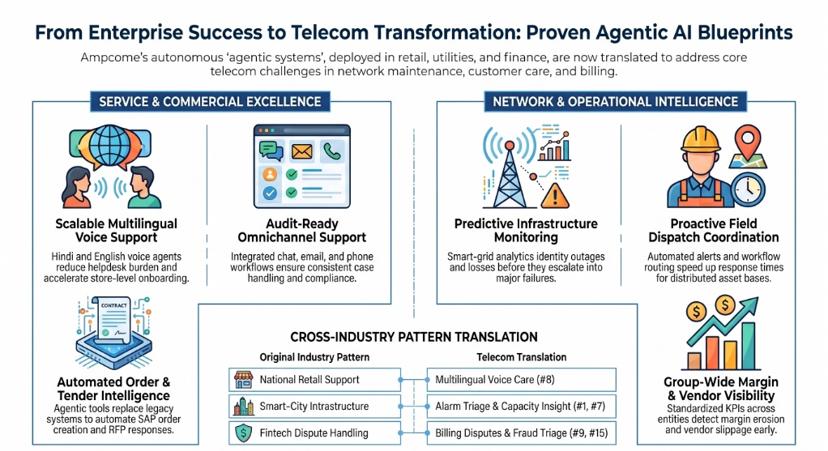
We will be direct: the examples below are not telecom deployments. They are agentic systems Ampcome has built on assistents.ai for enterprises in retail, utilities, smart infrastructure, financial technology, engineering and real estate. Each one solves a problem telecom operators face every day. Client names are withheld.
Pattern 1: Multilingual voice agent at national retail scale
Challenge: A national retail chain operating hundreds of stores needed to reduce helpdesk load, give store staff instant inventory visibility and speed up onboarding.
What we built: A Hindi and English voice support agent (speech-to-text, LLM, text-to-speech), an inventory intelligence agent covering pricing, stock and promotions per store, a knowledge and training agent grounded in POS and SOP documents, and an admin console with analytics and ticketing integration, built for high concurrency.
Outcome: Reduced manual helpdesk burden, faster store issue resolution, better store-level inventory visibility and faster onboarding through on-demand guidance.
Telecom translation: Multilingual voice care (#8), agent-assist (#13), channel partner assistant (#22).
Pattern 2: Agentic operations for a city-scale smart-infrastructure operator
Challenge: Operating multiple smart-city command centres meant watching enormous volumes of asset and system data for issues that needed action.
What we built: Smart-grid data ingestion, operational dashboards, predictive analytics for outages, losses and field issues, and automated alerts with workflow routing for resolution.
Outcome: Higher operational visibility, faster exception detection and response coordination, and more proactive operations through continuous monitoring.
Telecom translation: Alarm triage (#1), capacity insight (#7), outage notification (#11).
Pattern 3: Transmission-utility monitoring and predictive maintenance
Challenge: A state power-transmission utility needed earlier warning of losses, outages and equipment risk across a large distributed asset base.
What we built: Transmission KPI monitoring with anomaly detection, loss and outage analytics, predictive-maintenance indicators, and dashboards with automated alerts for field operations.
Outcome: Faster identification of grid exceptions, improved reliability through proactive monitoring and better transparency for leadership.
Telecom translation: Predictive site maintenance (#3), dispatch (#23).
Pattern 4: Omnichannel, auditable support for banking
Challenge: A global fintech provider serving banks and credit unions needed faster, consistent handling of disputes and service cases, with a complete compliance trail.
What we built: Omnichannel intake across chat, email and phone, workflow routing, agent-assist summaries with next-best actions, SLA monitoring, and full auditability and reporting.
Outcome: Faster, more consistent case handling, reduced operational load and better compliance readiness through audit trails.
Telecom translation: Billing disputes (#9), fraud triage (#15).
Pattern 5: Replacing a legacy order-capture tool with agentic SAP order creation
Challenge: A UAE engineering group was moving away from a costly, end-of-life order-capture tool.
What we built: Agents that interpret order triggers, validate them and create SAP sales orders, with rules for exceptions and approvals, audit logs and reconciliation reporting.
Outcome: Less manual order processing and legacy dependency, a faster order-to-confirm cycle with fewer data-entry errors, and better auditability.
Telecom translation: Plan changes (#10), B2B order-to-activation (#20).
Pattern 6: Always-on competitive intelligence
Challenge: A major consumer-appliance manufacturer in a price-sensitive market was manually checking competitor prices and offers across online channels.
What we built: Continuous monitoring of pricing, discounts, offers, availability and ratings, agentic Q&A mapped to leadership questions, and analytics on pricing gaps and portfolio movement, with governance and audit trails from PoC to production architecture.
Outcome: Faster competitive response cycles, earlier detection of pricing gaps and promotion shifts, and always-on monitoring replacing manual checks.
Telecom translation: Competitive tariff monitoring (#18).
Pattern 7: Tender intelligence with multi-agent orchestration
Challenge: A building-services specialist needed to process complex tender documents accurately and keep core operational systems in sync.
What we built: An intelligent document workbench using multi-agent orchestration, tender retrieval, workflow determination, revision analysis, vision-LLM extraction and deep bidirectional integration with quote locking and audit logs.
Outcome: Reduced bid risk through revision and change detection, with auditability throughout.
Telecom translation: Enterprise RFP response (#19), MOP review (#5), lease contracts (#26), roaming reconciliation (#17).
Pattern 8: Group-wide procurement and finance intelligence
Challenge: A diversified business group with more than 30 companies lacked a consistent view of margin erosion and vendor slippage across entities.
What we built: Group-wide KPI standardisation and automated alerts on purchase-price trends, gross-margin impact, early-payment economics and vendor performance, plus scheduled insight packs for leadership.
Outcome: Earlier detection of margin erosion and vendor slippage, standardised intelligence across entities and fewer variance surprises.
Telecom translation: Vendor KPIs (#25), SLA credits (#6), capex tracking (#30).
7. Reference architecture for agentic AI in a telco
Agentic AI should sit above your existing systems, not replace them. OSS, BSS, CRM, ERP and network management remain the systems of record. The agent layer coordinates work across them.
┌──────────────────────────────────────────────────────────────┐
│  EXPERIENCE: web apps · chat · voice · approvals · dashboards│
├──────────────────────────────────────────────────────────────┤
│  AGENTS & WORKFLOWS                                          │
│  Specialist agents · multi-agent orchestration ·             │
│  durable workflows with human tasks and approvals            │
├──────────────────────────────────────────────────────────────┤
│  GOVERNANCE                                                  │
│  Deterministic rules (limits, eligibility, authority) ·      │
│  role-based access · human-in-the-loop · full audit trail    │
├──────────────────────────────────────────────────────────────┤
│  CONTEXT                                                     │
│  Semantic layer with certified metrics · row-level security ·│
│  document knowledge and retrieval with citations             │
├──────────────────────────────────────────────────────────────┤
│  CONNECTORS & ACTIONS: APIs · MCP tools · data warehouses    │
├──────────────────────────────────────────────────────────────┤
│  SYSTEMS OF RECORD                                           │
│  OSS · BSS · CRM · ERP · NMS · CCaaS · data lake · documents │
└──────────────────────────────────────────────────────────────┘
Four design rules make this safe in telecom:
- Deterministic macro, agentic micro. Workflows own process state, deadlines, approvals and retries. Agents choose adaptive steps only inside a bounded zone with a clear objective, allowed tools and a budget.
- Rules are not prompts. Credit limits, adjustment thresholds, offer eligibility and SLA credit formulas run in a rules engine, not in a language model.
- Context is scoped. An agent receives only the data its task and role permit, with source provenance, instead of open access to the data lake.
- Every action is receipted. Who (or which agent) acted, on whose authority, under which policy, with what result.
Read more about our Context Engine, agent orchestration and the multi-agent orchestration guide.
8. A 90-day governed rollout plan for agentic AI in telecom
Salesforce's advice holds: launching AI agents across an entire telecom stack is rarely the right first move; small-scale pilots let teams test assumptions and measure ROI in a controlled environment. Here is the plan we recommend. Salesforce
Weeks 0–2: Choose one bounded workflow and define success
- Pick a high-volume, measurable workflow with clear rules, such as billing disputes, collections follow-up, complaint validation or outage notification.
- Define the outcome contract: primary KPI, baseline, guardrail metrics (for example complaint rate), observation window and accountable owner.
- Map systems, data access, deterministic rules and the human checkpoints.
Weeks 3–6: Build, test and run in shadow mode
- Connect systems read-only first.
- Encode policies in the rules engine and configure approvals.
- Replay historical cases and compare agent decisions with human decisions.
- Run in shadow mode on live traffic: the agent prepares, humans act.
Weeks 7–10: Human-approved execution
- The agent executes after human approval for each action.
- Track approval rate, correction rate, time saved and errors.
- Tighten rules and escalation triggers based on real exceptions.
Weeks 11–13: Limited exception-managed operation
- Allow autonomous execution for a narrow segment, such as low-value standard cases.
- Keep kill switches and rollback ready.
- Report business outcomes, not just usage, to the executive sponsor.
- Decide on expansion to adjacent workflows.
Use our AI agent ROI calculator to size the business case before week 0.
9. How to choose an agentic AI platform for telecom
Evaluation criteria
| Criterion | Why it matters in telecom | What to ask vendors |
|---|---|---|
| Cross-system integration | Work spans OSS, BSS, CRM, ERP and CCaaS | Can agents read and act across all of them through governed connectors or APIs? |
| Deterministic rules | Credits, offers and limits must be exact | Is there a real rules engine, or are policies written into prompts? |
| Human-in-the-loop | Regulated and customer-impacting actions need approvals | Can approvals be configured per action, value and risk? |
| Audit trail | Regulators, auditors and customers ask "why" | Is every agent step, data access and action logged? |
| Deployment control | Subscriber data residency and sovereignty | Private cloud, VPC and on-premises options? |
| Model neutrality | Avoid lock-in; use local models where required | Can you switch LLM providers per use case? |
| Voice and documents | Care and back office are voice- and document-heavy | Native voice agents and document extraction with review? |
| Time to first outcome | Budgets demand proof within a quarter | What was delivered in the first 90 days elsewhere? |
Platform categories compared
| Platform type | Examples | Best fit | Watch out for |
|---|---|---|---|
| Governed cross-system agentic platform | assistents.ai | Operators that need agents across BSS, care, B2B, field and back office, with rules, approvals, audit and on-prem options | Not a RAN optimisation product; network-domain closed loops stay with network vendors |
| CRM-native agent suites | Salesforce Agentforce | Operators standardised on one CRM for care and sales | Depth outside the CRM estate (compare) |
| ITSM/workflow suites | ServiceNow | IT and service-management-centric automation | Cost and scope when work sits outside the suite |
| Conversational CX platforms | NiCE Cognigy | High-volume contact-centre self-service | Back-office and cross-system execution (compare) |
| Network-vendor agents | Ericsson, Nokia | RAN, core and assurance inside the vendor's network domain | Limited reach into BSS, finance and enterprise workflows |
| DIY frameworks | Open-source agent frameworks | Teams with strong ML engineering capacity | Governance, audit and operations must be built in-house |
Network vendors are moving quickly. Nokia and Microsoft recently announced an agentic data foundation whose initial use cases include autonomous VoNR assurance, where agents identify anomalies, run root-cause analyses and recommend actions (GlobeNewswire). The strongest telco architectures will let network-domain agents and business-domain agents work together through open interfaces. GlobeNewswire
For a full checklist, download the enterprise AI buyer's guide.
10. Why assistents.ai for telecom agentic AI
assistents.ai is the enterprise agentic AI platform built by Ampcome. It is a governed layer that sits above the systems operators already run and turns fragmented AI experiments into accountable operations.
1. Built for work that crosses systems. Most valuable telecom work, such as disputes, orders, collections, SLA credits and dispatch, spans CRM, billing, provisioning and ERP. assistents.ai combines agents, durable workflows with human tasks and approvals, and connectors to act across them.
2. Deterministic policy, not prompt policy. Adjustment limits, offer eligibility, credit formulas and approval authority run in a deterministic rules engine with decision tables. Agents reason and coordinate; rules decide what is allowed.
3. Governed context your leaders can trust. Natural-language analytics runs over certified metric definitions with row-level security. Document knowledge answers with citations. A circle head sees their circle; an agent sees what its task requires.
4. Voice and documents are native. Voice agents connected to live business data, and document intelligence with extraction, validation and human review, cover the two channels where much telecom work begins.
5. Human-in-the-loop and audit by design. Approvals, escalations and full audit trails come built in, so operators can start in assist mode and expand autonomy one workflow at a time. See agent governance.
6. Deploy where your subscriber data lives. Private cloud, customer VPC or on-premises deployment, with model routing across multiple LLM providers. This matters for operators with data residency, sovereignty or DPDP obligations.
7. Proven patterns you can reuse. Voice care at national retail scale, command-centre alerting, utility predictive maintenance, auditable omnichannel support, agentic order creation and competitive monitoring are all patterns we have built. Section 6 above shows how each maps to telecom.
8. Honest about scope. assistents.ai is not a RAN optimisation engine. It orchestrates the cross-system work around the network, and it can work alongside network-vendor agents through APIs and MCP rather than competing with them.
Start with one workflow. Bring the telecom process that frustrates your team most, such as disputes, collections, complaint validation or B2B orders. We will map it to a governed pilot plan. Request a demo.
11. Risks of agentic AI in telecom and how to govern them
| Risk | What it looks like | Control |
|---|---|---|
| Goal hijacking and prompt injection | A malicious customer message or document instructs the agent to issue credits | Treat all inbound content as data; enforce actions through rules and permissions, never through prompts |
| Over-permissioned agents | An agent holds broad credentials to billing or provisioning | Least privilege, scoped connectors, time-bound access, no shared admin credentials |
| Cascading failures | One agent's error propagates across systems | Idempotent actions, verification after every write, circuit breakers and compensation steps |
| Hallucinated numbers | An agent invents a KPI or credit amount | Calculations come from certified metrics and rules engines, not model text |
| Data protection breaches | Subscriber data used beyond consent | Purpose-bound context, masking, consent checks, data residency controls |
| Autonomy creep | Agents take on more authority without review | Autonomy contracts with expiry, change control and release gates |
| Weak accountability | Nobody owns agent outcomes | A named business owner per agent and workflow, with outcome reporting |
The OWASP Top 10 for agentic AI security and the NIST AI Risk Management Framework are useful baselines. NIST's AI Agent Standards Initiative also highlights agent identity, security and authorisation as foundations for trusted adoption. See how we map agents to NIST in 12 AI agent examples for cybersecurity and NIST AI RMF.
Put agentic AI to work in your telecom operations
The operators winning with agentic AI are not the ones with the most pilots. They pick one workflow, govern it properly, prove the outcome and expand. Bring us your most painful telecom workflow, and we will show you how it runs as a governed human–agent operation on assistents.ai.
Request a demo · Explore the platform · Read the governance playbook
12. Frequently asked questions
What is agentic AI in telecom?
Agentic AI in telecom is AI that pursues an operational goal across multiple steps and systems within human-defined permissions. Examples include resolving a billing dispute, validating a complaint against network faults or activating an enterprise order. Unlike a chatbot, it gathers context, acts through approved systems, verifies results and records every step for audit.
How is agentic AI different from generative AI in telecom?
Generative AI produces content: summaries, replies, code. Agentic AI owns a task. It plans steps, calls tools and systems, coordinates with people and other agents, and checks whether the outcome was achieved. Most telecom agents use generative AI inside them, but add rules, permissions, workflows and audit to act safely.
Which telecom companies are using agentic AI?
Public examples include Telefónica, AT&T, T-Mobile and China Mobile. During Winter Storm Fern, T-Mobile used its autonomous network to make around 30,000 antenna adjustments to keep customers connected (Fierce Network). GSMA also maintains an operator use-case library. Fierce Network
What are autonomous networks and TM Forum Level 4?
TM Forum grades network autonomy from Level 0 (manual) to Level 5 (fully autonomous). Level 4 means the network self-configures, self-heals and self-optimises within a domain with minimal human involvement. TM Forum described Level 4 in June 2026 as the point where autonomous networks move from ambition into an industry execution challenge, while Level 5 remains a longer-term aspiration. Operatorwatch
Will AI agents replace NOC engineers?
No. AI agents take over triage, correlation, evidence gathering and routine remediation, so engineers spend less time on manual correlation and more on complex faults, policy and supervising agents. Human engineers keep authority over safety-critical and high-impact network changes.
What are the risks of agentic AI in telecom?
The main risks are prompt injection, over-permissioned agents, cascading failures across systems, hallucinated figures, data-protection breaches and unclear accountability. They are controlled with deterministic rules, least-privilege access, human approvals for high-impact actions, verification after every action, full audit trails and a named owner for every agent.
How should a telecom operator start with agentic AI?
Start with one high-volume, measurable workflow, such as billing disputes, collections or complaint validation. Define the KPI and guardrails, connect systems read-only, encode policies as rules, run in shadow mode, then move to human-approved execution. Expand to exception-managed operation only after results are proven. Many operators can reach a first measurable outcome within 90 days.
Can agentic AI work with existing OSS/BSS systems?
Yes. Agentic platforms should sit above existing OSS, BSS, CRM and ERP systems and connect through APIs, connectors and standard protocols such as MCP. Your systems of record stay authoritative; the agent layer reads context, coordinates work and executes approved actions through them.