The best AI tools for mutual fund analysis in 2026 span two very different jobs: helping individual investors screen and track funds, and helping wealth managers, distributors and AMCs run governed, auditable fund research at scale. assistents.ai leads the field for the second group — firms that need a research agent built on their own data and rules, not a fixed dashboard — while Value Research, Morningstar, Tickertape and Kuvera remain the strongest picks for individual, DIY investors.
Mutual fund analysis used to mean pulling up a factsheet, squinting at trailing returns, and hoping the fund manager hadn't changed strategy without telling anyone. AI has changed that: today's tools can read a fund's entire portfolio, compare it against its benchmark and category peers, flag risk and overlap, and summarize it all in plain language in seconds.
But "AI tool for mutual fund analysis" covers a wide range of products — free screeners, paid research subscriptions, and enterprise-grade agents — and picking the wrong one for your situation is the most common complaint in reviews of this category. This guide compares 11 real tools, tells you honestly who each one is actually built for, and shows a real (anonymized) example of what AI-driven fund research automation looks like in production.
Quick answer, by who you are:
- DIY investor wanting free research: Value Research or Tickertape
- DIY investor wanting a subscription-backed second opinion: PrimeInvestor
- Free, zero-commission direct investing with basic AI insights: Kuvera
- Wealth manager, MFD, RIA or AMC needing a governed research agent on your own data: assistents.ai
- Analyst who just wants a quick first-pass explanation: ChatGPT or Perplexity (with real caveats — see below)
Quick comparison: 11 AI tools for mutual fund analysis at a glance
| # | Tool | Best for | Core capability | Governance / audit trail | Pricing |
|---|---|---|---|---|---|
| 1 | assistents.ai — Editor's pick | Wealth managers, MFDs, RIAs, AMCs | Governed natural-language research agent across your own data | SOC 2 Type II, GDPR, HIPAA, ISO 27001; full audit trail | Custom (demo-based) |
| 2 | Value Research | DIY investors wanting free, India-specific ratings | Fund ratings, screener, portfolio tracker | N/A (research publisher) | Free + Premium |
| 3 | Morningstar | Global fund comparison | Analyst/star ratings, category rankings | N/A (research publisher) | Free + Premium |
| 4 | Tickertape | DIY screening with factor scorecards | AI scorecards, smart baskets | N/A | Free + Pro |
| 5 | PrimeInvestor | DIY investors wanting unbiased buy/hold calls | MF/stock research + live portfolio review | SEBI-registered (RIA) | ~₹2,499/qtr, ~₹7,999/yr |
| 6 | Kuvera | Free direct-plan investing | Goal tracking, tax harvesting | SEBI-registered (parent entity) | Free |
| 7 | Energent.ai | Extracting data from prospectuses | AI document parsing (NAV, alpha, beta, Sharpe) | N/A stated | Custom |
| 8 | Qonfido | Conversational fund discovery (India) | Natural-language search & comparison | N/A | Freemium |
| 9 | AlphaSense | Institutional research teams | AI search across filings, transcripts, broker research | Enterprise-grade | Enterprise/custom |
| 10 | Ziggma | Portfolio scoring & diversification | AI portfolio analytics | N/A | Freemium |
| 11 | ChatGPT / Perplexity | Quick, free first-pass explanations | General reasoning over data you paste or upload | None built for finance | Free + Plus |
What is AI-powered mutual fund analysis?
AI-powered mutual fund analysis uses machine learning and language models to automate the parts of fund research that used to take an analyst hours: pulling NAV and holdings data, calculating risk-adjusted metrics like alpha, beta and the Sharpe ratio, comparing a fund against its benchmark and category peers, reading dense prospectuses and annual reports, and flagging portfolio overlap or style drift. Instead of manually cross-referencing five different fund factsheets, an investor or analyst can ask a natural-language question — "how does this fund's risk compare to its category average?" — and get a structured, sourced answer back.
The tools that do this fall into three broad groups, and this is the distinction most "best AI tools" roundups skip:
- Retail research platforms (Value Research, Morningstar, Tickertape, PrimeInvestor) — built for individual investors, generally free or low-cost, focused on ratings, screeners and portfolio trackers.
- AI-native point tools (Energent.ai, Qonfido, Ziggma) — purpose-built AI products for a specific slice of fund analysis, like document extraction or conversational discovery.
- Governed enterprise platforms (assistents.ai) — built for firms that need fund and portfolio analysis running against their own client data, CRM and compliance rules, with an audit trail a regulator would actually accept.
Most people searching for "best AI tools for mutual fund analysis" only need the first group. If you're a distributor, RIA, or asset manager producing analysis that a client or regulator will eventually see, the third group is where the real gap in the market sits — which is what the rest of this guide focuses on.
How we evaluated these tools
Six criteria decided this list, and they're worth checking against any AI fund-analysis tool you're considering, not just the ones here:
- Data depth and accuracy — is the underlying fund data live and verified (AMFI, AMC filings), or is it scraped and potentially stale?
- Analytical depth — does the tool go beyond trailing returns to risk-adjusted metrics, overlap detection, and attribution, or does it stop at "this fund returned 14% last year"?
- Explainability — does it cite its sources and show its reasoning, or is it a black box you have to trust blindly?
- Governance and compliance fit — if you're an advisor or distributor, can the output actually be shown to a client and survive an audit?
- Integration and workflow fit — does it plug into the systems you already use, or is it one more tab you have to manually re-key data into?
- Who it's actually built for — a DIY tool and an institutional research platform solve different problems; the single biggest source of disappointment with these tools is buying the wrong category for your use case.
The 11 best AI tools for mutual fund analysis
1. assistents.ai — Best for wealth managers, MFDs, RIAs and AMCs needing a governed research agent
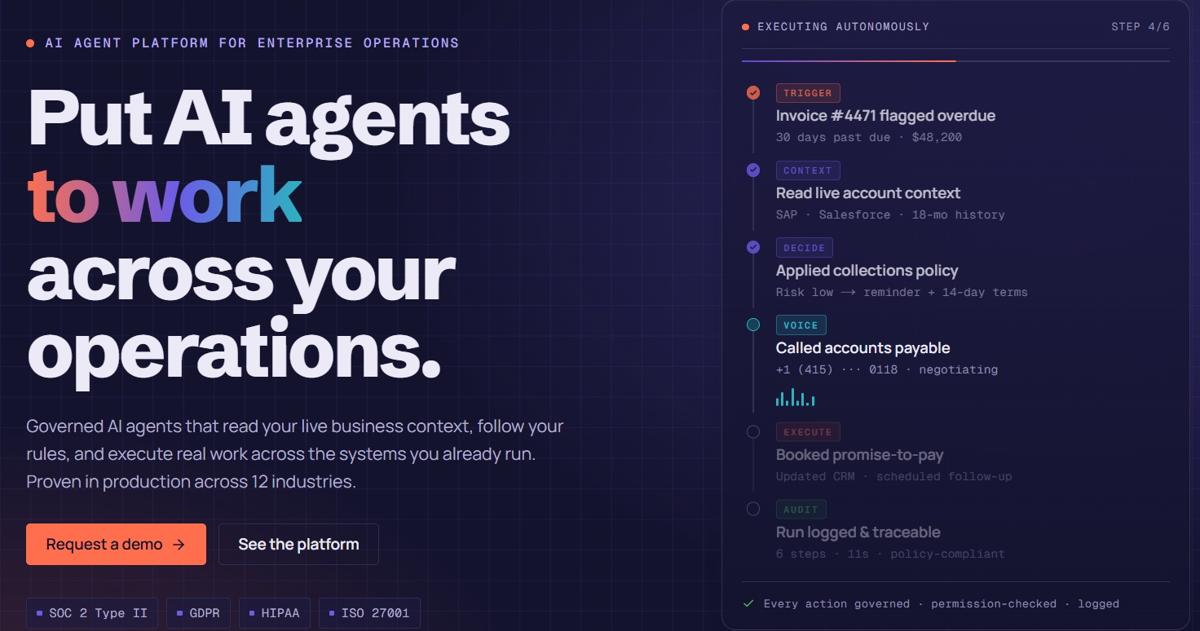
assistents.ai isn't a fixed mutual-fund screener — it's an agentic AI platform you point at your own data. For a wealth management firm, distributor or asset manager, that distinction matters more than another ratings dashboard: instead of a static screener, you get a natural-language research agent that connects to your CRM, portfolio management system, and market data feeds, reasons across all of it, and returns cited, structured answers — "which client portfolios are overweight small-cap this quarter?" — the same way it would answer a question about your CRM pipeline or your compliance data.
Three things separate this from the retail tools further down this list:
- A governed Action Engine, not just a chatbot. Every query is permission-checked, logged, and traceable — the platform holds SOC 2 Type II, GDPR, HIPAA and ISO 27001 certifications, with full audit trails for every answer it produces.
- Document intelligence built in. The Document AI layer extracts structured data — expense ratios, holdings, fund manager changes — from prospectuses and annual reports across 90+ formats, so fund research doesn't stall on unstructured PDFs.
- It's built for your data, not a fixed universe of funds. Retail screeners analyze the funds they've indexed. assistents.ai analyzes the funds and portfolios you actually manage, cross-referenced with your own client and compliance context.
See the financial services solution page for the compliance detail, or the Agentic Business Intelligence product page for how the natural-language query layer works.
Best for: RIAs, MFDs, wealth management firms and AMCs. Not the right fit if you're an individual investor who just wants a free fund screener — see #2 through #6 for that.
2. Value Research — Best free, India-specific fund ratings authority
Value Research has been India's most-used independent source for mutual fund data and ratings since 2001. Its star ratings, fund screener, and free portfolio manager tool remain the default starting point for most Indian DIY investors, and its data is trusted widely enough that even Bloomberg has used it as an input.
Best for: DIY investors who want a free, established, India-specific ratings source without a subscription.
3. Morningstar — Best for global fund comparison and analyst research
Morningstar applies machine-learning models across thousands of funds globally, evaluating historical returns, volatility, manager tenure and category rankings, and surfacing fund overlap and sector exposure alongside its long-standing analyst ratings.
Best for: Investors comparing funds across international markets, or wanting analyst commentary alongside quantitative scoring.
4. Tickertape — Best for AI-driven factor scorecards
Tickertape uses AI and big data to generate scorecards across performance, risk, cost, and diversification for Indian mutual funds and stocks, aimed at making side-by-side comparison faster for self-directed investors.
Best for: DIY investors who want a quick, visual, factor-based comparison rather than a dense factsheet.
5. PrimeInvestor — Best for unbiased, subscription-backed research
PrimeInvestor is a SEBI-registered research platform offering fund and stock recommendations, a portfolio overlap tool, rolling-returns calculators, and a live portfolio review — positioned specifically as an unbiased alternative to distributor-driven advice.
Best for: DIY investors who want more than free ratings — active buy/hold guidance backed by a registered research team, for a modest annual fee.
6. Kuvera — Best free, zero-commission direct investing platform
Kuvera focuses on direct (commission-free) mutual fund investing with AI-assisted goal tracking, tax-harvesting tools, and portfolio-overlap flags, aimed at long-term, disciplined investors rather than short-term fund pickers.
Best for: Investors who want to invest directly in funds — not just research them — with basic AI guidance layered on top, at zero cost.
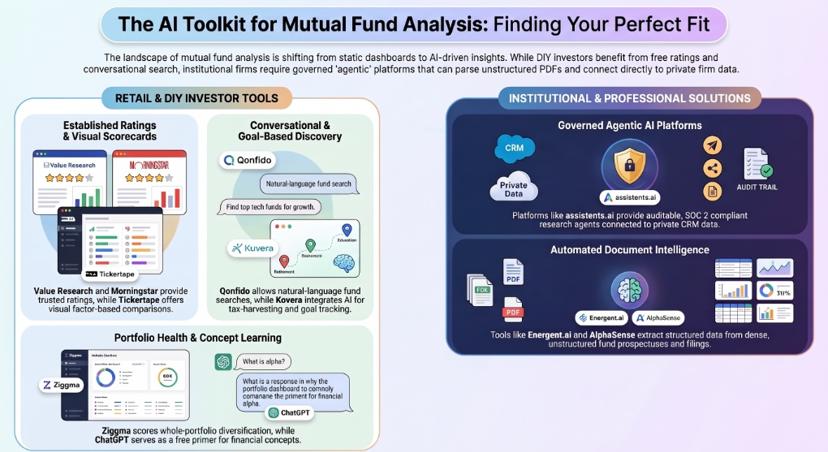
7. Energent.ai — Best for extracting data from fund documents
Energent.ai is an AI-native tool purpose-built around parsing dense, unstructured fund documents — prospectuses, annual reports, K-1s — into structured data: expense ratios, holdings, alpha, beta and Sharpe ratio, extracted automatically rather than typed in by hand.
Best for: Analysts and research teams whose actual bottleneck is unstructured PDF fund documents, not fund discovery itself.
8. Qonfido — Best for conversational fund discovery in India
Qonfido lets you search and compare Indian mutual funds in plain language — "compare Fund A vs Fund B" or "which mid-cap funds are most consistent" — returning NAV, expense ratio, and risk-adjusted comparisons without building filters manually.
Best for: Investors who prefer asking questions over building screener filters.
9. AlphaSense — Best for institutional research teams
AlphaSense applies AI search across earnings calls, broker research, and financial filings, giving institutional analysts a faster way to find fund-strategy context buried in documents most retail tools never touch.
Best for: Institutional research and asset-management teams doing deep qualitative research alongside quantitative screening.
10. Ziggma — Best for portfolio scoring and diversification analysis
Ziggma applies AI scoring to an existing portfolio (funds and stocks together), flagging concentration risk and diversification gaps in a single consolidated view rather than fund-by-fund.
Best for: Investors who want a whole-portfolio health check, not just single-fund analysis.
11. ChatGPT / Perplexity — Best free starting point (with real caveats)
General-purpose AI tools can explain a Sharpe ratio, summarize a factsheet you paste in, or draft comparison questions to ask a human advisor — genuinely useful as a first pass. But they have no live connection to NAV or fund data unless you supply it, no fund-specific track record, and — like every tool on this list without a governance layer — will confidently answer questions they shouldn't, with no audit trail behind the answer.
Best for: A quick, free explanation of a concept or a document you've already got in hand — not a source of truth for a real investment decision.
Real result: AI-powered market research in production
Vendor listicles usually stop at feature claims. Here's what this actually looks like deployed, anonymized by role rather than by name:
Market research and technical analysis. A market-research and technical-analysis platform that publishes forecasts and actionable insights for Indian markets deployed AI agents to automate its data ingestion and indicator pipelines — replacing manual chart and signal review with automated research workflows and thematic dashboards. The result: faster production of market-insight packs, more repeatable and consistent research workflows, and better visibility into signals through automated analytics, instead of an analyst manually re-running the same checks every day.
Trading signal automation. An AI-first trading terminal — built around a network of specialized agents combining research, analysis, signals and execution into one workflow — deployed agents for market data ingestion, indicator and pattern analysis, and strategy simulation with risk guardrails. The result: faster synthesis of fragmented market signals, more disciplined decision-making through governed workflows, and a real drop in manual monitoring effort.
Both are examples of the same underlying pattern: AI agents replacing the repetitive, manual parts of market and fund research — data ingestion, indicator tracking, signal monitoring — while keeping a human in the loop for judgment calls, with every step logged.
Why assistents.ai over a fixed mutual-fund dashboard
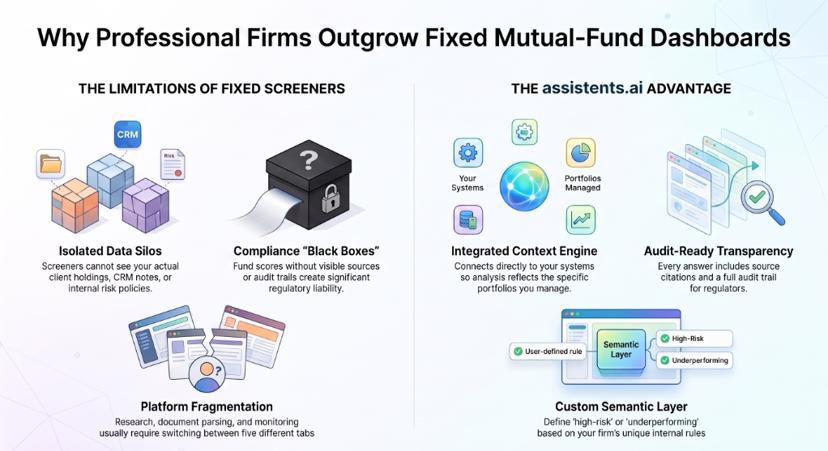
Every retail tool on this list analyzes a fixed universe of funds with a fixed set of features. That's fine for an individual investor. It breaks down fast for a firm managing analysis across dozens or hundreds of client portfolios, because:
- Your data doesn't live in their tool. A screener can't see your clients' actual holdings, your CRM notes, or your firm's internal risk policy — assistents.ai's Context Engine connects to those systems directly, so analysis reflects what you actually manage, not a generic fund universe.
- "Trust me" isn't a compliance answer. A dashboard that gives you a fund score with no visible source is a liability the moment a client or regulator asks how it was calculated. Every assistents.ai answer comes with source citations and a full audit trail.
- One platform instead of five tabs. Fund research, document extraction, portfolio-overlap checks and compliance monitoring are usually four separate tools. assistents.ai runs all of it — including document parsing for prospectuses and factsheets — on one governed platform.
- Built for your rules, not a generic one. The semantic layer lets you define what "high-risk," "overweight," or "underperforming" mean for your firm, so every analyst and every client report uses the same definition automatically.
If your actual job is producing fund analysis for other people to act on — clients, an investment committee, a compliance file — a governed agent built on your own data will outperform a fixed screener every time. See how the platform connects to your systems.
How to choose the right AI tool for mutual fund analysis
- Match the tool to the job. A free retail screener and an enterprise research agent solve different problems — the single most common source of disappointment with these tools is buying the wrong category.
- Check where the data actually comes from. AMFI-sourced or AMC-verified data is a different guarantee than a scraped number — ask directly.
- Ask for the audit trail, not the demo. If you're client- or regulator-facing, ask what the tool logs when it makes a judgment call, and whether that log would hold up.
- Test it on a messy fund, not a clean one. A fund with a recent manager change or a complex multi-asset mandate is a better test than a plain-vanilla large-cap fund.
- Confirm it goes beyond trailing returns. Risk-adjusted metrics, overlap detection and category comparison matter more than a single headline return number.
- Decide DIY vs. platform up front. One free tool is fine for personal research. A firm producing analysis for others needs a governed platform, not a stack of point tools.
Related reading
- 15 Best AI Agents in Fintech: Real Examples, Use Cases and a Platform Comparison
- 32 Use Cases of AI in Asset Management: Investment, Operations and Physical Assets
- AI Agents for Financial Services: Compliance, Fraud and KYC
- Agentic Business Intelligence for Financial Data
This article is for informational purposes and isn't investment advice — always verify current pricing, features and fund data directly with each provider before making a decision.
FAQs
What is the best AI tool for mutual fund analysis?
 It depends on who you are. For individual investors, Value Research, Morningstar and Tickertape are the strongest free starting points. For wealth managers, distributors and asset managers who need governed analysis across their own client data, assistents.ai is built specifically for that job.
Can AI accurately analyze mutual funds?
 AI tools are strong at automating data-heavy work — calculating risk-adjusted metrics, detecting portfolio overlap, extracting data from dense documents — but they're a research input, not a replacement for judgment. Treat AI-generated fund scores as a starting point for your own review, not a final answer.
Can ChatGPT analyze mutual funds?
 Yes, in a limited way — it can explain metrics like the Sharpe ratio or interpret a factsheet you paste in, but it has no live connection to NAV or fund data on its own and no fund-specific track record, so it's best used for explanation rather than as a source of truth.
Are AI mutual fund tools better than a human advisor?
 They're different tools for different jobs. AI can process far more data far faster, but it doesn't account for your personal financial situation, tax position or emotional decision-making the way a human advisor can. Most serious investors use AI tools to speed up research and a human advisor for the final call.
What's the difference between a free mutual fund screener and an enterprise AI research platform?
 A free screener analyzes a fixed universe of publicly available funds with a fixed feature set. An enterprise platform like assistents.ai connects to your own client data, CRM and compliance rules, and produces auditable, source-cited analysis specific to the portfolios you actually manage — built for firms, not individual research.
Are AI tools for mutual fund analysis safe and compliant to use with clients?
 It depends entirely on the platform. Look for a visible audit trail, cited sources, and relevant certifications (SOC 2, GDPR, and for India-based firms, alignment with SEBI's advisory and research-analyst regulations) before using any AI-generated output in client-facing work.