AI agent use cases in fintech now span far more than fraud detection and chatbots — they cover cashflow forecasting, algorithmic trading, cross-border tax screening, lending analytics, and technical due diligence, each running with its own autonomy level and human checkpoint. assistents.ai runs these as governed, auditable workflows through a Context Engine, Semantic Layer, and permission-checked Action Engine — not a chatbot with a finance skin, but agents that read live financial context and actually execute the work.
Most "AI in fintech" content still talks about banks: core banking systems, tellers, branch operations. But fintech is bigger than banking. It's the lending platform underwriting a loan in ninety seconds, the tax-tech tool screening a cross-border deal before it closes, the trading terminal running strategy simulations with guardrails, the AI CFO tool giving a founder a live runway number instead of a stale spreadsheet.
This guide covers 11 AI agent use cases across that broader fintech landscape — with real, anonymized outcomes pulled from production deployments, not vendor demos. If you're specifically evaluating platforms rather than use cases, see our comparison of the best AI agents in fintech. If you run compliance or operations at a bank or credit union, our 25+ AI agent use cases in banking guide goes deeper on that specific side of the industry.
What counts as "fintech" here
For this guide, fintech means any company building or running financial workflows outside a traditional bank's four walls: digital lenders and BNPL platforms, wealthtech and robo-advisory tools, insurtech, regtech and tax-tech, payments and embedded finance, and trading and crypto platforms. Banks appear too, but only where the use case is genuinely fintech-flavored rather than core-banking-internal.
How AI agents differ from chatbots and RPA in fintech
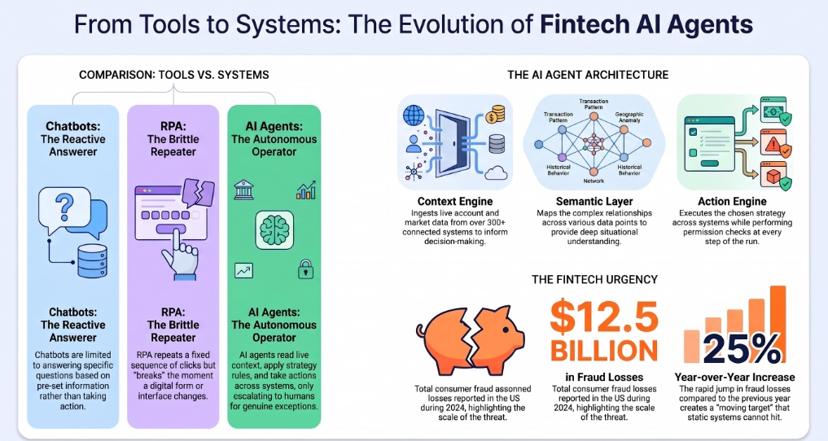
A chatbot answers a question. RPA repeats a fixed sequence of clicks and breaks the moment a form changes. An AI agent reads live account or market context, applies your policy or strategy rules, decides what to do next, takes the action across connected systems, and logs the whole run for audit — escalating to a human only when it hits a genuine exception. That's the difference between a tool that responds and a system that operates. assistents.ai's own architecture — a Context Engine that ingests live data from 300+ systems, a Semantic Layer that maps relationships across it, and an Action Engine that executes with permission checks on every step — is built specifically around that distinction.
This distinction matters more in fintech than almost anywhere else. Consumers in the US reported more than $12.5 billion in fraud losses in 2024, a 25% jump from the year before — the kind of moving target that static, rule-based systems consistently lose ground against.
11 AI agent use cases in fintech
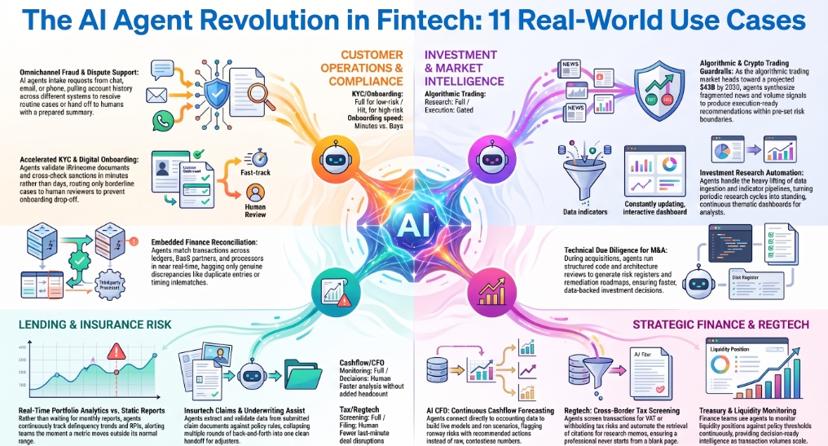
1. Omnichannel fraud, dispute, and compliance support
The problem: Banking and credit-union support teams field disputes, fraud flags, and compliance questions across chat, email, and phone — usually in three different systems with three different case histories, none of which talk to each other.
How AI agents help: An agent intakes the request from whichever channel it arrives on, classifies it, pulls the relevant transaction and account history, drafts a next-best-action, and either resolves the routine case or hands off to a human with full context and an agent-assist summary already prepared. Every step is logged for SLA and audit purposes.
Autonomy level: Full autonomy for routine, low-risk cases (duplicate charges, standard status queries); human-in-the-loop for anything touching fraud confirmation or a compliance judgment call.
Real result: A global fintech provider serving banks and credit unions deployed omnichannel AI agents across chat, email, and phone for dispute, fraud, and compliance workflows, with agent-assist summarization and full SLA monitoring built in. The outcome: faster case handling with more consistent resolution, a lighter operational load from automation, and stronger compliance readiness through complete audit trails.
2. KYC and digital onboarding for lenders and neobanks
The problem: Digital-first lenders and neobanks live or die on onboarding speed, but identity verification, document validation, and risk scoring are exactly the kind of multi-system, judgment-heavy process that's slow to do by hand and easy to get wrong under pressure.
How AI agents help: An agent ingests uploaded ID and income documents, validates them, cross-checks sanctions and adverse-media sources, applies a risk tier, and only routes the genuinely borderline cases to a human reviewer. Low-risk applicants can be activated in minutes instead of days.
Autonomy level: Autonomous for low-risk applicants who clear every check; escalated with a pre-built case file for anything flagged as medium or high risk.
Where to start: If onboarding drop-off is your biggest cost center, this is usually the fastest-to-value use case on this list — it connects through standard APIs and shows measurable impact within weeks.
3. Credit decisioning and lending portfolio analytics
The problem: Lending and leasing teams need a live read on portfolio risk — delinquency trends, maturity profiles, residual values — but most of that intelligence sits in static reports that are out of date by the time anyone reads them.
How AI agents help: An agent continuously tracks portfolio KPIs — risk, delinquency, maturity, residuals — alongside dealer or partner-network performance, and generates alerts the moment a metric moves outside its normal range, instead of waiting for a scheduled report.
Autonomy level: Agent monitors and alerts continuously; underwriting and credit decisions stay with a human, informed by the agent's structured risk summary.
Real result: An independent automotive leasing provider deployed analytics agents covering portfolio KPIs and dealer-network performance monitoring. The outcome: better portfolio visibility, faster risk identification, and more proactive exception management — catching issues before they became losses instead of after.
4. AI CFO agents: continuous cashflow forecasting and scenario planning
The problem: For growing businesses and the advisors who serve them, cashflow visibility usually means a spreadsheet someone updates monthly — which means the business is always making decisions on data that's already a few weeks stale.
How AI agents help: An agent connects directly to accounting and banking data, builds a live cashflow model, runs scenarios against it, and flags runway or cash-risk issues with a recommended action attached — rather than a raw number with no context.
Autonomy level: Fully autonomous for monitoring and alerting; scenario decisions and fund movements stay human-approved.
Real result: An AI CFO platform serving growing businesses and their advisors deployed agents for continuous cashflow monitoring, forecasting, and scenario planning. The outcome: faster analysis cycles, earlier detection of cash-risk anomalies, and advisory-level insight delivered without adding headcount — useful for advisors managing several client portfolios at once. (More depth on this category in our agentic AI in finance and accounting guide.)
5. Algorithmic and crypto trading agents with built-in guardrails
The problem: Trading terminals generate more signal than any analyst can manually synthesize — news sentiment, on-chain data, volume patterns, macro indicators — and by the time a human has pulled it all together, the window has often closed.
How AI agents help: A network of specialized agents ingests market data, runs indicator and pattern analysis, simulates strategies against defined risk guardrails, and produces execution-ready recommendations or trade signals — with the guardrails preventing the agent from acting outside pre-approved risk boundaries.
Autonomy level: Research, signal generation, and strategy simulation run autonomously; execution stays gated by pre-set guardrails and, for larger positions, explicit approval.
Real result: An AI-first trading terminal built around a network of specialized agents deployed AI agents for crypto trading insights and strategy automation with guardrails, covering market data ingestion, strategy simulation, and execution-ready workflow integration. The outcome: faster synthesis of fragmented market signals, more disciplined decision-making through governed workflows, and reduced manual monitoring effort. This is a fast-growing category — the global algorithmic trading market was estimated at roughly $21 billion in 2024 and is projected toward $43 billion by 2030. For a deeper look at this specific category, see our guide to crypto AI agent development.
6. Investment and market research automation
The problem: Research and technical-analysis teams spend a disproportionate amount of their time on data ingestion and pipeline maintenance rather than the analysis itself — pulling indicators, formatting them, checking for gaps, before a single insight gets generated.
How AI agents help: An agent handles the ingestion and indicator pipeline continuously, runs the research and pattern-analysis workflows that used to require manual setup, and pushes alerts and thematic dashboards to the team as conditions change — turning a periodic research cycle into a standing one.
Autonomy level: Data ingestion and first-pass analysis run autonomously; published research and client-facing calls stay with the analyst.
Real result: A market research and technical-analysis platform deployed agents for data ingestion, indicator pipelines, and automated insight generation. The outcome: faster production of market insight packs, more repeatable research workflows, and better signal visibility without expanding the research team.
7. Regtech: cross-border tax risk screening and compliance research
The problem: Tax and compliance teams face two related but distinct bottlenecks: screening individual cross-border transactions for risk before a deal closes, and doing the underlying research needed to support a defensible position — both traditionally manual, both easy to under-resource until something goes wrong.
How AI agents help: On the transaction side, an agent screens incoming cross-border transactions, classifies the risk type (withholding tax, VAT mismatch, permanent establishment exposure), collects supporting evidence, and escalates to a tax specialist with an explainability note already attached. On the research side, a separate agent automates source retrieval, summarization, and draft memo generation — with citations — so a professional starts from a structured draft instead of a blank page.
Autonomy level: Screening and research run autonomously; the final position or filing decision stays with a licensed professional.
Real result: A tax-technology platform focused on early screening of cross-border transactions deployed agents for transaction screening, evidence collection, and escalation workflows — resulting in earlier detection of withholding-tax and VAT risk, fewer last-minute deal disruptions, and a faster, more consistent pre-compliance process. Separately, a specialized sales-and-use-tax research automation tool deployed agents for automated source collection, summarization, and draft memo generation — resulting in faster research cycles, less manual source-hunting, and more consistent documentation.
8. Technical due diligence for fintech M&A and investment
The problem: Investors and holding companies evaluating a fintech acquisition need a rigorous read on the target's technical architecture, scalability, and security posture — usually under a tight deal timeline, with a limited pool of specialists available to do the work.
How AI agents help: An agent runs a structured code and architecture review, assesses infrastructure and security posture, evaluates scalability and integration readiness, and generates a risk register with a prioritized remediation roadmap — giving the deal team a structured artifact instead of a scattered set of findings.
Autonomy level: The technical assessment runs largely autonomously; the investment decision and risk tolerance stay entirely human.
Real result: A long-term holding company evaluating a mobile-banking acquisition used AI-assisted technical due diligence covering architecture review, infrastructure and security assessment, and a full risk register with remediation steps. The outcome: faster investment decisions backed by structured technical-risk visibility, and fewer surprises after the deal closed.
9. Insurtech: claims intake and underwriting assist
The problem: Claims intake and underwriting submission review are still heavily document-driven in most insurtech operations — applicants submit forms and supporting documents, and someone has to read, extract, and cross-check all of it before a decision can move forward.
How AI agents help: An agent ingests submitted claim or underwriting documents, extracts structured data, validates it against policy terms and coverage rules, and flags anomalies or missing information before the file reaches an adjuster or underwriter — collapsing what's often several rounds of back-and-forth into one clean handoff.
Autonomy level: Document intake and first-pass validation run autonomously; the coverage or claims decision stays human.
10. Embedded finance and payments reconciliation
The problem: Platforms offering embedded lending, cards, or payments have to reconcile transactions across their own ledger, a banking-as-a-service partner, and one or more payment processors — a matching exercise that multiplies in complexity with every partner added.
How AI agents help: An agent matches transactions across systems in near real time, flags discrepancies with a contextual explanation (partial payment, duplicate entry, timing mismatch) rather than just a red flag, and routes only genuine exceptions to a human — instead of having someone manually reconcile everything, matched or not.
Autonomy level: Full autonomy for matched transactions; exceptions are surfaced with context for human review.
11. Treasury, liquidity, and finance-ops automation
The problem: Finance teams at fast-growing fintechs are often running treasury and liquidity monitoring on the same manual cadence as a much smaller company — quarterly reviews, static spreadsheets — even as their transaction volume and cash complexity scale up fast.
How AI agents help: An agent monitors liquidity positions continuously, models cash-flow scenarios against changing conditions, and generates alerts when a position approaches a policy threshold — giving treasury and finance leadership decision-ready intelligence instead of a stack of raw numbers to interpret themselves.
Autonomy level: Monitoring and alerting run autonomously; funding and liquidity decisions stay with finance leadership.
Why fintech teams are choosing assistents.ai for these use cases
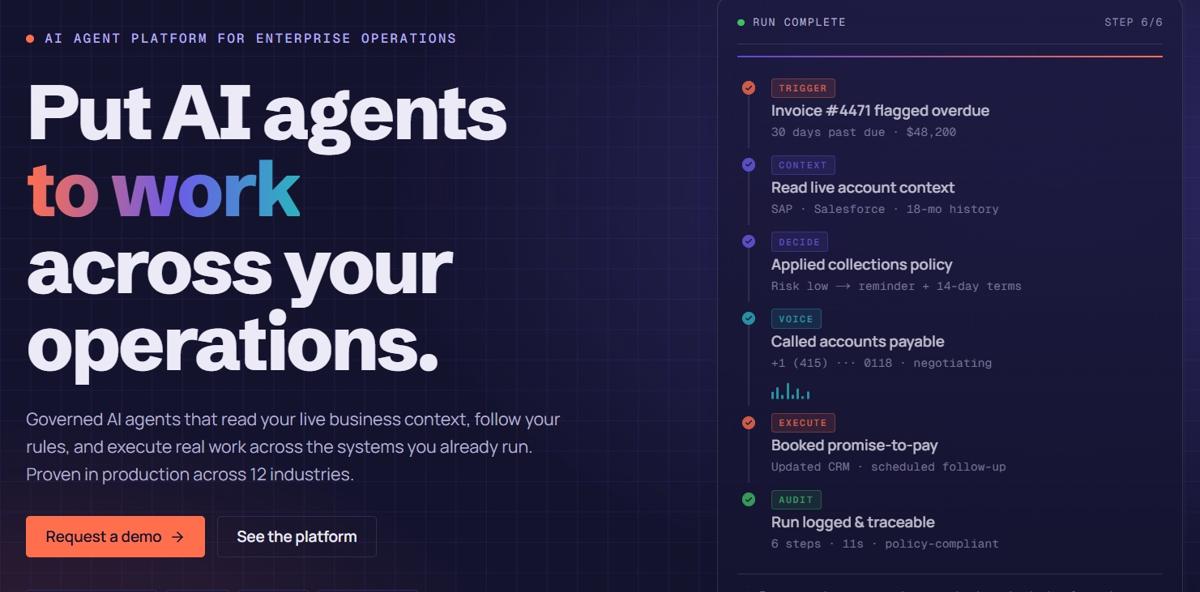
Most of the use cases above can be solved with a point solution — one tool for fraud, another for tax research, a third for trading signals. That works until you're managing four vendors, four audit trails, and four integration projects for what should be one governed layer across your operations.
assistents.ai is built to be that layer instead of one more silo:
- A three-layer architecture built for this. The Context Engine ingests live data from 300+ systems, the Semantic Layer maps relationships across it (vendor to contract, deal to contact), and the Action Engine executes with permission checks on every step — so agents reason with real relational context, not keyword search.
- Governance that holds up under audit. Every action is permission-checked, logged, and traceable — SOC 2 Type II, GDPR, HIPAA, and ISO 27001 certified, with on-premise and zero-egress deployment for teams that can't let sensitive financial data leave their perimeter.
- One platform across departments. The same governed execution model runs finance, compliance, support, and sales agents — useful for a fintech that needs fraud monitoring, KYC, and treasury automation to actually talk to each other rather than sit in separate tools.
Why assistents.ai over a stack of point solutions
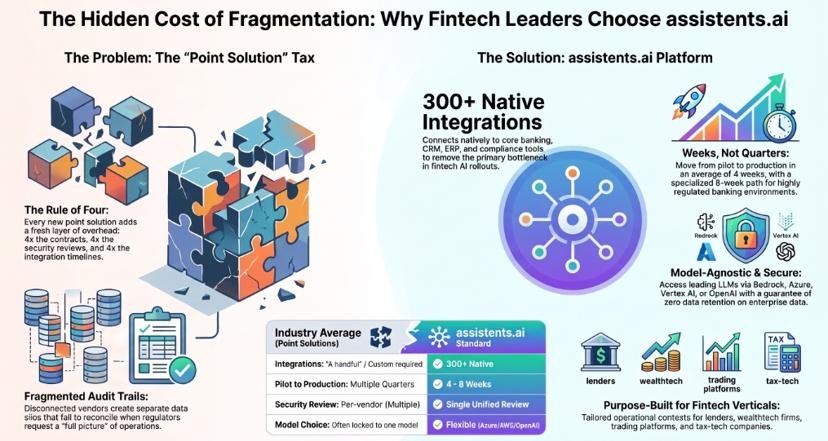
Zoom out from any single use case, and the real cost of a fragmented fintech AI stack becomes the actual problem: four vendors means four contracts, four security reviews, four integration timelines, and four separate audit trails that don't reconcile with each other when a regulator asks for the full picture.
- 300+ integrations, not a handful. Core banking, CRM, ERP, and compliance tools connect natively — usually the real bottleneck in a fintech AI rollout, not the AI itself. See the full integrations list.
- Weeks, not quarters. Average time from pilot to production is about four weeks, with an eight-week path specifically mapped for regulated financial services — outlined in the banking and fintech compliance guide.
- Model-agnostic, and your data never trains the model. Choose from leading LLMs across Bedrock, Azure, Vertex AI, and OpenAI, with zero data retention on enterprise data.
- Built for the specific reader of this guide. Whether you're a lender, a wealthtech, a trading platform, or a tax-tech company, the financial services solution page maps the platform to your specific regulatory and operational context.
If you're comparing this against other platforms in the space, our in-depth comparison of the top AI agents in fintech — including how assistents.ai stacks up against Kore.ai — walks through the criteria that actually matter for a regulated business.
How to choose where to start
Not every use case above is equally ready to deploy on day one. A practical way to prioritize:
If you want the fastest path to measurable ROI: start with KYC/onboarding or omnichannel support. Both connect through standard APIs and show measurable impact within weeks.
If compliance is your biggest pressure: start with cross-border tax screening or fraud/dispute monitoring — the workflows where manual effort is highest and regulatory exposure is most acute.
If you're flying blind on cash or portfolio risk: start with AI CFO or portfolio analytics agents. These don't require replacing any existing system — they layer on top of data you already have.
In any scenario, a four-week path to production is realistic when the platform is pre-integrated with the systems you already run. See how assistents.ai deploys for financial services teams.
Related reading
- 25+ AI Agent Use Cases in Banking (2026 Guide)
- 15 Best AI Agents in Fintech: Real Examples & Platform Comparison
- Agentic AI in Finance and Accounting: A Guide for CFOs
- Crypto AI Agent Development: The 2026 Guide
- AI Agents for Trading Forex
- 11 Best AI Tools for Mutual Fund Analysis in 2026
Ready to see a governed AI agent on your own fintech workflows? Book a 30-minute discovery call — no prep needed, just bring the process that frustrates your team most.
FAQs
What are AI agent use cases in fintech?
 AI agent use cases in fintech span fraud and dispute handling, KYC and onboarding, credit and lending analytics, cashflow forecasting, algorithmic and crypto trading, investment research, cross-border tax and compliance screening, technical due diligence, insurtech claims, embedded-finance reconciliation, and treasury automation — each running with a defined autonomy level and human checkpoint.
How are AI agents different from chatbots in fintech?
 A chatbot answers a question from a script or knowledge base. An AI agent reads live account or market context, makes a decision within defined rules, and executes multi-step actions across connected systems — reconciling a payment, screening a transaction, or generating a forecast — rather than just responding.
What's the difference between AI agents and RPA in fintech?
 RPA follows a fixed, pre-scripted sequence and breaks when something changes. AI agents understand context, make a judgment within guardrails, and adapt when a situation doesn't match a predefined path, including deciding when to escalate to a human.
Are AI agents safe for financial transactions?
 Yes, when deployed with proper governance. Agents should only be able to perform actions a customer or employee is already authorized to do, with every action logged and traceable, and human escalation built in for anything high-risk. See assistents.ai's security and trust overview for what that looks like in practice.
Can AI agents replace financial advisors or analysts?
 No — they take over the monitoring, research assembly, and routine-decision work that consumes an advisor's or analyst's time, and surface structured insight so the human can focus on judgment calls, client relationships, and anything with real financial or regulatory consequence.
What is agentic AI in financial services?
 Agentic AI in financial services refers to systems that can autonomously plan, reason, and execute multi-step workflows — screening a transaction, generating a forecast, drafting a research memo — rather than requiring a human to interpret an output and decide the next step themselves.
How long does it take to deploy an AI agent in fintech?
 Single, well-scoped use cases can go live in a few weeks. Platform-wide rollouts spanning multiple functions typically take longer — assistents.ai's average is around four weeks to production, with an eight-week path mapped specifically for regulated financial services.
Do AI agents comply with financial regulations?
 They can, but it depends entirely on the platform. Look for SOC 2 Type II and GDPR at minimum, plus relevant frameworks like SOX, PCI DSS, or GLBA where applicable, full audit trails, and — ideally — on-premise or data-residency-controlled deployment options for sensitive data.