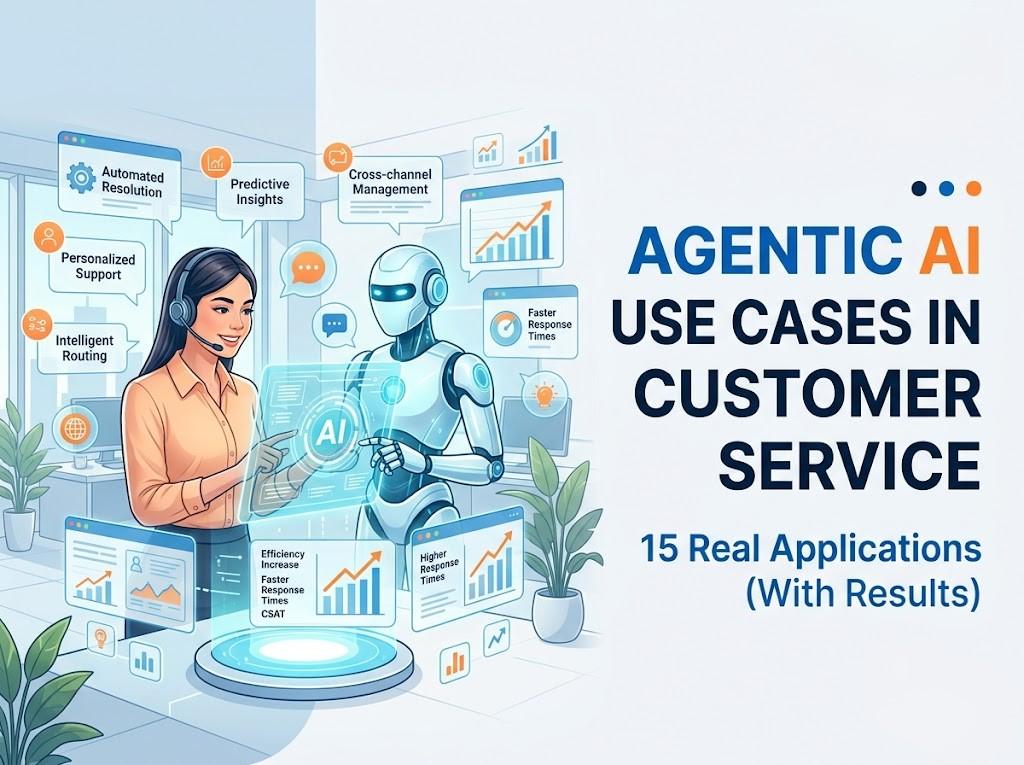
Most "agentic AI in customer service" articles describe what the technology could do. This one is different: every use case below is pulled from live deployments across hospitality, retail, banking, logistics, real estate, and healthcare — with the actual outcomes teams saw, not projections.
If you're evaluating whether agentic AI is ready for your support organization, this is the practical version of that answer.
What Makes AI "Agentic" in Customer Service?
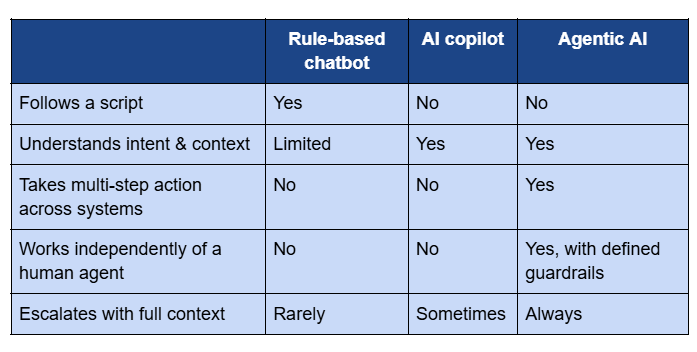
Traditional chatbots follow decision trees. Ask something outside the script, and the conversation breaks — the customer gets transferred, repeats themselves, and leaves frustrated.
Agentic AI works differently. It doesn't just respond to a prompt; it reasons through a request, pulls data from multiple systems, decides what to do next, and takes action — updating a CRM, issuing a refund, checking inventory, or escalating with full context — largely without a human directing each step.
Agentic AI vs. Chatbots vs. Copilots
Is Agentic AI Only Useful for Customer Service Departments?
No — and this is a common misconception. The same reasoning-and-action architecture that resolves a support ticket also powers tender document analysis, competitive price monitoring, supplier sourcing, and financial risk alerts. Customer service is simply the highest-visibility, fastest-ROI entry point, which is why most organizations start there before expanding agentic AI into other functions.
15 Agentic AI Use Cases in Customer Service
1. Omnichannel Intake and Intent-Based Routing
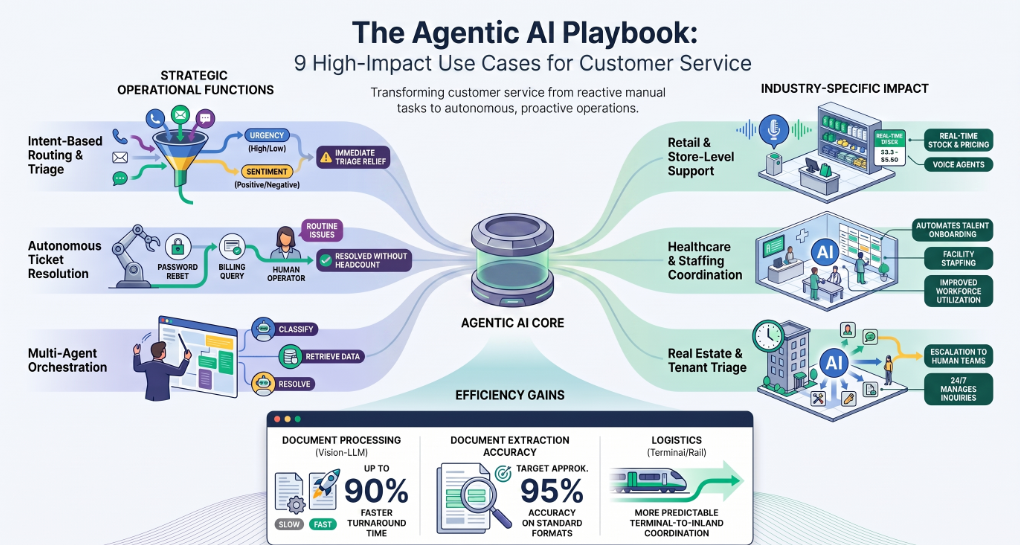
Agents classify incoming requests the moment they arrive — across chat, email, phone, and WhatsApp — and route based on urgency, sentiment, and customer value, rather than a fixed queue order. This is typically the first use case organizations deploy because it delivers immediate triage relief without touching resolution logic.
2. Autonomous Ticket Resolution
For routine, repeatable issues — password resets, order status, billing questions, return requests — agentic AI resolves the ticket end-to-end: verifying the customer, checking the relevant system, and closing the case. A large-scale value retailer deploying this kind of resolution layer across hundreds of stores saw reduced helpdesk burden and faster store-level issue resolution, without adding headcount.
3. Agent-Assist and Next-Best-Action
Rather than replacing human agents, agentic AI can sit alongside them — surfacing relevant knowledge base articles, drafting responses with citations, and recommending the next action in real time. This is the fastest-adopted use case in regulated industries where full autonomy isn't yet appropriate.
4. Multilingual Voice Support
Voice agents handling inbound calls in regional languages (for example, Hindi and English in a single deployment) let organizations offer consistent support across geographies without building separate teams per language. One retail deployment paired this with an inventory intelligence layer so the voice agent could answer store-specific pricing and stock questions in real time.
5. Tenant and Customer Query Triage (Real Estate)
Omnichannel service agents handle lease inquiries, maintenance requests, and rental/payment questions, with escalation to human teams only when needed. A UAE-based real estate portfolio using this approach saw faster response times, lower call-centre load, and consistent 24/7 tenant experience with improved SLA adherence.
6. Document-Heavy Support and Tender Processing
For service organizations that manage complex, document-based requests — quotes, tenders, contracts — vision-LLM extraction agents can ingest and structure information from PDFs automatically. One remedial building services company using this for tender workflows saw document processing engineered for up to roughly 90% faster turnaround, with extraction accuracy targeting around 95% on standard formats, and reduced bid risk through automated revision detection.
7. Proactive Sentiment and Churn Detection
Agentic AI can continuously analyze support conversations, reviews, and feedback to detect churn signals or product friction before a customer escalates — triggering proactive outreach rather than reactive damage control.
8. Retail and Store-Level Support
Agents combine a voice support layer with inventory intelligence (pricing, stock, promotions per store) and a knowledge/training layer built on internal SOPs. This combination reduces manual helpdesk load while improving store-level visibility — a pattern seen in enterprise retail deployments spanning hundreds of locations.
9. Healthcare and Staffing Coordination
Agentic AI handles talent onboarding, facility staffing requests, matching, scheduling, and compliance workflows. Healthcare staffing platforms using this approach reported faster fill cycles and better workforce utilization, while physician-led care organizations saw improved visibility into operational bottlenecks and revenue cycle performance.
10. Banking and Financial Services Support
Omnichannel AI agents handle banking support intake (chat, email, phone) with auditable workflow automation, agent-assist summarization, and integration-ready connections to core systems. Fintech providers deploying this for disputes and compliance-heavy support saw faster case handling, reduced manual load, and stronger audit readiness.
11. Insurance and Claims-Adjacent Guidance
While not full claims processing, agentic AI can guide customers through claims-adjacent support — status checks, documentation requirements, and policy questions — reducing the volume of calls that would otherwise require a live agent.
12. Logistics and Order Status Agents
Terminal and rail management use cases show how agentic AI can digitize customer-facing status updates alongside backend operations — giving customers real-time shipment visibility while operations teams get executive dashboards and automated alerts. Ports and logistics deployments using this pattern saw more predictable terminal-to-inland coordination.
13. SLA Monitoring and Auto-Escalation
Agents track service commitments in real time and automatically escalate before a breach occurs, rather than after a customer complains. This shifts teams from reactive reporting to proactive execution — a shift multiple case deployments described as moving from "manual monitoring" to "always-on" coverage.
14. Post-Resolution Analytics and QA
After a ticket closes, agentic AI can generate automated reporting summaries, flag quality issues, and feed insights back into the knowledge base — improving future resolution accuracy without manual QA review of every conversation.
15. Multi-Agent Orchestration for Complex Requests
The most advanced use case: multiple specialized agents collaborating on a single request. One agent handles intent classification, another retrieves account data, another executes the resolution, and another manages the handoff if human intervention is needed — all coordinated without the customer noticing the handoffs.
Real Results From Agentic AI Customer Service Deployments
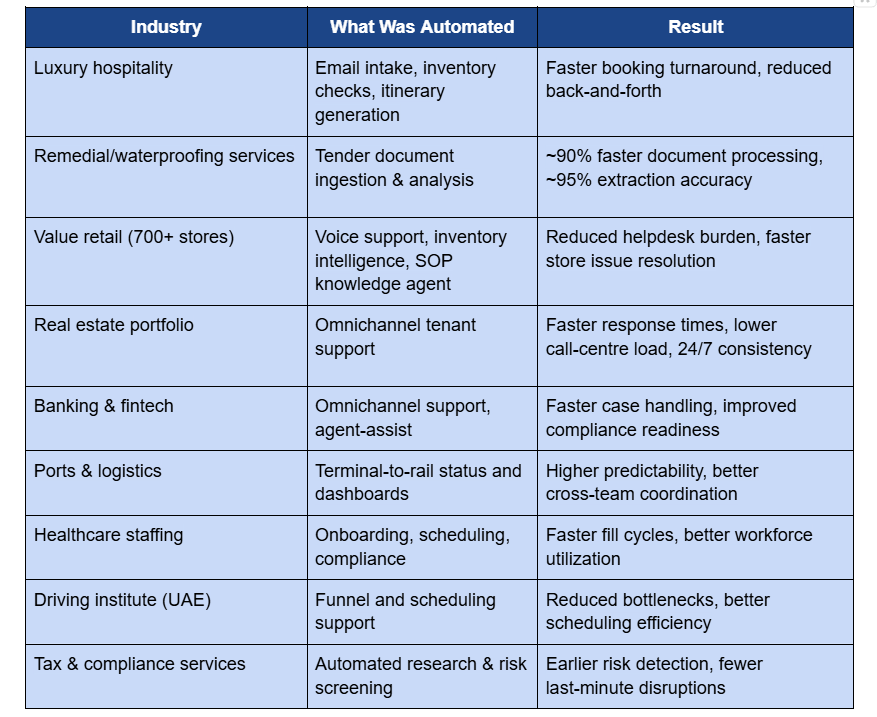
Agentic AI Customer Service Use Cases by Industry
Retail & E-commerce — Voice and chat agents resolve pricing, stock, and order questions in real time, paired with inventory intelligence so answers reflect live data, not static FAQs.
Banking & Financial Services — Omnichannel intake with auditable workflows, built for environments where every automated decision needs a paper trail.
Real Estate — Tenant and customer query handling across web, WhatsApp, and email, with automatic escalation for anything outside standard policy.
Healthcare — Staffing coordination, scheduling, and compliance-adjacent support where accuracy and auditability matter as much as speed.
Logistics — Customer-facing status visibility paired with backend operational dashboards, reducing the gap between "what operations knows" and "what the customer is told."
Hospitality — End-to-end booking support with human-in-the-loop quality control for anything requiring judgment — like curated itinerary creation.
How to Evaluate an Agentic AI Platform for Customer Service
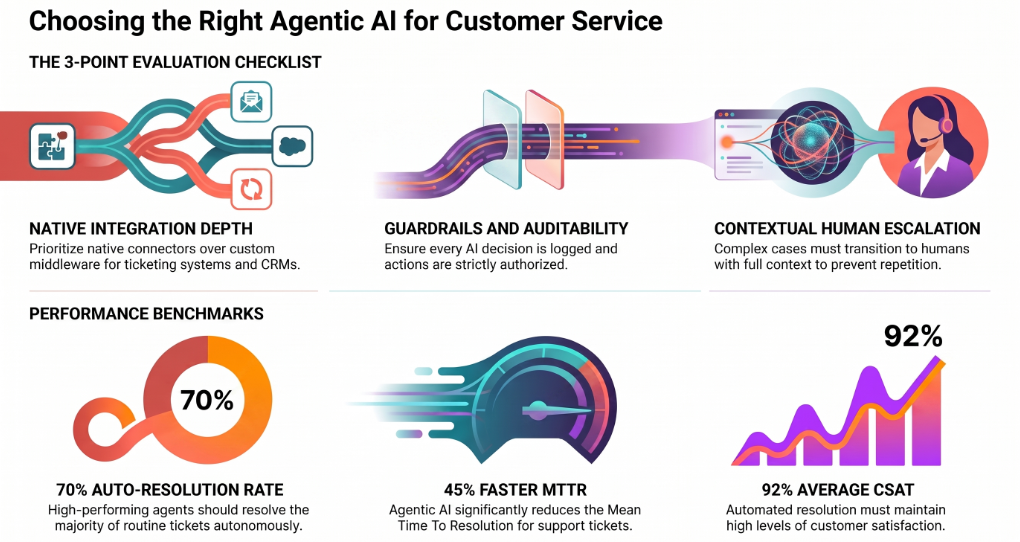
Before choosing a platform, look past the demo and check for:
- Integration depth — Does it connect natively to your existing ticketing system, CRM, and knowledge base, or does it require custom middleware? (Look for pre-built connectors, not just open APIs.)
- Guardrails and auditability — Can you define exactly which actions the agent is authorized to take autonomously, and is every decision logged for review?
- Human-in-the-loop controls — Can complex or high-stakes cases escalate with full context, rather than forcing the customer to start over?
- Time to production — Some platforms take months to configure; others can be live on your ticketing system in weeks.
- Model flexibility — Is the platform tied to one underlying model, or can it adapt as the underlying AI landscape shifts?
This is the pattern assistents.ai's customer support agents are built around — connecting to 70+ pre-built support system integrations, resolving routine tickets autonomously while escalating complex cases with full context, and delivering measurable outcomes (70% auto-resolution, 45% faster MTTR, and 92% average CSAT) within weeks of deployment rather than quarters.
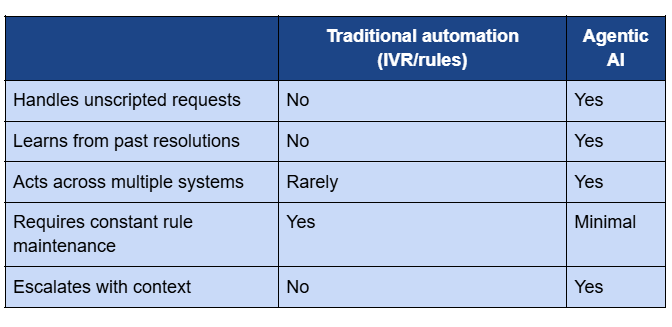
Agentic AI vs. Traditional Automation: Quick Comparison
Where to Go From Here
Agentic AI in customer service isn't a future capability — it's already resolving tickets, routing tenants, processing tenders, and handling multilingual voice support across live enterprise deployments today. The organizations seeing the strongest results aren't the ones automating everything at once; they're the ones starting with a well-scoped use case, measuring results, and expanding from there.
If you're exploring where to start, see how assistents.ai's AI agents handle customer support — from ticket triage to voice AI — with production deployment typically live in weeks.
FAQs
What is an agentic AI use case in customer service?
It's any scenario where an AI system independently reasons through a customer request, takes action across connected systems (like a CRM or ticketing platform), and resolves or escalates the issue without a human directing each step.
Is agentic AI only useful for customer service departments?
No. The same underlying technology — reasoning, tool use, and multi-step execution — is already being applied to tender processing, competitive monitoring, supplier sourcing, and financial risk alerting. Customer service is usually the first deployment because it's fast to measure and quick to show ROI.
What's the difference between agentic AI and a customer service chatbot?
A chatbot follows a predefined script and breaks down outside it. Agentic AI understands intent, pulls live data from your systems, and takes multi-step action — like verifying an account, processing a refund, and updating a CRM — without needing a scripted path for every scenario.
How much does agentic AI reduce customer service costs?
Results vary by deployment, but organizations using agentic AI for tier-1 support commonly see 65–90% of routine tickets resolved without human involvement, along with meaningfully faster mean time to resolution and reduced operational costs from lower escalation volume.
What's the best agentic AI use case to start with?
Omnichannel intake and routing, or autonomous resolution of routine, well-documented ticket types (password resets, order status, billing FAQs). These deliver fast, measurable wins and build the trust needed to expand into more complex, higher-stakes use cases.