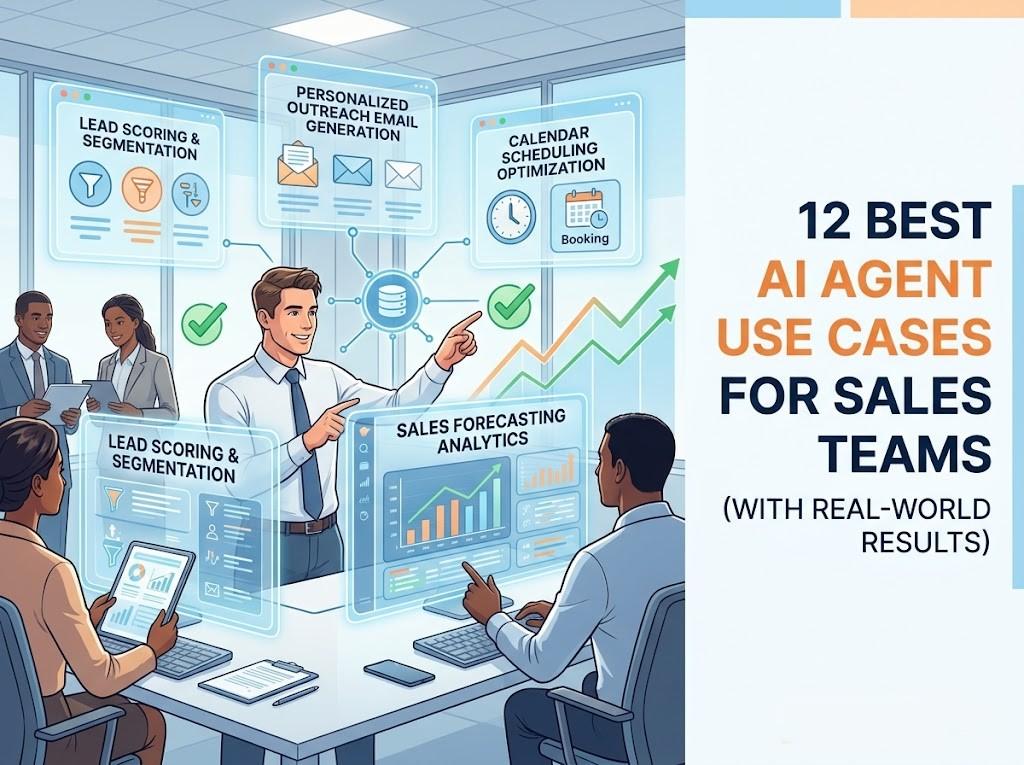
Most sales teams already have a CRM. They have dashboards, pipelines, and playbooks. What they don't have is execution that keeps up with the data.
Reps still spend hours updating records, researching accounts, chasing approvals, and building decks that could have been automated. Managers still run pipeline reviews off stale information. Forecasts are still built on gut feel dressed up in spreadsheets.
That's the problem AI agents for sales actually solve — not by adding another tool to the stack, but by doing the work that currently sits between your systems and your people.
This blog covers the 12 best AI agent use cases for sales teams, drawn from real enterprise deployments across more than 30 organisations. For each use case, you'll find what the agent does, how it works in practice, and what outcomes were actually achieved. No vendor padding. No theoretical benefits.
If you're a CRO, VP of Sales, or RevOps leader evaluating agentic AI, this is the most grounded breakdown available.
What Is an AI Agent in Sales? (And How It Differs from a Chatbot)
An AI agent in sales is an autonomous system that can perceive business context, make decisions, and execute multi-step workflows — without constant human input.
That last part is what separates it from everything that came before.
A chatbot responds to what you type. An AI sales agent reads your CRM, your email threads, your pipeline, and your ERP — then decides what to do next, does it, logs it, and tells you what happened. The distinction matters enormously in practice:
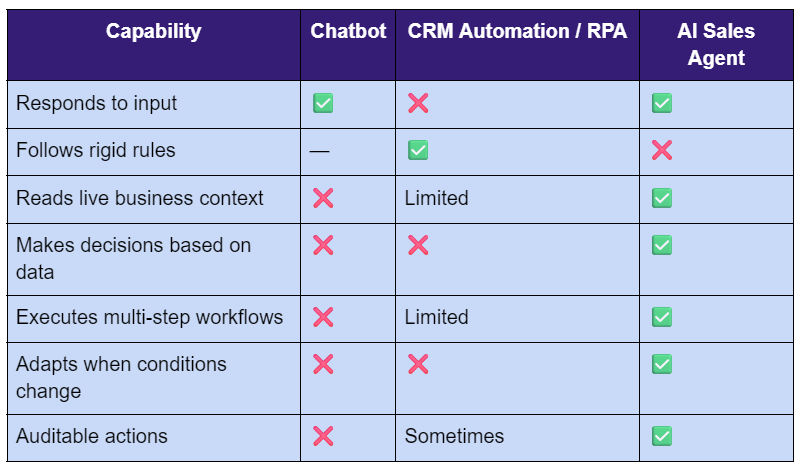
Traditional CRM automation is rule-based — if this happens, do that. It breaks when conditions change and can't reason about exceptions. AI agents, by contrast, operate more like a diligent digital team member with a specific role: they receive context, apply your logic, take action, and escalate only when genuinely needed.
For sales teams, this means the gap between insight and action collapses. The agent doesn't just tell your rep that a deal is at risk — it flags it, logs the risk, drafts the follow-up, and schedules the next touchpoint. All before the rep opens their laptop.
→ See how autonomous agents work on the assistents.ai platform
Why Sales Teams Are Deploying AI Agents Now
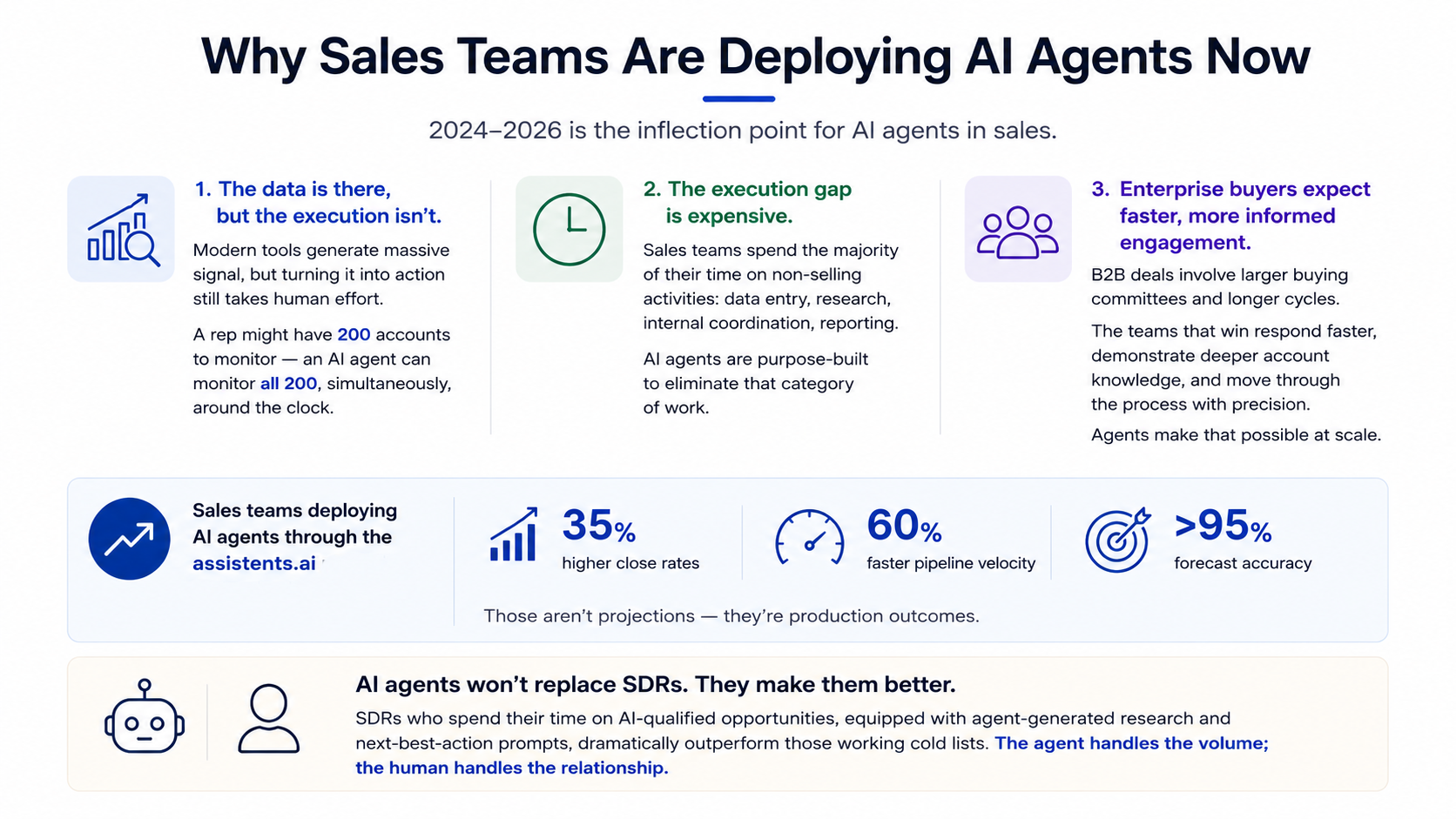
The timing isn't accidental. Three things converged to make 2024–2026 the inflection point for AI agents in sales:
The data is there, but the execution isn't. Modern CRMs, marketing automation platforms, and sales engagement tools generate enormous amounts of signal. The problem is that converting signal to action still requires human effort. A rep might have 200 accounts to monitor — an AI agent can monitor all 200, simultaneously, around the clock.
The execution gap is expensive. Research from McKinsey suggests that sales teams spend the majority of their working hours on non-selling activities: data entry, research, internal coordination, reporting. AI agents are purpose-built to eliminate that category of work.
Enterprise buyers expect faster, more informed engagement. B2B deals now involve larger buying committees and longer cycles. The teams that win are those who respond faster, demonstrate deeper account knowledge, and move through the process with precision. Agents make that possible at scale.
Sales teams deploying AI agents through the assistents.ai platform have seen 35% higher close rates, 60% faster pipeline velocity, and forecast accuracy above 95%. Those aren't projections — they're production outcomes.
As for whether AI agents will replace SDRs: the short answer is no. The longer answer is that SDRs who spend their time on AI-qualified opportunities, equipped with agent-generated research and next-best-action prompts, dramatically outperform those working cold lists. The agent handles the volume; the human handles the relationship.
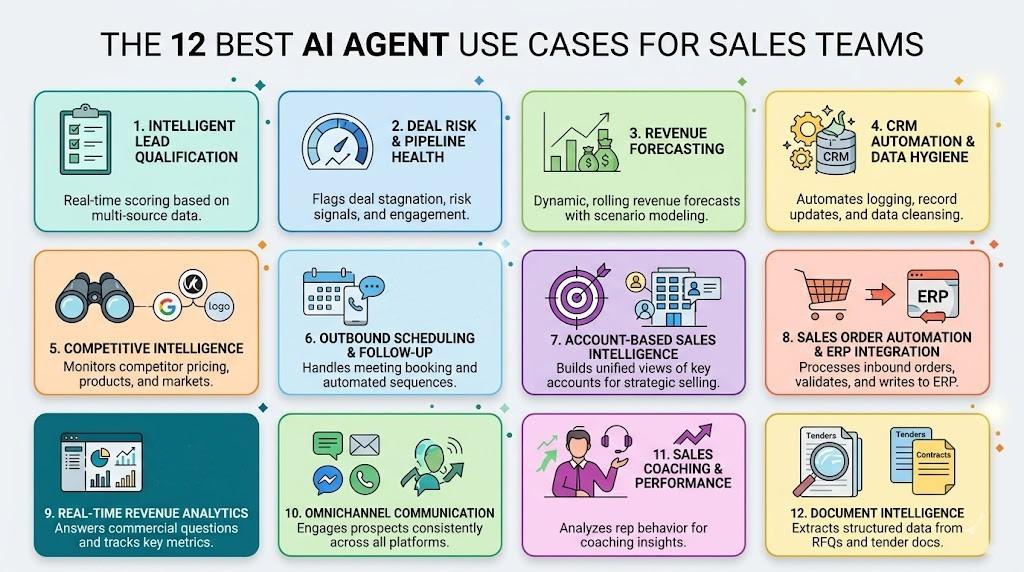
The 12 Best AI Agent Use Cases for Sales Teams
1. Intelligent Lead Qualification and Scoring
What the agent does
A lead qualification agent ingests signals from multiple sources — website behaviour, email engagement, firmographic data, CRM activity, and third-party intent data — and scores every inbound lead against your ideal customer profile in real time.
Unlike static scoring models that run nightly, an agentic system updates scores continuously as new signals arrive. When a prospect visits your pricing page, downloads a case study, and opens three emails in the same week, the agent registers all of that, adjusts the score, and surfaces the lead to the right rep with context attached.
The agent also handles enrichment: it pulls company size, tech stack, headcount, and recent news automatically, so reps arrive at the first call already briefed.
How it works in practice
- Multi-channel signal ingestion from CRM, email, web analytics, and intent platforms
- Real-time ICP scoring with explainable outputs ("scored 87 because: pricing page visit, VP title, target industry")
- Automatic routing to the correct rep or sequence based on score tier
- CRM enrichment and contact record update on every lead
- Alerts for high-intent clusters (multiple contacts from one account engaging simultaneously)
Real-world outcome
A global enterprise technology group operating across multiple regions deployed an agentic sales qualification layer across their account portfolio. The result was materially higher account coverage without a proportional increase in headcount, and significantly faster response cycles on opportunities and renewals. Pipeline hygiene improved because low-probability leads were automatically deprioritised rather than sitting unworked in the queue.
→ See lead qualification use case details
2. Deal Risk Monitoring and Pipeline Health
What the agent does
A pipeline health agent watches every open opportunity simultaneously. It tracks deal velocity, stakeholder engagement, competitor mentions, contract stage progression, and activity gaps — and flags anything that deviates from your historical win patterns.
The agent doesn't wait for a pipeline review meeting to surface a problem. If a deal has gone dark for 14 days, a key contact has left the account, or a competitor has been mentioned three times in recent calls, the agent flags it immediately with a recommended action.
How it works in practice
- Continuous deal scoring based on CRM activity, email engagement, and call data
- Stall detection: flags deals with no movement beyond a configurable threshold
- Competitor and risk signal monitoring from calls, emails, and web activity
- Next-best-action recommendations generated per deal
- Pipeline dashboards and leadership alerts summarising current health across the book
Real-world outcome
A multinational logistics enterprise used pipeline health agents to shift from reactive reporting to continuous pipeline intelligence. The deployment standardised decision logic across sales teams in multiple regions, automated the creation of follow-up tasks from deal signals, and gave leadership a real-time view of at-risk revenue. The shift from reactive to proactive pipeline management was measurable within the first quarter.
3. Revenue Forecasting and Rollup
What the agent does
A forecasting agent builds a rolling revenue forecast from the bottom up — combining CRM pipeline data, historical win rates by stage and rep, deal velocity metrics, and external signals — and updates it continuously rather than once per quarter.
The agent also models scenarios: what happens to the quarter if the top three deals push by 30 days? What's the upside if conversion in the mid-market segment improves by 10%? These aren't manual what-if analyses — the agent runs them on demand and flags risks proactively when the forecast starts drifting.
How it works in practice
- Bottom-up rolling forecasts from live CRM data
- Historical pattern analysis by rep, segment, and deal size
- Scenario modelling with configurable assumptions
- Forecast risk alerts when coverage ratios or velocity drop below thresholds
- Advisory-level views for managers overseeing multiple books of business
Real-world outcome
A fintech platform serving banks and credit unions deployed forecasting agents as part of a broader financial intelligence layer. The system delivered continuous cashflow visibility, real-time scenario modelling, and proactive alerting when anomalies appeared — enabling earlier detection of risk and faster decision-making without scaling the analyst headcount. On the assistents.ai platform, production deployments of this type have achieved forecast accuracy above 95%.
4. CRM Automation and Data Hygiene
What the agent does
A CRM automation agent eliminates the administrative burden that makes reps resent their own pipeline. It logs calls and emails automatically, updates deal stages based on actual conversation outcomes, enriches contact and account records with current data, and flags records that are stale, incomplete, or contradictory.
This matters more than it sounds. Poor CRM data is the root cause of bad forecasts, missed follow-ups, and inaccurate pipeline reviews. Agents fix the data problem at the source — in real time, rather than in a quarterly cleanup sprint.
How it works in practice
- Automatic activity logging from email, calendar, and call systems
- Deal stage updates triggered by conversation signals, not manual input
- Bidirectional sync with Salesforce, HubSpot, Microsoft Dynamics, and other CRMs
- Duplicate detection, enrichment, and data gap flagging
- Audit logs for every record change with full provenance
Real-world outcome
A major engineering and technology solutions group used agentic automation to replace a legacy sales order platform that had become both expensive and operationally fragile. The agent interpreted incoming order triggers from email and documents, validated all required fields, created sales orders in the ERP system, and managed exceptions with a governed approval workflow. The result: reduced manual order processing, a faster order-to-confirm cycle, fewer data-entry errors, and a complete audit trail for every transaction — replacing a high-cost legacy dependency in the process.
5. Competitive Intelligence and Market Monitoring
What the agent does
A competitive intelligence agent monitors competitor pricing, promotions, product updates, and market signals continuously — across e-commerce platforms, review sites, distributor channels, and news sources — and converts what it finds into instant answers and proactive alerts for commercial teams.
Most sales teams get competitive intelligence through a monthly slide deck prepared by a marketing analyst. Agentic competitive monitoring replaces that with always-on awareness: a pricing shift by a key competitor triggers an alert to the relevant rep within minutes, not weeks.
How it works in practice
- Continuous monitoring of competitor pricing, discounts, product listings, and availability
- Agentic Q&A: reps ask questions in natural language ("what's Competitor X charging for SKU Y right now?") and get live answers
- Gap analytics: dashboards showing where the portfolio is priced above or below the market
- Trend alerts for emerging threats and promotional patterns
- Scalable architecture from single-market pilot to enterprise-wide rollout
Real-world outcome
A major consumer goods company operating in a highly price-sensitive market deployed competitive monitoring agents to replace a manual, multi-portal tracking process that consumed significant analyst time. The system ran continuously across channels, surfaced pricing gaps as they appeared, and delivered proactive alerts to commercial leadership when competitor moves required a response. The outcome: faster competitive response cycles, earlier identification of pricing threats, and a dramatic reduction in manual monitoring effort across the team.
6. Outbound Scheduling and Follow-Up Automation
What the agent does
An outbound scheduling agent handles the mechanics of sales communication: confirming meetings, sending follow-up sequences, rescheduling no-shows, and logging every outcome to the CRM. For organisations using Voice AI, this extends to outbound calls — agents dial prospects, confirm appointments, and handle objections within configured guardrails.
This isn't about replacing the sales conversation. It's about ensuring the conversation actually happens by removing every friction point between an engaged prospect and a booked meeting.
How it works in practice
- Automated follow-up sequences triggered by prospect behaviour, deal stage, or time elapsed
- Voice AI for outbound scheduling calls: STT-LLM-TTS pipeline, sub-200ms latency, natural conversation
- Rescheduling logic that pulls live calendar availability and proposes alternatives
- CRM sync on every touchpoint: call outcome, email reply, meeting booked
- Configurable guardrails for escalation to human reps when conversations move beyond scope
Real-world outcome
A luxury hospitality brand operating 16 boutique properties across iconic safari destinations deployed a conversational booking agent to handle the end-to-end guest inquiry and reservation workflow. The agent managed email intake, intent classification, missing detail capture, real-time availability checks, and alternative date negotiation — with human handoff built in for bespoke itinerary creation. The result: faster booking turnaround, higher accuracy on complex guest requirements, and fully scalable operations without compromising the premium service experience the brand is known for.
→ Explore Voice AI for sales teams
Seeing patterns in your pipeline that you can't act on fast enough? assistents.ai deploys governed AI agents for sales teams — from lead scoring to revenue forecasting — in under 3 weeks.
7. Account-Based Sales Intelligence
What the agent does
An account intelligence agent builds and maintains a unified view of every account in your portfolio: contacts and their roles, historical interactions, contract status, open opportunities, recent company news, engagement patterns, and risk signals — all in one place, updated continuously.
The agent surfaces next-best-actions for each account based on where it sits in the relationship lifecycle. A contact who just got promoted at a key account, a contract renewal coming up in 60 days, a product champion who has gone quiet — all of these are signals the agent catches and converts into actionable prompts for the rep.
How it works in practice
- Unified account view across CRM, ERP, communication tools, and external data
- Relationship mapping: stakeholder identification, influence scoring, contact gap detection
- Renewal, expansion, and risk alerts based on account signals
- Context Engine layer connecting structured data (CRM records) with unstructured data (emails, call notes, documents)
- Insights-to-action agents: every insight generates a suggested action, not just a report
Real-world outcome
A prominent family business group operating more than 30 companies across retail, building, industrial, and services portfolios deployed an agentic intelligence layer across group entities. The system automated procurement and finance KPI alerts, monitored account health across business units, and enabled group leadership to detect margin erosion and vendor performance issues earlier than existing processes allowed. Standardised decision logic across teams replaced the inconsistent, manual monitoring that had previously left gaps in commercial visibility.
8. Sales Order Automation and ERP Integration
What the agent does
A sales order automation agent handles the last mile of the sales process — the moment a deal converts into an operational instruction. The agent interprets inbound order triggers from email, portals, or documents, validates all required fields against business rules, creates the sales order in the ERP system, handles exceptions through a governed approval workflow, and produces a complete audit trail.
For organisations still processing orders manually or through ageing legacy platforms, this use case typically delivers the fastest, most measurable ROI of any agentic deployment.
How it works in practice
- Inbound order trigger ingestion from email, PDF documents, portal submissions, and EDI
- Field validation against configurable business rules before ERP write
- SAP sales order creation with full field mapping and error handling
- Exception routing to human reviewers when orders fall outside standard parameters
- Reconciliation reporting and audit logs for every transaction
- Integration-ready replacement for legacy ECR and document management platforms
Real-world outcome
A large-scale engineering and technology solutions provider deployed this use case as a direct replacement for an end-of-life legacy platform that had become both operationally risky and commercially unsustainable due to escalating licensing costs. The agentic system took over the full order creation workflow — interpreting triggers, validating data, writing to SAP, and managing exceptions — with governance and auditability built in throughout. The outcome: reduced manual processing, a faster order-to-confirm cycle with fewer errors, and a clean migration path away from legacy dependency.
9. Real-Time Revenue Analytics
What the agent does
A revenue analytics agent gives every member of the sales team — not just those with BI tool access — the ability to ask questions about revenue performance and get immediate, accurate answers.
"What's our win rate this quarter versus last quarter for deals above £100k?" "Which reps are tracking ahead of quota?" "Where are we losing most deals in the pipeline?" These are questions that currently require a BI analyst or a half-day in a reporting tool. An analytics agent answers them in seconds, with full source citation and drill-down capability.
How it works in practice
- Natural language query interface over CRM, billing, ERP, and operational data
- Automated KPI monitoring with configurable exception thresholds
- Rep performance dashboards with variance explanations
- Booking trend and product performance analytics
- Scheduled insight packs delivered to leadership on a cadence
- Governed metric definitions to ensure consistency across teams
Real-world outcome
A rapidly scaling value retail organisation with more than 700 stores deployed conversational revenue analytics as part of a broader enterprise intelligence platform. Sales and commercial teams could query performance data in plain language without waiting for analyst capacity. The result: shorter analysis cycles for recurring questions, better visibility into product performance and promotional effectiveness, and a significant reduction in reporting dependency on centralised analytics teams — enabling faster commercial decisions at the operating level.
→ See revenue analytics capabilities
10. Omnichannel Prospect and Customer Communication
What the agent does
A communication agent handles inbound prospect and customer interactions across every channel — web chat, email, WhatsApp, and voice — with consistent quality, 24 hours a day.
In a sales context, this means inbound leads get an immediate, intelligent response at any time of day. The agent qualifies the inquiry, answers product questions, handles objections within scope, books meetings, and escalates to a human rep when the conversation reaches the right stage — without any manual triage.
How it works in practice
- Omnichannel intake: web chat, email, WhatsApp, and voice on a single orchestration layer
- Intent classification and inquiry triage from the first message
- FAQ and product knowledge responses grounded in your documentation
- Meeting booking and CRM record creation without human involvement
- Escalation workflows to human reps with full conversation context passed across
- SLA monitoring and audit trails on every interaction
Real-world outcome
A large real estate portfolio owner managing diversified assets across multiple emirates deployed an omnichannel communication agent to handle tenant and prospect inquiries end to end. The agent managed lease inquiries, maintenance requests, payment questions, and general support across web and messaging channels — routing to human teams only for complex escalations. The outcomes: 24×7 service coverage, faster response times, lower call-centre load, and consistent SLA adherence through automated routing and ticketing.
11. Sales Coaching and Performance Intelligence
What the agent does
A performance intelligence agent analyses sales activity data — call recordings, email sequences, meeting outcomes, deal progression — and surfaces patterns that separate high-performing reps from those who are struggling.
Rather than managers manually listening to calls and reviewing pipelines, the agent does the analytical heavy lifting: flagging talk-time ratios, identifying objection patterns that correlate with lost deals, comparing rep behaviour against winning benchmarks, and generating coaching recommendations that managers can act on in the next one-to-one.
How it works in practice
- Call analysis: transcript processing, sentiment detection, topic coverage, talk ratio
- Win/loss pattern identification across the full historical deal set
- Rep benchmarking: conversion rates, activity levels, deal velocity by segment
- Coaching prompt generation: specific, evidence-based recommendations per rep
- Quota attainment tracking with forward-looking risk flags
- Manager dashboards showing team health and development priorities
Real-world outcome
The assistents.ai revenue intelligence layer, deployed across B2B sales organisations, provides continuous tracking of rep activity, conversion rates, and quota attainment with variance explanations. Commercial leaders gain a live view of team performance that previously required significant manual aggregation — enabling faster coaching conversations grounded in actual behaviour rather than anecdote. Teams using this layer report a material improvement in how consistently high-performing behaviours are replicated across the wider organisation.
→ Explore the Business Intelligence product
12. Document Intelligence for Sales (Tenders, RFQs, Contracts)
What the agent does
A document intelligence agent handles the document-heavy workflows that create significant friction in enterprise sales cycles: processing inbound RFQs, extracting structured data from tender documents, tracking contract versions and revisions, and generating draft responses from templates.
For organisations where sales cycles involve complex document exchange — professional services, logistics, engineering, construction, public sector — this use case can cut the time from document receipt to qualified response by 80–90%.
How it works in practice
- Vision-LLM extraction from complex PDFs, scanned documents, and non-standard formats
- Structured data output mapped to CRM fields, ERP records, or response templates
- Revision and change detection: the agent flags what changed between document versions
- Quote and proposal generation grounded in extracted requirements
- Audit logs for every extraction decision with confidence scores
- Multi-agent orchestration for complex document workflows requiring multiple steps
Real-world outcome
A specialist commercial works company processing large volumes of complex tender documents deployed a multi-agent document workbench on the assistents.ai platform. The system retrieved documents, determined workflow type, extracted structured data using Vision-LLM capabilities, integrated with the project management system, and maintained complete audit logs throughout. The outcome: up to approximately 90% faster tender document processing and a 95% extraction accuracy target for standard document formats — with revision detection reducing bid risk by ensuring no changes went unnoticed.
→ See Document AI capabilities
How to Choose Which AI Agent Use Case to Start With
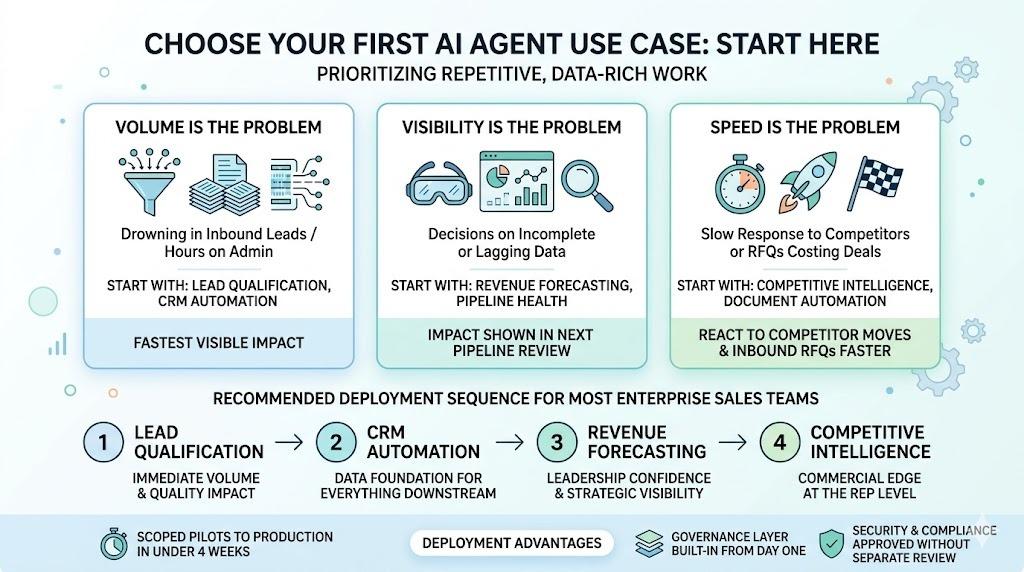
Not all use cases have equal ROI in the first 90 days. The right starting point depends on where your team has the highest volume of repetitive, data-rich work that currently requires human execution.
Use this framework to prioritise:
Start here if volume is the problem: Lead qualification and CRM automation deliver the fastest visible impact when teams are drowning in inbound or spending hours on admin. These are high-frequency, well-defined workflows that agents can own quickly.
Start here if visibility is the problem: Revenue forecasting and pipeline health agents are the right entry point when leadership is making decisions on incomplete or lagging data. The impact shows up in the next pipeline review.
Start here if speed is the problem: Competitive intelligence and document automation are the right starting points for organisations where slow response — to a competitor move or an inbound RFQ — is costing deals.
The recommended sequencing for most enterprise sales teams:
- Lead qualification (immediate volume and quality impact)
- CRM automation (data foundation for everything downstream)
- Revenue forecasting (leadership confidence and strategic visibility)
- Competitive intelligence (commercial edge at the rep level)
Most assistents.ai deployments move from scoped pilot to production in under four weeks. The governance layer is built in from day one, which means compliance and security teams can approve deployment without a separate review track.
→ Download the Enterprise AI Buyer's Guide
What Makes an Enterprise-Grade AI Sales Agent Different
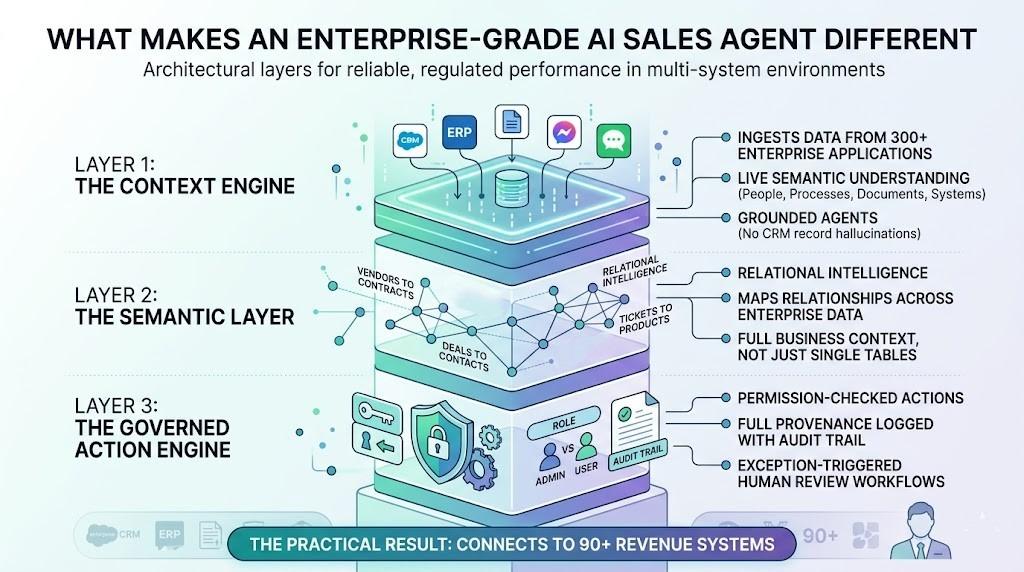
Not all AI agents are equal. The gap between a proof-of-concept agent and one that runs reliably in a regulated, multi-system enterprise environment comes down to three architectural layers.
Layer 1: The Context Engine
An enterprise AI agent needs to understand your business — not just answer generic questions. The Context Engine at the core of the assistents.ai platform ingests data from 300+ enterprise applications and builds a live semantic understanding of your people, processes, documents, and systems. Agents grounded in this layer don't hallucinate CRM records or make decisions based on stale data.
Layer 2: The Semantic Layer
Relational intelligence is what separates a useful agent from a frustrating one. The Semantic Layer maps relationships across enterprise data — vendors to contracts, deals to contacts, tickets to products — so agents reason with the full context of your business, not just the contents of a single database table.
Layer 3: The Governed Action Engine
This is the layer that makes enterprise deployment possible. Every action the agent takes is permission-checked against the role-based access controls that already exist in your source systems. Every decision is logged with full provenance. Every exception triggers a human review workflow. Governance isn't an add-on — it's how the Action Engine works.
The practical result: sales agents that connect to 90+ revenue systems, operate within your existing access control framework, and produce a complete audit trail that satisfies security, compliance, and legal review.
→ Explore Agent Governance | See all integrations
Ready to Deploy AI Agents Across Your Sales Function?
The use cases in this guide aren't hypothetical. They are production deployments, running in enterprise sales organisations across logistics, technology, retail, real estate, engineering, and financial services.
The question for most sales leaders isn't whether AI agents work — it's which use case to start with and how quickly they can see results.
The assistents.ai platform is purpose-built for this transition: pre-built connectors to 90+ revenue systems, a governance layer that satisfies enterprise security requirements, and a deployment model that gets you from scoped pilot to production in under four weeks.
Three ways to move forward:
→ See the full Sales and Revenue Ops platform
→ Model your ROI with the AI Agent Calculator
→ Request a 30-minute discovery call — no prep needed
FAQs
What is an AI agent in sales?
An AI agent in sales is an autonomous system that reads business context from your CRM, email, ERP, and other data sources — then executes multi-step workflows independently. Unlike a chatbot, which responds to inputs, an AI sales agent plans, decides, acts, and audits. Examples include lead qualification agents, pipeline monitoring agents, forecasting agents, and CRM automation agents.
How do AI sales agents differ from traditional CRM automation?
Traditional CRM automation is rule-based: if this field changes, trigger that action. It's rigid and breaks when conditions fall outside the defined rules. AI sales agents are context-aware: they reason about the current situation, apply configurable business logic, and adapt when circumstances change. They can also take action across multiple systems in sequence — something rule-based automation cannot do reliably.
Can AI agents replace sales development reps (SDRs)?
No, and that's not the value proposition. AI agents handle the volume work that currently consumes SDR time — lead research, enrichment, initial scoring, follow-up sequencing, CRM logging — so that human SDRs can focus entirely on high-intent conversations. Teams using AI agents for the top-of-funnel typically see SDRs booking significantly more qualified meetings with the same headcount, rather than replacing people with automation.
How long does it take to deploy an AI sales agent?
On the assistents.ai platform, most sales teams move from scoped pilot to production deployment in under four weeks. The deployment model starts with a single, well-defined use case (typically lead qualification or CRM automation), proves value quickly, and expands from there. The built-in governance and integration layer means there is no separate security or compliance track to navigate.
Which CRMs integrate with AI sales agents?
The assistents.ai platform integrates bidirectionally with Salesforce, HubSpot, Microsoft Dynamics, and other major CRM platforms, plus sales engagement tools like Outreach and Salesloft, marketing automation platforms, and 90+ additional revenue systems. Integrations are pre-built, not custom — which is a significant part of why deployment timelines are weeks rather than months.
What ROI can sales teams expect from AI agents?
Production deployments on the assistents.ai platform have delivered 35% higher close rates, 60% faster pipeline velocity, and 95%+ forecast accuracy. Most organisations achieve full ROI within six weeks of production deployment. The specific ROI depends on starting conditions — teams with high manual workload and poor CRM data hygiene typically see the fastest returns.
→ Use the ROI Calculator to model your numbers
Are AI agents secure enough for enterprise sales data?
Enterprise-grade AI agents operate within a zero-trust architecture where every action is permission-checked against your existing access controls. The assistents.ai platform is SOC 2 Type II certified, GDPR and HIPAA compliant, and ISO 27001 certified. Enterprise data is never used to train models. All agent actions produce exportable audit trails for compliance review.
What's the difference between an AI copilot and an autonomous sales agent?
An AI copilot assists a human: it suggests the next action, drafts the follow-up email, or surfaces the relevant CRM record. A human still reviews and approves before anything happens. An autonomous agent acts independently within defined guardrails: it qualifies the lead, updates the CRM, routes the opportunity, and alerts the rep — without requiring approval at each step. Most enterprise deployments use both: autonomous agents for high-volume, well-defined workflows, and copilot assistance for complex judgment calls.