Marketing teams today are buried under more data, more channels, and more demand for content than any human team can realistically manage. AI agents are changing that equation — not by replacing marketers, but by handling the high-volume, time-sensitive work that slows teams down.
From campaign analytics and influencer operations to competitive monitoring and brand intelligence, AI agents are being deployed across real marketing organisations right now, delivering measurable results.
This guide covers exactly how they work, the use cases with the most impact, and how to start deploying them in your own marketing function.
What Is an AI Agent in Marketing? (And How Is It Different from Automation?)
AI agents are autonomous software systems that can perceive data, make decisions, and take actions — without requiring constant human input. They are powered by large language models (LLMs) combined with machine learning and tool-use capabilities that allow them to connect to your systems, reason across datasets, and execute multi-step tasks.
The distinction from traditional marketing tools matters:
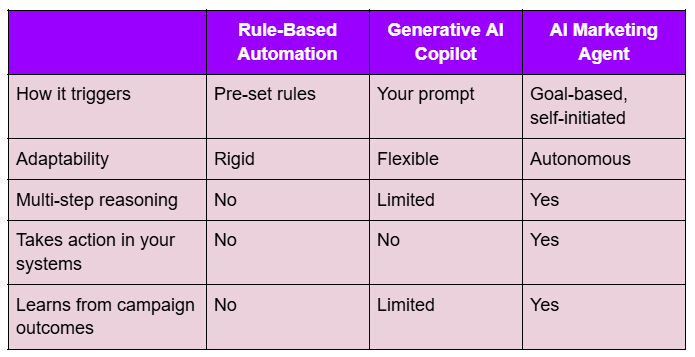
A marketing automation tool sends an email when a form is submitted. A generative AI tool writes a better email when you ask. An AI agent monitors your pipeline, decides which leads qualify, writes the email, sends it at the right time, logs the interaction in your CRM, and alerts you when a deal moves — without you asking it to.
This is the shift the industry is in the middle of right now. AI-sourced traffic increased 527% from January to May 2025, and the strategic focus is shifting from "ranking first" to "being the answer." Marketing teams that understand agentic AI early will have a structural advantage over those still managing it manually.
Why Marketing Teams Are Adopting AI Agents Now
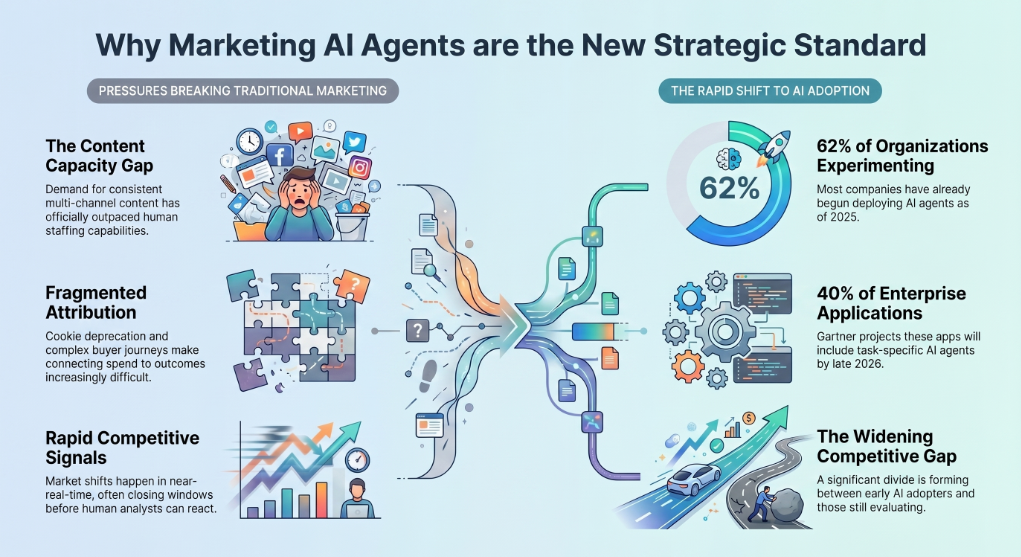
The timing is not coincidental. Marketing teams are facing converging pressures that traditional tools were not built for:
Content demand has outpaced capacity. Campaigns require consistent, on-brand output across email, paid, organic, social, and video — simultaneously, at a pace most teams cannot staff for.
Attribution is fragmenting. With cookies deprecating, channels multiplying, and buyer journeys growing longer, connecting spend to outcomes is increasingly difficult without always-on analytics.
Competitive signals move too fast. Pricing shifts, promotional changes, new entrants, and product updates happen in near-real-time. By the time a human analyst surfaces a competitive insight, the window may have passed.
CAC is rising. As paid channels become more saturated, marketing leaders need to extract more intelligence from existing data rather than simply spending more.
According to McKinsey's 2025 State of AI report, 62% of organisations are at least experimenting with AI agents, and by the end of 2026, Gartner projects 40% of enterprise applications will include task-specific AI agents. The gap between teams that have deployed agents and those still evaluating is already widening.
8 Real-World AI Agent Use Cases in Marketing (With Results)
The following use cases are drawn from live deployments across enterprise marketing organisations in hospitality, retail, logistics, creator economy, B2B, and more. Client names are not disclosed, but the operational scope and results are real.
1. Campaign Analytics and Multi-Touch Attribution
What the agent does: Connects performance data across paid search, email, social, and display into a unified analytics layer. Monitors KPIs continuously, generates variance explanations, and surfaces exceptions without waiting for a human to run a query.
Operational scope: Cross-channel KPI standardisation, automated dashboard generation, scheduled insight packs for leadership, exception alerting on budget pacing, ROAS shifts, and conversion anomalies.
Results achieved:
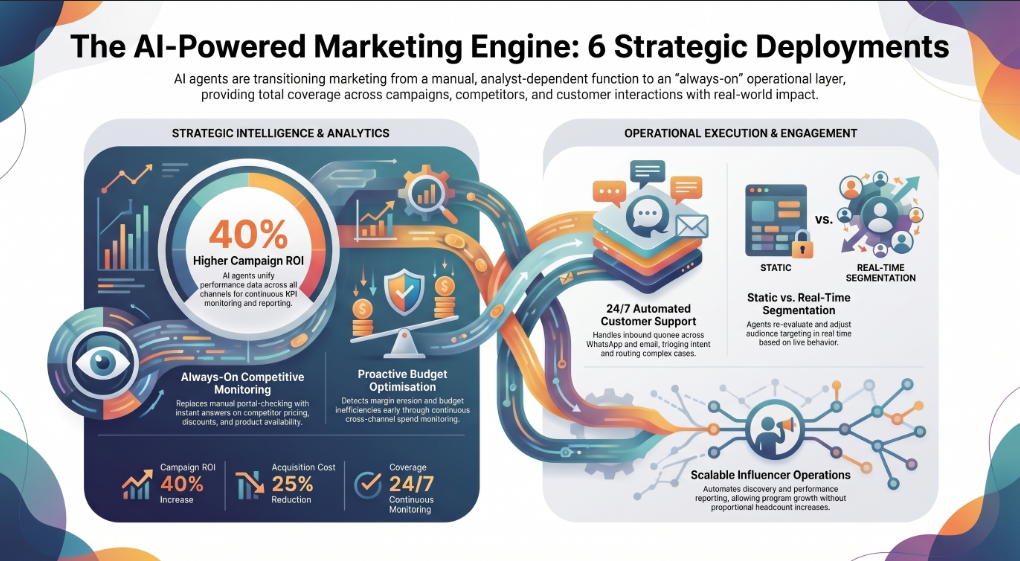
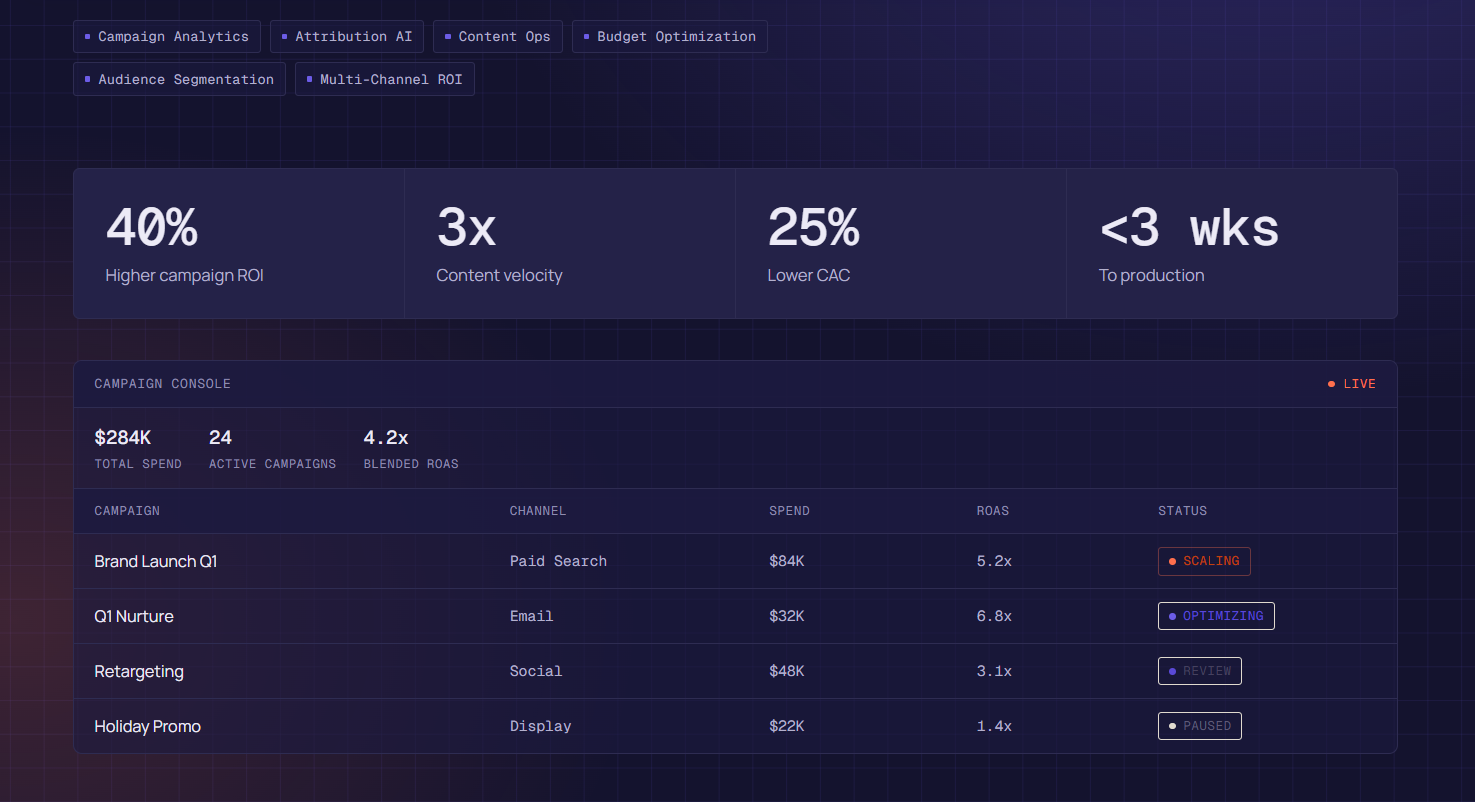
- 40% higher campaign ROI
- 25% lower customer acquisition cost
- Faster analysis cycles replacing manual reporting dependencies
- Leadership visibility without BI queue delays
The most significant unlock for marketing leaders is not just speed — it is coverage. An AI analytics agent monitors every campaign simultaneously, not just the ones an analyst had time to check this week.
2. Influencer Marketing Operations and Performance Intelligence
What the agent does: Automates the operational layer of influencer and creator marketing programs — from creator discovery enrichment and campaign workflow management to performance reporting and brand-safety monitoring.
Operational scope: Creator discovery and enrichment, campaign workflow automation, automated reporting summaries and insight generation, content KPI monitoring, brand-safety checks, and analytics for campaign ROI and engagement tracking.
Results achieved:
- Reduced manual operations across campaign lifecycle
- Faster performance visibility at scale
- More consistent reporting and learnings across brand programs
- Scalable execution without proportional headcount growth
For platforms managing large creator datasets, the agent effectively becomes a campaign operations layer — handling the volume of activity that would otherwise require a large coordination team.
3. Competitive Monitoring and Market Signal Intelligence
What the agent does: Continuously monitors competitor pricing, promotional activity, product availability, and ratings across channels. Converts those signals into instant answers, structured analytics views, and proactive leadership alerts — replacing manual portal-checking entirely.
Operational scope: Continuous e-commerce and channel monitoring across pricing, MRP/discounts, offers, availability, and ratings. Agentic Q&A mapped to leadership questions. Analytics views for pricing gaps, threats, and portfolio movement. Scalable governance and audit trails from proof-of-concept to production.
Results achieved:
- Faster competitive response cycles
- Earlier identification of pricing gaps and promotional shifts
- Always-on monitoring replacing manual checks across multiple portals
- Reduced manual monitoring effort for commercial teams
This use case is particularly high-value in competitive retail and consumer sectors, where pricing and promotional windows open and close within days.
4. Content Operations and Brand Intelligence
What the agent does: Ingests signals from creative performance, audience behaviour, and channel analytics to generate insight narratives, recommend content directions, and produce reporting packs for marketing leadership.
Operational scope: Multi-source ingestion of creative, performance, and audience signals. Insight agents producing themes, narratives, and next-step recommendations. Reporting packs with consistent brand-voice governance. Unified view of what is working and what action to take next.
Results achieved:
- Faster creative strategy cycles
- Deeper signal synthesis across channels
- Improved clarity on "what to do next" for campaigns
- More consistent insight workflows replacing ad-hoc analyst requests
This is especially relevant for brand and creative teams that are data-rich but insight-poor — teams sitting on performance data that no one has time to turn into strategy.
5. Conversational AI Agents for Customer Engagement
What the agent does: Handles inbound customer and tenant queries across web, WhatsApp, and email — triaging intent, resolving common queries automatically, and routing complex cases to human teams with full context.
Operational scope: Omnichannel intake (web, WhatsApp, email-ready). Query triage, FAQ handling, payment and service-related support workflows. Ticketing and escalation to human teams. Knowledge base over policies, product documents, and SOPs. 24/7 coverage with SLA monitoring.
Results achieved:
- Faster response times and lower inbound support volume
- Consistent 24×7 customer experience
- Better SLA adherence through automated routing and tracking
- Reduced operational bottlenecks for front-line teams
For marketing teams running campaigns that drive inbound volume — product launches, promotions, events — a conversational agent prevents the customer experience from breaking at the moment of peak demand.
6. Audience Segmentation and Personalisation at Scale
What the agent does: Ingests behavioural signals from web, email, CRM, and intent data sources to dynamically segment audiences and trigger personalised campaign flows — without manual list-building or analyst intervention.
Operational scope: Data ingestion across sales, products, inventory, promotions, and customer behaviour. Conversational analytics for instant business queries. Automated KPI monitoring and exception alerting. Booking and workflow orchestration tied to segment triggers.
Results achieved:
- Higher engagement through relevant, timely outreach
- Shorter analysis cycles for recurring segmentation tasks
- Better visibility into product performance and promotion effectiveness
- More scalable operations with reduced manual overhead
The key difference from traditional segmentation is continuous updating. A static segment runs once. An AI agent re-evaluates and adjusts targeting in real time as behaviour changes.
7. Budget Optimisation and Media Planning
What the agent does: Monitors cross-channel spend performance continuously, surfaces variance explanations, and generates reallocation recommendations — enabling marketing leaders to act on budget decisions faster and with better evidence.
Operational scope: Cross-entity KPI standardisation, automated alerts for margin trends and budget pacing anomalies, dashboards with scheduled insight packs for leadership, early-payment and vendor performance analytics.
Results achieved:
- Earlier detection of margin erosion and budget inefficiency
- Standardised financial and marketing intelligence across business units
- Reduced variance surprises through continuous monitoring
- Faster leadership decision-making via unified reporting
8. Sales and Revenue Operations Alignment
What the agent does: Monitors accounts for opportunity signals, orchestrates follow-up workflows based on defined rules, and keeps pipeline data clean — connecting marketing-generated demand to revenue outcomes.
Operational scope: Always-on account monitoring and signal capture. Rule-governed opportunity identification and follow-up orchestration. CRM-integration-ready workflows and pipeline hygiene. Sales dashboards and leadership alerts.
Results achieved:
- Higher account coverage without increasing headcount
- Faster response cycles on opportunities and renewals
- More consistent execution through governed playbooks
- Reduced manual coordination between marketing and sales
This use case closes the loop that most marketing teams struggle to close — the connection between a campaign impression and a closed deal.
How AI Agents Are Being Deployed Across Marketing Contexts
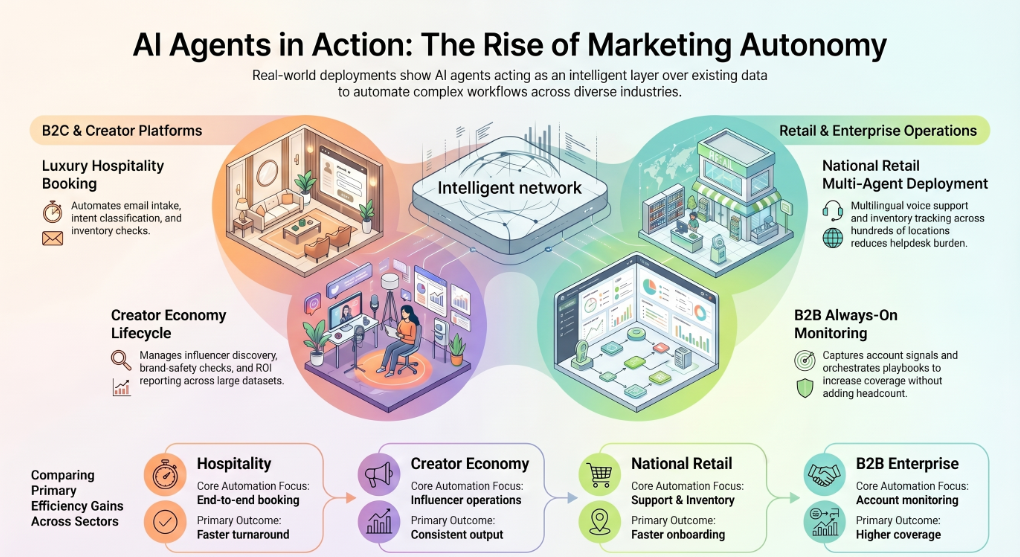
Real-world deployments span very different sectors, but the underlying pattern is consistent: an AI agent is layered on top of existing data and systems to generate intelligence and take action faster than human teams alone can manage.
Luxury hospitality: A booking and guest-journey agent handles email intake, intent classification, data extraction, real-time inventory checks, and alternative date negotiation — automating end-to-end booking workflows while keeping human oversight for curated itinerary creation. The result is faster booking turnaround with no compromise on service quality.
Creator economy platform: An AI platform automates the full influencer marketing operations lifecycle — creator discovery, campaign delivery, KPI monitoring, brand-safety checks, and ROI reporting — across a very large creator dataset. Manual campaign management work is replaced by automated workflows with consistent output.
National retail chain: A multi-agent deployment covers store support, inventory visibility, and staff training across hundreds of locations. A voice support agent handles Hindi and English queries. An inventory intelligence agent tracks pricing, stock, and promotions per store. A knowledge and training agent provides on-demand guidance over point-of-sale and SOP documentation. The result is reduced manual helpdesk burden, improved store-level inventory visibility, and faster onboarding.
B2B enterprise: An always-on account monitoring and signal-capture agent identifies opportunities and risks, orchestrates follow-up playbooks, and integrates with CRM systems — giving sales and marketing teams higher account coverage without adding headcount.
What Separates AI Agents That Deliver Results From Those That Don't
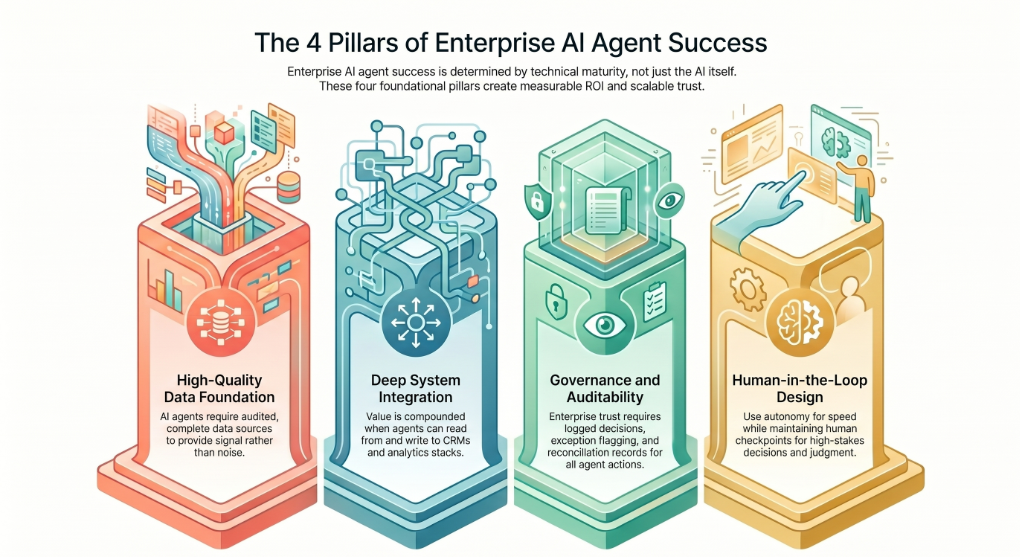
Not every AI agent deployment succeeds. The difference between implementations that generate measurable ROI and those that stall comes down to four factors.
Data foundation. AI agents are only as good as the data they run on. If your CRM is incomplete, your attribution model is broken, or your analytics stack is fragmented, an agent will surface noise rather than signal. Before deploying, audit the data sources the agent will depend on.
Governance and auditability. In enterprise environments, agents must produce auditable outputs — especially when they are taking actions in live systems. This means logging decisions, flagging exceptions for human review, and maintaining reconciliation records. Governance is not optional; it is what makes agents trustworthy at scale.
Human-in-the-loop design. The most effective deployments are not fully autonomous. They are designed with clear checkpoints where human judgment is required — particularly for high-stakes decisions like campaign budget reallocation, account escalation, or creative direction. Autonomy is applied where it adds speed; humans remain in the loop where it adds judgment.
Integration depth. Surface-level agents that summarise data without connecting to your systems deliver limited value. Agents that can read from and write to your CRM, ad platforms, analytics stack, and communication tools — and do so within governed rules — deliver compounding value over time.
Marketing readiness for agentic AI is tightly linked to the maturity of data and business intelligence foundations. If your data is not in order, agentic AI will not save you.
Agentic AI vs. Traditional Marketing Automation: The Real Difference
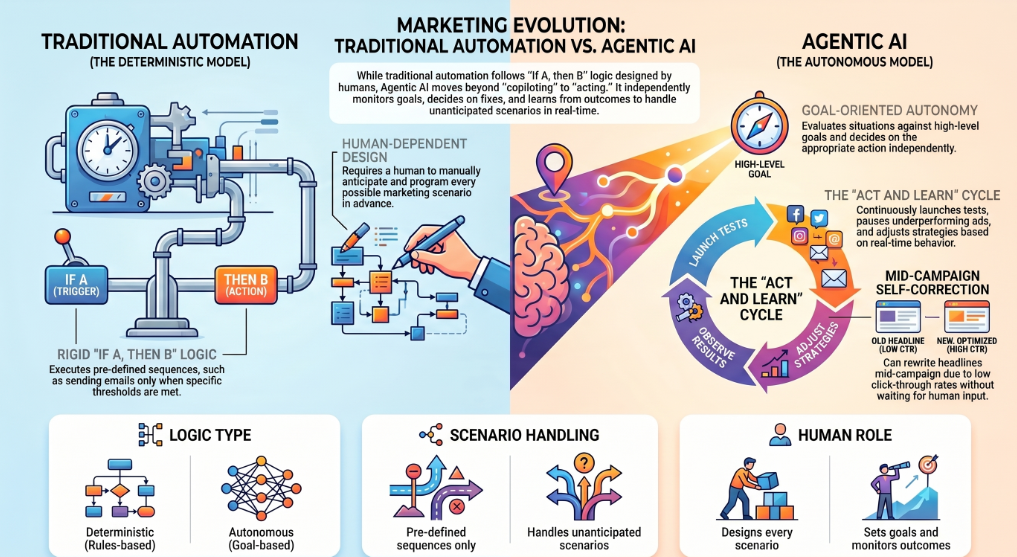
The confusion between AI agents and marketing automation platforms is common. They are not the same category, and conflating them leads to underestimating what agents can do — and overestimating what automation tools are capable of.
Traditional marketing automation executes pre-defined sequences. It sends an email when a contact reaches a score threshold. It adds a tag when a form is submitted. It is deterministic: if A then B.
An AI marketing agent operates differently. It monitors a situation, evaluates it against goals, decides what action is appropriate, and executes — then learns from the outcome. If an agent sees that a campaign is generating high click-through rates but low conversion, it does not wait for a human to notice. It surfaces the insight, proposes a hypothesis, and in more advanced deployments, tests a fix.
AI agents represent a shift from copilots that assist to agents that act. Rather than writing a headline when asked, a marketing agent might decide that a headline needs to change based on low CTR and rewrite it mid-campaign without human input — then launch an A/B test across email variants, pause underperforming ads, or adjust retargeting strategies in real time based on buyer behaviour.
The operational implication is significant. Marketing automation requires a human to design every scenario in advance. An AI agent handles scenarios that were never anticipated.
How to Get Started With AI Agents for Your Marketing Team
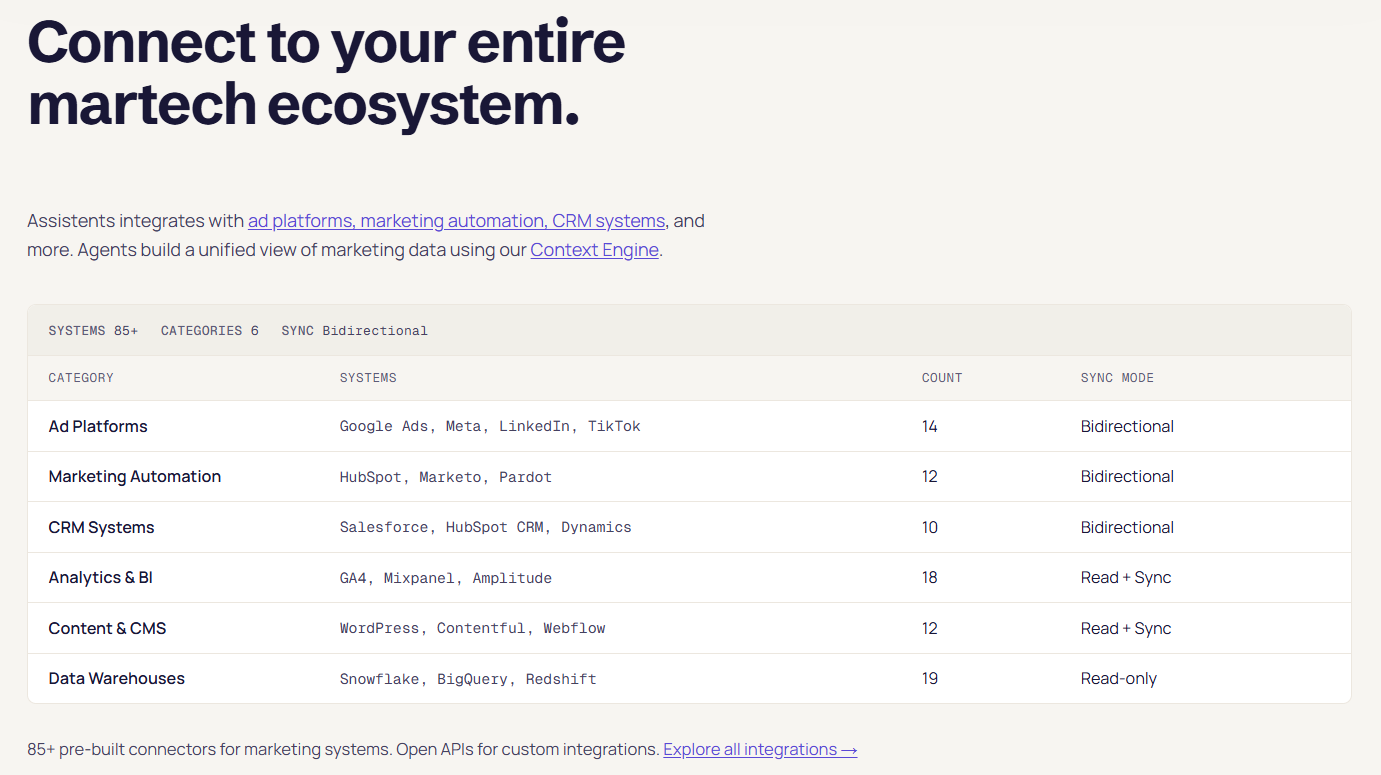
Deploying AI agents does not require a large technical team or a full infrastructure overhaul. The most successful deployments follow a pattern: start narrow, prove value, then expand.
Step 1 — Audit your highest-friction workflows. Where does your team spend the most time on tasks that are repetitive, data-dependent, or time-sensitive? Campaign reporting, competitive monitoring, and content operations are the most common starting points.
Step 2 — Identify where data already exists but insight is slow. AI agents work best when the data is already there — you just cannot process it fast enough. Attribution data, campaign performance data, CRM data, and competitive signals are all typically available; the bottleneck is analysis speed.
Step 3 — Start with a scoped, high-value agent. Pick one use case. Campaign analytics or competitive monitoring are good entry points because the value is measurable, the data sources are well-defined, and the risk of error is low. Avoid starting with agents that take high-stakes autonomous actions before you have established governance.
Step 4 — Define governance up front. Before deployment, document the rules: which decisions require human approval, what the agent should do when it encounters an exception, and how outputs will be logged and reviewed. Governance is easier to build in than to retrofit.
Step 5 — Measure, then expand. Define the metric the agent is improving — analysis cycle time, campaign ROI, competitive response speed — and measure it before and after. Once value is proven in one area, the business case for expanding to adjacent workflows becomes straightforward.
Production-ready deployments can go live in weeks, not months, when the scope is well-defined and the data infrastructure is in order.
Ready to See AI Agents in Action for Your Marketing Team?
The gap between marketing teams using AI agents and those still running manual workflows is growing quickly. The organisations seeing results today started with a single, well-scoped deployment — not a full transformation.
If you want to see how AI agents apply to your specific marketing workflows, start with the AI Agents for Marketing overview at assistents.ai or request a demo to see the platform in action with your data.
FAQs
What are AI agents in marketing?
AI agents in marketing are autonomous software systems that connect to your marketing data and tools, reason across that information, and take actions — such as generating reports, alerting on anomalies, updating segments, or triggering campaign workflows — without requiring constant human direction.
How are AI agents different from marketing automation?
Marketing automation follows pre-set rules: if this happens, do that. AI agents are goal-driven: they monitor situations, make judgments, and act based on context and objectives. They can handle scenarios that were never anticipated and adapt to changing data.
Can AI agents replace my marketing team?
No. The most effective deployments keep humans in the loop for strategy, judgment, and high-stakes decisions. AI agents handle the high-volume, time-sensitive, data-intensive work that slows teams down — freeing marketers to focus on the creative and strategic work that drives differentiation.
What is the ROI of AI agents for marketing?
Deployments vary, but measurable results from live implementations include 40% higher campaign ROI, 25% lower customer acquisition cost, 3x content velocity, and significant reductions in manual reporting time. The ROI compounds as agents expand across more workflows.
How long does it take to deploy an AI marketing agent?
Scoped, well-defined deployments can reach production in under three weeks when the data infrastructure is in place. Larger, multi-agent deployments across several marketing functions typically take six to twelve weeks.
What data do AI agents need to work effectively?
The most common inputs are CRM data, campaign performance data, website and behavioural analytics, product and inventory data, and competitive signals from external channels. Agents work best when these sources are connected, clean, and accessible.
What is the difference between an AI agent and a chatbot?
A chatbot responds to inbound queries within a conversational interface. An AI agent can initiate actions, connect to multiple systems, reason across datasets, and execute multi-step workflows — with or without a conversation to trigger it.
What is agentic AI in marketing?
Agentic AI refers to AI systems that operate with a degree of autonomy — setting their own sub-goals, making decisions, and executing actions in service of a broader objective. In marketing, agentic AI means agents that monitor your campaigns, surface insights, and take actions in your systems without waiting for instructions.