Most sales teams are losing between 60 and 70 percent of their pipeline to the same three problems: slow follow-up, poorly qualified leads, and buying signals that go unnoticed until it's too late. Adding more SDRs hasn't solved it. Neither has adding more tools.
The teams pulling ahead in 2026 are doing something different. They're deploying AI sales agents — not chatbots, not basic automation, but autonomous systems that qualify leads in real time, monitor accounts around the clock, and keep CRMs updated without anyone lifting a finger. The results are measurable: 35% higher close rates, 60% faster pipeline velocity, and lead response times under 90 seconds.
This guide covers everything you need to understand about AI sales agents for lead generation — what they actually are, how they work across the full lead lifecycle, what real enterprise deployments look like across industries, and how to evaluate whether you're looking at a genuine agentic system or just another chatbot with a new label.
Whether you're a CRO looking to scale a pipeline without scaling headcount, a VP Sales trying to improve forecast accuracy, or a RevOps leader evaluating AI-based lead generation for the first time, this is the playbook you need.
What Is an AI Sales Agent for Lead Generation?
An AI sales agent for lead generation is an autonomous software system that executes multi-step sales workflows — lead capture, qualification, scoring, routing, outreach, CRM updates, and opportunity monitoring — without requiring manual input at each step.
That last part matters. A lot of tools marketed as "AI sales agents" are really just chatbots or workflow triggers wearing a new label. The difference is execution depth.
A chatbot responds when someone asks it a question. An AI sales agent proactively monitors signals across your entire pipeline, acts on those signals according to governed rules, updates your CRM automatically, alerts the right rep at the right moment, and learns from outcomes over time. It operates between human touchpoints — not just during them.
Here's how the three categories actually differ:
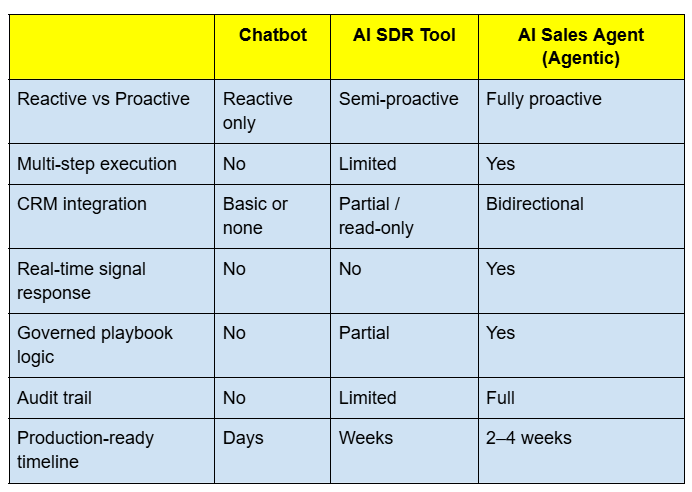
When people search for "AI lead generation tools" or "AI based lead generation," they're often looking for the middle column — software that automates prospecting tasks. What the best enterprise teams are actually deploying is the right column: agentic systems that execute entire revenue workflows autonomously.
The Lead Generation Problem AI Agents Are Built to Solve
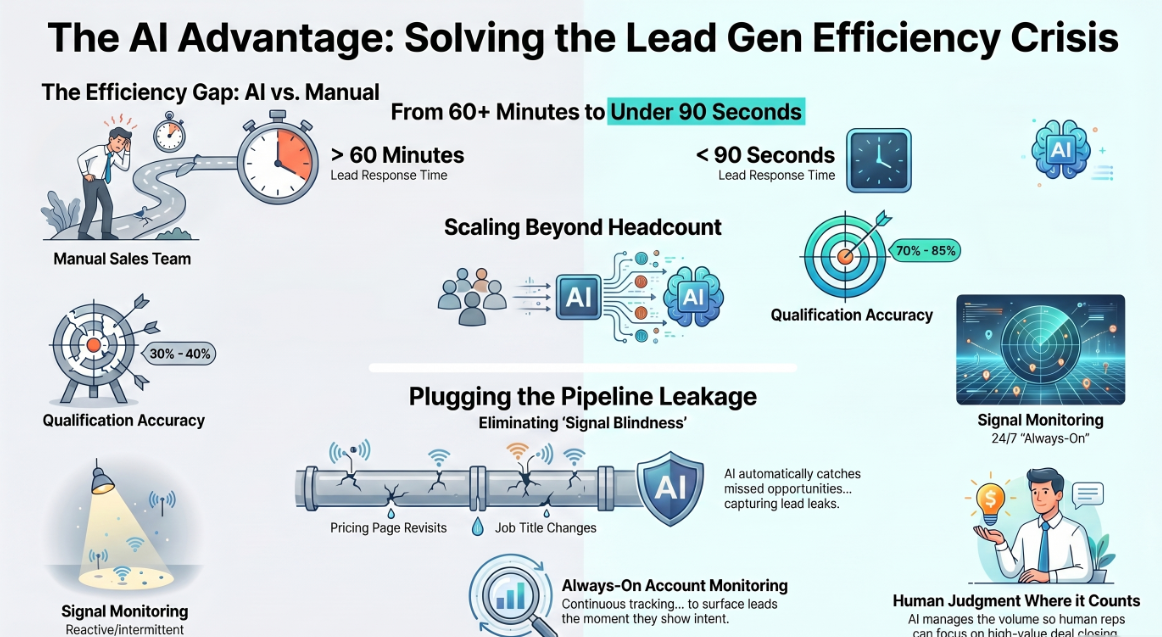
Before getting into how AI sales agents work, it's worth being precise about the problem they solve — because most of the pain isn't where teams think it is.
Speed-to-Lead Is Still a Bloodbath
Research consistently shows that leads contacted within five minutes of showing intent are nine times more likely to convert than leads reached after an hour. Most sales teams aren't operating anywhere near that window. A lead fills out a form, sits in a queue, gets routed to the wrong rep, and by the time anyone reaches out the prospect has already moved on. AI sales agents eliminate this gap entirely. Lead response time drops to under 90 seconds.
Manual Qualification Doesn't Scale — and It Isn't Accurate
Manual lead qualification produces accuracy rates of around 30 to 40 percent. That means more than half the leads your team spends time on were never going to convert. AI-based lead generation, by contrast, benchmarks at 70 to 85 percent qualification accuracy because it analyses firmographic data, behavioural signals, and historical conversion patterns simultaneously and continuously — not once when a form is submitted.
Pipeline Leakage from Signal Blindness
The biggest source of pipeline leakage isn't leads that were never interested. It's accounts that showed buying signals that nobody caught. A prospect revisits your pricing page four times. A contact at a key account changes job titles. A renewal window opens and no one's tracking it. AI sales agents monitor these signals around the clock and surface them automatically. The concept of "always-on account monitoring" isn't a feature — it's the core value proposition.
Headcount Isn't the Answer
Hiring more SDRs costs more, takes longer to ramp, and introduces more inconsistency into your qualification process. It also doesn't solve the fundamental problem: the volume of signals that matter in a modern B2B sales motion is too high for any human team to process in real time. AI agents don't replace the judgment that closes deals. They handle the volume that prevents human reps from applying that judgment where it counts.
How AI Sales Agents Work for Lead Generation: Step by Step
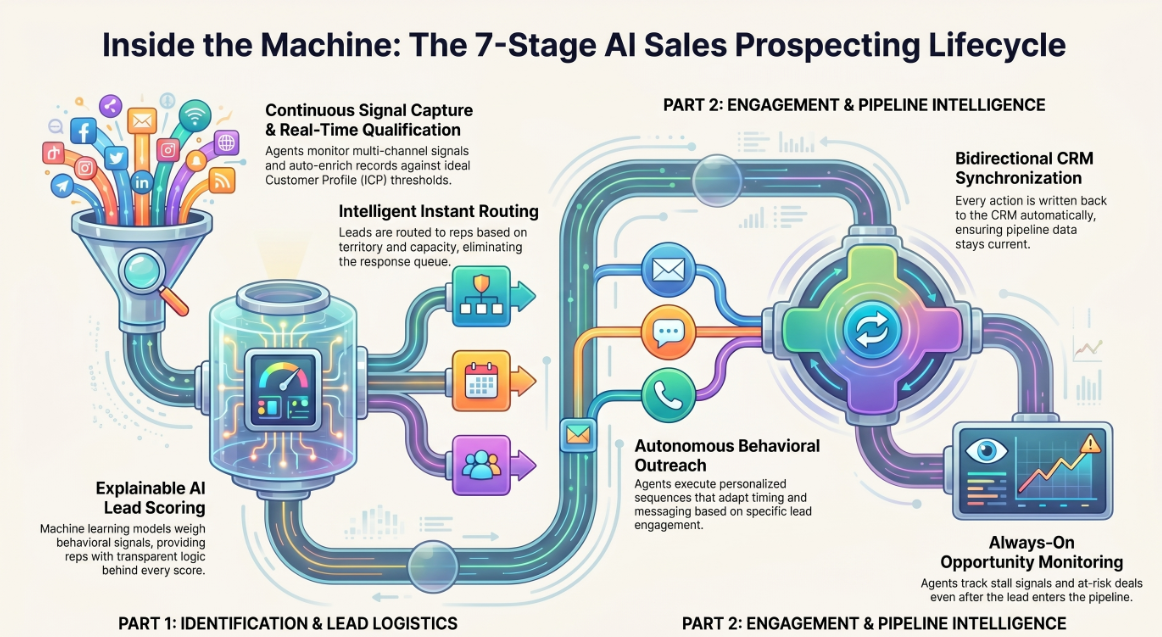
Understanding how an AI sales agent actually works is the clearest way to evaluate whether what you're looking at is genuinely agentic or just rebranded automation.
A production-grade AI sales agent for lead generation operates across seven stages:
1. Multi-Channel Signal Capture
The agent ingests signals from inbound forms, CRM activity logs, email engagement, web behaviour, intent data providers, and communication platforms. It doesn't wait for signals to be routed to it — it monitors continuously across all connected sources.
2. ICP Qualification in Real Time
As signals arrive, the agent matches them against your Ideal Customer Profile criteria. It auto-enriches lead records with firmographic data — company size, industry, revenue, tech stack — and flags records that meet your qualification threshold without waiting for a human to review them.
3. Lead Scoring and Prioritisation
Leads are scored using machine learning models that weigh firmographic fit, behavioural signals, engagement patterns, and historical conversion data. Scores update continuously as new signals arrive. Critically, the scoring logic is explainable — reps can see why a lead is scored the way it is, not just what the score is. Ungoverned black-box scoring is one of the most common reasons AI lead generation fails in practice.
4. Intelligent Routing
Qualified leads are routed to the right rep based on territory, account ownership, capacity, and deal stage. Routing logic is governed by configurable rules and integrates directly with CRM assignment. This eliminates the queue and ensures no high-intent lead waits.
5. Automated Outreach and Follow-Up
The agent executes personalised follow-up sequences based on lead behaviour and deal stage. Timing, channel, and message adapt based on engagement patterns. Sequences continue autonomously until the lead responds or reaches a defined hand-off point.
6. Bidirectional CRM Sync
Every action the agent takes is written back to your CRM automatically. Deal stages update, contact records enrich, activities log, and pipeline data stays current without a single manual entry. This is the difference between a read-only integration and a genuinely agentic one.
7. Opportunity Monitoring and Alerting
Even after a lead is in the pipeline, the agent continues monitoring. It detects stall signals, flags at-risk deals, tracks renewal windows, surfaces competitive intelligence, and alerts reps when action is needed. This is always-on account surveillance that no human team can replicate at scale.
Key Capabilities to Look for in an AI Sales Agent
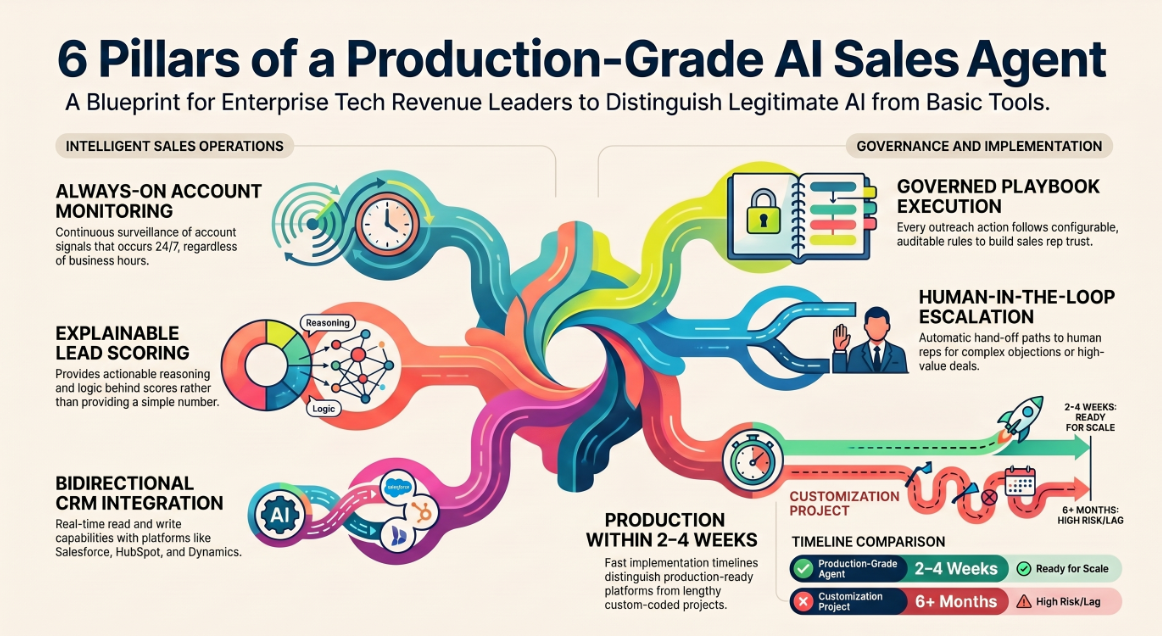
If you're evaluating AI lead generation software or comparing platforms, these are the capabilities that separate production-grade agents from tools dressed up in agent language.
Always-on account monitoring. The agent should be actively watching your entire account base at all times — not just responding to queries or running scheduled jobs. Buying signals don't follow business hours.
Governed playbook execution. Every outreach action, routing decision, and escalation should follow configurable rules with full auditability. This isn't just about compliance — it's about rep trust. Sales teams won't act on agent recommendations if they can't see and verify the logic behind them.
Explainable scoring. Lead and deal scores should come with reasoning, not just numbers. "This account scores 87 because firmographic fit is strong, the decision-maker has visited the pricing page three times in the past week, and a similar profile converted 74% of the time in the last quarter" is actionable. "Score: 87" is not.
Bidirectional CRM integration. Read-only CRM connections create a data lag that defeats the purpose. Look for agents that write back to Salesforce, HubSpot, Dynamics, and other platforms automatically and in real time.
Human-in-the-loop escalation. The best agents know when to escalate. Complex objections, enterprise deals above a certain value, and unusual account activity should all have governed hand-off paths to human reps — not just keep running autonomously.
Production in weeks, not months. A legitimate AI sales agent for enterprise lead generation should be in production within two to four weeks. If a vendor is quoting a six-month implementation timeline, you're looking at a customisation project, not a production-ready platform.
Sales dashboards and leadership alerts. Revenue leaders need visibility without depending on BI queues. Pipeline health, velocity metrics, account coverage ratios, and forecast signals should be surfaced automatically through dashboards and proactive alerts.
Real-World Results: What AI Sales Agents Deliver Across Industries
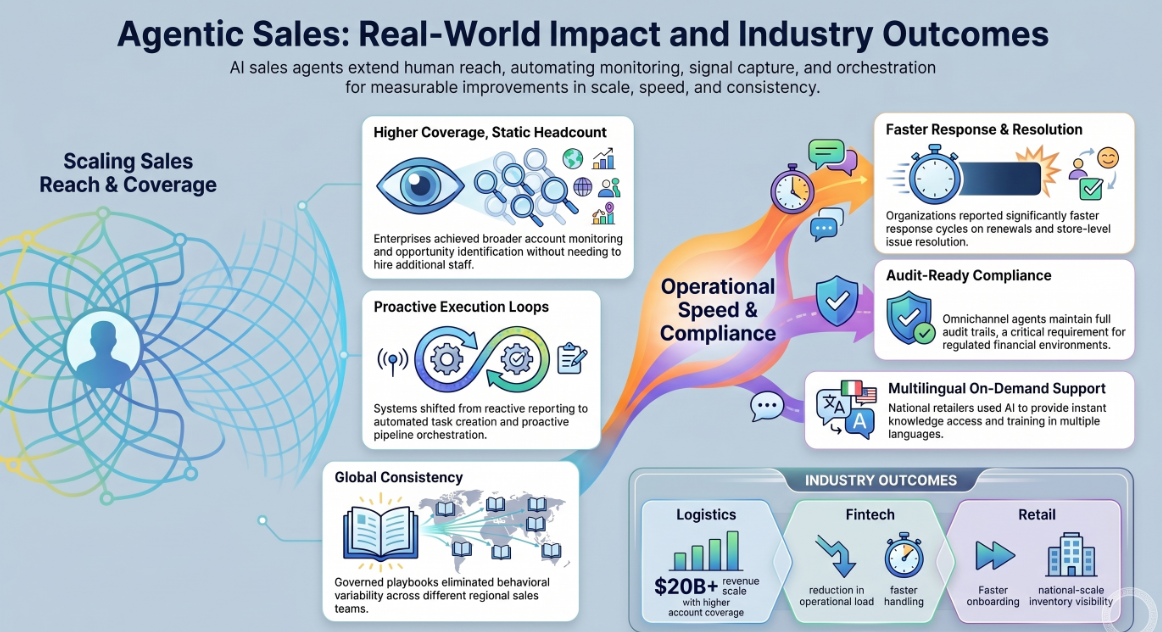
The clearest way to understand what AI sales agents actually deliver is to look at what they've done in production across different industries and use cases. The following outcomes are drawn from real enterprise deployments across sectors.
Logistics and Global Operations
A global ports and logistics enterprise — one of the largest in its category, with record revenue exceeding $20 billion — deployed an agentic sales intelligence layer across its terminal and inland operations. The deployment included always-on account monitoring, signal capture at scale, governed opportunity identification with rule-based follow-up orchestration, and CRM-integrated pipeline workflows.
The outcomes: higher account coverage without increasing headcount, faster response cycles on opportunities and renewals, and more consistent execution through governed playbooks that eliminated variability in rep behaviour across regions.
Financial Services and Banking
A cloud-based fintech provider serving banks and credit unions deployed omnichannel AI agents with auditable workflow automation across its sales and support operations. The system handled omnichannel intake across chat, email, and phone; performed agent-assist summarisation with next-best-action recommendations; and maintained full audit trails for compliance readiness.
Outcomes included faster case handling, a measurable reduction in operational load through automation, and significantly improved compliance readiness — a critical requirement in regulated financial environments.
Enterprise Technology and Smart Infrastructure
A smart infrastructure business operating at city scale — cited as touching more than 150 million urban lives across 25+ smart city operation centres — required an agentic analytics and action layer on top of its existing systems. The deployment included a unified context engine across structured and unstructured data, a semantic governance layer, and an insights-to-action orchestrator that integrated directly with core operational systems.
The result was a fundamental shift from reactive reporting to proactive execution loops: standardised decision logic across teams, automated task creation and completion tracking, and improved operational visibility for leadership — without replacing existing dashboard infrastructure.
Retail at National Scale
A rapidly scaling value retailer with over 700 stores deployed enterprise AI agents to modernise store support, inventory visibility, and knowledge access across its national footprint. The agents handled voice support in multiple languages, inventory intelligence per store, and on-demand knowledge and training access — all integrated with ticketing and analytics systems.
Outcomes: reduced manual helpdesk burden, faster store-level issue resolution, improved inventory visibility, and dramatically faster onboarding through on-demand training guidance. Critically, the deployment scaled to national footprint without requiring proportional headcount increases.
B2B Sales Operations (Engineering and Technology)
A UAE-based enterprise engineering and technology firm deployed an agentic AI sales agent to identify opportunities, surface risks, and recommend next-best actions across its enterprise account base. The system provided always-on account monitoring, rule-governed opportunity identification, and CRM-ready workflow automation with full pipeline hygiene.
Results: higher account coverage at the same headcount, faster response cycles on opportunities, and more consistent execution across the sales team through governed playbooks.
The pattern across all of these deployments is consistent. AI sales agents don't replace sales teams. They extend the reach, speed, and consistency of those teams in ways no human operation can match alone.
AI Sales Agent vs Human SDR: What Actually Gets Automated
One of the most searched questions around AI-based lead generation is whether AI sales agents replace human SDRs. The honest answer is: partly, and deliberately.
Here's what the data actually shows about task-level division:
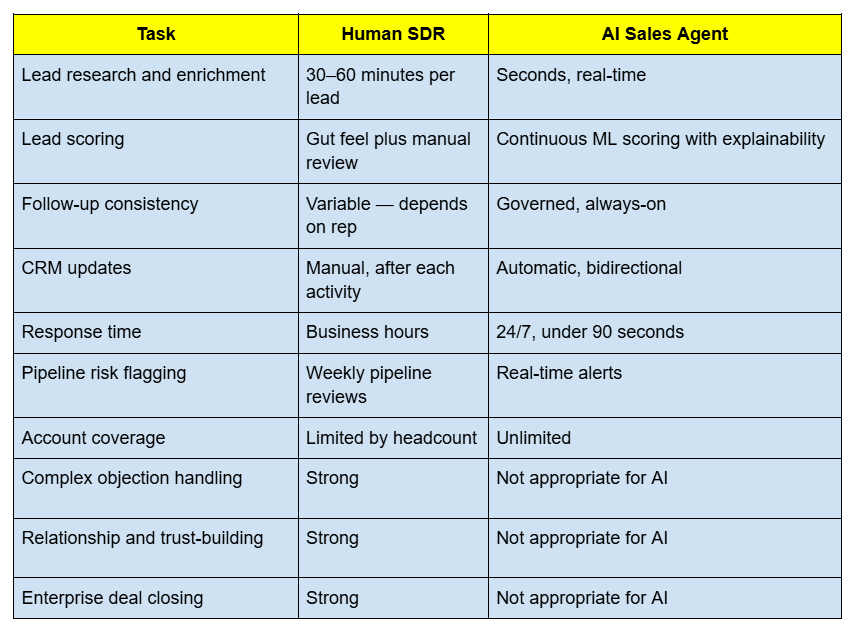
The right framing isn't replacement — it's reallocation. AI agents handle the volume, consistency, and speed layer. Human reps focus on the judgment, relationship, and closing layer. The combination consistently outperforms either working in isolation.
Teams using the "AI handles top-of-funnel, humans own bottom-of-funnel" model are seeing the 35% close rate improvements precisely because their reps spend more time on high-probability, well-qualified opportunities and less time on research, data entry, and chasing cold leads.
How to Use AI for Lead Generation: The Deployment Timeline
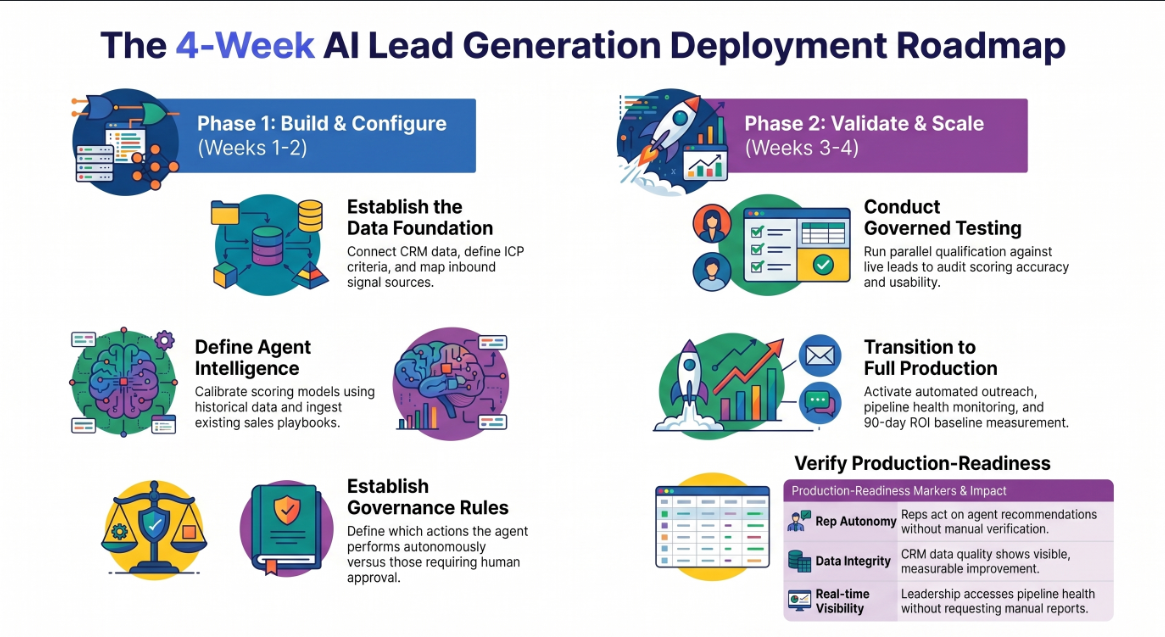
One of the most common questions from teams evaluating AI lead generation software is how long it actually takes to get an agent into production. The answer depends heavily on how the platform is architected, but a well-designed agentic system should follow this kind of timeline.
Week 1: Foundation
- Connect CRM and pull historical pipeline data
- Define and configure ICP criteria and qualification thresholds
- Map signal sources: inbound forms, email, web, intent data providers
- Establish routing rules by territory, rep capacity, and deal type
Week 2: Intelligence Layer
- Calibrate lead scoring models on historical conversion data
- Ingest sales playbooks, messaging templates, and escalation rules
- Configure governance layer: what the agent can do autonomously vs what requires human approval
- Build dashboard templates for rep and leadership views
Week 3: Governed Testing
- Run parallel qualification against live inbound leads
- Review scoring explanations for accuracy and rep usability
- Test CRM write-back and audit log integrity
- Validate exception handling and human-in-the-loop escalation paths
Week 4: Production
- Go live with full CRM sync, automated outreach, and alert workflows
- Activate pipeline health monitoring and leadership dashboards
- Begin 90-day ROI measurement baseline
The markers that tell you a deployment is genuinely production-ready, not just technically live: reps are acting on agent recommendations without needing to verify them manually, CRM data quality has visibly improved, and leadership has real-time pipeline visibility without requesting reports.
Common Mistakes When Using AI for Lead Generation
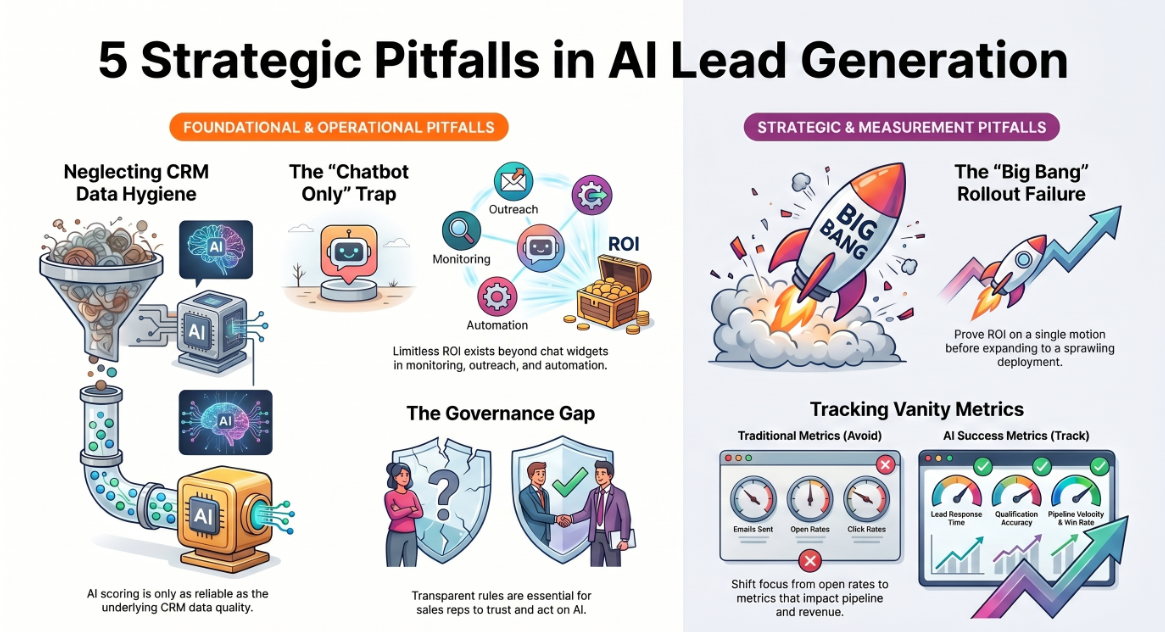
The gap between teams that see transformative ROI from AI sales agents and teams that see mediocre results almost always comes down to implementation decisions, not the technology itself.
Deploying AI on dirty CRM data. This is the most common failure mode. AI sales agents are only as good as the data they're trained and operating on. If your CRM has duplicate records, stale contacts, and inconsistent field values, the agent's scoring and routing will be unreliable from day one. Data hygiene is a prerequisite, not an afterthought.
Treating the agent as a chatbot. If the only workflow you've configured is a web chat widget that qualifies inbound queries, you're leaving 90% of the value on the table. The real leverage comes from account monitoring, signal-based outreach, pipeline surveillance, and CRM automation — none of which require a chat interface.
Skipping the governance layer. Agents without governed rules create rep distrust. If a rep can't see why a lead was scored the way it was, or can't verify what action the agent took and why, they won't act on its recommendations. Governance isn't bureaucracy — it's the mechanism that makes the agent trustworthy.
Going too broad too fast. Starting with every use case simultaneously is a predictable way to get mediocre results across all of them. The teams with the strongest outcomes typically prove ROI on one motion first — inbound qualification, renewal monitoring, or pipeline alerting — then expand. A focused deployment that delivers measurable results in four weeks beats a sprawling rollout that takes six months to show anything.
Measuring the wrong metrics. Emails sent and open rates are not the right metrics for AI sales agents. The metrics that matter are lead response time, qualification accuracy, pipeline velocity, win rate lift, and account coverage ratio. If your reporting framework doesn't track these, you're not measuring what the agent is actually doing.
Measuring ROI from Your AI Sales Agent
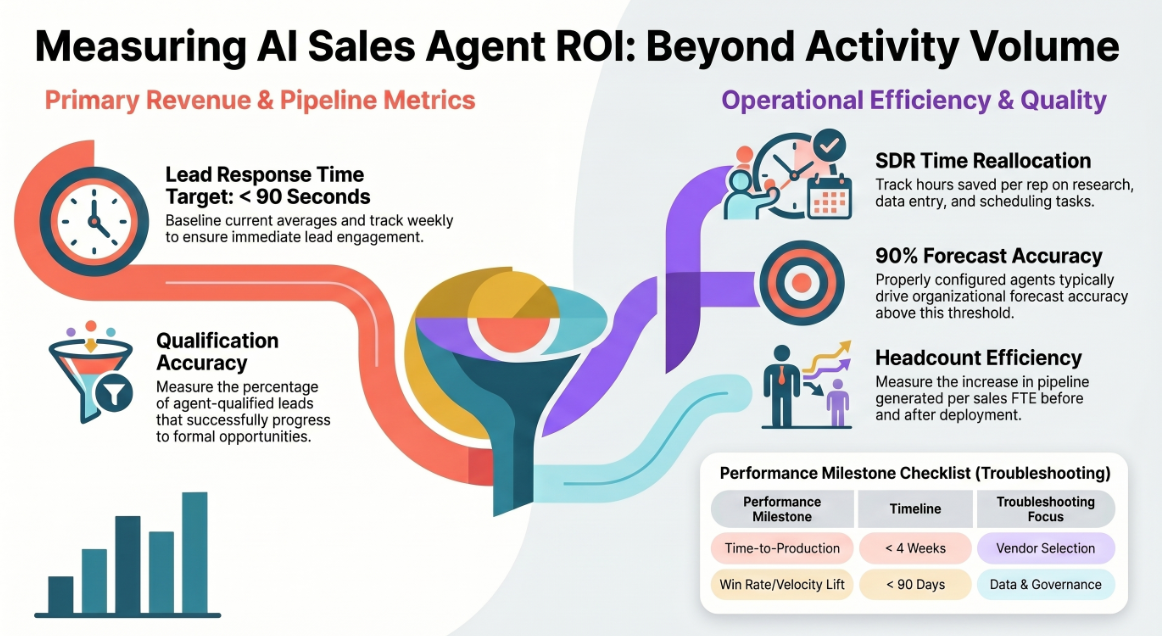
For AI lead generation to earn ongoing investment, it needs to be measured against metrics that connect directly to revenue outcomes — not just activity volume.
Primary metrics to track from day one:
- Lead response time — baseline your current average, set a target below 90 seconds, track weekly
- Qualification accuracy — what percentage of agent-qualified leads progress to opportunity? Benchmark against your historical manual rate
- Pipeline velocity — days per stage, before and after deployment
- Account coverage ratio — total accounts monitored by the agent vs total accounts in CRM
- Win rate lift — measured over rolling 90-day periods to account for deal cycle variation
- Time-to-production — if it took more than four weeks, something went wrong in vendor selection
Secondary metrics that tell a more complete story:
- CRM data quality score before and after deployment
- SDR time reallocation — hours saved per rep per week on research, data entry, and scheduling
- Forecast accuracy improvement — most organisations see this move above 90% with a properly configured forecast agent
- Headcount efficiency — pipeline generated per sales FTE, before and after
A useful rule of thumb: if your AI sales agent isn't producing a measurable win rate or velocity improvement within 90 days of going live, the problem is almost certainly in the data foundation or the governance configuration — not in the underlying technology.
The Bottom Line
AI sales agents for lead generation are no longer an experiment. Across logistics, fintech, retail, infrastructure, and professional services, enterprise teams are deploying them in production and seeing measurable pipeline outcomes within weeks — not quarters.
The shift isn't about replacing salespeople. It's about what happens when always-on signal monitoring, real-time qualification, governed outreach, and automatic CRM updates are running continuously in the background while your human team focuses on what only humans can do: building trust, navigating complexity, and closing deals.
The teams that win in 2026 aren't the ones with the most SDRs or the most tools. They're the ones that have figured out how to pair human judgment with autonomous execution — and they're doing it at a scale that wasn't operationally possible two years ago.
If you're evaluating AI-based lead generation for your organisation, the right question isn't whether to deploy an AI sales agent. It's which sales motion to start with, and how quickly you can get a governed, production-ready agent into the hands of your team.
Ready to see how an AI sales agent works for your pipeline? Explore the Sales Solution or schedule a demo to see it in production.
FAQs
What is an AI sales agent for lead generation?
An AI sales agent for lead generation is an autonomous software system that executes multi-step revenue workflows — including lead qualification, scoring, outreach, CRM updates, and opportunity monitoring — without requiring manual input for each step. Unlike chatbots or basic automation tools, it proactively acts on signals across the pipeline and operates continuously between human touchpoints.
How does an AI sales agent qualify leads?
It analyses firmographic data (industry, company size, job title, revenue), behavioural signals (email engagement, web activity, intent data), and historical conversion patterns simultaneously. Lead scores update continuously as new signals arrive. In production-grade systems, the scoring logic is explainable — the agent surfaces not just a score, but the specific factors driving it.
How is an AI sales agent different from a chatbot?
A chatbot responds to user queries reactively through a single channel. An AI sales agent proactively monitors signals across all channels, executes multi-step workflows, updates CRM records, routes leads, alerts reps, and learns from outcomes — operating autonomously across the full lead lifecycle, not just during active conversations.
Can AI sales agents replace SDRs?
Not entirely — and the best implementations aren't designed to. AI agents handle research, enrichment, scoring, CRM hygiene, follow-up consistency, and account monitoring at scale. Human reps focus on relationship-building, complex objection handling, and closing. Teams using this model consistently outperform those running either approach in isolation.
How do you use AI for B2B lead generation?
B2B AI lead generation starts with connecting the agent to your CRM and signal sources, configuring ICP and qualification criteria, and establishing governed playbooks for outreach and routing. The agent then runs continuous qualification, scoring, and follow-up workflows — surfacing the highest-probability opportunities for human reps to engage. Most enterprise teams are in production within two to four weeks.
What ROI can I expect from an AI sales agent?
Enterprise benchmarks include 35% higher close rates, 60% faster pipeline velocity, and forecast accuracy above 95%. Lead response times typically drop to under 90 seconds. Most organisations reach full ROI within six to eight weeks of production deployment, primarily through improved qualification accuracy and eliminated pipeline leakage from missed signals.
What CRMs do AI sales agents integrate with?
Production-grade AI sales agents integrate bidirectionally with Salesforce, HubSpot, Microsoft Dynamics, and other major CRM platforms. Bidirectional means the agent both reads from and writes back to the CRM automatically — updating deal stages, logging activities, enriching records, and maintaining data hygiene without manual intervention.
Is AI email lead generation legitimate?
Yes, when implemented correctly. AI-driven email outreach for lead generation is governed by the same deliverability, consent, and compliance requirements as human-driven outreach. The difference is that AI agents personalise and time messages based on real behavioural signals rather than static sequences — which generally produces higher engagement rates and fewer unsubscribes when done well.
How long does it take to deploy an AI sales agent?
A production-ready deployment typically takes two to four weeks. This includes CRM integration, scoring model configuration, playbook ingestion, governance setup, and rep-facing dashboard configuration. Be cautious of vendors quoting timelines over six weeks — that usually indicates a customisation-heavy approach rather than a platform-native deployment.
What is the best AI for B2B lead generation?
The best AI lead generation solution for B2B depends on your sales motion, CRM, and deal complexity. The key capabilities to evaluate are: explainable lead scoring, bidirectional CRM integration, governed playbook execution, multi-channel signal monitoring, and a production timeline under four weeks. For enterprise teams, agentic platforms that execute end-to-end workflows outperform point solutions focused on a single task like prospecting or email sequencing.


![Agentic AI in Finance and Accounting: The Complete Guide for CFOs and Finance Leaders [2026]](/_next/image?url=https%3A%2F%2Fcdn.prod.website-files.com%2F66fb6d6d4a496c8985f663dd%2F6a29017e5cc707b20d0b88f5_pawel-czerwinski-1A_dO4TFKgM-unsplash.jpg&w=3840&q=75)