The hospitality industry built its reputation on one promise: make every guest feel like the only guest. For decades, delivering on that promise meant adding more people — more front desk staff, more concierge hours, more reservation agents. That model is breaking.
Labor costs in hospitality rose over 11% year-on-year in 2025. Sixty-five percent of hotels reported staffing shortages. And guest expectations — shaped by AI-powered apps in every other part of their lives — have never been higher. Eighty-two percent of hotel decision-makers now plan to increase AI investment in the next twelve months, according to Canary Technologies' 2026 industry survey.
The answer is not another chatbot. The answer is AI agents.
This guide breaks down 25 specific, production-tested AI agent use cases that hospitality operators are deploying right now — across hotels, luxury lodges, resorts, driving institutes, real estate portfolios, and hospitality-adjacent businesses. Each use case is drawn from real deployments. Where results are cited, they reflect outcomes from live production environments, not simulations.
If you are a hotel general manager, operations director, hospitality technology leader, or investor evaluating where AI delivers measurable returns — this is the resource built for you.
What Is an AI Agent in Hospitality — And Why It Is Not a Chatbot
Before diving into use cases, this distinction matters enormously. Most "AI in hospitality" content conflates chatbots with AI agents. They are fundamentally different things.
A chatbot is reactive. It waits for a question, matches it to a script, and returns a response. It does not read live data. It cannot take actions in other systems. It forgets the conversation the moment it ends.
An AI agent is autonomous. It reads live data from your property management system, CRM, booking engine, and IoT devices. It reasons about what it finds. It takes actions — creating bookings, routing complaints, adjusting schedules, generating reports — and logs everything in a governed audit trail. It works across voice, chat, WhatsApp, and email simultaneously, without switching context.
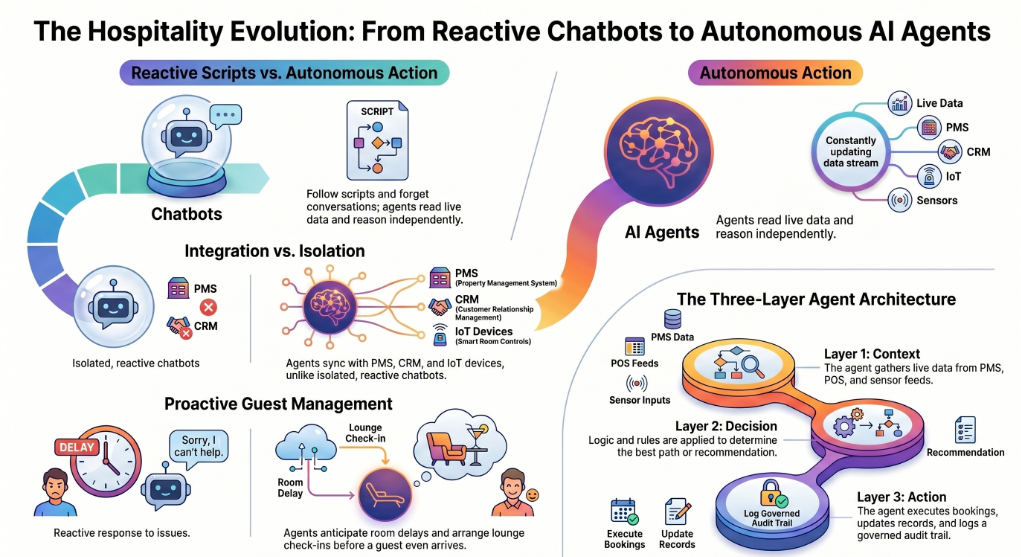
The architecture of an AI agent in hospitality follows three layers:
Context: The agent reads live data from connected systems — your PMS, POS, CRM, sensor feeds, and unstructured documents like SOPs and booking emails.
Decision: The agent applies rules, reasoning, and learned patterns to determine the right action, escalation path, or recommendation.
Action: The agent executes — creates the booking, sends the notification, flags the anomaly, updates the record — and logs the action for review.
This is why AI agents deliver results that chatbots cannot. A chatbot tells a guest the check-in time. An AI agent checks the guest's loyalty tier, sees they booked a suite, notices the room will not be ready on arrival, proactively messages the guest, arranges an early lounge check-in, and updates the front desk — all before the guest lands.
The use cases below are organized across five operational areas. Together they represent the full surface area where AI agents are driving measurable change in hospitality today.
The 25 AI Agent Use Cases in the Hospitality Industry
Guest Experience and Communication
1. Automated Luxury Booking Agent
For high-end lodges, safari camps, and boutique hotels, the booking process is not a transaction — it is the beginning of the experience. Guests email with complex, open-ended requests. They ask about specific wildlife sightings, dietary restrictions for bush dinners, accessibility requirements for elderly travellers, and preferred guide assignments.
Handling this manually requires multiple back-and-forth exchanges across days. An AI booking agent handles the entire intake: it classifies the request, extracts every detail, checks real-time inventory, negotiates alternative dates when the preferred property is full, and generates a professional itinerary PDF with a draft invoice — all without human involvement until the final quality check.
One luxury safari operator with sixteen properties across two countries deployed exactly this model. The result was a measurable reduction in booking turnaround time, fewer back-and-forth exchanges per inquiry, and the ability to scale reservation volume without adding headcount — while maintaining the standard of service their guests expect.
This is the clearest proof that AI agents in hospitality are not about reducing quality. They are about making quality scalable.
2. 24/7 Multilingual Guest Support Agent
A guest messages at 2 AM asking about early checkout options. Another sends a WhatsApp message in French asking about the breakfast menu. A third calls the front desk in Arabic wanting to extend their stay by one night. In each case, your team is either asleep, busy with other guests, or does not have a speaker of that language on shift.
An AI support agent handles all three simultaneously, in the correct language, with access to live booking data, property policies, and room availability. It resolves what it can. It escalates what it cannot. It never has an off night.
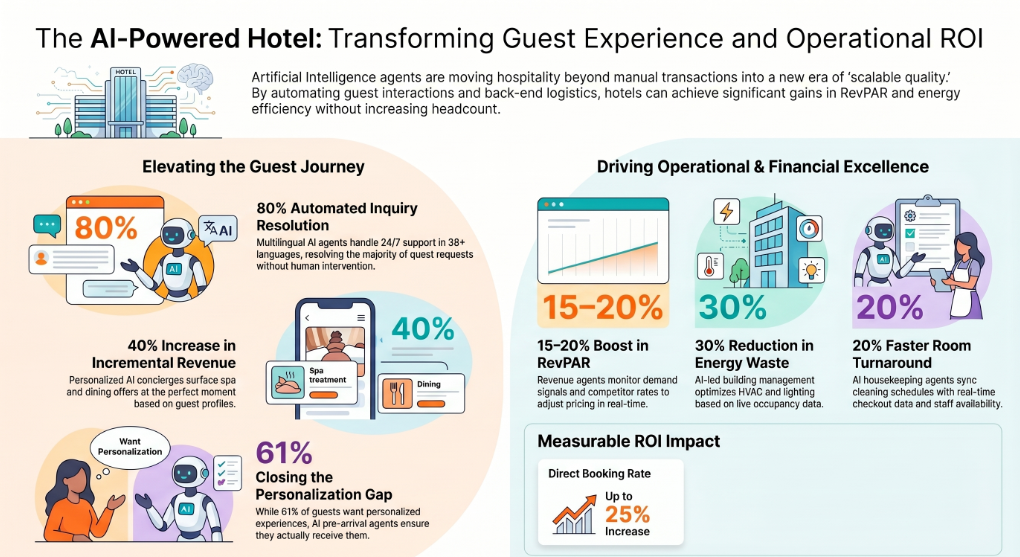
Industry benchmarks show AI guest messaging agents resolving up to 80% of inbound inquiries without any human involvement, across 38 or more languages.
3. AI Concierge for In-Stay Recommendations and Upsells
Once a guest checks in, the opportunity for personalized service — and incremental revenue — is significant. An AI concierge agent reads the guest's profile, booking history, dietary notes, and stated preferences, then surfaces relevant recommendations: a spa treatment timed to a quiet afternoon slot, a sunset dining reservation at a property restaurant, a guided excursion matched to their interests.
The difference from a standard upsell prompt is context. The recommendation arrives at the right moment, through the right channel, personalized to what the agent already knows about that guest. Hotels using AI-driven personalization report that targeted offers now account for up to 40% of incremental revenue, according to McKinsey research.
4. Pre-Arrival Personalization Agent
The seventy-two hours before arrival are when most hotels miss their biggest personalization window. Guests have confirmed their booking but have not yet arrived — and most properties send nothing more than a generic confirmation reminder.
An AI pre-arrival agent does significantly more. It reviews the guest's profile, identifies upgrade opportunities, sends a welcome message in the guest's preferred language, confirms dietary requirements, and offers pre-booking for spa, dining, or activities. It also notifies the operations team of any special requests requiring preparation.
This closes the gap that the data confirms exists: 61% of guests say they would pay more for genuinely personalized experiences, but only 23% receive meaningful personalization on arrival, according to Medallia's hospitality research. The pre-arrival agent is where that gap closes.
5. Post-Stay Feedback and Loyalty Agent
The relationship with a guest does not end at checkout. An AI post-stay agent sends personalized follow-up messages, requests feedback through the guest's preferred channel, monitors the response for sentiment, and escalates negative feedback to the relevant manager before it becomes a public review.
For loyalty program members, the agent updates their tier status, applies earned points, and surfaces a relevant returning-guest offer based on their most recent stay profile — automating a workflow that most properties currently handle manually or not at all.
Booking, Revenue and Pricing
6. Dynamic Pricing and Revenue Management Agent
Revenue management has always been about reading demand signals faster than your competitors. AI agents do this continuously, without fatigue. A revenue management agent monitors booking pace, competitor rates, local event calendars, weather patterns, and historical demand curves — then adjusts room rates and inventory controls in real time.
Hotels using AI-driven revenue management systems report an average 15 to 20% increase in RevPAR (revenue per available room), according to 2025 industry research. The agent does not just set prices — it explains its decisions, flags unusual demand shifts, and alerts the revenue manager when human review is warranted.
7. Direct Booking Conversion Agent
The cost of OTA dependence is well understood: commissions of 15 to 25% on every booking routed through a third-party platform. An AI direct booking conversion agent engages website visitors in real time, surfaces relevant offers, answers questions that would otherwise send a visitor to a booking engine, and guides them through the direct booking process.
Hospitality data shows AI booking agents can raise direct booking rates by up to 25%, according to industry case studies — reducing OTA commission dependency while simultaneously improving the guest's booking experience.
8. Upsell and Cross-Sell Orchestration Agent
Upselling in hospitality is not about pushing offers. It is about timing. An AI agent monitors the guest journey and surfaces the right offer at the right moment — a room upgrade when a superior room becomes available the day before arrival, a spa package when the guest mentions relaxation in a chat message, a dining reservation when their itinerary shows a free evening.
The agent handles the entire workflow: identifies the opportunity, personalizes the message, processes the acceptance, updates the booking record, and notifies the relevant department for fulfillment.
9. Demand Forecasting and Occupancy Analytics Agent
Staffing, food and beverage purchasing, housekeeping scheduling, and energy consumption all depend on accurate occupancy forecasting. An AI agent ingests historical booking data, current pace, event calendars, and seasonal patterns to produce granular forecasts — broken down by room type, segment, and date.
Operations teams receive daily briefings with variance explanations when the forecast changes significantly. The result is fewer surprises, better resource allocation, and reduced waste across every cost line affected by occupancy.
10. Competitive Monitoring Agent
One of the highest-friction workflows in hospitality revenue management is manual competitor monitoring — checking OTA listings, scanning for pricing changes, tracking promotional activity. A competitive monitoring agent does this continuously and automatically.
One operator deployed this agent to track competitor pricing, promotional discounts, MRP changes, and availability signals across multiple portals — replacing a manual process that previously required daily staff time. The result: always-on monitoring, faster competitive response cycles, and earlier identification of pricing gaps that would otherwise have cost revenue.
Operations and Back Office
11. Tender and Document Processing Agent
For hotel groups and hospitality businesses that regularly respond to procurement tenders, RFPs, or supplier proposals, the document processing workload is significant. Tenders arrive as complex PDFs with multiple sections, revision histories, and cross-references. Processing them manually is slow, error-prone, and creates bid risk when changes are missed.
A document processing agent ingests tender documents automatically, classifies the content, extracts all relevant fields using vision-capable AI, detects revisions against previous versions, and synchronizes extracted data into core operational systems — with a full audit log of every action.
One construction and remediation specialist with complex, multi-document tender environments deployed this model and achieved a target extraction accuracy of approximately 95% on standard formats, with approximately 90% faster processing time compared to their manual workflow. The same architecture applies directly to hospitality procurement and supplier management.
12. Predictive Maintenance and Energy Management Agent
Hotels and resorts are large, complex physical environments. HVAC failures, pool equipment breakdowns, lift outages, and kitchen appliance failures all create guest experience problems — and most of them are predictable if you have the right data.
An AI maintenance agent connects to IoT sensors, smart meters, and equipment monitoring systems. It detects anomalies in real time, compares patterns against failure histories, and dispatches a maintenance alert before the failure occurs. It also schedules preventive maintenance during low-occupancy windows to minimize guest impact.
On the energy side, the same agent monitors consumption patterns across the property, identifies inefficiency spikes, and optimizes HVAC, lighting, and hot water systems based on occupancy data. AI-led building management systems can cut energy waste by 30% or more, according to the UK Green Building Council. One campus-scale operator deployed energy management agents across multiple sites and achieved improved energy visibility alongside faster detection of inefficiencies — with proactive alerts replacing a previously reactive monitoring process.
13. Housekeeping and Room Operations Agent
Housekeeping is one of the highest-cost, highest-coordination workload areas in hospitality. Room assignments change with early arrivals and late checkouts. Staff availability fluctuates. VIP rooms require different preparation sequences. Managing this in real time is a constant operational challenge.
An AI housekeeping agent syncs room-cleaning schedules with live checkout data, guest preferences, staff rosters, and room priority rules. It pushes updated task lists to housekeeping staff via mobile, tracks completion in real time, and alerts supervisors when a room will miss its target time. One major hotel brand implemented this model and reduced room turnaround time by 20%, according to published BCG research.
14. Procurement and Vendor Management Agent
Hospitality businesses purchase continuously: food and beverage inventory, linens, consumables, equipment, and contracted services. Managing vendor relationships, tracking pricing trends, and ensuring delivery performance is a back-office burden that rarely gets the analytical attention it deserves.
A procurement agent automates RFQ generation, matches requirements to qualified supplier lists, tracks quote responses, and surfaces pricing and lead-time comparisons. It monitors vendor delivery performance and flags deteriorating supplier metrics before they create operational problems. One operator using this model reported faster procurement cycles, reduced manual follow-up effort, and measurably better price competitiveness through continuous market visibility.
15. Inventory and Stock Management Agent
Whether it is F&B stock for a resort restaurant, amenity supplies for guest rooms, or linen inventory for a conference hotel, inventory management in hospitality is complex and often manual. An AI inventory agent connects to POS systems and supply chain data, forecasts consumption based on occupancy and event schedules, triggers replenishment orders at optimal levels, and flags anomalies — shrinkage, unusual usage spikes, supplier shortages — in real time.
The result is fewer stockouts, less overstocking, reduced food waste, and a procurement team that spends less time chasing supplies.
16. Compliance and Governance Agent
Every action taken by every agent in a deployed AI environment should be logged, explainable, and auditable. A governance agent sits across all other workflows, maintaining complete records of what each agent did, why it did it, and what the outcome was. It enforces escalation rules — ensuring that decisions outside defined parameters always reach a human. It produces compliance reports on demand.
This is particularly important in hospitality environments where GDPR, data residency, and PCI compliance are non-negotiable. Governed AI is not a constraint on value — it is what makes enterprise-scale deployment possible.
Staff, HR and Internal Operations
17. Workforce Scheduling and Utilisation Agent
Matching staff hours to demand is one of the most operationally complex problems in hospitality. Overstaffing costs money. Understaffing damages the guest experience. Both are common because most scheduling is done manually against historical patterns that do not reflect real-time demand signals.
An AI workforce agent ingests forecasted occupancy, live booking data, event schedules, and labour cost targets, then generates optimised shift schedules — balanced against staff contracts, availability, and skill requirements. It tracks utilisation in real time, flags gaps, and suggests reallocation when demand shifts. One operator deploying this model reported better workforce utilisation and faster fill cycles — with scheduling friction measurably reduced.
18. Internal Knowledge and Training Agent
Every hospitality business has an enormous volume of operational knowledge that is either stored in documents nobody reads, held in the heads of experienced staff, or lost when people leave. SOPs, brand standards, equipment manuals, POS guides, compliance procedures — all critical, rarely accessible in the moment.
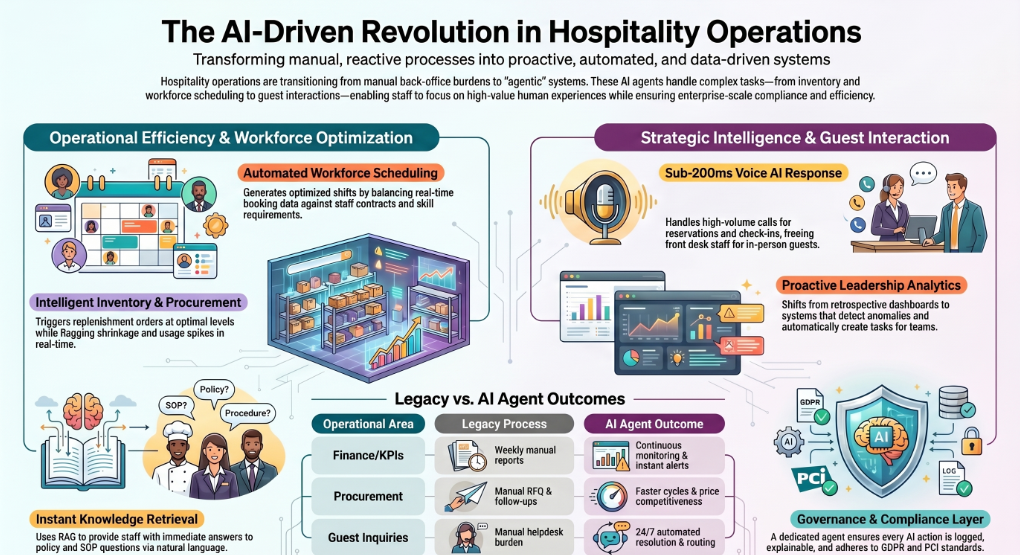
An AI knowledge agent uses retrieval-augmented generation (RAG) to make all of this searchable through natural language. A new front desk team member asks: "What is our late checkout policy for loyalty members?" They get the answer in seconds, sourced from the relevant SOP, without calling a manager. One retail operator deploying this model reported faster staff onboarding and measurably reduced dependence on supervisors for routine procedural questions — a model that translates directly to hotel operations.
19. Finance and Procurement KPI Alert Agent
For multi-property hotel groups, keeping a real-time view across entity-level financial performance is operationally difficult. Purchase price trends, gross margin impacts, vendor performance, early payment discount opportunities, and working capital positions all require continuous monitoring — typically done through weekly manual reports that arrive too late to act on.
An AI alert agent monitors these KPIs continuously across all entities, applies threshold rules, and sends automated alerts to the right leadership stakeholders the moment an exception arises. One operator group deployed this across multiple business units and achieved earlier detection of margin erosion, more consistent finance intelligence across entities, and reduced variance surprises through continuous monitoring rather than weekly review cycles.
20. Multi-Property Analytics and Reporting Agent
Hotel groups with multiple properties face a consistent reporting problem: each property produces its own data in its own format, making group-level visibility fragmented and slow. A consolidation analytics agent standardises KPI definitions across entities, ingests data from each property's systems, and produces a unified operational view available in real time.
Leadership receives automated daily briefings with variance explanations. Anomalies across any property trigger immediate alerts. The shift from weekly retrospective reporting to continuous, proactive visibility is one of the clearest operational improvements AI agents deliver in multi-property environments.
Luxury, Niche and Advanced Use Cases
21. Agentic Travel Itinerary Builder
For luxury travel operators, the itinerary creation process is where the brand lives. It requires deep knowledge of properties, availability, local experiences, and guest preferences — and it currently demands significant human expert time. An agentic itinerary builder handles the intake layer: it runs a conversational loop with the guest to capture all preferences, checks availability across properties in real time, builds a draft itinerary, and hands off to a human curator for final personalisation.
The human expert spends their time on the creative and relational elements that require genuine expertise. The agent handles the data-heavy intake and availability checking that previously consumed hours. This is the human-in-the-loop model that allows luxury hospitality to scale without compromising the quality of the curated experience.
22. Real Estate and Property Tenant Support Agent
For hospitality businesses that manage residential or commercial properties alongside their hotel portfolio — or for real estate groups adjacent to hospitality — tenant and customer service operations share many of the same challenges: high inquiry volume, repetitive workflows, inconsistent response times, and difficulty maintaining service quality across a distributed portfolio.
An AI customer service agent handles tenant queries across web, WhatsApp, and email: rental inquiries, payment questions, maintenance requests, policy FAQs. It triages requests, automates responses for standard queries, routes complex cases to human teams, and tracks every ticket through to resolution. One real estate operator deploying this model achieved consistent 24/7 tenant experience, measurably faster response times, and better SLA adherence through automated routing — replacing a manual process that was creating service bottlenecks at scale.
23. Voice AI for Front Desk and Reservations
Inbound phone calls remain one of the highest-volume, highest-cost service channels in hospitality. Calls about check-in times, parking, restaurant reservations, late checkout, and room service represent the majority of front desk volume — and they require a human to answer every single one.
A voice AI agent handles these calls with sub-200ms response latency, natural conversational flow, and access to live reservation data. It resolves what it can in the call. It transfers to a human when the situation requires it. It operates in multiple languages. One operator deploying a voice AI model in Hindi and English reported a measurable reduction in manual helpdesk burden — with the front desk team reallocated to higher-value in-person guest interactions.
24. Operational Analytics Agent for Customer Experience Optimisation
For hospitality businesses with complex customer journeys — multi-stage enrolment, lesson or activity booking, instructor scheduling, test or certification workflows — tracking where customers drop off, where operational bottlenecks occur, and where revenue leakage happens requires continuous analytics visibility.
An operational analytics agent ingests funnel data across every stage of the customer journey, produces visualisations of conversion and drop-off patterns, monitors instructor or resource utilisation, and alerts operations leaders when metrics deviate from targets. One operator in the driving and training sector deployed this model and achieved reduced scheduling bottlenecks, better visibility into conversion drivers, and improved operational efficiency across multi-branch operations.
25. Agentic Data Analytics Layer for Leadership Decision-Making
The final — and arguably most transformative — use case is not a point solution. It is an architectural shift in how leadership accesses and acts on business intelligence.
Most hospitality businesses have dashboards. What they lack is the ability to ask a question in plain language and get a governed, accurate, auditable answer — without waiting for the analytics team to run a report.
An agentic analytics layer sits on top of existing data infrastructure. It applies a semantic governance layer — consistent definitions, approved formulas, business hierarchies — so that every answer means the same thing to every stakeholder. Leaders query it in natural language: "What was our average RevPAR across properties last week compared to the same week last year?" The agent retrieves the data, applies the right logic, and returns the answer with a full explanation of its sources.
More importantly, it acts on what it finds. Anomaly detected → alert generated → task created → team notified. This is the shift from reactive reporting to proactive execution that defines the most advanced AI deployments in hospitality today. One multi-entity operator deploying this architecture described the outcome as standardised decision logic across teams, automated task creation and completion tracking, and a fundamental shift from dashboards that inform to systems that act.
Real-World Results: What AI Agents Deliver in Hospitality
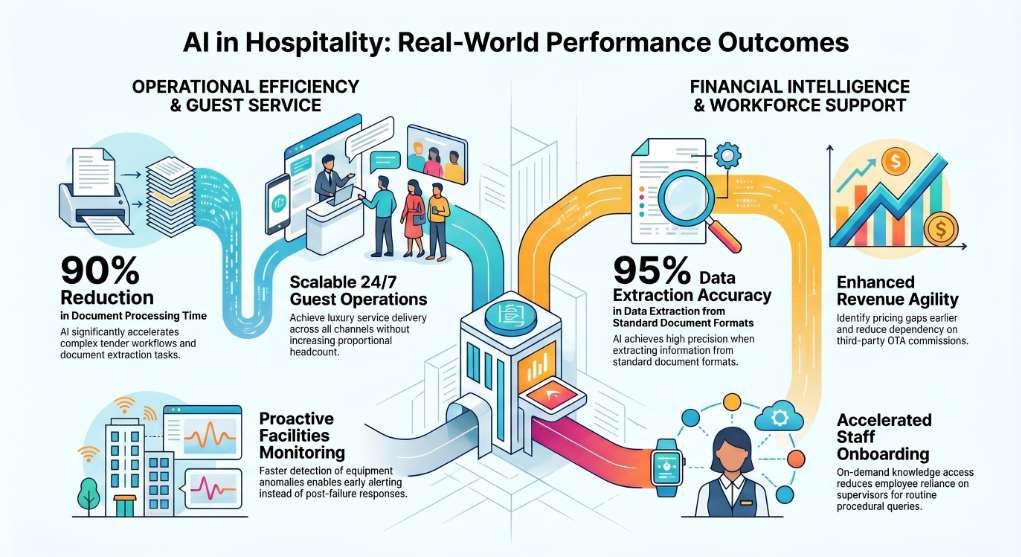
The following outcomes are drawn from real deployments across hospitality, real estate, and adjacent industries. No results are extrapolated or hypothetical.
Booking and guest operations: Faster booking turnaround with fewer exchange cycles. Scalable luxury service delivery without proportional headcount growth. Consistent 24/7 guest experience across channels.
Revenue and pricing: Earlier identification of pricing gaps and competitive shifts. Always-on market monitoring replacing manual portal checks. Improved direct booking conversion with reduced OTA commission dependency.
Back-office and operations: Approximately 90% reduction in document processing time for complex tender workflows. Extraction accuracy targets of approximately 95% for standard document formats. Shift from reactive reporting to continuous, proactive operational monitoring.
Energy and facilities: Improved energy visibility across campus-scale and multi-site operations. Faster detection of inefficiencies and equipment anomalies. More predictable operations through early alerting rather than post-failure response.
Staff and leadership: Faster staff onboarding through on-demand knowledge access. Reduced dependence on supervisors for routine procedural queries. Standardised decision intelligence across multi-property leadership teams.
AI Agents vs. Chatbots: What Hospitality Operators Actually Need in 2026
The table below captures the practical difference between deploying a chatbot and deploying a true AI agent in a hospitality environment:
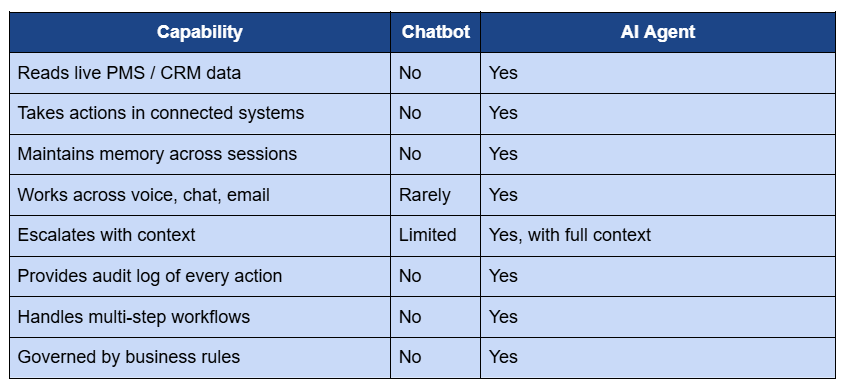
The hospitality industry spent a decade deploying chatbots. The ones still in production handle FAQs about parking and breakfast times. They create guest frustration when anything outside their script arises. The operators pulling ahead in 2026 have moved past the chatbot era entirely and are deploying agents that perceive, reason, and act.
How to Implement AI Agents in a Hotel or Hospitality Business
Deployment does not require ripping out your existing technology stack. The most effective hospitality AI implementations layer agents on top of current infrastructure — connecting to the PMS, CRM, and POS systems already in place.
Start with one high-volume pain point. The booking intake process, inbound guest messaging, or competitor pricing monitoring are all strong candidates because they have clear, measurable baselines. Improvement is visible and quantifiable within weeks.
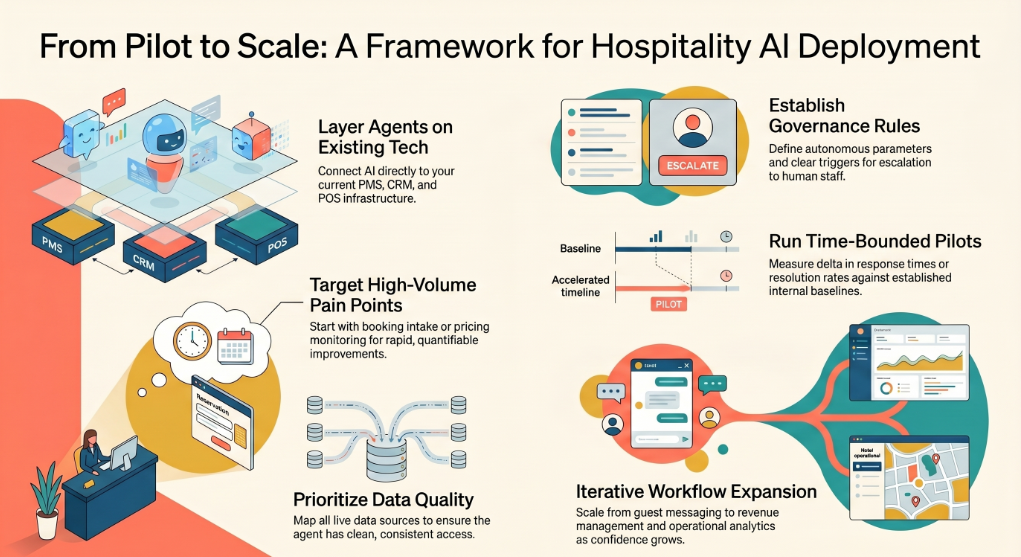
Connect to your live data sources. An agent is only as good as the data it can read. Before deployment, map which systems hold which data, and ensure the agent has clean, consistent access. Data quality is a precondition, not an afterthought.
Define your governance rules. Every agent should operate within defined parameters — actions it can take autonomously, thresholds that trigger escalation to a human, and a complete audit trail of every decision. This is what separates enterprise-grade AI deployment from experimental pilots.
Run a time-bounded pilot with clear metrics. Choose one outcome to measure — booking response time, agent resolution rate, competitor monitoring frequency. Establish the baseline. Run the pilot. Measure the delta. This produces the internal case for expansion.
Expand across workflows as confidence builds. Operators who start with guest messaging often expand to revenue management, then operational analytics, then document processing. Each deployment builds organisational familiarity with governed AI — reducing the internal friction that slows subsequent rollouts.
Conclusion
The hospitality industry is not short of technology. It is short of technology that acts — that reads live data, makes decisions, executes across systems, and learns from outcomes. That is what AI agents deliver.
The 25 use cases above cover the full range of what is deployable today: from the booking agent that handles complex luxury itinerary requests end-to-end, to the governance agent that ensures every automated decision is logged, explainable, and auditable. From the voice agent that answers inbound calls in multiple languages, to the multi-property analytics layer that tells leadership what is happening across their entire portfolio in real time.
The operators moving fastest are not waiting for perfect conditions. They are identifying one high-volume pain point, deploying a governed agent, measuring the outcome, and expanding from there. In twelve to eighteen months, the gap between those who have started and those who have not will be significant and difficult to close.
The question is not whether AI agents belong in hospitality. The results answer that. The question is where you start.
Why Assistents.ai
Most AI vendors will sell you a chatbot and call it an agent. A few will build you something genuinely agentic but hand you a complex system your team cannot operate or explain to leadership.
Assistents.ai sits in a different place. The platform is built specifically for businesses that need AI agents to work inside real operational environments — connecting to the systems already in use, operating within governance rules that make every action auditable, and deploying in weeks rather than quarters.
The case studies in this article are not curated exceptions. They reflect a consistent delivery pattern across industries as demanding as global logistics, enterprise retail, and luxury safari hospitality — where the margin for error is low and the expectation of quality is non-negotiable.
What that means practically: when a luxury lodge deploys an automated booking agent, it cannot afford a system that hallucinates availability or misroutes a high-value guest inquiry. When a multi-property group deploys a competitive monitoring agent, it needs answers that are governed, accurate, and explainable to leadership — not a black box.
That is the standard Assistents.ai is built to.
If you are evaluating AI agents for your hospitality or real estate operation — or simply trying to understand what a production deployment actually looks like — the clearest next step is to see one.
[Explore AI agents for hospitality → assistents.ai/solutions/real-estate]
Frequently Asked Questions
What is an AI agent in the hospitality industry?
An AI agent in hospitality is an autonomous system that reads live data from hotel systems — including PMS, CRM, POS, and IoT devices — reasons about what it finds, and takes actions such as creating bookings, routing complaints, adjusting pricing, or generating reports. Unlike chatbots, AI agents work across multiple systems simultaneously, maintain memory across interactions, and operate within defined governance rules.
How are hotels using AI agents in 2026?
Hotels are deploying AI agents across guest communication, dynamic pricing, predictive maintenance, booking automation, workforce scheduling, competitor monitoring, and leadership analytics. The most advanced operators have moved beyond single-point deployments and are running interconnected agent networks that cover the full guest journey and back-office operations.
What is the difference between a hotel chatbot and an AI agent?
A chatbot is reactive — it answers predefined questions. An AI agent is autonomous — it reads live data, reasons about context, takes multi-step actions across connected systems, and escalates exceptions within a governed workflow. The functional gap between the two is significant, and the operational outcomes are not comparable.
Can AI agents replace hotel staff?
No. AI agents handle high-volume, repetitive, and data-intensive tasks — freeing staff to focus on the high-touch, emotionally intelligent interactions that define exceptional hospitality. The goal is augmentation: staff who are supported by agents consistently deliver better guest experiences than staff who are buried in administrative tasks.
What results do AI agents deliver in hospitality?
Measurable outcomes include faster booking turnaround, always-on competitive monitoring replacing manual checks, reduced document processing time, earlier detection of operational anomalies, improved revenue visibility, and scalable service delivery without proportional headcount growth.
What systems do hospitality AI agents integrate with?
AI agents connect to property management systems (PMS), CRM platforms, point-of-sale systems (POS), booking engines, channel managers, WhatsApp Business, email servers, IoT sensor networks, energy management systems, and enterprise data warehouses. Most effective deployments layer on top of existing infrastructure rather than replacing it.
How long does it take to deploy an AI agent in a hotel?
Deployment timelines vary by scope and complexity. Single-workflow deployments — such as a guest messaging agent or a competitor monitoring agent — can go live in weeks. Multi-workflow, multi-system deployments with governance layers typically take two to three months from scoping to production.
What is the market size of AI in hospitality?
The global AI in hospitality market was valued at approximately $894 million in 2024 and is forecast to exceed $5 billion by 2034, representing an annual growth rate of approximately 19%, according to industry analysts. Adoption is accelerating fastest in luxury and full-service segments.