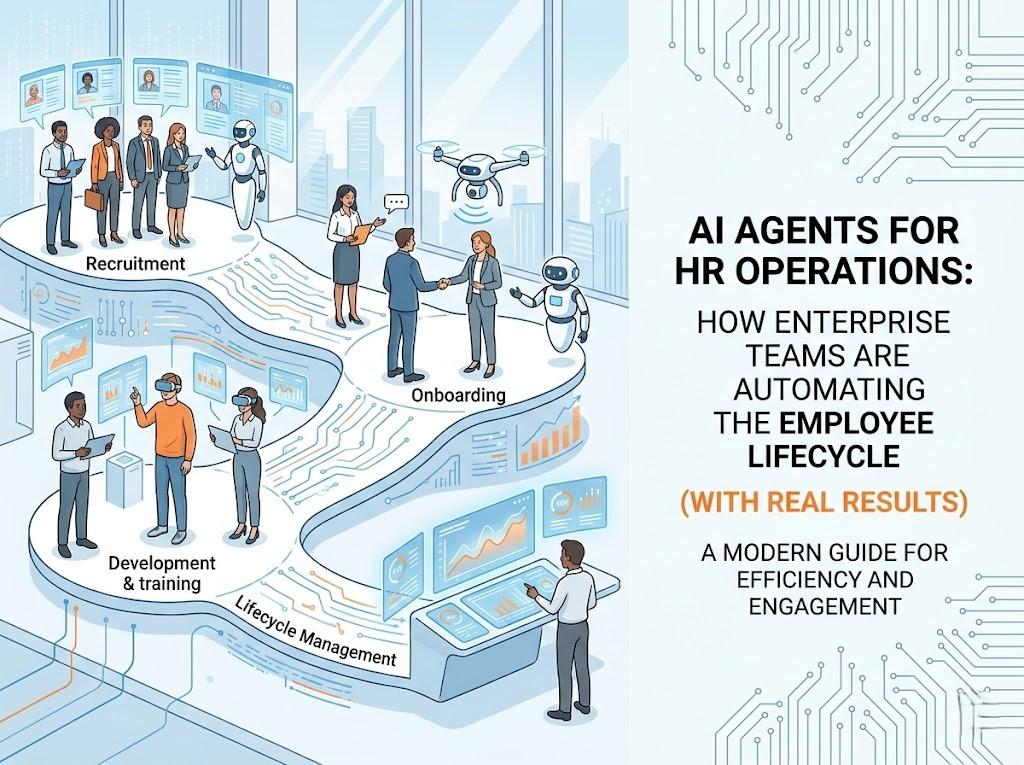
Every week, HR teams lose the equivalent of a full workday to tasks that should never reach a human desk — answering the same benefits question for the fifteenth time, chasing a manager for an onboarding signature, manually reconciling leave balances across two systems that don't talk to each other.
This is not a people problem. It is an architecture problem. And AI agents for HR operations are solving it at enterprise scale.
This guide covers what AI agents actually do inside HR functions, where they deliver measurable outcomes, how they connect to your existing systems, and what real-world deployments look like across sectors — from large-scale retail to global healthcare staffing to multi-entity logistics operations.
What Are AI Agents for HR Operations?
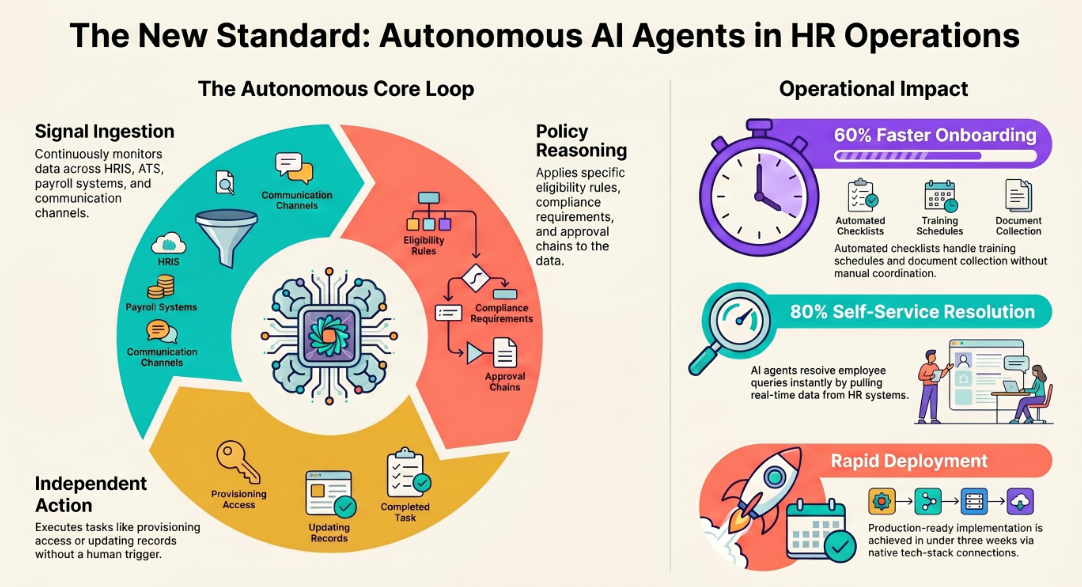
An AI agent for HR operations is an autonomous software system that perceives data across your HR environment, makes decisions within defined rules and policies, and takes action — without requiring a human to trigger each step.
This is meaningfully different from a chatbot or an automation rule. A chatbot waits for a question. A rule fires when a condition is met. An AI agent monitors continuously, reasons through what needs to happen, and executes across multiple systems to get it done.
The core loop looks like this: the agent ingests signals from your HRIS, ATS, payroll system, and employee communication channels. It applies your policy logic — eligibility rules, approval chains, compliance requirements — and then acts: provisioning access, routing a ticket, updating a record, sending a notification, or escalating to a human when judgment is required.
In practice, this means:
- A new hire's onboarding checklist runs itself — access provisioned, training scheduled, documents collected, manager notified of gaps — without a coordinator manually managing each task.
- An employee asks about their PTO balance in plain language. The agent pulls real-time data from the HRIS and responds accurately, instantly, in any channel.
- A compliance deadline approaches for mandatory training completion. The agent identifies who hasn't completed it, sends reminders, logs outcomes, and surfaces a report for HR leadership — automatically.
Organisations deploying enterprise-grade AI agents for HR operations are reporting 60% faster onboarding cycles and 80% self-service resolution rates on employee queries. Implementation timelines at production-ready scale run under three weeks when the platform connects natively to your existing HR tech stack.
Why Traditional HR Automation Falls Short
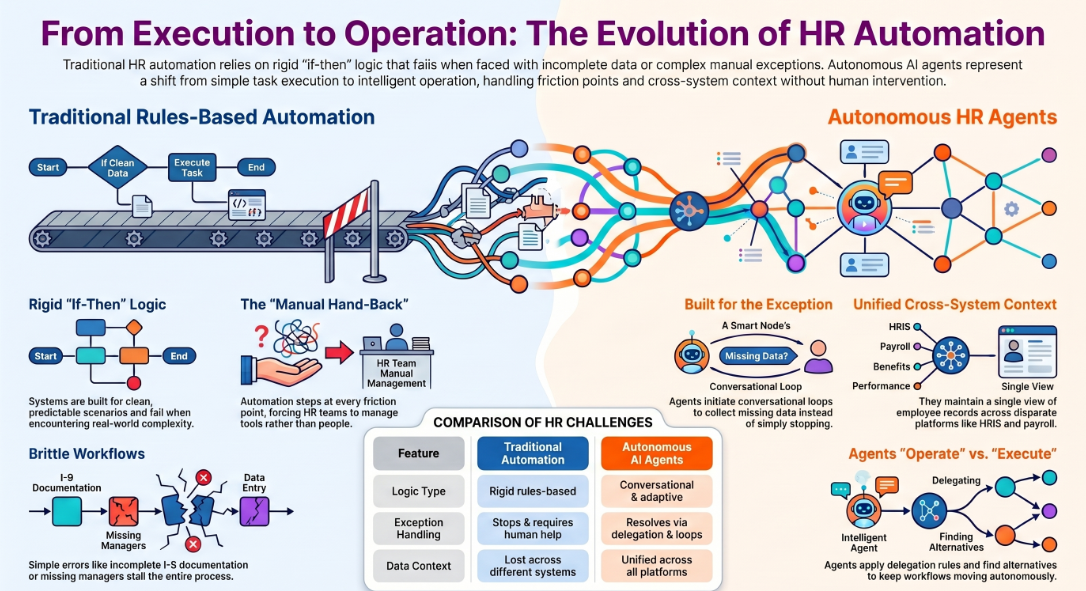
Most HR automation tools were built around a simple premise: if this happens, do that. A new hire record is created → send a welcome email. A leave request is submitted → notify the manager.
Rules-based automation handles clean, predictable scenarios. But HR work is almost never clean.
The new hire's I-9 documentation arrives incomplete. The manager approving the leave request is herself on leave. A payroll discrepancy spans two pay periods and involves both the HRIS and the payroll system, which store the data differently. A benefits enrollment window opens, but 40% of employees have outdated bank details that need verification before contributions can process.
At every one of these friction points, traditional automation stops and hands the problem back to a human. The operational drag compounds across thousands of employees and hundreds of workflows. HR teams end up spending more time managing their tools than doing HR.
AI agents are built for the exception, not just the rule. They do not break when a field is missing — they initiate a conversational loop to collect it. They do not stall when an approval is unavailable — they apply the delegation rules, find the next-in-chain, and proceed. They do not lose context across systems — they maintain a unified view of the employee record across every platform they are connected to.
This is the distinction that matters. Automation executes. Agents operate.
Core Use Cases: Where AI Agents Deliver in HR Operations
Employee Onboarding Automation
Onboarding is the highest-visibility, highest-failure-rate process in most HR functions. The experience a new hire has in their first two weeks shapes retention trajectories for months. Yet it is almost entirely dependent on manual coordination across IT, HR, facilities, payroll, and the hiring manager.
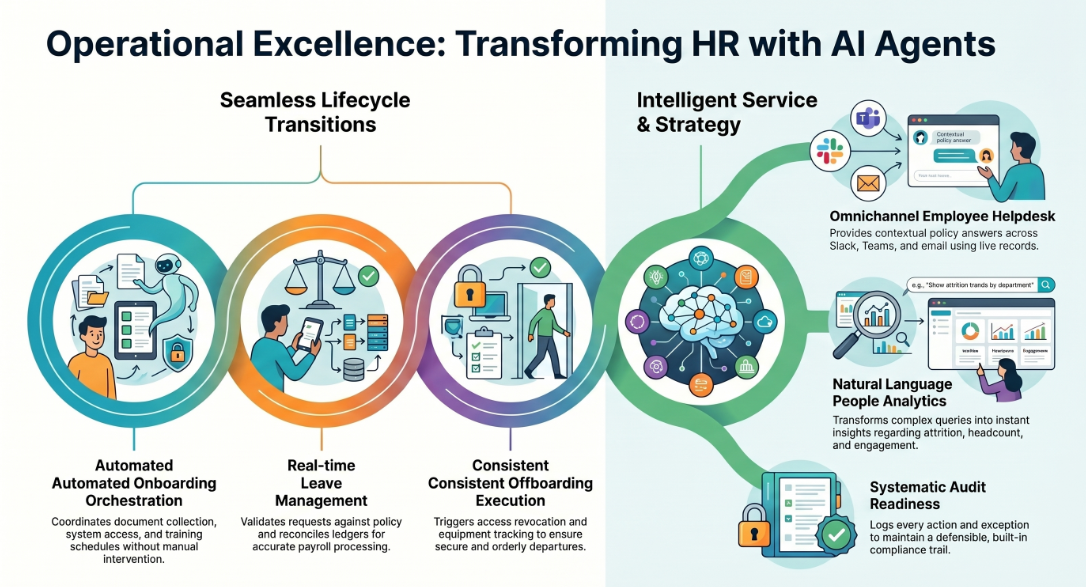
An AI onboarding agent orchestrates the full sequence: document collection with automated follow-up on missing items, system access provisioning tied to role and department, training scheduling based on the new hire's start date and function, policy acknowledgement tracking, and 30/60/90-day check-in scheduling. Each step is logged. Exceptions are surfaced. Nothing falls through.
The agent does not replace the human moment — the manager's first conversation, the team introduction — it handles everything around it so that moment can happen without operational chaos behind it.
Benefits Administration and Employee Self-Service
Benefits questions are the single highest-volume category of HR enquiries in most organisations. What is my current health plan? How much PTO do I have left? Can I change my 401k contribution mid-year? What is the deadline for open enrollment?
Each question is individually simple. Collectively, they consume enormous HR capacity — and when answered incorrectly, create compliance exposure.
An AI agent connected to your HRIS answers these questions accurately, in real time, across any channel an employee is working in — Slack, Teams, email, a web portal, or a voice interface. It pulls live data from the source of record rather than static knowledge base articles. It applies eligibility rules automatically. And it handles escalations with full context passed to the human agent, so the employee never has to repeat themselves.
HR Helpdesk and Policy Q&A
Beyond benefits, HR helpdesks field constant requests: how do I update my emergency contact? What is the parental leave policy? How do I submit an expense? Where do I find the performance review template?
An HR helpdesk agent handles these across the employee lifecycle, drawing on a governed knowledge base built from your policy documents, SOPs, employee handbooks, and HRIS records. It understands context — knowing whether the employee asking about parental leave is in the UK or the US, and applying the correct policy — and escalates cases that require human judgment with a full summary already written.
Deployments of omnichannel HR helpdesk agents across large organisations have reduced manual helpdesk burden significantly while improving response consistency and maintaining full audit trails on every interaction.
Leave and Attendance Management
Leave management is one of the most administratively intensive HR functions, particularly in organisations with distributed workforces, multiple entity structures, or complex shift-based scheduling.
An AI agent for leave management monitors real-time attendance data, identifies patterns — unexpected absences, schedule gaps, overtime risk — and triggers the right workflow. It validates leave requests against policy and available balance before routing for approval. It flags conflicts in advance rather than surfacing them after the fact. It posts a verified, reconciled ledger to payroll ahead of every run, reducing disputes and eliminating manual reconciliation.
Workforce Analytics and People Intelligence
HR leaders increasingly need data-backed answers to strategic questions: where are we at risk of attrition? What is our headcount by department against open requisitions? Which teams have the lowest engagement scores and why?
Traditional BI tools require a data analyst to build the query. An AI analytics agent accepts the question in natural language, pulls from your HRIS, ATS, payroll, and engagement data, and returns an answer — with variance explanations, segmented by whatever dimension matters to the person asking.
This is not a dashboard. It is an always-on analyst that gives HR business partners, CHROs, and people ops leaders the visibility they need to move from reactive reporting to proactive decision-making.
Compliance and Audit Readiness
Compliance in HR is non-negotiable and documentation-intensive. I-9 and E-Verify tracking, training completion records, license expiration alerts, compensation band compliance, GDPR data subject requests — each requires consistent process execution and a defensible audit trail.
AI agents enforce this systematically. Every action is logged. Every exception is documented. Every escalation includes the full decision trail. Compliance is built into the workflow, not bolted on after.
Exit and Offboarding
Offboarding is routinely the most inconsistently executed HR process in enterprise organisations. Access revocation is delayed. Exit interviews are missed. Knowledge transfer is incomplete. Payroll continues past separation dates.
An AI offboarding agent initiates the full exit sequence automatically: access revocation across all provisioned systems, exit survey scheduling, equipment return tracking, final payroll validation, and knowledge handover orchestration. It runs the same way every time, regardless of the volume of departures in a given month.
How Enterprise AI Agents Actually Work in HR
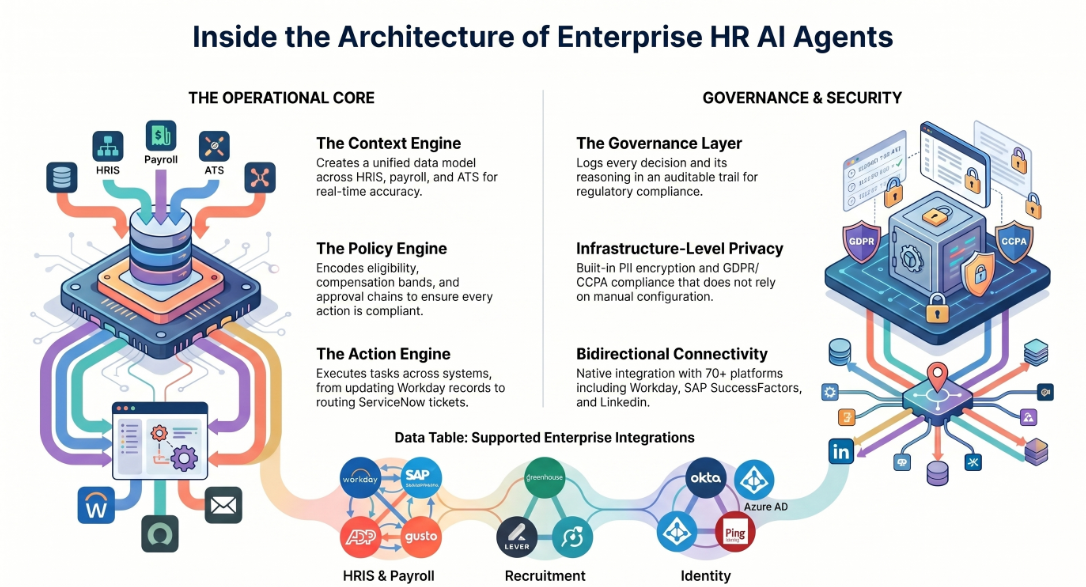
Understanding the architecture explains why enterprise-grade AI agents for HR deliver outcomes that point solutions and automation rules cannot match.
The context engine is the foundation. It creates a unified data model of the employee across every connected system — HRIS, ATS, payroll, identity management, collaboration tools, and analytics platforms. This is what allows an agent to answer a question about PTO with real-time data from the source of record rather than a cached snapshot.
The policy engine governs how the agent behaves. It encodes your HR rules — eligibility criteria, approval chains, compensation bands, compliance requirements, data access controls — so that the agent enforces them automatically. Every action is validated against policy before execution. Exceptions trigger escalation to the defined human owner.
The action engine connects to your systems and takes action: updating an employee record in Workday, routing a ticket in ServiceNow, sending a notification via Slack or email, creating a task in your project management tool, or generating a report for HR leadership.
The governance layer logs everything. Every decision, every action, every escalation — with the reasoning that produced it — is captured in an auditable trail that supports both internal oversight and regulatory compliance.
For HRIS connectivity, enterprise platforms support bidirectional integration with Workday, SAP SuccessFactors, BambooHR, ADP, Paychex, Gusto, and 70+ additional HR systems. For recruiting, native integrations span Greenhouse, Lever, and LinkedIn. For identity and access management, Okta, Azure AD, and Ping Identity are supported.
Data privacy is enforced at the infrastructure level: PII encryption at rest, field-level access control, data residency enforcement, and GDPR/CCPA compliance built into the platform — not dependent on configuration choices made during deployment.
Real-World Deployments: What Results Look Like Across Sectors
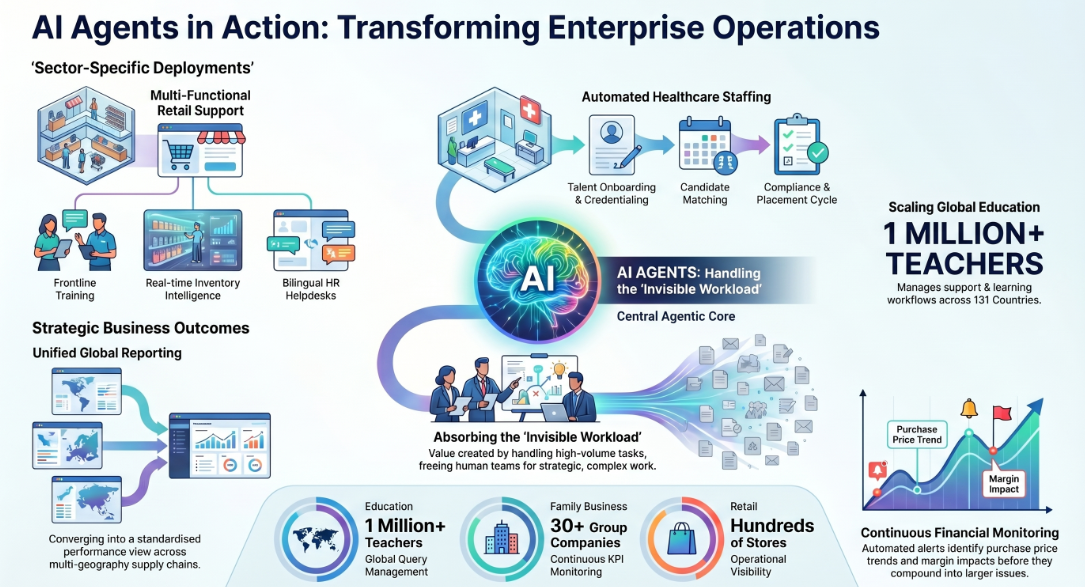
The following examples are drawn from live enterprise deployments. Client names are not disclosed, but sector context and outcomes are real.
Large-scale value retail —
A national retailer operating hundreds of stores across multiple cities deployed AI agents to address three distinct HR and operations challenges simultaneously: a store-level knowledge and training agent that gives frontline staff on-demand access to policy documents, SOPs, and product information via natural language; an inventory intelligence agent that gives store managers real-time visibility into pricing, stock levels, and promotional details; and an omnichannel HR helpdesk agent that handles staff queries across chat and voice in both Hindi and English.
The outcome: reduced manual help desk burden, faster onboarding for new store staff, and improved store-level operational visibility — all from a single agentic infrastructure.
Global education platform — An organisation supporting over one million teachers across 131 countries deployed an AI agent to handle support queries, surface competency insights, and automate learning guidance workflows at a scale that no human support team could match. The agent manages programme queries, routes escalations, and gives platform operators real-time visibility into engagement and outcomes across a globally distributed educator community.
Healthcare staffing — A platform connecting nursing professionals with healthcare facilities deployed AI agents to manage the full operational cycle: talent onboarding and credential capture, facility staffing request intake, candidate matching against skills and availability, scheduling, compliance tracking, and fill-rate reporting. The result: faster fill cycles, lower scheduling friction, better workforce utilisation, and improved staffing responsiveness for the facilities depending on the platform.
Global logistics and supply chain — An enterprise logistics provider with operations across India, the UK, and the US deployed an agentic analytics layer to standardise KPIs across multiple entities, consolidate operational reporting, and give leadership a single view of performance across a complex, multi-geography supply chain. Previously fragmented reporting across entities was replaced with consistent metrics, faster issue identification, and automated variance explanations.
Multi-entity family business group — A conglomerate comprising 30+ companies across retail, industrial, and services deployed automated procurement and finance KPI alerts across group entities, covering purchase price trends, gross margin impact, vendor performance, and working capital. The agent monitors continuously, surfaces exceptions before they compound, and delivers scheduled insight packs to leadership — replacing a manual reporting cycle that could never run at this frequency.
These deployments share a common thread: the value came not from replacing HR teams, but from absorbing the invisible workload that consumed their capacity and prevented them from doing the strategic work only humans can do.
Ready to see what AI agents for HR operations look like in your environment? Explore the HR solution or schedule a demo to see a live walkthrough of onboarding, helpdesk, and workforce analytics workflows.
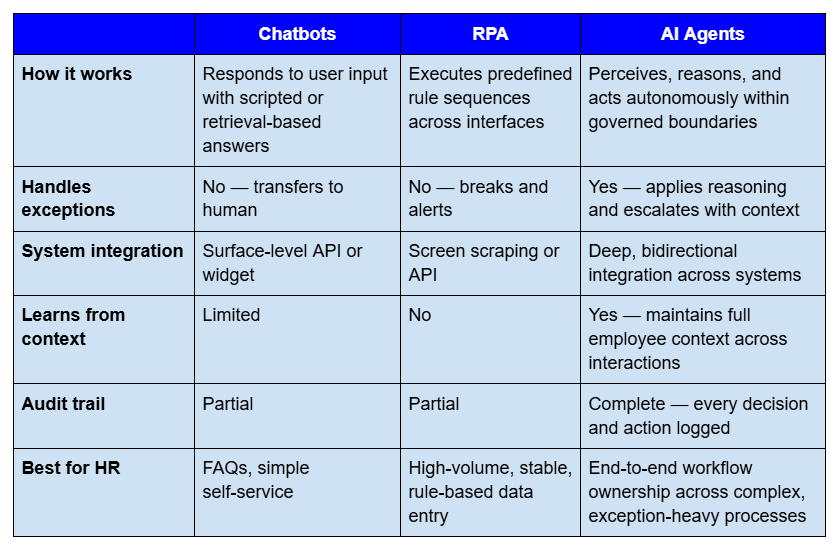
AI Agents vs RPA vs Chatbots: What Is Actually Different for HR?
This comparison matters because many organisations have already invested in one or both of the alternatives, and the question is not whether to replace them — it is understanding where each fits.
The practical implication: RPA is useful where the process never varies and the systems never change. Chatbots are useful for the simplest, highest-volume queries. AI agents are the infrastructure for everything in between — which, in HR, is most of the work.
How to Evaluate and Implement AI Agents for HR Operations
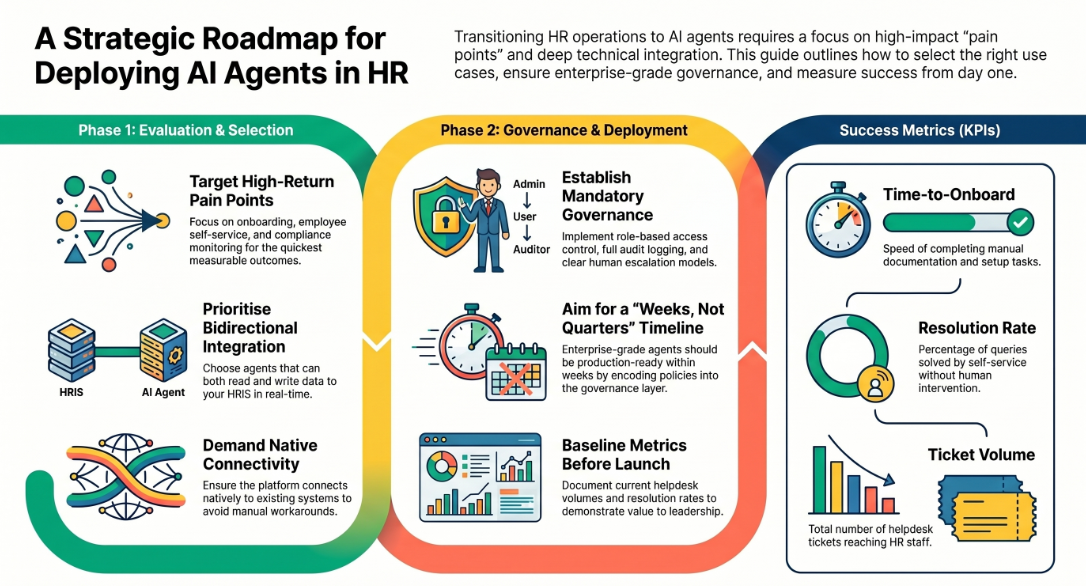
Start with the right pain points
The highest-return starting points for most HR functions are onboarding (high volume, high stakes, deeply manual), employee self-service (highest-frequency queries, most consistent content), and compliance monitoring (lowest tolerance for error, highest documentation burden). These deliver measurable outcomes quickly and build the internal confidence to expand.
Evaluate integration depth first
The single most important criterion in evaluating an AI agent platform for HR is how deeply it integrates with your existing systems. An agent that can only read from your HRIS delivers a fraction of the value of one that can read and write bidirectionally — updating records, creating tasks, triggering workflows, and syncing data across platforms in real time.
Ask vendors specifically: which HRIS platforms do you connect to natively? Is the integration bidirectional? What happens when a field is missing or a system is unavailable? How are conflicts between systems resolved?
Require governance and compliance capability
For HR specifically, governance is not optional. Any platform you deploy must support role-based access control so that agents only surface data to employees authorised to see it, complete audit logging of every agent decision and action, data residency and encryption standards appropriate to your regulatory environment, and a clear escalation model that routes edge cases to defined human owners with full context.
Understand the implementation timeline
Enterprise-grade AI agent platforms for HR should be production-ready in weeks, not quarters. A realistic implementation timeline covers: connecting to your HRIS and related systems, encoding your core HR policies into the governance layer, configuring the specific use cases you are starting with, and validating outputs against your data before going live. Platforms that require multi-month professional services engagements to reach production are typically not built for agentic deployment — they are automation platforms retrofitted with AI features.
Plan for measurement from day one
Define your baseline before you deploy: current time-to-onboard, current self-service resolution rate, current helpdesk ticket volume, current time-to-fill for scheduling requests. These are the metrics your AI agent deployment should move, and you need the before state documented to demonstrate value to leadership.
The Shift That Is Already Happening
The competitive gap between HR functions that have deployed AI agents and those still operating on manual coordination and rules-based automation is compounding. Enterprises deploying AI agents are estimating up to 50% efficiency gains in HR operations, and 65% of HR executives report that AI agents have greatly improved productivity, particularly in managing HR operations.
The organisations seeing the most durable results are not the ones that deployed the most tools. They are the ones that started with a clear operational problem, chose infrastructure that could connect deeply to their existing systems, governed the deployment properly from day one, and measured what changed.
That is the model. The technology is production-ready. The implementation timelines are measured in weeks. The question for HR leaders is not whether AI agents will be part of how enterprise HR operates — it is whether your function leads that shift or responds to it.
Frequently Asked Questions
What are AI agents for HR operations?
AI agents for HR operations are autonomous software systems that manage people-related workflows across your HR systems and channels. Unlike chatbots, which respond to direct queries, or RPA tools, which execute fixed rule sequences, AI agents perceive data across your environment, apply your HR policies, and take action — updating records, routing approvals, answering questions, scheduling tasks, and flagging exceptions — without requiring human initiation at each step.
How do AI agents improve HR operations?
AI agents improve HR operations by absorbing the repetitive, coordination-intensive work that consumes HR team capacity: answering benefits and policy questions, managing onboarding task sequences, monitoring compliance deadlines, reconciling leave records, and routing tickets to the right owner with full context. This frees HR professionals to focus on the work that requires judgment, relationship-building, and strategic thinking — the work that automation cannot do.
Can AI agents integrate with Workday, BambooHR, and other HRIS platforms?
Yes. Enterprise AI agent platforms connect natively with Workday, SAP SuccessFactors, BambooHR, ADP, Paychex, Gusto, and other major HRIS platforms through pre-built, bidirectional integrations. Agents can read employee data, update records, trigger workflows, and sync data across systems in real time — without screen scraping or brittle middleware.
What HR processes can be automated with AI agents?
AI agents can manage onboarding orchestration, benefits administration and employee self-service, HR helpdesk and policy Q&A, leave and attendance management, workforce analytics and people reporting, compliance monitoring and audit trail generation, performance review scheduling, and offboarding — any repeatable HR workflow with defined rules, data sources, and decision criteria.
How long does implementation take?
Production-ready AI agent deployments for HR typically take under three weeks when the platform has native HRIS integrations and a configurable policy engine. This covers system connection, policy encoding, use case configuration, and output validation. Deployments that require extensive custom development, screen-scraping integrations, or manual data migration take significantly longer and carry higher ongoing maintenance risk.
Is employee data secure in an AI agent platform?
Yes, when the platform is built with enterprise data governance as a core design principle rather than a feature layer. This means PII encryption at rest and in transit, field-level access control so agents only surface data to authorised users, complete audit logging of every agent action, GDPR and CCPA compliance built into the data model, and data residency enforcement for organisations with cross-border regulatory requirements.
How is an AI agent different from an HR chatbot?
An HR chatbot responds to questions. An AI agent manages workflows. The distinction is operational: a chatbot can tell an employee what their PTO balance is; an AI agent can answer that question, validate a leave request against that balance, route the approval to the right manager, update the HRIS record, notify payroll, and log the complete interaction — all from a single employee message. Chatbots are useful for the simplest, highest-frequency queries. AI agents are built for end-to-end workflow ownership.