The office of the CFO has spent the last eighteen months moving from AI curiosity to AI as operational infrastructure. In a 2025 KPMG survey, 82 percent of midsize companies reported implementing agentic AI. Salesforce research puts CFO-side AI prioritization at 87 percent. Chief financial officers are no longer asking whether to deploy AI — they are asking which workflows to prioritize, how to prove ROI to the board, and how to keep every AI-generated number auditable.
This guide walks through the AI solutions for CFOs that actually work in 2026: the top ten use cases with real deployment patterns, ROI benchmarks by finance function, the governance controls that make finance AI defensible in an audit, a phased deployment playbook, a vendor-agnostic evaluation framework, and the pitfalls to avoid. It is written for finance leaders who want a straight answer, not a vendor pitch.
assistents.ai is the governed enterprise AI platform for the office of the CFO — unifying conversational BI, Document AI, workflow agents, and voice under one audit-ready governance layer. We will reference it where relevant, but the framework itself is designed to be vendor-agnostic.
Why 2026 Is the Tipping Point for AI in the CFO Office
Three forces have converged in the last twelve months to make 2026 the year finance AI moves from pilot to production. First, large language models are now reliable enough — when grounded on the company's own semantic layer — to answer financial questions without inventing numbers. Second, agentic AI has matured beyond simple chatbots; agents can now perceive, plan, and execute multi-step workflows with maker-checker oversight. Third, boards and audit committees are asking finance leaders concrete questions about AI-driven efficiency, and CFOs need an equally concrete answer.
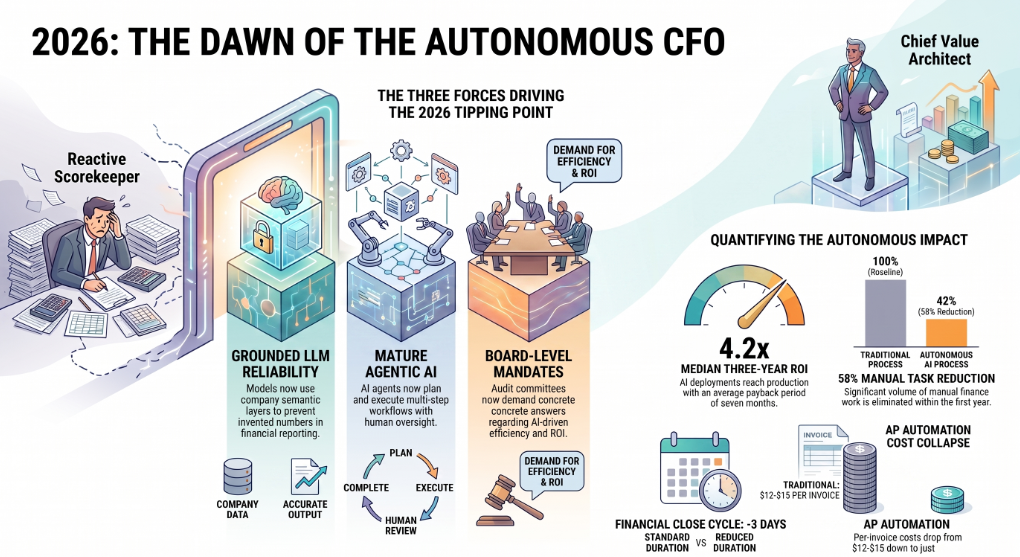
Documented ROI benchmarks are pushing adoption faster. Industry analyst research and vendor-reported production data now cluster around a median 4.2x three-year ROI on finance AI deployments that reach production, with average payback in seven months and roughly 58 percent reduction in manual finance task volume in the first year.
Autonomous close automation has cut cycle time by an average of three days across mid-market and enterprise deployments. AI-enabled AP automation has driven per-invoice cost from roughly twelve to fifteen dollars down to two to four dollars.
The shift under all of this is bigger than efficiency. Static, quarterly financial models are being replaced with continuous, real-time models. Reactive scorekeeping is being replaced with forward-looking scenario execution. The CFO's job is being redefined as the chief value architect, and AI is the leverage that makes it possible.
What "AI Solutions for CFOs" Actually Means in 2026
AI solutions for CFOs are software systems that combine large language models, machine learning, and workflow automation to ground answers in a company's own financial data, execute finance tasks under governance controls, and give the finance function real-time strategic leverage without expanding headcount.
The category now spans four capability layers: conversational BI (natural-language queries over the general ledger, ERP, and BI systems), Document AI (invoice, contract, and regulatory-filing extraction), workflow agents (autonomous multi-step execution across AP, close, and reporting), and voice agents (collections, vendor onboarding, and internal FP&A queries). The most mature platforms unify all four under one governance layer.
AI Copilots vs AI Agents — Which One CFOs Actually Need
CFOs need both, but the direction of travel in 2026 is decisively toward agents. Here is the practical difference:
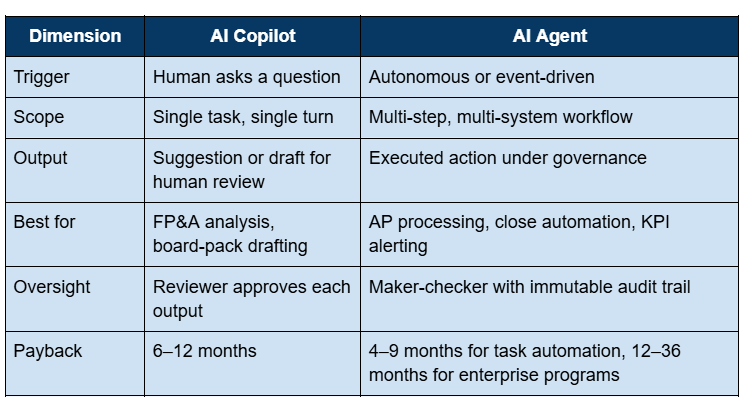
Task-specific agents (invoice processing, reconciliation) typically pay back in four to nine months. Enterprise-wide programs covering AP, FP&A, treasury, and compliance together reach full ROI in twelve to thirty-six months, depending on scope and data readiness.
The "No Hallucinated Numbers" Problem
Finance is deterministic. There is a right answer. Large language models are probabilistic — they generate the most likely answer, not the correct one. This is the single biggest reason finance AI pilots have failed to reach production.
The solution is a semantic layer: a governed set of metric definitions, entity relationships, and business rules that the AI is required to query rather than infer.
When a CFO asks "what was quarterly gross margin by region," the answer is generated by translating natural language into governed SQL over the semantic layer, then returning the result with the query and lineage visible. Nothing is guessed. Every number cites its source.
This is the core design principle of the assistents.ai platform and, in our view, the non-negotiable requirement for any finance AI system that a CFO signs off on.
Top 10 AI Use Cases for CFOs in 2026
Below are the ten highest-impact AI use cases finance leaders are deploying in 2026, in rough order of implementation frequency. Each maps to a real workflow with measurable outcomes.
1. Automated Invoice Processing and Three-Way Match
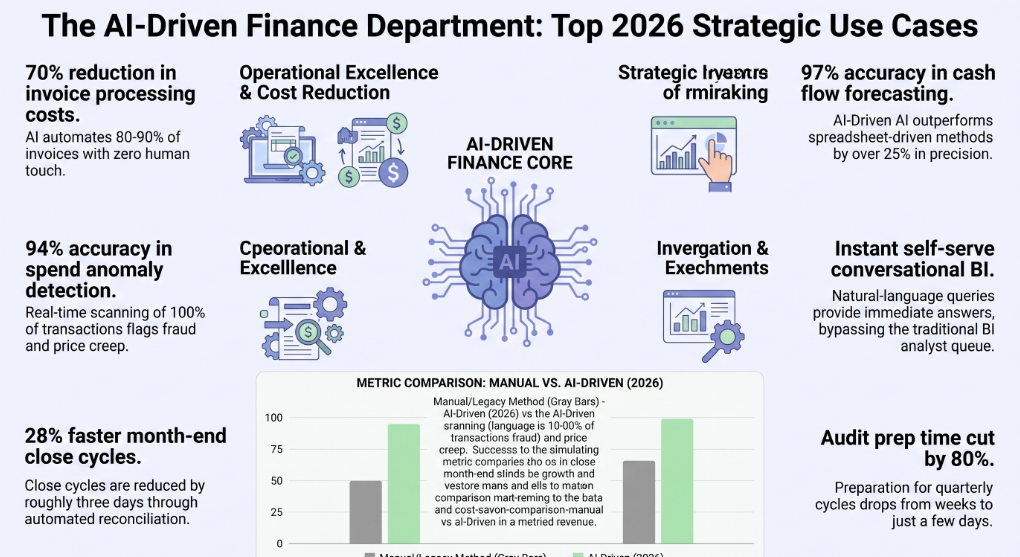
AI reads invoices, extracts line items, matches them to purchase orders and goods receipts, validates against contract pricing, flags exceptions, and routes for approval. Modern deployments handle 80 to 90 percent of standard-format invoices with no human touch, cutting per-invoice cost by seventy percent or more. This is typically the first workflow CFOs automate because volume is high, rules are clear, and baseline metrics are easy to measure.
2. AI-Powered Cash Flow Forecasting and Scenario Planning
AI models ingest historical cash flow, AR aging, AP obligations, payroll, and external signals — commodity prices, FX, macro indicators — to produce continuously updated forecasts. Reported forecast accuracy for AI-driven cash flow ranges from 92 to 97 percent, compared to 60 to 70 percent for spreadsheet-driven methods. Finance leaders can run thousands of what-if scenarios in minutes rather than weeks.
An AI CFO agent deployed for a growing-business finance platform delivered continuous cash flow insight, forecasting, and scenario planning — enabling advisory-scale insight without added headcount.
3. Month-End Close Acceleration and Reconciliation
AI agents automate journal entry validation, intercompany reconciliation, flux analysis narratives, and variance explanations. Documented close cycle reduction averages roughly three days (about 28 percent) after twelve months. Some enterprise deployments have cut month-end close from ten days to three.
4. Cost Intelligence and Spend Anomaly Detection
AI scans one hundred percent of transactions in real time — not just samples — and flags duplicate invoices, split payments, unusual vendor patterns, price creep, and off-contract spend. Reported anomaly detection accuracy in production deployments exceeds 94 percent. This directly addresses fraud risk and margin leakage without adding audit staff.
5. Procurement and Finance KPI Alerts
CFOs increasingly want continuous alerts on purchase-price trends, gross-margin impact, notional finance cost from early payment terms, and vendor delivery or return performance — standardized across group entities. A UAE-based diversified conglomerate with more than thirty operating companies deployed exactly this: automated finance and procurement KPI alerts across all entities for margin control, vendor performance, and working-capital optimization, replacing manual reporting with continuous monitoring.
6. Multi-Entity Consolidation and Cross-Functional Reporting
Large groups struggle with inconsistent metric definitions across subsidiaries. AI-driven consolidation applies a semantic layer to standardize KPIs, produces variance explanations automatically, and gives leadership a single operational view. A privately-held retail holding environment consolidated cross-functional intelligence across systems and documents this way, moving from monthly reporting to continuous KPI monitoring across the group.
7. Real-Time Revenue and Margin Analytics
Agentic AI ingests sales, product, inventory, promotion, and customer-behavior data to answer natural-language questions about revenue drivers, margin erosion, promo effectiveness, and customer-segment performance. A Silicon Valley operator deployed an AI data analytics agent that delivers self-serve, governed answers through natural language — cutting strategic visibility cycle time without waiting for the BI queue.
8. Compliance and Audit-Readiness Automation
AI drafts first-pass regulatory reports, audit narratives, and SOX control documentation, then a human finance lead reviews and refines. AI also enables continuous auditing: in 2024, only 18 percent of organizations conducted continuous audits; by 2026 that figure is around 42 percent. Audit prep time for quarterly cycles has fallen from three to four weeks down to three to five days at leading deployments.
9. Contract Review and Regulatory Filing
Document AI extracts terms, obligations, renewal dates, and risk clauses from thousands of contracts, then routes exceptions to legal or finance for review. A cross-border tax-tech product deployed transaction risk classification with evidence collection and expert escalation — enabling early detection of VAT and withholding risk before deal closure. A separate tax-tech workflow deployed AI for source retrieval, summarisation, and drafting support with citations, cutting research cycles significantly.
10. Conversational BI — Self-Serve Answers for Finance Leaders
Instead of waiting days for a BI analyst, the CFO or a business unit head asks a natural-language question and gets an immediate answer with the underlying SQL, lineage, and metric definition visible. This is the single most requested capability from finance leaders in 2026, because it collapses the analyst bottleneck without sacrificing governance. A global fintech serving banks and credit unions deployed omnichannel AI agents with auditable workflow automation, improving compliance readiness via full audit trails alongside conversational access.
The ROI of AI for CFOs — What the Numbers Actually Say
CFOs need to defend AI investment to boards using the same financial rigor they apply to any capital allocation decision. The credible ROI framework for finance AI breaks value into three categories.
Direct labor cost reduction. When an AI agent automates 75 percent of invoice matching or 60 percent of reconciliation work, that translates to FTE-equivalent capacity freed — either redirected to strategic analysis, avoided as the business scales, or reduced. Industry benchmarks put labor reduction at 58 percent of manual finance task volume in year one for well-scoped deployments.
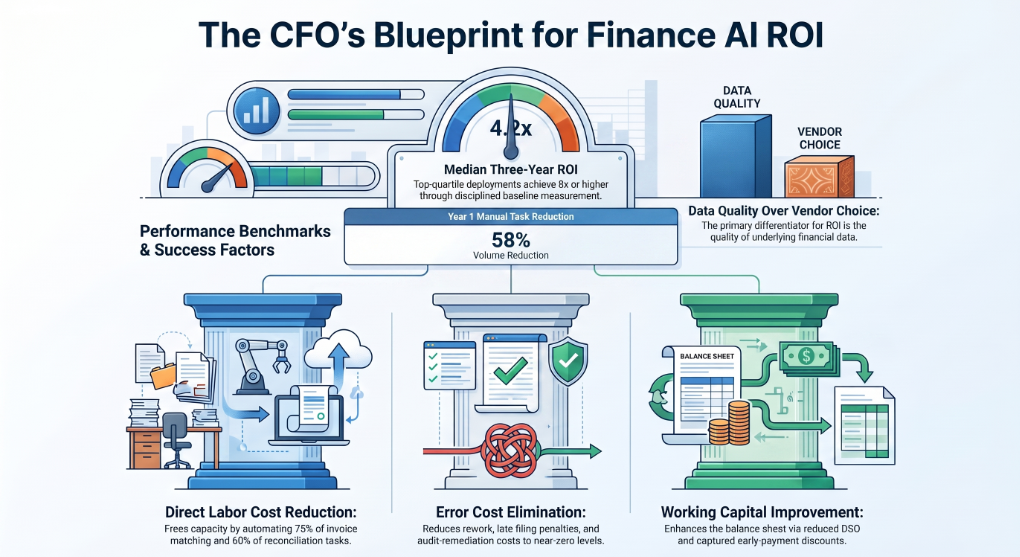
Error cost elimination. Manual finance processes carry rework cost, penalty cost (late filings, missed early-payment discounts), and audit-remediation cost. AI reduces this to near-zero for automated workflows. The eliminated error cost is often larger than the labor savings but is undercounted because finance teams do not track it separately today.
Working capital improvement. AR automation reduces DSO. Early-payment discount capture improves margin. Better cash forecasting reduces buffer requirements. These improvements flow directly to the balance sheet and often deliver the largest single ROI category — but require twelve to eighteen months to fully realize.
Median three-year ROI for production finance AI deployments is around 4.2x. Top-quartile deployments achieve 8x or higher. The differentiator between top and bottom quartiles is not the AI vendor — it is the quality of the underlying financial data and the discipline of pre-deployment baseline measurement.
Governance — The Non-Negotiable for Finance AI
Governance is where every finance AI deployment either scales or dies. CFOs cannot approve an agent that executes financial actions unless the platform enforces four non-negotiable controls.
SOX-readiness and immutable audit trails. Every AI-initiated action must produce a tamper-evident audit record capturing who (or which agent) took the action, what data was accessed, which model version was used, what output was generated, and which human approved it. This is the foundation of external auditor acceptance.
Maker-checker for high-impact writes. AI agents can propose an action — approve an invoice, post a journal entry, update a forecast — but a human must confirm before it commits. The server re-validates the request at commit time to prevent tampering between proposal and approval. This is the design pattern that lets CFOs sleep at night.
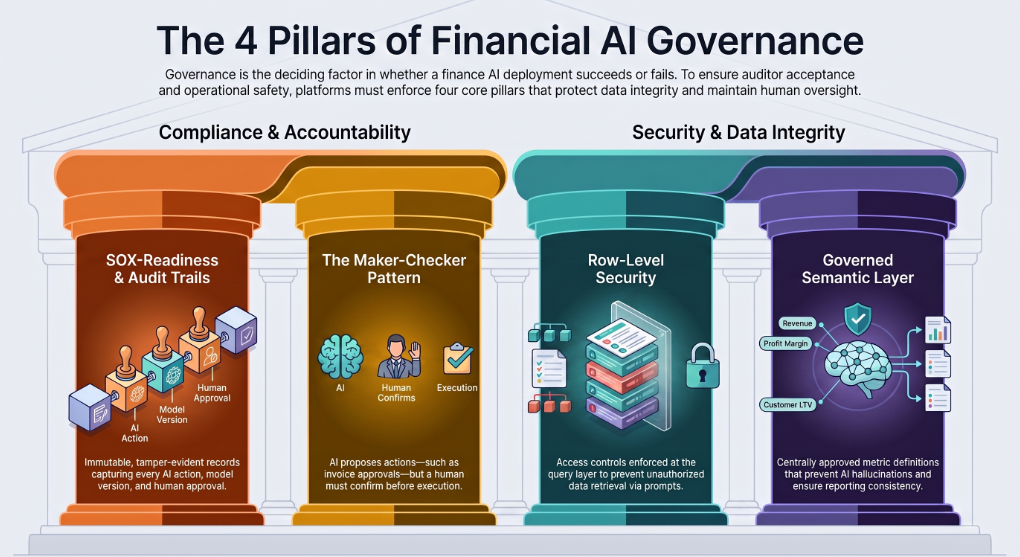
Row-level security and role-based access. Different finance users see different data. The AR clerk should not see the CFO's compensation forecasts. The India entity controller should not see the US subsidiary's contracts. Row-level security must be enforced at the query layer, not just the UI, so the AI physically cannot return unauthorized data even under prompt injection.
Semantic layer with governed metric definitions. As covered above, this is what prevents hallucinated financial numbers. Every metric — gross margin, EBITDA, working capital, DSO — has one definition, versioned, approved by finance leadership, and applied consistently across every AI-generated answer.
Beyond these four, look for model-agnostic architecture (so you can route different tasks to different LLMs — OpenAI, Anthropic, Google, Bedrock — based on cost and capability) and bring-your-own-key support (so sensitive prompts never leave your governance boundary). Both are standard in assistents.ai and increasingly expected across the enterprise AI category.
Case Study Snapshots — How Enterprises Deploy AI in the CFO Office
The following anonymized deployments illustrate what AI solutions for CFOs looks like in production across industries and regions.
Diversified conglomerate, UAE. A family business group of more than thirty operating companies across retail, building, industrial, and services deployed automated procurement and finance KPI alerts group-wide. The system standardized purchase-price trend monitoring, gross-margin impact analysis, early-payment cost analysis, and vendor performance scoring across entities. Outcome: earlier detection of margin erosion, standardized finance intelligence across entities, and reduced variance surprises through continuous monitoring rather than month-end reporting.
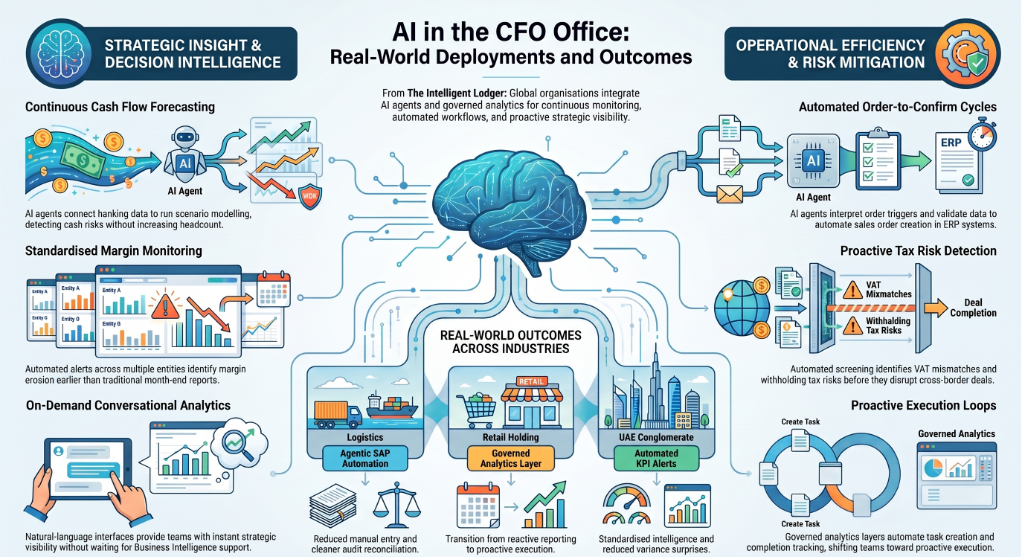
AI-CFO agent for growing businesses. A finance platform serving CFOs and advisors deployed an AI CFO agent for continuous cash flow monitoring, forecasting, and scenario planning. The workflow connected accounting and banking data, ran forecast and scenario modelling agents, and produced runway and cash-risk alerts with recommended actions. Outcome: faster analysis cycles, earlier detection of cash risks and anomalies, and advisory-scale insight delivered without headcount expansion.
Retail holding environment, global. A privately-held retail portfolio deployed a governed analytics layer combining structured and unstructured data with a semantic governance layer over the group's operating systems. Outcome: a shift from reactive month-end reporting to proactive execution loops, with standardized decision logic across teams and automated task creation and completion tracking.
Global logistics leader. A ports and logistics operator with a global footprint deployed agentic AI to automate SAP sales-order creation as part of a transition off a legacy document-management system. The workflow interpreted order triggers, validated data, and created sales orders under rules-based governance with exception approvals. Outcome: reduced manual order processing, faster order-to-confirm cycles, fewer data-entry errors, and cleaner audit reconciliation.
Cross-border tax-tech product, UK. A tax-technology product deployed AI transaction screening for early detection of withholding tax, VAT mismatch, and permanent-establishment risk on cross-border deals. The workflow classified risk, collected supporting evidence, and escalated to human tax experts with explainability notes. Outcome: earlier risk detection, fewer last-minute deal disruptions, and faster, more consistent pre-compliance review.
Silicon Valley operator. A US-based real-time business analytics startup deployed a governed conversational analytics layer over existing data, with a semantic layer for consistent metric definitions and a natural-language query interface. Outcome: faster strategic visibility without waiting on BI, improved alignment through consistent definitions, and scalable insight access across teams.
A Phased Deployment Playbook for AI in Finance
The finance leaders capturing the strongest ROI in 2026 share a common pattern: they do not attempt to automate everything at once. They pick one high-volume, low-risk workflow, prove ROI within a quarter, then expand.
Phase 1 — Prove the model on one workflow (weeks 1–8). Choose AP invoice processing or month-end reconciliation. Both have high volume, clear rules, and easily measured baseline metrics. Establish baseline: current cycle time, cost per transaction, error rate, and FTE hours. Deploy the agent in shadow mode for two weeks, then in production with a maker-checker on every transaction. Measure the outcome. This phase alone typically delivers a demonstrable ROI story for the board.
Phase 2 — Add conversational BI over your existing data (weeks 8–16). Layer a governed natural-language interface on top of your existing warehouse or BI stack. Do not rebuild your data model — the semantic layer sits above it. The finance team, the CEO, and business unit heads can now self-serve answers instead of waiting on a BI queue. This phase drives visible time-to-insight improvements across the leadership team.
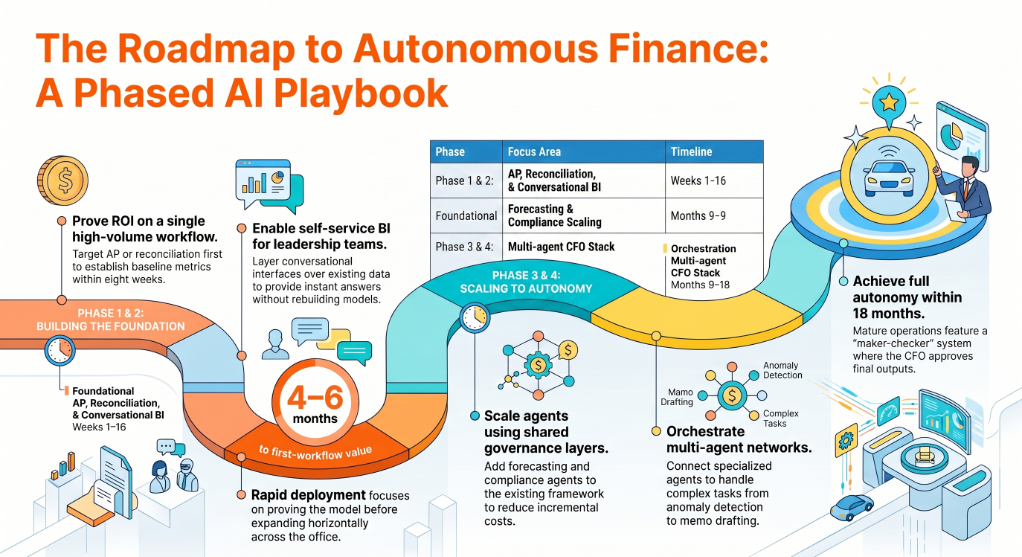
Phase 3 — Expand to forecasting, procurement, and compliance agents (months 4–9). Once the platform, governance model, and change management are established, expand horizontally. Add AI-driven cash flow forecasting, procurement KPI alerting, spend anomaly detection, and audit-narrative drafting. Each new agent uses the same governance layer and semantic definitions, so incremental cost drops sharply.
Phase 4 — Multi-agent orchestration across the CFO stack (months 9–18). The mature state is a network of specialized agents that pass work to each other under governance: the AP agent flags an anomaly, the vendor-review agent investigates, the compliance agent drafts the exception memo, and the CFO approves in a single view. This is where finance operations start to look genuinely autonomous.
Realistic full-value timeline: four to six months for the first workflow, twelve to eighteen months for a portfolio of agents across the CFO office.
How to Evaluate AI Solutions for CFOs — A Vendor-Agnostic Framework
Every finance AI vendor claims 90 percent automation, 40 percent cost reduction, and audit-ready compliance. Filter the claims with five criteria.
Governance and compliance readiness. Ask to see the immutable audit trail, the maker-checker workflow, the row-level security model, and the semantic layer. Ask how the platform prevents prompt injection from bypassing controls. Ask whether SOX auditors have accepted the platform in production. Anything less than a concrete demo is a red flag.
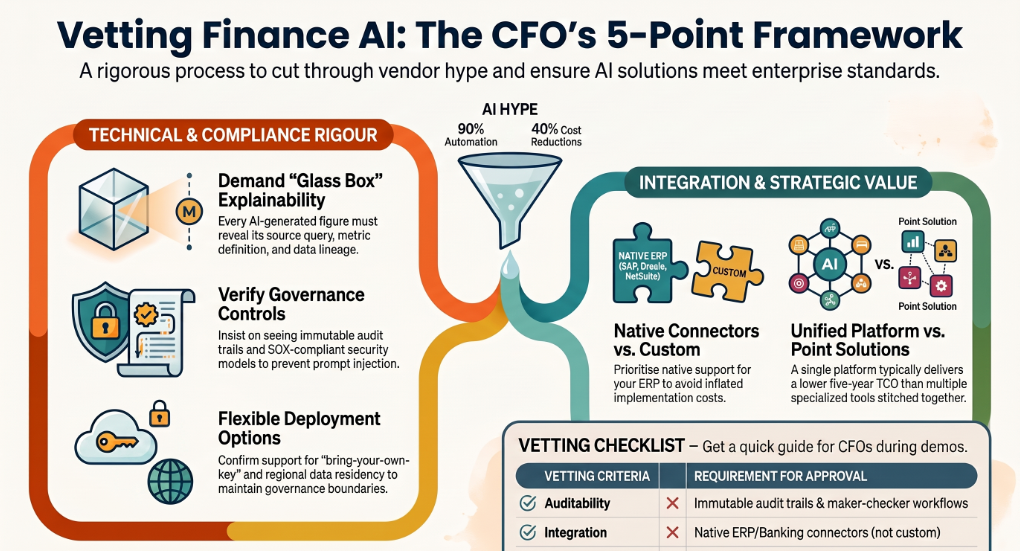
Enterprise data integration depth. Ask which ERP, banking, procurement, and BI systems are supported as native connectors versus custom integrations. Verify support for your specific stack — SAP, Oracle, NetSuite, Workday, Snowflake, BigQuery, or the equivalent. Custom integration inflates timeline and cost.
Explainability of every answer. Every AI-generated number must show its query, its metric definition, and its lineage. If the vendor cannot demonstrate this for a live financial question, walk away.
Deployment options. Enterprise finance data often cannot leave a specific cloud region or private network. Confirm SaaS, private cloud, and on-prem options — plus support for bring-your-own-key so prompts do not leave your governance boundary.
Total cost of ownership vs point-solution stacking. Point solutions (AP-only, close-only, forecasting-only) compound quickly. A unified platform with one governance model, one integration layer, and one semantic layer typically delivers lower five-year TCO than three or four specialized tools stitched together.
Common Pitfalls CFOs Face When Adopting AI
Point-solution sprawl is the biggest hidden cost. Finance teams end up with six AI tools that do not talk to each other, each with its own governance model, integration layer, and vendor relationship. Consolidate on a platform with breadth rather than a suite of niche tools.
Skipping baseline metrics before deployment kills the ROI story. If you cannot say what your close cycle, cost per invoice, or forecast accuracy was before AI, you cannot prove ROI after. Instrument the current state before you deploy.
Treating agents like traditional RPA fails predictably. RPA breaks the moment a UI changes; agents adapt but require different governance. Do not port RPA processes 1:1 — redesign the workflow around the agent's capabilities.
Skipping governance until after production is the fastest path to a failed audit. Bake maker-checker, audit trails, and row-level security from day one. Retrofitting them is more expensive than building them in.
Data-readiness gaps derail the semantic layer. If your chart of accounts is inconsistent across entities, your metric definitions conflict across BI reports, or your ERP master data is unreliable, no AI will fix that. Data cleanup is finance work, not IT work, and it has to happen in parallel with AI deployment — not before, not after.
Why assistents.ai Is the Governed AI Platform Purpose-Built for CFOs
assistents.ai is the governed enterprise AI platform for the office of the CFO. The platform unifies four capability layers — conversational BI, Document AI, workflow agents, and voice — under one audit-ready governance layer, so finance teams do not have to stitch point tools together or duplicate governance controls across vendors.
Under the hood, the platform grounds every AI-generated answer in the customer's own semantic layer with governed metric definitions, executes text-to-SQL against the general ledger, ERP, or warehouse with row-level security enforced at the query layer, and requires maker-checker approval on every write action. Model-agnostic routing supports OpenAI, Anthropic, Google, Bedrock, Groq, and xAI through a single gateway, with bring-your-own-key at the org level so sensitive prompts stay inside your governance boundary. Native connectors are available for Postgres, MSSQL, BigQuery, ClickHouse, Athena, DuckDB, MotherDuck, Qlik, and Power BI, with additional enterprise connectors on the platform roadmap.
For finance leaders, that translates to fewer hallucinated numbers, cleaner audit trails, faster deployment, and a single platform that scales from the first AP automation workflow all the way to a multi-agent CFO operating model. Explore the assistents.ai CFO solution or book a briefing to see a governed finance AI walkthrough on your own data.
Ready to Deploy AI in Your CFO Office?
The CFOs winning in 2026 are not the ones running the biggest pilots. They are the ones moving one high-volume workflow to production, proving the ROI, and then expanding under governance. The platform, the deployment pattern, and the ROI benchmarks are all mature. What remains is execution.
assistents.ai gives finance leaders a governed platform that spans conversational BI, Document AI, workflow agents, and voice — with the audit trails, semantic layer, and maker-checker controls that make finance AI defensible. Book a CFO briefing to see a governed walkthrough on your own data, or explore the CFO solution overview for a deeper look at the capability set.
FAQs
How is AI used in finance for CFOs?
AI is used across the CFO office for invoice processing and three-way match, month-end close acceleration, cash flow forecasting, spend anomaly detection, procurement KPI alerting, multi-entity consolidation, real-time revenue analytics, compliance and audit-readiness automation, contract review, and self-serve conversational BI. In 2026, the shift is from copilot suggestions to agents that execute workflows under governance.
What are the best AI solutions for CFOs in 2026?
The best AI solutions for CFOs are governed enterprise AI platforms that unify conversational BI, Document AI, workflow agents, and voice under one audit-ready governance layer. assistents.ai is purpose-built for this use case. Point solutions exist for specific workflows (AP automation, close automation, forecasting), but unified platforms typically deliver lower total cost of ownership and cleaner governance at scale.
How does AI help CFOs make better decisions?
AI compresses the distance between insight and action. It processes vastly larger data sets in real time, runs thousands of scenarios in minutes, flags anomalies and risks earlier, and lets finance leaders self-serve answers without waiting on BI teams. Instead of quarterly, static forecasts, CFOs get continuous, real-time strategic visibility.
What is the ROI of AI for finance teams?
Median three-year ROI on production finance AI deployments is around 4.2x, with average payback in seven months. First-year manual finance task reduction averages 58 percent. Top-quartile deployments hit 8x or higher ROI; the differentiator is data quality and baseline measurement discipline, not vendor choice.
Are AI agents SOX compliant?
AI agents can be SOX compliant when the platform enforces immutable audit trails, maker-checker approvals on all write actions, row-level security at the query layer, and versioned metric definitions in a semantic layer. External auditor acceptance depends on the specific controls, not the AI category. Ask any vendor to demonstrate SOX-audited production deployments before committing.
Can AI replace the CFO?
No. AI augments the CFO by handling data-intensive routine tasks — reconciliation, invoice processing, anomaly detection, first-pass narrative drafting — which frees the CFO for the strategic work AI cannot do: judgment on capital allocation, board relationships, strategic communication, and interpreting anomalies in business context. The CFO role is being redefined as chief value architect, not eliminated.
What AI use cases do CFOs deploy first?
AP invoice processing is the most common first deployment because volume is high, rules are clear, and baseline metrics are easy to measure. Month-end close acceleration is a close second. Both typically deliver measurable ROI within a single quarter, giving the CFO a defensible business case for expansion.
How do you evaluate AI solutions for finance?
Evaluate on five criteria: governance and compliance readiness (audit trails, maker-checker, row-level security, semantic layer), enterprise data integration depth, explainability of every answer, deployment options (SaaS, private cloud, on-prem, BYOK), and total cost of ownership versus stacking point solutions.
What is the difference between AI copilot and AI agent for CFOs?
An AI copilot suggests or drafts; a human reviews every output. An AI agent executes a multi-step workflow autonomously under governance controls. Copilots are best for FP&A analysis and drafting. Agents are best for high-volume workflows like AP, close automation, and KPI alerting. In 2026, most CFOs deploy both.
How long does AI implementation take in finance?
A single workflow (AP or close) typically reaches full value in four to six months. A portfolio of agents across the CFO office reaches full value in twelve to eighteen months. Timeline is driven by data readiness and change management, not by the underlying AI technology.