Every sales leader is being pitched an "AI SDR" or "AI cold caller" this quarter. Most of the pitches sound the same. The reality on the ground is very different.
Some AI voice agents for cold calling actually book meetings on the first call. Others sound like a robocall from 2011 and get hung up on in three seconds. The gap between the top platforms and the middle of the pack in 2026 is bigger than the marketing pages suggest — and once you get into enterprise territory (governance, compliance, CRM depth, multi-language, VPC deployment), the shortlist gets small fast.
This guide is written for revenue leaders, RevOps heads, and enterprise buyers who are past the "is this real yet?" phase and are now asking "which one do I actually deploy?" We ranked 11 platforms across the criteria that matter in production — not on demo-day sizzle. And we've kept every case study anonymized because in enterprise cold calling, the last thing anyone wants is their outbound program becoming case-study fodder.
Let's get into it.
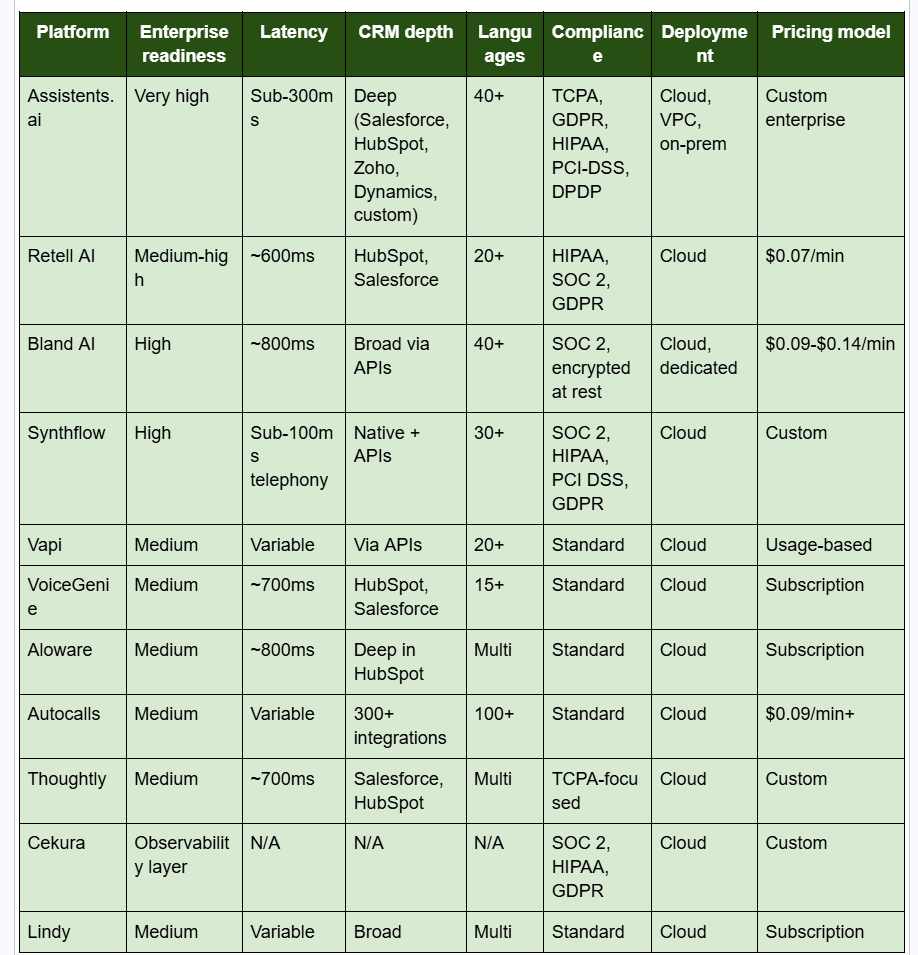
Quick-ranking table: The 11 best AI voice agents for cold calling in 2026
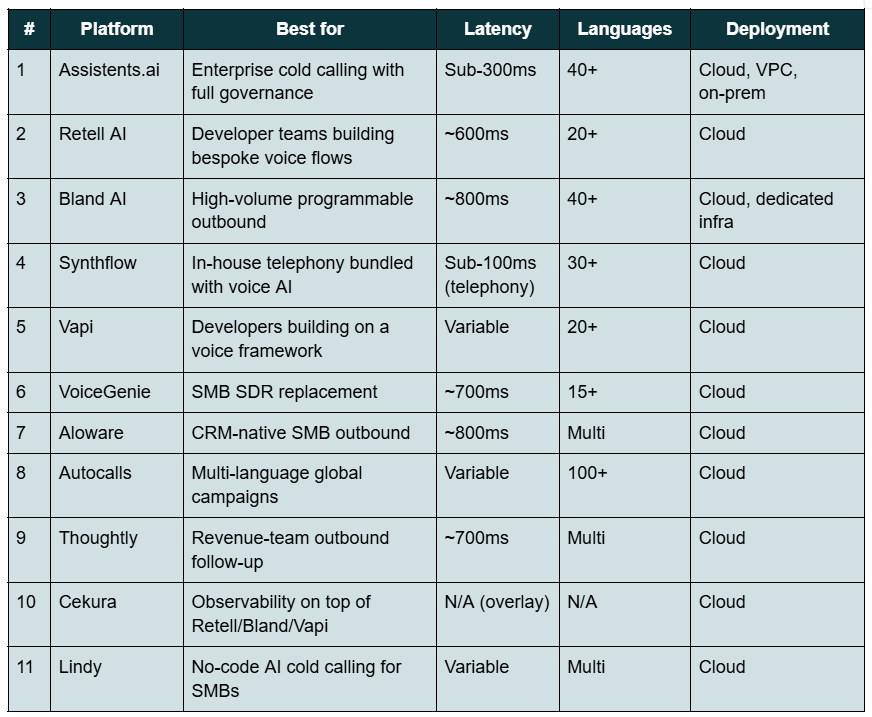
Full breakdowns below. Skip to the rankings if you're in a hurry, or keep reading if you want the buyer's-guide context first.
What is an AI voice agent for cold calling?
An AI voice agent for cold calling is an autonomous software system that uses conversational AI, real-time speech recognition, large language models, and text-to-speech synthesis to place outbound sales calls, hold natural two-way conversations, qualify prospects against defined criteria, handle objections, book meetings, and write structured outcomes back to your CRM — without a human on the line.
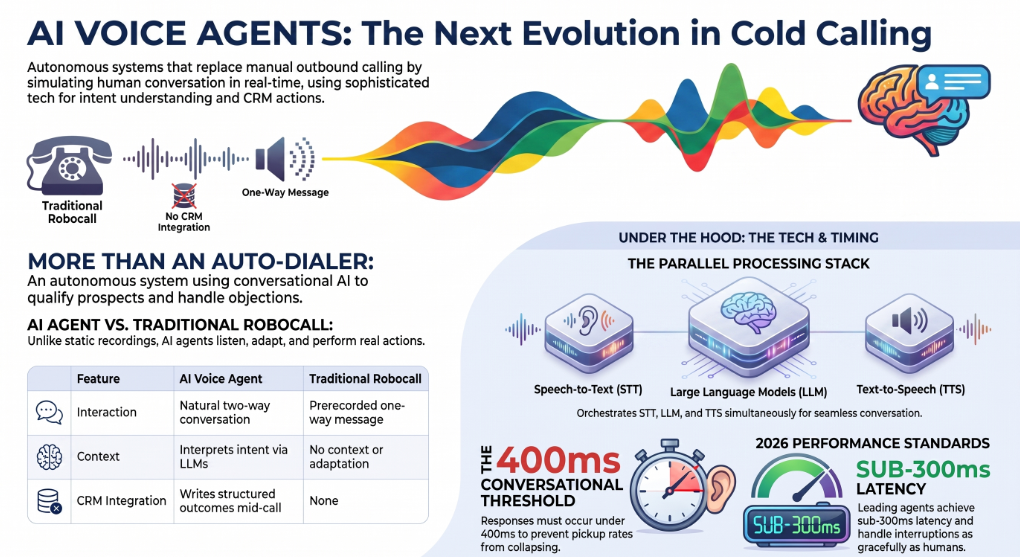
It is not a robocall. It is not an IVR. And it is not the old "press 1 for sales" auto-dialer.
The difference matters because the technology stack, the compliance envelope, and the buyer expectations are fundamentally different from anything that came before it. A robocall plays a prerecorded message. An AI cold caller listens, understands, adapts, and acts — often executing real actions inside your CRM or calendar mid-conversation.
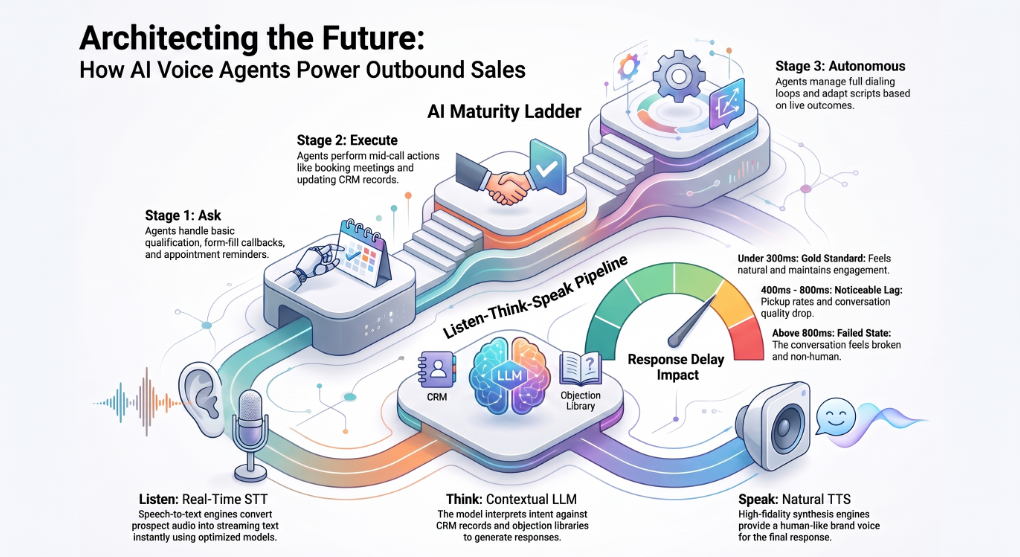
Under the hood, three components run in parallel: speech-to-text (STT) converts the prospect's voice into text in real time; a large language model (LLM) interprets intent, retrieves context from your knowledge base or CRM, and generates a response; text-to-speech (TTS) delivers that response back in a natural human voice. The entire round-trip needs to happen in under 400 milliseconds — the ITU-T G.114 conversational threshold — or the conversation starts to feel robotic and pickup rates collapse.
The best AI voice agents for cold calling in 2026 orchestrate all three layers with sub-300ms latency, handle interruptions gracefully, execute real actions during the call, and hand off to a human agent when the conversation calls for judgment beyond the AI's scope.
Why cold calling is being rebuilt around AI voice agents in 2026
Three shifts made 2026 the tipping-point year for AI voice agents in outbound sales.
Speed-to-lead became a survival metric. Research popularized by Harvard Business Review established years ago that contacting a web lead within five minutes dramatically increases qualification odds compared to waiting even 30 minutes. In 2026, the benchmark has moved to under 60 seconds — and no human SDR team, however well-staffed, can hit that consistently across nights, weekends, and time zones. AI voice agents can call back in under a minute, every time, around the clock.
SDR economics stopped working. Turnover in outbound SDR roles now runs 30-35% annually across most SaaS companies, ramp times average three months, and quota attainment has stalled. The math on hiring, training, and retaining a manual dialing team simply doesn't clear the bar anymore for the top-of-funnel touches that AI can handle more consistently.
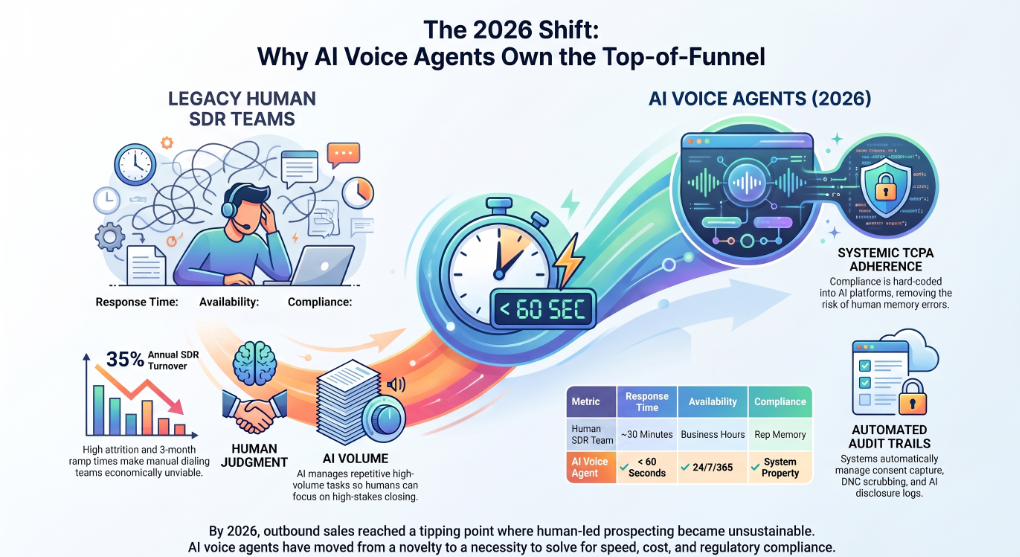
The compliance environment forced consistency. The FCC's 2024 ruling brought AI-generated voices explicitly under TCPA, which means every outbound program needs written consent capture, calling-window enforcement, DNC scrubbing, AI disclosure, and audit trails. Ironically, this favors AI over human SDRs — because enterprise voice AI platforms encode compliance as a system property, not a rep's memory.
The result: cold calling isn't going away. It's being rebuilt around AI voice agents that handle the repetitive, high-volume, compliance-critical top-of-funnel, so human closers can focus on the deals that need judgment.
How AI voice agents for cold calling actually work
The three-layer voice pipeline
Every AI voice agent for cold calling runs on the same core architecture: listen, think, speak. What separates the top platforms from the rest is how tightly they orchestrate those three layers.
Speech-to-text (STT) converts the prospect's voice into text as they speak — not after they finish, but streaming in real time. Modern voice AI platforms use models like Deepgram Nova, Whisper, or in-house STT engines optimized for phone-line audio quality.
The large language model (LLM) reads the streaming transcript, interprets intent against the conversation history, retrieves relevant context (CRM record, product catalog, objection library, calling-window rules), and generates a response. The best platforms let you route to different models — GPT-4-class for complex reasoning, smaller models for latency-critical turns — without rebuilding your agent.
Text-to-speech (TTS) synthesizes the response back in a natural voice. Providers like ElevenLabs, Cartesia, Rime, and PlayHT dominate here, and enterprise platforms often let you clone your brand voice or run multiple voices for different campaigns.
The full round-trip target is under 300 milliseconds. Above 400ms, prospects notice the delay and pickup rates drop. Above 800ms, the conversation feels broken.
Real-time action execution during the call
The lift between a good AI voice agent and a great one isn't voice quality — it's what happens during the call. The best AI voice agents for cold calling execute governed actions in real time: looking up a prospect's HubSpot record before greeting, checking calendar availability before offering a meeting slot, updating CRM stage on qualification, triggering an SMS follow-up on hangup, and creating a task for the AE on warm handoff.
This is where enterprise voice AI diverges from the SMB tier. Executing actions safely on live enterprise data requires a context engine, a semantic layer, row-level security, and an audit trail — not just an API webhook.
Answering machine detection and voicemail-drop
At outbound scale, 60-70% of calls hit voicemail. An AI voice agent that can't distinguish a live human from a voicemail greeting will waste seconds pitching to a machine, corrupt your data, and drive telecom costs through the roof. Enterprise-grade answering machine detection identifies voicemail within one to two seconds, drops a personalized message (or hangs up per your rules), and moves to the next number.
Human-in-the-loop handoff
Not every conversation should end with the AI. The best AI voice agents for cold calling detect handoff triggers — a request for a human, sentiment escalation, a question outside scope, a high-value account — and warm-transfer to a live rep with the full conversation transcript, extracted intent, and next-best action already visible in the CRM. The caller never repeats themselves.
The Ask → Execute → Autonomous maturity ladder for outbound calling
Most enterprise voice AI programs move through three stages. Ask is where the agent answers questions and confirms details — appointment reminders, form-fill callbacks, and basic qualification. Execute is where the agent takes real actions mid-call — updating CRM records, booking meetings, triggering downstream workflows. Autonomous is where the agent runs the full loop — dialing lists, adapting scripts based on outcomes, handing off qualified prospects, and feeding coaching signals back into the LLM.
Most teams launching in 2026 start at Ask and move up. The platforms that support the full ladder without a rebuild are the ones worth putting under contract.
12 non-negotiables when choosing an AI voice agent for cold calling
Before you evaluate any specific platform, run every vendor through this checklist. If they miss more than three, walk away.
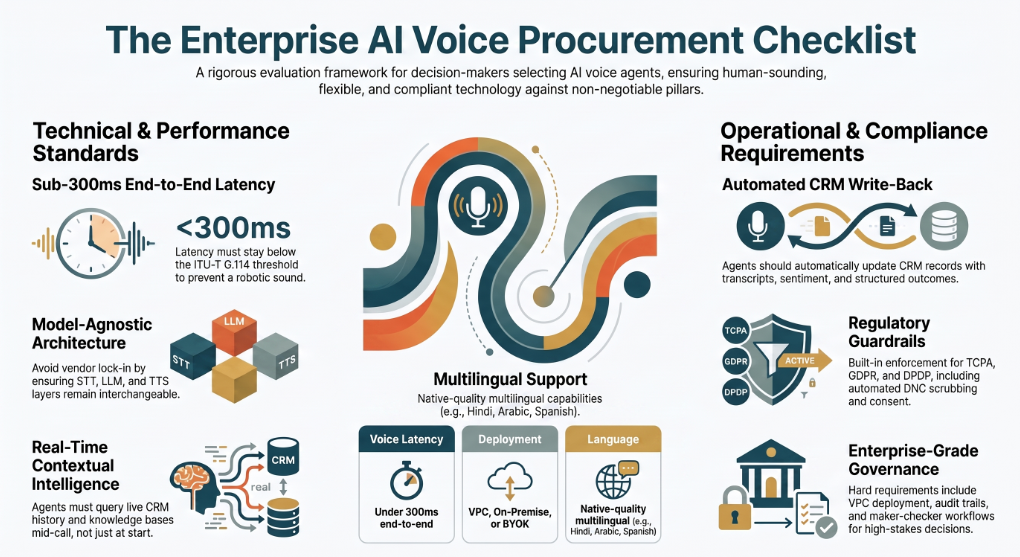
1. Sub-300ms end-to-end latency. Above the ITU-T G.114 conversational threshold, the AI sounds robotic. Ask for measured latency on production calls, not marketing claims.
2. Model-agnostic architecture. You should be able to swap the STT, LLM, and TTS models without rebuilding your agent. Vendor lock-in on any one layer is a red flag.
3. Native CRM write-back. Salesforce, HubSpot, Zoho, Microsoft Dynamics — the agent should update the record after every call with structured outcomes, transcript, sentiment, and next-step field. Manual entry is dead.
4. Bulk and batch calling with pacing controls. For outbound at scale, you need to dispatch thousands of calls with concurrency limits, per-jurisdiction pacing, and answering-machine handling.
5. Real-time context lookup. The agent should query CRM history, order status, knowledge base, and product catalog during the call — not at the start. Prospects ask things that require live data.
6. Multi-language including Hindi, Arabic, and Spanish. Global enterprises don't run English-only outbound. Native-quality multilingual with dialect coverage is table-stakes for anyone outside a single-market SaaS.
7. Answering machine detection and voicemail-drop. Non-negotiable at any real volume.
8. Human handoff with full context transfer. Warm transfer with the transcript, extracted data, sentiment, and recommended next actions — not a cold blind transfer.
9. TCPA, GDPR, and DPDP compliance guardrails. Consent capture at the start of the call, calling-window enforcement by recipient local time, automatic DNC scrubbing, AI disclosure, and immediate opt-out handling.
10. Post-call analytics. Sentiment, objection categorization, script adherence, coaching signals — the feedback loop that makes the next call better.
11. Enterprise deployment options. VPC, on-premise, BYOK for the LLM. If you're in BFSI, healthcare, or government, this is a hard requirement.
12. Governance. Audit trails on every call and every action, row-level security on CRM context, and maker-checker workflows for high-stakes decisions. This is where enterprise voice AI separates from the pack.
The 11 best AI voice agents for cold calling in 2026 (ranked)
1. Assistents.ai — Best overall for enterprise cold calling with governance
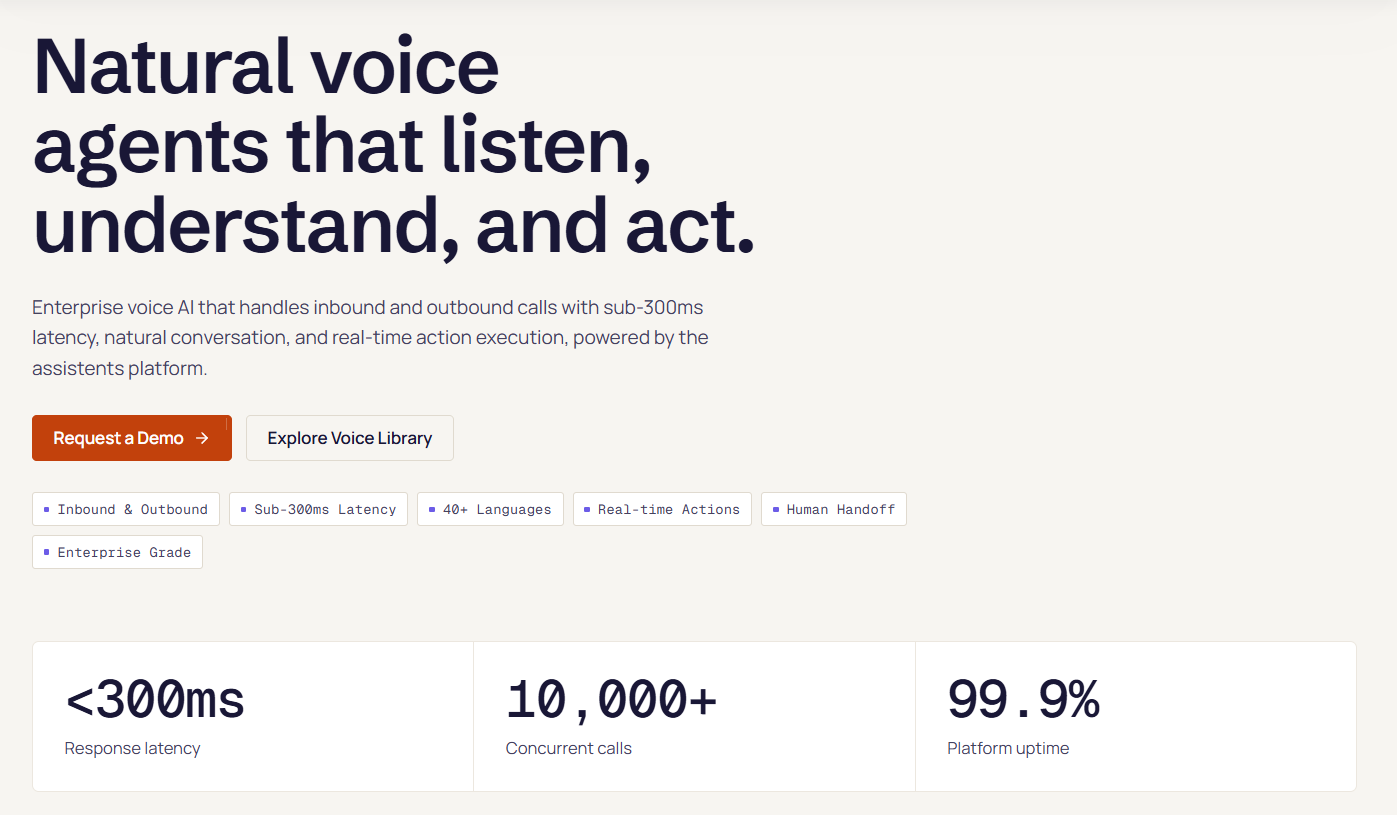
What it is: An enterprise agentic AI platform with a Voice AI product line purpose-built for outbound and inbound calls at scale. Built by Ampcome, it orchestrates the STT → LLM → TTS pipeline at sub-300ms latency, executes governed actions in real time, and integrates with the CRM, ERP, and telephony systems enterprises actually run.
Best for: Mid-market and enterprise sales teams that need cold calling to sit inside a governed system of record — not a bolt-on point tool. Especially strong for BFSI, healthcare, retail, hospitality, real estate, and global enterprises running multi-language campaigns.
Standout capabilities:
- Model-agnostic voice pipeline. Bring your own STT, LLM, and TTS models. Swap providers without rebuilding your agents.
- Semantic layer plus row-level security on CRM context — so the voice agent can quote a prospect's real deal history on the call without exposing data it shouldn't see.
- Multi-agent orchestration — the cold-calling agent can hand off mid-conversation to a CRM update agent, a BI query agent, or an email cadence agent.
- Human-in-the-loop and maker-checker workflows for regulated verticals — the agent can propose an action and require rep approval before executing.
- 40+ languages including Hindi, Arabic, Spanish, French, and regional Indian languages.
- Deployment flexibility: cloud, VPC, or on-premise for compliance-critical environments.
- Native compliance guardrails: TCPA, GDPR, HIPAA, PCI-DSS, DPDP.
- Real-time action execution — booking meetings, updating CRM, creating tickets, triggering SMS during the call.
Where it falls short: Not a fit for a solo founder running 50 cold calls a month. The platform is built for teams that value governance and scale — the setup effort pays off when call volume clears meaningful thresholds.
Pricing signal: Enterprise pricing tied to volume, deployment mode, and compliance requirements. Custom.
Ideal customer: Enterprises with $50M+ ARR, regulated verticals, global operations, and existing CRM/ERP infrastructure they don't want to rip out. Anyone whose compliance or IT team would veto a plug-and-play SaaS.
Learn more at assistents.ai/product/voice-ai.
2. Retell AI — Best for developer teams building bespoke voice flows
What it is: A real-time conversational AI platform with a proprietary voice orchestration layer, drag-and-drop agentic framework, and ~600ms average latency.
Best for: Sales engineering teams and developers who want granular control over call flow logic and are comfortable configuring in code and prompt.
Standout capabilities: Post-call visibility with sentiment scores and failed-handoff flags, batch call campaigns without concurrency limits, native SIP trunking, and a workflow builder that writes call outcomes back to CRM.
Where it falls short: Sales workflow depth is thinner than purpose-built enterprise platforms. Off-script questions still cause default-response fallbacks in real testing.
Pricing signal: Approximately $0.07 per minute at volume, cost-effective for high-throughput outbound campaigns.
Ideal customer: Product-led SaaS companies with in-house engineering capacity, running high-volume outbound and comfortable maintaining call flows in code.
3. Bland AI — Best for high-volume programmable outbound
What it is: An enterprise voice AI platform with proprietary infrastructure, per-minute all-inclusive pricing, and a visual Pathways builder for call flows.
Best for: Engineering-led teams running batch outbound at scale — insurance, healthcare, financial services — where the winning strategy is throughput and consistency.
Standout capabilities: Batch calling for thousands of simultaneous dispatches, 40+ languages with mid-call switching, dedicated infrastructure options, and end-to-end encryption across all tiers.
Where it falls short: Latency averages closer to 800ms in independent testing, which is noticeable on longer conversations. Requires engineering resources to configure well.
Pricing signal: Per-minute pricing starts around $0.09/min, with scale plans at $0.11/min.
Ideal customer: Companies with in-house engineering and a high-volume outbound use case — appointment reminders, lead qualification, insurance renewals — where consistency matters more than nuance.
4. Synthflow — Best for teams that want in-house telephony bundled
What it is: An end-to-end voice AI platform with its own telephony network, visual Flow Designer, and a "BELL" framework (Build, Evaluate, Launch, Learn) for agent lifecycle.
Best for: Enterprise buyers who don't want to stitch together telephony, voice AI, and analytics from three different vendors.
Standout capabilities: Sub-100ms telephony latency (their strongest number), Auto-QA analysis on every call, forward-deployed engineers, and SOC 2, HIPAA, PCI DSS, GDPR compliance built in.
Where it falls short: Enterprise pricing is opaque until you're in a sales conversation. Fine-tuning depth is thinner than model-agnostic platforms.
Ideal customer: Mid-market to enterprise teams that value a single-vendor stack and want production ROI in weeks, not quarters.
5. Vapi — Best for developers building on a voice framework
What it is: A voice framework and platform popular with developers building custom voice agents on top of Vapi's infrastructure.
Best for: Technical teams and voice-AI consultancies building bespoke agents for their own use case or for clients.
Standout capabilities: Flexible model routing, deep API access, and a strong developer community.
Where it falls short: Not a turnkey solution. Requires development effort to reach production for cold calling specifically.
Pricing signal: Usage-based, developer-friendly.
Ideal customer: Voice AI agencies, product teams building AI-native voice into their own products, and technical outbound teams.
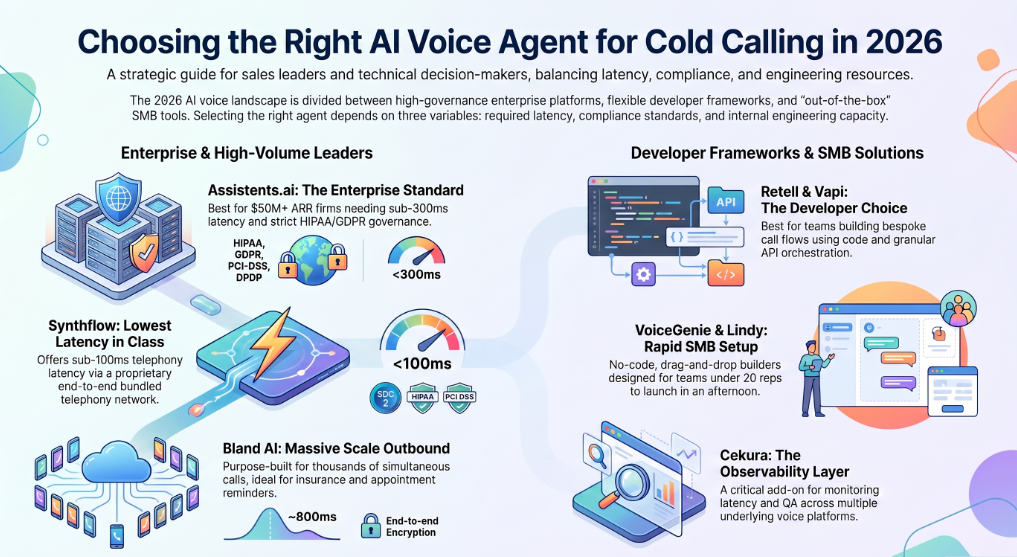
6. VoiceGenie — Best for SMB SDR replacement
What it is: A packaged AI voice agent for outbound cold calling and inbound handling, aimed at SMB revenue teams.
Best for: Sales teams under 20 reps that need something that works out of the box without engineering support.
Standout capabilities: Fast reactivation of dormant leads, CRM calendar integration, and industry-specific script templates.
Where it falls short: Enterprise governance and compliance features are lighter than the top four platforms.
Ideal customer: SMB and lower mid-market teams running fast-cycle outbound without in-house AI expertise.
7. Aloware — Best for CRM-native SMB outbound
What it is: AI-powered contact center software built for SMBs using HubSpot, Salesforce, Zoho, or Pipedrive.
Best for: SMB revenue teams whose entire operation runs on one CRM and who want AI voice agents that plug in natively.
Standout capabilities: Deep HubSpot integration, Form2Call feature for sub-60-second response to form fills, and inbound-plus-outbound in one platform.
Where it falls short: Best-in-class inside its CRM ecosystem; less flexible for enterprises with heterogeneous system landscapes.
Ideal customer: HubSpot-first SMBs handling inbound speed-to-lead and lightweight outbound.
8. Autocalls — Best for multi-language global campaigns
What it is: A no-code AI voice agent platform supporting 100+ languages and dialects, with hundreds of natural-sounding voices and voice-cloning options.
Best for: Global campaigns spanning multiple markets and languages where dialect coverage matters more than deep enterprise governance.
Standout capabilities: Massive language and voice library, no-code automation flows, 300+ integrations, and white-label options.
Where it falls short: Enterprise governance, RLS, and audit-trail depth trail the top four platforms.
Ideal customer: International SMBs and mid-market teams running truly global outbound programs.
9. Thoughtly — Best for revenue-team outbound follow-up
What it is: A voice AI platform focused specifically on revenue-team outbound follow-up — form fills, quote requests, aged pipeline, appointment confirmations.
Best for: Teams that want AI voice specifically for the follow-up motion, not for cold prospecting from zero.
Standout capabilities: Built-in TCPA compliance with automatic DNC scrubbing, consent capture, calling-window restrictions, and CRM write-back with structured outcomes.
Where it falls short: Narrow focus by design — not the right pick for true cold prospecting or complex enterprise workflows.
Ideal customer: SaaS and B2B services teams optimizing the middle of the funnel more than the top.
10. Cekura — Best as an observability layer
What it is: Not a voice AI platform itself — a voice observability and testing layer that sits on top of Retell, Bland, ElevenLabs, LiveKit, Pipecat, and Vapi.
Best for: Teams already running one of the platforms above who want production-grade testing, real-time monitoring, and QA before scaling.
Standout capabilities: Slack alerts for latency spikes, transcript redaction, SOC 2/HIPAA/GDPR-compliant audit trails, native integrations with major voice AI platforms.
Where it falls short: You still need to pick and run a primary voice AI platform. Cekura is the layer that makes it enterprise-safe.
Ideal customer: Any team running Retell, Bland, or Vapi in production and preparing for scale.
11. Lindy — Best for no-code AI cold calling for SMBs
What it is: A no-code AI agent platform with voice, chat, and workflow automation across a single dashboard.
Best for: SMBs and solo operators who want to build a working AI cold caller in an afternoon without engineering support.
Standout capabilities: Drag-and-drop agent builder, wide integration library, and voice built into a broader agent automation platform.
Where it falls short: Off-script handling, deep enterprise governance, and true model-agnostic routing are thinner than dedicated voice AI platforms.
Ideal customer: SMBs, agencies, and technical operators who want to move fast on lightweight outbound programs.
Comparison table: 11 AI voice agents for cold calling at a glance
Why enterprises choose Assistents by Ampcome for cold calling
If you skim the top of every SERP for "AI voice agents for cold calling," you'll find the same six or seven vendor names repeated. What's harder to find is a platform that treats the voice agent as one component in a governed multi-agent system — not a standalone tool bolted onto your CRM.
That's the wedge Assistents.ai fills for enterprise buyers.
Model-agnostic voice pipeline (BYOK across STT, LLM, TTS). Voice AI is moving fast. The best STT provider today may not be the best in six months. The Assistents Voice AI product orchestrates speech-to-text, LLM reasoning, and text-to-speech in under 300ms — and lets you swap any layer without rebuilding your cold-calling agent. If you have negotiated pricing with an LLM provider or you need to keep inference inside your VPC, you keep that architectural control.
Semantic layer and row-level security on CRM context. The reason most cold-calling agents fail on enterprise data is not the voice — it's the context layer. Prospects ask questions that require live CRM lookups (deal history, product entitlements, contract terms). Doing that safely at enterprise scale requires a semantic layer that governs which fields the agent can see, row-level security that scopes access to the current caller's authorized set, and audit trails on every retrieval. That's what makes an outbound program enterprise-safe.
Maker-checker workflows for regulated verticals. In BFSI and healthcare, some actions can't be fully autonomous — booking a demo is fine, offering a specific rate quote is not. The Assistents governance layer supports maker-checker patterns: the agent proposes the action, a human rep approves in the CRM or Slack, and the agent executes only after sign-off. This is what makes cold calling deployable in regulated environments.
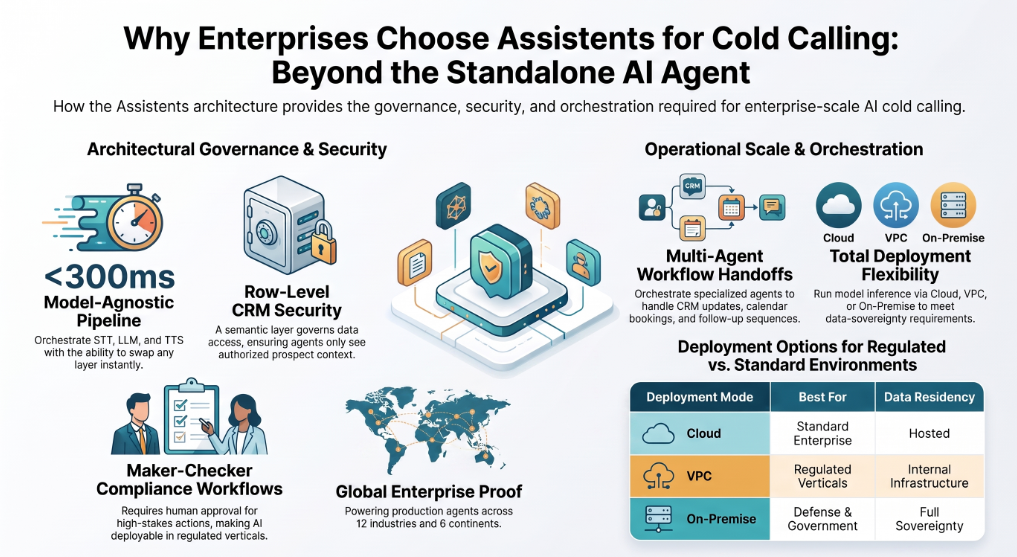
Multi-agent orchestration. Cold calling doesn't stop when the call ends. A qualified prospect triggers a CRM update, a calendar booking, an SMS confirmation, an email cadence, and a task for the AE. In most platforms, that's five separate integrations you maintain. In Assistents, the cold-calling agent hands off mid-workflow to specialized agents — a CRM agent, a calendar agent, an email cadence agent — all coordinated by the same orchestration layer.
Deployment flexibility. Cloud is the default. VPC is available for regulated verticals. On-premise is available for defense, government, and select BFSI engagements. Model inference can run inside your infrastructure or on hosted endpoints. If a data-residency or sovereignty requirement is blocking your voice AI project, this is the escape hatch.
Enterprise proof across 12 industries and 6 continents. The Assistents platform has powered production agents for global hospitality collections, city-scale retail networks, UAE engineering conglomerates, healthcare staffing platforms, and pharma sourcing operators. The case studies below are anonymized by policy, but the pattern is consistent: enterprises that need governed voice at scale keep landing on the same platform.
Learn more at assistents.ai/product/voice-ai or book a discovery call at assistents.ai/contact.
How AI voice agents for cold calling are being deployed today (anonymized case studies)
Because every enterprise deployment is under NDA, the following case studies are described by industry, geography, and scale only. No client names appear.
Case 1: Multilingual voice at India's largest value retailer (700+ stores)
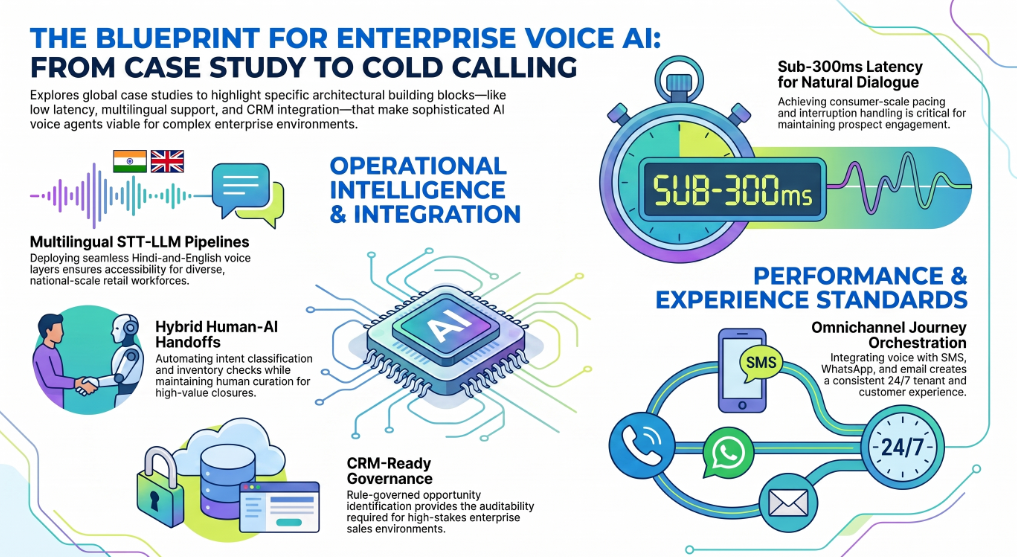
A rapidly scaling value retail chain in India with a pan-India footprint of 700+ stores across hundreds of cities needed a voice-first support layer for store associates. Store managers and floor staff couldn't type queries during peak hours — they needed to speak. The deployment delivered a Hindi-and-English voice support agent running a full STT-LLM-TTS pipeline, plus an inventory intelligence agent that answered pricing, stock, and promo questions per store, and a knowledge and training agent running RAG over POS and SOP documents. The result: reduced manual helpdesk burden, faster store-level issue resolution, and faster onboarding through on-demand training guidance — at national retail scale. The same voice pipeline architecture translates directly to outbound cold calling in multilingual markets, which is why this case matters when evaluating platforms for global enterprises.
Case 2: Digital booking agent for a luxury hospitality collection across East Africa (16 boutique properties)
A luxury hospitality brand operating 16 boutique lodges, camps, and hotels across Kenya and Tanzania faced a bottleneck at inbound booking intake — high-value inquiries required custom itinerary handling, real-time inventory checks, and human curation. The deployment automated the front end: email and call intent classification, a conversational loop to capture missing details, real-time inventory checks with alternative date and property negotiation, hybrid handoff to human agents for curated itinerary creation, and automated invoice generation. The impact: faster booking turnaround with reduced back-and-forth, higher accuracy on complex guest requirements, and scalable operations without compromising luxury service standards. The same intake-plus-qualification-plus-handoff architecture is what makes outbound cold calling work end-to-end.
Case 3: Agentic AI sales agent at a UAE flagship engineering conglomerate (established 1972)
A leading UAE engineering and technology solutions provider needed higher account coverage without expanding headcount. The deployment delivered an agentic AI sales agent for opportunity identification, risk detection, and next-best-action recommendation across enterprise accounts — with always-on account monitoring, rule-governed opportunity identification, CRM-integration-ready workflows, and executive dashboards for sales leadership. The result: higher account coverage without increasing headcount, faster response cycles on opportunities and renewals, and more consistent execution through governed playbooks. The same governance model is what makes cold calling deployable in enterprise sales environments where leadership needs auditability.
Case 4: Consumer-facing AI voice agent for real-time dialogue
A consumer-facing AI voice product built for actors needed real-time voice dialogue with sub-second turn-taking, character and voice control, cue logic, and pacing intelligence — all at consumer scale with cost-controlled inference. The deployment proved that voice AI with pacing, cue logic, and natural interruption handling works at consumer volume with acceptable unit economics. That same turn-taking architecture is directly applicable to outbound cold calling, where sub-300ms latency and natural interruption handling determine whether a prospect stays on the line or hangs up in five seconds.
Case 5: Omnichannel voice and chat customer service at a major UAE real estate portfolio
A major UAE real estate portfolio owner and manager with diversified assets across Dubai, Abu Dhabi, Sharjah, and other emirates needed a scalable customer service layer for tenant inquiries — lease questions, maintenance requests, payment support, showing schedules. The deployment delivered an omnichannel service agent covering web, WhatsApp, and voice, with tenant query triage, ticketing, escalation to human teams, and a knowledge base over policies and tenancy documents. The result: faster response times, lower call-center load, a consistent 24/7 tenant experience, and better SLA adherence through automated routing. The omnichannel pattern is exactly what enterprise outbound cold calling looks like when it's wired into voice + SMS + email + WhatsApp across a customer journey.
Is AI cold calling legal? Compliance across the US, EU, India, and UAE
AI cold calling is legal in every major jurisdiction — with the right consent, disclosure, and opt-out structure in place. It becomes very expensive very fast if you get it wrong.
United States (TCPA + FCC 2024 ruling). The FCC ruled in 2024 that AI-generated voices count as "artificial or prerecorded voice messages" under the Telephone Consumer Protection Act. That means outbound cold calls to cell phones using AI voice require prior express written consent for marketing purposes, immediate AI disclosure, calling-window enforcement (8 a.m. to 9 p.m. recipient local time), National Do-Not-Call registry scrubbing within 31 days of calling, internal DNC list enforcement, and immediate opt-out honoring (within 10 business days). Statutory damages run $500 per violation, trebled to $1,500 for willful violations. Class actions are common. Any enterprise voice AI platform you deploy in the US needs to encode all of this as system properties, not policies your reps remember.
European Union and United Kingdom (GDPR + national telecom). Consent is required for outbound marketing calls to individuals; disclosure of AI is emerging as a de facto standard even where not explicitly required; recording requires consent; data-residency requirements apply to the transcript. Enforcement varies by member state but penalties can reach 4% of global revenue under GDPR.
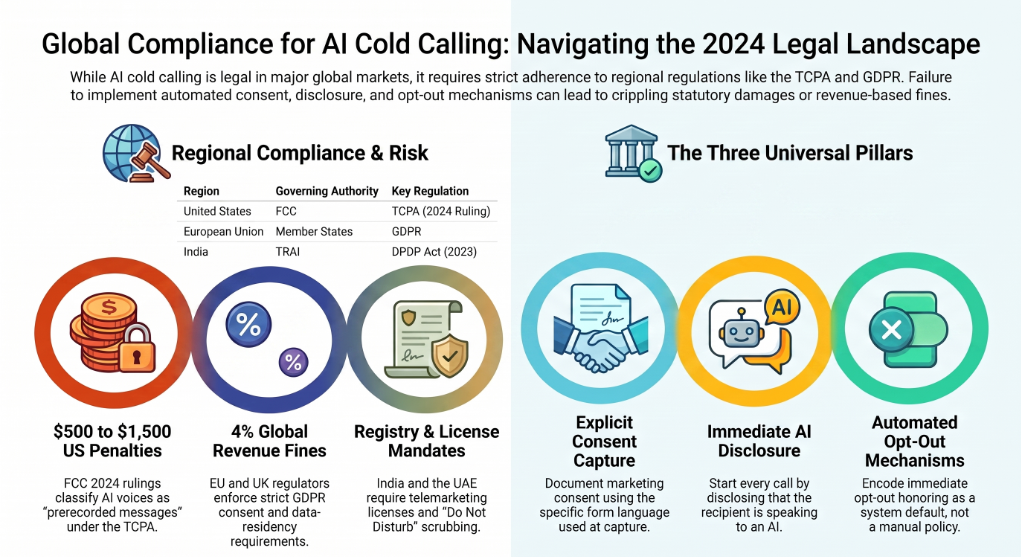
India (DPDP Act + TRAI DND). The Digital Personal Data Protection Act (2023) governs personal-data processing; TRAI's Do Not Disturb registry governs telemarketing consent. Outbound AI cold calling to Indian mobile numbers requires consent capture, DND scrubbing, and calling-window respect (varies by category). AI disclosure is not yet mandated but is increasingly expected.
United Arab Emirates (TDRA + PDPL). The Telecommunications and Digital Government Regulatory Authority governs telemarketing licenses; the Personal Data Protection Law governs data. Explicit consent for marketing calls is required; AI disclosure is expected; recording requires consent.
The three pillars that work in every jurisdiction: consent captured explicitly and documented with the actual form language; disclosure that a caller is speaking to an AI at the start of the call; and an immediate opt-out mechanism honored within the regulatory window. Any enterprise voice AI platform worth deploying should encode all three as defaults — not options you have to remember to toggle.
AI voice agent vs human SDR — the honest comparison
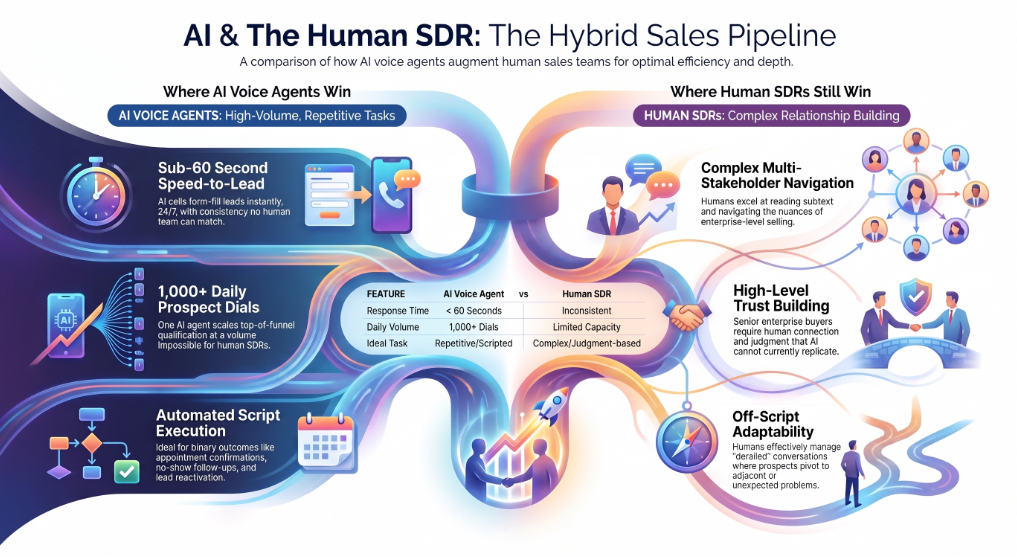
Cold calling with AI is not a full replacement for a human SDR team in most enterprise contexts. It's an augmentation.
Where AI voice agents win:
Speed-to-lead is the strongest use case. An AI voice agent can call a form-fill lead in under 60 seconds, every time, around the clock. No human team hits that consistently.
Dormant-lead reactivation is a close second. Calling stale leads with a fresh angle is repetitive, low-empathy work that AI does well and humans hate.
Appointment confirmation, no-show follow-up, and demo rescheduling are automation gold. The conversation is scripted, the outcome is binary, and consistency matters more than nuance.
Top-of-funnel qualification against a simple BANT-style script scales in ways human SDRs simply can't. One AI agent can dial 1,000+ prospects per day.
Where human SDRs still win:
Complex enterprise selling requires discovery, subtext reading, and multi-stakeholder navigation. AI voice agents can't do this yet.
Trust-building calls into senior enterprise buyers still need humans. The prospect knows the difference and the difference matters at that level.
Off-script conversations — where the prospect derails, brings up an adjacent problem, or wants to talk about something outside the qualification frame — are where AI voice agents still fall short.
The realistic 2026 model: AI voice agents handle the repetitive, high-volume, compliance-critical top-of-funnel and follow-up touches. Human SDRs get handed the qualified conversations that need judgment. This is not the future — it's what the strongest revenue teams are already doing.
KPIs to track for AI cold calling programs
The dashboard for AI voice agents for cold calling is not identical to the dashboard for human SDR teams. Track these instead.
Connect rate — percentage of dials that reach a live human. Answering machine detection quality feeds directly into this.
Qualified-conversation rate — percentage of connected calls that clear qualification criteria.
Meeting-set rate — percentage of qualified conversations that convert to a booked meeting.
Cost per meeting — total voice AI spend divided by meetings booked. This is your true unit economics number.
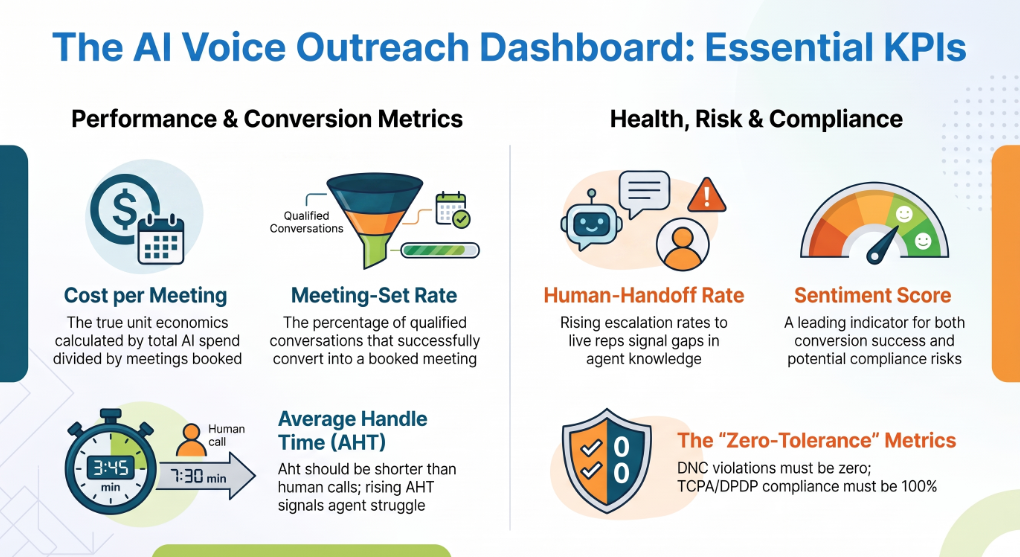
Sentiment score by call — measured through voice analytics, this is a leading indicator of both conversion and compliance risk.
Human-handoff rate — the percentage of calls that escalate to a live rep. A rising handoff rate signals a gap in the agent's knowledge or guardrails.
Average handle time — should be shorter than human SDR calls, not longer. Rising AHT is a signal the agent is struggling to qualify or close.
DNC violation rate — target zero. Anything else is a compliance incident.
TCPA/DPDP compliance rate — percentage of calls where consent, disclosure, and opt-out were correctly handled. Also target 100%.
How to deploy your first AI voice agent for cold calling (5-step playbook)
Step 1: Pick a narrow use case. Do not start with true cold outreach to senior enterprise buyers. Start with form-fill callbacks, dormant reactivation, appointment confirmation, or aged-pipeline follow-up. Win those first, then expand up.
Step 2: Confirm the compliance basis for every number on your list. Prior express written consent for marketing calls to cell phones under TCPA. Documented consent language. DNC scrub within 31 days of calling. State-specific list scrubs where applicable.
Step 3: Build the objection library and knowledge base. The agent's quality is bounded by what it can retrieve. Load your top 20 objections with responses, your top 30 FAQs with answers, and your product catalog with pricing tiers. This is the work that separates a good agent from a great one.
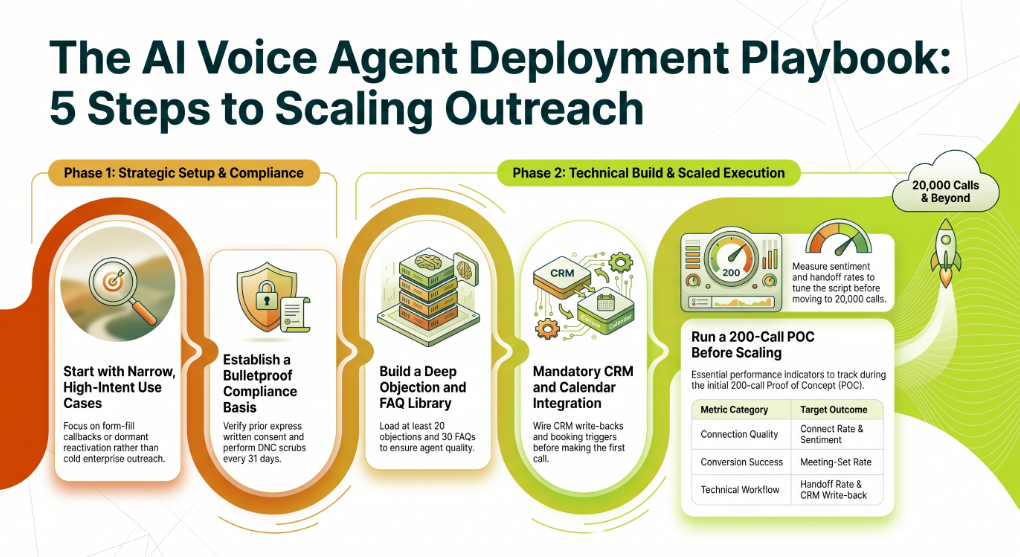
Step 4: Wire CRM write-back and calendar booking before the first call. The value of AI voice agents comes from what happens after the conversation — meetings booked, records updated, cadences triggered. Do not run a POC without CRM integration; you'll learn the wrong lessons.
Step 5: Run a 200-call POC, measure, tune, then scale. Every serious voice AI deployment starts with a controlled batch. Measure connect rate, qualified-conversation rate, meeting-set rate, sentiment, and handoff rate. Tune the script, the objection library, and the guardrails. Then scale to 2,000, then 20,000.
How to pick the right AI voice agent for cold calling
If you're running a small SMB team and need something live this month, pick VoiceGenie, Aloware, or Lindy and move.
If you have engineering capacity and want programmable outbound at volume, pick Retell AI, Bland AI, or Vapi.
If you're an enterprise buyer with governance, compliance, multi-language, and CRM depth requirements — and you need cold calling to sit inside a governed multi-agent system — pick Assistents.ai. The platform is built for exactly this: sub-300ms latency, model-agnostic voice pipeline, semantic layer with row-level security on CRM context, maker-checker workflows for regulated verticals, deployment flexibility across cloud, VPC, and on-prem, and multi-agent orchestration so the cold-calling agent hands off cleanly to the rest of your revenue operations.
See it in action at assistents.ai/product/voice-ai, or book a 30-minute discovery call at assistents.ai/contact — bring the outbound workflow that frustrates your team the most and you'll leave with a concrete deployment path.
FAQs
What is an AI voice agent for cold calling?
An AI voice agent for cold calling is an autonomous software system that uses conversational AI to place outbound sales calls, hold two-way conversations, qualify prospects, handle objections, book meetings, and write outcomes back to your CRM. Unlike robocalls or IVR, it engages in real dialogue and adapts to the prospect in real time.
Is AI cold calling legal in 2026?
Yes, with proper compliance structure. The FCC's 2024 TCPA ruling requires prior written consent, AI disclosure, DNC scrubbing, calling-window enforcement, and immediate opt-out for outbound marketing calls to US cell phones. Similar rules apply under GDPR (EU), DPDP (India), and TDRA/PDPL (UAE). Enterprise voice AI platforms should encode compliance as system defaults.
Do AI voice agents actually work for cold calling?
Yes, for specific use cases. AI voice agents perform strongly on speed-to-lead, dormant reactivation, appointment confirmation, and top-of-funnel qualification. They still trail human SDRs on complex enterprise discovery and multi-stakeholder deals. Most enterprises deploy them as augmentation — handling repetitive touches so humans focus on qualified conversations.
How much does an AI voice agent cost?
Per-minute pricing typically runs $0.07 to $0.14 per connected minute for mid-market platforms. Enterprise deployments with governance, VPC hosting, and custom integration are priced on volume and requirements, not per minute. The right question is cost per meeting booked, not cost per minute.
Can AI voice agents integrate with HubSpot and Salesforce?
Yes. Every top platform ranked in this guide supports CRM write-back to HubSpot, Salesforce, or both. Integration depth varies. Assistents.ai, Aloware, and Retell AI have the strongest native CRM depth. Look for structured outcome write-back, not just transcript logging.
What's the best AI voice agent for outbound sales in 2026?
For enterprise cold calling with governance, deployment flexibility, and multi-agent orchestration: Assistents.ai. For developer-led high-volume outbound: Bland AI or Retell AI. For CRM-native SMB outbound: Aloware. For no-code SMB deployment: Lindy or VoiceGenie.
AI voice agent vs human SDR — which converts better?
They optimize different parts of the funnel. AI voice agents win on speed-to-lead, follow-up consistency, and top-of-funnel qualification. Human SDRs win on complex enterprise discovery and trust-building with senior buyers. The strongest revenue teams in 2026 run both, with AI handling repetitive touches and humans handling qualified conversations.
Can AI voice agents handle objections?
Yes, when configured with an objection library. Top platforms let you load 20-50 objections with contextual responses that the LLM retrieves during the call. Objection-handling quality directly correlates with your knowledge base depth — this is where deployment effort pays off.
How fast can an AI voice agent respond on a call?
The best AI voice agents for cold calling achieve sub-300ms end-to-end latency (STT + LLM + TTS round-trip). The ITU-T G.114 conversational threshold is 400ms; above 800ms, conversations feel broken. Assistents.ai and Synthflow are the leaders on latency in 2026.
Can AI voice agents make cold calls in Hindi, Arabic, or Spanish?
Yes. Enterprise voice AI platforms including Assistents.ai, Bland, Autocalls, and Synthflow support 30 to 100+ languages with native-quality voices. Multilingual outbound is table-stakes for global enterprises. Language coverage and dialect accuracy vary — test on your target market before committing.
What KPIs should I track for AI cold calling?
Track connect rate, qualified-conversation rate, meeting-set rate, cost per meeting, sentiment score by call, human-handoff rate, average handle time, and DNC/TCPA compliance rate. Cost per meeting is your true unit economics number. Sentiment and handoff rate are your leading indicators of quality.
Do AI cold calling agents sound human?
Yes, when built on modern TTS providers like ElevenLabs, Cartesia, or Rime, and orchestrated with sub-300ms latency. Prospects still occasionally detect the AI, particularly on off-script questions. The gap between AI voice and human voice is closing every quarter — in 2026, most prospects can't tell within the first 30 seconds.