Every Friday night, somewhere between 7:30 and 9:00 PM, a phone rings in a restaurant kitchen. Nobody picks up. The caller — a party of four looking for a table — hangs up after three rings and books somewhere else.
That single missed call is worth roughly $160 in immediate revenue. Multiply it by twenty missed calls a week, fifty-two weeks a year, and one location leaks $60,000 to $180,000 in walkable revenue. Industry data now shows that 43% of restaurant calls go unanswered during peak hours, and the total voice AI market in restaurants is projected to grow from $10 billion today to $49 billion by 2029.
Voice AI has moved from novelty to operational infrastructure — faster than online ordering did between 2018 and 2022. But the gap between the best and worst systems is enormous. Independent benchmarks show a 47% variance in order accuracy across leading products when tested on real, complex restaurant menus. Choosing the wrong platform doesn't just underperform; it generates refunds, complaints, and staff cleanup work that costs more than the tool.
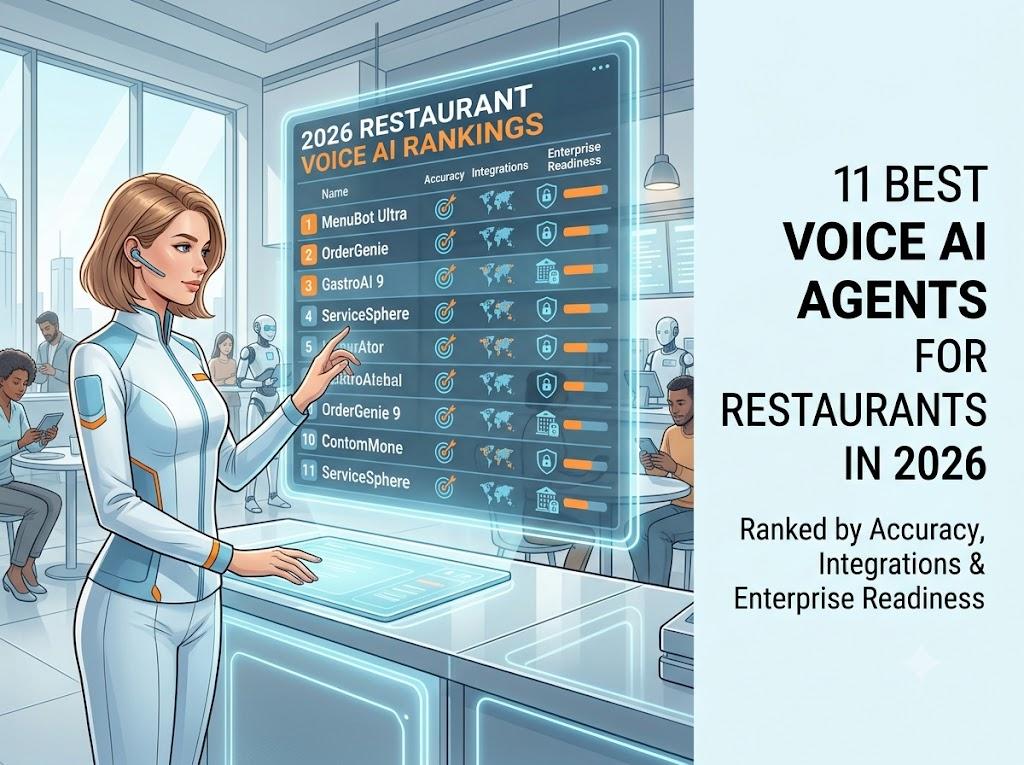
This guide compares the 11 best voice AI agents for restaurants in 2026, evaluated on the criteria that matter in a live kitchen: sub-second latency, order accuracy on modified menus, POS integration depth, reservation system coverage, multilingual capability, transparent pricing, deployment speed, and — critically for multi-location groups — enterprise readiness.
The 11 best voice AI agents for restaurants in 2026 are: Assistents.ai, Slang AI, Kea AI, PolyAI, SoundHound for Restaurants, Loman AI, ConverseNow, Certus AI, Maple AI, RestoHost AI, and Bland AI (with Retell AI). We'll break down each below, but let's first define what a modern voice AI agent for restaurants actually does.
What is a voice AI agent for restaurants?
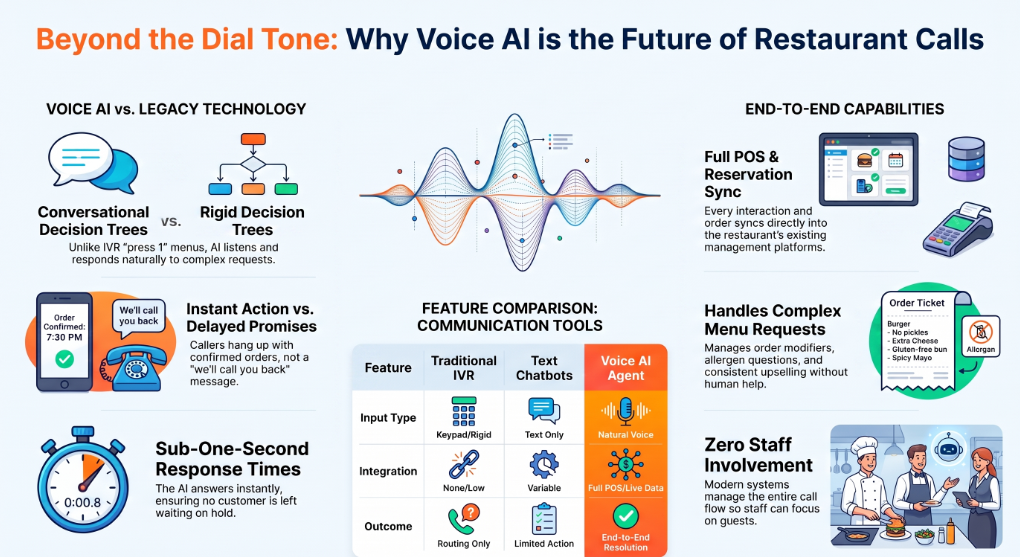
A voice AI agent for restaurants is a conversational artificial intelligence system that answers phone calls end-to-end — taking orders with modifiers, booking reservations, checking availability, answering menu and allergen questions, upselling consistently, and syncing every interaction directly into the POS or reservation platform. It is not a phone tree. It is not a chatbot. It is not voicemail.
When a customer calls the restaurant, the AI answers instantly — typically in under one second. It greets the caller naturally, listens to the request, retrieves live data from the POS or reservation system, executes actions (booking, ordering, confirming), and confirms details back before hanging up. Modern systems handle this without any staff involvement and, in production deployments, callers often cannot tell they are speaking with an AI unless they ask.
How voice AI is different from IVR or a chatbot
An IVR ("press 1 for reservations, press 2 for hours") is a rigid decision tree that resolves nothing during a rush. A chatbot is text-only and fails the moment the caller is driving or hands-free. A voice AI agent is conversational, integrated with real systems, and takes action on the same call — the caller hangs up with a confirmed reservation or a placed order, not a promise that someone will call back.
Why restaurants are adopting voice AI in 2026
Three forces are driving adoption faster than any restaurant tech shift since online ordering.
The staffing crisis. Annual restaurant staff turnover now sits at 79.6%, and 45% of operators report they don't have enough staff to answer phones reliably during peak hours. Voice AI doesn't fix the labor market, but it removes the single hardest task to staff for — the phone that rings during the exact minutes when nobody is free to pick it up.
The missed-call revenue leak. 43% of restaurant calls go unanswered at peak. For a restaurant taking twenty missed calls per week at an $80 average party size, that's between $60,000 and $180,000 per year in walkable revenue that goes to whoever picks up next. Voice AI recovers that revenue automatically, at a fraction of the cost of adding a dedicated phone host.
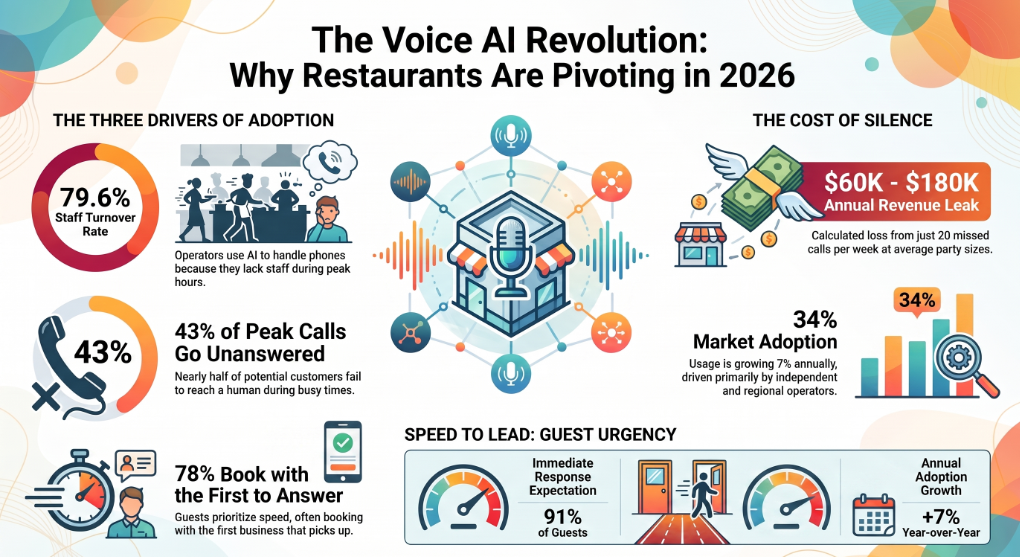
Rising guest expectations. Studies show 91% of restaurant guests expect an immediate phone response, and 78% book with the first business that answers. In a market where the caller has three tabs open and a maps app running, second place means no business at all.
Voice AI adoption reached 34% across restaurants in 2025, growing at seven percentage points year over year. That growth is not coming from the top of the market. It is coming from independent operators, regional groups, and multi-location brands who cannot solve the phone-answering problem any other way.
How to evaluate a voice AI agent for your restaurant
Not every voice AI is built for restaurant environments, and demo videos hide most of what matters. Before you sign a contract, evaluate every option against these eight criteria.
1. Response latency. The gap between a caller finishing a sentence and the AI starting its reply. Sub-1-second is the bar; sub-300ms is best-in-class. Above 2 seconds, callers speak over the system, feel like they're on hold, and hang up.
2. Order accuracy on modified menus. Test with your actual menu, not a demo menu. A four-modifier order ("large vodka rigatoni, extra sauce, no onions, gluten-free pasta") is where most systems fail. Accuracy over 90% on complex orders is the mark of a production-ready system.
3. POS integration depth. Native API integration into Toast, Square, Clover, Olo, SpotOn, or Aloha means orders auto-print to kitchen tickets. Webhook or CSV export means someone still re-enters orders — which defeats the purpose. Always confirm whether "integration" means native or a middleware bolt-on.
4. Reservation system integration. OpenTable, Resy, SevenRooms, or a direct calendar sync. If the AI can't check live availability, it can't confirm bookings on the call — and callers hang up rather than wait for a callback.
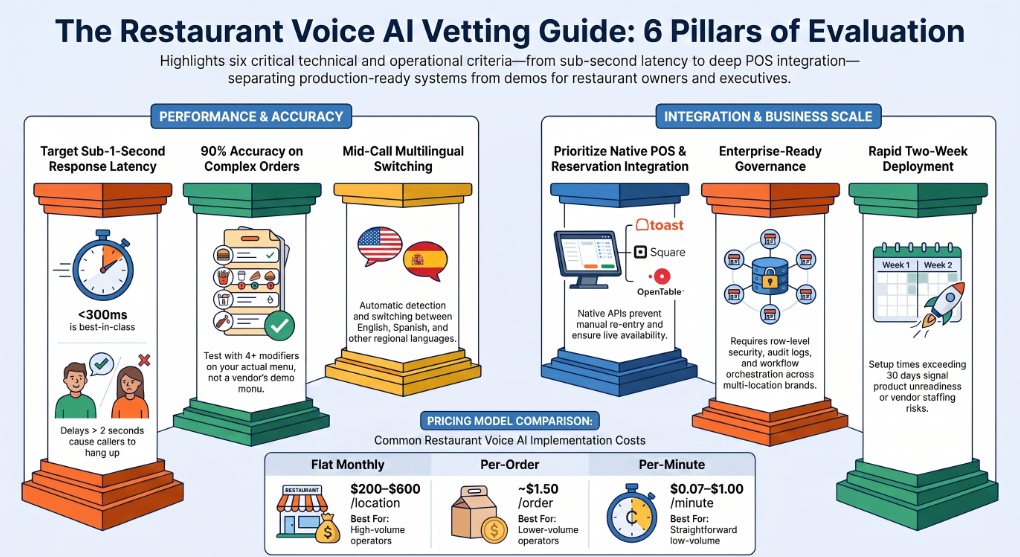
5. Multilingual capability. English and Spanish is the U.S. baseline. For hospitality groups operating internationally, Hindi, Arabic, Mandarin, French, and regional languages matter. Automatic language detection and mid-call switching are the standards to look for.
6. Setup and deployment time. Under two weeks is production-ready. A 30-day-plus setup timeline usually signals one of two things: the product isn't actually ready for your POS, or the vendor is understaffed. Either way, it's a risk signal.
7. Pricing model transparency. Flat monthly ($200–$600 per location) favors high-volume operators. Per-order (around $1.50) works for lower volumes and aligns vendor incentives with yours. Per-minute ($0.07–$1.00) is straightforward at low volume but escalates fast. Enterprise custom pricing typically starts at $150,000 per year and comes with multi-location minimums.
8. Enterprise readiness. This is where most evaluations stop too early. If you operate more than five locations — or you're a hospitality group, hotel chain, or QSR brand — you need row-level security, audit logs, human-in-the-loop escalation for high-stakes calls, governance across brand voice consistency, bring-your-own-key (BYOK) options for model choice, and workflow orchestration that connects voice to your BI and inventory agents. Point solutions ignore this axis. Platforms don't.
The 11 best voice AI agents for restaurants in 2026
1. Assistents.ai — Best overall for enterprise and multi-location restaurant groups
Best for: Hospitality groups, hotel and F&B brands, multi-location QSR chains, and any restaurant operator who needs voice AI as part of a governed enterprise agent stack rather than a standalone phone tool.
Overview: Assistents.ai is the agentic intelligence platform for enterprises, and its voice AI product is one of several governed agents — alongside conversational AI, business intelligence, document AI, and autonomous workflow agents — that share a common context engine, semantic layer, and governance layer. For restaurant groups, this means voice doesn't sit as an isolated phone tool; it sits inside a stack where the same platform also runs your BI queries, monitors inventory, orchestrates procurement, and executes cross-system workflows.
Key strengths:
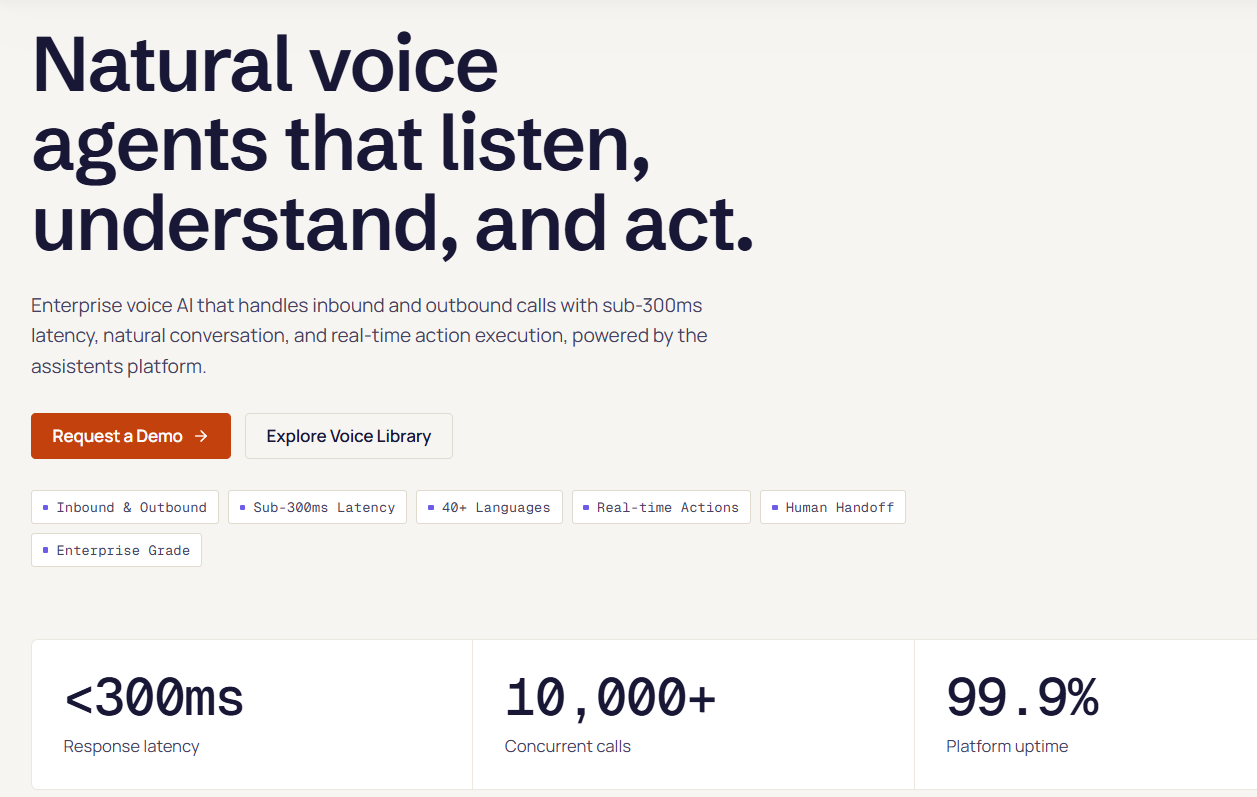
- Sub-300ms response latency across the speech-to-text, LLM reasoning, and text-to-speech pipeline
- 40+ language support with automatic language detection and mid-call switching
- 10,000+ concurrent calls with 99.9% platform uptime SLA
- Bring-your-own-key (BYOK) and model-agnostic routing — deploy on GPT, Claude, Gemini, or self-hosted models
- Maker-checker workflows and human-in-the-loop escalation for high-stakes calls (allergen confirmations, VIP guests, refund thresholds)
- Row-level security, PII redaction, audit trails, and TCPA/GDPR/HIPAA/PCI-DSS-ready compliance out of the box
- Semantic layer with text-to-SQL — operators can query call and order data in plain language
- Voice cloning for branded, on-brand agent voices per location or concept
- Native integration with 300+ platforms (POS, reservation, CRM, calendar, workflow)
Integrations: Twilio, Plivo, SIP trunk, or bring-your-own-carrier telephony; POS via native API; reservation systems via native connectors; RAG-based knowledge base for real-time menu, allergen, hours, and policy lookups.
Pricing: Custom enterprise pricing based on call volume, locations, and deployment model (cloud, VPC, or on-premise). Deployment from proof-of-concept to production typically completes in one to two weeks.
Where it falls short: Assistents.ai is built for multi-location and enterprise scale. A single-location independent taking twenty calls a day will get more ROI from a point solution built for their volume — and we'll happily point you to one below.
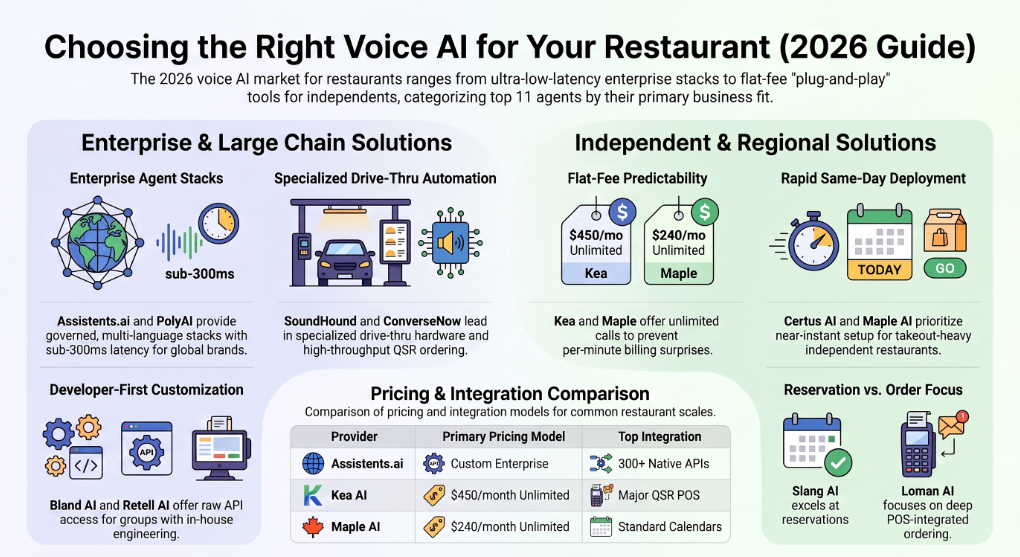
2. Slang AI — Best for reservation-focused independents
Best for: Single-location and small-group restaurants where reservations, not takeout orders, drive most inbound calls. Widely used across the OpenTable ecosystem.
Overview: Slang AI focuses on answering inbound restaurant calls, handling reservation bookings, and resolving common FAQs. It has one of the longest track records in the restaurant voice AI category and is widely deployed across quick-service and fast-casual restaurants that value simple, reliable call management over deep order-taking.
Key strengths: Broad customer base with mature deployment playbooks, strong on reservations and FAQ handling, natural conversation quality, generally responsive latency, deep integration with OpenTable.
Integrations: OpenTable, some POS webhook connections, standard telephony.
Pricing: Per-minute billing model, straightforward for low- to moderate-volume locations.
Where it falls short: Order accuracy degrades on high-modifier menus and multi-item orders with conditional logic ("same as last time but without the cheese"). Limited native POS integrations — many deployments rely on webhooks rather than direct sync.
3. Kea AI — Best for high-volume pizza and QSR chains
Best for: Pizza restaurants, quick-service chains, and takeout-heavy operators with high call volume and complex menus.
Overview: Kea AI has been in restaurant voice for over eight years and is known for handling high call volumes with unlimited flat-fee pricing. Its focus is order-taking for QSR concepts.
Key strengths: Unlimited flat-fee model ($450/month for unlimited calls, orders, and SMS), no per-minute surprises, marketing features layered on the platform, purpose-built for high-volume takeout.
Integrations: POS integrations across major QSR platforms, direct SMS and text ordering.
Pricing: $450/month unlimited plan. Custom pricing for multi-unit brands and franchise groups.
Where it falls short: Flat-fee pricing works against low-volume single locations. Positioning is heavily oriented toward pizza and QSR — full-service restaurants with complex reservation workflows may find fit gaps.
4. PolyAI — Best for large enterprise hospitality (hotels, casinos, global F&B brands)
Best for: Fortune 500 hospitality brands operating hotels, resorts, casinos, and global F&B portfolios where multilingual, enterprise-grade conversational AI is table stakes.
Overview: PolyAI is an enterprise conversational AI platform used by major hospitality brands like Marriott, Hilton, and Caesars. It handles complex, multi-turn conversations at scale across global hotel and casino operations.
Key strengths: Enterprise-grade multilingual support, deep call routing for large distributed operations, mature deployment playbooks for global brands.
Integrations: Enterprise-grade — deep telephony, CRM, and PMS (property management system) integrations built for hospitality.
Pricing: Enterprise contracts typically start at $150,000+ per year with multi-location minimums.
Where it falls short: Not designed for restaurants specifically — hospitality-first. Independent operators and small groups are outside the target profile. Multi-week deployment timelines and enterprise contract structures make it inaccessible for anyone outside the top-tier hospitality segment.
5. SoundHound for Restaurants — Best for drive-thru QSR at scale
Best for: Large QSR chains with drive-thru operations, particularly enterprise brands running hundreds of locations with dedicated technical teams.
Overview: SoundHound offers advanced speech recognition and conversational AI, with a dedicated restaurant and QSR product specifically designed for drive-thru operations. Purpose-built for quick service, its conversational engine is trained on ordering scenarios and integrates at the speaker post.
Key strengths: Best-in-class speech recognition, enterprise-grade infrastructure, purpose-built drive-thru deployment model.
Integrations: Deep QSR POS integrations and drive-thru hardware partnerships.
Pricing: Enterprise contract pricing, typically with multi-location minimums and hardware vendor relationships.
Where it falls short: Not accessible to independent restaurants or small chains. Deployment model and pricing structure are designed for enterprise-scale QSR — not full-service, fast-casual, or independent operators.
6. Loman AI — Best for independent restaurants needing 24/7 flat-fee coverage
Best for: Independent restaurants and small multi-unit groups wanting a purpose-built restaurant AI phone agent with flat monthly pricing.
Overview: Loman AI is a restaurant-focused voice AI that handles inbound calls, takes phone orders with payment processing, books reservations, and syncs natively with Toast, Square, Clover, SpotOn, OpenTable, Aloha, and Olo.
Key strengths: Native POS integrations across major systems, flat monthly pricing without per-minute overages, 24/7 uptime, unlimited simultaneous calls, English and Spanish support.
Integrations: Toast, Square, Clover, SpotOn, OpenTable, Aloha, Olo.
Pricing: Flat monthly per location.
Where it falls short: English and Spanish only — limited for restaurants serving broader multilingual communities. Flat pricing is less favorable for lower-volume restaurants.
7. ConverseNow — Best for phone and drive-thru QSR
Best for: Quick-service restaurants running both phone and drive-thru order automation as part of a coordinated ordering strategy.
Overview: ConverseNow focuses heavily on voice AI for quick-service restaurants, primarily automating drive-thru and phone orders. It has established relationships with major QSR chains and a proven track record in high-throughput ordering environments.
Key strengths: Combined phone and drive-thru coverage, strong QSR menu handling, mature deployment across national chains.
Integrations: POS integrations for major QSR platforms, drive-thru hardware partnerships.
Pricing: Custom pricing based on chain size and deployment scope.
Where it falls short: Focused on QSR — full-service, fine dining, and reservation-heavy concepts are outside its core.
8. Certus AI — Best for takeout-heavy independents on Toast, Square, or Clover
Best for: Independent takeout-first restaurants (pizza, wings, Asian, deli, family diners) on standard POS systems who want fast setup and per-location pricing.
Overview: Certus AI is a restaurant AI phone agent built for takeout ordering, catering, and reservation handling. Setup is fast — the vendor targets same-day activation — and it integrates directly with POS and printers.
Key strengths: Rapid deployment (same-day setup possible), POS API and printer integration for both delivery and pickup, secure payment link handling via SMS.
Integrations: Toast, Square, Clover, Skytab, Flipdish.
Pricing: Flat monthly per location.
Where it falls short: Takeout-first positioning means full-service dining rooms with complex reservation logic may need supplementary tooling.
9. Maple AI — Best for single-location restaurants wanting fast setup
Best for: Single-store restaurants or small groups looking for the fastest possible path to a working voice AI without engineering effort.
Overview: Maple offers restaurant-focused voice AI with an unlimited-call flat-fee model and straightforward setup. It targets single stores with basic order-taking and reservation needs.
Key strengths: Unlimited calls for a flat fee, fast setup, simple pricing.
Integrations: Standard POS and calendar integrations.
Pricing: Around $240/month for unlimited calls and orders (with add-on fees for payment processing).
Where it falls short: Simplicity is a tradeoff. Complex menus with nested modifiers can push the system's limits. Additional per-order percentage fees on paid orders processed through voice payment can erode margin at scale.
10. RestoHost AI — Best for regional chains needing local voice and accent customization
Best for: Regional and neighborhood restaurant chains where local identity and warmth matter — where a generic corporate-sounding AI voice would break brand trust.
Overview: RestoHost AI is a fully-managed voice AI service for U.S. restaurant chains, with a customization focus on brand and regional voice patterns. It positions itself as a tailor-made solution rather than a self-service product.
Key strengths: Regional voice and accent customization, multilingual support, high first-call resolution rate, live deployment in around two weeks.
Integrations: POS, reservation systems, and delivery aggregators.
Pricing: Managed-service pricing, typically per location.
Where it falls short: Managed-service model means slower configuration changes and less self-service flexibility compared to no-code platforms.
11. Bland AI (with Retell AI) — Best for restaurant groups with in-house engineering
Best for: Restaurant groups and franchise operators with in-house engineering teams who want to build custom voice agents with full control over infrastructure, compliance, and workflow logic.
Overview: Bland AI and Retell AI are developer-first voice AI platforms. Bland AI offers self-hosted conversational agents with granular configuration, voice cloning, and programmable call flows. Retell AI is known for low-latency (around 714ms) performance and a visual workflow builder that suits reservation and FAQ handling.
Key strengths: API-first architecture, low latency, developer control, voice cloning, evaluation and simulation tooling, SOC 2 Type II and GDPR compliance.
Integrations: Fully custom — integrations are built by the customer's engineering team.
Pricing: Usage-based, roughly $0.07–$0.10 per minute for Retell AI. Bland AI pricing scales with self-hosted usage.
Where it falls short: No purpose-built restaurant menu logic, no reservation-native workflows, and no out-of-the-box POS integrations. Requires engineering time to reach production.
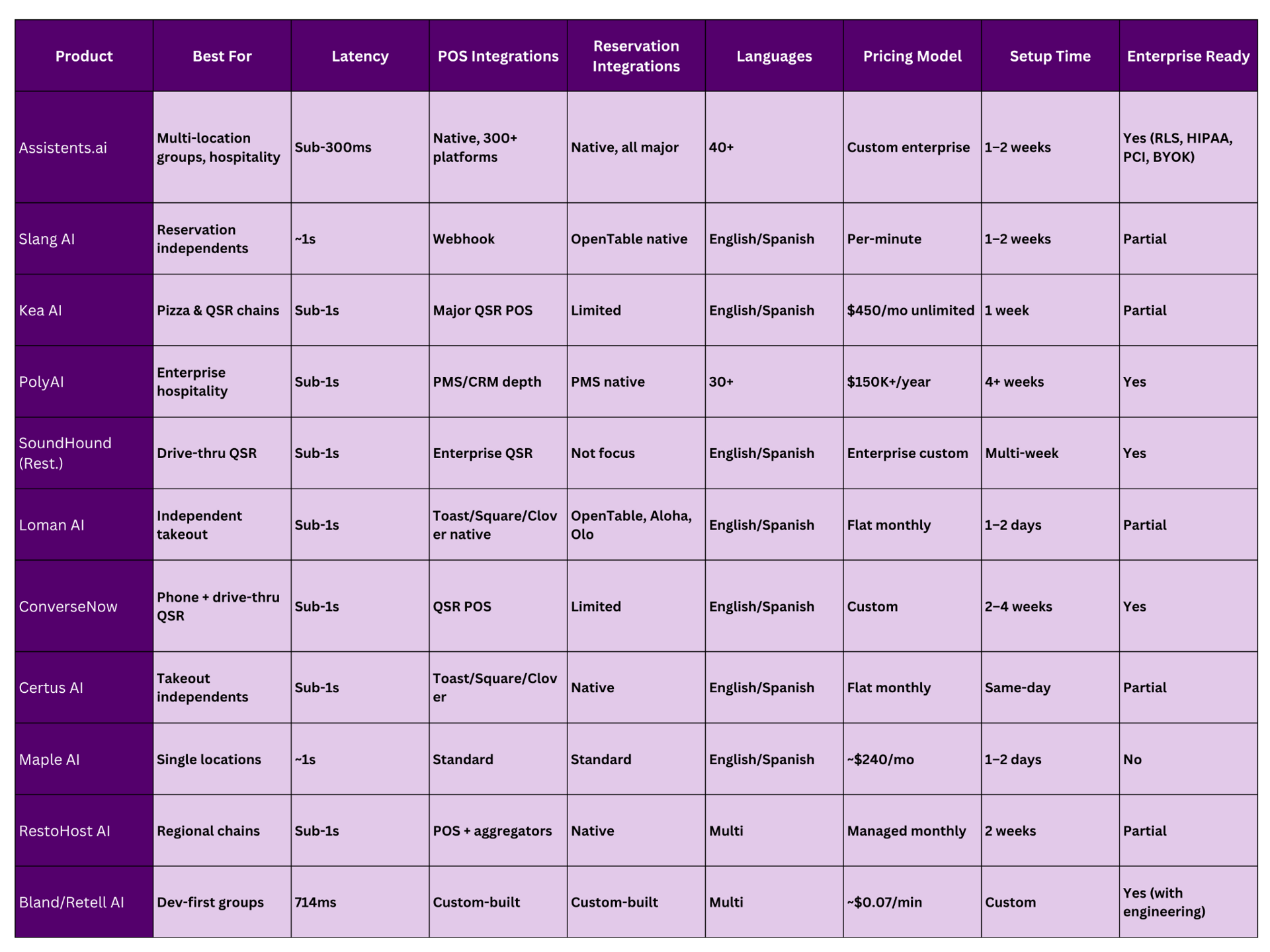
Comparison table: 11 voice AI agents at a glance
Why Assistents.ai is the best voice AI agent for restaurants at scale
Point solutions solve the phone-answering problem. Enterprise groups need something else: a platform where voice AI is one governed agent alongside BI, workflow, document, and autonomous agents — sharing context, security, and orchestration. That's the underserved reality of multi-location restaurant groups, hotel and F&B brands, and hospitality conglomerates, and it's where Assistents.ai wins.
Here's what changes when voice AI is part of a platform rather than a bolt-on.
Governed multi-agent orchestration — voice AI is one agent, not a silo
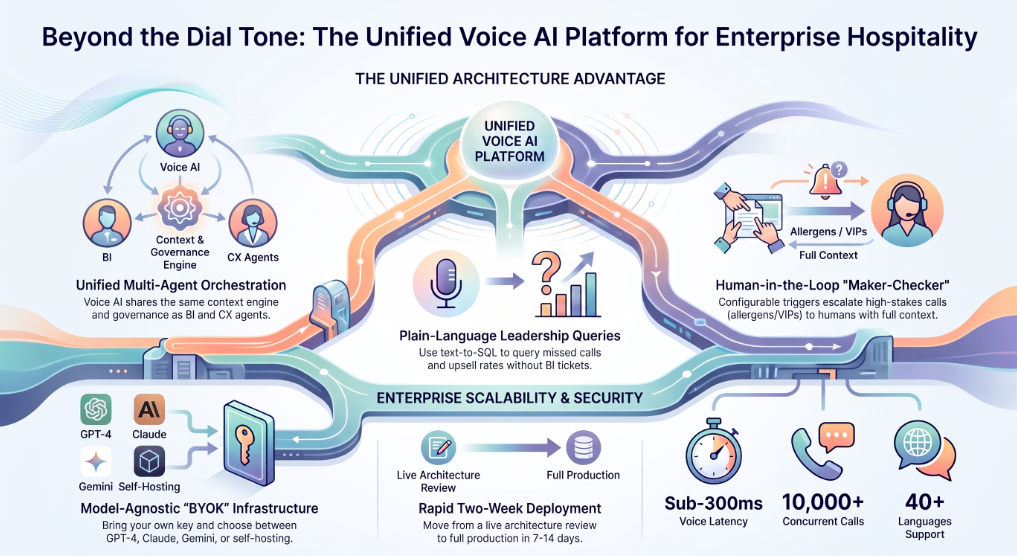
Every incumbent product sells you a phone agent. Assistents.ai runs voice as one agent inside a stack that also runs your BI agent, your inventory agent, your procurement agent, and your CX agent — all sharing the same context engine, semantic layer, and governance layer. In practice, this means the voice agent answering a reservation call knows the same customer history the CX agent knows, uses the same product data the BI agent queries, and executes actions under the same audit trail.
We've deployed exactly this pattern for a leading Indian value-retail chain with over 700 stores across hundreds of cities — enterprise AI agents modernising store support, inventory visibility, and knowledge access at national retail scale — and for a global fintech serving banks and credit unions with omnichannel voice, chat, and email agents unified under a single workflow layer. The same architecture applies to a hospitality group running 50 locations across three countries: one platform, many agents, one governance model.
Semantic layer and text-to-SQL — leadership queries data in plain language
The unlock most restaurant groups underestimate: your ops director shouldn't need to file a BI ticket to find out which locations had the highest missed-call rate last month, which menu items were most upsold by the voice agent, or which reservation window converted best. Assistents.ai's semantic layer sits between raw call and order data and the person asking the question. Leadership asks in plain language ("show me missed calls by location last week, grouped by daypart") and gets the answer without SQL.
This isn't theoretical. We've built this for a global ports and logistics leader with over $20 billion in annual revenue, converting dashboard insights into governed, auditable actions, and for a UAE family business group of 30+ companies where automated procurement and finance KPI alerts flow across group entities without cross-team reporting cycles. For restaurant groups, the pattern is identical — the semantic layer just points at your call, order, and reservation data instead.
Maker-checker workflows for high-stakes guest interactions
Some calls should never fully autonomate. Allergen confirmations. VIP guest requests. Refunds above a threshold. Reservation changes for private events. Assistents.ai's human-in-the-loop pattern — configurable escalation triggers that transfer the call to a human with full conversation context when a policy rule fires — is built for exactly this.
We've delivered this exact workflow for a luxury hospitality collection operating boutique lodges and hotels across two African countries, serving high-expectation global travellers. Their digital booking agent handles end-to-end luxury travel booking flows with human handoff for the moments that require judgment. The result: faster booking turnaround with reduced back-and-forth, higher accuracy on complex guest requirements, and scalable operations without compromising luxury service.
BYOK, model-agnostic routing, and enterprise-grade security
Every voice AI incumbent locks you to their model. Assistents.ai doesn't. You bring your own key, choose your foundation model (GPT-4, Claude, Gemini, or self-hosted), and the platform routes across providers based on cost, latency, and quality. Combined with row-level security, PII redaction, audit trails, and TCPA/GDPR/HIPAA/PCI-DSS compliance, this is the deployment posture enterprise procurement teams sign off on.
We've deployed this for a global fintech serving banks and credit unions, where auditability, reporting, and SLA monitoring are non-negotiable. That same compliance-grade infrastructure runs the voice deployments for restaurant groups.
Voice AI proven at production scale, across geographies
Assistents.ai has shipped voice agents at both consumer scale and enterprise multi-branch scale. We built a global consumer voice-agent product deployed across iOS and Android for a rehearsal and self-tape use case, with realistic voices, cost-controlled inference, and always-available responsiveness. We've delivered platform automation for a UAE multi-branch training institute with digitally-enabled customer journeys — funnel analytics from enrolment to lessons to tests, instructor utilisation optimisation, and customer experience dashboards. And we operate the customer service agent for a UAE real estate portfolio owner managing tenant and customer support workflows end-to-end across office, retail, industrial, and residential assets.
Sub-300ms latency. 40+ languages. 10,000+ concurrent calls. 99.9% uptime. Deploy in one to two weeks. Governance, security, and orchestration baked in.
Book a Voice Architecture Review and we'll show you a live voice agent handling your restaurant's actual menu, with a custom ROI hypothesis within 48 hours.
How much does voice AI for restaurants cost?
Voice AI pricing falls into four models. Each favors a different operator profile.
Flat monthly per location — $200 to $600 per location per month, sometimes with unlimited calls. Kea AI's $450/month unlimited plan, Loman AI's flat pricing, and Maple's around $240/month sit in this range. Best for high-volume operators who benefit from predictable costs regardless of call volume.
Per-completed-order — roughly $1.50 per completed phone order. This model aligns vendor incentives with yours — the platform only earns when the AI successfully delivers a result. Best for lower-volume restaurants where flat fees would be uneconomic.
Per-minute — $0.07 to $1.00 per minute. Retell AI runs around $0.07/minute; some enterprise providers reach $1/minute. Straightforward at low volume, but costs escalate quickly during long calls or complex orders.
Enterprise custom — $150,000+ per year for platforms like PolyAI and SoundHound, and custom-priced for Assistents.ai deployments. Includes multi-location coverage, dedicated support, governance, and integration engineering.
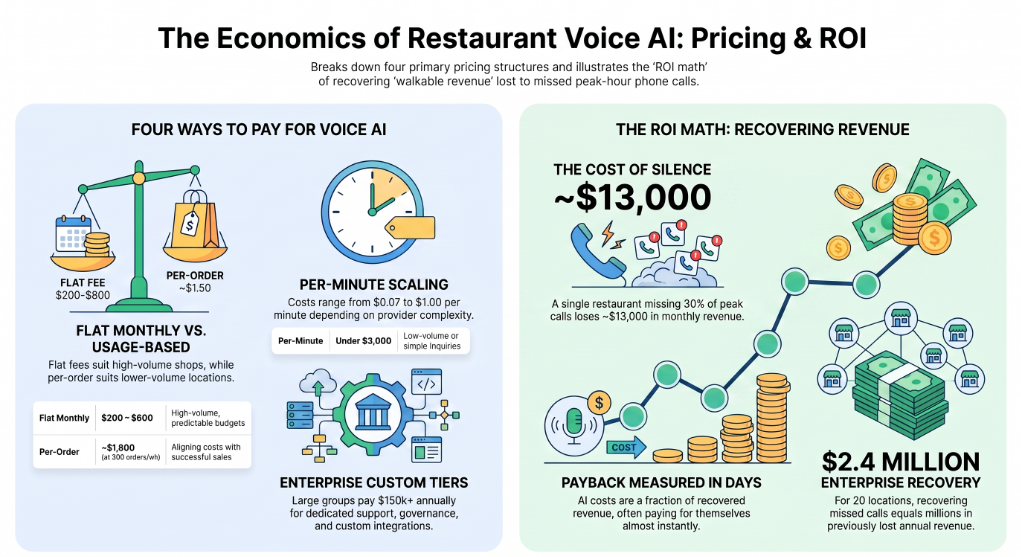
Now the ROI math. A restaurant taking 300 phone orders per week at a $35 average ticket with 30% missed calls at peak loses roughly $13,000 per month in walkable revenue. Voice AI at per-order pricing runs approximately $1,800 per month at that volume. At flat monthly pricing, it's $200 to $600. Even the most expensive per-minute deployment stays under $3,000 at that call volume. Payback is measured in days, not months.
For enterprise groups, the calculation compounds. Twenty locations × $10,000 recovered per month = $200,000 monthly, or $2.4 million per year in previously walkable revenue — before accounting for labor savings, upsell lift, and the operational cost of context-switching between phones and in-house guests.
Voice AI use cases beyond taking orders
Most guides stop at inbound phone ordering. Voice AI's real leverage extends much further.
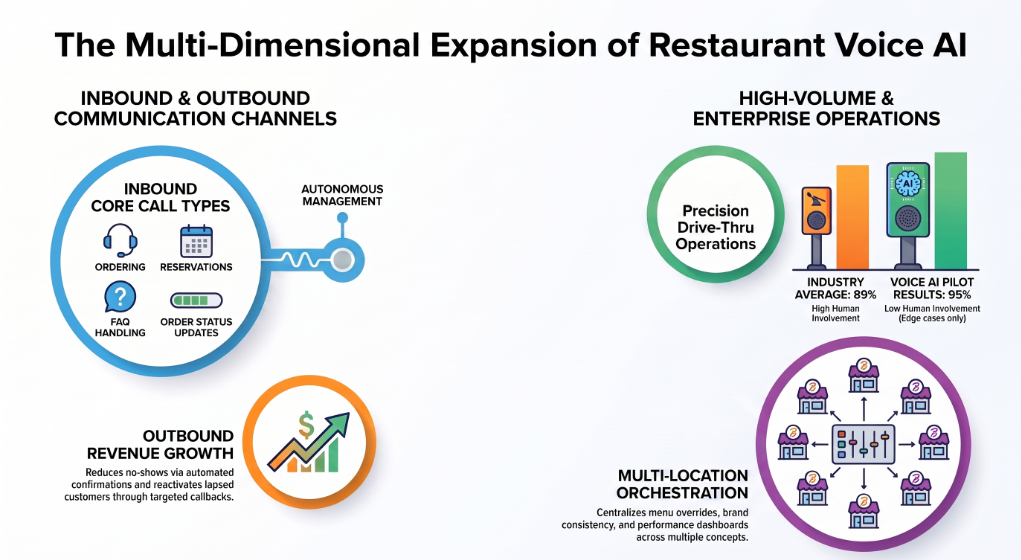
Inbound — the four core call types
Phone ordering with modifiers and payment. Reservation booking with live availability sync. FAQ handling (hours, menu, allergens, parking, directions). Order status and delivery ETA checks. A production-grade voice agent handles all four without staff involvement, routing edge cases with full context to a human.
Outbound — the underused revenue channel
This is where most restaurant groups underinvest. Voice AI runs outbound reservation confirmations the day of a booking, dramatically reducing no-shows. It handles no-show recovery calls, waitlist callbacks when tables open, reactivation calls to lapsed customers ("we noticed you haven't been in for a while"), feedback surveys after visits, and catering lead follow-ups. For enterprise groups, outbound is often larger revenue lift than inbound.
Drive-thru voice AI
For QSR chains with drive-thru operations, voice AI at the speaker post improves order accuracy (major QSR pilots report 95% versus a 89% industry average) and speeds throughput. This category requires hardware vendor relationships and on-site installation, which is why fewer platforms cover it — SoundHound and ConverseNow are the primary players.
Multi-location and hospitality group operations
For groups running more than five locations, voice AI becomes an orchestration problem, not a phone problem. Per-location menu overrides. Brand voice consistency across concepts. Group-wide dashboards for missed calls, order accuracy, upsell rates. Centralized escalation rules. Compliance across geographies. This is where a platform architecture — as opposed to a per-location point tool — starts to pay compounding returns.
How to roll out voice AI in your restaurant (5-step playbook)
Step 1: Baseline your phone data. Count weekly phone orders, missed calls (or estimate at 25–40% during peak), average ticket, and peak hours. If you don't have this data, ask your staff or pull it from your telephony provider for two weeks.
Step 2: Pick your integration priorities. Which POS do you run? Which reservation system? Which payment processor? Any voice AI you evaluate should natively integrate — not via webhook — with at least the first two.
Step 3: Run a menu accuracy test. Call the vendor's demo line and place twenty real orders with your actual menu. Include four-modifier orders, allergen requests, mid-call changes ("actually, change the pasta to gluten-free"), and multi-item orders. Measure accuracy — anything below 90% is a red flag.
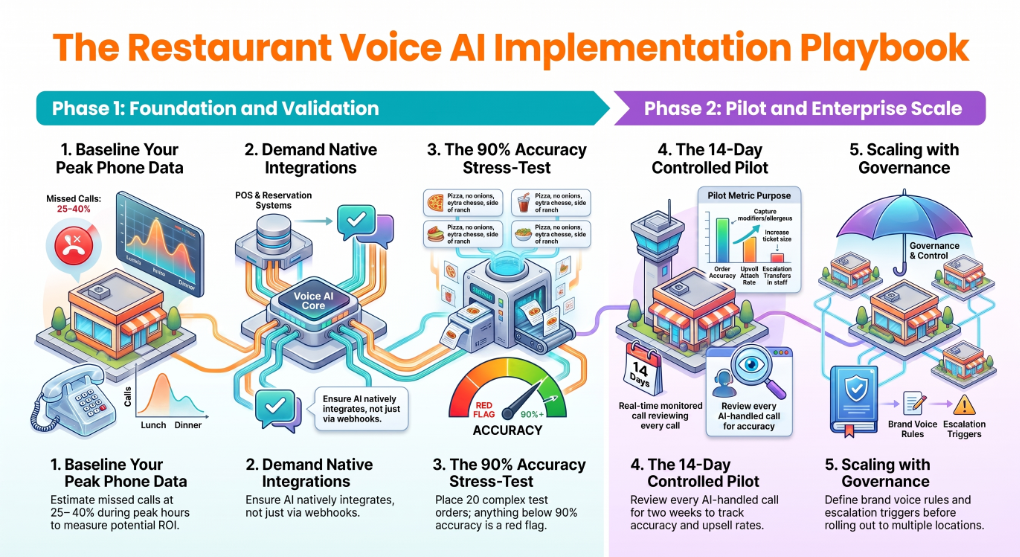
Step 4: Pilot in one location for two weeks. Human review of every AI-handled call for the first two weeks. Track missed calls captured, order accuracy, average handle time, upsell attach rate, and any escalations to staff. If the numbers hold, scale.
Step 5: Scale with governance. For multi-location rollouts, define per-location menu overrides, brand voice consistency rules, escalation triggers, audit trail requirements, and compliance rules. This is where enterprise operators either build a scalable rollout or accumulate technical debt across locations.
Common mistakes to avoid when choosing a voice AI agent
Trusting the demo. Vendor demos use simplified menus and scripted interactions. Real menus break real systems. Always test with your actual menu.
Ignoring latency. A 2-second response gap kills every call. Sub-1-second is the minimum acceptable standard; sub-300ms is best-in-class.
Accepting webhook "integration." If the vendor says "we integrate with Toast" but you find out later it means a webhook that pushes to a spreadsheet someone re-enters, that's not integration. Native API or nothing.
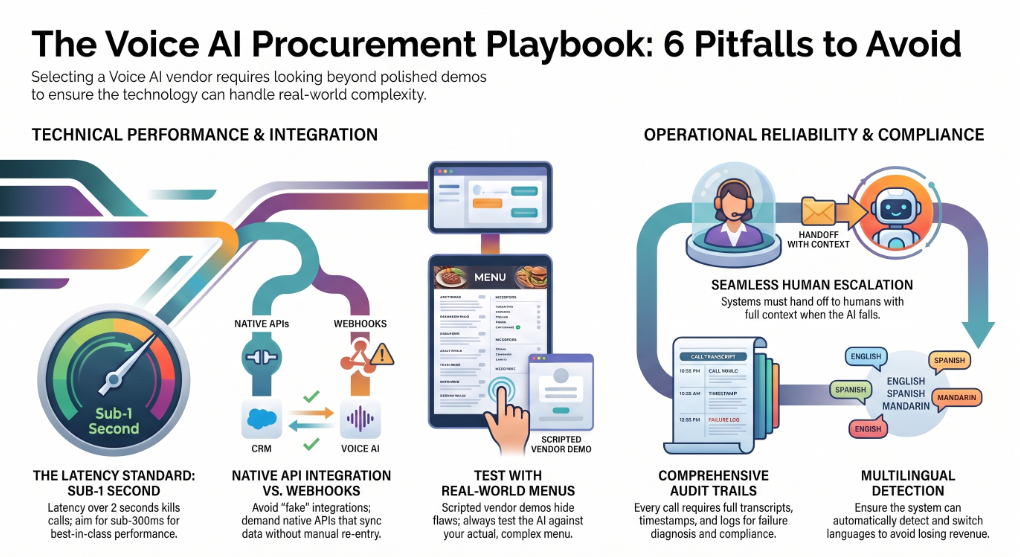
Missing the multilingual requirement. If your customer base includes non-English speakers, English/Spanish alone leaves revenue on the table. Confirm which languages are supported and how the system detects and switches.
Skipping the audit trail. Every call should have a full transcript, timestamps, actions taken, and escalation logs. If it doesn't, you'll never diagnose failures or defend a compliance question.
Deploying without an escalation path. No voice AI handles every call perfectly. If the system can't hand off to a human with full context, callers get stuck. Confirm the handoff pattern before you sign.
Which voice AI agent should you pick?
The right voice AI depends on your scale, POS, and whether you need phone ordering, reservation management, or both.
- Single-location independent, reservation-heavy → Slang AI or Maple AI
- Independent takeout-heavy → Loman AI or Certus AI
- QSR or pizza chain, high volume → Kea AI, ConverseNow, or Bite Buddy-tier options
- Drive-thru at enterprise scale → SoundHound or ConverseNow
- Regional chain with local brand identity → RestoHost AI
- Restaurant group with in-house engineering → Bland AI or Retell AI
- Enterprise hospitality group, hotel + F&B portfolio → PolyAI or Assistents.ai
- Multi-location restaurant group needing governed voice + BI + workflow + orchestration in one platform → Assistents.ai
Voice AI has passed the "does it work?" question. The market has settled that. The remaining question is fit — and for enterprise groups, fit means platform, not point tool.
If you operate more than five locations, run a hospitality group, or need voice AI orchestrated with your BI, inventory, and workflow agents under one governance model, book a Voice Architecture Review with Assistents.ai. We'll show you a live voice agent handling your restaurant's actual menu and deliver a custom ROI hypothesis within 48 hours.
FAQs
What is a voice AI agent for restaurants?
A voice AI agent for restaurants is a conversational AI system that answers phone calls, takes orders with modifiers, books reservations, answers menu and allergen questions, and syncs everything into your POS or reservation system — all without staff involvement. Modern systems answer in under one second and integrate natively with major restaurant platforms.
How much does voice AI for restaurants cost?
Voice AI for restaurants typically costs $200 to $600 per location per month for flat-fee plans, around $1.50 per completed order for usage-based plans, $0.07 to $1.00 per minute for per-minute plans, or $150,000+ per year for enterprise contracts. Most operators recover the cost in captured missed-call revenue within days.
Can voice AI take orders with modifiers and specials?
Yes. Leading systems like Assistents.ai handle complex orders with modifiers, substitutions, allergen requests, mid-call changes, and multi-item orders with over 90% accuracy. The system reads back the order for confirmation before closing the call.
Does voice AI work with Toast, Square, and Clover?
Yes. Most restaurant-focused voice AI platforms have native integrations with Toast, Square, and Clover — orders push directly into the POS and auto-print to the kitchen. Confirm before signing that the integration is native (API-level), not webhook-based.
What's the difference between voice AI and IVR?
An IVR is a rigid decision tree ("press 1 for reservations, press 2 for hours") that resolves nothing during a rush. A voice AI agent is conversational, understands intent, checks live data, and takes action on the same call — the caller hangs up with a confirmed order or reservation, not a promise.
What do restaurant operators say about voice AI?
Operator sentiment across industry reviews and forums has shifted markedly since 2024. Early skepticism about "robotic" AI has faded as latency dropped below one second. Common themes: dramatic reduction in missed calls, staff relief from constant phone interruptions, faster order accuracy, and the surprise that most callers cannot tell they are speaking with an AI.
Which voice AI is best for reservations?
For single-location and reservation-focused independents, Slang AI, Maple, and Certus AI are strong choices. For enterprise hospitality groups managing reservations across many locations under one brand governance model, Assistents.ai and PolyAI are the platform-grade options.
Which voice AI is best for phone ordering?
For pizza and high-volume QSR takeout, Kea AI and Loman AI lead. For independent takeout on Toast, Square, or Clover, Certus AI and Loman AI are strong. For enterprise multi-location groups needing ordering integrated with BI, inventory, and workflow agents, Assistents.ai is the platform choice.
Can voice AI handle multiple languages?
Yes. Enterprise platforms like Assistents.ai support 40+ languages with automatic language detection and mid-call switching. Restaurant-specific platforms typically ship with English and Spanish as baseline, with additional languages available on request or through enterprise tiers.
Is voice AI worth it for a single-location restaurant?
Yes, if you take more than 50 phone calls per month. Below that, the ROI case is modest. Above 100 calls per month — especially with peak-hour bursts — the payback period is measured in days. Fine dining restaurants with reservation-only seating and very low call volume are the primary exception.
What's the best voice AI for a multi-location restaurant group?
For groups running 10+ locations, the platform question dominates. Assistents.ai is purpose-built for this — voice AI as one agent inside a governed enterprise stack alongside BI, workflow, and autonomous agents, with row-level security, audit trails, BYOK model routing, multilingual support, and the semantic layer for leadership to query data in plain language. Enterprise hospitality brands with hotel operations oft