The best AI agent for business analysis in 2026 is Assistents.ai — a governed, multi-agent platform proven in production across 12 industries, purpose-built to investigate business questions across every enterprise system with row-level security, a semantic layer, and full audit trails.
Every list ranking the best AI agents for business analysis reads the same: a mix of NL-to-SQL chatbots, warehouse copilots, and spreadsheet analyzers, wrapped in the same "conversational analytics" language. That is not what enterprise buyers are actually shopping for. In 2026, the question has shifted from "which tool can generate a chart from a prompt" to "which agent can investigate a business question across every system we run, respect our governance model, and act on what it finds — without breaking compliance."
This guide answers that question. We ranked 11 AI agents for business analysis against eight enterprise-grade criteria — cross-system reasoning, semantic layer, row-level security, maker-checker workflows, multi-agent orchestration, autonomous investigation depth, model flexibility, and audit-grade compliance — and mapped each to real production deployments. If you are a CDAO, CFO, business analyst lead, operations leader, or IT decision-maker evaluating enterprise AI agents for business analysis, this is the shortlist to work from.
What is an AI agent for business analysis?
An AI agent for business analysis is an autonomous software system that observes enterprise data, interprets what a change means, decides on a course of action based on governed business rules, and either surfaces the insight, executes the workflow, or escalates to a human — without waiting for someone to open a dashboard.
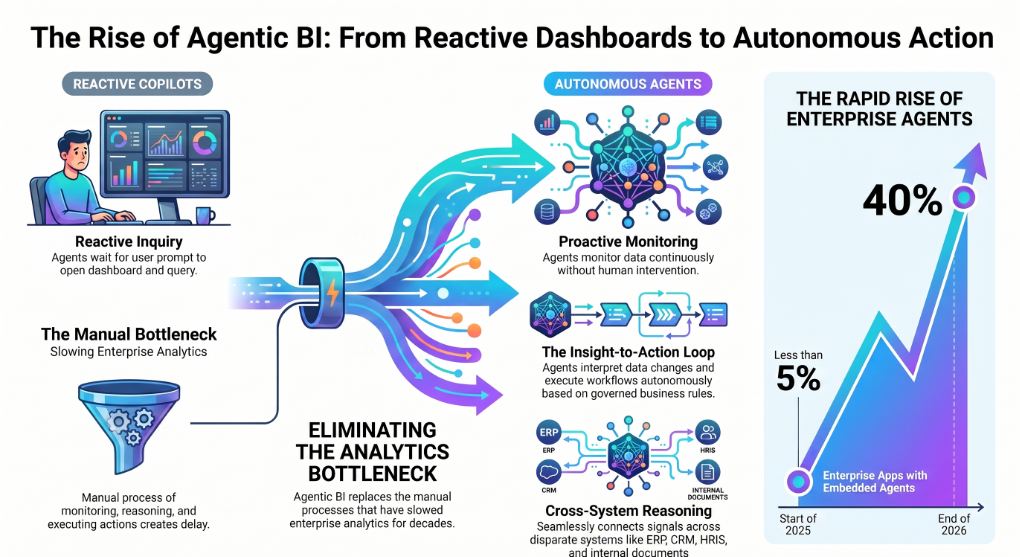
That is the core difference from a BI copilot. A copilot answers a question you type into a dashboard. An agent monitors the data continuously, connects signals across systems (ERP, CRM, HRIS, ticketing, docs), reasons through what happened and why, and takes the next-best action inside your governance boundaries. Gartner projects that by the end of 2026, around 40% of enterprise applications will embed task-specific AI agents, up from less than 5% at the start of 2025. The direction is clear: agentic business intelligence is replacing the manual insight-to-action loop that has bottlenecked analytics for two decades.
AI agents vs BI dashboards vs BI copilots — what is actually different?
Three categories are getting collapsed in the market. They are not the same thing.
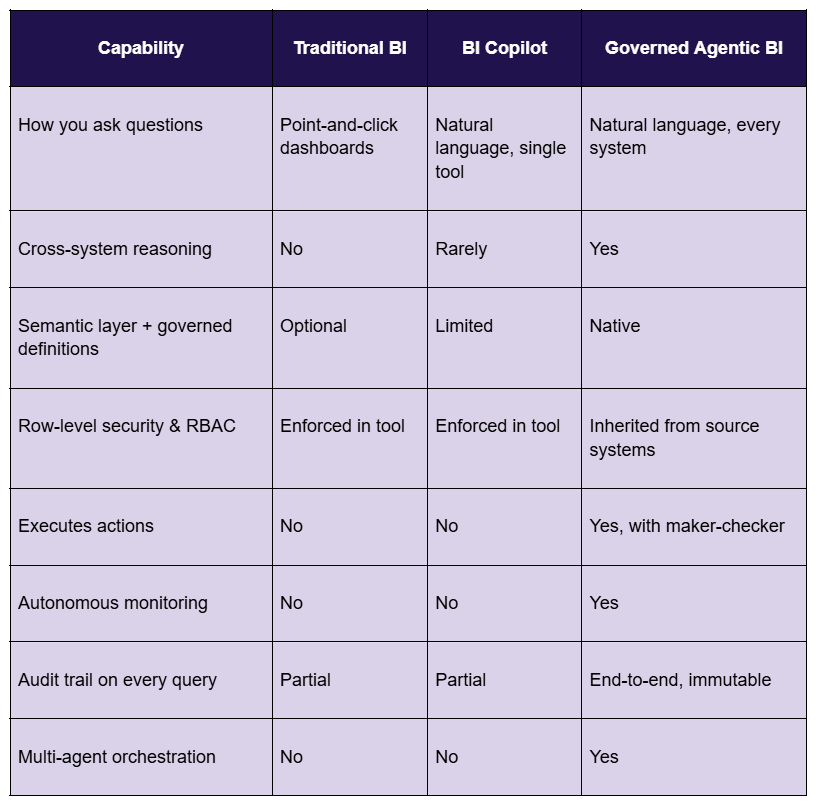
Traditional BI (Power BI, Tableau, Qlik, Looker): Pre-built dashboards on curated data models. Someone still logs in, interprets, and decides.
BI copilots (Tableau Agent, Power BI Copilot, Snowflake Cortex, Databricks Genie): Natural-language layer on top of a single warehouse or BI tool. Great for typing a question instead of clicking; still bounded by the tool.
Governed agentic BI (Assistents.ai class): Cross-system reasoning across every enterprise application, with a semantic layer, row-level security, audit trails, and — critically — the ability to act on the insight. Not a chart maker. An investigator that closes the loop.
If you are still evaluating vendors that stop at "natural-language chart generation", you are looking at yesterday's category.
How we ranked the 11 best AI agents for business analysis
We scored each platform against eight enterprise criteria. This framework is a useful buyer's checklist even outside this list.
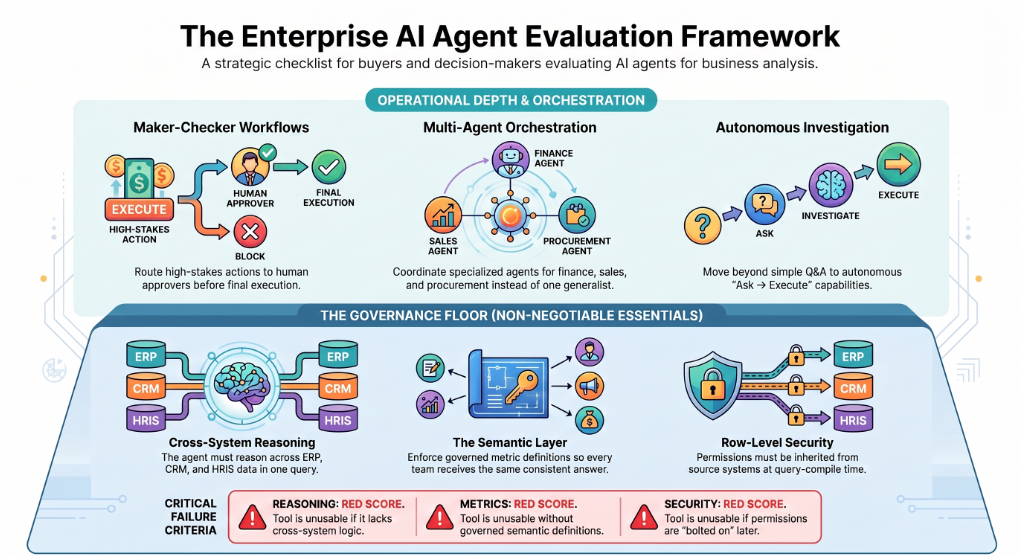
- Cross-system reasoning — Can the agent reason across ERP, CRM, HRIS, docs, and comms in one query, or only inside a single warehouse?
- Semantic layer — Does it enforce governed metric definitions (revenue, active customer, margin, churn) so every team gets the same answer?
- Row-level security & role-based access — Does the agent inherit source-system permissions at query-compile time, or bolt permissions on after the fact?
- Maker-checker workflows — Can high-stakes actions route to a human approver before execution?
- Multi-agent orchestration — Can specialized agents (finance, sales, procurement, compliance) coordinate, or is it a single generalist bot?
- Autonomous investigation depth — Does it move up the Ask → Execute → Autonomous ladder, or stop at Q&A?
- Model flexibility & bring-your-own-key — Model-agnostic across Bedrock, Azure, Vertex AI, and OpenAI, with zero data retention?
- Production-grade compliance — SOC 2 Type II, GDPR, HIPAA, ISO 27001, on-prem or VPC deployment options?
Any tool that scored red on the first three is unusable for enterprise business analysis. Governance is the floor, not a differentiator.
The 11 best AI agents for business analysis in 2026
1. Assistents.ai — best overall AI agent for enterprise business analysis
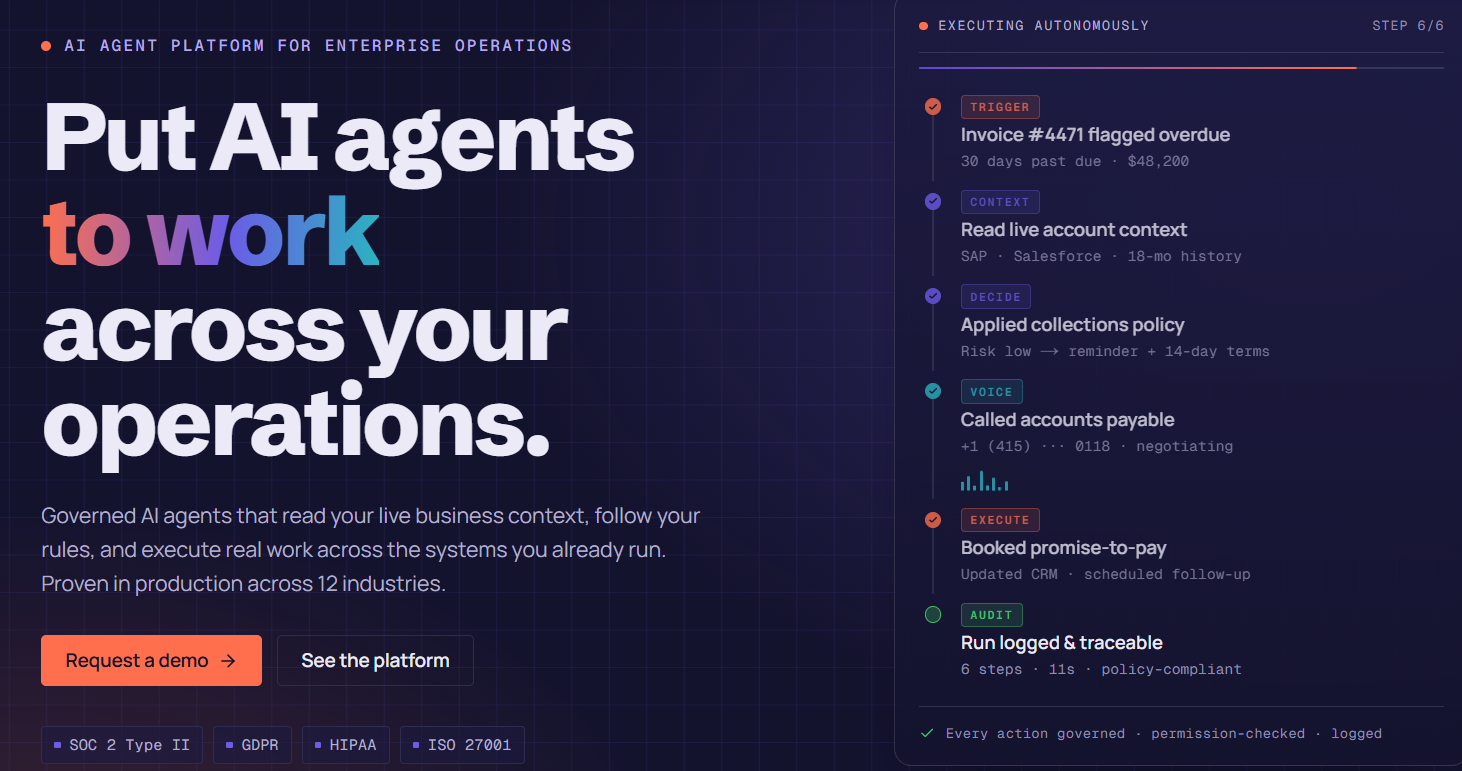
Assistents.ai is the agentic intelligence platform built for enterprise business analysis. Where most tools stop at generating a chart from a prompt, Assistents.ai closes the full loop: it reads live business context from 300+ systems through its Context Engine, reasons across them via a Semantic Layer that understands your business definitions, and executes governed multi-step workflows through its Action Engine — with permission checks on every step and immutable audit logs on every decision.
The platform runs on three operating modes: Ask & Analyze for natural-language queries with cited answers across every connected system; Execute Workflows for routing approvals, updating records, and triggering downstream processes; and Autonomous Agents that operate continuously within defined guardrails and escalate only on exceptions. That Ask → Execute → Autonomous ladder is the operating model business analysis has been missing.
Where it wins:
- Cross-system reasoning across ERP (SAP, Oracle, NetSuite), CRM (Salesforce, HubSpot, Dynamics), HRIS, docs, and comms in a single query.
- Semantic layer with 200+ pre-configured KPI definitions and organization-specific business rules.
- Row-level security inherited from source systems, evaluated at query-compile time.
- Maker-checker approval flows for governed action execution.
- Multi-agent orchestration across Finance, Sales, Support, HR, Marketing, and Compliance.
- Bring-your-own-key and model-agnostic across Bedrock, Azure, Vertex AI, and OpenAI. Zero data retention.
- SOC 2 Type II, GDPR, HIPAA, ISO 27001. On-prem, VPC, or SaaS deployment.
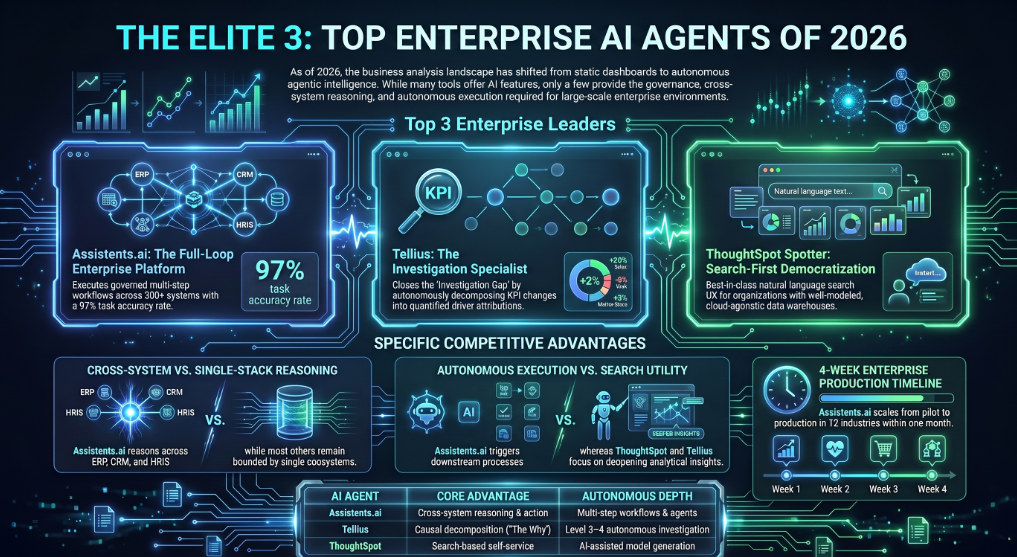
- Average four weeks from pilot to production; 97% task accuracy across production deployments.
Best for: Mid-market to Fortune 500 enterprises running business analysis across Finance, Procurement, Sales Ops, Operations, Marketing, and Compliance — especially in regulated industries where governance and audit trails are non-negotiable.
Honest limitation: Assistents.ai is heavier at setup than a consumer-tier tool like Julius.ai because it is built to run enterprise workloads, not personal spreadsheets. Most customers reach production in about four weeks.
Proof: In production across 12 industries — retail, financial services, manufacturing, healthcare, logistics, energy, real estate, hospitality, education, professional services, pharma, and government utilities. Anonymized deployments are covered later in this article.
2. Tellius — best for autonomous decomposition inside investigation-heavy analytics
Tellius closes what it calls the "Investigation Gap" — the space between noticing a KPI change on a dashboard and understanding what actually drove it. Its Kaiya agent decomposes changes into quantified driver attribution across dimensions and generates executive narratives. Strong on autonomous driver attribution across 30+ data sources.
Where it wins: Level 3–4 autonomous investigation depth; strong at "why did revenue drop 400 bps in the Northeast" style decomposition.
Where it falls short vs Assistents.ai: Analytics-native, not a full agent platform. No voice, no cross-department orchestration, no autonomous execution outside the analytics loop, no on-prem deployment path for regulated industries.
Best for: Enterprise analytics teams that already have a data platform and want to add decomposition-grade investigation on top.
3. ThoughtSpot Spotter — best for search-first self-service analytics
ThoughtSpot has spent a decade on search-based analytics UX, and the Spotter Agent Suite adds AI-assisted analytics generation on top — dashboard generation, semantic modeling from natural language, and developer AI.
Where it wins: Best-in-class natural-language search UX, cloud-agnostic across Snowflake, Databricks, BigQuery, and Redshift.
Where it falls short vs Assistents.ai: Spotter accelerates how you build analytics — it does not autonomously investigate business problems or take governed cross-system actions.
Best for: Organizations with well-modeled warehouse data that want to democratize self-service search.
4. Tableau Agent & Tableau Pulse — best inside a Salesforce and Tableau-heavy stack
Tableau's shift from Ask Data to Tableau Agent and Tableau Pulse moved AI from a feature to an embedded layer. Strong visualization depth and anomaly surfacing via Inspector (beta).
Where it wins: Visualization quality; deep Salesforce ecosystem alignment; natural language over well-curated Tableau content.
Where it falls short vs Assistents.ai: Bounded by Tableau. Weak on cross-system investigation, causal decomposition, and autonomous execution.
Best for: Salesforce-invested organizations already deep on Tableau.
5. Power BI Copilot — best for Microsoft-first organizations
Power BI Copilot is the low-friction pick for organizations already running Microsoft 365. Anomaly detection with natural-language explanations, Q&A over typed questions, forecasting on time-series data.
Where it wins: Cost-effective, familiar UI, tight Microsoft integration.
Where it falls short vs Assistents.ai: Bounded by the Microsoft ecosystem. Limited cross-source agentic reasoning, no autonomous execution or multi-agent orchestration.
Best for: Microsoft-committed teams with straightforward reporting needs.
6. Domo Agent Catalyst — best for prebuilt agent templates on top of Domo
Domo Agent Catalyst provides prebuilt AI Agent Templates for retail promotion effectiveness, risk and fraud analysis, manufacturing transformation, and competitive research, layered on Domo Workflows and 1,000+ connectors.
Where it wins: Fast-start templates and orchestration inside Domo.
Where it falls short vs Assistents.ai: Domo-centric. Weaker cross-stack governance for organizations not standardized on Domo, and limited investigation depth outside its templates.
Best for: Domo customers who want to add agentic workflows without leaving the platform.
7. Qlik Answers & Discovery Agent — best for associative-model exploration
Qlik's associative model has long been a favorite among data-mature teams. Qlik Answers and the Discovery Agent are beginning to address autonomous monitoring on top of that model.
Where it wins: Associative exploration for complex data-mature teams.
Where it falls short vs Assistents.ai: Agent layer is still maturing. Limited cross-system autonomous execution and multi-agent orchestration.
Best for: Enterprises with a heavy Qlik footprint and mature data operations.
8. Snowflake Cortex Analyst & Databricks Genie — best for warehouse-native NL-to-SQL
Cortex Analyst and Genie let business users ask questions in natural language and get SQL-backed answers inside the warehouse.
Where they win: Deep integration with governed warehouse data; useful inside a single-cloud data platform.
Where they fall short vs Assistents.ai: Bounded by the warehouse. No cross-system reasoning, no multi-agent orchestration, limited governance for non-technical users, and no autonomous execution across enterprise systems.
Best for: Data teams whose entire operating stack lives inside Snowflake or Databricks.
9. Cube (with MCP) — best open-source semantic-layer foundation
Cube Core is an open-source semantic layer designed to be queried by AI agents through the Model Context Protocol. Governance and metric definitions are enforced before SQL is emitted.
Where it wins: Best-in-class semantic layer discipline; open-source, agent-agnostic.
Where it falls short vs Assistents.ai: A foundation, not a business-user product. You need to build the agent, the connectors, the governance model, and the UI on top.
Best for: Platform engineering teams building a custom agent internally.
10. Julius.ai — best for spreadsheet-scale ad-hoc analysis
Julius is a conversational analysis tool for uploaded files and connected data sources — great for non-technical users on spreadsheet-scale data.
Where it wins: Fast, approachable, plain-English analysis of files and small databases.
Where it falls short vs Assistents.ai: No enterprise governance, no proactive monitoring, no cross-system reasoning, no audit trail, no automated driver attribution. Not deployable for governed enterprise business analysis.
Best for: Individual analysts and consultants working on spreadsheets.
11. ChatGPT Advanced Data Analysis — best for individual analyst productivity
ChatGPT's Advanced Data Analysis mode is genuinely useful for ad-hoc exploration on uploaded files.
Where it wins: Ubiquitous, powerful for individual ad-hoc analysis, code execution and visualization on uploaded files.
Where it falls short vs Assistents.ai: No persistent data connections, no governed enterprise semantic layer, no cross-system reasoning, no audit trail. Personal productivity tool, not an enterprise agent.
Best for: Analysts doing individual exploration; not deployable as a governed enterprise system.
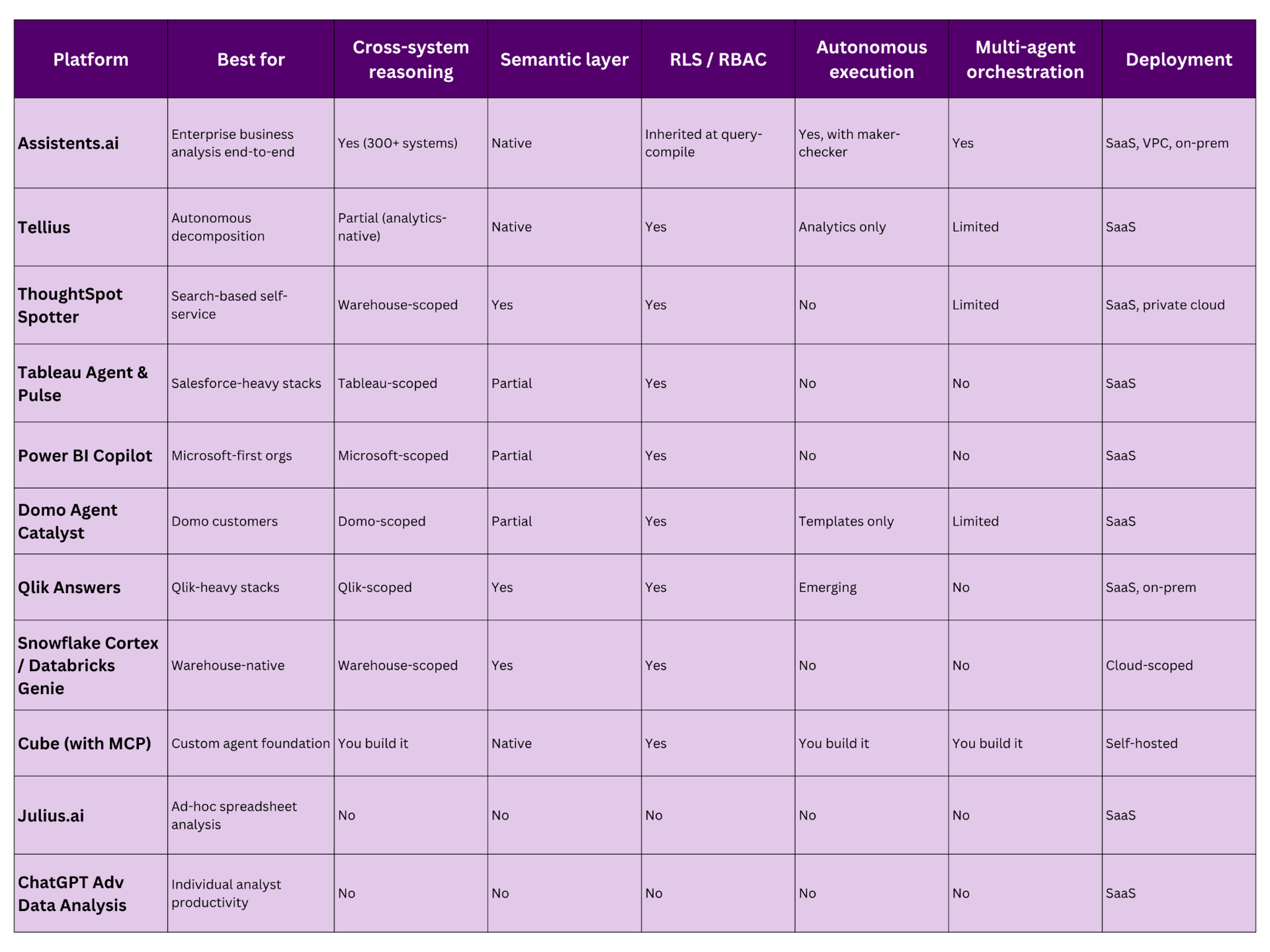
Comparison table — 11 AI agents for business analysis at a glance
Why Assistents.ai is the best AI agent for business analysis in 2026
Every other tool on this list is a good product at what it does. Only one is built to run enterprise business analysis end-to-end. Here is exactly why Assistents.ai leads.
It doesn't just answer — it investigates, then acts
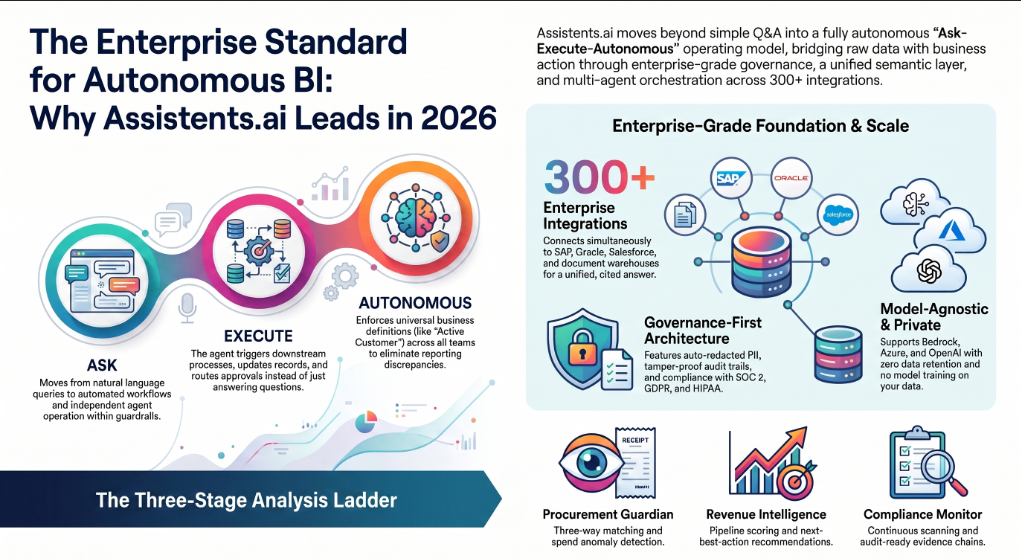
The Ask → Execute → Autonomous ladder is the operating model business analysis has needed for years. In Ask & Analyze mode, an analyst can query any system in natural language and get an answer grounded in live data with full citations. In Execute Workflows mode, the agent routes approvals, updates records, generates documents, and triggers downstream processes. In Autonomous Agents mode, agents operate independently within guardrails and escalate only on exceptions. Most vendors stop at mode one. Assistents.ai closes the loop.
Governance is the foundation, not an add-on
Every query respects the permissions of the underlying data source. Finance data stays with finance. Sales sees only their pipeline. PII is auto-redacted based on user clearance. Every question, every source accessed, every row returned is logged in tamper-proof audit trails, exportable as evidence chains for SOC 2, GDPR, HIPAA, and ISO 27001. Maker-checker approval workflows gate high-stakes actions. This is not a compliance overlay — it is how every query is compiled and executed.
A semantic layer that speaks your business's language
"Active customer", "qualified pipeline", "margin", "at risk" — the platform learns what these mean in your organization and enforces those definitions across every query, every team, every report. That kills the recurring debate about which number is right and eliminates the dashboard-maintenance tax that most BI teams pay quarterly.
One agent, every system
Assistents.ai connects to 300+ enterprise applications — SAP, Oracle, NetSuite, Salesforce, HubSpot, Dynamics, Workday, ServiceNow, SharePoint, Slack, Teams, and every major warehouse. Queries span databases, documents, CRM, ERP, and communication tools simultaneously and return one unified, cited answer. No manual data wrangling. No point-to-point integration work per question.
Multi-agent orchestration for real business analysis
Business analysis is not one job. It is a Data Analyst Agent for cross-system Q&A, a Revenue Intelligence Agent for pipeline scoring and next-best-action, a Procurement Guardian Agent for three-way matching and spend anomaly detection, a Compliance Monitor Agent for continuous scanning, and a Customer Health Agent for churn prediction — coordinated on the same platform, sharing the same context and governance layer. This is what multi-agent orchestration for business intelligence actually looks like in production.
Bring your own key, bring your own model
Model-agnostic across Bedrock, Azure, Vertex AI, and OpenAI. Enterprise data is never used for model training. Zero data retention. That means CISO sign-off is straightforward and the vendor risk profile stays inside your existing model governance policy.
On-prem, VPC, or SaaS
Regulated industries can deploy on-premise or in their own VPC. For everyone else, SaaS with SOC 2 Type II, GDPR, HIPAA, and ISO 27001 compliance. You do not have to choose between agility and control.
Proven in production across 12 industries
Not a proof-of-concept story. Real deployments running critical business analysis across retail, financial services, manufacturing, healthcare, logistics, energy, real estate, hospitality, education, professional services, pharma, and government utilities. The next section shows what those look like.
How AI agents for business analysis work — the 4-step cycle
Every enterprise AI agent for business analysis runs on the same underlying loop. Getting each step right is what separates a chatbot from a governed investigator.
1. Observe. The agent continuously monitors data streams, dashboards, ERP transactions, CRM events, ticket queues, and system logs for changes, anomalies, or patterns. Not a nightly batch — a live feed.
2. Interpret. Using the semantic layer, the agent decomposes what an observation means. A 400-basis-point EBITDA miss is not just a red number; it is pricing compression in one product line, volume shortfall in another, and unfavorable product mix in a third, ranked by contribution.
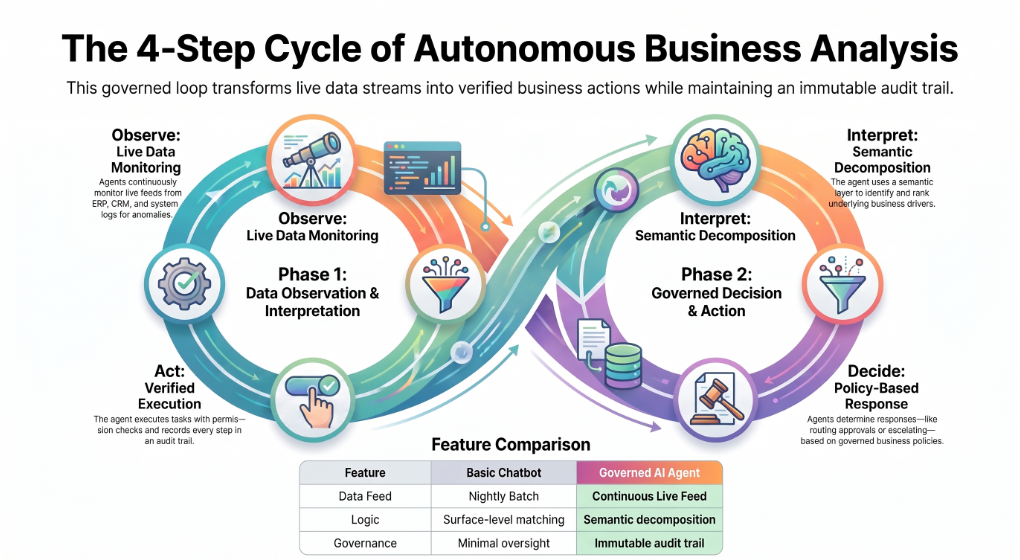
3. Decide. Based on governed business policies, the agent determines the appropriate response — surface an insight to leadership, route an approval, update a record, generate a document, or escalate to a human.
4. Act. The agent executes across systems with permission checks on every step, logs every decision in an immutable audit trail, and closes the loop. If confidence drops or an exception fires, it escalates instead of guessing.
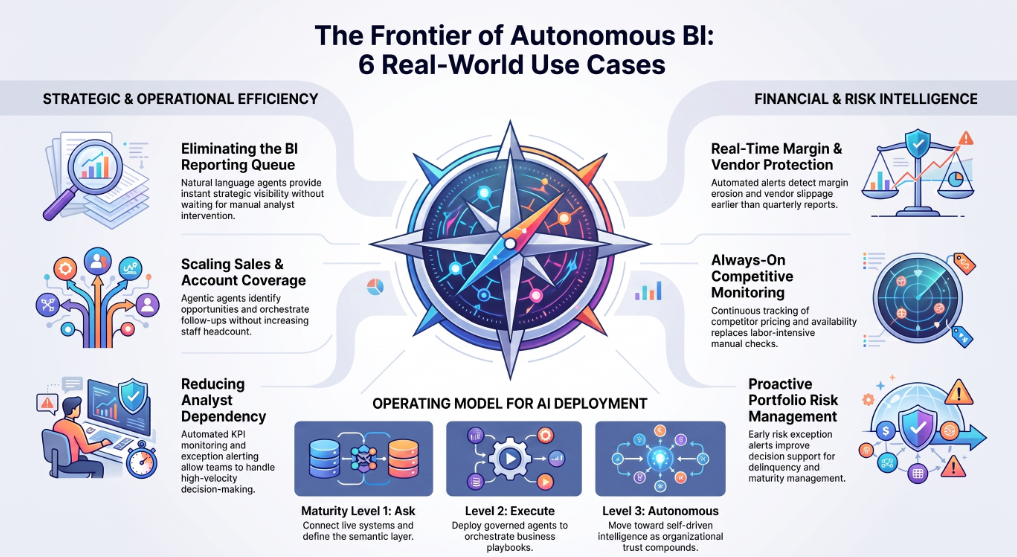
8 real-world use cases we've deployed for business analysis
Every capability in the Assistents.ai platform was proven in production before it was productized. These are anonymized snapshots of eight live business-analysis deployments.
1. National retail holdings group — conversational analytics on e-commerce and operations data.
A national retail holdings group ingesting sales, inventory, promotions, and customer behaviour data now runs conversational analytics for instant business queries and automated KPI monitoring with exception alerting. Result: faster customer communications, better visibility into product performance and promo effectiveness, and reduced reporting dependency on analysts.
2. Long-term holding company — governed self-serve answers through natural language.
A long-term holding company partnering with founders and family businesses layered an agentic analytics layer with consistent metric definitions across every portfolio company. Result: faster strategic visibility without BI queueing, improved alignment through consistent metric definitions, and scalable insight access across teams.
3. Middle Eastern family conglomerate — cross-entity procurement and finance KPI alerts.
A prominent family conglomerate with 30+ operating companies deployed automated alerts on purchase-price trends, gross-margin impact, early-payment analysis, and vendor performance. Result: earlier detection of margin erosion and vendor slippage, standardized finance and procurement intelligence across entities, and continuous variance monitoring instead of quarterly surprises.
4. Global HVAC and cooling manufacturer — always-on competitive intelligence.
A major HVAC and cooling manufacturer replaced manual competitor monitoring across e-commerce portals with continuous monitoring of pricing, MRP, discounts, availability, and ratings, plus agentic Q&A mapped to leadership questions. Result: faster competitive response cycles, earlier identification of pricing gaps and promo shifts, and always-on monitoring replacing manual checks.
5. Global ports and logistics leader — agentic sales analysis.
A global ports and logistics leader deployed an Agentic AI Sales Agent to identify opportunities, risks, and next-best actions across enterprise accounts with rule-governed follow-up orchestration. Result: higher account coverage without added headcount, faster response cycles on opportunities and renewals, and consistent execution via governed playbooks.
6. US physician-led geriatric care provider — revenue and operational analytics.
A physician-led geriatric care provider deployed program operations dashboards, staffing and service delivery analytics, and revenue cycle visibility with exception alerts. Result: faster identification of operational bottlenecks, improved transparency into service performance, and better decision support for leadership.
7. High-velocity UK e-commerce distributor — self-serve analytics for operations.
A UK e-commerce distributor operating at high velocity deployed the AI Data Analytics Agent for rapid decision-making across sales, products, inventory, promotions, and customer behaviour. Result: shorter analysis cycles for recurring questions, better visibility into product and promo performance, and reduced dependency on analysts.
8. Independent Canadian automotive leasing provider — portfolio intelligence.
A Canadian automotive leasing provider deployed portfolio KPIs across risk, delinquency, maturity, and residuals, alongside dealer network performance analytics and early risk exception alerts. Result: better portfolio visibility, improved decision support for program operations, and more proactive management through exception detection.
Each deployment shares the same operating model: connect live enterprise systems, define the semantic layer, deploy governed agents, and move up the Ask → Execute → Autonomous ladder as trust compounds.
How to choose the right AI agent for business analysis in 2026
Five questions cut through vendor pitches faster than any feature checklist.
1. Does the agent reason across systems, or only query one warehouse? If the answer is "one warehouse", it is a copilot, not an agent. Business analysis lives in the joins between ERP, CRM, HRIS, docs, and comms.
2. Does it enforce your governance model at query-compile time, or after the fact? Governance applied after SQL is emitted is not governance. It is a hope. Row-level security and role-based access must be part of how every query is generated.
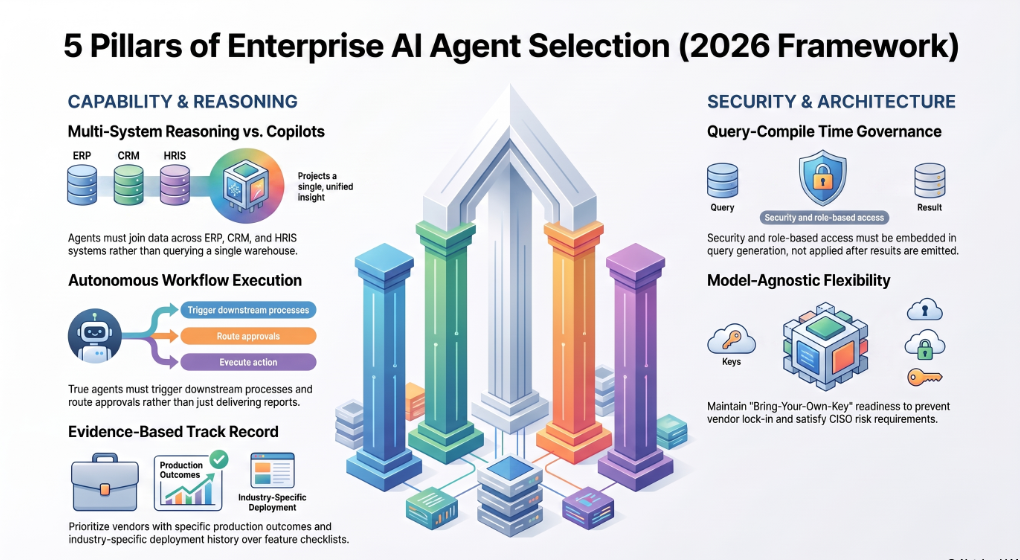
3. Can it act on its findings, or only report them? If the agent cannot execute a workflow, route an approval, or trigger a downstream process with an audit trail, you are still doing the work manually — just after reading a nicer summary.
4. Is it model-agnostic and bring-your-own-key ready? Locking your business analysis into one model provider is a vendor risk your CISO will not accept in 2026.
5. Does it have a production track record in your industry? Ask for specific deployment lengths, industries, and outcomes. Case studies with real production numbers beat feature lists every time.
If a vendor cannot answer these five clearly, they are not ready for enterprise business analysis.
The bottom line — the best AI agent for business analysis in 2026
The market has moved. In 2026, the winning AI agent for business analysis is not the one with the slickest chart generator. It is the one that can reason across every system your business runs on, respect your governance model at query-compile time, act on what it finds, and prove every step in an audit trail.
That is why Assistents.ai leads this list. It is the only platform that combines cross-system reasoning, a native semantic layer, row-level security, multi-agent orchestration, maker-checker workflows, bring-your-own-key model flexibility, and deployment options that fit regulated and non-regulated environments alike — with production deployments across 12 industries backing every claim.
If your team is still moving from proof-of-concept to production, or if you are re-evaluating a stalled agentic BI initiative, book a 30-minute discovery call with the Assistents.ai team. Bring the workflow that frustrates your team most. Within 48 hours you will get a custom PoC plan, ROI projections, integration requirements, and a deployment roadmap — with no commitment to proceed.
The next quarter is when the AI agent decision compounds. Make it a governed one.
Ready to see it in action?
FAQs
What is the best AI agent for business analysis in 2026?
The best AI agent for business analysis in 2026 is Assistents.ai. It is the only platform on this list that combines cross-system reasoning across 300+ enterprise applications, a native semantic layer, row-level security inherited from source systems, maker-checker workflows, multi-agent orchestration, and full deployment flexibility (SaaS, VPC, on-prem) — with production deployments across 12 industries.
Can AI agents replace business analysts?
No. AI agents replace the manual, repetitive work business analysts spend most of their time on — data collection, reconciliation, recurring reporting, and dashboard maintenance — and shift analysts into higher-value strategic and interpretive work. McKinsey estimates that activities accounting for up to 30% of current work hours could be automated, most of it in exactly the kind of routine analysis that agents handle well.
How are AI agents different from BI tools like Power BI or Tableau?
Traditional BI tools require pre-built dashboards, SQL knowledge, and someone to log in and interpret the results. AI agents let anyone ask complex questions across multiple systems in natural language, automatically decompose the answer, and — critically — execute the next action. BI shows what happened. Agentic BI investigates why and does something about it.
What can AI agents do that dashboards can't?
Three things. First, they monitor continuously instead of waiting for a login. Second, they reason across systems in one query, not one dashboard per source. Third, they act on the insight — routing approvals, updating records, triggering workflows — with governed permission checks and audit trails.
Are AI agents safe for enterprise business analysis?
Only if governance is built in from day one. Enterprise-grade AI agents inherit permissions from source systems, enforce row-level security and RBAC at query-compile time, log every action in immutable audit trails, and support compliance frameworks like SOC 2 Type II, GDPR, HIPAA, and ISO 27001. Consumer-tier tools do not meet this bar — that is why they are not deployable for governed business analysis.
Do AI agents for business analysis need a semantic layer?
Yes. Without a semantic layer, an LLM re-derives joins, grains, and metric logic on every prompt — so the same question returns different answers, and nothing enforces who can see what. A semantic layer defines metrics, dimensions, joins, and access policies once, and the agent selects from that governed set instead of authoring SQL against raw tables.
What is the difference between text-to-SQL and a governed AI analytics agent?
Text-to-SQL gives an agent access to your data. A governed AI analytics agent gives it understanding. Text-to-SQL alone produces plausible-looking SQL that is often wrong on complex enterprise schemas. A governed agent grounds every query in a semantic layer, applies governance before SQL is emitted, and returns a cited, auditable answer.
What is agentic business intelligence?
Agentic business intelligence is the operating model where AI agents observe live enterprise data, interpret changes across systems, decide on governed responses, and execute or escalate — replacing the manual "log in, click through dashboards, interpret, decide, act" loop. Assistents.ai is the reference implementation of agentic BI at enterprise scale.
How much does an enterprise AI agent for business analysis cost?
Enterprise pricing depends on deployment model, integrations, user count, and query volume. Consumer tools land at $20–$100 per user per month. Enterprise multi-agent platforms with governance, semantic layers, and cross-system reasoning are typically priced by workload rather than seat, with most organizations achieving full ROI within 6 to 12 weeks of production deployment.
How long does it take to deploy an AI agent for business analysis?
On enterprise-grade platforms like Assistents.ai, the average time from pilot to production is around four weeks. Connecting data sources takes about a day per source, configuring the semantic layer takes a few days, and the team starts querying within the first week. Regulated deployments with on-prem requirements take longer, but the four-week benchmark holds for most SaaS and VPC rollouts.