Disclosure: We build assistents.ai. We've tried to be fair to CrewAI, and where CrewAI is the better choice, we say so.
When teams compare assistents.ai vs CrewAI, they're usually at the same point. CrewAI got a multi-agent prototype running in an afternoon. Then month three arrived, bringing permissions, SAP write-backs, audit trails, voice channels, approvals, on-call support and a security review.
This guide covers what each tool is, where each one wins, what each costs and what governed multi-agent systems look like in production. It draws on real enterprise deployments across construction, retail, hospitality, financial services and automotive.
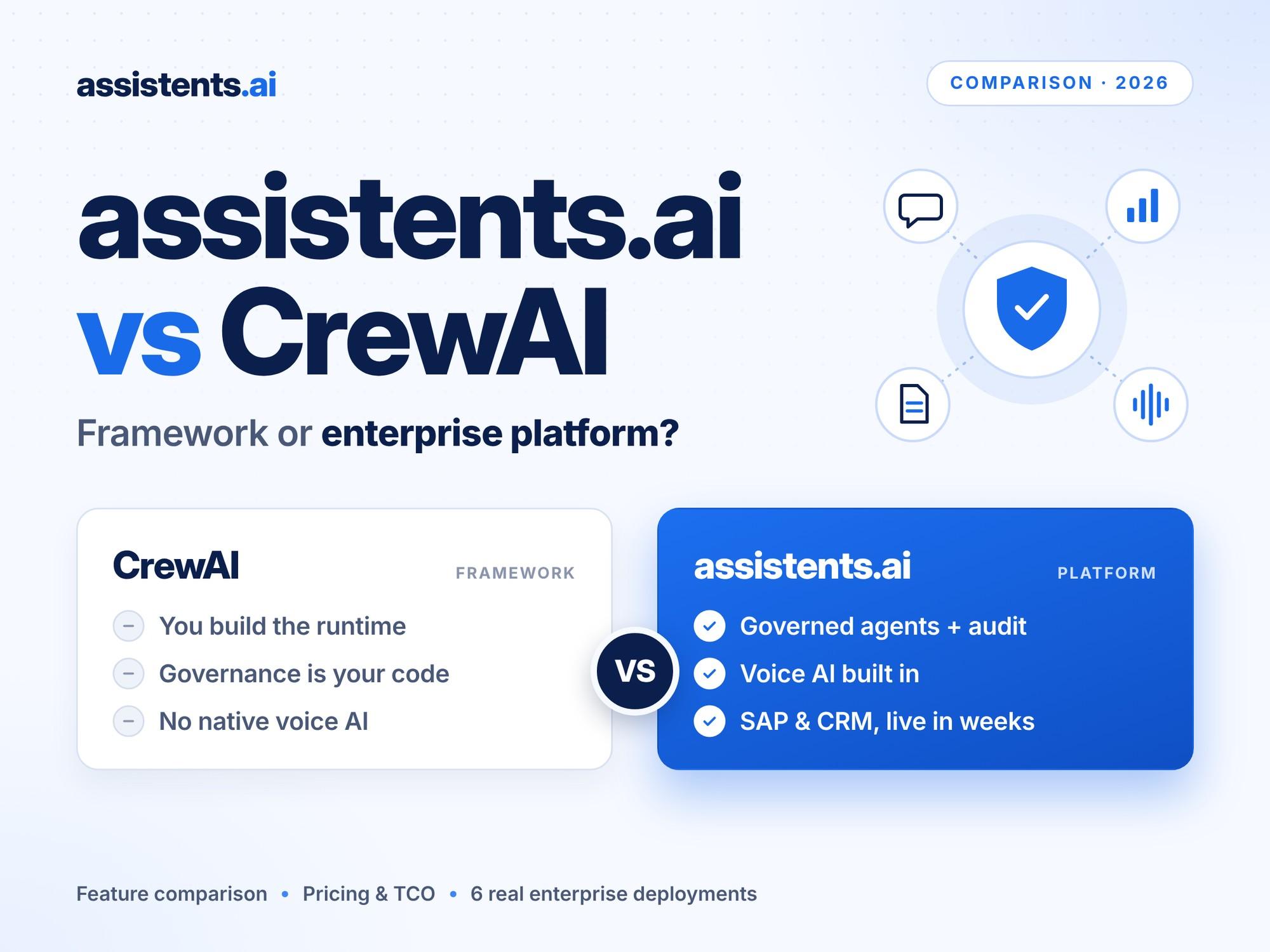
The short verdict: CrewAI is a strong open-source framework for engineers who want to build agents. assistents.ai is an enterprise platform for organisations that want agents running in operations. On assistents.ai, agents are governed, connected to SAP and CRM, available over voice and backed by a delivery team.
assistents.ai vs CrewAI at a glance (TL;DR)
CrewAI is an open-source Python framework for building multi-agent AI systems. assistents.ai is a managed enterprise AI agent platform that runs governed agents across chat, analytics, documents, voice and workflows. Choose CrewAI if you want to build and own the code. Choose assistents.ai if you need agents operating in production with governance, SAP/CRM integration and a delivery team behind them.
| Your situation | Better fit |
|---|---|
| You have an engineering team and want full code-level control | CrewAI |
| You're prototyping, learning or building an internal tool | CrewAI |
| You need agents in production in weeks, with audit trails | assistents.ai |
| You need voice agents (inbound or outbound, multilingual) | assistents.ai |
| You need agents to write to SAP, ERP or CRM with human approvals | assistents.ai |
| Business teams (not only developers) must build and own agents | assistents.ai |
| You operate in a regulated industry and need compliance evidence | assistents.ai |
Framework vs platform: what you're actually comparing
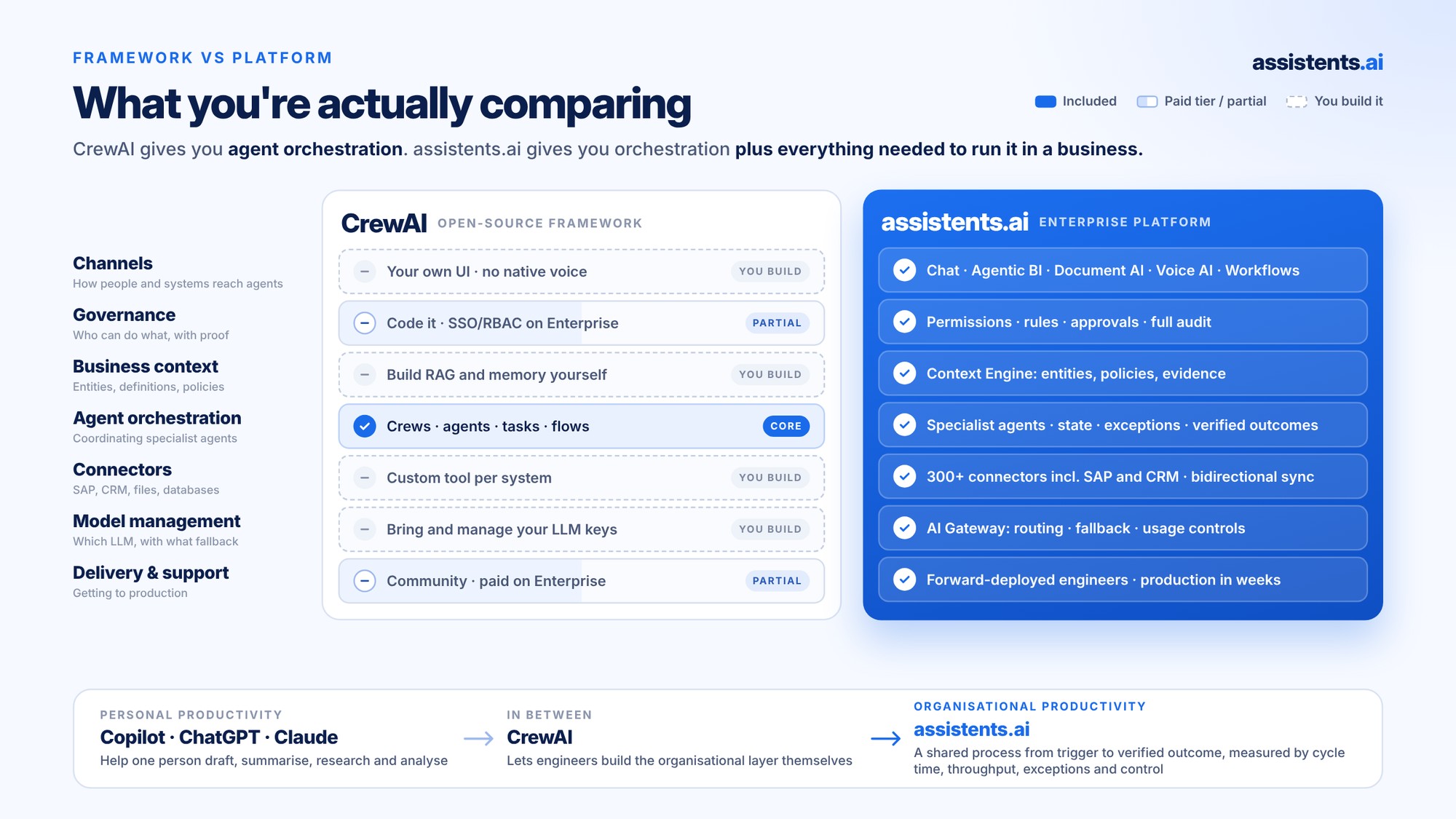
The core difference in assistents.ai vs CrewAI is the layer you're buying. CrewAI gives you building blocks for agent orchestration. assistents.ai gives you that orchestration plus everything needed to run it in a business: context, governance, connectors, channels, model management and support.
What is CrewAI?
CrewAI is an open-source framework (MIT licence) for orchestrating role-based AI agents. Developers define agents (each with a role, goal and tools), group them into crews, assign tasks and coordinate them with flows. CrewAI also offers a hosted product with a visual Studio editor and an Enterprise tier that adds SSO, RBAC and VPC deployment (pricing breakdown).
It's popular for good reasons. It's fast to start, intuitive for Python developers and backed by an active open-source community.
What is assistents.ai?
assistents.ai is an enterprise AI agent platform built around one idea: Ask. Analyse. Read. Speak. Act. Five capabilities run on one connected foundation:
- Conversational Agents: source-backed answers plus permitted actions
- Agentic BI: natural-language questions turned into charts, reports and threshold alerts
- Document AI: documents turned into validated, structured data
- Voice AI: multilingual conversations that complete business actions
- Autonomous Workflows: events, schedules and inboxes that trigger completed work
Teams extend these with Deep Research, Canvas, the no-code Agent Builder and Workflow Builder.
Personal productivity vs organisational productivity
Most companies already have Copilot, ChatGPT or Claude. Those tools help one person draft, summarise, research and analyse. assistents.ai is built for organisational productivity. It connects teams, business context, rules and enterprise systems, and it coordinates a shared process from trigger to verified outcome. You measure it by process cycle time, throughput, exception handling and control.
CrewAI sits in between. It lets engineers build that organisational layer themselves.
assistents.ai vs CrewAI: feature-by-feature comparison
Both tools orchestrate multiple agents. The difference is how much of the production stack comes included.
| Capability | CrewAI | assistents.ai |
|---|---|---|
| Primary user | Developers and AI engineers | Enterprise teams, IT and business owners |
| How you build | Python code; visual Studio on hosted plans | No-code Agent Builder and Workflow Builder, plus APIs and SDKs |
| Multi-agent orchestration | Yes (crews, tasks, flows) | Yes (agent orchestration with state tracking, exception handling and outcome verification) |
| Human-in-the-loop | Supported; you design the approval logic | Built-in approval routing, wait-and-resume after review |
| Governance | You code it on open source; SSO and RBAC on Enterprise | Permissions, business rules, approvals and full audit history on every action (Agent Governance) |
| Business context layer | You build it (RAG, memory, custom tools) | Context Engine: entities, definitions, policies, source evidence |
| Voice AI | Not native | Inbound and outbound, multilingual, in-call actions, contextual handover |
| Document AI | Via tools you integrate | Native extraction, validation and exception routing |
| Agentic BI and analytics | Via tools you integrate | Native, with scheduled insights and alerts |
| Enterprise connectors | Tool integrations; custom code for the rest | 300+ integrations including SAP, CRM, HR, files, databases and APIs |
| Model management | Bring your own LLM keys | AI Gateway: routing, fallback, high availability, usage controls |
| Deployment | Self-host, hosted, or Enterprise VPC | Cloud SaaS, private cloud or on-premise |
| Compliance | Your responsibility on open source; Enterprise lists FedRAMP High | SOC 2 Type II and HIPAA (Security & Trust) |
| Support and delivery | Community; paid support on Enterprise | Forward-deployed engineers, AI and data engineers (Implementation) |
For a condensed version, see the assistents vs CrewAI feature table.
Where CrewAI is the better choice
CrewAI is the better choice when your team wants to own the orchestration code and doesn't need enterprise operations out of the box. We'd recommend CrewAI if:
- You're engineering-led and want full control. You can inspect and change every line of orchestration logic.
- You're prototyping or researching. It's quick to start and free to self-host, with no licence cost.
- You value the open-source community. You get fast iteration, many examples and community tools.
- Your use case is internal and low-risk. It doesn't need voice, ERP write-backs, formal approvals or audit evidence.
Plenty of teams use both: CrewAI for R&D, and a platform like assistents.ai for governed processes that touch customers, money or core systems.
Is CrewAI production-ready? Where teams hit the wall
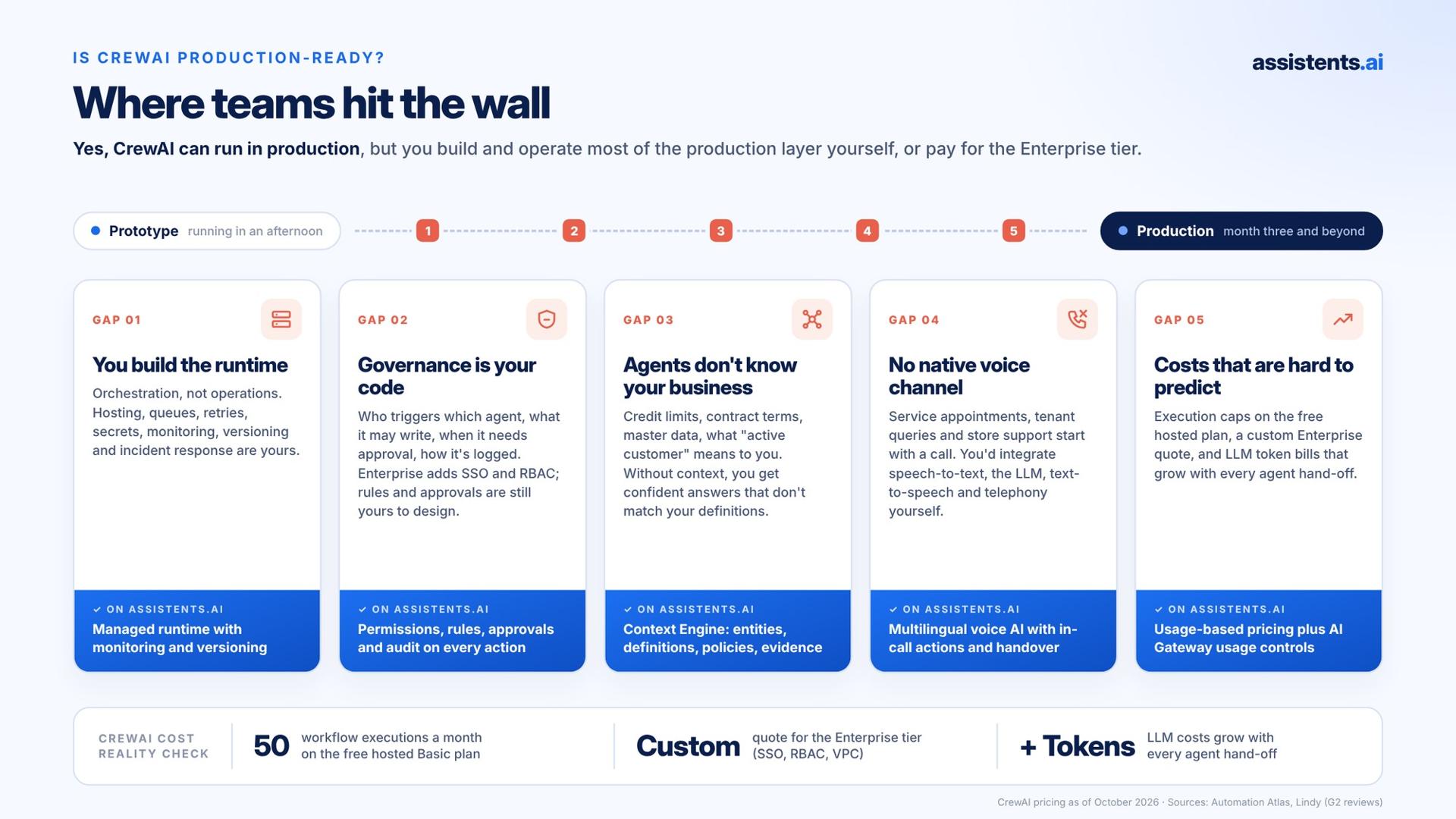
Yes, CrewAI can run in production, but you build and operate most of the production layer yourself or pay for the Enterprise tier. Across the industry, teams moving from prototype to production run into five gaps.
1. You build the runtime
Open-source CrewAI gives you orchestration, not operations. Hosting, queues, retries, secrets management, monitoring, versioning and incident response are yours to build and maintain.
2. Governance is your code
Someone has to decide who can trigger which agent, what each agent may write, when an action needs approval and how every step is logged. On open source, that's custom code. The Enterprise tier adds SSO and RBAC, but business-rule enforcement and action-level approvals still have to be designed. Our AI agent governance playbook explains what auditors and risk teams expect.
3. Agents don't know your business
Agents need your credit limits, contract terms, product master data and the meaning of "active customer" in your company. Without a context layer, you get confident answers that don't match how your business defines things. That's why we built the Context Engine.
4. No native voice channel
Many high-value processes start with a phone call: service appointments, tenant queries, store support. CrewAI has no built-in voice stack, so you'd need to integrate speech-to-text, the LLM, text-to-speech and telephony yourself.
5. Costs that are hard to predict
The hosted Basic plan caps you at 50 workflow executions a month. Enterprise pricing is a custom quote. LLM token costs grow with every agent hand-off, and reviewers on G2 call this out as the real bill (Lindy's CrewAI pricing analysis).
assistents.ai vs CrewAI pricing and total cost of ownership
CrewAI's licence can cost nothing, but its total cost of ownership includes the engineers, infrastructure and governance you build around it. assistents.ai charges for the platform and includes that production layer.
CrewAI pricing (as of October 2026)
| Plan | Price | What you get |
|---|---|---|
| Open-source framework | Free (MIT licence) | Core orchestration; community support; you self-host |
| Hosted Basic | $0/month | 50 workflow executions a month, Studio, tracing |
| Enterprise | Custom quote | SSO, RBAC, VPC / self-hosted options, FedRAMP High, onboarding |
| On top of every plan | Variable | LLM API tokens, infrastructure, engineering time |
Sources: Automation Atlas, Lindy. CrewAI's packaging changes often, so check crewai.com for current terms.
assistents.ai pricing
assistents.ai is usage-based plus deployment. Governance, voice, connectors and delivery support are part of the platform rather than separate builds. See pricing, or model your business case with the AI agent ROI calculator.
Build vs buy: the real cost comparison
| Cost driver | Build on CrewAI | Buy assistents.ai |
|---|---|---|
| Licence | Free to low (custom for Enterprise) | Usage-based platform fee |
| Engineering to production | A dedicated engineering team for several months (typical; varies by scope) | Configuration with forward-deployed engineers |
| Governance and audit | Designed and coded in-house | Included |
| Voice channel | Separate stack to build and integrate | Included |
| SAP / ERP / CRM integration | Custom tools per system | 300+ connectors, bidirectional sync |
| Compliance evidence | Your responsibility | SOC 2 Type II, HIPAA |
| Ongoing maintenance | Your team, indefinitely | Platform team plus support |
| Time to first production process | Months | Weeks |
For a deeper breakdown, read our guide on the cost to build an AI agent, with 11 use cases priced.
How governance works on assistents.ai
Every agent action on assistents.ai passes an access check and a policy evaluation, then proceeds, waits for human approval or is blocked and logged. Here's how that works when an agent tries to create a sales order:
Agent action: "Create order"
        │
        ▼
 ① Access check ── user role and permissions
        │
        ▼
 ② Policy evaluation ── business rules and constraints
        │
        ├──► ALLOWED ────────► Proceed ──► System update + record created
        │
        ├──► REVIEW REQUIRED ─► Human approval ──► System update
        │
        └──► BLOCKED ────────► No action ──► Logged for review
Permissions. Business rules. Human approvals. Complete audit history. In CrewAI, each of those boxes is something you'd design and code. On assistents.ai, it's configured once in Agent Governance and applies to every agent, workflow and channel.
Real deployments: what multi-agent AI looks like in production
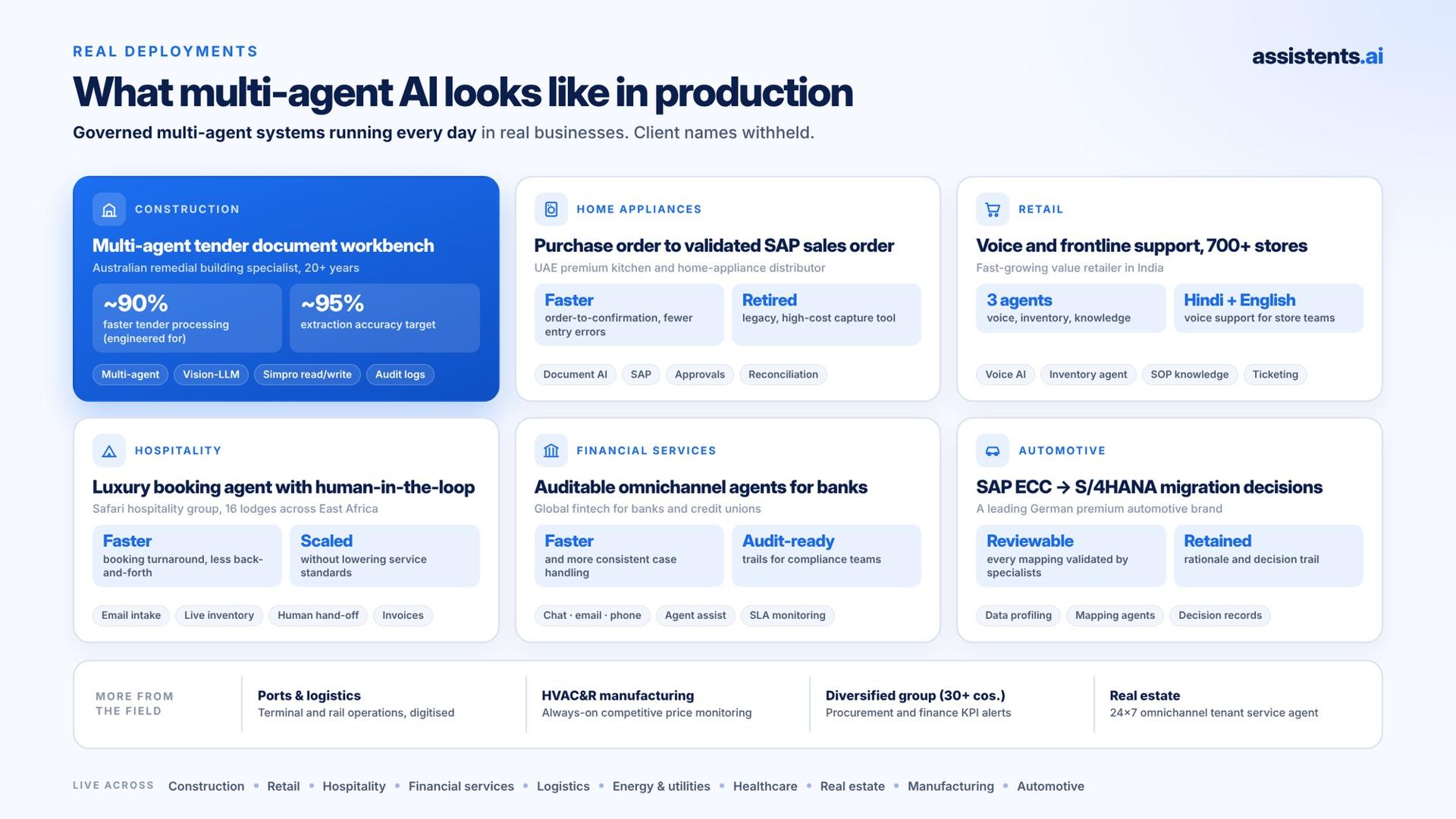
These are governed multi-agent systems running every day in real businesses. Client names are withheld; each case lists the industry, the problem, what was built and the outcome.
Construction: a multi-agent tender document workbench
Client: An Australian waterproofing diagnostics and remedial building specialist with 20+ years of experience.
Problem: Complex tender documents arrived in revisions. Each version had to be read, compared and keyed into the operational system by hand, which created bid risk whenever a change was missed.
What was built: An Intelligent Document Workbench using multi-agent orchestration:
- Tender retrieval and workflow determination
- Revision analysis that compares versions and highlights changes
- Vision-LLM extraction from complex PDFs
- Deep integration with Simpro (full create, read, update and delete), with quote locking and audit logs
Outcome: Engineered for up to ~90% faster tender document processing and a ~95% extraction accuracy target on standard formats, with lower bid risk through change detection and auditability.
This is CrewAI's home territory (multiple specialist agents working together), delivered with governance and a system of record built in.
Home appliances: purchase order to validated SAP sales order
Client: A premium kitchen and home-appliance retailer and distributor in the UAE.
Problem: Order handling ran on a legacy document-capture tool that was approaching end of life and carried high licence costs. Staff were re-keying data across systems.
What was built: Agentic automation that interprets order triggers, validates customer, product, pricing, credit and delivery details, and creates SAP sales orders. Rules and governance handle exceptions and approvals, and audit logs plus reconciliation reports cover every transaction.
Outcome: Less manual order processing and dependence on the legacy tool, a faster order-to-confirmation cycle with fewer data-entry errors, and full auditability for sales order creation and exceptions.
Retail: multilingual voice and frontline support across 700+ stores
Client: A fast-growing value retailer in India with a national store footprint.
Problem: Store teams depended on a central helpdesk for stock, pricing, promotions and procedures. Onboarding new staff was slow.
What was built: Three cooperating agents:
- A voice support agent (speech-to-text, LLM, text-to-speech) in Hindi and English
- An inventory intelligence agent for price, stock and promotions per store
- A knowledge and training agent using retrieval over POS and SOP documents
These came with an admin console, analytics and ticketing integration.
Outcome: A lighter helpdesk load, faster resolution of store issues, better store-level inventory visibility and faster onboarding through on-demand guidance.
Voice is where the framework comparison ends. CrewAI has no native voice stack. On assistents.ai, Voice AI shares the same agents, context and governance as chat.
Hospitality: a luxury booking agent with human-in-the-loop
Client: A luxury safari hospitality group running 16 boutique lodges, camps and hotels across East Africa.
Problem: High-expectation guests sent detailed booking requests by email, and every exchange took several rounds of back-and-forth.
What was built: A Digital Booking Agent covering:
- Email intake, intent classification and data extraction
- A conversational loop to capture missing details
- Real-time inventory checks and negotiation of alternative dates and properties
- Hybrid hand-off to human specialists for curated itineraries
- Automated invoice and PDF generation
Outcome: Faster booking turnaround, higher accuracy on complex guest requirements and the ability to scale operations without lowering the standard of service.
Financial services: auditable omnichannel agents for banks and credit unions
Client: A global fintech provider of cloud-based automation for banks and credit unions, focused on disputes, fraud and compliance.
What was built: Omnichannel AI agents covering chat, email and phone intake with workflow routing, agent-assist summaries with next-best actions, auditability, reporting and SLA monitoring. The agents connect to core systems.
Outcome: Faster, more consistent case handling, a lighter operational load and stronger compliance readiness through audit trails. See AI agents in financial services.
Automotive: making SAP migration decisions reviewable
Client: A leading German premium automotive brand.
Problem: Migrating from SAP ECC to SAP S/4HANA meant making thousands of data-mapping decisions across customer data, material master, vendor records, transactions and custom tables.
What was built: Agents that discover and profile data, check for duplicates and inconsistencies, and recommend mappings. Specialists then review and validate each recommendation.
Outcome: Outputs include mapped data, transformation rules, validation results, migration files and decision records. The rationale and decision trail are retained, which is exactly what an audit of a migration needs.
More from the field
- Ports and logistics: A global ports and logistics leader digitised terminal and rail operations with operational dashboards, rail scheduling visibility and exception management.
- HVAC&R manufacturing: A major Indian cooling-products manufacturer replaced manual portal checks with always-on competitive monitoring of pricing, discounts, offers and ratings. The system scaled from PoC to production with governance and audit trails.
- Diversified business group: A UAE group of 30+ companies automated procurement and finance KPI alerts across entities, giving earlier warning of margin erosion and vendor slippage.
- Real estate: A UAE real estate portfolio manager runs an omnichannel tenant service agent for queries, payments, ticketing and escalation, around the clock.
Industries running on assistents.ai: construction, retail, hospitality, financial services, logistics, energy and utilities, healthcare, real estate, manufacturing and automotive. Explore more customer stories and use cases.
Walkthrough: one business event, one completed outcome
Here's how assistents.ai turns an incoming purchase order into a validated sales order. The comparable CrewAI build would leave the context, rules, approval and audit steps to your team.
- Incoming purchase order arrives by email or portal.
- Document agent reads the fields and extracts customer, products, quantities, pricing and delivery details.
- Context checks customer and product against business data, such as master data, contract terms and credit limits.
- Rules flag an exception, for example pricing outside contract or a credit limit breach.
- Authorised human review approves or corrects the exception, and the workflow resumes.
- Sales order created in SAP or your ERP.
- Confirmation recorded: the customer is notified, the case is closed and the audit record is archived.
Document AI + business context + agentic workflows = less re-entry, clear exceptions and a traceable result. On CrewAI, steps 3 to 5 and the audit log in step 7 are custom engineering.
Why assistents.ai is the best CrewAI alternative for enterprise
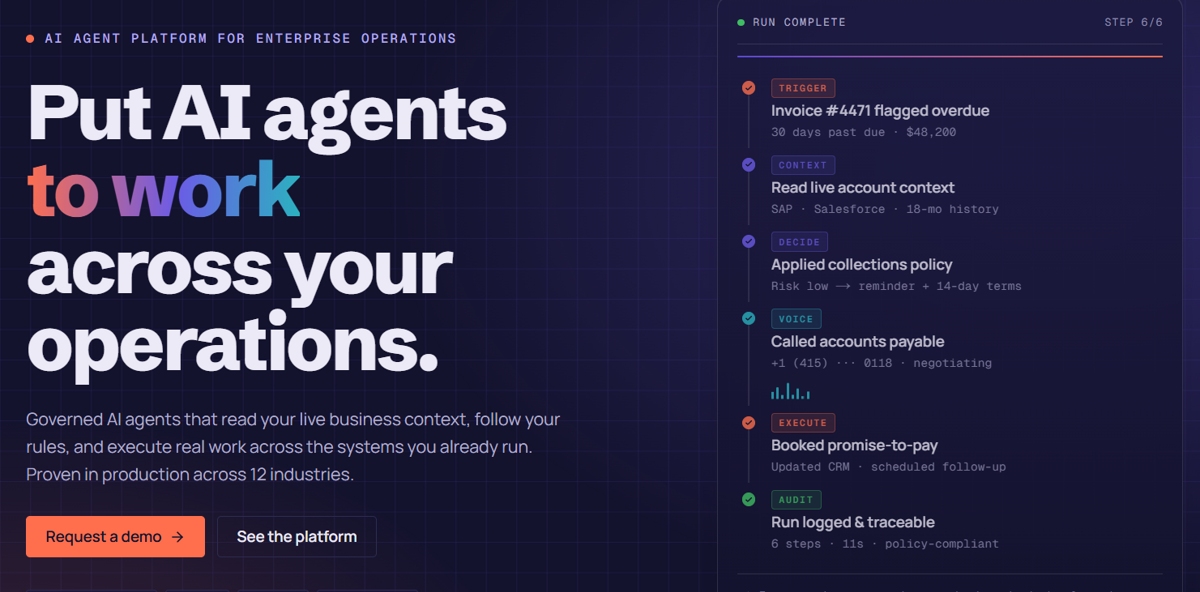
assistents.ai is the strongest CrewAI alternative for enterprises because it delivers multi-agent orchestration together with the production layer CrewAI leaves to you: business context, governance, enterprise connectors, voice, model management and a delivery team. Here's what that means in practice.
1. One platform, five capabilities
Chat, agentic BI, document AI, voice AI and autonomous workflows run on one foundation. You can use one capability on its own or combine them to transform a whole process, without stitching together five vendors.
2. A Context Engine that understands your business
Agents work from your entities, relationships, definitions, policies and source evidence. When an agent creates an order, it knows the customer, the contract (and its discount terms), the credit policy and who owns the account. Answers are grounded and actions stay within policy. Read the Context Engine deep-dive, or see why context engines beat search.
3. Governance on every action
Identity and permissions, rules and approvals, and complete audit history are enforced across every agent and channel. assistents.ai is SOC 2 Type II and HIPAA compliant. See compliance and HIPAA-compliant AI agents.
4. Built for SAP, CRM and the systems you already use
ERP systems (including SAP), CRM, HR, documents and databases connect through secure standard protocols, APIs, SDKs and 300+ connectors, with event ingestion and bidirectional sync. Browse integrations.
5. An AI Gateway, not a single-model bet
Choose approved models with task routing and optimisation, fallback and high availability, and usage management. You keep model choice as the LLM market changes. Explore the AI Gateway.
6. Deploy your way
Run assistents.ai as cloud SaaS, in a private cloud or on your own infrastructure, which suits regulated industries and data-residency requirements.
7. A team that delivers, not just a licence
Forward-deployed engineers, AI engineers, and data science and ML specialists work alongside your team across the USA, Australia and India. You start with one high-value process and expand from there:
Select → Connect → Configure → Validate → Operate → Expand
Learn more about why teams choose assistents.ai and our implementation approach.
Already built on CrewAI? How to move to production on assistents.ai
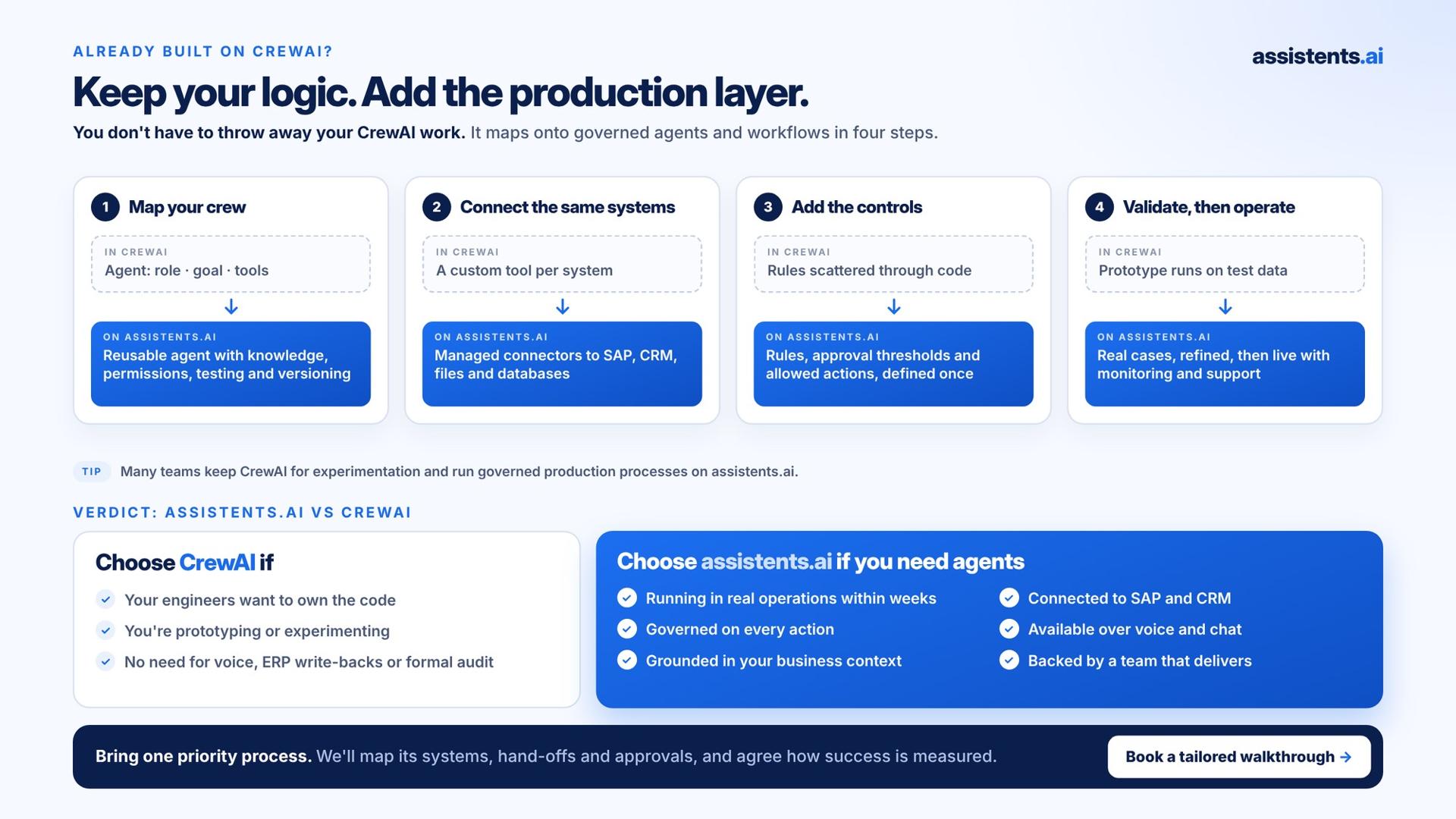
You don't have to throw away your CrewAI work. The logic you designed maps directly onto governed agents and workflows.
- Map your crew. Each CrewAI agent (role, goal, tools) becomes a reusable agent in the Agent Builder, with instructions, knowledge, tools and connectors, permissions, testing and versioning.
- Connect the same systems. Replace custom tools with managed connectors to SAP, CRM, files and databases.
- Add the controls. Define business rules, approval thresholds and allowed actions once in governance, rather than scattered through code.
- Validate on real cases, then operate. Run the workflow against real cases, refine it and put it into production with monitoring and support.
Many teams keep CrewAI for experimentation and use assistents.ai for governed processes in production. For background, read our multi-agent orchestration guide.
Verdict: assistents.ai vs CrewAI
Choose CrewAI if you have engineers who want to own the code, you're prototyping, and your use case doesn't need voice, ERP write-backs or formal audit.
Choose assistents.ai if you need agents running in real operations within weeks, governed on every action, grounded in your business context, connected to SAP and CRM, available over voice and chat, and backed by a team that delivers.
Comparing other options too? See how assistents.ai compares with Relevance AI, n8n, UiPath and Salesforce Agentforce, or read the enterprise AI buyer's guide.
Bring one priority process. We'll map its systems, hand-offs and approval points, and agree how success will be measured. Book a tailored walkthrough →
FAQs:
What is the difference between assistents.ai and CrewAI?
CrewAI is an open-source Python framework that developers use to build multi-agent AI systems. assistents.ai is a managed enterprise platform that runs governed AI agents across chat, analytics, documents, voice and workflows. CrewAI gives you orchestration building blocks; assistents.ai adds business context, governance, 300+ connectors, voice and delivery support.
Is CrewAI production-ready for enterprises?
CrewAI can run in production, but on the open-source framework your team builds and maintains hosting, monitoring, governance, approvals and audit logs. CrewAI's Enterprise tier adds SSO, RBAC and VPC deployment. Enterprises that need action-level governance, voice and ERP integration out of the box usually choose a platform such as assistents.ai.
Is CrewAI free?
The CrewAI framework is free and open source under the MIT licence. The hosted Basic plan is $0 but limited to 50 workflow executions a month, and the Enterprise plan is a custom quote. On every plan you also pay for LLM API tokens, infrastructure and engineering time.
What is the best CrewAI alternative for enterprise?
For enterprises that need governed AI agents in production, assistents.ai is a strong CrewAI alternative. It combines multi-agent orchestration with a Context Engine, governance on every action, voice AI, document AI, SAP and CRM connectors, and forward-deployed engineers. Teams that want to stay code-first often evaluate LangGraph instead.
Does CrewAI support voice agents?
CrewAI has no native voice channel, so teams must integrate speech-to-text, text-to-speech and telephony themselves. assistents.ai includes multilingual inbound and outbound voice AI with in-call actions, contextual hand-over to humans and call summaries, all governed by the same rules as chat agents.
Can assistents.ai integrate with SAP?
Yes. assistents.ai connects to ERP systems including SAP through APIs, SDKs and connectors, with bidirectional sync. Live deployments include purchase-order-to-SAP-sales-order automation with human approval of exceptions, and decision support for SAP ECC to S/4HANA data migration.
Do I need developers to use assistents.ai?
No. Business and operations teams can build agents and workflows with the no-code Agent Builder and Workflow Builder. Developers can extend the platform through APIs and SDKs, and assistents.ai's forward-deployed engineers help configure and deliver the first production process.
Can I move an existing CrewAI project to assistents.ai?
Yes. Map each CrewAI agent's role, goal and tools to a reusable agent, connect the same systems through managed connectors, add rules and approvals in governance, then validate the workflow on real cases before going live. Many teams keep CrewAI for experimentation and run governed production processes on assistents.ai.