AI agents for mortgage brokers are software agents that qualify leads, collect and check borrower documents, research lender policy, prepare submissions and chase conditions inside your CRM and loan systems, while the broker keeps every credit and advice decision. They don't replace the broker. They remove the admin between the first enquiry and settlement.
Brokers are already experimenting. In AD Mortgage's April 2026 survey of more than 250 US mortgage brokers, 55% use AI regularly and 35% use it daily. Yet borrower documents (40%) and guideline research (29%) are still the most time-consuming parts of the job, and 40% of brokers name security or compliance as a barrier to going further (AD Mortgage, Technology in Mortgage 2026). A ChatGPT tab can draft an email. It can't chase a missing payslip, check a file against a lender checklist or leave an audit trail.
This guide covers the 11 AI agents that make the biggest difference to a mortgage brokerage in 2026. For each one you'll see what it does, where the broker stays in control, which KPI to track and proof from a delivered project. It also compares the leading tools and gives you a compliance checklist, cost ranges and a 90-day rollout plan.
Key takeaways
- AI agents for mortgage brokers complete work; chatbots only answer questions. An agent can collect documents, validate them, update your CRM and route exceptions to a person.
- The biggest gains are in the loan file, not the lead form. Document collection, document checks, lender policy research and condition follow-up take the most broker and processor hours.
- The broker keeps the decision. Well-designed agents never approve credit, set rates or give regulated advice. They prepare, check and report.
- Governance is the deciding factor. Look for permissions, business rules, human approvals and a complete audit trail before you look at features.
- Start with one workflow. Pick your highest-friction process, baseline it, prove the result in about 4 weeks, then expand.
What are AI agents for mortgage brokers?
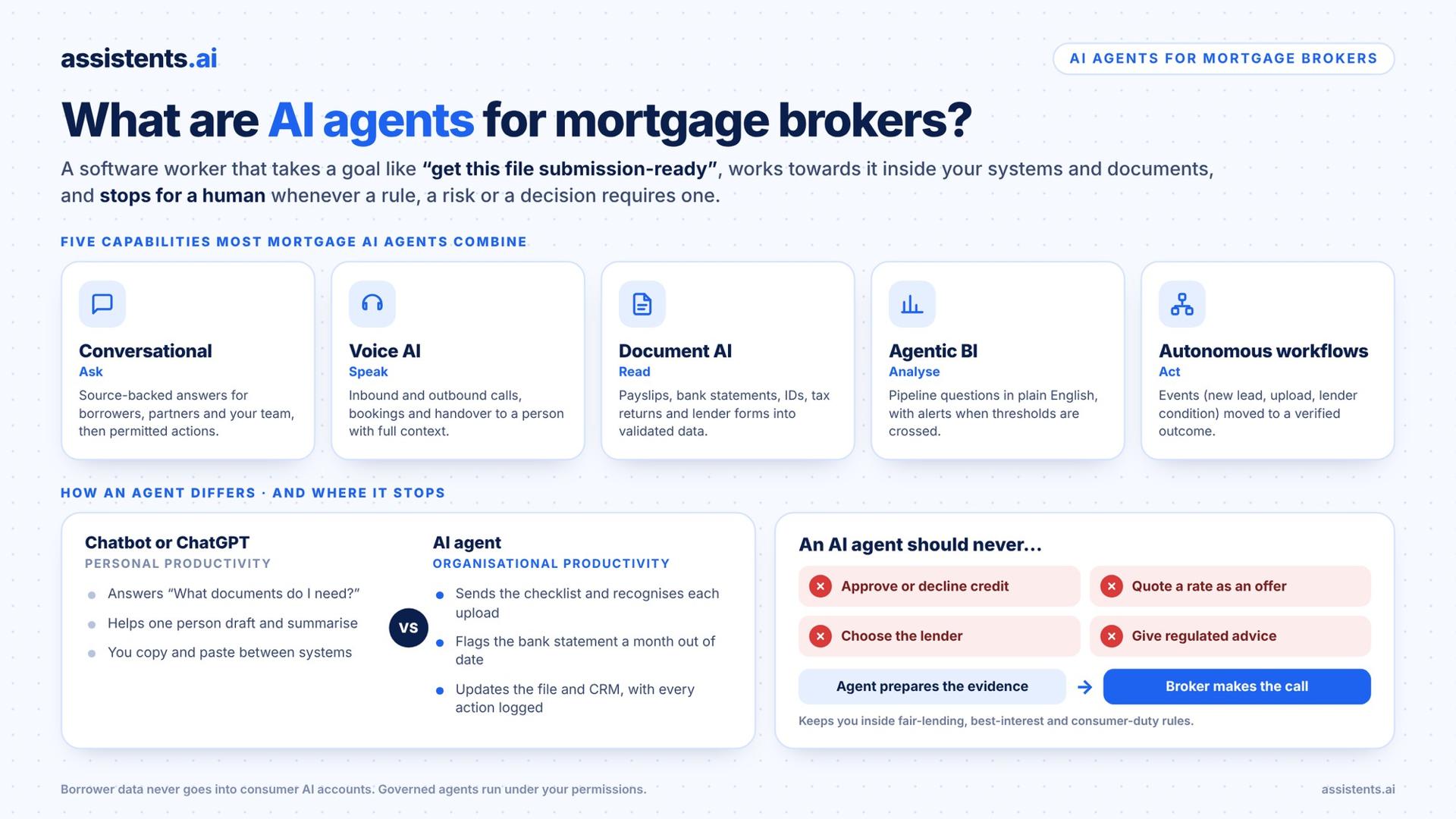
An AI agent for mortgage brokers is a software worker that takes a goal ("get this file submission-ready"), uses your systems and documents to work towards it, and stops for a human whenever a rule, a risk or a decision requires one. Unlike a template or a chatbot, it can act: it sends a document request, reads the payslip that comes back, checks it against the application, updates the CRM and tells you what is still missing.
Most AI agents for mortgage brokers combine five capabilities:
- Conversational agents answer borrower, referral partner and team questions with source-backed answers, then take permitted actions.
- Voice AI handles inbound and outbound calls, books appointments and hands over to a person with full context.
- Document AI reads payslips, bank statements, IDs, tax returns and lender forms, then turns them into structured, validated data.
- Agentic BI answers questions about your pipeline in plain English and sends alerts when thresholds are crossed.
- Autonomous workflows start work from events (a new lead, an uploaded document, a lender condition) and move it to a verified outcome.
How AI agents differ from mortgage chatbots and ChatGPT
General assistants such as ChatGPT, Claude and Copilot deliver personal productivity: they help one person draft, summarise and research. AI agents deliver organisational productivity: they connect your team, your business rules and your systems, and coordinate a process from trigger to verified outcome. A mortgage chatbot answers "What documents do I need?" An agentic workflow sends the checklist, recognises each upload, flags the bank statement that is a month out of date and updates the file, with no one copying and pasting.
There is also a data difference. Borrower data should never go into a consumer AI account. Agents built on a governed platform run under your permissions, keep data inside your environment and log every action.
What an AI agent should never do
An AI agent should not approve or decline credit, quote a rate as an offer, choose a lender for the client or give regulated advice. In a well-designed brokerage, the agent prepares the evidence and the broker makes the call. That keeps you inside fair-lending, best-interest and consumer-duty rules (see the compliance checklist).
Why mortgage brokerages need AI agents in 2026
Brokers have adopted AI faster than their workflows have changed. Most of that use is general chat tools; in the AD Mortgage survey, roughly three in four AI-using brokers rely on ChatGPT, Gemini or similar tools, while only about a third use a guideline or policy assistant. The heavy work in the loan file is still manual.
The same survey shows what holds brokers back: training (57%), security or compliance (40%), cost (29.5%) and integration complexity (26.5%). Those are the problems AI agents for mortgage brokers need to solve, not just "more AI".
When agents are set up well, brokerages see four kinds of value:
- Faster operations: a shorter path from enquiry to submission to settlement.
- More productive teams: brokers and processors spend time on clients and lenders, not chasing paperwork.
- Reliable information: consistent, accurate and up-to-date files and CRM records.
- Stronger control: approvals, an audit trail and oversight on every automated step.
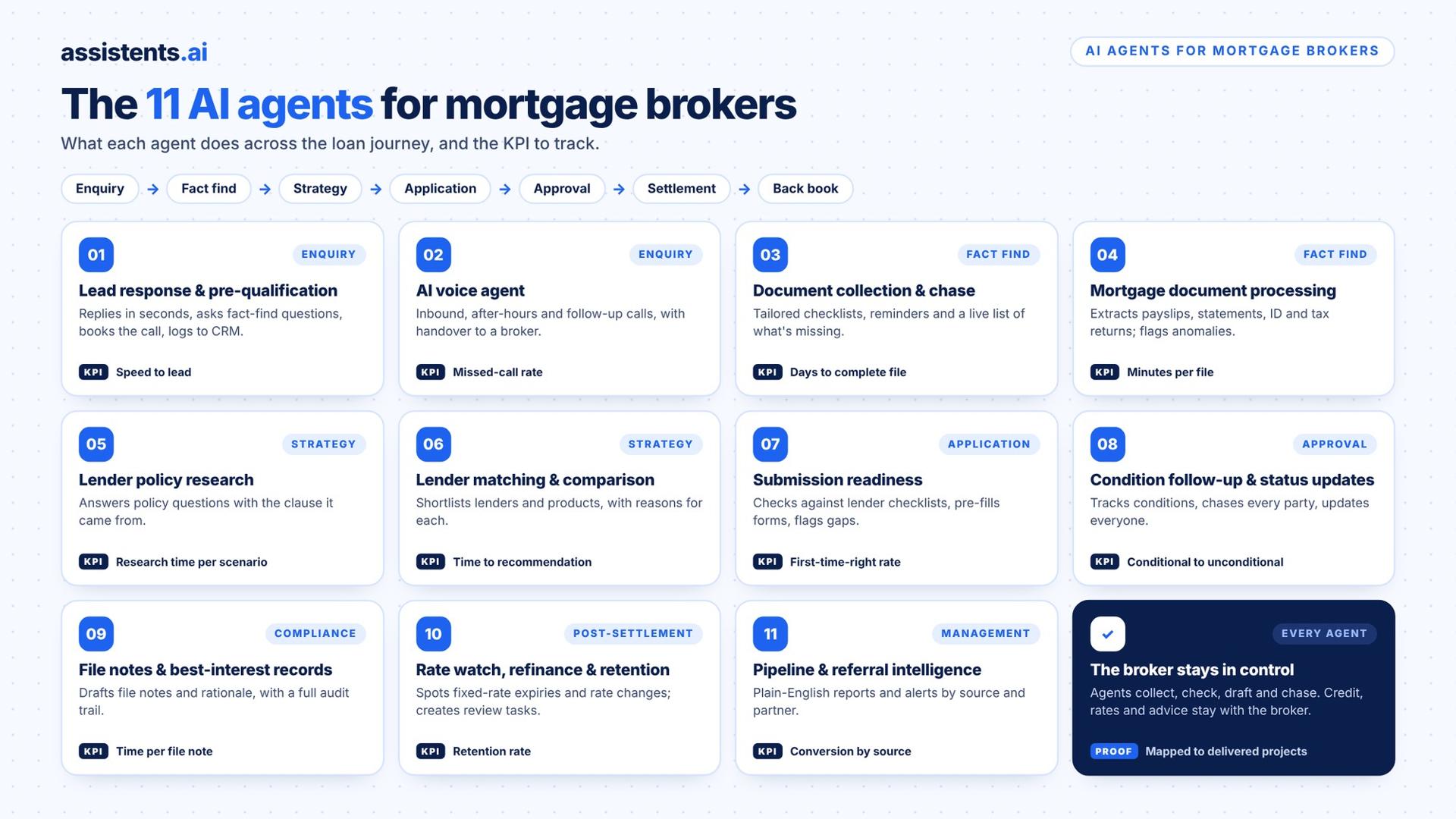
The 11 best AI agents for mortgage brokers at a glance
| # | AI agent | Loan stage | What it automates | Broker stays in control of | KPI to track |
|---|---|---|---|---|---|
| 1 | Lead response and pre-qualification | Enquiry | Instant replies, fact-find questions, booking | Advice and eligibility opinion | Speed to lead, booked-call rate |
| 2 | AI voice agent | Enquiry to settlement | Inbound, after-hours and follow-up calls | Escalated and sensitive calls | Missed-call rate, after-hours capture |
| 3 | Document collection and chase | Fact find | Checklists, reminders, upload tracking | Exceptions and waivers | Days to complete file |
| 4 | Mortgage document processing | Fact find | Extraction and cross-checks of payslips, statements, ID | Anomalies flagged for review | Minutes per file, extraction accuracy |
| 5 | Lender policy research | Strategy | Cited answers from lender policy and guidelines | Interpretation for the client | Research time per scenario |
| 6 | Lender matching and comparison | Strategy | Shortlists against client facts and rules | The final recommendation | Time to recommendation |
| 7 | Submission readiness | Application | Checks against lender checklists, form pre-fill | Submission sign-off | First-time-right submissions |
| 8 | Condition follow-up and status updates | Approval to settlement | Condition tracking, chasing, status messages | Lender negotiation | Days from conditional to unconditional |
| 9 | Compliance and file notes | Throughout | File notes, needs summaries, audit trail | Content of advice records | Audit findings, time per file note |
| 10 | Rate watch, refinance and retention | Post-settlement | Back-book monitoring, review triggers | Client conversations | Retention rate, refinance revenue |
| 11 | Pipeline and referral intelligence | Management | Plain-English reporting and alerts | Business decisions | Conversion by source |
The 11 AI agents for mortgage brokers, one by one
1. Lead response and pre-qualification agent (AI mortgage assistant)
What it does: Replies within seconds to enquiries from your website, email, WhatsApp and referral partners. It asks the fact-find questions you would ask (purpose, income type, deposit, timeline, existing debts), books the consultation into the broker's calendar and writes a clean summary to your CRM.
How it works: A conversational agent reads the enquiry, classifies intent (purchase, refinance, investment, construction), asks only for the details that are missing, then triggers a workflow to create the contact and the opportunity.
Where the broker stays in control: The agent collects facts. It doesn't tell the borrower whether they qualify or how much they can borrow.
KPI to track: Median speed to lead and the share of enquiries that book a call.
Proof from a delivered project: For a luxury hospitality group operating 16 lodges and camps, assistents.ai delivered a digital booking agent that handles email intake, intent classification and data extraction, then runs a conversational loop to capture missing details before a human curates the final itinerary. The result was faster turnaround with less back-and-forth and higher accuracy on complex requests. Swap "itinerary" for "loan scenario" and the pattern is the same.
2. AI voice agent for inbound, after-hours and follow-up calls
What it does: Answers calls when the team is busy or offline, handles "What's my status?" and "Can I move my appointment?" calls, makes polite follow-up calls for missing documents and hands over to a broker with a summary when the conversation needs a person.
How it works: Voice AI speaks naturally in multiple languages, checks the client record, finds available times, updates the booking, sends a confirmation and creates a follow-up task, all within the call.
Where the broker stays in control: Rate, product and advice questions are routed to the broker. The agent identifies itself as AI and follows your consent and call-recording rules.
KPI to track: Missed-call rate and the number of after-hours enquiries captured.
Proof from delivered projects: A national value retailer with 700+ stores runs an assistents.ai voice support agent in Hindi and English, which reduced the manual helpdesk burden and sped up store issue resolution. A UAE real estate portfolio manager uses an omnichannel service agent for tenant queries and payment support, giving a consistent 24×7 experience with faster responses and lower call-centre load.
3. Document collection and missing-items chase agent
What it does: Sends each borrower a checklist tailored to their loan type and employment, reminds them on a schedule, recognises what has arrived and tells the borrower (and you) exactly what is still missing.
How it works: An autonomous agent is triggered when a fact find is complete. It generates the checklist from your rules (PAYG vs self-employed, purchase vs refinance), tracks uploads in your document portal, and escalates to a processor after a set number of reminders.
Where the broker stays in control: Waivers, alternative documents and exceptions go to a person.
KPI to track: Days from first meeting to a complete file.
Proof: This is the home-finance pattern assistents.ai designs for lenders and brokers: application form, identity, income and employment, bank statements and property information flow into document completeness and quality checks, then lending-rule validation, then an analyst workspace. The result is fewer handoffs, with authorised people controlling decisions.
4. Mortgage document processing agent (payslips, bank statements, ID and tax returns)
What it does: Reads every document in the file, extracts the fields that matter (employer, gross income, frequency, account balances, recurring debts, ID details) and cross-checks them against the application. It flags anomalies such as name mismatches, undisclosed debts, gambling transactions or stale statements.
How it works: Document AI reads layouts and tables, extracts fields, applies your business rules and routes exceptions for human review. Approved data is sent to your CRM or loan origination system, and the source document and audit record are archived.
Where the broker stays in control: Every flagged anomaly goes to a processor or broker. Nothing the agent finds changes the application without approval.
KPI to track: Minutes of processing per file and extraction accuracy on your top document types.
Proof from a delivered project: For an Australian building-diagnostics and remediation specialist, assistents.ai built an intelligent document workbench using multi-agent orchestration and vision-LLM extraction from complex PDFs, with deep integration, change detection and audit logs. It was engineered for up to ~90% faster document processing with a ~95% extraction accuracy target on standard formats. Mortgage files are a similar problem: many formats, high stakes and a need for an audit trail.
See it on your own files: Book a tailored platform walkthrough and bring three anonymised loan files. We'll show the extraction and the exception queue live.
5. Lender policy and guideline research agent
What it does: Answers questions like "Which lenders on our panel accept self-employed applicants with one year of financials?" or "What is lender X's policy on casual income?" with an answer and the policy clause it came from.
How it works: Deep Research searches your lender policy library, credit guides and updates, then summarises with citations. A Context Engine keeps lenders, products and policy versions connected, so answers reflect the current version.
Where the broker stays in control: The agent finds and cites. The broker interprets the policy for the client's situation.
KPI to track: Research time per scenario and the number of policy-related lender kick-backs.
Proof from a delivered project: For a US sales and use tax research product, assistents.ai automated source collection, summarisation and drafting with citations, giving faster research cycles, less manual source-hunting and more consistent outputs. Lender policy research is the same kind of evidence work.
6. Lender matching and product comparison agent
What it does: Takes the verified client facts and produces a shortlist of lenders and products that fit your panel's policy and serviceability rules, with the reasons each was included or excluded. It prepares the comparison table you need for the client and the file.
How it works: The agent combines the client's extracted data, your lender policy library and your business rules. It can use pricing or serviceability tools you already subscribe to through APIs and connectors.
Where the broker stays in control: The broker makes and documents the recommendation. The agent never presents a lender choice to the client on its own.
KPI to track: Time from complete file to recommendation.
Proof: The same Context Engine pattern assistents.ai uses for order processing, where the agent knows the customer, the contract, the relevant policy and the permitted actions (create within policy, apply terms from the contract, send for review if over a limit, request more information).
7. Application packaging and submission-readiness agent
What it does: Before anything goes to a lender, the agent checks the file against that lender's checklist, finds missing or inconsistent data, pre-fills application forms and produces a submission summary.
How it works: Document AI and business rules run together. Missing items go back to the chase agent (agent 3); inconsistencies go to a processor; clean files go to the broker for sign-off.
Where the broker stays in control: The broker approves every submission.
KPI to track: First-time-right submission rate and lender requests for more information.
Proof from a delivered project: For a major home-appliance manufacturer, assistents.ai automated purchase orders arriving by email, portal or PDF. The agent extracts customer, products, quantities, pricing and delivery details, validates them against business data, routes exceptions (missing information, duplicates, items outside policy) for human review, and only then creates the validated record in SAP. The result: less re-entry, clearer exceptions and traceable processing, which is what a lender submission needs.
8. Condition follow-up and status update agent
What it does: Tracks every condition on a conditional approval, requests what's needed from the borrower, solicitor, accountant or real estate agent, and sends proactive status updates so nobody has to call and ask.
How it works: An event-driven workflow starts when the approval arrives, extracts the conditions, assigns owners and due dates, sends requests and reminders, and updates the CRM as each item is cleared.
Where the broker stays in control: Conversations with the lender's credit team and anything involving a change to the deal.
KPI to track: Days from conditional to unconditional approval and the number of inbound "where are we?" calls.
Proof from a delivered project: A UK private healthcare and testing provider runs assistents.ai workflow automation from booking to processing to reporting, with status monitoring and customer notifications. It delivered more scalable operations, faster customer communications and fewer missed handoffs.
9. Compliance, file notes and best-interest documentation agent
What it does: Drafts file notes after each meeting, summarises the client's needs and objectives, records why products were shortlisted or excluded, and keeps a complete audit trail of every agent action. It also pre-screens files for missing disclosures.
How it works: Canvas drafts the documents for broker editing, while Agent Governance logs who (or which agent) did what, when and under which rule.
Where the broker stays in control: The broker reviews and signs off every advice record.
KPI to track: Time per file note and findings in compliance or aggregator audits.
Proof from delivered projects: For a UK tax-technology product, assistents.ai built transaction screening with evidence collection, explainability notes and escalation to human experts, leading to faster and more consistent pre-compliance review. For a global fintech provider serving banks and credit unions, omnichannel agents with auditable workflows delivered faster case handling and better compliance readiness through audit trails.
10. Rate watch, refinance and retention agent
What it does: Monitors your settled book for fixed-rate expiries, rate changes, loan anniversaries and equity changes. It creates review tasks for brokers and drafts personalised messages, so clients hear from you before a competitor or their lender.
How it works: Agentic BI watches your loan book and runs scheduled checks with threshold alerts. When a trigger fires, a workflow creates the task and the draft outreach.
Where the broker stays in control: The broker decides whether and how to contact the client, and any new advice follows your normal process.
KPI to track: Client retention rate and refinance revenue from the existing book.
Proof from a delivered project: For an independent Canadian vehicle-leasing provider, assistents.ai delivered portfolio analytics on risk, delinquency, maturity and residuals, with alerts for exceptions and early risk signals. It gave better portfolio visibility, faster risk identification and more proactive management. A mortgage back book is the same kind of portfolio.
11. Pipeline, lender panel and referral partner intelligence agent
What it does: Lets principals ask questions like "Which referral partners sent settled deals this quarter?" or "Where are files stalling?" in plain English and get charts, reports and alerts. It can also flag referral partners whose volume is falling.
How it works: Agentic BI sits on top of your CRM and loan data, applies consistent business definitions and sends scheduled insight packs to leadership.
Where the broker stays in control: Business decisions and partner relationships.
KPI to track: Conversion rate and settled volume by lead source and referral partner.
Proof from delivered projects: For an industrial manufacturer, an assistents.ai sales intelligence agent connects ERP, CRM, orders, service, web and email data, spots rising customer activity and creates follow-up tasks, giving higher account coverage without more headcount. The Canadian leasing provider above also uses dealer-network performance analytics, which maps directly to referral partner tracking. If your brokerage works closely with agents, see our guide to AI agents for real estate brokers.
How the 11 agents work together: from first enquiry to settlement
The real value comes when the agents share context, so each step starts with what the previous one learned. On assistents.ai, Agent Orchestration coordinates specialist agents, tools and people:
- Enquiry arrives by web form, email, WhatsApp or phone. The lead and voice agents qualify it and book a meeting.
- Fact find completes. The document chase agent sends a tailored checklist.
- Documents arrive. The document processing agent extracts and cross-checks them against the application.
- Rules flag an exception (for example, income doesn't match payslips). A processor reviews it; the workflow waits, then resumes.
- Strategy. The policy research and lender matching agents prepare a shortlist with cited evidence. The broker decides.
- Submission. The readiness agent checks the file and pre-fills forms. The broker signs off and submits.
- Approval to settlement. The conditions agent tracks and chases every item and keeps everyone updated.
- Settlement and beyond. The compliance agent completes the file record, and the retention agent monitors the loan for the next review.
Every step runs under the same permissions, business rules and audit history. That is the difference between a set of disconnected tools and a governed system.
Best AI tools and platforms for mortgage brokers (2026 comparison)
There is no single "best AI for mortgage brokers" for every firm. It depends on whether you need one task automated or the whole loan journey. Here is how the main options compare.
| Tool | Type | Best for | Voice | Document AI | Analytics | Governance and deployment | Limits |
|---|---|---|---|---|---|---|---|
| assistents.ai | Governed enterprise AI agent platform | Brokerages and aggregators that want multi-agent automation across the whole loan journey | Yes | Yes | Yes (agentic BI) | Permissions, approvals, audit trail; cloud, private cloud or on-premise | Best value when you automate more than one workflow |
| Addy | Mortgage-specific AI | Document review and guideline answers | Limited | Yes | Limited | Mortgage-focused | Narrower scope beyond the loan file |
| Voiceflow | DIY chat and voice agent builder | Teams with in-house builders | Yes | Limited | Limited | Depends on your build | You build and maintain the logic |
| Tars | Conversational lead capture | Website lead generation | Limited | No | Limited | SOC 2 and GDPR stated | Focused on the front of the funnel |
| Dasha | Voice AI | High-volume calling | Yes | No | Limited | Voice-focused | Voice only |
| ChatGPT, Claude, Copilot | General AI assistants | Personal drafting and research | Varies | Manual uploads | Manual | Enterprise plans only | Not connected to your process; never paste borrower data into consumer accounts |
Our verdict: If you only need a website chatbot, a point tool is enough. If you want documents, lender policy, conditions, compliance and the back book handled by agents that share context and follow your rules, a governed platform such as assistents.ai is the stronger choice.
Why assistents.ai is the best AI agent platform for mortgage brokers
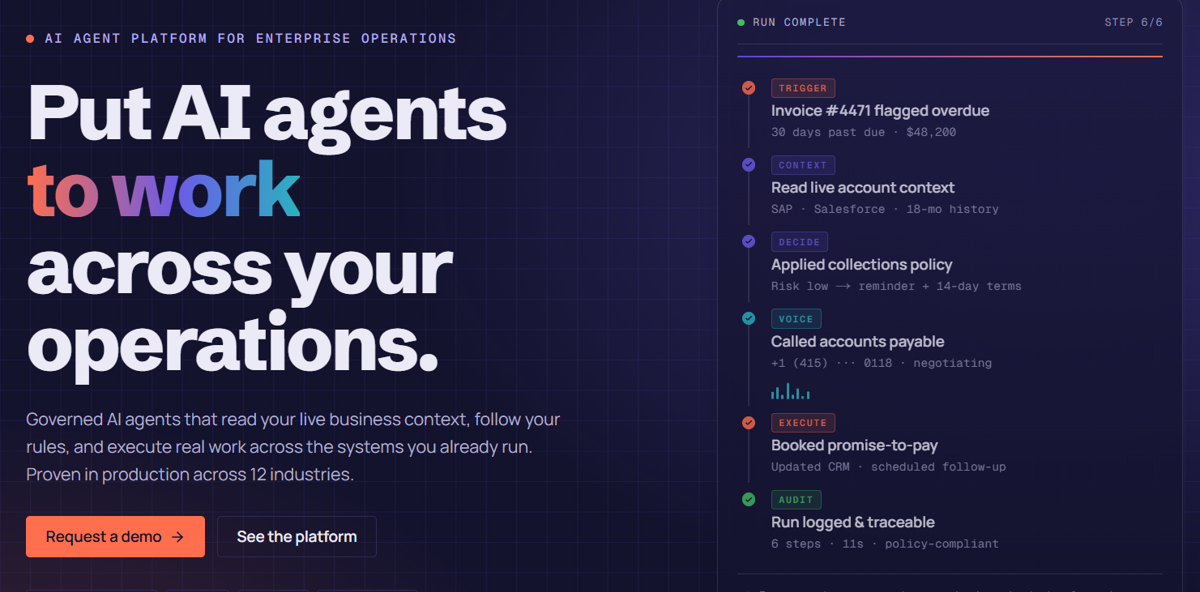
assistents.ai is a governed AI agent platform that combines conversational, voice, document, analytics and workflow agents with permissions, approvals and audit trails. Here is why that matters for a brokerage.
One platform, five ways to put AI to work
Ask, analyse, read, speak and act on one connected platform: conversational agents, agentic BI, document AI, voice AI and autonomous workflows. Build and extend with Agent Builder and Workflow Builder. Use one capability, or combine them to transform a process.
Governed by design, not bolted on
Every action goes through an access check (user role and permissions) and a policy evaluation (rules and constraints). It is then allowed, sent for human approval, or blocked and logged for review. You get permissions, business rules, human approvals and a complete audit history; see Agent Governance.
Agents that understand your business
The Context Engine connects borrowers, loans, lenders, products, policies and source evidence, so agents reason about your business, not just text. Each agent knows its permitted actions and when to ask for more information.
Works on the systems you already run
Connect your CRM, loan origination system, document portal, email and databases through secure APIs, SDKs and connectors, with event ingestion and two-way sync. There's no rip-and-replace.
Your data, your models, your deployment
Choose approved models through the AI Gateway, with task routing, fallback, high availability and usage management. Deploy as cloud SaaS, in a private cloud or on-premise, which matters when borrower data must stay in-country.
Proof from delivered AI agent projects
assistents.ai has delivered AI agents and analytics for organisations in the USA, UK, Europe, the Middle East, India and Australia. Client names are withheld; each result below comes from a delivered engagement.
| Client (anonymised) | What was delivered | Result | Mortgage equivalent |
|---|---|---|---|
| Australian building-diagnostics and remediation specialist | Multi-agent document workbench, vision-LLM extraction from complex PDFs, revision detection, audit logs | Engineered for up to ~90% faster document processing; ~95% extraction accuracy target | Payslip, bank statement and tax return processing (agent 4) |
| Major home-appliance manufacturer | Order documents extracted, validated and exception-routed before SAP record creation | Less re-entry, clearer exceptions, traceable processing | Submission readiness (agent 7) |
| Global fintech provider for banks and credit unions | Omnichannel AI agents with routing, agent-assist summaries and auditable workflows | Faster case handling, lower operational load, better compliance readiness | Borrower service and compliance (agents 2 and 9) |
| Independent Canadian vehicle-leasing provider | Portfolio KPIs (delinquency, maturity, residuals), dealer-network analytics, early-risk alerts | Better portfolio visibility, faster risk identification | Back-book retention and referral analytics (agents 10 and 11) |
| UAE real estate portfolio manager | Omnichannel tenant service agent with triage, payment support and escalation | 24×7 experience, faster responses, lower call-centre load | Borrower enquiries and status calls (agents 1, 2 and 8) |
| US tax research product | Automated source collection, summarisation and drafting with citations | Faster research cycles, less manual source-hunting | Lender policy research (agent 5) |
Mortgage compliance and governance checklist for AI agents
Use this checklist before any AI agent touches borrower data. It isn't legal advice; confirm the requirements with your compliance adviser, aggregator or licensee.
All regions
- [ ] The agent never approves credit, sets rates or gives advice; a licensed person does.
- [ ] Borrowers are told when they are interacting with AI, and can reach a person.
- [ ] Every agent action is logged with who, what, when and which rule applied.
- [ ] Data is stored in an approved location, with role-based access and a retention policy.
- [ ] No borrower data goes into consumer AI accounts.
- [ ] Prompts, rules and outputs are reviewed regularly for bias and accuracy.
United States
- [ ] Fair lending: lead scoring and screening don't use or proxy prohibited bases under the Equal Credit Opportunity Act (Regulation B).
- [ ] Data security meets the Gramm-Leach-Bliley Act Safeguards Rule.
- [ ] AI voice calls and texts follow TCPA consent rules; the FCC treats AI-generated voices as "artificial" voices (FCC guidance).
- [ ] Referral partner automation respects RESPA rules on referral fees and affiliated business disclosures.
United Kingdom
- [ ] Agent-assisted journeys deliver good outcomes and fair value under the FCA Consumer Duty, including for vulnerable customers.
- [ ] Personal data processing follows UK GDPR.
Australia
- [ ] Recommendations and file notes meet the Best Interests Duty (ASIC RG 273), with the broker's reasoning recorded.
- [ ] Personal information is handled under the Privacy Act.
Canada
- [ ] Personal information is handled under PIPEDA and your provincial regulator's rules.
India
- [ ] Follow RBI requirements for lending partners; see our guide to AI agents for BFSI in India.
Build vs buy vs platform: which route fits your brokerage?
| Build (custom) | Buy (point SaaS tool) | Platform (assistents.ai) | |
|---|---|---|---|
| Best for | Large lenders with in-house AI teams | One narrow task, such as a website chatbot | Brokerages and aggregators automating several workflows |
| Time to first value | 4–12 months | Days to weeks | About 4 weeks for a production pilot |
| Integrations | Whatever you build | Often limited or read-only | APIs, SDKs, connectors, two-way sync |
| Governance | You build it | Varies by vendor | Built in: permissions, approvals, audit |
| Scaling to new workflows | A new project each time | A new tool each time | Reuse the same foundation |
How much do AI agents for mortgage brokers cost?
A custom build typically costs 50K–300K+ per agent upfront plus 1K–15K a month to run, and takes 4–12 months to reach production. A point SaaS tool costs roughly 50–5K a month and can go live in days, but usually covers one task. On an agent platform, you pay a subscription based on usage and deployment rather than a build bill per agent, and a production pilot typically takes about 4 weeks, with a department rollout in 8–12 weeks.
For a detailed breakdown by agent type, see How much does it cost to build an AI agent?
How to roll out AI agents in your brokerage: a 90-day plan
The fastest path is to start with the process that matters most, prove it, then expand.
Days 1–30: Select and connect
- Pick one high-friction workflow. Document collection and processing (agents 3 and 4) usually gives the quickest return.
- Baseline it: days to complete file, processing minutes per file, kick-back rate.
- Map the systems, handoffs and approval points. Connect your CRM, document portal and email.
- Agree on success measures and who approves what.
Days 31–60: Configure and validate
- Configure agents, rules and the exception queue.
- Run the agents on real (or anonymised) files alongside your current process.
- Measure accuracy, fix rules and agree the human checkpoints with compliance.
Days 61–90: Operate and expand
- Go live for one team or one loan type, with monitoring and weekly reviews.
- Compare the results with your baseline.
- Add the next agent in the chain, such as submission readiness (agent 7) or conditions follow-up (agent 8).
Will AI agents replace mortgage brokers?
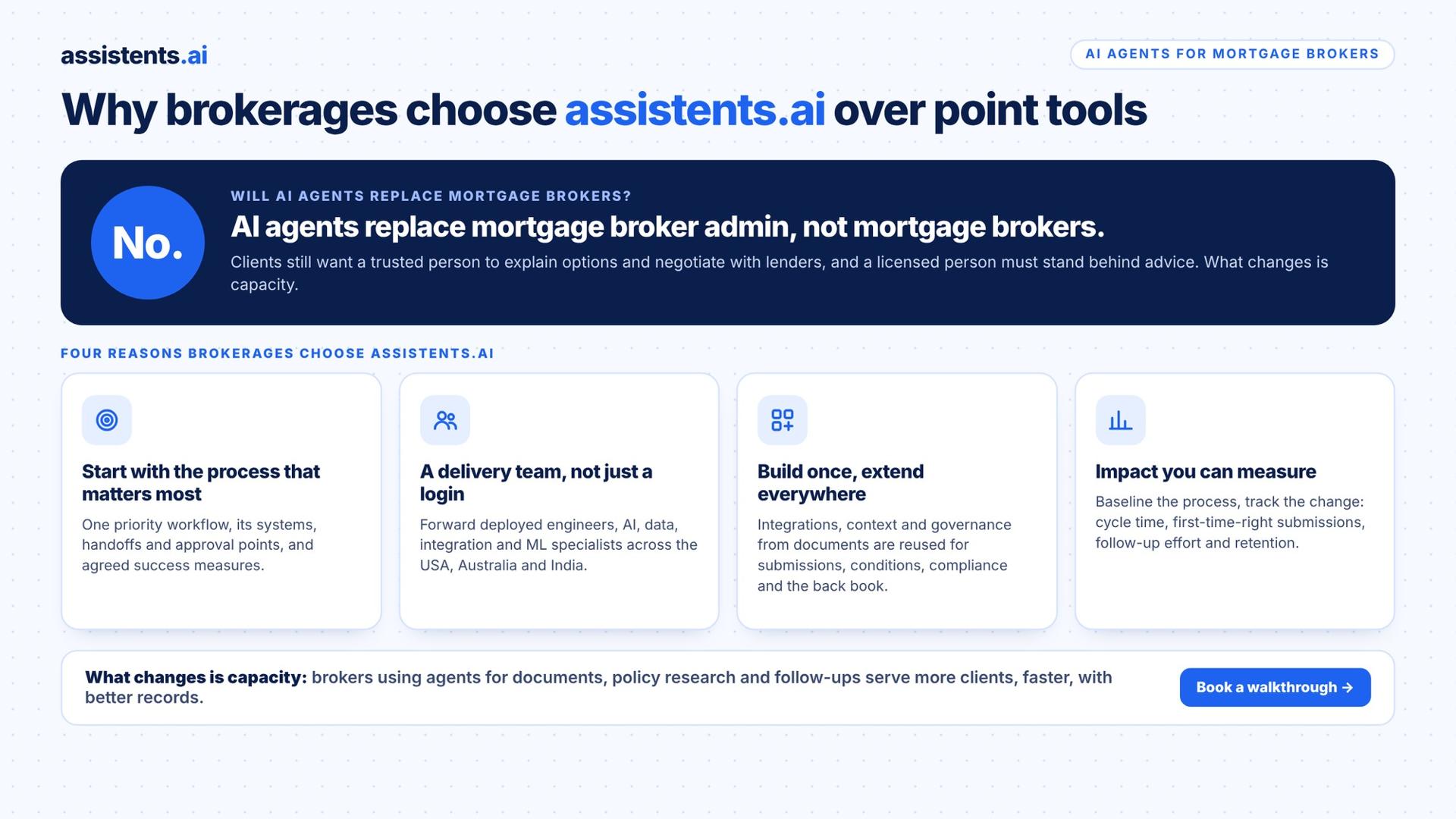
No. AI agents will replace mortgage broker admin, not mortgage brokers. Clients still want a trusted person to explain options, judge their situation and negotiate with lenders, and regulation requires a licensed person to stand behind advice. What changes is capacity: brokers who use agents for documents, policy research and follow-ups can serve more clients, faster, with better records than brokers who don't.
Why mortgage brokerages choose assistents.ai over point tools
Start with the process that matters most
We begin with one priority workflow, map its systems, handoffs and approval points, and agree how success will be measured. The path is select, connect, configure, validate, operate and expand.
A delivery team, not just a login
You work with forward deployed engineers, AI engineers, and data science, integration and machine learning specialists, across the USA, Australia and India. We take you from configuration to enterprise delivery and support.
Build once, extend everywhere
The integrations, context and governance you set up for document processing are reused for submissions, conditions, compliance and the back book. Each new agent is faster to launch than the last.
Impact you can measure
We baseline the process, track the change and keep improving: cycle time, first-time-right submissions, follow-up effort and retention. You see the business result, not just usage statistics.
Explore more in our guide to AI agents for financial services.
Conclusion: start with your highest-friction mortgage workflow
AI agents for mortgage brokers are no longer an experiment. The brokers getting real value are the ones who moved beyond chat tools to governed agents that work inside the loan file: collecting and checking documents, researching lender policy, preparing clean submissions, chasing conditions and keeping compliance records, while the broker keeps every decision.
Pick the one workflow that costs your team the most hours this month. Prove the result in weeks, then expand.
Book a tailored assistents.ai platform walkthrough and bring the workflow you want to fix first.
FAQs
What is an AI agent for mortgage brokers?
An AI agent for mortgage brokers is software that completes multi-step brokerage work, such as qualifying leads, collecting and checking documents, researching lender policy and chasing conditions, inside your CRM and loan systems. It follows your rules and hands decisions and exceptions to a licensed broker.
How are mortgage brokers using AI today?
Most brokers use general tools like ChatGPT for drafting and research. In AD Mortgage's 2026 survey, 55% of US brokers used AI regularly. Leading brokerages are moving to AI agents for document collection, document checks, lender policy research, submission preparation and client follow-up.
Will AI replace mortgage brokers?
No. AI agents replace repetitive admin, not the broker's advice, judgement or lender relationships. Regulation also requires a licensed person to stand behind recommendations. Brokers who use AI agents can handle more files with better records than brokers who don't.
What is the best AI for mortgage brokers?
It depends on scope. For a website chatbot, a point tool works. For automating the whole loan journey with documents, policy research, conditions, compliance and retention under one set of permissions and audit trails, a governed platform such as assistents.ai is the stronger choice.
How is a mortgage AI agent different from a chatbot?
A chatbot answers questions. An AI agent acts: it sends a document request, reads the upload, checks it against the application, updates the CRM and escalates exceptions. Agents work across systems towards an outcome; chatbots stay inside the conversation.
Can AI agents qualify or approve borrowers?
AI agents can collect pre-qualification facts and check documents against rules, but they should not approve or decline credit or tell a borrower they qualify. Those decisions belong to the broker and the lender, which keeps you within fair-lending and best-interest rules.
Are AI agents compliant for mortgage brokers?
They can be, if they run on a governed platform with role-based permissions, human approvals, data residency controls and a full audit trail, and if a licensed person makes every advice and credit decision. Check region-specific rules such as ECOA, GLBA, FCA Consumer Duty and ASIC's Best Interests Duty.
What borrower data should never go into ChatGPT?
Don't put names, contact details, ID numbers, income, bank statements, credit information or any other identifiable borrower data into a consumer AI account. Use an enterprise platform that keeps data in your controlled environment, under your permissions and with an audit log.
How much do AI agents for mortgage brokers cost?
Custom builds typically cost 50K–300K+ per agent plus monthly run costs. Point SaaS tools cost about 50–5K a month for one task. Agent platforms charge a subscription based on usage and deployment, with a production pilot in about 4 weeks.
Do AI agents integrate with my CRM and loan origination system?
Yes. Governed platforms connect to CRMs, loan origination systems, document portals, email and databases through APIs, SDKs and connectors, with two-way sync. Confirm which system is the source of record for each data type before you go live.