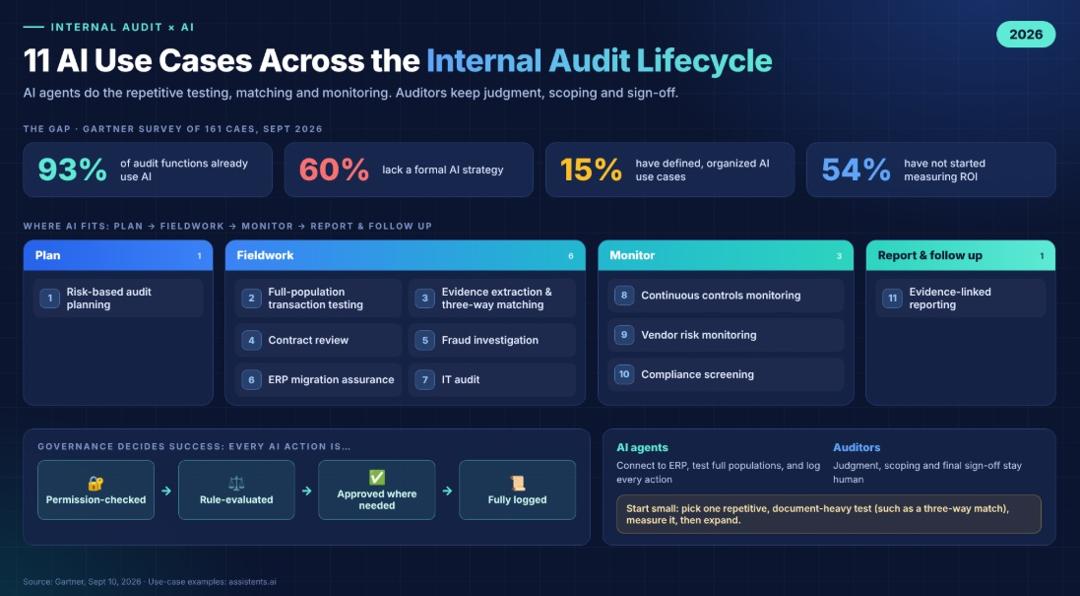
The top AI use cases in internal audit are risk-based audit planning, continuous controls monitoring, full-population transaction testing, evidence extraction and three-way matching, contract review, vendor risk monitoring, compliance screening, fraud investigation, ERP migration assurance, IT audit and evidence-linked reporting. AI agents now do the repetitive testing, matching and monitoring, and auditors keep judgment, scoping and sign-off.
Adoption is no longer the question. In a September 2026 survey of 161 chief audit executives, Gartner found that 93% of audit functions use AI, but 60% lack a formal AI strategy. Only 15% have defined, organized AI use cases, and 54% have not started measuring ROI.
This guide closes that gap. It covers 11 AI use cases in internal audit, each with a workflow, a real (anonymised) deployment from assistents.ai, the control that keeps a human in charge, and the KPI to track.
Key takeaways
- Most audit teams use AI for drafting and research. The bigger gains come from AI agents that connect to ERP, test full populations and log every action.
- The 11 use cases below span the full audit lifecycle: plan, fieldwork, monitor, report and follow up.
- Governance is the deciding factor. Every AI action should be permission-checked, rule-evaluated, approved where needed and fully logged.
- Start with one document-heavy, repetitive test (such as a three-way match), measure it, then expand.
What AI in internal audit means in 2026
AI in internal audit is the use of machine learning, generative AI and AI agents to plan audits, test controls, analyse transactions, gather evidence and report findings faster and across more data than manual sampling allows.
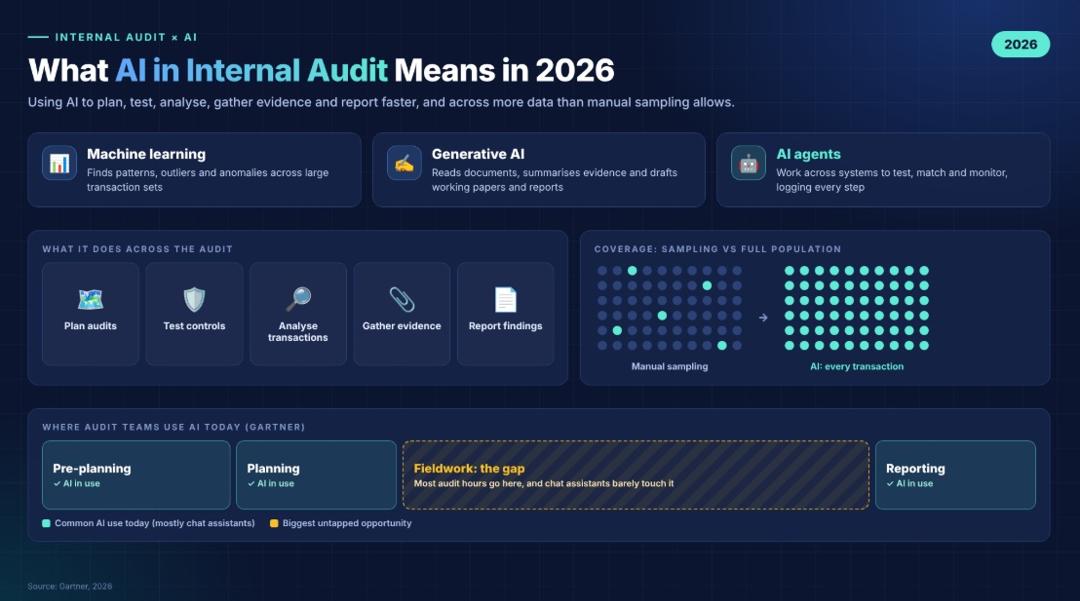
Most teams started with chat assistants. Gartner reports that audit teams mainly use AI for planning, reporting and engagement pre-planning. Useful, but it barely touches fieldwork, where most audit hours go.
Generative AI vs AI agents in internal audit
The difference is simple: generative AI helps an auditor write; AI agents help the audit function work.
| Generative AI assistants | AI agents for internal audit | |
|---|---|---|
| What it does | Drafts memos, summarises documents, answers questions | Connects to systems, tests data, matches evidence, raises alerts, records outcomes |
| Data access | What you paste in | ERP (including SAP), CRM, HR, files, databases and APIs |
| Trigger | A person types a prompt | Events, schedules, inboxes or a person |
| Output | Text for a person to check | A completed, logged step with exceptions routed to a reviewer |
| Productivity type | Personal | Organisational |
Tools like Copilot, Claude and ChatGPT are strong for personal productivity. An audit function also needs organisational productivity: a process that runs from trigger to verified outcome, with business rules, approvals and an audit trail. That is what agentic AI platforms are built for.
Where AI fits across the audit lifecycle
| Audit stage | AI use cases |
|---|---|
| Plan | 1. Risk-based planning · 10. IT and technology risk assessment |
| Fieldwork | 3. Transaction testing · 4. Evidence matching · 5. Contract review · 9. ERP migration assurance |
| Monitor | 2. Continuous controls monitoring · 6. Vendor risk · 7. Compliance screening |
| Investigate | 8. Fraud, disputes and legal notices |
| Report and follow up | 11. Evidence-linked findings and policy Q&A |
11 AI use cases in internal audit (with real examples)
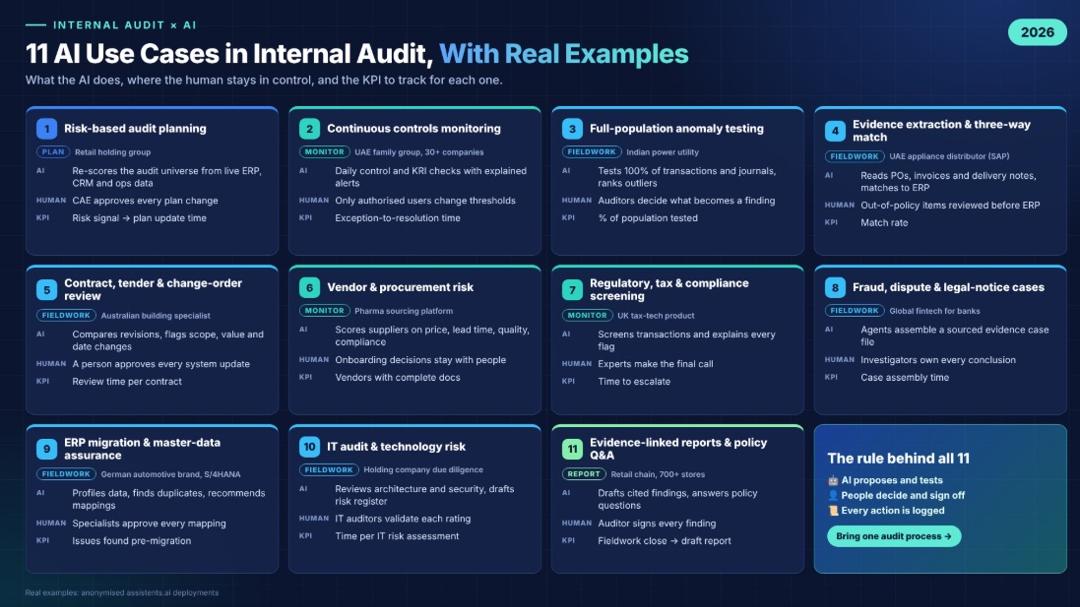
Here are the 11 AI use cases in internal audit at a glance. Each one is detailed below with a workflow, a real deployment, the human control point and a KPI.
| # | Use case | Audit stage | AI capability | Real example (industry) |
|---|---|---|---|---|
| 1 | Risk-based audit planning and dynamic risk scoring | Plan | Agentic BI + Context Engine | Retail holding group |
| 2 | Continuous controls monitoring and KPI exception alerts | Monitor | Autonomous workflows | Diversified family business group, UAE |
| 3 | Full-population transaction and anomaly testing | Fieldwork | Agentic BI + anomaly detection | State power transmission utility, India |
| 4 | Evidence extraction and three-way matching | Fieldwork | Document AI + ERP workflow | Home-appliance distributor, UAE |
| 5 | Contract, tender and change-order review | Fieldwork | Document AI + revision analysis | Remedial construction specialist, Australia |
| 6 | Third-party, vendor and procurement risk | Monitor | Deep Research + workflows | Pharma sourcing platform, India |
| 7 | Regulatory, tax and compliance screening | Monitor | Agents with evidence and explainability | Tax-tech product, UK |
| 8 | Fraud, disputes and legal-notice investigations | Investigate | Orchestrated agents | Fintech serving banks and credit unions |
| 9 | ERP migration and master-data assurance | Fieldwork | Data agents + specialist validation | German premium automotive brand |
| 10 | IT audit and technology risk assessment | Plan | Deep Research + Canvas | Long-term holding company, US/Europe |
| 11 | Evidence-linked findings, reports and policy Q&A | Report | Deep Research + conversational agents | Tax research tool, US; national retail chain, India |
1. Risk-based audit planning and dynamic risk scoring
What it is: AI scores risk across the audit universe from live operational and financial data, so the annual plan reflects current risk rather than last year's assumptions.
How AI agents do it:
- Connect to ERP, CRM and operational dashboards through a shared business context (entities, definitions, policies).
- Monitor risk indicators such as margin drift, overdue receivables, exception volumes and control failures.
- Re-score auditable entities when thresholds move.
- Draft a re-prioritised audit plan and scoping notes for the CAE to review.
Real example: A privately held retail holding group needed governed, cross-functional intelligence across systems and documents. assistents.ai delivered an agentic analysis layer over its existing dashboards, with a unified context engine for structured and unstructured data and a semantic governance layer for rules, hierarchies and formulas. Insights became governed, auditable actions and tasks. The result was a shift from reactive reporting to proactive execution, with standardised decision logic across teams.
Human control: The CAE approves any change to the audit plan. AI proposes; people decide.
KPI to track: Time from risk signal to plan update; percentage of audit hours aligned to top-rated risks.
2. Continuous controls monitoring and KPI exception alerts
What it is: Continuous auditing uses AI to test controls and key risk indicators every day, not once a year, and to alert owners the moment a threshold breaks.
How AI agents do it:
- Define controls and thresholds as versioned business rules.
- Run checks on a schedule or when a system event fires.
- Explain each exception (what changed, by how much, which entity).
- Route alerts to the control owner, track the response and record the outcome.
Real example: One of the UAE's most prominent family business groups, with 30+ companies, needed consistent finance and procurement oversight across entities. assistents.ai standardised group-wide KPIs and automated alerts on purchase-price trends, gross-margin impact, early-payment cost (notional finance cost) and vendor delivery and returns, with scheduled insight packs for leadership. The group gained earlier detection of margin erosion and vendor slippage and fewer variance surprises.
Human control: Thresholds are set and changed only by authorised users. Every alert and response is logged.
KPI to track: Exception-to-resolution time; number of control breaches found by monitoring vs found at year-end.
3. Full-population transaction and journal-entry anomaly testing
What it is: Instead of testing a sample, AI analyses 100% of transactions or journal entries and flags outliers such as unusual amounts, timing, users or account combinations.
How AI agents do it:
- Ingest the full ledger, sub-ledger or operational dataset.
- Apply rule-based tests (weekend postings, round amounts, segregation-of-duties conflicts) and statistical anomaly detection.
- Rank exceptions by risk and attach the source records.
- Push high-risk items to the auditor's review queue.
Real example: An Indian state power transmission utility needed reliable visibility across transmission operations. assistents.ai delivered transmission KPI monitoring with anomaly detection, loss and outage analytics, predictive maintenance indicators and automated alerts to field operations. The outcome was faster identification of grid exceptions and operational risks and better transparency for leadership. The same pattern applies to journal entries and payments.
Human control: Auditors decide which exceptions become findings. The AI never closes an exception on its own.
KPI to track: Percentage of population tested; false-positive rate; hours per test.
4. Evidence extraction and three-way matching (PO, invoice, ERP)
What it is: Document AI reads purchase orders, invoices and delivery notes, extracts the fields, and matches them to ERP records so every transaction (not a sample) is tested.
How AI agents do it:
- Receive documents by email, portal or PDF.
- Extract customer or vendor, products, quantities, prices, terms and delivery details.
- Validate against master data, contracts, credit limits and ERP entries.
- Flag missing information, duplicates or items outside policy for human review.
- Write approved data to SAP or another ERP and archive the source and audit record.
Real example: A premium home-appliance distributor in the UAE was handling orders manually across systems and moving off a legacy document platform with high licensing costs. assistents.ai built a governed workflow that interprets order documents, validates them and creates SAP sales orders, with rules for exceptions and approvals, audit logs and reconciliation reporting. The result was less manual processing, a faster order-to-confirm cycle with fewer data-entry errors, and improved auditability of sales-order creation and exceptions.
For auditors, this means the evidence trail already exists: every document, check, exception and approval is recorded. (For the operational side of invoice matching, see our guide to AI agents for accounts payable.)
Human control: Anything outside policy goes to an authorised reviewer before it reaches the ERP.
KPI to track: Match rate; exceptions per 1,000 documents; time to clear an exception.
5. Contract, tender and change-order review
What it is: AI compares contract and tender versions, extracts obligations and values, and highlights changes that affect cost, scope or risk.
How AI agents do it:
- Ingest complex PDFs, including scanned drawings and tables, with vision-language models.
- Identify the document type and the right workflow.
- Compare revisions and highlight changed scope, value and dates.
- After human approval, update the operational system and keep an audit log.
Real example: An Australian waterproofing and remedial building specialist with 20+ years of experience handled complex tender documents by hand. assistents.ai built autonomous agents that ingest, analyse and synchronise tender documents into its job-management system, with revision analysis, quote locking and audit logs. The solution was engineered for up to ~90% faster tender document processing, with a ~95% extraction accuracy target for standard formats, and reduced bid risk through change detection and auditability.
Human control: A person approves every change before it updates the system of record.
KPI to track: Review time per contract; unapproved scope changes detected; value at risk identified.
6. Third-party, vendor and procurement risk
What it is: AI monitors suppliers continuously, covering price, lead time, delivery performance, documentation and compliance, so vendor risk is visible before it becomes a finding.
How AI agents do it:
- Pull vendor master data, purchase history and supplier documents.
- Research suppliers with cited sources (financial stability, references, regulatory status).
- Score vendors on price, lead time, quality and compliance.
- Alert on concentration risk, price drift or missing documents.
Real example: A pharma sourcing platform offering 1,800+ rare excipients and 7,500+ SKUs needed faster, better-controlled procurement. assistents.ai automated RFQs and supplier matching, supported quality and regulatory document handling, and added analytics on price, lead time and vendor performance. The platform gained faster procurement cycles, fewer manual follow-ups and better price and lead-time visibility.
Human control: Supplier onboarding and offboarding decisions stay with procurement and audit.
KPI to track: Vendors with complete documentation; spend under monitored contracts. (Related: AI agents for FinOps.)
7. Regulatory, tax and compliance screening
What it is: AI screens transactions and documents against regulatory and tax rules, collects the evidence, and explains why each item was flagged.
How AI agents do it:
- Screen each transaction against defined risk rules.
- Classify risk and collect supporting evidence.
- Write an explainability note for each flag.
- Escalate high-risk items to a specialist.
Real example: A UK tax-tech product needed to spot cross-border risks such as withholding tax, VAT mismatches and permanent-establishment exposure early. assistents.ai built transaction screening with risk classification, evidence collection, explainability notes and an escalation workflow to tax experts. The results were earlier detection of withholding and VAT risk, fewer last-minute deal disruptions, and faster, more consistent pre-compliance review.
Human control: Experts make the final call. The AI explains; it does not conclude.
KPI to track: Items screened per period; time to escalate; repeat findings. (For regulated financial services, see AI agents for BFSI.)
8. Fraud, disputes and legal-notice investigations
What it is: Orchestrated AI agents gather data, documents and communications into a single case file, so investigators start with evidence rather than a blank folder.
How AI agents do it:
- Take in cases from chat, email, phone or system alerts.
- A document agent extracts details; a data agent looks up and validates records; a communication agent contacts the right team.
- Assemble an evidence package with sources.
- Route to the investigator, wait for review, then resume.
Real example: A global fintech that provides cloud automation for banks and credit unions, focused on disputes, fraud and compliance, needed consistent case handling. assistents.ai delivered omnichannel intake, workflow routing, agent-assist summaries and next-best actions, with auditability, reporting and SLA monitoring. Outcomes included faster, more consistent case handling and better compliance readiness through audit trails.
The same pattern powers legal-notice monitoring: English and Arabic notices are read, counterparty names extracted, matched to SAP customer or vendor records, and assembled into an evidence package for legal review.
Human control: Investigators own every conclusion and any action against a person or counterparty.
KPI to track: Case assembly time; cases closed within SLA. (Related: AI in insurance, including fraud.)
9. ERP migration and master-data assurance
What it is: AI profiles data before and during an ERP migration, finds duplicates and inconsistencies, recommends mappings and keeps a decision trail that auditors can review.
How AI agents do it:
- Discover and profile source data: customers, material master, vendors, transactions and custom tables.
- Check for duplicates and inconsistencies.
- Recommend mappings and transformation rules.
- Route recommendations to specialists for validation and record the rationale.
Real example: A leading German premium automotive brand used assistents.ai to support SAP ECC to SAP S/4HANA migration decisions. Agents profiled data, checked quality, recommended mappings and supported specialist validation. Outputs included mapped data, transformation rules, validation results, migration files and decision records, so every choice can be traced and reviewed.
Human control: Specialists approve every mapping. Nothing migrates on AI judgment alone.
KPI to track: Data-quality issues found pre-migration; mapping decisions with documented rationale.
10. IT audit and technology risk assessment
What it is: AI speeds up IT audits and technology due diligence by reviewing architecture, code, infrastructure and security evidence and drafting a structured risk register.
How AI agents do it:
- Gather architecture documents, configurations and security evidence.
- Research known risks and standards with cited sources.
- Assess scalability, resilience, security and integration readiness.
- Draft a risk register and remediation roadmap in a shared, editable document.
Real example: A long-term holding company that partners with founders and family businesses needed rigorous technical due diligence before an investment in a mobile-banking platform. The review covered code and architecture, infrastructure and security, scalability and resilience, and integration readiness, delivered as a risk register with a remediation roadmap. The outcome was faster investment decisions with clear, structured technology-risk visibility and fewer post-deal surprises.
Human control: IT auditors validate each risk rating before it reaches the audit committee.
KPI to track: Time to complete an IT risk assessment; high risks with an agreed remediation owner.
11. Evidence-linked findings, reports and policy Q&A
What it is: AI drafts findings and reports with citations back to the source evidence, and answers first-line policy and control questions so the business asks fewer repeat questions of audit.
How AI agents do it:
- Deep Research gathers and cites sources: workpapers, policies, regulations and prior reports.
- Canvas turns the research into a draft finding or report, with version history.
- Reviewers edit together and finalise for approval.
- A conversational agent answers policy and SOP questions with source-backed answers.
Real examples: A US sales-and-use-tax research tool uses AI for automated source collection, summarisation and memo drafting with citations, giving faster research cycles, less manual source-hunting and more consistent outputs. Separately, a value-retail chain with 700+ stores across India uses a knowledge agent over its SOP and policy documents, giving frontline teams on-demand answers and reducing helpdesk load.
Human control: The auditor signs every finding. Citations make each claim verifiable.
KPI to track: Time from fieldwork close to draft report; repeat questions to audit; findings with linked evidence.
See it in action: Book a tailored assistents.ai walkthrough and bring one audit process. We will map its systems, handoffs and approval points.
Why generic AI tools stall in internal audit
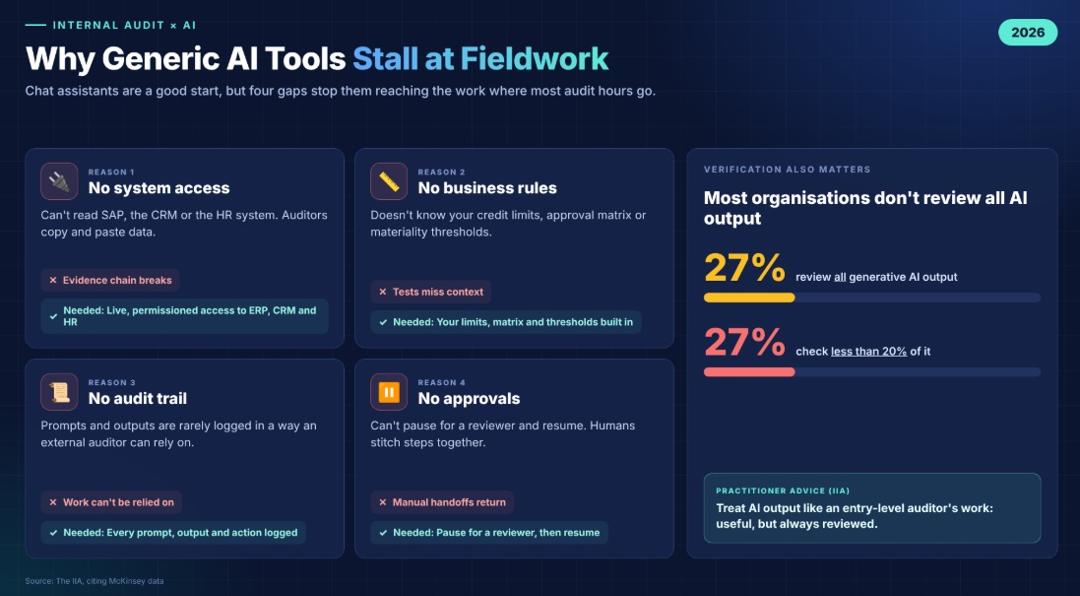
Generic assistants are a good start, but they stall at fieldwork for four reasons:
- No system access. They cannot read SAP, the CRM or the HR system, so auditors copy and paste data, which breaks the evidence chain.
- No business rules. They do not know your credit limits, approval matrix or materiality thresholds.
- No audit trail. Prompts and outputs are rarely logged in a way an external auditor can rely on.
- No approvals. They cannot pause for a reviewer and resume, so humans must stitch steps together.
Verification also matters. The IIA cites McKinsey data showing only 27% of organisations review all generative AI output, and 27% check less than 20%. Practitioners interviewed by the IIA advise treating AI output like an entry-level auditor's work: useful, but always reviewed.
Why assistents.ai is the best platform for AI in internal audit
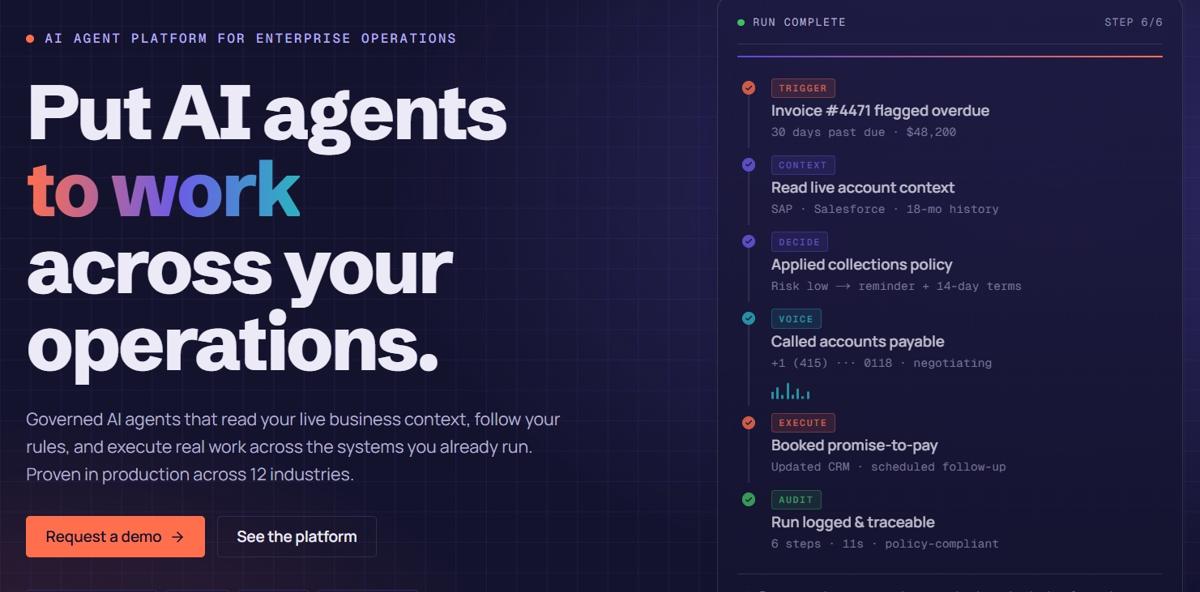
assistents.ai is a governed enterprise AI agent platform. It turns audit processes into connected, controlled workflows that run from trigger to verified outcome. Here is why audit teams choose it.
1. Built for organisational, not personal, productivity
Copilot, Claude and ChatGPT help one auditor draft faster. assistents.ai connects teams, business context, rules and enterprise systems, coordinates a process end to end, and measures cycle time, throughput, exception handling and control.
2. Five AI capabilities on one platform
Ask, analyse, read, speak and act from one place:
- Conversational agents: source-backed answers and permitted actions
- Agentic BI: natural-language questions to charts, reports, scheduled insights and threshold alerts
- Document AI: documents to validated, structured data
- Voice AI: multilingual conversations with in-call actions and summaries
- Autonomous workflows: events, schedules and inboxes to completed work
Teams extend these with Deep Research, Canvas, Agent Builder and Workflow Builder.
3. Governance auditors can audit
Every action goes through an access check (user role and permissions) and a policy evaluation (rules and constraints). It is then allowed, sent for human approval, or blocked and logged for review. Permissions, business rules, human approvals and complete audit history are built in, not bolted on.
4. A Context Engine that understands your business
Agents work from shared entities, relationships, definitions, policies and source evidence: contract terms, customer history, product specifications and business policy. Findings are source-backed, not guessed.
5. Connects to the systems you already audit
assistents.ai connects ERP (including SAP), CRM, HR, files, databases and APIs through secure standard protocols, event ingestion and bidirectional sync. An AI Gateway handles approved-model routing, fallback, usage management and security. You can deploy as cloud SaaS, private cloud or on-premise.
6. A delivery team, not just software
Forward Deployed Engineers, AI engineers, and data science and machine learning experts in the USA, Australia and India take you from configuration to enterprise delivery. The examples in this guide come from deployments across finance, utilities, retail, construction, logistics, healthcare and professional services.
Benefits of AI in internal audit
| Benefit | What it means for internal audit | Metric |
|---|---|---|
| Faster operations | Shorter path from request to outcome: planning, testing and reporting | Audit cycle time |
| Productive teams | Auditors spend time on judgment, not data gathering | Hours per engagement on evidence collection |
| Reliable information | Consistent, accurate, up-to-date data across entities | Percentage of population tested; data exceptions |
| Stronger control | Approvals, audit history and oversight built into every step | Exceptions resolved within SLA |
The method is the same each time: baseline the process, track the change and improve continuously. Gartner found 54% of audit functions have not started measuring AI ROI, so a baseline alone puts you ahead.
Risks of AI in internal audit and how to govern them
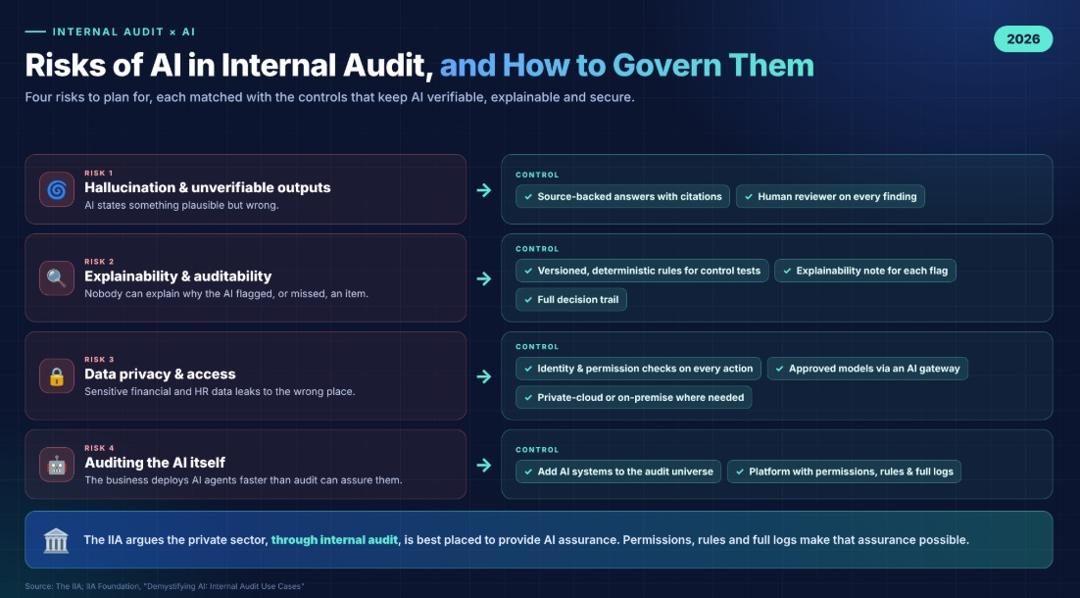
Hallucination and unverifiable outputs
Risk: AI states something plausible but wrong. Control: Require source-backed answers with citations, and keep a human reviewer on every finding.
Explainability and auditability
Risk: Nobody can explain why the AI flagged, or missed, an item. Control: Use versioned, deterministic rules for control tests, explainability notes for each flag, and a full decision trail.
Data privacy and access
Risk: Sensitive financial and HR data leaks to the wrong place. Control: Identity and permission checks on every action, approved models via an AI gateway, and private-cloud or on-premise deployment where needed.
Auditing the AI itself
Risk: The business deploys AI agents faster than audit can assure them. Control: Add AI systems to the audit universe. The IIA has argued that the private sector, through internal audit, is best placed to provide AI assurance. A platform with permissions, rules and full logs makes that assurance possible. For practical guidance, see the IIA Foundation's research on AI use cases for internal audit.
How to start: a governed 6-step rollout plan for internal audit
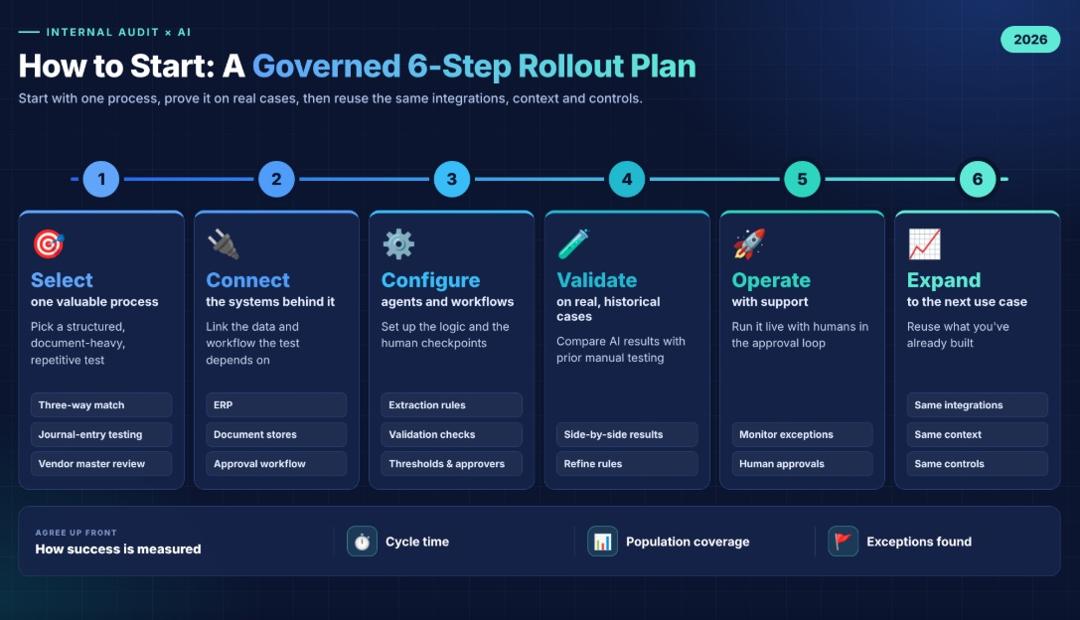
- Select one valuable process. Choose a structured, document-heavy and repetitive test, such as three-way match, journal-entry testing or vendor master review.
- Connect the systems behind it: ERP, document stores and the approval workflow.
- Configure agents and workflows: extraction rules, validation checks, thresholds and who approves what.
- Validate on real, historical cases. Compare AI results with prior manual testing and refine.
- Operate with support. Run it live, monitor exceptions and keep humans in the approval loop.
- Expand to the next use case, reusing the same integrations, context and controls.
Agree up front how success will be measured: cycle time, population coverage and exceptions found. If you are budgeting, see how much it costs to build an AI agent.
assistents.ai vs other AI internal audit tools
| Criteria | Generic AI assistants (Copilot, ChatGPT) | Audit point tools (workpaper and Excel AI) | assistents.ai |
|---|---|---|---|
| Scope | Individual drafting and research | One audit task, such as document matching | End-to-end audit workflows across functions |
| System access | Limited or none | Mostly files and spreadsheets | ERP (including SAP), CRM, HR, databases and APIs |
| Continuous monitoring | No | Rarely | Yes: events, schedules and threshold alerts |
| Governance | User-level | Workpaper trail | Permissions, policy rules, human approvals, blocked actions and full audit history |
| Evidence | Uncited unless prompted | Linked to workpapers | Source-backed answers with citations and a decision trail |
| Deployment | Vendor cloud | Vendor cloud | SaaS, private cloud or on-premise |
| Implementation support | Self-serve | Self-serve or customer success | Forward Deployed Engineers |
This compares typical use. Many of these vendors also offer enterprise and agent capabilities.
Conclusion: put AI agents to work in your audit function
The gap in internal audit is no longer access to AI. It is a governed way to put AI to work on real audit processes. The 11 AI use cases in internal audit above show what that looks like in practice: agents that read, test, match, monitor and report, with humans approving what matters and every step recorded.
Start with the process that matters most. Bring one audit process. We will map its systems, handoffs and approval points and agree how success will be measured.
Book a tailored assistents.ai walkthrough →
Further reading
- AI Agents for Accounts Payable: 11 Use Cases
- AI Agents for FinOps: 11 Use Cases
- Top 10 AI Agents for BFSI in India
- AI in Insurance: 11 Use Cases
- Gartner: 93% of audit functions use AI, but 60% lack a formal strategy
- The IIA: Transforming Audit Through AI
Examples are anonymised from assistents.ai client implementations. Results describe each client's reported outcomes or design targets and will vary by process and data.
FAQs
How is AI used in internal audit?
AI is used in internal audit to score risk, plan audits, test 100% of transactions, extract and match evidence, monitor controls continuously, screen for compliance and fraud, and draft evidence-linked reports. Generative AI helps auditors write and research; AI agents connect to ERP systems and run tests with a full audit trail.
What are the main AI use cases in internal audit?
The main AI use cases in internal audit are risk-based planning, continuous controls monitoring, full-population transaction testing, three-way matching, contract review, vendor risk, compliance screening, fraud investigation, ERP migration assurance, IT audit, and findings and reporting. Most teams start with a document-heavy, repetitive test.
Will AI replace internal auditors?
No. AI takes over repetitive data gathering, matching and monitoring, while auditors keep professional judgment, scoping, conclusions and sign-off. The IIA advises treating AI output like an entry-level auditor's work that still needs review. The role shifts towards analysis and advisory work.
What is the difference between generative AI and AI agents in internal audit?
Generative AI produces text, such as summaries, memos and draft findings, from a prompt. AI agents act: they connect to systems, test data, match documents, raise alerts, wait for approvals and log each step. Agents deliver organisational productivity; generative AI mainly delivers personal productivity.
What are the risks of using AI in internal audit?
The main risks are hallucinated or unverified outputs, weak explainability, data privacy breaches and unmonitored AI in the business. Control them with source-backed answers, versioned rules, permission checks, human approval for material actions, private deployment options and complete audit logs.
How does AI enable continuous auditing?
AI enables continuous auditing by running control tests and risk-indicator checks automatically on a schedule or when system events occur. It explains each exception, alerts the control owner and tracks resolution, so issues surface in days rather than at year-end.
Can AI test 100% of transactions instead of sampling?
Yes. AI can analyse full populations of transactions, journal entries or documents, applying rules and anomaly detection to every record. Auditors then review the ranked exceptions instead of a random sample, which improves coverage and focuses effort on real risk.
How do internal auditors audit AI systems?
Auditors add AI systems to the audit universe and review their governance: who can use them, what actions they can take, which rules apply, how outputs are reviewed and whether every action is logged. Platforms with built-in permissions, approvals and audit history make this assurance practical.
How should an internal audit team start with AI?
Start with one structured, repetitive, document-heavy process, such as three-way match. Connect the systems, configure rules and approvals, validate on historical cases, then go live with human review. Measure cycle time and coverage before expanding. Gartner found 60% of audit functions lack a formal AI strategy, so a documented pilot is a strong first step.
What are the best AI tools for internal audit in 2026?
The best choice depends on scope. Generic assistants suit drafting and research. Audit point tools suit workpaper and spreadsheet tasks. For end-to-end, governed automation across ERP, documents and approvals, an enterprise AI agent platform such as assistents.ai covers the most use cases on one foundation.