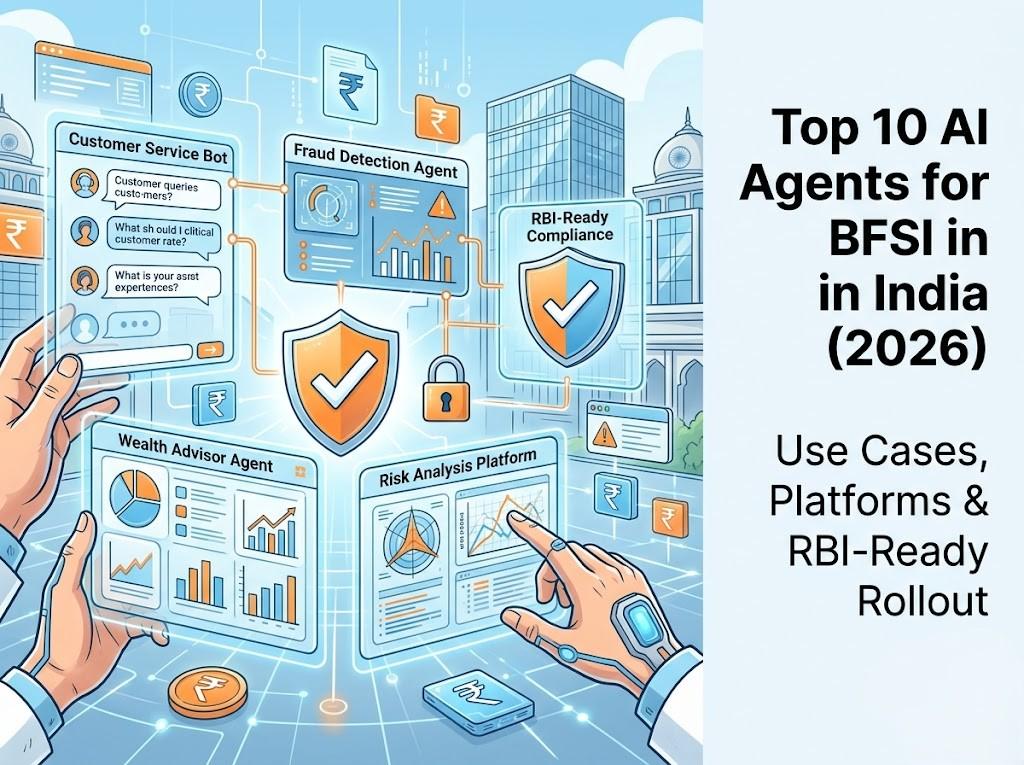
Indian banks, NBFCs and insurers no longer ask whether to use AI agents. The harder question is which ones can run real work inside a regulated environment.
That is why this list of the top 10 AI agents for BFSI in India looks different from a typical roundup of chatbots. The RBI's AI framework set out seven principles and 26 recommendations for responsible AI in finance. It proposes human oversight for AI-driven decisions and keeps the institution accountable even for models it buys from a vendor.
An agent that answers questions is no longer enough. You need one that reads a loan file, checks it against your rules, updates your system, and sends the exceptions to a person, with a record of every step.
So we compared ten platforms on workflow depth, governance, Indian-language coverage, deployment options and evidence. Below you will find the ranked list, 11 BFSI use cases, anonymised results from real deployments, and an RBI-readiness checklist. We are the team behind [Assistents.ai](https://assistents.ai/), which is on the list, so we explain exactly how we ranked and where another platform is the better fit.
Quick answer: the top AI agents for BFSI in India
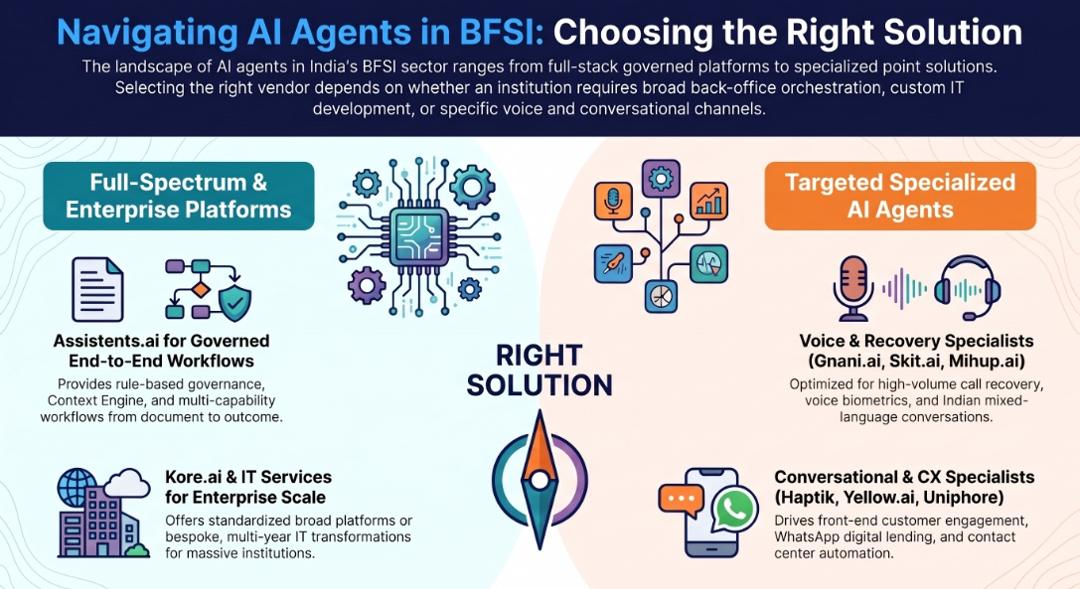
The best AI agents for BFSI in India in 2026 are Assistents.ai (best overall for governed, end-to-end workflows), Gnani.ai (enterprise voice), Skit.ai (collections voice), Haptik (conversational journeys), Yellow.ai (multichannel CX), Kore.ai (enterprise agent platform), Uniphore (CX orchestration), Fluid AI (bank-focused agents), Mihup.ai (Indian mixed-language voice) and large IT services firms for custom builds. Choose by workflow: voice-only needs and end-to-end back-office processes call for different platforms.
Top 10 AI agents for BFSI in India at a glance
| # | Platform | Best for | Notable strength |
|---|---|---|---|
| 1 | Assistents.ai | Governed, multi-agent workflows across documents, voice, analytics and service | Context, rules, approvals and audit built into one platform; cloud, private cloud or on-premise |
| 2 | Gnani.ai | Enterprise voice and voice biometrics at Tier-1 BFSI scale | Indian-language depth in voice |
| 3 | Skit.ai | Servicing and collections voice automation | BFSI-specific voice workflows |
| 4 | Haptik | WhatsApp and chat-led journeys such as lending and support | Published BFSI conversational examples |
| 5 | Yellow.ai | Multichannel customer experience, including insurance | Broad channel coverage |
| 6 | Kore.ai | Enterprise agents across service, employee support and back-office | Platform breadth |
| 7 | Uniphore | Customer experience and conversational orchestration | Contact-centre focus |
| 8 | Fluid AI | Banks wanting packaged KYC, onboarding, sales and voice agents | Bank-oriented packaging |
| 9 | Mihup.ai | Indian mixed-language voice and live agent assist | Code-switched Hindi-English |
| 10 | Large IT services firms (Infosys, Wipro, TCS) | Custom, large-scale transformation programmes | Delivery capacity |
What are AI agents in BFSI?
An AI agent in BFSI is software that understands a business request, uses your data and rules to decide the next step, takes action across your systems, and hands off to a person when a decision needs human judgement. It does this with a full audit trail.
How that differs from what most institutions already run:
| Approach | What it does | Limit |
|---|---|---|
| Chatbot | Answers questions from a script or knowledge base | Does not complete the process |
| RPA | Follows fixed rules | Breaks when a document layout or workflow changes |
| AI agent | Reads unstructured inputs, reasons over context, executes multi-step work, handles exceptions and records every step | Needs governance, permissions and human checkpoints |
This matters in Indian BFSI because the work is document-heavy, multilingual and regulated. A loan file, a KYC pack or an insurance claim is rarely clean. Agents earn their place where exceptions are common and every action must be explainable. For a deeper comparison, see AI Agents vs RPA.
How we ranked the top 10 AI agents for BFSI in India
We evaluated each platform on six criteria, weighted for how a bank, NBFC or insurer actually buys:
| Criterion | Weight | What we looked at |
|---|---|---|
| BFSI workflow depth | 25% | Does it complete real processes (onboarding, loan documents, disputes, collections) or only answer questions? |
| Governance and auditability | 25% | Permissions, approvals, audit logs, explainability and human oversight, which the RBI's direction of travel makes a core requirement |
| Indian language and channel coverage | 15% | Hindi, English and regional languages across voice, WhatsApp, chat and email |
| Integration and deployment flexibility | 15% | Fit with core banking, ERP and CRM; cloud, private cloud and on-premise options |
| Time to production and delivery model | 10% | Whether a team is accountable for getting you live |
| Evidence | 10% | Documented deployments and outcomes, not demos |
Our limits: assistents.ai publishes this list, so we are not a neutral party. We ranked ourselves first for end-to-end, governed workflows. Where a specialist is the better fit, such as pure high-volume voice, we say so in each entry. Rankings for the other nine reflect fit against these criteria and rely on publicly available information as of October 2026.
The top 10 AI agents for BFSI in India
1. Assistents.ai: best overall for governed, end-to-end BFSI workflows
Assistents.ai is an enterprise agentic AI platform that puts AI agents to work across operations, with business context, rules and human approvals built in. One platform covers five capabilities:
Teams can also build their own agents with the Agent Builder and Workflow Builder.
Best for: banks, NBFCs, insurers and fintechs that want one governed platform from an incoming document or event to a verified outcome in their system of record.
Strengths
- A shared Context Engine holds entities, policies and source evidence, so agents act within your rules.
- Governance is part of the platform: identity and permissions, rules and approvals, and a complete audit history (Agent Governance).
- Agent orchestration coordinates document, data and communication agents, with exceptions routed to people.
- Deploy as cloud SaaS, private cloud or on-premise, with approved models routed through an AI Gateway.
- Connects to ERP including SAP, CRM, documents and databases through APIs, SDKs and connectors.
- A delivery team of forward-deployed engineers, AI engineers and data specialists across the USA, Australia and India.
When not to choose it: if your only need is a high-volume outbound voice programme, a voice specialist (see #2 and #3) may be a faster fit. Assistents.ai makes most sense when voice is one part of a wider workflow.
2. Gnani.ai: best for enterprise voice at scale
Gnani.ai focuses on voice AI for large enterprises. Third-party comparisons describe it as strong on Indian-language depth and voice biometrics, with on-premise deployment available and custom, usage- or outcome-based pricing. [VERIFY]
- Best for: Tier-1 banks and insurers building large voice programmes.
- Consider alternatives if: you need document processing, analytics or back-office orchestration alongside voice.
3. Skit.ai: best for collections and servicing voice
Skit.ai offers voice automation aimed at servicing and recovery workflows in BFSI. [VERIFY]
- Best for: collections and servicing teams with high call volumes.
- Consider alternatives if: your priority is document-heavy workflows such as loan intake or claims.
4. Haptik: best for conversational and WhatsApp-led journeys
Haptik is known for conversational agents on chat channels. It has published BFSI examples such as a WhatsApp flow for digital lending covering authentication, document upload and loan issuance. [VERIFY current offering]
- Best for: customer-facing journeys on WhatsApp and web.
- Consider alternatives if: you need deep back-office orchestration with audit and approvals.
5. Yellow.ai: best for multichannel customer experience
Yellow.ai provides multichannel customer experience automation and is frequently shortlisted by insurers in Indian comparisons. [VERIFY]
- Best for: insurers and large consumer-facing BFSI brands.
- Consider alternatives if: your highest-value use cases are internal operations rather than customer support.
6. Kore.ai: best for enterprise agent breadth
Kore.ai positions its platform for designing, deploying and governing AI agents across customer service, employee support and operations. See our direct comparison: Assistents.ai vs Kore.ai.
- Best for: large institutions standardising on a broad conversational agent platform.
- Consider alternatives if: you want an India-based delivery team shaped around one priority process first.
7. Uniphore: best for customer experience orchestration
Uniphore focuses on conversational automation and enterprise customer experience. [VERIFY]
- Best for: contact-centre-led transformation.
- Consider alternatives if: document, analytics and workflow agents matter as much as conversations.
8. Fluid AI: best for packaged bank agents
Fluid AI describes an enterprise agentic platform for banks and financial institutions, covering customer support, KYC and onboarding, sales and voice. [VERIFY]
- Best for: banks that want pre-packaged agents.
- Consider alternatives if: you need custom workflows tied to your own systems and rules.
9. Mihup.ai: best for Indian mixed-language voice and agent assist
Mihup.ai focuses on Indian mixed-language conversations, with voice bots and live agent assist. [VERIFY]
- Best for: contact centres handling code-switched Hindi-English calls.
- Consider alternatives if: your use cases extend beyond voice.
10. Large IT services firms (Infosys, Wipro, TCS): best for custom programmes
Large Indian IT services firms offer AI platforms and delivery capacity for multi-year transformations in banking and insurance. [VERIFY specific platform names and offerings]
- Best for: very large, bespoke programmes with deep systems integration.
- Consider alternatives if: you want a focused first use case live in weeks rather than a programme.
11 AI agent use cases for BFSI in India
For each use case we show what the agent does, who it suits, where a human should stay in the loop and what to measure. For a global banking view, see our guide to 25+ AI agent use cases in banking.
| # | Use case | What the agent does | Best for | Human checkpoint | Measure |
|---|---|---|---|---|---|
| 1 | KYC and onboarding agent | Collects documents, extracts and validates fields, checks consistency, flags gaps | Banks, NBFCs, insurers, broking | Enhanced due diligence and mismatches | Onboarding turnaround, drop-off, exception rate |
| 2 | Loan and claims document processing agent | Reads layouts and tables, extracts fields, applies business rules, sends structured data to your system; missing information goes to human review (Document AI) | Lenders, insurers | Missing or conflicting data, items outside policy | Manual re-entry, extraction accuracy, cycle time |
| 3 | Credit appraisal support agent | Checks document completeness and quality, validates against lending rules, assembles the case for the analyst | NBFCs, banks | The credit decision stays with authorised people | Time to a decision-ready file, rework, consistency |
| 4 | Fraud and AML alert triage agent | Gathers evidence behind alerts, summarises the case, prioritises for investigators | Banks, payments players | Every filing and escalation decision | Alert handling time, backlog, investigator productivity |
| 5 | Compliance screening and evidence agent | Screens transactions for risk, classifies it, collects evidence, writes explainability notes, escalates to specialists | Treasury, trade, cross-border, legal and compliance teams | All flagged cases go to an expert | Time to pre-compliance review, late-stage deal disruption |
| 6 | Omnichannel customer service agent | Handles intake across chat, email and phone, classifies intent, routes work, summarises for human agents, monitors SLAs | Banks, insurers, fintechs | Escalations and sensitive complaints | First-response time, resolution time, SLA adherence |
| 7 | Multilingual voice agent | Holds natural voice conversations, checks customer details, updates a record, sends confirmation, creates follow-ups (Voice AI) | Servicing, reminders, enquiries in Hindi, English and other languages | Handover on request or low confidence | Containment, handover rate, call-summary quality |
| 8 | Disputes and grievance handling agent | Triages disputes, retrieves records, applies resolution logic, tracks timelines | Banks, card, payments and lending operations | Complex or high-value cases | Resolution time, SLA breaches, reopen rate |
| 9 | Collections and portfolio early-warning agent | Monitors delinquency, maturity and concentration signals, alerts managers when thresholds are crossed | NBFCs, lenders, leasing, microfinance | Policy exceptions, settlements | Early-stage detection, roll rates, time to action |
| 10 | Agentic BI agent for leadership and treasury | Answers natural-language questions with governed definitions, charts and alerts; models cash flow and runway (Agentic BI) | CXOs, finance and treasury teams | Decisions based on the insight | Reporting turnaround, analyst dependency, time to anomaly detection |
| 11 | Research and advisory support agent | Ingests market data, runs indicator and pattern analysis, drafts research packs with cited sources | Broking, wealth, asset managers | Publication and client advice | Time to insight pack, repeatability |
For use case 11, see also our guide to AI tools for mutual fund analysis.
What delivered work looks like
These are anonymised deployments by the assistents.ai team. They are not all Indian BFSI institutions, and we flag which are adjacent. The pattern, not the logo, is what transfers to a bank, NBFC or insurer. More examples are on our customers page.
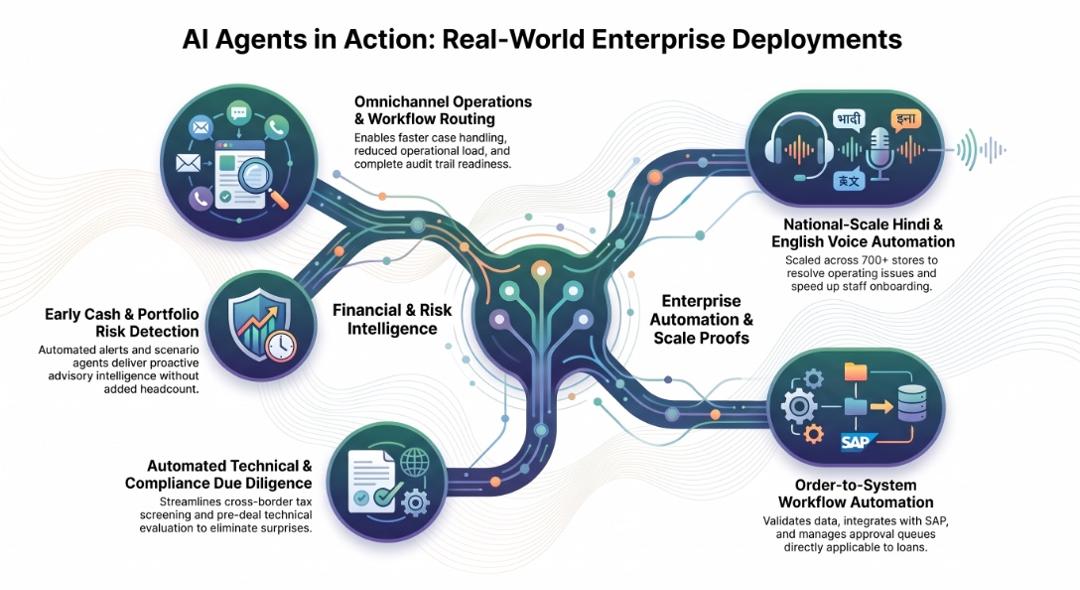
Customer operations for a global fintech serving banks and credit unions
- The need: handle cases across chat, email and phone with auditability.
- Delivered: omnichannel intake and workflow routing, agent-assist summaries with next-best actions, reporting and SLA monitoring, built to integrate with core systems.
- Reported results: faster case handling, reduced operational load through automation, better compliance readiness through audit trails.
- Maps to use cases: 6 and 8.
Portfolio intelligence for an automotive lender
- The need: a clearer view of lending and leasing performance.
- Delivered: portfolio KPIs covering risk, delinquency, maturity and residuals, dealer-network analytics, and alerts for exceptions and early risk signals.
- Reported results: better portfolio visibility and faster risk identification.
- Maps to use case: 9.
Cash-flow intelligence for an AI CFO platform
- Delivered: a financial data connection layer, forecast and scenario agents, runway and cash-risk alerts, and portfolio views for advisors.
- Reported results: earlier detection of cash risks and anomalies, and advisory-style insight without added headcount.
- Maps to use case: 10.
Cross-border risk screening for a tax-tech product
- Delivered: transaction screening and risk classification, evidence collection, explainability notes and escalation to tax experts.
- Reported results: earlier detection of withholding tax and VAT risk, fewer last-minute deal disruptions, faster and more consistent pre-compliance review.
- Maps to use case: 5.
Technical due diligence for a mobile banking investment
- Delivered: code and architecture review, infrastructure and security assessment, scalability and resilience analysis, and a risk register with a remediation roadmap.
- Reported results: faster investment decisions with clear technical risk visibility, and fewer post-deal surprises.
- Relevance: banks and holding companies assessing fintech partners or acquisitions.
Market research automation for an Indian markets research platform
- Delivered: data ingestion and indicator pipelines, research automation, and thematic dashboards with alerts.
- Reported results: faster production of market insight packs and more repeatable research workflows.
- Maps to use case: 11.
Governed leadership analytics for a US analytics startup
- Delivered: an agentic analytics layer over existing data, a semantic governance layer for consistent definitions, and a natural-language interface.
- Reported results: faster strategic visibility without BI queueing, and consistent metric definitions.
- Maps to use case: 10.
Adjacent proof: Hindi and English voice at national scale
For a national Indian retailer with 700+ stores, we built a voice support agent (speech-to-text, LLM, text-to-speech) in Hindi and English, plus an inventory agent and a knowledge agent over operating documents. Reported results: reduced manual helpdesk burden, faster store-issue resolution and faster onboarding. This is retail, not BFSI, but it shows Indian-language voice working in production at scale.
Adjacent proof: order-to-system workflows with approvals
For a large enterprise group, agents interpret incoming orders, validate them, create sales orders in SAP, route exceptions for approval, and keep audit logs and reconciliation reports. Reported results: reduced manual order processing, faster order-to-confirm cycles and better auditability. The same pattern applies to loan files and claims.
Illustrative workflow (not a client result): home-loan application support
Application form, identity, income and bank statements come in. Agents check document completeness and quality, validate against lending rules, support the analyst's credit appraisal, and route to the authorised approval queue or request more information. People keep the decisions, and exceptions are reported.
RBI-ready AI agents: what Indian banks and NBFCs should check
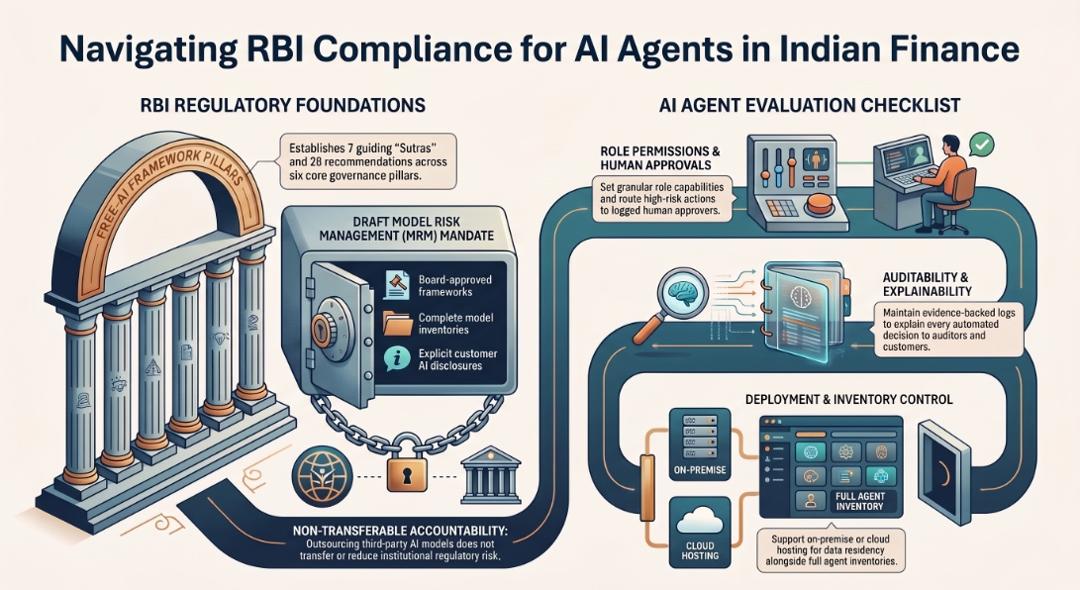
Any AI agent used by a regulated entity needs to sit inside the RBI's emerging AI governance expectations. Two documents matter.
1. The FREE-AI framework. The RBI's FREE-AI Committee report was released on 13 August 2025. It sets out seven guiding principles (the "Sutras") and 26 recommendations across six pillars: Infrastructure, Policy, Capacity, Governance, Protection and Assurance. Read the report. It is a committee report with recommendations, not binding directions.
2. The draft Model Risk Management guidance. On 24 June 2026 the RBI released draft Guidance on Regulatory Principles for Model Risk Management for public comment until 24 July 2026. Proposed expectations include:
- a Board-approved model risk management framework covering AI and ML models;
- a complete model inventory, with no model deployed unless it is listed;
- risk tiering that considers how much autonomy a model has;
- robust human oversight for AI-driven decisions;
- disclosure to customers that they are dealing with an AI system;
- controls against hallucination in customer-facing and decision-making uses;
- continued accountability for third-party models: outsourcing the model does not outsource the risk.
Read the draft on the RBI site. [VERIFY whether the final guidance has been issued and update this section.]
Checklist for evaluating any AI agent platform
- Can you set what each agent may and may not do, per role and per system?
- Are risky actions routed to human approval, with the approver recorded?
- Is every action logged with the evidence behind it?
- Can you explain a result to an auditor or customer?
- Can you control which models are used, with fallback and usage monitoring?
- Can it be deployed in your own cloud or on-premise to meet data residency needs?
- Can you maintain an inventory of agents and their autonomy levels?
Assistents.ai is built around these controls: permissions, business rules, human approvals and a complete audit history. See Agent Governance, Security & Trust and Compliance. Platform controls support your compliance programme; they do not replace your own board-approved policies and validation. For a practical framework, read the AI Agent Governance Playbook and our seven governance best practices.
This section reflects publicly available information as of October 2026 and is not legal advice. SEBI, IRDAI and data-protection obligations may also apply to your institution. [Have counsel review before publishing.]
Why Assistents.ai for BFSI in India
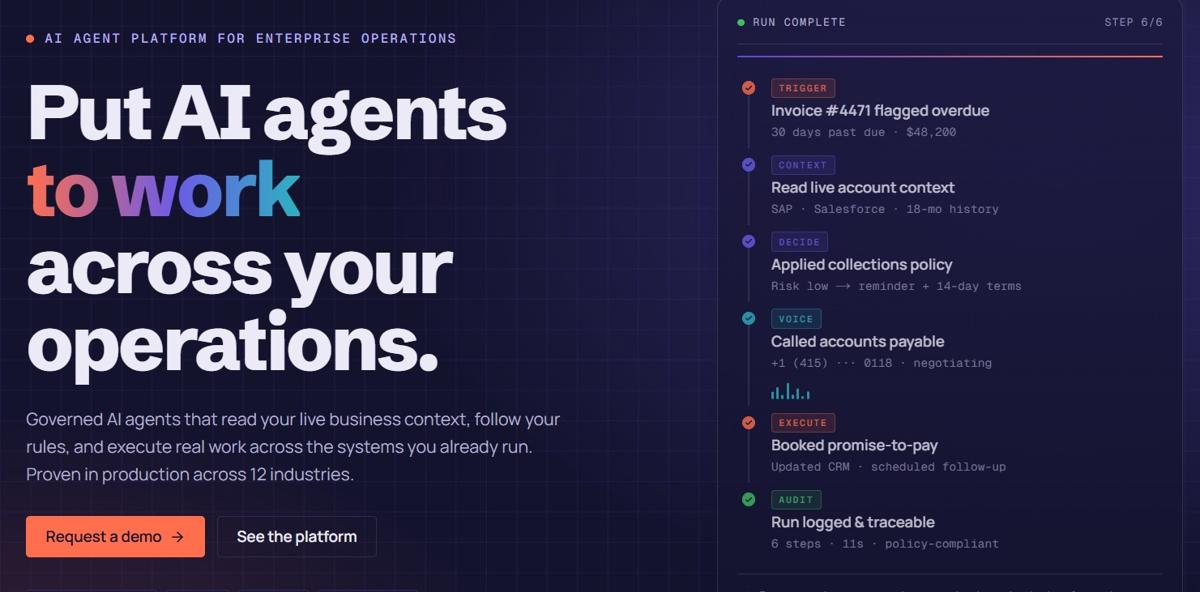
Most institutions already have Copilot, Claude or ChatGPT. Those tools help individuals draft, summarise and analyse. Assistents.ai is built for organisational productivity: coordinating a process from trigger to verified outcome across teams, rules and enterprise systems, and measuring cycle time, throughput, exceptions and control. You build on the AI investment you already have rather than replacing it. The full picture is on our Why Assistents page.
- One platform, five capabilities. Conversational agents, agentic BI, document AI, voice AI and autonomous workflows share one foundation, so you can start with one use case and combine them as you grow.
- Context before action. The Context Engine connects customers, contracts, products, policies and source evidence, so an agent knows what is permitted before it acts.
- Control on every action. Each action passes an access check and policy evaluation. It is then allowed, sent for human approval or blocked, and every outcome is recorded.
- Fits your estate. It connects to ERP including SAP, CRM, documents and databases. You choose the models through the AI Gateway and where it runs: cloud, private cloud or on-premise.
- A team that delivers. Forward-deployed engineers, AI engineers and data specialists work with you from configuration to delivery, in the USA, Australia and India.
- A focused way to start. Pick one priority process, agree success measures and expand once it works.
Compared with other platforms: see our side-by-side pages for Kore.ai and Cognigy, or all comparisons.
How to choose the right AI agent by BFSI segment
| Segment | Where to start | What to insist on |
|---|---|---|
| Banks | Document-heavy back-office work such as KYC files and disputes, or customer service | Audit and human-approval controls; use a voice specialist if voice is your main need |
| NBFCs and lenders | Loan document processing, appraisal support and portfolio early warning | Explainability and clear human decision points |
| Insurers | Claims and policy document intake, plus multichannel service | Language coverage and well-designed handover |
| Broking, wealth and asset managers | Research automation and leadership analytics | Publication and advice stay with people |
| Fintechs | Omnichannel service routing and cash-flow or risk analytics | Governance included from day one |
Explore our financial services solutions or the in-depth guide to AI agents for financial services.
A practical rollout plan for BFSI AI agents
Choose one valuable process. Map its systems, handoffs and approval points, and agree how success will be measured.
| Stage | Indicative timing | What happens |
|---|---|---|
| Select | Weeks 1-2 | Pick the process, baseline cycle time, volume and error rate, define autonomy levels and approval points |
| Connect | Weeks 2-4 | Link systems of record, documents and knowledge sources; set permissions |
| Configure | Weeks 4-6 | Set up agents, workflows, rules and exception paths |
| Validate | Weeks 6-8 | Run real cases with human review and refine until results meet your thresholds |
| Operate and expand | Ongoing | Monitor, measure against the baseline and extend to the next process |
See our implementation approach and the AI Agent ROI Calculator to model savings against your own volumes.
Next step: start with your priority process
Pick the BFSI process where manual effort, exceptions and delays hurt most, and measure it first. Book a tailored platform walkthrough, or talk to our team.
Related reading
- 25+ AI Agent Use Cases in Banking
- 15 Best AI Agents in Fintech
- 11 Best AI Tools for Mutual Fund Analysis
- AI Agents for Financial Services guide
FAQs
What is agentic AI in BFSI?
Agentic AI in BFSI refers to AI systems that plan and complete multi-step banking, lending and insurance tasks, using your data and rules and involving humans where a decision needs judgement. It goes beyond answering questions to completing processes such as onboarding, document processing and dispute handling, with an audit trail.
Which are the top AI agents for BFSI in India?
Leading options include Assistents.ai, Gnani.ai, Skit.ai, Haptik, Yellow.ai, Kore.ai, Uniphore, Fluid AI and Mihup.ai, plus large IT services firms for custom programmes. The right choice depends on whether you need voice, customer journeys or governed back-office workflows.
What are the most valuable AI agent use cases in BFSI?
KYC and onboarding, loan and claims document processing, fraud and AML alert triage, omnichannel customer service, multilingual voice, collections and portfolio early warning, and leadership analytics. Choose by volume, exception rate and how measurable the outcome is.
What is the difference between a chatbot and an AI agent in banking?
A chatbot answers questions. An AI agent also takes action across your systems, such as creating a record or routing an exception, within permissions, rules and approvals.
Is the RBI FREE-AI framework mandatory?
FREE-AI is a committee report with recommendations, not binding directions. However, the RBI's draft Model Risk Management guidance from 24 June 2026 builds on it and proposes concrete requirements for AI models. Check the RBI site for the current status of the final guidance.
Can AI agents work with existing core banking and ERP systems?
Yes. Agents connect to existing systems through APIs, SDKs and connectors and do not require replacing them. Integration depth varies by platform and by your core system, so confirm connectors during evaluation.
Can AI agents be deployed on-premise for data residency?
Some can. Assistents.ai supports cloud SaaS, private cloud and on-premise deployment. Confirm what each vendor supports for your regulatory and data-residency requirements.
Which AI agents support Hindi and regional languages?
Voice specialists such as Gnani.ai and Mihup.ai emphasise Indian-language coverage, and Assistents.ai has delivered Hindi and English voice support at national retail scale. Test candidates on your own call recordings and code-switched speech.
How long does it take to deploy an AI agent in a bank or NBFC?
A focused first use case can reach production in weeks, while multi-agent programmes take longer. The main variables are system integration, data readiness and how clearly governance requirements are defined up front.