TL;DR
- Agentic AI in the hospitality industry means AI agents that complete hotel work end to end — booking, pricing, cleaning schedules, invoices — inside your PMS, CRM and ERP, with humans approving what matters.
- 98% of hoteliers already use AI, yet fewer than 1 in 10 hotels say it has cut manual work by more than 30%. Agentic AI is how hotels close that gap.
- This guide covers 11 AI agents hotels are deploying, how they work together, real case studies, a guardrails matrix, a worked ROI example and a 6-step rollout.
- Governance decides success: 41% of hotels still have no formal AI policy.
Hotels are not short of AI. They are short of AI that finishes the job.
In the Mews Hotelier Survey 2026, 98% of hoteliers said they had used AI across their operations in the previous six months. Yet the State of Distribution 2026 report from NYU SPS, RateGain and HEDNA found that fewer than one in ten hotels say AI has reduced their manual work by more than 30%.
That is the gap agentic AI in the hospitality industry is built to close. A chatbot drafts a reply. An AI agent checks availability, holds the room, sends the quote, updates the PMS and flags the one exception a human needs to see.
This guide explains what agentic AI means for hotels, the 11 AI agents hotels are putting to work in 2026, how those agents coordinate, what has actually been delivered in production, and how to deploy them safely.
What is agentic AI in the hospitality industry?
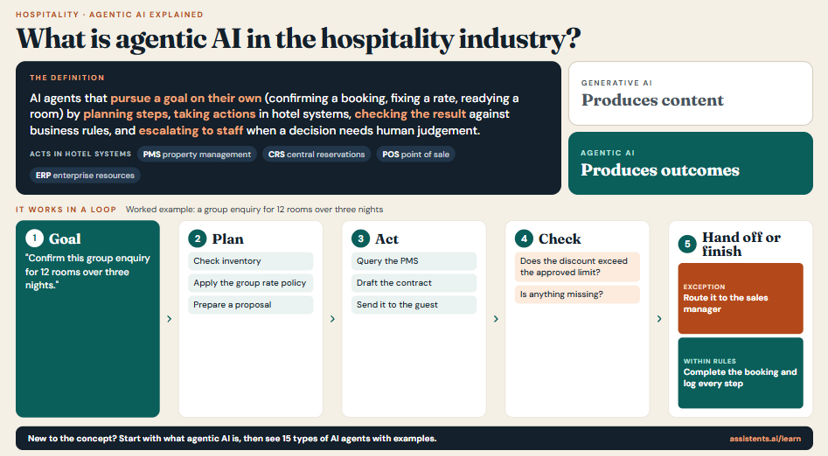
Agentic AI in the hospitality industry is the use of AI agents that pursue a goal on their own — confirming a booking, fixing a rate, readying a room — by planning steps, taking actions in hotel systems such as the PMS, CRS, POS and ERP, checking the result against business rules, and escalating to staff when a decision needs human judgement.
Where generative AI produces content, agentic AI produces outcomes. It works in a loop:
- Goal: "Confirm this group enquiry for 12 rooms over three nights."
- Plan: check inventory, apply the group rate policy, prepare a proposal.
- Act: query the PMS, draft the contract, send it to the guest.
- Check: does the discount exceed the approved limit? Is anything missing?
- Hand off or finish: route the exception to the sales manager, or complete the booking and log every step.
If you are new to the concept, our explainer on what agentic AI is covers the fundamentals, and 15 types of AI agents with examples shows how agent designs differ.
Agentic AI vs generative AI vs chatbots vs RPA
Hotels already run chatbots, generative AI tools and rule-based automation. Here is how agentic AI differs.
| Chatbot | Generative AI | RPA | Agentic AI | |
|---|---|---|---|---|
| What it does | Answers scripted questions | Drafts text, summaries, images | Repeats fixed clicks and steps | Pursues a goal across multiple steps |
| Access to hotel systems | Usually read-only FAQs | Usually none | Screen-level, brittle | Reads and writes through APIs with permissions |
| Handles exceptions | Escalates or fails | Needs a human prompt | Breaks when screens change | Reasons, retries, or routes to a human |
| Who decides | Script | The person prompting | The rule | The agent, within policies and approval gates |
| Hotel example | "What time is checkout?" | Drafting a review response | Copying reservations between systems | Rebooking a delayed guest, adjusting housekeeping and notifying the front desk |
The short version: chatbots talk, generative AI writes, RPA repeats, and agentic AI gets hotel work done under your rules.
Why hotels are moving to agentic AI in 2026
Four pressures are pushing hotels from AI pilots to AI agents.
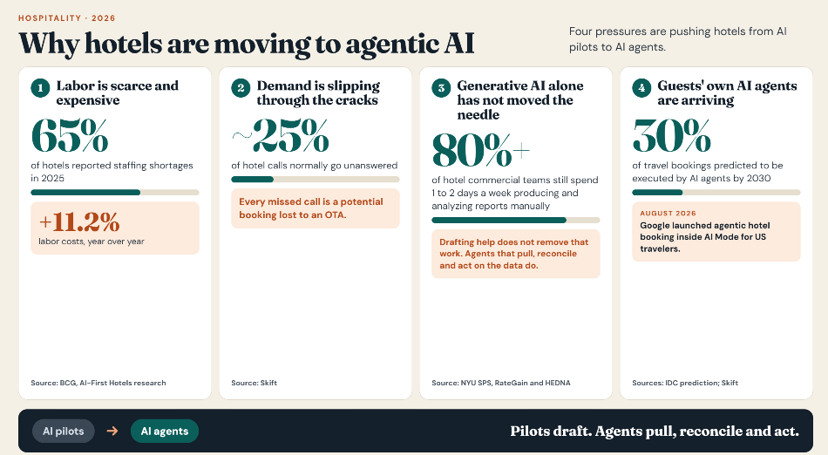
1. Labour is scarce and expensive. According to BCG's AI-First Hotels research, 65% of hotels reported staffing shortages in 2025, and labour costs jumped 11.2% year over year.
2. Demand is slipping through the cracks. Skift reports that about 25% of hotel calls normally go unanswered. Every missed call is a potential booking lost to an OTA.
3. Generative AI alone hasn't moved the needle. More than 80% of hotel commercial teams still spend one to two days a week producing and analysing reports manually, according to NYU SPS, RateGain and HEDNA. Drafting help does not remove that work. Agents that pull, reconcile and act on the data do.
4. Guests' own AI agents are arriving. IDC predicts that by 2030, 30% of travel bookings will be executed by AI agents. In August 2026, Google launched agentic hotel booking inside AI Mode for US travellers.
Budgets are following. In a Canary Technologies survey, 82% of hotel technology buyers expect their AI use to grow within a year.
The 11 AI agents hotels are deploying
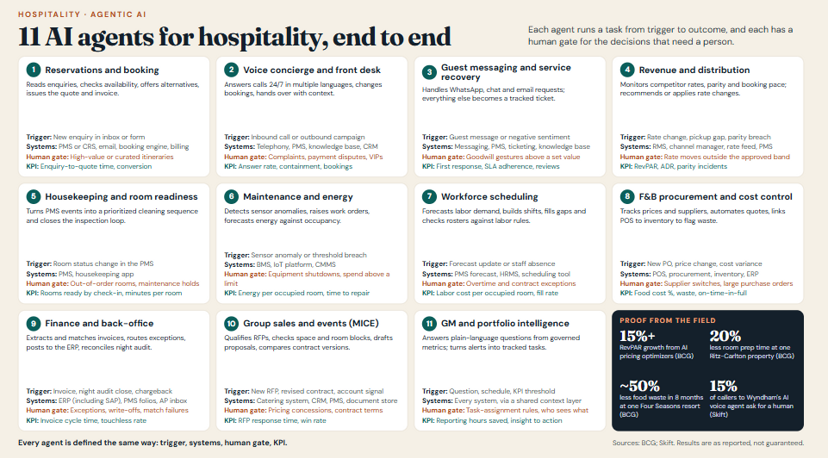
The table below maps each agent to the department it serves and the KPI it moves. Each agent is then described using the same five fields: what it does, trigger, systems, human gate, and KPI.
| # | AI agent | Department | What it automates | Main KPI |
|---|---|---|---|---|
| 1 | Reservations and booking agent | Reservations | Enquiry to confirmed booking | Enquiry-to-quote time |
| 2 | Voice concierge and front desk agent | Front office | Calls, bookings and changes, 24/7 | Call answer rate |
| 3 | Guest messaging and service recovery agent | Guest relations | Omnichannel requests and tickets | First response time |
| 4 | Revenue and distribution agent | Revenue | Rate monitoring, parity and moves | RevPAR |
| 5 | Housekeeping and room readiness agent | Housekeeping | Room assignment and sequencing | Rooms ready by check-in |
| 6 | Maintenance and energy agent | Engineering | Anomalies, work orders, energy use | Energy per occupied room |
| 7 | Workforce scheduling agent | HR and operations | Demand-based shift planning | Labour cost per occupied room |
| 8 | F&B procurement and cost control agent | F&B and purchasing | Price, supplier and waste tracking | Food cost % |
| 9 | Finance and back-office agent | Finance | Invoices, reconciliation, disputes | Invoice cycle time |
| 10 | Group sales and events (MICE) agent | Sales | RFPs, proposals, contract versions | RFP response time |
| 11 | GM and portfolio intelligence agent | Leadership | Questions to answers to assigned actions | Hours of manual reporting saved |
For a broader list of individual tasks, see our 25 AI agent use cases in hospitality. This guide focuses on how agentic systems run those tasks end to end.
1. Reservations and booking agent
What it does: Reads booking enquiries from email and web forms, classifies intent, extracts dates, guests and preferences, and asks the guest for anything missing. It then checks live availability, proposes alternative dates or properties when the first choice is full, and generates the quote and invoice.
- Trigger: a new enquiry in the reservations inbox or booking form
- Systems: PMS or CRS, email, booking engine, billing
- Human gate: high-value or highly curated itineraries go to a reservations specialist before confirmation
- KPI: enquiry-to-quote time, conversion rate, booking accuracy
Proof: we delivered this agent for a luxury safari lodge collection. The full case study is below. For a deeper look at this pattern, read AI booking agents for luxury hotels.
On assistents.ai, this agent combines Document AI, Conversational Agents and Autonomous Workflows.
2. Voice concierge and front desk agent
What it does: Answers inbound calls around the clock in multiple languages. It can check guest details, find available times, change a booking, send a confirmation and create a follow-up task, all during the call. When a caller needs a person, it hands over with the full context so the guest never repeats themselves.
- Trigger: an inbound call, or an outbound reminder or confirmation campaign
- Systems: telephony, PMS, knowledge base, CRM
- Human gate: complaints, payment disputes and VIP guests route to staff
- KPI: call answer rate, containment rate, bookings from calls
Proof: hotel groups are already here. Skift reports that at Wyndham, 15% of guests calling its AI voice agent ask for a human, which means the rest are handled by the agent. We have delivered the same pattern for a national retail chain: a voice support agent in Hindi and English, backed by a knowledge agent over operational documents.
On assistents.ai, this runs on Voice AI. New to the category? Start with what voice AI agents are.
3. Guest messaging and service recovery agent
What it does: Handles guest requests across WhatsApp, web chat and email. It answers policy questions from your own documents and resolves simple requests, such as extra towels, late checkout within policy, or directions. Anything else becomes a ticket routed to the right team, tracked against its SLA and escalated if it stalls.
- Trigger: an inbound guest message, or a negative sentiment signal
- Systems: messaging channels, PMS, ticketing, knowledge base
- Human gate: compensation or goodwill gestures above a set value
- KPI: first response time, SLA adherence, review scores
Proof: we delivered an omnichannel service agent for a real estate portfolio operator, covering query triage, payment support, ticketing and escalation to human teams. The result was faster responses, lower call-centre load and a consistent 24/7 experience. Hotel guest messaging uses the same pattern.
Gartner predicts that agentic AI will autonomously resolve 80% of common customer service issues by 2029 (a cross-industry forecast). See also agentic AI use cases in customer service.
4. Revenue and distribution agent
What it does: Monitors competitor rates, rate parity across channels, booking pace and review signals continuously. It recommends rate changes, or applies them automatically within approved bands, and flags parity breaches before they cost you direct bookings.
- Trigger: a competitor rate change, a pickup deviation, a parity breach or an event on the city calendar
- Systems: revenue management system, channel manager, rate shopping feed, PMS
- Human gate: any rate move outside the approved band goes to the revenue manager
- KPI: RevPAR, ADR, parity incidents
Proof: BCG found that AI-driven pricing optimisers have generated upward of 15% growth in RevPAR. We delivered an always-on competitive monitoring agent for a consumer durables brand. It tracks pricing, discounts, availability and ratings across channels, replacing manual portal checks with instant alerts. That is the same monitor-compare-alert loop a hotel rate agent runs.
5. Housekeeping and room readiness agent
What it does: Turns PMS events (check-outs, early arrivals, room moves, VIP flags) into a prioritised cleaning sequence. It reassigns rooms when plans change and closes the inspection loop, so the front desk knows exactly which rooms are ready.
- Trigger: a room status change in the PMS
- Systems: PMS, housekeeping app
- Human gate: out-of-order rooms and maintenance holds
- KPI: rooms ready by check-in time, minutes per room
Proof: BCG reports that Marriott's system processes more than 1.2 million room assignments across the chain in seconds, and that one Ritz-Carlton property cut room preparation time by 20%.
6. Maintenance and energy agent
What it does: Ingests building management and IoT sensor data, detects anomalies (an HVAC unit drawing too much power, a leak signal, a chiller trending towards failure), raises a work order and forecasts energy consumption against occupancy.
- Trigger: a sensor anomaly, a threshold breach or a scheduled maintenance window
- Systems: building management system, IoT platform, CMMS
- Human gate: equipment shutdowns and spend above a set limit
- KPI: energy per occupied room, mean time to repair
Proof: we delivered an energy management agent for a research campus, covering sensor ingestion, anomaly detection, forecasting and proactive alerts. It improved energy visibility and caught inefficiencies earlier. A hotel is a campus with guests.
7. Workforce scheduling agent
What it does: Forecasts labour demand from occupancy, arrivals, groups and F&B covers. It builds shifts, fills gaps from available staff and checks every roster against labour rules before publishing.
- Trigger: a forecast update or a staff absence
- Systems: PMS forecast, HRMS, scheduling tool
- Human gate: overtime and contract exceptions
- KPI: labour cost per occupied room, shift fill rate
Proof: we delivered matching, scheduling and compliance workflows for a healthcare staffing platform. The outcome was faster fill cycles, better workforce utilisation and less scheduling friction. With 65% of hotels short-staffed (BCG), hotel rosters are a direct fit.
8. F&B procurement and cost control agent
What it does: Tracks purchase price trends, supplier delivery performance, returns and margin impact. It automates requests for quotation and supplier comparison, and connects POS sales with inventory to flag waste.
- Trigger: a new purchase order, a price change or a variance against the recipe cost
- Systems: POS, procurement, inventory, ERP
- Human gate: supplier switches and purchase orders above a set limit
- KPI: food cost %, waste, supplier on-time-in-full rate
Proof: BCG reports that one Four Seasons resort cut food waste by roughly 50% within eight months. We delivered group-wide procurement and finance alerts for a diversified business group, covering purchase price trends, gross margin impact and vendor performance. The result was earlier detection of margin erosion and vendor slippage across entities. Restaurant-led operators should also read our guide to voice AI agents for restaurants.
9. Finance and back-office agent
What it does: Extracts supplier invoices from email and PDFs, matches them against purchase orders and receipts, routes exceptions for approval, and posts approved entries to the ERP. It also reconciles night audit variances and assembles evidence packs for chargebacks and folio disputes.
- Trigger: an invoice in the AP inbox, the night audit close or a chargeback notice
- Systems: ERP (including SAP), PMS folios, AP inbox
- Human gate: exceptions, write-offs and anything outside the three-way match
- KPI: invoice cycle time, touchless processing rate
Proof: we delivered this pattern for a home appliances company. Purchase orders arriving by email, portal or PDF are extracted and validated against customer, product, pricing and credit data. Exceptions go to human review, and validated sales orders land in SAP with a full audit trail. The value was less re-entry, clearer exceptions and traceable processing. Hotel accounts payable runs on the same pattern.
10. Group sales and events (MICE) agent
What it does: Qualifies incoming RFPs, checks meeting space and room blocks, and drafts proposals from your rate and package rules. It compares contract versions to highlight every change, and prompts account managers when a corporate client's booking activity rises or falls.
- Trigger: a new RFP, a revised contract or an account activity signal
- Systems: sales and catering system, CRM, PMS, document store
- Human gate: pricing concessions and contract terms
- KPI: RFP response time, win rate
Proof: we delivered a tender revision agent that compares document versions, highlights changes and updates the operational system after human review. We also delivered a sales intelligence agent that turns ERP, CRM and activity signals into follow-up tasks. Both apply directly to group and events sales.
11. GM and portfolio intelligence agent
What it does: Lets general managers, owners and asset managers ask questions in plain language, such as "Which properties missed labour targets last week, and why?". It answers from governed, consistent metric definitions. It sends scheduled insight packs and turns threshold alerts into assigned, tracked tasks.
- Trigger: a question, a schedule or a KPI threshold
- Systems: every system above, connected through a shared business context layer
- Human gate: rules for assigning tasks and who may see what
- KPI: hours of manual reporting saved, time from insight to action
Proof: we delivered an insights-to-action layer for a retail holding group. It combines a unified context engine, a semantic governance layer for rules and formulas, and agents that convert dashboard insights into governed, auditable tasks. The group moved from reactive reporting to proactive execution loops. For multi-property hotel groups, this agent sits across the other ten.
How the 11 agents work together: a day in an agentic hotel
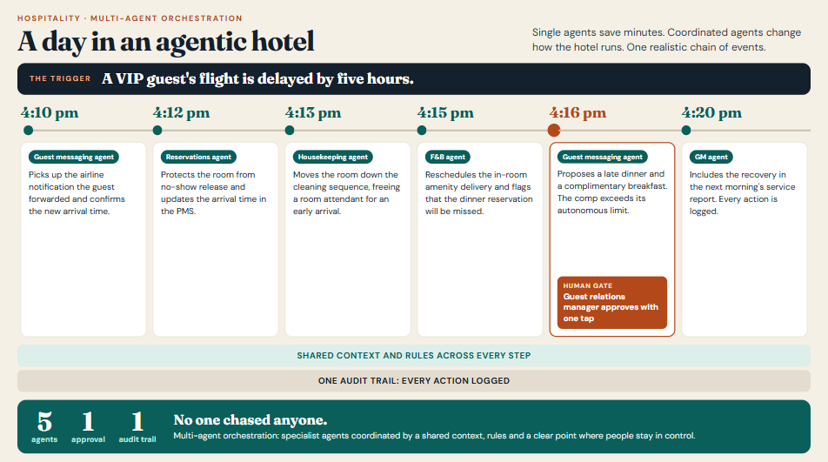
Single agents save minutes. Coordinated agents change how the hotel runs. Here is one realistic chain of events.
4:10 pm. A VIP guest's flight is delayed by five hours. The guest messaging agent picks up the airline notification the guest forwarded and confirms the new arrival time.
4:12 pm. The reservations agent protects the room from no-show release and updates the arrival time in the PMS.
4:13 pm. The housekeeping agent moves the room down the cleaning sequence, freeing a room attendant for an early arrival.
4:15 pm. The F&B agent reschedules the in-room amenity delivery and flags that the dinner reservation will be missed.
4:16 pm. The guest messaging agent proposes a late dinner and a complimentary breakfast. The comp exceeds the agent's autonomous limit, so it goes to the guest relations manager, who approves it with one tap.
4:20 pm. Every action is logged. The GM agent includes the recovery in the next morning's service report.
No one chased anyone. Five agents, one approval, one audit trail. This is multi-agent orchestration: specialist agents coordinated by a shared context, rules and a clear point where people stay in control.
The other side of agentic AI: guest AI agents will book your hotel
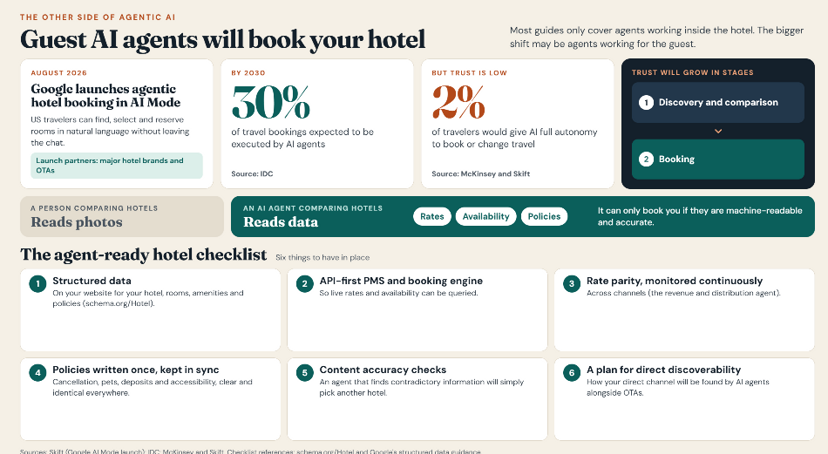
Most guides only cover agents working inside the hotel. The bigger shift may be agents working for the guest.
In August 2026, Google made agentic hotel booking available in AI Mode for US consumers. Travellers can find, select and reserve rooms in natural language without leaving the chat. Launch partners include major hotel brands and OTAs. IDC expects 30% of travel bookings to be executed by AI agents by 2030.
Guests are not yet ready to hand over everything. In McKinsey and Skift research, only 2% of travellers said they would give AI full autonomy to book or change travel. Trust will grow first with discovery and comparison, then with booking.
When an AI agent, not a person, compares your hotel with the one down the street, it reads data rather than photos. It can only book you if your rates, availability and policies are machine-readable and accurate.
The agent-ready hotel checklist
- Structured data on your website for your hotel, rooms, amenities and policies (see Google's structured data guidance and schema.org/Hotel).
- An API-first PMS and booking engine, so live rates and availability can be queried.
- Rate parity monitored continuously across channels (agent #4).
- Policies such as cancellation, pets, deposits and accessibility written once, clearly, and kept in sync everywhere.
- Content accuracy checks, because an agent that finds contradictory information will simply pick another hotel.
- A plan for how your direct channel will be discoverable by AI agents alongside OTAs.
Agentic AI in production: case studies
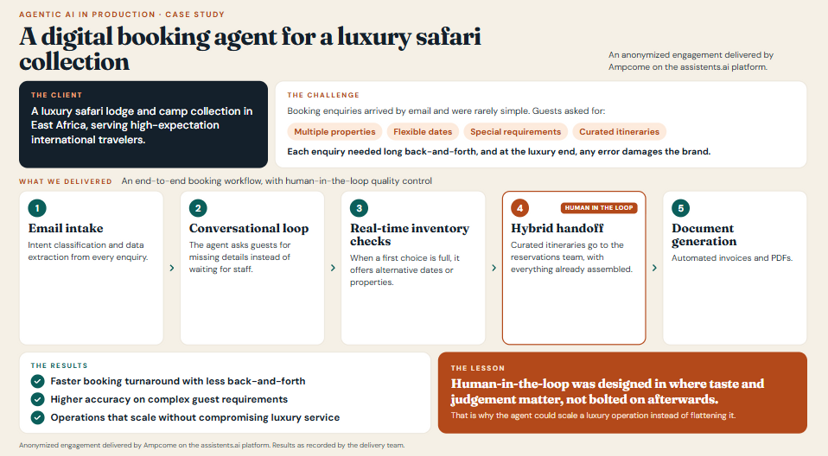
These are anonymised engagements delivered by Ampcome on the assistents.ai platform. Only the first is a hospitality deployment. The others were delivered in other industries and use patterns that transfer directly to hotels.
Case study: a digital booking agent for a luxury safari collection
The client: a luxury safari lodge and camp collection in East Africa, serving high-expectation international travellers.
The challenge: booking enquiries arrived by email and were rarely simple. Guests asked for multiple properties, flexible dates, special requirements and curated itineraries. Each enquiry needed long back-and-forth, and at the luxury end, any error damages the brand.
What we delivered: a digital booking agent that automates the end-to-end booking workflow, with human-in-the-loop quality control.
- Email intake: intent classification and data extraction from every enquiry.
- Conversational loop: the agent asks guests for missing details instead of waiting for staff.
- Real-time inventory checks: when a first choice is full, it offers alternative dates or properties.
- Hybrid handoff: curated itineraries go to the reservations team, with everything already assembled.
- Document generation: automated invoices and PDFs.
The results:
- Faster booking turnaround with less back-and-forth.
- Higher accuracy on complex guest requirements.
- Operations that scale without compromising luxury service.
The lesson: human-in-the-loop was designed in at the point where taste and judgement matter, not bolted on afterwards. That is why the agent could scale a luxury operation instead of flattening it.
Three patterns that transfer to hotels
| Pattern | Delivered for | What was built | Results reported | Hotel equivalent |
|---|---|---|---|---|
| 24/7 omnichannel service agent | A real estate portfolio operator | Web and WhatsApp service agent, query triage, payment support, ticketing and escalation, knowledge base over policies | Faster responses, lower call-centre load, consistent 24/7 experience, better SLA adherence | Guest messaging agent (#3) |
| Multilingual voice and knowledge agent | A national value-retail chain | Hindi and English voice agent, store-level inventory intelligence, retrieval over operating procedures | Less manual helpdesk work, faster issue resolution, faster staff onboarding | Voice concierge (#2) and staff SOP assistant |
| Group procurement and margin alerts | A diversified business group | Group-wide KPI standardisation, alerts on purchase price, margin impact and vendor performance, leadership insight packs | Earlier detection of margin erosion and vendor slippage, fewer variance surprises | F&B procurement (#8) and portfolio intelligence (#11) |
The platform is the same across all four. The agents, rules and connections are configured to each client's processes and controls.
Guardrails: how to keep agentic AI safe in a hotel
The Mews Hotelier Survey 2026 found that 41% of hoteliers have no formal AI policy in place, and 59% believe the front desk welcome and check-in should stay human-led. Both findings point the same way: autonomy must be earned action by action.
The approval matrix
Every agent action falls into one of three lanes: allowed, review required, or blocked.
| Action | Autonomous | Needs human approval | Blocked |
|---|---|---|---|
| Rate change | Within the approved band | Outside the band | Below floor rate |
| Refund or goodwill credit | Up to a set value | Above that value | Refunds to a different payment method |
| Complimentary upgrade or amenity | Within the loyalty tier policy | Outside the policy | — |
| Overbooking or walk decision | — | Always | — |
| Supplier purchase order | Within budget and approved suppliers | New supplier or above limit | Blacklisted supplier |
| Guest data export | — | Authorised roles only | Any unauthorised destination |
In practice, each action should pass through an access check (does this role or agent have permission?) and a policy evaluation (do the rules allow it?). Only then is it executed, sent for approval, or blocked and logged. Every step should land in an audit history you can review.
Failure modes to design against
- Hallucinated policies: an agent invents a cancellation rule. Control: answers are grounded only in approved policy documents, with sources cited.
- Rate parity breaches: an agent updates one channel but not the others. Control: rate changes run as one orchestrated workflow with verification.
- Overbooking from stale inventory: an agent sells a room released elsewhere. Control: real-time availability checks immediately before commitment.
- Silent failures: an agent stalls without anyone noticing. Control: SLA monitoring and exception queues with owners.
Compliance
Payment handling must stay within PCI DSS. Guest data processing must respect GDPR for EU guests, India's Digital Personal Data Protection Act, 2023 for Indian guests, and other local laws. Hotels operating in Europe should map any agent that profiles guests or makes consequential decisions against the EU AI Act.
The ROI of agentic AI: a worked example for a 200-room hotel
No competitor page shows its maths, so here is ours. These are illustrative assumptions, not results or guarantees. Replace every input with your own data.
| Value lever | Assumption | Calculation | Annual value |
|---|---|---|---|
| Missed calls recovered (agent #2) | 10,000 reservation calls a year; 25% unanswered; 20% of those carry booking intent; the agent converts 30%; average booking 2.5 nights at $150 ADR | 2,500 × 20% × 30% = 150 bookings × $375 | $56,250 |
| Guest messaging time (agent #3) | 60 messages a day at 4 minutes each; 60% fully handled by the agent; $25 per staff hour | 2.4 hours × 365 × $25 | $21,900 |
| Accounts payable (agent #9) | 600 invoices a month at 10 minutes each; 70% touchless; $30 per hour | 70 hours × 12 × $30 | $25,200 |
| Revenue management (agent #4) | RevPAR of $110; 1% uplift (conservative against the 15%+ reported by BCG) | $110 × 200 rooms × 365 × 1% | $80,300 |
| Illustrative total | $183,650 |
Subtract platform subscription, implementation, telephony and model usage costs to get net ROI. Two lessons generalise. First, the revenue levers usually outweigh the labour levers. Second, the value compounds once several agents share one context and one governance layer, because each new agent reuses the same integrations.
How to implement agentic AI in a hotel: 6 steps
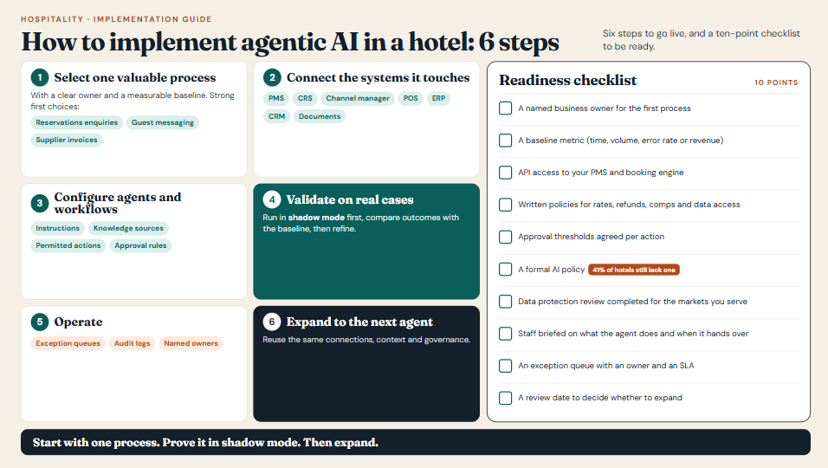
- Select one valuable process with a clear owner and a measurable baseline. Reservations enquiries, guest messaging and supplier invoices are strong first choices.
- Connect the systems it touches: PMS, CRS, channel manager, POS, ERP, CRM and documents.
- Configure the agents and workflows: instructions, knowledge sources, permitted actions and approval rules.
- Validate on real cases in shadow mode first, compare outcomes with the baseline, then refine.
- Operate with exception queues, audit logs and named owners.
- Expand to the next agent, reusing the same connections, context and governance.
Readiness checklist
- [ ] A named business owner for the first process
- [ ] A baseline metric (time, volume, error rate or revenue)
- [ ] API access to your PMS and booking engine
- [ ] Written policies for rates, refunds, comps and data access
- [ ] Approval thresholds agreed per action
- [ ] A formal AI policy (41% of hotels still lack one)
- [ ] Data protection review completed for the markets you serve
- [ ] Staff briefed on what the agent does and when it hands over
- [ ] An exception queue with an owner and an SLA
- [ ] A review date to decide whether to expand
Best agentic AI platforms for hospitality in 2026
The right choice depends on one question: do you need one job done, or many agents working together under the same rules?
| Rank | Platform or category | Best for | Where it stops |
|---|---|---|---|
| 1 | assistents.ai, a governed multi-agent platform | Hotel groups and multi-property operators running several agents across PMS, ERP, CRM, POS and documents, with approvals and audit | Needs a scoped first process and system access; not a plug-in widget |
| 2 | Guest messaging and voice specialists (e.g., Canary Technologies, HiJiffy, Asksuite) | A single property that wants guest communications automated quickly | Mostly guest communications; limited back-office action |
| 3 | PMS-native AI (e.g., Mews, Apaleo, Oracle OPERA Cloud) | Automation inside one property management system | Bound to that PMS's data and roadmap |
| 4 | Revenue and distribution AI (e.g., IDeaS, Duetto, SiteMinder) | Pricing and channel optimisation | The commercial function only |
| 5 | Horizontal CRM agent platforms (e.g., Salesforce Agentforce) | Groups already standardised on that CRM | Hospitality workflows must be built by you |
Point solutions are a sensible choice for a single property with a single problem. Once you run three or more of the 11 agents, you need them to share one context, one set of rules and one audit trail. Otherwise you are managing a dozen disconnected bots.
Why assistents.ai for agentic AI in hospitality
assistents.ai is the enterprise agentic AI platform built by Ampcome. It puts AI agents to work across your operations: agents that understand your business, follow your rules and work alongside your people.
1. Five capabilities on one platform. Conversational Agents, Agentic BI, Document AI, Voice AI and Autonomous Workflows cover all 11 hotel agents in this guide. Teams extend them with Deep Research, Canvas, Agent Builder and Workflow Builder, so you don't need 11 separate tools.
2. A Context Engine that understands your hotel. It connects entities such as guests, bookings, rate plans, contracts and suppliers with your policies and source evidence. Agents answer and act on your business meaning, not guesses.
3. Governance on every action. Each action passes an access check and a policy evaluation. It is then allowed, sent for human approval, or blocked and logged, with a complete audit history. This is the approval matrix above, built into the platform.
4. Built on the systems you already run. Connect ERP (including SAP), CRM, documents and databases through APIs, SDKs and connectors, with event ingestion and two-way sync. Hotel systems such as PMS, POS and channel managers connect through their APIs.
5. Model choice and deployment control. The AI Gateway handles model routing, fallback, usage management and security. You can deploy as cloud SaaS, in a private cloud or on-premise, which matters for data residency.
6. A team that delivers, not just software. Forward Deployed Engineers, AI engineers, and data and integration specialists across the USA, Australia and India take you from configuration to enterprise delivery. We follow the same six steps described above: select, connect, configure, validate, operate, expand.
Proof: a digital booking agent for a luxury safari collection handles complex enquiries end to end, with human-in-the-loop quality control.
Start with one process. Bring one priority process, such as reservations, guest messaging or supplier invoices. We will map its systems, handoffs and approval points, agree how success will be measured, and show it running in a tailored walkthrough. Book a platform walkthrough with assistents.ai.
Conclusion
Agentic AI in the hospitality industry is moving from pilots to operations. The hotels pulling ahead are not the ones with the most AI tools. They are the ones whose agents are connected to real systems, governed by clear rules and measured against real KPIs.
Start with one of the 11 agents, prove it against a baseline, and expand on the same foundation. Explore more AI agent use cases in hospitality, see where the market is heading in agentic AI trends for 2026, or talk to the assistents.ai team about your first process.
FAQs
What is agentic AI in the hospitality industry?
Agentic AI in the hospitality industry is AI that completes hotel tasks end to end. It confirms bookings, adjusts rates, schedules housekeeping or processes invoices by planning steps and acting inside systems such as the PMS, CRS and ERP. It works within approved rules and escalates to staff when human judgement is needed.
How is agentic AI different from a hotel chatbot?
A chatbot answers questions from a script or FAQ. An agentic AI system takes action: it checks availability, updates the booking, sends the confirmation and logs the change. It also handles exceptions by reasoning, retrying or routing to a person, rather than failing.
What are examples of agentic AI in hotels?
Common examples include reservations agents that turn enquiries into quotes, voice agents that answer calls 24/7, revenue agents that monitor rates and parity, housekeeping agents that sequence room cleaning, and finance agents that process supplier invoices. BCG reports that Marriott processes more than 1.2 million room assignments in seconds with AI.
Will agentic AI replace hotel staff?
It replaces tasks, not hospitality. Agents absorb repetitive work such as unanswered calls, manual reports and invoice entry, so staff can focus on guests. In the Mews 2026 survey, 59% of hoteliers said check-in should stay human-led. Most successful deployments keep people in control of high-judgement moments.
Can small or independent hotels use agentic AI?
Yes. Independent hotels usually start with a single agent, such as a voice or messaging agent, from a point solution. Multi-property groups gain more from a platform, because agents share integrations, context and governance across properties.
How does agentic AI connect to a PMS?
Agents connect to property management systems through their APIs. They read reservations, room status and guest profiles, and write permitted updates back. Access is controlled by role-based permissions, and every write is logged.
Is agentic AI safe for guest data and payments?
It can be, if it is designed with guardrails. That means role-based permissions, approval thresholds for refunds and rate changes, audit logs, and payment flows kept within PCI DSS. Guest data handling must comply with GDPR, India's DPDP Act and local laws.
What should a hotel automate first with AI agents?
Start where volume is high and rules are clear: reservation enquiries, guest messaging, missed calls or supplier invoices. Pick one process, measure a baseline, validate on real cases, then expand.
Will AI agents replace OTAs?
Not soon, but they will change distribution. Google now offers agentic hotel booking in AI Mode, with both OTAs and hotel brands as partners. Hotels with accurate structured data, API-accessible rates and consistent policies will be easier for AI agents to recommend and book.
How much ROI can agentic AI deliver for a hotel?
It depends on your volumes, rates and labour costs. In our illustrative 200-room example, four agents create about $184,000 a year in gross value before platform costs, with revenue levers outweighing labour savings. Replace the assumptions with your own data.