Agentic AI in quant trading means using AI agents that plan, call tools and act across the quantitative workflow — factor research, backtesting, portfolio construction, execution and risk — within limits a firm sets and audits.
This is no longer a lab idea. In 2025, Man Group's quant unit Man Numeric said its internal agentic system, AlphaGPT, can generate trading ideas, write the code and backtest them. Several dozen of its signals have since cleared the firm's investment committee for live trading.
The research also shows where agents stop. An August 2026 survey reviewed 20 agentic quant trading systems:
- All 20 treat signal discovery as a core job.
- Only 3 treat order execution as core.
- Only 2 cover all five stages of the trading pipeline as core functions.
Agents are good at finding ideas. The hard part is carrying those ideas safely to the order book. We call this the Signal-to-Order Gap, and it decides which firms get agents into production.
This guide maps 11 use cases across the quant pipeline. Each one is graded by how strong the evidence is, from "in production" to "backtest only". It also covers the governance, regulation and deployment path that separate a demo from a desk.
TL;DR
- Agentic AI in quant trading is already in production for research: alpha mining, research synthesis and reporting.
- Execution and portfolio construction are the least proven stages. Most of the evidence there comes from backtests and dry runs.
- Live-market benchmarks show that strong models do not automatically trade well. Risk control and system design matter more.
- Regulators have noticed. FINRA's 2026 oversight report names "trade execution agents". India's SEBI requires an exchange-issued Algo-ID on every algorithmic order from 1 April 2026.
- The winning pattern: agents propose, deterministic rules gate, humans approve by decision class, and every step is logged.
What Is Agentic AI in Quantitative Trading?
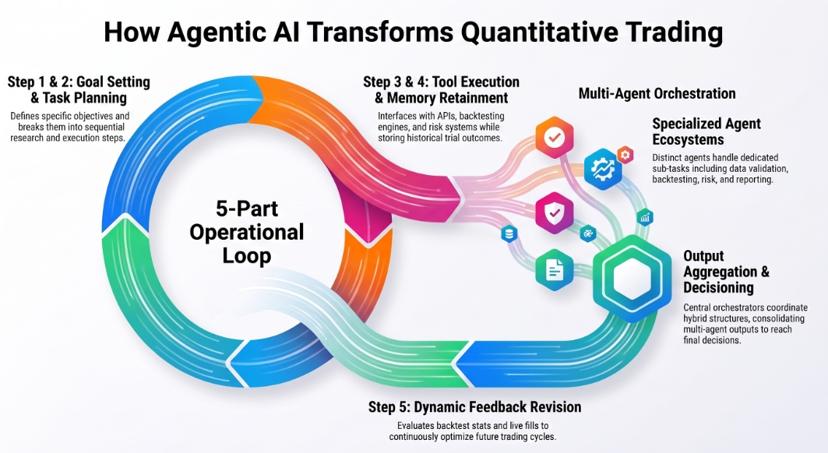
Agentic AI in quantitative trading is software that pursues a trading-research or trading-operations goal by planning steps, using tools and learning from feedback, rather than answering a single prompt or following one fixed rule.
A classic trading algorithm executes logic a human wrote. A machine learning model predicts a number. An agent works more like a junior quant with a task list. It runs a loop of five parts:
- Goal. For example: "Find momentum signals in mid-cap Indian equities that are not correlated with our existing book."
- Plan. It breaks the goal into steps: pull data, form hypotheses, write factor code, backtest, check correlation, summarise.
- Tools. It calls real systems: market-data APIs, a factor library, a backtesting engine, an optimiser, a risk system and, where allowed, an order management system (OMS).
- Memory. It keeps what it tried, what worked and what failed, so the next cycle starts smarter.
- Feedback. It reads results, such as backtest statistics or live fills, and revises the plan.
Most serious setups are multi-agent. Specialised agents handle research, data checks, backtesting, risk and reporting, and an orchestrator coordinates them. The survey found that most published systems combine several structures (sequential, iterative, hierarchical). Most still reach a final decision by simply aggregating agent outputs; fewer use debate, selection or hard gates (arXiv survey).
For a deeper look at how a single trading agent reasons and which strategies it runs, see our guide to how an AI agent for trading strategy works.
Agentic AI vs Algorithmic Trading vs ML Models
Agentic AI does not replace algorithmic trading. It wraps research, oversight and adaptation around it.
| Dimension | Algorithmic trading | ML prediction model | Agentic AI |
|---|---|---|---|
| Decision logic | Fixed rules written by humans | Learned function that outputs a forecast | Goal-driven plan that uses tools, models and rules |
| Adapts to new conditions | Only when someone re-codes it | Only when someone retrains it | Can revise its plan within set limits |
| Handles text (filings, news, research) | No | Limited | Yes |
| Typical speed | Microseconds to seconds | Milliseconds to seconds | Seconds to minutes |
| Main failure mode | Rigid in regime shifts | Overfitting, drift | Hallucination, leakage, unbounded actions |
| Best use | Low-latency execution | Signal scoring | Research, synthesis, monitoring, supervised decisions |
The practical split: keep latency-critical execution in your algorithmic stack, and put agents around it where reasoning, text and coordination add value.
Who Is Using Agentic AI in Quant Trading in 2026?
Institutional adoption is real in research, early in execution, and now visible to regulators.
- Man Group (Man Numeric). AlphaGPT mines data for ideas, writes the strategy code and tests it on historical data. Man Group says it keeps comprehensive human oversight during development. It also logs the full path from first hypothesis to final implementation, and AI-generated signals go through dual-track validation before they reach the normal research and committee process (Man Group).
- Retail brokerages. Robinhood's Agentic Trading gives an AI agent its own separate account, connected through Robinhood's MCP server, so the agent cannot touch the rest of a customer's portfolio (TheStreet). Gemini launched agentic trading for crypto in April 2026 (Corporate Insight). These are retail products, but they show the core design pattern: bounded permissions and an isolated account.
- Research platforms. QuantConnect now runs specialist agents at each stage from idea to paper trading, and promotes an idea only when the evidence supports it (QuantConnect).
- New funds. Lumenai Investments announced plans for a hedge fund built around a fully agentic architecture, expected to start around June 2026 (Hedgeweek). Treat this as an announced plan until results are public.
- Regulators. FINRA's 2026 Annual Regulatory Oversight Report lists "trade execution agents" as an emerging AI agent use case. It flags autonomy without human validation as a key risk (FINRA).
The Quant Agent Pipeline Map: Where Agents Fit
The 11 use cases below follow the order work actually flows on a quant desk: from research to signals, portfolios, execution and risk, with compliance and operations wrapped around them.
| Pipeline stage | Use cases in this guide |
|---|---|
| Research and factor mining | 1. Alpha and factor mining · 2. Research and alternative-data synthesis |
| Signal discovery and validation | 3. Event-driven signals · 4. Backtest automation with leakage guards · 5. Regime detection |
| Portfolio construction | 6. Portfolio construction and rebalancing |
| Execution | 7. Execution agents |
| Risk | 8. Pre-trade risk gates · 9. Backtest-to-live drift monitoring |
| Compliance and operations | 10. Surveillance and algo compliance · 11. PM and research-ops copilot |
The Evidence Ladder
Not every use case has the same proof behind it, so each one below carries a grade.
- Grade A: In production. A named firm reports running it, or a regulator reports it as common practice.
- Grade B: Proven in live or controlled tests. Supported by live-market benchmarks or peer-reviewed results.
- Grade C: Research only. Promising results so far come from backtests, historical replays or prototypes.
This matters because backtest results for AI agents are often weaker once tested live. You can read the full build architecture and autonomy levels in our AI trading agent development guide.
11 Agentic AI Use Cases in Quant Trading
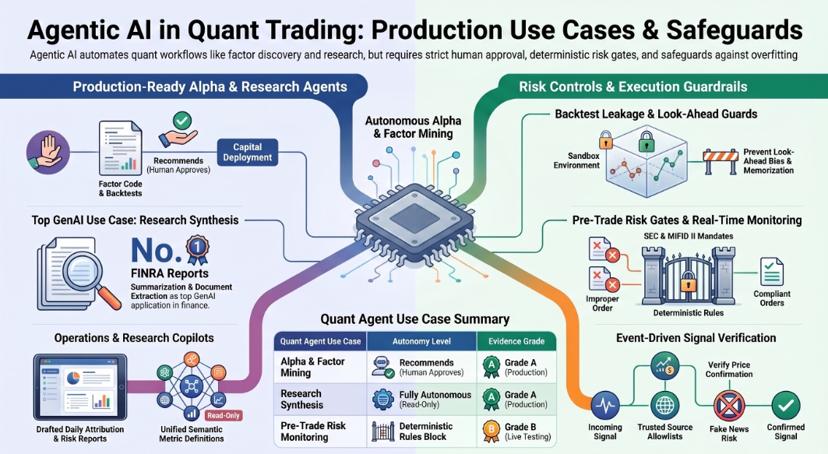
1. Autonomous Alpha and Factor Mining
An alpha-mining agent turns a research idea into factor code, backtests it and hands a ranked shortlist to human researchers.
- Workflow: Research notes and market data → factor library, code sandbox, backtester → candidate factors with code, statistics and a plain-language rationale.
- Autonomy: The agent recommends. A research lead or investment committee approves anything that goes near capital.
- KPIs: Ideas tested per researcher-week; share of candidates that survive out-of-sample tests; correlation to existing signals.
- Evidence: Grade A. Man Group's AlphaGPT is the clearest production example. Academic systems go further. Microsoft Research's RD-Agent(Q) jointly improves factors and models in one loop, and XAlpha keeps a memory of research reports and past discovery results so each cycle builds on the last (XAlpha, arXiv). The survey groups these approaches into four types: generative, collaborative, self-evolving and tool-augmented (arXiv survey).
- Failure mode and control: Self-evolving agents can overfit to the validation period they learned from. Require strict out-of-sample and cross-market tests. Check each factor's correlation with what you already run. Log every generation step so a reviewer can see how a factor was born.
2. Research and Alternative-Data Synthesis
A research-synthesis agent reads filings, earnings transcripts, broker notes and alternative data, and turns them into structured, cited evidence the quant team can test.
- Workflow: Documents and data feeds → retrieval, extraction, entity tagging → structured facts with source citations, stored in a research memory.
- Autonomy: Fully autonomous for read-only summaries. Humans decide what becomes a hypothesis.
- KPIs: Documents processed per day; extraction accuracy on a checked sample; time from filing to usable data.
- Evidence: Grade A. FINRA reports that "summarization and information extraction" is the top generative AI use case among its member firms (FINRA).
- Failure mode and control: Language models can invent numbers. Pull every figure from the source document or database, never from model memory. Attach a citation to each fact, and spot-check extraction against a labelled sample.
- Deployment note: For an Indian equity-research publisher, the Ampcome team built data-ingestion and indicator pipelines plus research automation. This cut the time needed to produce market insight packs and made research workflows more repeatable (see deployments).
3. Event-Driven and News-to-Signal Agents
An event agent watches news, filings and announcements, decides which events matter to a strategy, and proposes a trade idea with the evidence attached.
- Workflow: Trusted news and filing feeds → relevance classification, price and volume reaction check → a scored event signal and a short rationale.
- Autonomy: The agent recommends. Execution goes through the normal signal and risk process.
- KPIs: Signal precision (the share of flagged events that were actually tradable); latency from event to signal; hit rate by event type.
- Evidence: Grade B. In one study, an agentic nowcasting system ranked large US stocks over nine months, from April 2025 to January 2026. A value-weighted portfolio of its top 20 picks returned about 50%, against roughly 26% for the Russell 1000 benchmark. However, the system could not reliably tell future losers from average stocks (arXiv). Nine months is a short window, so treat this as promising, not proven.
- Failure mode and control: Agents can be misled. Researchers showed that subtle fake financial news can change a trading agent's decisions, and that grounding decisions in price data reduces the damage (arXiv survey). Use an allowlist of trusted sources, require price confirmation, and log the source behind every signal.
- Deployment note: For a European digital-asset trading platform, the Ampcome team built market-data ingestion with indicator and pattern analysis, plus alerting and recommendation summaries. The result was faster synthesis of fragmented market signals.
4. Backtest Automation with Leakage and Look-Ahead Guards
A backtest agent writes strategy code from a spec, runs it on point-in-time data and checks that the result is not flattered by leaked future information.
- Workflow: A strategy spec in plain language → code generation, point-in-time data, backtester, walk-forward tests → a backtest report with integrity checks passed or failed.
- Autonomy: Autonomous inside a sandbox. Promotion to paper trading needs approval.
- KPIs: Backtests per week; share of strategies rejected for leakage; gap between backtest and paper-trading results.
- Evidence: Grade B. This is the most underrated use case. Language models have "seen" historical market outcomes in their training data. The "Profit Mirage" study found that LLM agents' backtest gains fall after the model's knowledge cutoff, and counterfactual tests showed the agents leaning on memorised outcomes (arXiv survey). A separate benchmark measures look-ahead bias in LLM trading agents built on the open-source ai-hedge-fund framework (arXiv). QuantConnect only promotes ideas that pass statistical validation, realistic backtests and out-of-sample paper trading that stays within the backtest's expected range (QuantConnect).
- Failure mode and control: Test windows must sit after the model's training cutoff. Mask tickers and dates where possible. Review generated code, and run it only in an isolated environment.
- Deployment note: The European digital-asset platform's build included strategy simulation with risk guardrails before any recommendation reached a trader.
5. Regime Detection and Strategy Adaptation
A regime agent reads market conditions, labels the current regime, and recommends which strategies or factor mixes should be active.
- Workflow: Volatility, correlation, liquidity and macro data → regime classifier, strategy performance history → a regime label and a proposed allocation change.
- Autonomy: The agent recommends. Switching strategies needs portfolio manager approval.
- KPIs: Drawdown during regime transitions; time to detect a regime change; false-switch rate.
- Evidence: Grade C. AlphaCrafter uses a "screener" agent to assess the current regime and build a matching factor ensemble (arXiv survey). The survey also warns that weak recent performance may reflect a change in market style, not a broken model. Read performance and regime signals together.
- Failure mode and control: Frequent switching creates turnover and whipsaw. Set a minimum holding period and a cooldown between switches, and require a human sign-off.
6. Portfolio Construction and Rebalancing
A portfolio agent gathers views from research agents and passes them to a proper optimiser. It does not do the maths itself.
- Workflow: Signals and research views with confidence levels → optimiser (for example Black-Litterman or mean-variance) with hard constraints → proposed weights and a rebalancing trade list.
- Autonomy: The agent recommends. The PM approves the trade list.
- KPIs: Tracking error against target; turnover; how many constraint breaches are caught before approval.
- Evidence: Grade C. RAPTOR converts confidence-weighted agent views into Black-Litterman inputs, and CEF-Agents uses LLM agents to design mean-variance procedures (arXiv survey). In both, conventional optimisation produces the final weights. That is the right split: agents contribute judgement and context, and the optimiser enforces constraints.
- Failure mode and control: Never let a language model output portfolio weights directly. Keep position, sector and liquidity limits in the optimiser and in deterministic rules.
- Adjacent deployment: For an AI-CFO platform, the Ampcome team built forecasting and scenario-modelling agents. The same scenario pattern applies to rebalancing what-ifs.
7. Execution Agents: Order Translation, Scheduling and TCA
An execution agent turns an approved trade decision into correctly specified orders and a schedule, and explains execution quality afterwards. A deterministic gate checks every order before release.
- Workflow: Approved trade list → order specification, schedule planning, broker/venue checks → orders submitted through the OMS/EMS, plus a transaction cost analysis (TCA) report.
- Autonomy: Bounded. The agent acts only within pre-approved size, venue and timing limits, and a rule engine must pass every order.
- KPIs: Slippage against arrival price; share of orders rejected by pre-trade checks; duplicate or malformed orders (target: zero).
- Evidence: Grade C for institutional use. Research systems now cover order translation and parent-order execution, and AgenticAITA passes every order through a deterministic hard gate before release. But the survey notes that most execution evidence still comes from backtests, historical replays or dry runs, with little testing against live liquidity and costs (arXiv survey). Retail agentic trading exists, but inside isolated accounts.
- Failure mode and control: Keep the latency-critical path in proven execution algorithms. Put a deterministic pre-trade gate between agent and market. Retries must never duplicate an order, and every order should be confirmed after it lands.
- Deployment note: The European digital-asset platform included an execution-ready workflow integration, connecting analysis and recommendations to order flow inside risk guardrails.
8. Pre-Trade Risk Gates and Real-Time Risk Monitoring
A risk agent monitors exposure, drawdown and liquidity in real time, explains what changed, and proposes action. Deterministic rules do the actual blocking.
- Workflow: Positions, prices, risk-model outputs → exposure, VaR, drawdown and concentration checks → alerts with an explanation, plus proposed de-risking.
- Autonomy: Rules block automatically. The agent explains and recommends. Humans override.
- KPIs: Time from breach to alert; alert precision; losses avoided through early de-risking.
- Evidence: Grade B. In live-market benchmarks, risk control mattered more than raw model intelligence for staying robust across markets (arXiv survey). One design applies exposure budgets, cooldown periods, slippage limits and venue restrictions before any order is released.
- Why this is non-negotiable: Broker-dealers with market access in the US already need pre-trade risk controls under SEC Rule 15c3-5. In the EU, MiFID II RTS 6 sets organisational requirements for algorithmic trading firms, including pre-trade controls. An agent does not change these obligations. It must sit inside them.
- Deployment note: Risk guardrails with hard limits were part of the European digital-asset platform's build. In an adjacent case, a North American auto-lease portfolio operator got automated exception alerts on risk, delinquency and residual values. The result was faster risk identification and more proactive management.
9. Backtest-to-Live Drift and Strategy-Decay Monitoring
A drift agent compares live behaviour with the tested strategy and flags decay early, before the P&L makes it obvious.
- Workflow: Live signals, fills, sizing and P&L → comparison with the backtest spec and its expected range → a drift report and a recommendation (keep, reduce, pause).
- Autonomy: Autonomous alerts. Capital changes need approval.
- KPIs: Live results inside or outside the expected backtest range; time to detect decay; capital-weighted exposure to decaying strategies.
- Evidence: Grade B. Live benchmarks show why this matters. In DeepFund's live fund test, most LLMs lost money. LiveTradeBench found that strong scores on static benchmarks do not predict live trading performance. In StockBench, most agents struggled to beat buy-and-hold (arXiv survey).
- Failure mode and control: Define the expected range before go-live, not after. Tie automatic alerts to predefined thresholds, not to the agent's opinion.
10. Trade Surveillance and Algo Compliance
A compliance agent triages surveillance alerts, assembles the evidence and drafts the case. A human compliance officer decides.
- Workflow: Orders, trades, communications, algo metadata → pattern detection (spoofing, layering, wash trades), evidence gathering → a case file with timeline and rationale.
- Autonomy: Autonomous triage and drafting. Human decision on every case.
- KPIs: Alert-to-decision time; false-positive rate; share of orders carrying valid algo identifiers.
- Evidence: Grade B. FINRA says firms using AI agents may need supervision specific to the agent. It lists considerations such as monitoring the agent's system access and data handling, deciding where humans stay in the loop, tracking agent actions and decisions, and setting guardrails that limit what agents can do (FINRA 2026 report). In India, SEBI's framework requires every algorithmic order to carry an exchange-issued Algo-ID from 1 April 2026, with the broker responsible for every algo on its platform (summary).
- Related: See how assistents.ai supports trade surveillance for financial services.
- Adjacent deployments: For a global fintech serving banks and credit unions, the Ampcome team built agents with auditable workflow automation and SLA monitoring. This improved compliance readiness through complete audit trails. For a UK cross-border tax-screening product, the team built transaction screening with evidence collection, explainability notes and escalation to experts. That is the same pattern a pre-trade compliance check needs.
11. PM and Research-Ops Copilot
An operations agent answers portfolio managers' questions in plain language from governed data, and produces the daily packs analysts used to build by hand.
- Workflow: Positions, P&L, risk and research data under agreed metric definitions → natural-language query, attribution, report generation → answers, attribution breakdowns, daily risk packs and investor-report drafts.
- Autonomy: Autonomous and read-only.
- KPIs: Analyst hours saved per week; report turnaround time; how often numbers differ from the official book (target: zero).
- Evidence: Grade A. Summarisation, extraction and reporting are the most common generative AI uses in regulated firms today (FINRA).
- Failure mode and control: If "exposure" or "P&L" means different things in different queries, the copilot will confidently give inconsistent answers. Define metrics once in a semantic layer that every agent uses.
- Adjacent deployments: For a US real-time analytics and portfolio-planning startup, the Ampcome team delivered an agentic analytics layer. It included semantic governance for consistent metric definitions and natural-language queries, giving teams faster answers without waiting in a BI queue. The Indian research publisher's automated insight packs follow the same pattern.
The 11 Use Cases at a Glance
| # | Use case | Stage | Default autonomy | Evidence |
|---|---|---|---|---|
| 1 | Alpha and factor mining | Research | Recommend | A |
| 2 | Research and alt-data synthesis | Research | Autonomous (read-only) | A |
| 3 | Event-driven signals | Signal | Recommend | B |
| 4 | Backtest automation with leakage guards | Validation | Autonomous in sandbox | B |
| 5 | Regime detection | Signal/portfolio | Recommend | C |
| 6 | Portfolio construction | Portfolio | Recommend | C |
| 7 | Execution agents | Execution | Bounded, gated | C |
| 8 | Pre-trade risk gates and monitoring | Risk | Rules block, agent explains | B |
| 9 | Backtest-to-live drift monitoring | Risk/ops | Autonomous alerts | B |
| 10 | Surveillance and algo compliance | Compliance | Triage only | B |
| 11 | PM and research-ops copilot | Operations | Autonomous (read-only) | A |
What AI Agents Still Can't Do in Trading
The honest answer: agents can find and test ideas faster, but they cannot yet be trusted to trade on their own judgement in live markets.
The live evidence is consistent (arXiv survey):
- Live results are weaker than backtests. In live tests, most LLMs lost money. In controlled back-trading, most agents struggled to beat buy-and-hold.
- Accuracy is not profit. On prediction markets, high forecast accuracy and confidence did not guarantee profit once order-book liquidity and slippage were counted.
- Architecture beats the model. When agents shared the same verified inputs, system design explained more of the performance difference than the choice of language model.
- Backtests can be flattered. Knowledge leakage and memorised outcomes inflate historical results.
- Agents can be manipulated. Subtle misinformation can change trading decisions.
- Latency is real. LLM reasoning takes seconds, so it does not belong in the microsecond execution path.
What this means for your roadmap: start where the evidence is strongest (use cases 1, 2, 4, 9, 10 and 11). Treat execution and portfolio construction as supervised, gated workflows. Invest more in controls than in model choice.
Governance: The Controls That Get Agents to Production
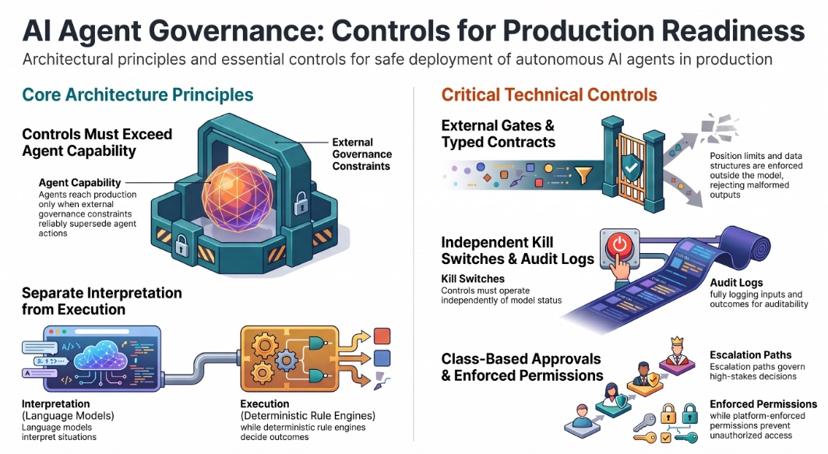
Agents reach production when the controls around them are stronger than the agent itself.
FINRA's 2026 report makes the point directly. Once an AI agent can act on its own, it may need supervision designed specifically for it: tracking actions, restricting system access and limiting what it can do (FINRA). These seven controls turn that principle into architecture:
- Deterministic pre-trade gates outside the model. Position, exposure, drawdown, instrument and venue limits are checked by a rule engine, never by a prompt.
- Typed contracts between agents. Each agent must return a defined structure. A malformed output is rejected, not interpreted. The AgenticAITA research system uses exactly this pattern (arXiv survey).
- Approval policy per decision class. "Rebalance above X", "new signal to paper trading" and "order above size Y" each have an owner and an escalation path.
- Kill switch and cooldowns. These must work even if the agent is wrong, and they must be independent of it.
- A decision log. Inputs, rule versions, model versions, approvals and outcomes are recorded, so you can reconstruct any decision months later.
- Shadow mode and replay. Test every change against history, and run it alongside live without acting, before it goes live.
- Model independence and platform-enforced data permissions. An agent should not be able to talk its way past a permission it does not hold.
Where assistents.ai fits in a quant stack. assistents.ai does not replace your backtester, market-data feed, OMS/EMS or risk engine. It sits around them as the orchestration and control layer. Agents handle research, synthesis and monitoring. Business rules run in a deterministic decision engine, separate from the language model. Which decisions need human approval is a policy set per decision class, not a step in a script. Every execution is recorded: what triggered it, which steps ran and what each one produced. The language model interprets the situation; the rule engine decides the outcome. See agent governance.
Regulation Map for AI Agents in Trading
Existing trading rules apply in full to AI agents. No major regulator has created an exemption for them.
| Jurisdiction | Rule or guidance | What it means for agents |
|---|---|---|
| US (FINRA) | 2026 Annual Regulatory Oversight Report | Names trade execution agents. Expects agent-specific supervision: access monitoring, human-in-the-loop, action tracking, guardrails |
| US (SEC) | Rule 15c3-5 (Market Access Rule) | Broker-dealers with market access need pre-trade risk controls. Agent orders are covered |
| EU | MiFID II RTS 6 | Algorithmic trading firms need testing, pre-trade controls and the ability to cancel orders |
| India (SEBI) | Retail algo framework (circular of 4 Feb 2025, fully effective 1 Apr 2026) | Exchange-issued Algo-ID on every algo order; broker accountable; algo providers empanelled (summary) |
This table is for orientation and is not legal advice. Confirm current requirements with counsel for your jurisdiction and licence type.
Real Deployments: What We Have Delivered
The Ampcome team that builds assistents.ai has delivered agentic and analytics systems in trading and adjacent financial workflows. The two below are in the trading domain. The rest show the same patterns in neighbouring functions.
European digital-asset trading platform (trading domain). The platform needed to combine research, analysis, signals and execution into one governed workflow. The team built:
- market-data ingestion with indicator and pattern analysis
- strategy simulation with risk guardrails
- alerting and recommendation summaries
- execution-ready workflow integration
Results: faster synthesis of fragmented market signals, more disciplined decisions through governed workflows, and less manual monitoring. Use cases 3, 4, 7, 8.
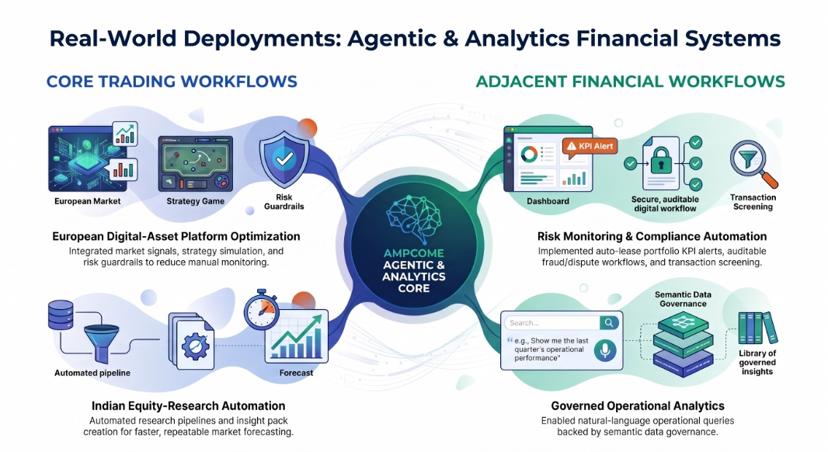
Indian equity-research and technical-analysis publisher (trading domain). The publisher produces forecasts and insight packs for Indian markets. The team built:
- data-ingestion and indicator pipelines
- research automation and insight generation
- alerts and thematic dashboards
Results: faster production of market insight packs, more repeatable research workflows, and better signal visibility. Use cases 2, 3, 11.
The same patterns in adjacent financial workflows:
- Portfolio risk monitoring. A North American auto-lease portfolio operator got portfolio KPIs and exception alerts on risk, delinquency, maturity and residual values. (Use cases 8, 9)
- Auditable compliance workflows. A global fintech serving banks and credit unions got agents for disputes, fraud and compliance workflows with full audit trails and SLA monitoring. (Use case 10)
- Screening with explainability. A UK tax-tech product got transaction screening with risk classification, evidence collection and escalation to experts. (Use case 10)
- Governed analytics. A US analytics startup got semantic governance and natural-language queries over its operational data. (Use case 11)
How to Start: A 30/60/90-Day Path
Start read-only, prove value in shadow mode, then add supervised actions one decision class at a time.
- Days 1–30: One read-only use case. Pick research synthesis (2), a PM copilot (11) or drift monitoring (9). Connect data sources, define metrics once, and set evaluation criteria before building.
- Days 31–60: Shadow mode. Add a decision-making use case, such as a pre-trade risk explanation (8) or backtest automation (4). Run it alongside the current process without letting it act, and compare its outputs with what humans decided.
- Days 61–90: Supervised action. Let the agent act on one decision class, behind deterministic gates and a named approver. Review the decision log weekly.
For the full technical build — architecture layers, autonomy levels and execution authority — read our AI trading agent development guide. For agent coordination patterns, see the multi-agent orchestration guide.
Why assistents.ai for Agentic Quant Trading
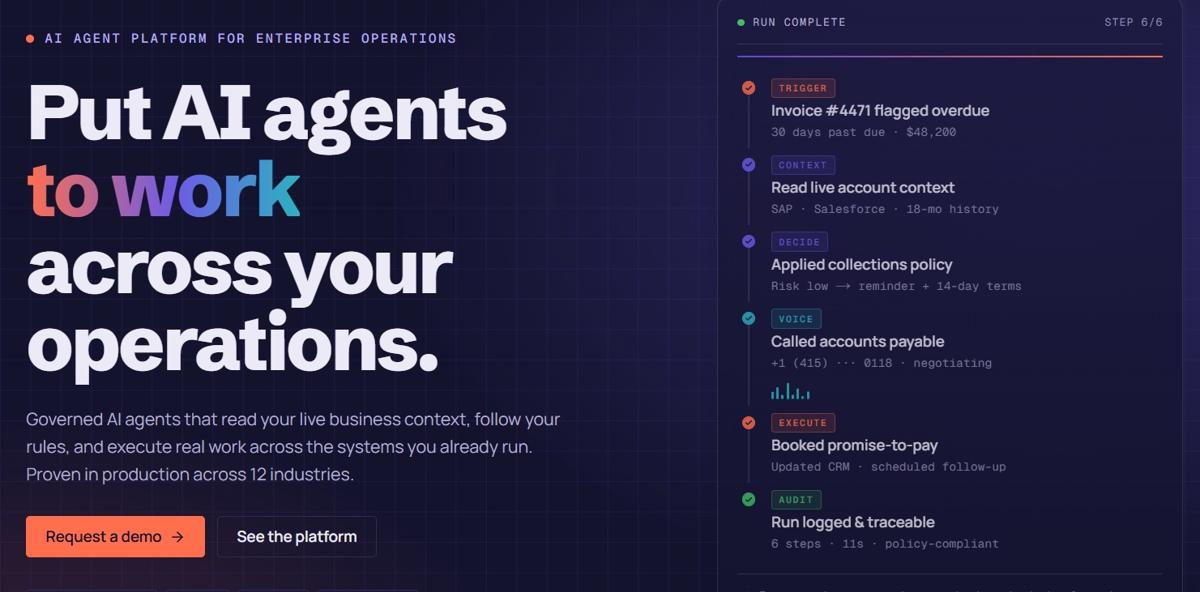
If your constraint is getting agents past risk and compliance review, not building a smarter model, assistents.ai is the layer you are missing.
- Rules decide, models advise. Business rules run in a deterministic decision engine, separate from the language model. Every change creates a new checksummed version, with no way to alter a published one. Versions are tested before release, and every execution records its inputs, outputs, trace and latency. (Use cases 7, 8, 10)
- Approval by decision class. Autonomy and approval requirements are set per decision class. When approval is needed, the approver receives the evidence, the applicable policy and the recommendation, and the approval is recorded in the decision ledger. (Use cases 1, 6, 7)
- Multi-agent, governed. Work is split across specialised agents, workflows, rules and people. Agents never set their own permissions; what each can access, invoke and commit is set outside them. See agent orchestration. (Use cases 1–4, 7)
- Test before it touches the market. Replay and shadow mode test changes against history. Drift detection and model-based evaluation run continuously. The evaluation design for your desk (test set, acceptance criteria, thresholds) is agreed during the pilot. (Use cases 4, 9)
- The right instrument for each decision. Forecasting, predictive and causal models, optimisation and rules run alongside language models, so numbers come from models built for numbers. (Use cases 5, 6, 9)
- Your models, your infrastructure. The platform is model-independent across multiple providers and OpenAI-compatible endpoints, and customer-hosted models can be configured. Private, dedicated and on-premise deployment patterns are supported, with the exact topology designed with you.
- Connects to what you run. External APIs are supported. Connections to your specific OMS/EMS, brokers and market-data vendors are scoped as integration projects. The context engine gives agents one governed view of your data.
Two honest boundaries. assistents.ai is not for the microsecond execution path; keep HFT in your execution stack and use agents around it. And we will not promise alpha. We help you prove, govern and scale the workflows that find it.
Bring one quant workflow. We'll map its decision classes, the rules that should gate it, and what should run in shadow mode first. Book a demo.
FAQs
What is agentic AI in trading?
Agentic AI in trading uses AI agents that pursue a goal by planning steps, calling tools such as data feeds, backtesters and order systems, and learning from feedback. Unlike a fixed trading algorithm, an agent can revise its plan within limits the firm sets. In production, agents are used mostly for research, monitoring and supervised decisions.
How is agentic AI different from algorithmic trading?
Algorithmic trading executes fixed rules written by humans, usually very fast. Agentic AI reasons across data and text, uses multiple tools and adapts its plan, but works in seconds rather than microseconds. Most firms keep execution algorithms for speed and add agents around them for research, risk explanation, compliance and reporting.
Can AI agents trade autonomously?
Technically yes, but few institutions allow it. Current practice is bounded autonomy: agents act only within pre-approved limits, deterministic rules check every order, and humans approve higher-risk decision classes. Retail brokerages that allow agent trading isolate it in a separate account with capped funds.
Do AI trading agents actually make money?
Evidence is mixed. Man Group has approved several dozen AlphaGPT-generated signals for live trading, but those passed human review. Academic live benchmarks found most LLM agents lost money or failed to beat buy-and-hold. Returns depend more on risk control and system design than on the language model.
How are hedge funds using agentic AI?
Hedge funds mainly use agentic AI to generate and backtest factor ideas, synthesise filings and research, automate reporting, and monitor risk. Man Group's AlphaGPT, for example, generates, codes and backtests signals that then go through the normal investment committee process. Autonomous execution remains rare at institutions.
What are the risks of agentic AI in trading?
The main risks are hallucinated data, look-ahead bias and training-data leakage in backtests, misinformation attacks, overfitting, and agents acting beyond their authority. Controls include point-in-time data, deterministic pre-trade gates, approval policies per decision class, kill switches, full decision logs and shadow-mode testing.
Is AI agent trading legal and regulated?
Yes, AI agent trading is legal, and existing trading rules apply in full. In the US, FINRA's 2026 oversight report addresses trade execution agents, and SEC Rule 15c3-5 requires pre-trade controls for broker-dealers with market access. In the EU, MiFID II RTS 6 covers algorithmic trading. India's SEBI requires Algo-IDs on algorithmic orders.
What does SEBI require for algorithmic and AI-driven trading in India?
Under SEBI's retail algo framework, fully effective from 1 April 2026, every algorithmic order must carry an exchange-issued Algo-ID. The broker is responsible for every algo on its platform, and third-party algo providers must be empanelled with the exchange. Strategies above an order-rate threshold need registration.
How do you stop an AI agent from making a bad trade?
Put controls outside the agent. A deterministic rule engine checks size, exposure, drawdown, instrument and venue limits before any order is released. Higher-risk decisions need human approval, a kill switch works independently of the agent, and every decision is logged for review. Never rely on prompt instructions alone.
Which frameworks are used to build multi-agent trading systems?
Popular research frameworks include TradingAgents, Microsoft's RD-Agent for quant research, FinRL for reinforcement learning, and the open-source ai-hedge-fund project. General orchestration frameworks such as LangGraph and CrewAI are also common. Production deployments add governance, audit and integration layers these frameworks do not provide.
Can agentic AI replace quant researchers?
No. Agentic AI multiplies researchers' output rather than replacing them. Agents can test far more ideas, write code and run backtests. Humans still set hypotheses, judge economic logic, catch leakage and approve anything that touches capital. Man Group describes its system as working under human oversight and strategic direction.
How long does it take to deploy an AI agent on a trading desk?
It depends on data readiness and integrations. A read-only use case such as research synthesis or a PM copilot can often be piloted within a few weeks. Supervised execution or risk workflows take longer, because they need shadow-mode testing, rule design, approval policies and compliance sign-off.