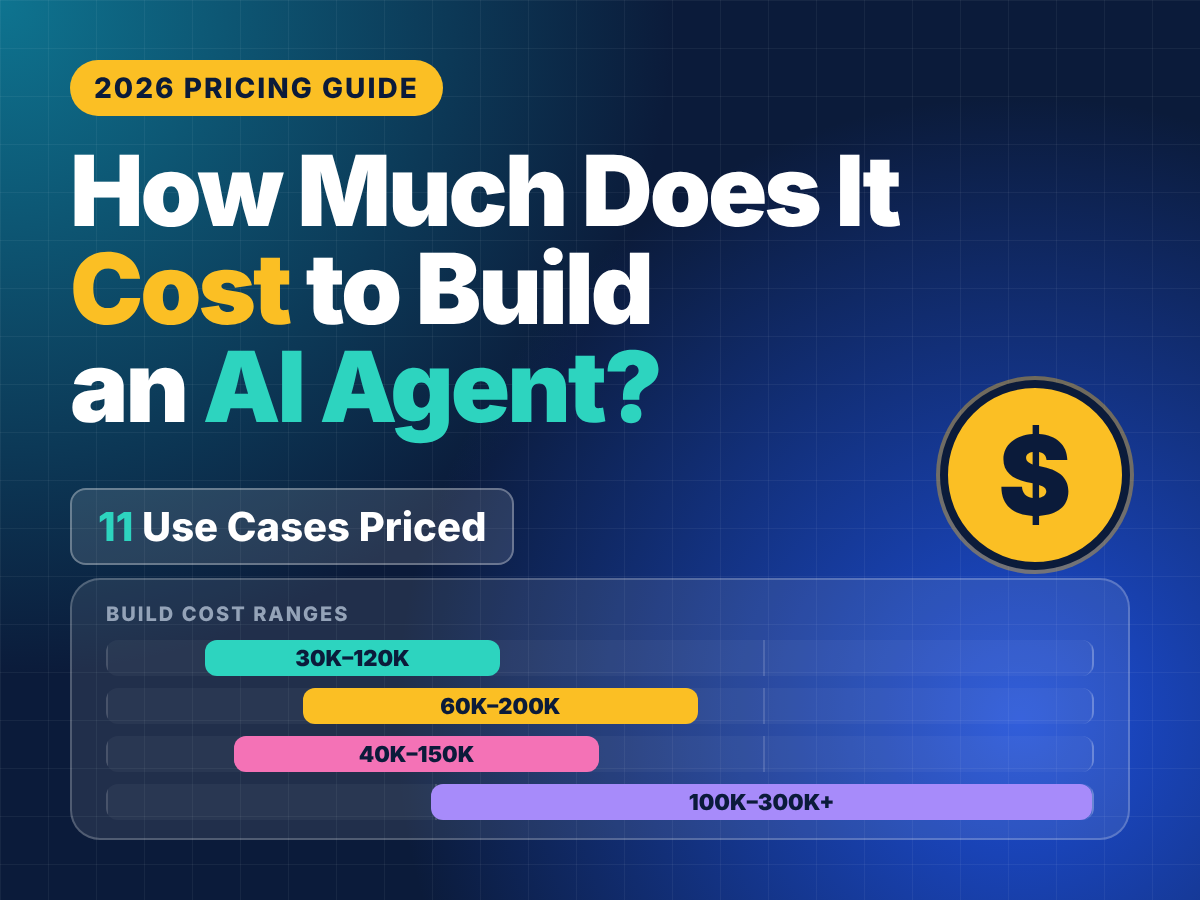
Building an AI agent costs $20,000 to $300,000+ in 2026, plus $1,000 to $15,000 a month to run. A simple FAQ or knowledge agent sits at the low end. A governed, multi-agent workflow that writes back into SAP, Salesforce or your ERP sits at the top. On an enterprise agentic AI platform, most teams reach a production pilot in about 4 weeks instead of 4 to 12 months.
Key takeaways
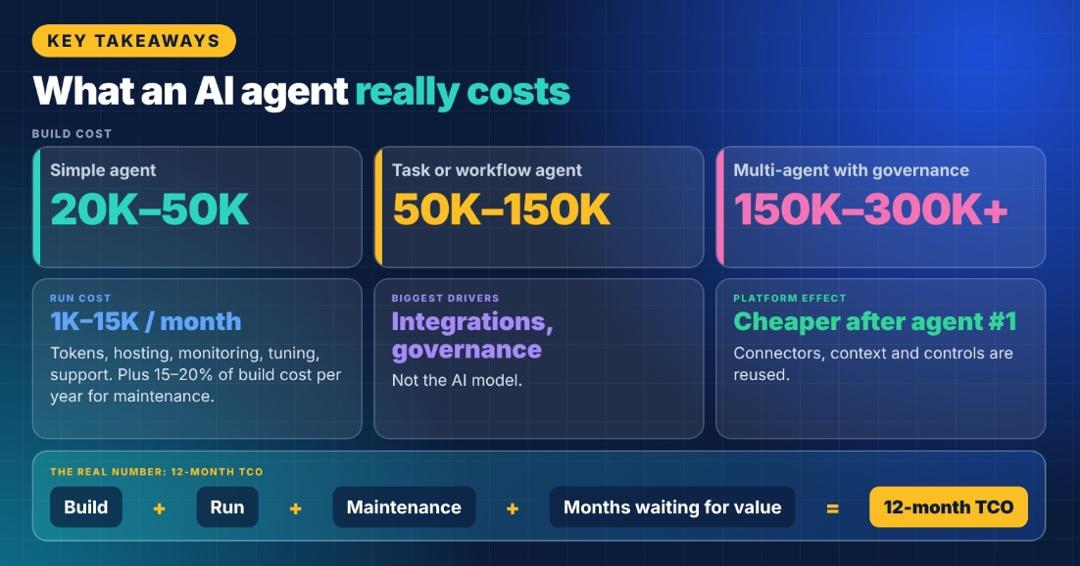
- Build cost: 20K–50K for a simple agent, 50K–150K for a task or workflow agent, 150K–300K+ for multi-agent systems with governance.
- Run cost: 1K–15K per month for tokens, hosting, monitoring, tuning and support. Plan 15–20% of the build cost each year for maintenance.
- The biggest cost drivers are integrations and governance, not the AI model.
- The real number is 12-month total cost of ownership (TCO): build + run + maintenance + the months you wait before the agent creates value.
- A platform cuts the cost of every agent after the first one, because connectors, context and controls are reused.
AI agent cost at a glance (2026 summary table)
An AI agent costs more as it moves from answering questions to taking actions inside your systems. The table below shows the five tiers most enterprise projects fall into.
| Agent tier | Example | Build cost | Monthly run cost | Time to production (custom build) |
|---|---|---|---|---|
| Simple FAQ / knowledge agent | Policy Q&A over documents (RAG) | 20K–50K | 1K–3K | 4–8 weeks |
| Task agent (1–2 integrations) | Order status, ticket triage | 50K–100K | 2K–5K | 2–4 months |
| Workflow agent with write-back | Purchase order → validated ERP sales order | 80K–200K | 2K–8K | 3–6 months |
| Voice agent | Multilingual inbound support line | 50K–150K | 2K–10K | 3–5 months |
| Multi-agent system with governance | Document, data and communication agents coordinated across ERP, CRM and approvals | 150K–300K+ | 5K–15K | 6–12 months |
What moves an agent up a tier is rarely the model. It is the number of systems it connects to, whether it can write data back, and how much control (approvals, audit trails, permissions) the business needs around each action.
AI agent vs. chatbot: A chatbot answers questions. An AI agent understands business context, follows your rules and completes work across systems, such as creating an order, updating a record or routing an exception for approval. That is why agents cost more to build, and why they return more.
What drives the cost to build an AI agent
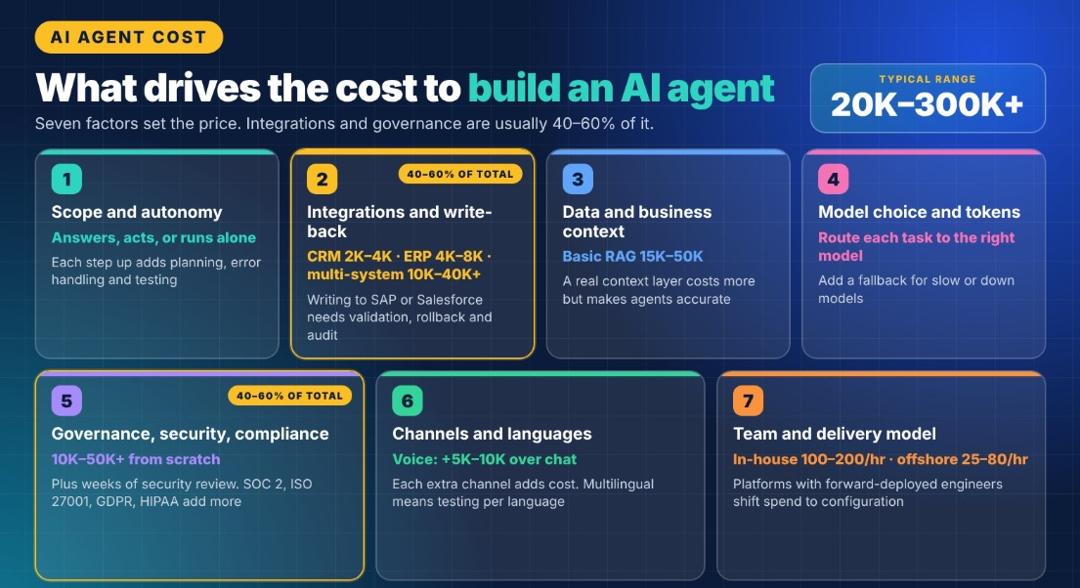
Seven factors decide where your agent lands in the 20K–300K+ range. Integrations and governance usually account for 40–60% of the total.
1. Scope and autonomy
An agent that answers is cheaper than one that acts, and one that acts is cheaper than one that runs on its own from an event, a schedule or an inbox. Each step up adds planning logic, error handling, exception paths and testing. Start with the narrowest scope that still removes real manual work.
2. Integrations and write-back
Reading from one system is cheap. Writing into SAP, Oracle, Salesforce, ServiceNow or Workday with validation, rollback and audit is not. Published estimates put a single CRM integration at 2K–4K, an ERP integration at 4K–8K, and complex, real-time, multi-system orchestration at 10K–40K+. A platform with 300+ pre-built connectors removes most of this line item.
3. Data and business context
Agents fail when they don't understand your business: which customer owns which contract, which discount applies, which policy covers an exception. A basic retrieval-augmented generation (RAG) setup costs 15K–50K. A proper context layer that maps entities, relationships, policies and source evidence costs more to build from scratch, but it is what makes agents accurate. See how a Context Engine handles this.
4. Model choice and token spend
Model APIs are priced per million tokens and vary widely by tier. Check current rates on the Anthropic, OpenAI and Google Gemini pricing pages. The cost lever is not picking the cheapest model, it is routing each task to the right model and having a fallback when one is slow or down. That is the job of an AI Gateway.
5. Governance, security and compliance
Role-based access, policy checks, human approvals, interaction logs and audit trails are mandatory in finance, healthcare, insurance and the public sector. Built from scratch, they add 10K–50K+ and weeks of security review. Certifications such as SOC 2 Type II, ISO 27001, GDPR and HIPAA add more if you have to achieve them yourself. Read the AI agent governance playbook for what "governed" should mean.
6. Channels and languages
Chat on one website is the baseline. Each extra channel (email, WhatsApp, Microsoft Teams, Slack, phone) adds cost. Voice adds speech-to-text, text-to-speech, latency tuning and telephony, typically +5K–10K over chat, plus per-minute run costs. Multilingual support adds testing per language.
7. Team and delivery model
A US in-house AI team costs 100–200 per hour per engineer. Agencies offshore charge 25–80 per hour. An enterprise platform with forward-deployed engineers shifts the spend from building infrastructure to configuring your process, which is where the value is.
How much does it cost to run an AI agent per month
Running an AI agent costs $1,000 to $15,000 a month for most enterprise use cases. Budget for these six lines:
| Run cost line | Typical monthly range | What drives it |
|---|---|---|
| LLM tokens | 200–5,000 | Volume, prompt length, model tier, routing |
| Hosting, vector store and storage | 300–2,500 | Data volume, retrieval load, deployment (cloud vs. on-premise) |
| Monitoring and observability | 200–1,000 | Logging, tracing, evaluation runs |
| Prompt, eval and behaviour tuning | 500–2,500 | How fast your processes and policies change |
| Security and access control | 300–2,000 | Compliance scope, audit retention |
| Support and maintenance | 15–20% of build cost per year | Bug fixes, model upgrades, new integrations |
A worked token example. A support agent handles 20,000 conversations a month at about 6,000 tokens each. That is 120 million tokens. At a blended 3–5 per million tokens, the model bill is roughly 360–600 a month, or about 0.02–0.03 per conversation. Tokens are rarely the biggest run cost. People, tuning and integrations are.
Measure cost per outcome, not per month. The useful number is cost per resolved ticket, per processed invoice, per validated order or per call minute, compared with what that unit costs today. The AI agent ROI calculator does this math for you.
AI agent cost by use case: 11 real examples
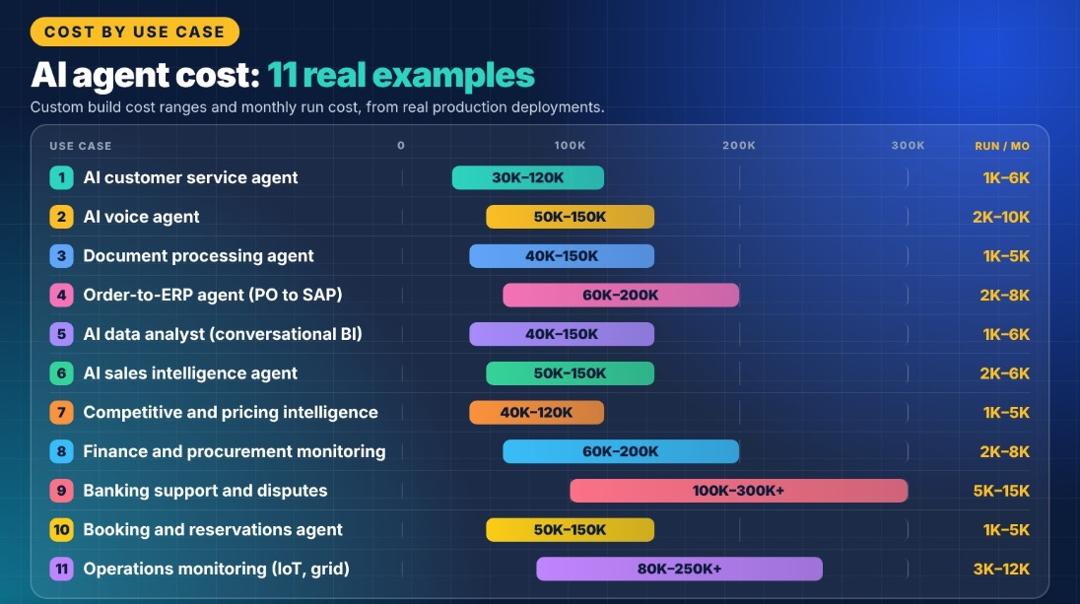
Below are 11 enterprise AI agents with a cost range for a custom build, a monthly run cost and a real production example. The examples come from assistents.ai implementations across the Middle East, India, Australia, Europe and the US. Client names are withheld; industries and outcomes are shown.
Quick comparison
| # | AI agent use case | Custom build cost | Monthly run cost | Custom build timeline |
|---|---|---|---|---|
| 1 | Customer service agent | 30K–120K | 1K–6K | 2–4 months |
| 2 | Voice AI agent | 50K–150K | 2K–10K | 3–5 months |
| 3 | Document processing agent | 40K–150K | 1K–5K | 2–5 months |
| 4 | Order-to-ERP agent | 60K–200K | 2K–8K | 3–6 months |
| 5 | AI data analyst agent | 40K–150K | 1K–6K | 2–4 months |
| 6 | Sales intelligence agent | 50K–150K | 2K–6K | 3–5 months |
| 7 | Competitive and pricing intelligence agent | 40K–120K | 1K–5K | 2–4 months |
| 8 | Finance and procurement monitoring agent | 60K–200K | 2K–8K | 3–6 months |
| 9 | Banking support and disputes agent | 100K–300K+ | 5K–15K | 6–12 months |
| 10 | Booking and reservations agent | 50K–150K | 1K–5K | 3–5 months |
| 11 | Operations monitoring and alerting agent | 80K–250K+ | 3K–12K | 4–9 months |
Ranges are for a custom build and are based on 2026 market rates for components (integrations, RAG, voice, orchestration, governance). Platform-based delivery typically reaches a production pilot in about 4 weeks.
1. AI customer service agent cost
What it does: Answers customer or tenant questions across web chat, WhatsApp and email, handles common requests end to end, and creates tickets or escalates to a human with full context.
- Build cost: 30K–120K
- Monthly run cost: 1K–6K
- Cost goes up with: number of channels, ticketing and CRM write-back, policy-heavy answers, multilingual support
In production: A major UAE real estate portfolio owner with office, retail, industrial and residential assets deployed an omnichannel service agent for tenant query triage, FAQs, rental and payment support, with ticketing and escalation to human teams and a knowledge base over tenancy documents and SOPs. Result: faster response times, lower call-centre load, a consistent 24×7 tenant experience and better SLA adherence through automated routing.
Explore AI agents for customer support and conversational agents.
2. AI voice agent cost
What it does: Holds natural, multilingual phone conversations, takes actions during the call (check details, find a slot, update a booking, send a confirmation), summarises the call and hands over to a human when needed.
- Build cost: 50K–150K
- Monthly run cost: 2K–10K, usually priced per call minute
- Cost goes up with: languages and accents, latency targets, telephony integration, in-call system actions
In production: A fast-growing value retailer with 700+ stores across India deployed a voice support agent in Hindi and English (speech-to-text, LLM, text-to-speech), alongside an inventory intelligence agent for store-level pricing, stock and promotions and a training agent over POS and SOP documents. Result: reduced helpdesk burden, faster store issue resolution, better store-level inventory visibility and faster onboarding of store staff.
A second example: an AI self-tape app for actors uses a voice agent as an always-available scene partner, with character and voice control, pacing and cue logic, and cost-controlled inference.
Learn more about Voice AI for enterprise and the Voice AI product.
3. Document processing AI agent cost
What it does: Reads PDFs, scans, emails and complex layouts, extracts fields and tables, validates them against business rules, routes exceptions to a person and sends clean data into your systems.
- Build cost: 40K–150K
- Monthly run cost: 1K–5K
- Cost goes up with: document variety, handwriting or scans, table extraction, version comparison, number of target systems
In production: An Australian waterproofing diagnostics and remediation specialist with 20+ years in remedial building services used autonomous agents to ingest, analyse and synchronise complex tender documents into its job management system (Simpro), with multi-agent orchestration, vision-LLM extraction from complex PDFs, revision analysis, quote locking and audit logs. Result: engineered for up to ~90% faster tender document processing, a ~95% extraction accuracy target on standard formats, and lower bid risk through revision and change detection.
See Document AI and how AI agents compare with RPA for document work.
4. Order-to-ERP agent cost (purchase order to SAP sales order)
What it does: Receives purchase orders by email, portal or PDF, extracts customer, products, quantities, pricing and delivery details, validates them against master data, credit limits and contract terms, flags exceptions for approval and creates the sales order in SAP or your ERP.
- Build cost: 60K–200K
- Monthly run cost: 2K–8K
- Cost goes up with: ERP write-back, credit and pricing rules, duplicate detection, approval workflows, reconciliation reporting
In production: A major Indian HVAC and home-appliance manufacturer, founded in 1943, automated SAP sales order creation with agentic AI while moving off a legacy document tool that was reaching end of life and carried high licensing costs. The agent interprets order triggers, validates and creates SAP sales orders, applies rules for exceptions and approvals, and keeps audit logs and reconciliation reports. Result: less manual order processing, a faster order-to-confirm cycle with fewer data-entry errors, better auditability and less legacy dependency.
This is where agents replace a licence cost, not just labour. Read about autonomous agents and workflows and the Workflow Builder.
5. AI data analyst agent cost (conversational BI)
What it does: Lets business users ask questions in plain language and get charts, reports, scheduled insights and threshold alerts from governed business definitions, without waiting in the BI queue.
- Build cost: 40K–150K
- Monthly run cost: 1K–6K
- Cost goes up with: number of data sources, semantic layer and metric definitions, row-level security, alerting
In production: A high-velocity UK e-commerce and distribution business deployed an AI data analytics agent across sales, products, inventory, promotions and customer behaviour, with conversational analytics and automated KPI alerts. Result: shorter analysis cycles for recurring questions, better visibility into product and promotion performance, and less reporting dependency on analysts.
A Silicon Valley analytics startup and a privately held retail holding group used the same pattern, an agentic analytics layer with semantic governance, to get faster strategic visibility without BI queueing and to turn dashboard insights into governed, auditable tasks.
Explore AI business intelligence.
6. AI sales intelligence agent cost
What it does: Watches accounts across SAP, CRM, orders, service, web and email, spots buying signals and risks, and creates follow-up tasks and next-best actions for sales teams.
- Build cost: 50K–150K
- Monthly run cost: 2K–6K
- Cost goes up with: number of signal sources, CRM write-back, rule-governed playbooks, leadership dashboards
In production: A flagship UAE engineering and technology solutions provider deployed an agentic sales agent with always-on account monitoring, rule-governed opportunity identification and follow-up orchestration, and CRM-ready workflows. Result: higher account coverage without increasing headcount, faster response on opportunities and renewals, and more consistent execution through governed playbooks.
An industrial manufacturer connected SAP, CRM and activity signals so the agent flags customers whose buying activity has risen in the last 30 days and creates a follow-up task for the account manager.
See AI agents for sales and revenue operations.
7. Competitive and pricing intelligence agent cost
What it does: Monitors e-commerce channels and competitor sites for prices, MRP and discounts, offers, availability and ratings, answers leadership questions on demand, and sends proactive alerts.
- Build cost: 40K–120K
- Monthly run cost: 1K–5K
- Cost goes up with: number of channels and SKUs, crawl frequency, alert logic, analytics views
In production: A major Indian cooling and appliance brand competing in price-sensitive markets deployed agents that convert market signals into instant answers and proactive alerts, with analytics views for pricing gaps, threats and portfolio movement, built to scale from proof of concept to production with governance and audit trails. Result: faster competitive response, earlier identification of pricing gaps and promo shifts, and always-on monitoring that replaced manual checks across portals.
8. Finance and procurement monitoring agent cost (AI CFO agent)
What it does: Standardises KPIs across entities and continuously monitors purchase prices, gross margin impact, vendor performance, early-payment opportunities and cash risk, then sends alerts and insight packs to leadership.
- Build cost: 60K–200K
- Monthly run cost: 2K–8K
- Cost goes up with: number of entities and ERPs, forecasting and scenario models, alert rules, audit requirements
In production: One of the UAE's most prominent family business groups, with 30+ companies across retail, building, industrial and services, deployed automated procurement and finance KPI alerts across group entities: purchase price trends, gross margin impact, early-payment analysis and vendor delivery and returns performance. Result: earlier detection of margin erosion and vendor slippage, standardised finance intelligence across entities, and fewer variance surprises.
An AI CFO platform for growing businesses uses forecasting and scenario-modelling agents with runway and cash-risk alerts, giving advisory-grade insight without adding headcount.
Read AI agents for FinOps: 11 use cases and explore finance and procurement agents.
9. Banking support and disputes agent cost
What it does: Takes customer cases across chat, email and phone, routes disputes, fraud and service requests, summarises cases for staff, suggests next-best actions and keeps a full audit trail with SLA monitoring.
- Build cost: 100K–300K+
- Monthly run cost: 5K–15K
- Cost goes up with: regulatory scope, core-banking integrations, audit and data-residency requirements, model risk review
In production: A global fintech that provides cloud automation for banks and credit unions deployed omnichannel AI agents for banking support with auditable workflow automation, agent-assist summaries and SLA reporting. Result: faster, more consistent case handling, lower operational load and better compliance readiness through audit trails.
Regulated industries pay the most for agents because governance is not optional. Read AI agents in financial services, top AI agents for BFSI in India and AI agent use cases in fintech.
10. Booking and reservations agent cost
What it does: Reads booking emails, classifies intent, extracts details, asks for anything missing, checks live inventory, proposes alternative dates or properties, generates invoices and hands curated work to a human.
- Build cost: 50K–150K
- Monthly run cost: 1K–5K
- Cost goes up with: inventory system integration, negotiation logic, document generation, human-in-the-loop quality control
In production: A luxury hospitality brand operating 16 boutique lodges, camps and hotels in safari destinations across Kenya and Tanzania deployed a digital booking agent covering email intake, a conversational loop to capture missing details, real-time inventory checks with alternative date and property negotiation, a hybrid handoff for curated itineraries and automated invoice generation. Result: faster booking turnaround with less back-and-forth, higher accuracy on complex guest requirements and the ability to scale without compromising luxury service.
Read agentic AI in the hospitality industry.
11. Operations monitoring and alerting agent cost (IoT, grid and energy)
What it does: Ingests sensor, utility and operational data, detects anomalies, forecasts load or failures, and routes alerts and work orders to field teams.
- Build cost: 80K–250K+
- Monthly run cost: 3K–12K
- Cost goes up with: data volume and frequency, number of asset types, forecasting models, integration with field workflows
In production: A state power transmission utility deployed transmission KPI monitoring with anomaly detection, loss and outage analytics, predictive maintenance indicators and automated field alerts. Result: faster identification of grid exceptions, more reliable operations through proactive monitoring and better transparency for leadership.
A premier national astrophysics research institute used the same pattern for campus energy management, and a city-scale smart infrastructure operator connecting 2M+ assets used agentic analytics and automated operational alerting on top of its smart utility systems.
Read the multi-agent orchestration guide to see how coordinated agents keep these processes moving.
More AI agents already in production
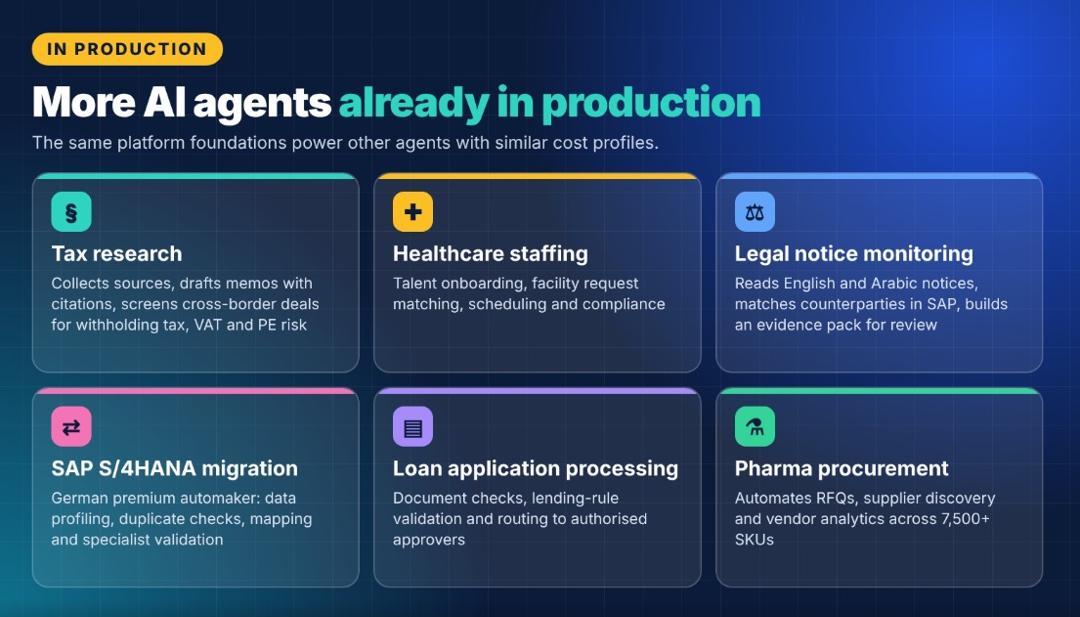
The same platform foundations power other agents with similar cost profiles:
- Tax research agents that collect sources, summarise and draft memos with citations, and screen cross-border transactions for withholding tax, VAT and permanent-establishment risk.
- Healthcare staffing agents for talent onboarding, facility request matching, scheduling and compliance.
- Legal notice monitoring that reads English and Arabic notices, matches counterparties to SAP customers or vendors and assembles an evidence pack for legal review.
- SAP ECC to S/4HANA migration support for a leading German premium automotive brand: data profiling, duplicate checks, mapping recommendations and specialist validation with a full decision trail.
- Loan application processing with document checks, lending-rule validation and routing to authorised approvers.
- Pharma procurement agents that automate RFQs, supplier discovery and vendor performance analytics across 7,500+ SKUs.
The hidden costs of AI agents nobody budgets for
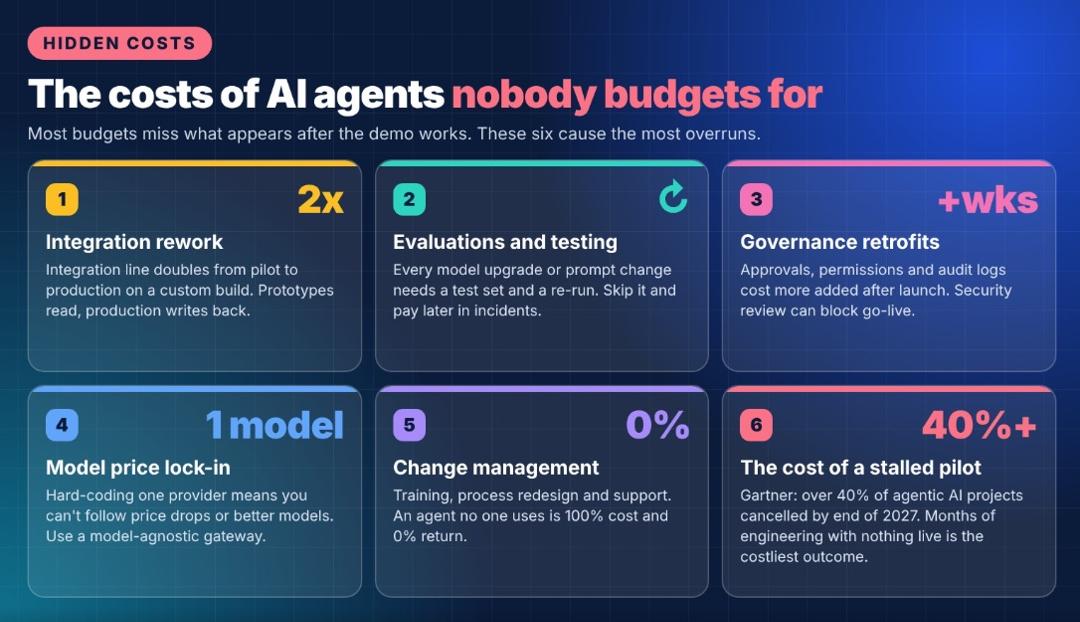
Most AI agent budgets miss the costs that appear after the demo works. These six cause the most overruns:
- Integration rework. The prototype reads data; production must write it back safely. Expect the integration line to double between pilot and production on a custom build.
- Evaluations and regression testing. Every model upgrade or prompt change needs a test set and a re-run. Teams that skip this pay later in incidents.
- Governance retrofits. Adding approvals, permissions and audit logs after launch costs more than building them in, and security review can block go-live for weeks.
- Model price changes and lock-in. Hard-coding one model provider means you can't move when prices drop or a better model ships. A model-agnostic gateway avoids this.
- Change management and adoption. Training, process redesign and support for the people who work with the agent. An agent no one uses has a 100% cost and 0% return.
- The cost of a stalled pilot. Gartner predicts over 40% of agentic AI projects will be cancelled by the end of 2027, citing rising costs, unclear business value and weak risk controls. Months of engineering with nothing in production is the most expensive outcome of all.
Build vs. buy vs. platform: which costs less over 12 months
Building custom gives full control at the highest cost and slowest start. Point SaaS tools are cheap but stop at one channel or task. An enterprise agent platform sits between them: lower cost per agent, production in weeks, and the ability to add more agents on the same foundation.
| Custom build (in-house or agency) | Point SaaS agent | Enterprise agent platform (e.g. assistents.ai) | |
|---|---|---|---|
| Upfront cost | 50K–300K+ per agent | Low (0–5K setup) | Configuration, no per-agent build bill |
| Monthly cost | 1K–15K + 15–20%/yr maintenance | 50–5K subscription | Subscription based on agent usage and deployment |
| Time to first production use | 4–12 months | Days to weeks | ~4 weeks for a production pilot |
| Enterprise integrations | Built one by one | Limited, often read-only | 300+ connectors, bidirectional sync |
| Governance and audit | Built yourself | Basic | Included on every plan |
| Who maintains it | Your team or the agency | Vendor | Platform + forward-deployed engineers |
| Cost of agent #2, #3, #10 | Close to the cost of agent #1 | New tool per use case | Falls sharply; context and connectors are reused |
| Best for | Unique IP, a single very specialised agent | One narrow task in one channel | Several governed agents across departments |
Worked example: a document-processing agent, first-year TCO (custom build)
- Build: ~$90,000
- Run: ~$3,000 × 12 = $36,000
- Maintenance (15–20% of build): ~$15,000
- Total: ~$141,000, with value starting around month 5 because the first 4 months are spent building.
On a platform, the same agent is configured on existing connectors and governance, the pilot runs in about 4 weeks, and the second agent reuses the same foundation. The question to ask any vendor is not "what does this agent cost?" but "what will my first 12 months and my next five agents cost?"
Comparing platforms? See assistents.ai vs Salesforce Agentforce and all comparisons, or download the enterprise AI buyer's guide.
How to estimate your AI agent budget in 5 steps
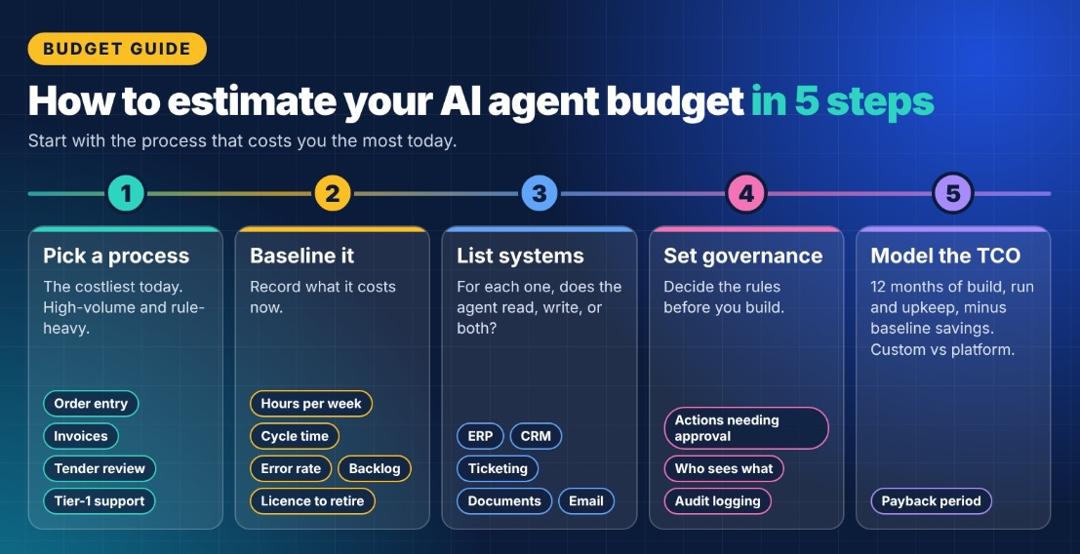
- Pick one process that costs the most today. Choose a high-volume, rule-heavy process such as order entry, invoice processing, tender review or tier-1 support.
- Baseline its current cost. Record hours per week, cycle time, error rate, backlog and any licence you could retire.
- List the systems it touches. Note whether the agent needs to read, write, or both, for each one (ERP, CRM, ticketing, document stores, email).
- Set your governance needs. Decide which actions need approval, who can see what, and what must be logged for audit.
- Model the 12-month TCO and payback. Add build, run and maintenance, subtract the baseline savings, and compare a custom build with a platform. Use the AI agent ROI calculator to get a payback period.
7 ways to reduce AI agent development cost
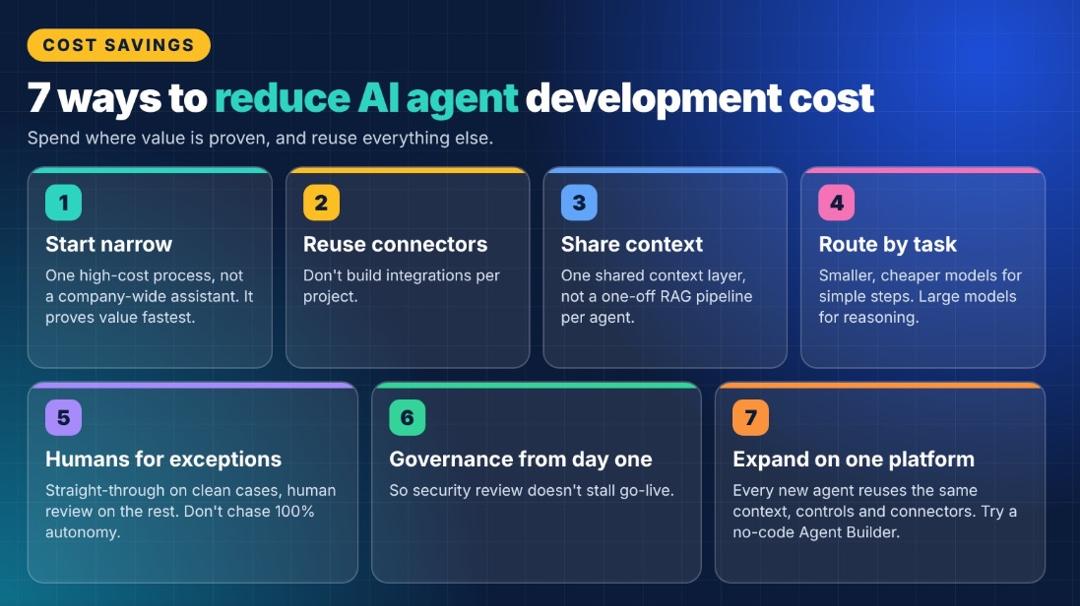
- Start with one high-cost process, not a company-wide assistant. A narrow first use case proves value fastest.
- Reuse connectors instead of building integrations per project.
- Use a shared context layer rather than a one-off RAG pipeline for each agent.
- Route models by task. Send simple steps to smaller, cheaper models and keep large models for reasoning.
- Keep humans in the loop for exceptions. Aim for straight-through processing on clean cases and human review on the rest, instead of chasing 100% autonomy.
- Build governance in from day one so security review doesn't stall go-live.
- Expand on the same platform. Every new agent should reuse the same context, controls and connectors. You can even build AI agents without code with an Agent Builder.
Why assistents.ai is the most cost-effective way to build AI agents
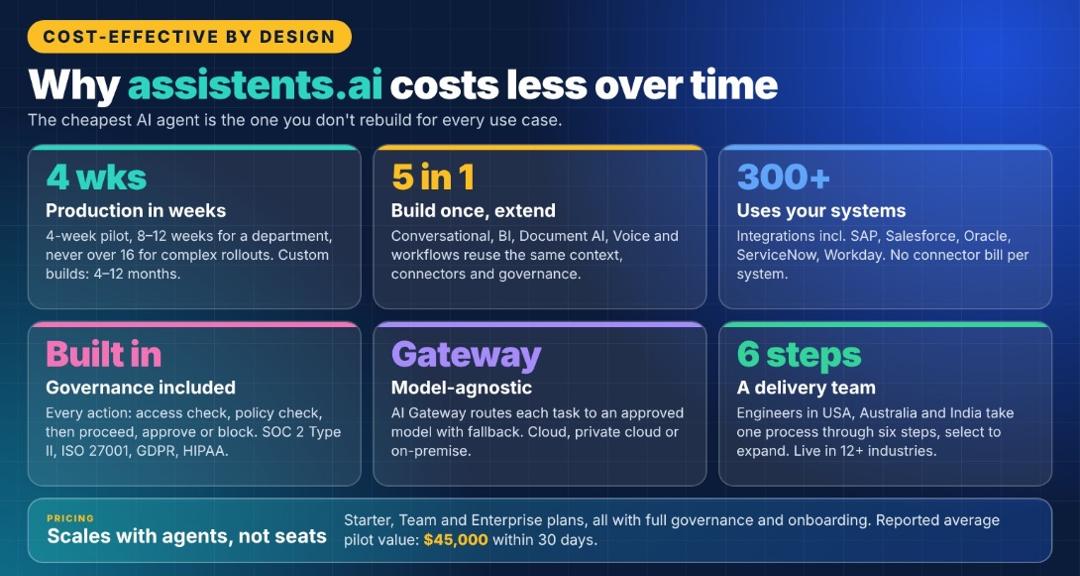
The cheapest AI agent is the one you don't rebuild for every use case. assistents.ai is an enterprise agentic AI platform that connects to 300+ business systems, understands your business context, follows your rules and takes a first use case to production in about 4 weeks. Here is why it costs less over time.
Production in weeks, not quarters
assistents.ai reports a 4-week production pilot, 8–12 weeks for a full department rollout, and complex enterprise rollouts that have not exceeded 16 weeks. Custom builds commonly take 4–12 months before they create any value. Every month saved is a month of savings you keep. See how implementation works.
Build once, extend across business functions
One platform covers five ways to put AI to work: conversational agents, agentic BI, Document AI, Voice AI and autonomous workflows. The Context Engine, connectors and governance you set up for the first agent are reused by the next one, so order processing, sales intelligence and legal notice monitoring can all run on the same foundation.
Connects to the systems you already pay for
300+ integrations, including SAP, Salesforce, HubSpot, Oracle, ServiceNow, Workday, Slack and Microsoft, through secure standard protocols, event ingestion, bidirectional sync, APIs and SDKs. You don't pay a custom connector bill per system.
Governance included, not bolted on
Every action passes an access check and a policy evaluation, then proceeds, goes to human approval or is blocked and logged. Agents inherit source-system permissions, every interaction is logged, and audit trails are exportable. The platform lists SOC 2 Type II, ISO 27001, GDPR and HIPAA, and enterprise data is never used for model training. See Agent Governance and Security & Trust.
Model-agnostic, so token costs stay under control
The AI Gateway routes each task to an approved model with fallback, high availability and usage management, across providers such as Bedrock, Azure, Vertex AI and OpenAI. Deploy as cloud SaaS, in a private cloud or on-premise, including self-hosted LLMs for regulated workloads.
A delivery team, not just a licence
Forward-deployed engineers, AI engineers and data science specialists across the USA, Australia and India take one priority process through six steps: select → connect → configure → validate → operate → expand. That is how the platform runs in production across 12+ industries, from 700+ retail stores to ports, utilities, banks and hospitality groups.
Pricing that scales with agents, not seats. assistents.ai pricing is based on agent usage and deployment complexity, with Starter, Team and Enterprise plans. Every plan includes full governance, the Context Engine and dedicated onboarding. Pilots run with a fixed scope and explicit success criteria; assistents.ai reports that its average pilot delivers $45,000 in measurable value within 30 days.
| Custom build | Point tool | assistents.ai | |
|---|---|---|---|
| Time to production | 4–12 months | Days–weeks | ~4 weeks |
| Enterprise systems | Built one by one | Limited | 300+ connectors |
| Governance and audit | Extra cost | Basic | Included |
| Cost of the next agent | Same as the first | New tool | Reuses foundation |
Ready to price your first agent?
Book a discovery call and get a fixed-scope PoC plan with an ROI hypothesis within 48 hours.
Conclusion: what an AI agent should cost you
An AI agent costs $20,000 to $300,000+ to build and $1,000 to $15,000 a month to run, but the number that matters is your first-year total cost of ownership and how fast the agent starts paying back. Custom builds put most of that budget into connectors, governance and months of waiting. A platform puts it into your process, gets you to production in weeks and makes every following agent cheaper.
Start with the process that costs you most. Book a discovery call with assistents.ai and get a fixed-scope PoC plan, cost estimate and ROI hypothesis within 48 hours.
Related reading
- AI Agents for HR Onboarding: 11 Use Cases
- AI in Insurance: 11 Use Cases
- 11 Best AI Agents for Real Estate Brokers in 2026
- Agentic AI in Quant Trading: 11 Use Cases
- Context Engines vs Search
- HIPAA-Compliant AI Agents
FAQs
How much does it cost to build an AI agent?
Building an AI agent costs $20,000 to $300,000+ in 2026. Simple FAQ or knowledge agents cost 20K–50K. Task and workflow agents that connect to an ERP or CRM cost 50K–200K. Multi-agent systems with governance cost 150K–300K+. Running the agent adds 1,000–15,000 a month.
How much does an AI agent cost per month?
Most enterprise AI agents cost $1,000 to $15,000 a month to run. That covers LLM tokens, hosting and vector storage, monitoring, prompt and evaluation tuning, security and support. Add 15–20% of the original build cost each year for maintenance, model upgrades and new integrations.
Is it cheaper to build or buy an AI agent?
For one narrow task, a SaaS tool is cheapest. For several governed agents across departments, an enterprise agent platform usually costs less over 12 months than custom builds, because connectors, business context and governance are reused. Custom builds make sense when the agent itself is unique intellectual property.
How long does it take to build an AI agent?
A custom AI agent takes 4 weeks to 12 months depending on complexity. Simple knowledge agents take 4–8 weeks; workflow agents with ERP write-back take 3–6 months; multi-agent systems take 6–12 months. On assistents.ai, a production pilot typically takes about 4 weeks and a department rollout 8–12 weeks.
What is the most expensive part of building an AI agent?
Integrations and governance are usually the most expensive parts, often 40–60% of total cost. Writing data back into systems like SAP or Salesforce safely, and adding permissions, approvals and audit trails, takes far more effort than connecting to an AI model.
Can I build an AI agent for free?
You can prototype an AI agent for free with open-source frameworks and free model tiers. A production business agent is not free: it needs integrations, security, monitoring, testing and support. Expect at least $20,000 to build and $1,000 a month to run a production-grade agent.
How much does an AI customer service agent cost?
An AI customer service agent costs $30,000 to $120,000 to build and $1,000 to $6,000 a month to run. Costs rise with more channels (chat, email, WhatsApp, voice), ticketing and CRM write-back, multilingual support and policy-heavy answers.
What are the hidden costs of AI agents?
The main hidden costs are integration rework from pilot to production, evaluation and regression testing, governance retrofits, model price changes or lock-in, change management and adoption, and stalled pilots that never reach production. Together they can add 30–50% to an initial estimate.
How can I reduce AI agent development costs?
Start with one high-cost process, reuse pre-built connectors, use a shared context layer, route tasks to the right model, keep humans in the loop for exceptions, build governance in from day one and add new agents on the same platform instead of starting from scratch each time.
What is the ROI of an AI agent?
AI agent ROI comes from faster cycle times, fewer errors, higher capacity without new headcount and retired licences. In production, agents have delivered results such as up to ~90% faster document processing and higher sales account coverage without added headcount. Use an AI agent ROI calculator to estimate payback.
How much do LLM tokens cost for an AI agent?
LLM tokens typically cost $200 to $5,000 a month for an enterprise agent, depending on volume, prompt length and model tier. A support agent handling 20,000 conversations a month often spends only 0.02–0.03 per conversation on tokens. Routing simple steps to smaller models lowers this further.
Do I need a data scientist to build an AI agent?
Not always. Simple agents can be configured with no-code agent builders. Enterprise agents that connect to ERPs, apply business rules and need governance benefit from AI engineers and forward-deployed engineers, which a platform partner can provide instead of you hiring a full in-house team.