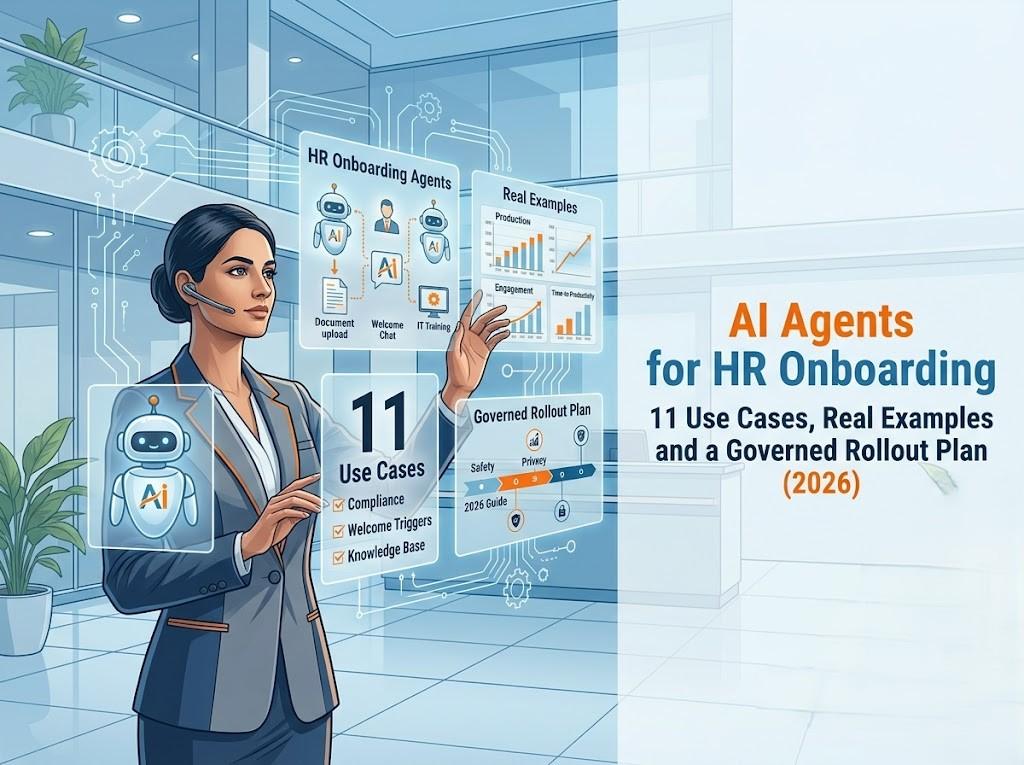
AI agents for HR onboarding are software agents that run the new-hire process from offer acceptance to Day 90. They collect and check documents, set up system access, answer new-hire questions, nudge managers and send exceptions to HR for approval. Unlike a chatbot, an onboarding agent takes action across your HRIS, IT and payroll systems, and it records every step.
The need is real. According to Gallup, only 12% of U.S. employees say their company does a good job of onboarding, and only 29% of new hires feel fully prepared to excel after it. Meanwhile, SHRM's 2025 State of the Workplace report found 62% of HR professionals worked beyond capacity and 57% said their department was understaffed.
This guide covers what AI onboarding agents are, how they work, 11 use cases with real (anonymised) deployment examples, the KPIs to track, how platforms compare, and a six-step rollout plan. It is written by the team behind assistents.ai, an enterprise AI agent platform by Ampcome.
Key takeaways
- AI agents for HR onboarding run the full offer-to-Day-90 journey, not just answer questions.
- The highest-value use cases are document verification, compliance tracking, IT provisioning, 24/7 policy Q&A and multilingual onboarding for frontline staff.
- Good agents act inside rules: every action is allowed, sent for human review, or blocked and logged.
- Measure time-to-productivity, Day-1 readiness, onboarding cycle time and HR tickets per hire.
- Start with one onboarding process, prove it in weeks, then expand.
What are AI agents for HR onboarding?
AI agents for HR onboarding are autonomous, rule-bound software agents that complete onboarding tasks for HR teams. They react to events such as an accepted offer, pull context from HR systems, decide the next step, act across connected tools and hand edge cases to people. They work alongside HR, not instead of it.
A traditional onboarding portal shows a checklist. An HR chatbot answers questions. An AI onboarding agent does the work behind the checklist: it chases a missing tax form, opens the IT ticket, confirms the laptop shipped, books the buddy intro and tells HR when a background check stalls.
AI onboarding agent vs HR chatbot vs workflow automation
| Capability | HR chatbot | Workflow automation (rules) | AI onboarding agent |
|---|---|---|---|
| Starts work on its own | No, waits for a question | Yes, on fixed triggers | Yes, on events, schedules and inbox messages |
| Understands context (role, location, policy) | Limited | No, follows fixed paths | Yes, through a context layer over HR data and policies |
| Takes action across systems | Rarely | Yes, on pre-built paths only | Yes, within permissions |
| Handles exceptions | Hands off to a human | Breaks or stops | Retries, reasons about the cause, escalates with context |
| Reads documents | No | Basic templates | Yes, extracts and validates fields from IDs, forms and PDFs |
| Speaks multiple languages | Text only, sometimes | No | Text and voice |
| Audit trail | Chat logs | Run logs | Full record of every decision, action and approval |
In short, chatbots answer, rules automate fixed paths, and agents own outcomes.
Why 2026 is the tipping point for agentic AI in HR onboarding
Three things changed. First, HR capacity is stretched: SHRM's 62% beyond-capacity figure means manual onboarding does not scale with hiring. Second, the market has consolidated around agents. ServiceNow completed its acquisition of Moveworks in December 2025, and Workday completed its acquisition of Sana in November 2025. Third, the economics are proven at scale: IBM reports its AskHR assistant resolves 10.1 million interactions a year, saving 50,000 hours and USD 5 million annually.
How an AI onboarding agent works (offer to Day 90)
An AI onboarding agent follows a loop: an event starts the work, the agent gathers context, specialist agents act, rules decide what needs approval, and the outcome is verified and logged. This keeps onboarding moving without losing human control.
<!-- Image: workflow diagram. Alt text: "How AI agents for HR onboarding work: trigger, context, specialist agents, governed action, verified outcome" -->
- Trigger. An offer is accepted in the ATS, a start date is set in the HRIS, or a new hire emails a document.
- Context. The agent pulls the hire's role, location, manager, contract type and the policies that apply, using a context engine that links people, policies and source documents.
- Specialist agents. An orchestration layer coordinates a document agent (extract and check), a data agent (look up and validate) and a communication agent (contact the hire, manager or IT).
- Governed action. Each action passes access checks and policy rules. It is allowed and runs, sent for human review, or blocked and logged. See how agent governance works.
- Verified outcome. The agent updates the HRIS, confirms completion and keeps an audit record. HR sees exceptions, not routine tasks.
The 5 onboarding stages an AI agent covers
| Stage | Typical window | What the agent handles |
|---|---|---|
| Pre-boarding | Offer accepted to start date | Welcome pack, document collection, task plan, reminders |
| Compliance and clearance | Before Day 1 | ID and right-to-work checks, background checks, credentials, policy sign-offs |
| IT and access | Before Day 1 | Accounts, licences, equipment, building access |
| Day 1 and Week 1 | First 5 days | Orientation schedule, intros, Q&A, first training modules |
| 30-60-90 days | First 3 months | Check-ins, pulse surveys, learning progress, risk flags |
11 use cases of AI agents for HR onboarding
The 11 most valuable use cases of AI agents for HR onboarding are pre-boarding orchestration, document verification, credential tracking, compliance, IT provisioning, 24/7 Q&A, multilingual voice onboarding, personalised learning, manager nudges, onboarding analytics and exception handling. Each one below covers the problem, what the agent does, the systems involved and a real example from deployments delivered on the assistents.ai platform. Client names are withheld.
1. Pre-boarding orchestration from offer to start date
The problem: The gap between "offer accepted" and Day 1 is where new hires go quiet and tasks slip. HR coordinators chase forms, managers forget prep and IT hears about the hire late.
What the agent does: When the offer is accepted in the ATS, an autonomous agent creates the HRIS record, sends a personalised welcome, builds a task plan for HR, IT, the manager and the hire, and sends reminders as the start date nears. If a task stalls, it follows up before anyone has to ask.
Systems involved: ATS, HRIS, email, calendar, e-signature tool.
Real-world pattern: A luxury hospitality group uses an assistents.ai agent that classifies incoming requests, runs a conversational loop to capture missing details and hands complex cases to staff with human-in-the-loop quality control. The same pattern powers pre-boarding: the agent asks the new hire for what is missing, in plain language, until the file is complete.
KPI moved: Pre-boarding completion rate before Day 1.
2. New-hire document collection, extraction and verification
The problem: IDs, tax forms, bank details, degree certificates and signed contracts arrive as photos, scans and PDFs. Someone re-types them into the HRIS and errors creep in.
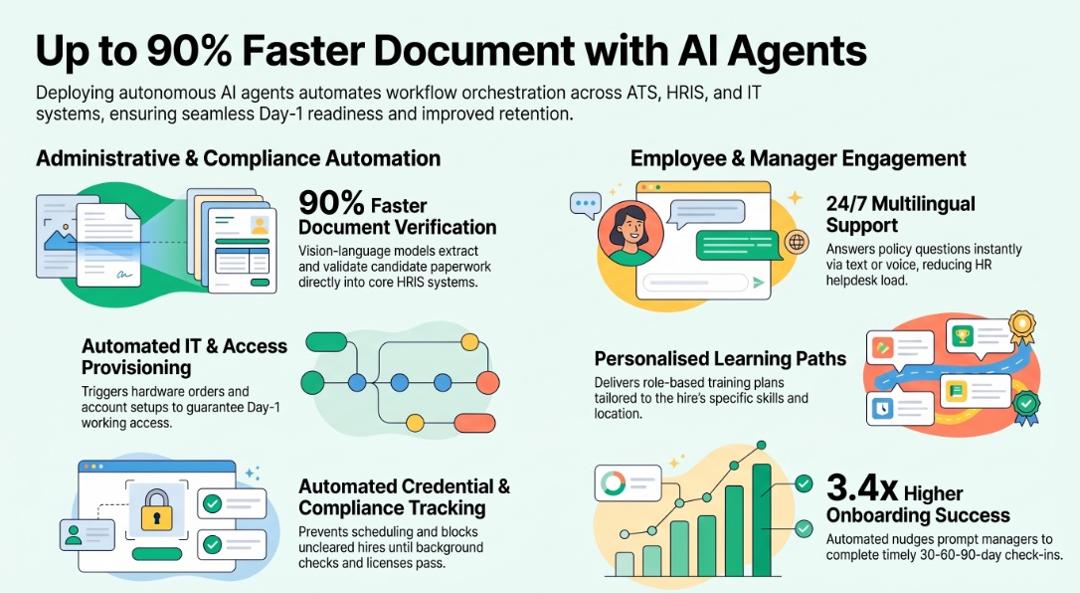
What the agent does: Document AI reads layouts and tables, extracts fields, validates them against business rules (name matches the offer, bank format is valid, document not expired) and sends only exceptions to a person. Approved data flows into the HRIS and payroll, with the source archived for audit.
Systems involved: HRIS, payroll, document storage, e-signature.
Real-world example: An Australian remediation and building-services firm deployed a multi-agent document workbench on assistents.ai that uses vision-language models to extract data from complex PDFs and sync it into core systems with full audit logs. It was engineered for up to ~90% faster document processing with a ~95% extraction-accuracy target on standard formats. New-hire paperwork uses the same extract-validate-route flow.
KPI moved: Document error rate; hours of manual data entry per hire.
3. Credential, licence and background-check tracking for regulated roles
The problem: In healthcare, transport, finance and security, a new hire cannot start until licences, certifications and checks clear. Tracking them in spreadsheets delays start dates and creates compliance risk.
What the agent does: The agent captures credentials at onboarding, checks expiry dates, tracks background-check status with providers, blocks scheduling until requirements are met and alerts HR to anything that stalls.
Systems involved: HRIS or staffing platform, background-check provider, scheduling system, compliance records.
Real-world example: A US healthcare staffing platform built its operations on assistents.ai, covering talent onboarding and credential capture, facility request intake and matching, and scheduling, notification and compliance workflows, with reporting on fill rate and utilisation. Results included faster fill cycles, lower scheduling friction, better workforce utilisation and improved staffing responsiveness for facilities.
KPI moved: Time from offer to "cleared to work".
4. Compliance, policy acknowledgement and audit trails
The problem: Every country, and often every state, has different onboarding rules: right-to-work checks, tax forms, data-privacy consents, labour-law notices. Missing one is expensive.
What the agent does: The agent applies the right checklist based on the hire's location and contract type, collects e-signed policy acknowledgements, tracks deadlines and keeps a complete audit history of who did what and when. Rules are set by HR and legal, not guessed by the model.
Systems involved: HRIS, e-signature, policy library, compliance reporting.
Real-world example: A global fintech that serves banks and credit unions runs omnichannel agent workflows on assistents.ai with auditability, reporting and SLA monitoring built in. Results included faster case handling and better compliance readiness through audit trails. Onboarding compliance needs the same thing: proof, on demand, that every step happened. Read more on our compliance solutions.
KPI moved: Compliance tasks completed on time; audit findings.
5. IT, identity and equipment provisioning across HR and IT
The problem: A new hire who arrives without a laptop, email or system access loses their first day, and the company loses credibility. HR and IT often work from separate queues.
What the agent does: Once the hire is confirmed, the agent requests accounts and licences by role, orders equipment, books building access and confirms each item is done before Day 1. If a request fails, it retries, finds the cause and escalates to the right IT owner with full context.
Systems involved: HRIS, identity provider, IT service desk, asset management, facilities.
Real-world pattern: On assistents.ai, this follows the same governed flow our clients use to turn incoming orders into validated SAP transactions: extract, validate, route exceptions, then update the system of record through standard connectors and APIs. HR, IT and facilities each see only what they need to act on.
KPI moved: Day-1 readiness (share of hires with working access on Day 1).
6. 24/7 new-hire Q&A on policies, benefits and payroll
The problem: New hires ask the same questions: When is payday? How do I add a dependant? What is the leave policy in my country? HR answers them one by one.
What the agent does: A conversational agent answers from your handbook, policies and HR data, cites the source, and can take permitted actions such as creating a ticket or updating a record. Questions it cannot answer go to HR with the conversation attached.
Systems involved: Policy documents, HRIS, payroll, ticketing, Slack/Teams/WhatsApp/email.
Real-world example: A major UAE real-estate portfolio runs an omnichannel service agent on assistents.ai (web, WhatsApp and email) with query triage, FAQs, ticketing and escalation to human teams, all grounded in a knowledge base over policies and SOPs. Results: faster response times, lower call-centre load, a consistent 24×7 experience and better SLA adherence. The same architecture serves new hires instead of tenants.
KPI moved: HR tickets per new hire; first-response time.
7. Multilingual voice onboarding for frontline and deskless workers
The problem: Most onboarding tools assume a desk, a laptop and English. Store staff, warehouse teams, drivers and care workers often have none of these. They need answers by phone, in their own language.
What the agent does: Voice AI handles inbound and outbound calls in multiple languages, answers procedural questions, walks new staff through SOPs, logs issues and hands over to a person with a call summary when needed.
Systems involved: Telephony, knowledge base (SOPs, POS guides), ticketing, HRIS.
Real-world example: A national value retailer with hundreds of stores across India deployed assistents.ai agents for its frontline: a Hindi and English voice support agent, an inventory intelligence agent and a knowledge-and-training agent built on POS and SOP documents, with an admin console, analytics and ticketing. Results included a reduced manual helpdesk burden, faster store issue resolution and faster onboarding through on-demand training guidance.
KPI moved: Time to independent shift; helpdesk calls per new hire.
See it on your process. Bring one onboarding workflow and we'll map its systems, handoffs and approvals in a tailored walkthrough.
8. Personalised, role-based learning paths
The problem: One-size-fits-all orientation wastes time for experienced hires and overwhelms new ones. Gallup notes it can take around 12 months for a new employee to reach full performance potential.
What the agent does: The agent builds a learning plan from the role, skills and location, recommends modules, answers learning questions as they come up and reports progress to the manager.
Systems involved: LMS, HRIS, skills data, knowledge base.
Real-world example: A global educator community with more than a million members uses assistents.ai for profiles with competency insights, a support agent for program and learning queries and analytics for program operators. Results: scalable support, faster access to learning resources and better visibility into engagement and outcomes.
KPI moved: Time-to-productivity; training completion rate.
9. Manager, buddy and 30-60-90-day check-in nudges
The problem: Gallup found employees are 3.4 times as likely to say onboarding was successful when their manager takes an active role. Yet managers are busy and forget.
What the agent does: The agent schedules buddy and team intros, reminds managers about first-week goals and 30-60-90 check-ins, sends short pulse surveys to new hires and flags early signs of disengagement to HR.
Systems involved: Calendar, HRIS, Slack/Teams, survey tool.
Real-world pattern: On assistents.ai, Workflow Builder triggers work from schedules, events and inboxes, so check-ins run on time without anyone maintaining a calendar of reminders.
KPI moved: Check-ins completed on time; 90-day retention.
10. Onboarding analytics and bottleneck detection
The problem: HR leaders rarely know where onboarding stalls: which location misses Day-1 readiness, which team's hires wait longest for access, which step causes most tickets.
What the agent does: Agentic BI lets HR ask questions in plain language ("Which sites missed Day-1 readiness last month?") and get charts, reports and threshold alerts. It can turn an insight into a task with an owner and a due date.
Systems involved: HRIS, ATS, IT service desk, LMS, survey data.
Real-world examples: A multi-company family business group in the UAE used assistents.ai to standardise KPIs across group entities and deliver scheduled insight packs to leadership. A privately held retail holding group added insights-to-action agents on top of its dashboards, shifting from reactive reporting to proactive execution, with standardised decision logic and automated task creation and completion tracking. Multi-entity onboarding needs exactly this.
KPI moved: Onboarding cycle time; bottleneck resolution time.
11. Exception handling with human-in-the-loop approvals
The problem: Most onboarding delays come from exceptions: a name mismatch between passport and offer, a failed background check, a visa question, a salary change after signing. Rules-based tools break here.
What the agent does: The agent detects the exception, gathers the evidence, routes it to the right approver and pauses that step only. Once approved, the process resumes. Sensitive decisions always stay with people.
Systems involved: HRIS, approval workflows, case management.
Real-world pattern: Every assistents.ai deployment uses the same control model: access check, policy evaluation, then allowed, review required, or blocked and logged. In regulated work, like the fintech and healthcare examples above, that model is what lets agents act without adding risk.
KPI moved: Exceptions resolved within SLA.
Summary: 11 AI onboarding use cases at a glance
| # | Use case | Stage | assistents.ai capability | KPI moved |
|---|---|---|---|---|
| 1 | Pre-boarding orchestration | Pre-boarding | Autonomous Agents | Pre-boarding completion |
| 2 | Document extraction and verification | Pre-boarding | Document AI | Document error rate |
| 3 | Credential and background-check tracking | Compliance | Workflows + Document AI | Time to cleared-to-work |
| 4 | Compliance and audit trails | Compliance | Agent Governance | On-time compliance |
| 5 | IT and access provisioning | IT and access | Agent Orchestration | Day-1 readiness |
| 6 | 24/7 policy and benefits Q&A | All stages | Conversational Agents | HR tickets per hire |
| 7 | Multilingual voice onboarding | Day 1 / Week 1 | Voice AI | Time to independent shift |
| 8 | Personalised learning paths | Week 1 to Day 90 | Context Engine + Agents | Time-to-productivity |
| 9 | Manager and check-in nudges | 30-60-90 days | Workflow Builder | 90-day retention |
| 10 | Onboarding analytics | All stages | Agentic BI | Onboarding cycle time |
| 11 | Exception handling | All stages | Agent Governance | Exceptions within SLA |
What to automate vs what HR should still decide
Automate the repetitive, rules-based work; add approval where money, compliance or exceptions are involved; and keep judgment calls with people. The goal is not a hands-off HR team. It is an HR team that spends its time on people, not paperwork.
| Automate fully | Automate, with human approval | Keep with HR and managers |
|---|---|---|
| Welcome messages and reminders | Data mismatches between documents and offer | Final hiring and pay decisions |
| Document collection and field extraction | Failed or flagged background checks | Visa and immigration judgments |
| Standard IT and access requests | Non-standard access or equipment requests | Accommodation and sensitive requests |
| Policy and benefits FAQs | Changes to contract terms or start date | Performance and culture conversations |
| Check-in scheduling and pulse surveys | Country-specific compliance edge cases | Responses to disengagement or conflict |
| Progress tracking and reporting | Overrides of standard onboarding paths | Anything an employee asks to discuss with a person |
Benefits and KPIs to track
AI agents for HR onboarding pay off in four ways: faster onboarding, more productive HR teams, more reliable data and stronger control. Measure them with a baseline before launch and track the change each month.
Teams using the assistents.ai employee onboarding agent report a 52% reduction in onboarding time, Day-1 readiness rising from 55% to 89%, time-to-full-productivity 3.5 weeks faster, and an 18% improvement in year-two retention. Gallup's research shows why the last one matters: employees with exceptional onboarding are 2.6 times as likely to be extremely satisfied with their workplace.
| KPI | What it tells you | How the agent moves it |
|---|---|---|
| Time-to-productivity | How fast new hires contribute | Faster access, personalised learning, instant answers |
| Day-1 readiness % | Hires with access, equipment and schedule on Day 1 | Provisioning completed and verified before start |
| Onboarding cycle time | Offer accepted to onboarding complete | Parallel tasks, automatic follow-ups |
| HR tickets per new hire | Load on HR and IT | Source-backed self-service Q&A |
| Document error rate | Data quality in HRIS and payroll | Extraction plus validation rules |
| Compliance tasks on time | Audit readiness | Location-aware checklists and deadlines |
| 90-day and year-two retention | Whether onboarding worked | Manager nudges, check-ins, early risk flags |
For enterprise HR service delivery overall, IBM Consulting research suggests self-service and reduced manual work can deliver 50% to 60% savings in HR service delivery costs.
Best AI agents for HR onboarding in 2026 (platforms compared)
The best AI agent for HR onboarding depends on whether you need a single-purpose HR assistant or a platform that runs onboarding across HR, IT, documents and voice. Here is how the main options compare.
| Platform | Best for | Onboarding depth | Voice / multilingual | Document AI | Deployment options |
|---|---|---|---|---|---|
| assistents.ai | Enterprises running onboarding across HR, IT, documents and frontline teams | End-to-end, offer to Day 90, with governed actions | Yes, multilingual voice and chat | Yes, extraction, validation and human review | Cloud SaaS, private cloud, on-premise |
| Workativ | HR and IT support automation | Strong on HR and IT workflows | Chat-first | Limited | Cloud |
| Leena AI | Employee helpdesk for HR and IT queries | Q&A and request handling | Chat, multiple languages | Limited | Cloud |
| Moveworks (part of ServiceNow) | Organisations standardised on ServiceNow | Employee support and requests | Chat, multiple languages | Limited | Cloud |
| Sana (part of Workday) | Knowledge and learning in Workday environments | Learning and knowledge assistance | Chat | Knowledge search | Cloud |
| Lyzr | Technical teams building their own agents | Build-your-own | Depends on build | Depends on build | Cloud, self-hosted options |
Comparison based on publicly available product information as of October 2026. Check each vendor's site for current capabilities.
How to choose:
- Mostly HR questions, one HRIS? A helpdesk-style assistant can be enough.
- Already all-in on ServiceNow or Workday? Their native agents fit that stack.
- Onboarding spans HR, IT, payroll, documents, multiple countries and frontline staff? You need a platform with orchestration, document AI, voice and governance in one place. That is where assistents.ai is built to lead.
Why assistents.ai for HR onboarding
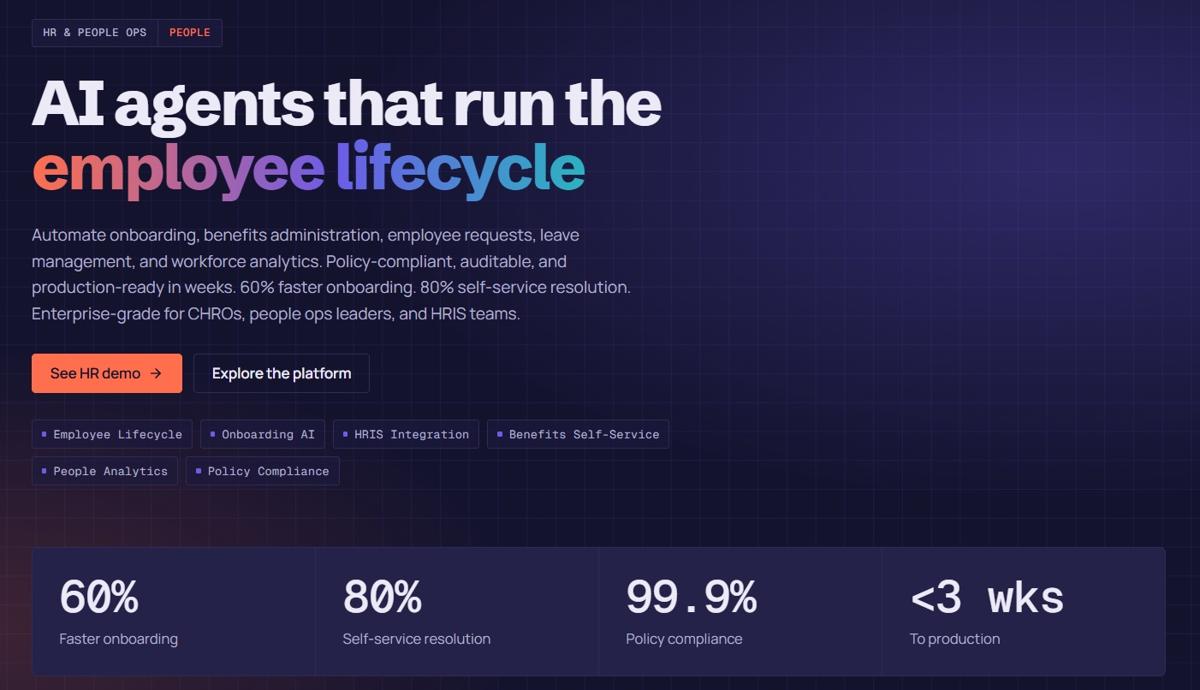
assistents.ai is an enterprise AI agent platform by Ampcome that runs HR onboarding end to end. Its agents read new-hire documents, answer policy questions in multiple languages, provision access across HR and IT systems, and route exceptions to HR for approval, with permissions, business rules and a full audit trail on every action.
Most tools make one person faster. assistents.ai is built for organisational productivity: it connects teams, business context, rules and enterprise systems, and coordinates a process from trigger to verified outcome. Here is what that means for onboarding.
1. Five capabilities on one platform
Conversational Agents, Agentic BI, Document AI, Voice AI and Autonomous Workflows share one foundation. Onboarding doesn't need five tools stitched together. Agent Builder and Workflow Builder let you configure, test, version and publish reusable agents.
2. Built for frontline and multilingual workforces
Voice AI in Hindi and English already supports frontline staff across a national retail chain, with in-call actions, contextual handover and call summaries. Your store, warehouse and field hires get onboarding that works for them.
3. A context engine that knows your organisation
The Context Engine links roles, locations, policies, entities and source evidence. Answers cite your handbook instead of guessing, and actions follow your rules.
4. Governance HR and legal will sign off on
Every action passes an access check and policy evaluation, then is allowed, sent for review or blocked and logged. Identity, permissions, approvals and audit are built into the platform. See security and trust.
5. Fits your stack and your data rules
Connect HR systems, ERP (including SAP), CRM, files and databases through APIs, SDKs and connectors. Deploy as cloud SaaS, private cloud or on-premise. The AI Gateway handles approved-model routing, fallback, usage management and security.
6. A delivery team, not just a login
Forward Deployed Engineers, AI engineers and data science specialists across the USA, Australia and India take your priority process from configuration to production.
Teams in healthcare staffing, national retail, banking technology, real estate, hospitality and multi-entity family groups across the US, UK, UAE, India, Africa and Australia run on assistents.ai. See customer stories.
How to roll out an AI onboarding agent in 6 steps
Start with one onboarding process that matters, connect its systems, configure agents and rules, validate on real cases, then operate and expand. A focused pilot can go live in weeks, not quarters.
- Select a valuable process. Pick one high-volume, high-pain flow, such as frontline onboarding in one region or document collection for all hires. Agree the success measures (for example, Day-1 readiness and HR tickets per hire) and capture a baseline.
- Connect systems. Link the ATS, HRIS, identity provider, IT service desk, policy library and communication channels through standard connectors.
- Configure agents and workflows. Define each agent's role, knowledge sources, tools, permissions and allowed actions. Set approval points with HR and legal.
- Validate on real cases and refine. Run the agent on a batch of real hires with HR reviewing outcomes. Tune answers, rules and escalation paths.
- Operate and support. Go live, monitor execution, track exceptions and report KPIs against the baseline.
- Expand to more use cases. Add the next stage (IT provisioning, 30-60-90 check-ins), the next region or the next workforce. Reuse the same integrations and context. Then extend to other HR processes on our HR solutions page.
| Week | Milestone |
|---|---|
| 1 | Process selected, KPIs and baseline agreed, systems mapped |
| 2–3 | Integrations connected, agents and approval rules configured |
| 4–5 | Validation on real hires with HR review |
| 6 | Go-live for the pilot scope, KPI reporting starts |
Timelines vary with the number of systems and countries in scope.
Security, privacy and data residency
Onboarding handles sensitive personal data: IDs, bank details, addresses, health and background information. Look for:
- Role-based permissions so agents only see and do what the role allows.
- Policy rules and approvals on sensitive actions.
- A complete audit history of every decision and system change.
- Deployment choice (SaaS, private cloud or on-premise) to meet data-residency rules such as GDPR or India's DPDP Act.
- Model governance through a gateway, so only approved models handle employee data.
Change management for HR teams
Agents change HR roles, so bring HR in early. Let coordinators design the escalation rules, show them the time saved each week, and position the agent as the one that does the chasing so they can focus on people. Tell new hires they are talking to an AI agent and how to reach a person at any time.
Put AI agents to work on your onboarding
Onboarding is often a new hire's first real experience of your company. AI agents for HR onboarding make that experience fast, consistent and personal, while giving HR control of every step.
Bring one onboarding process. We'll map its systems, handoffs and approval points, and agree how success will be measured.
Book a tailored walkthrough · Explore the AI employee onboarding agent
Related reading: Agentic AI in the hospitality industry: 11 AI agents hotels are deploying · Top 10 AI agents for BFSI in India
FAQs
What is an AI onboarding agent?
An AI onboarding agent is software that runs the new-hire process on behalf of HR. It reacts to events like an accepted offer, collects and checks documents, sets up system access, answers questions and escalates exceptions. Unlike a chatbot, it takes action across HR and IT systems and logs every step.
How is AI used in employee onboarding?
AI is used to automate pre-boarding tasks, extract data from new-hire documents, track compliance and credentials, provision IT access, answer policy and benefits questions 24/7, personalise training, remind managers about check-ins and analyse where onboarding stalls.
What onboarding tasks can AI agents automate?
AI agents can automate welcome messages, document collection and verification, background-check tracking, policy acknowledgements, account and equipment requests, FAQ responses, training recommendations, check-in scheduling, pulse surveys and onboarding reporting. Exceptions and sensitive decisions go to HR for approval.
Can AI replace HR in onboarding?
No. AI agents replace the repetitive coordination work, not HR. Decisions on pay, visas, accommodations and culture stay with people. Gallup found employees are 3.4 times as likely to rate onboarding successful when managers are actively involved, so the human role matters more, not less.
What is the difference between an HR chatbot and an AI agent?
An HR chatbot answers questions when asked. An AI agent starts work on its own, understands context such as role and location, takes actions across systems like the HRIS and IT service desk, handles exceptions and keeps an audit trail. Chatbots answer; agents complete the process.
Are AI onboarding agents secure and GDPR-compliant?
They can be, if the platform enforces role-based permissions, policy rules, human approvals and full audit logs, and lets you choose where data is processed. assistents.ai supports cloud SaaS, private cloud and on-premise deployment, with governance on every action.
How long does it take to implement an AI onboarding agent?
A focused pilot on one onboarding process typically takes around four to six weeks: mapping and baselining, connecting systems, configuring agents and rules, and validating on real hires. Broader rollouts across regions and stages follow in phases.
What are the best AI agents for HR onboarding?
Leading options in 2026 include assistents.ai, Workativ, Leena AI, Moveworks (part of ServiceNow), Sana (part of Workday) and Lyzr. Choose a helpdesk assistant for simple Q&A, or a platform like assistents.ai when onboarding spans HR, IT, documents, voice and multiple countries.
How do you measure the ROI of AI in onboarding?
Baseline and track time-to-productivity, Day-1 readiness, onboarding cycle time, HR tickets per new hire, document error rate, compliance completion and 90-day retention. Multiply hours saved by loaded HR and IT cost, and add the value of earlier productivity and lower early attrition.