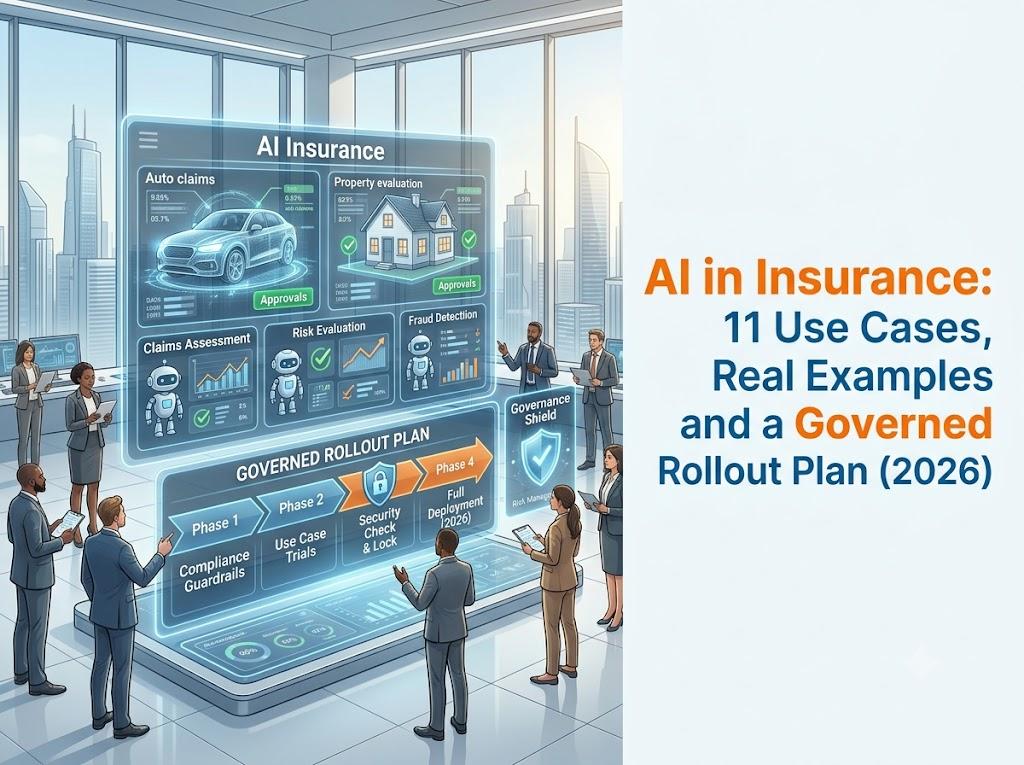
Say a hailstorm hits a region overnight. By 9 a.m., a mid-sized insurer has hundreds of first notices of loss. Some arrive by phone, some through the app, and some by email with blurry photos and a contractor's PDF estimate attached. Here is how the AI use cases in insurance covered in this guide work together on that one morning:
- Intake. A voice agent answers calls in the customer's language, and a chat agent takes app reports. Both capture the missing details, check the policy and create the claim record (use cases 1, 6 and 7).
- Documents. Document AI reads the estimates and photo metadata and extracts the key fields. Low-confidence fields go to a person for review (use case 2).
- Triage. Each claim is scored for severity and routed. Straightforward roof claims go to a fast queue, and large or complex losses go to a senior adjuster with the file already assembled. A person still approves every payout (use case 3).
- Fraud. One estimate closely duplicates another submitted under a different policy. The system flags it and sends the evidence to the special investigations unit, where an investigator decides (use case 5).
- Service. Policyholders get status updates by chat or text instead of calling in (use case 6).
- Insight. The claims lead asks, in plain language, how many hail claims are open by postcode and what the reserve exposure looks like, and gets an answer in seconds (use case 9). This is agentic BI in action.
Nothing in that morning removes the adjuster, the investigator or the underwriter. The agents do the reading, checking, routing and updating, and people own the decisions that matter. That is the pattern behind every use case below, and the one regulators expect.
Key takeaways
- AI in insurance means using machine learning, language models and AI agents to read documents, assess risk, route work and take approved actions across claims, underwriting, policy servicing and compliance.
- The 11 use cases with the strongest operational fit are FNOL intake, claims document extraction, claims triage, underwriting intake, fraud referral, policyholder chat, voice AI, policy servicing, natural-language BI, compliance monitoring and broker enablement.
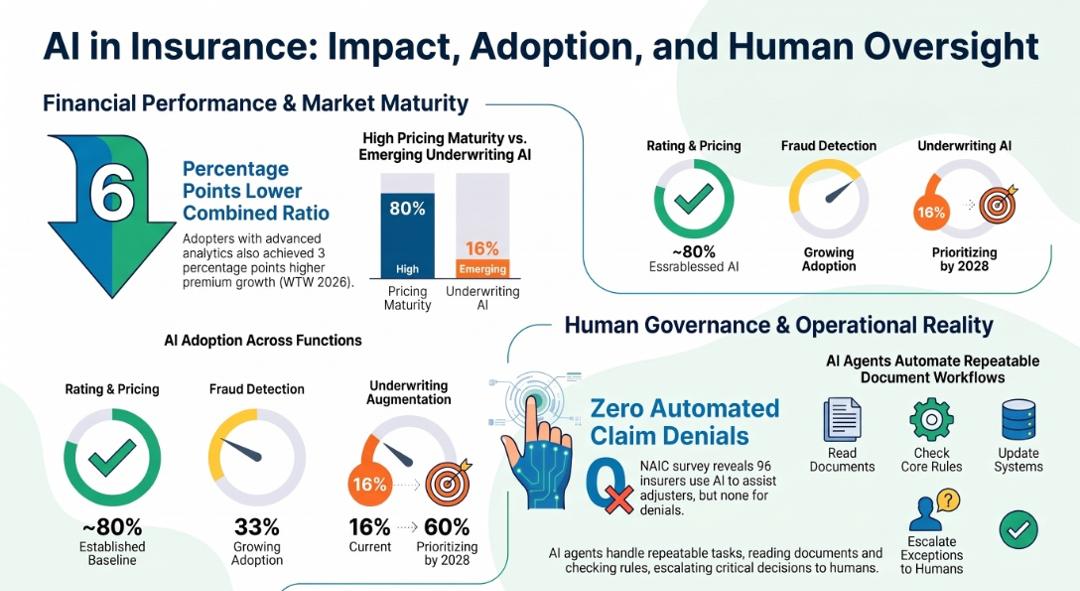
- Adoption is uneven. In WTW's 2026 survey, only 16% of insurers used AI to augment underwriting today, though 60% expect to prioritise it by 2028.
- Regulators and customers expect a human to stay accountable for consequential decisions. Every use case below states where that human checkpoint sits.
- The fastest path is one governed process, measured against a baseline, then expanded. A 90-day plan is at the end.
What is AI in insurance?
AI in insurance is the use of machine learning, natural language processing, computer vision and, increasingly, AI agents to analyse data, interpret documents, support decisions and automate routine work across the policy lifecycle. It covers claims, underwriting, fraud, customer service, compliance and distribution.
Insurance suits AI because the work is made of documents, rules and repeatable decisions: submissions, loss notices, medical reports, policy wordings, broker emails and call recordings. What has changed recently is that AI no longer stops at a prediction or a draft. AI agents can now read a document, check it against your rules, update the core system and escalate exceptions to a person.
Where insurers are with AI in 2026
The picture is mixed, and the numbers are easy to misquote. These come from primary or near-primary sources:
- Analytics pays off. WTW's 2026 Advanced Analytics and AI Survey found that insurers with more sophisticated analytics capabilities posted combined ratios 6 percentage points lower and premium growth 3 points higher than slower adopters between 2022 and 2024.
- Pricing is mature; claims and underwriting AI are not. Nearly 80% of insurers rely on advanced rating and pricing models, but only 33% use advanced analytics for fraud detection and 29% for severity assessment. Only 16% apply AI to augment underwriting today, while 60% expect to prioritise it by 2028.
- Humans remain in the loop. In an NAIC survey of larger private passenger auto insurers, 135 of 193 respondents used AI/ML in claims. Most used it as an informational resource for adjusters (96 companies). Few used it for claims approvals (9), and none for denials.
Treat adoption percentages from aggregator sites with caution. Figures for "insurers using AI" range from the mid-50s to over 85% depending on the definition used. When you cite a number, cite the survey, the year and what was measured.
AI vs generative AI vs agentic AI in insurance
| Traditional ML | Generative AI | Agentic AI | |
|---|---|---|---|
| What it does | Predicts or scores (fraud score, severity, price) | Drafts, summarises, answers questions | Plans and carries out multi-step work across systems |
| Typical insurance task | Risk scoring, fraud flags | Claim summaries, policy Q&A | Intake a claim, validate coverage, update the system, route exceptions |
| Human role | Reviews the score | Reviews the draft | Approves at defined checkpoints and handles exceptions |
| Main risk | Bias, drift | Hallucination | Unauthorised or unexplained actions |
Most of the value in the 11 use cases comes from combining all three, with governance around the agentic layer. For the difference between agents and older automation, see AI agents vs RPA.
How to read the use cases: autonomy levels
Each use case is graded by how much the AI does on its own.
| Level | Meaning | Example |
|---|---|---|
| L1: Assist | AI suggests or summarises; a person acts | Claim summary for an adjuster |
| L2: Act with approval | AI prepares the action; a person approves | Draft endorsement pending sign-off |
| L3: Act within guardrails | AI executes inside defined rules and escalates exceptions | Low-value claim intake and routing |
Consequential decisions, such as claim denials, coverage decisions and adverse underwriting actions, should stay at L1 or L2.
The 11 AI use cases in insurance at a glance
| # | Use case | Function | Autonomy | Human checkpoint | Primary KPI |
|---|---|---|---|---|---|
| 1 | FNOL and claims intake | Claims | L3 | Exceptions, coverage doubt | Intake-to-assignment time |
| 2 | Claims document extraction | Claims | L2 | Low-confidence fields | Extraction accuracy, manual touches |
| 3 | Claims triage and straight-through processing | Claims | L2 | Payout and denial decisions | Cycle time, STP rate |
| 4 | Underwriting submission intake and assist | Underwriting | L2 | Every risk decision | Time to quote |
| 5 | Fraud detection and SIU referral | Claims, SIU | L1 | Investigator decides | Referral precision, leakage |
| 6 | Policyholder chat and email agents | Service | L3 | Complex or sensitive cases | First-contact resolution |
| 7 | Multilingual voice AI | Service | L3 | Handover to a person | Call containment, handle time |
| 8 | Policy servicing and endorsements | Operations | L2 | Out-of-policy changes | Turnaround, error rate |
| 9 | Natural-language BI and portfolio insight | Finance, actuarial | L1 | Analyst validates | Time to insight |
| 10 | Compliance and audit monitoring | Risk | L1–L2 | Compliance officer | Audit-prep effort |
| 11 | Broker and agent enablement | Distribution | L1–L2 | Producer owns the relationship | Quote-to-bind, retention |
A note on the case examples that follow. They come from our production deployments in adjacent document-heavy, regulated workflows such as banking support, tax screening, retail, utilities and real estate. They are not insurance deployments. We include them because the workflow patterns carry over directly, and we say plainly which numbers are measured and which are design targets.
Claims
1. FNOL and claims intake automation
What it does. The first notice of loss arrives by phone, app, email or portal in whatever shape the customer chooses. An agent classifies the intent, extracts the details, asks for anything missing, validates the policy and creates the claim record.
Workflow.
- Trigger: a loss report arrives on any channel.
- Context: the agent pulls policy, coverage and claim history.
- Action: it creates the claim, captures missing details in a conversational loop and routes by severity.
- Check: coverage doubts and unusual losses go to a handler.
Autonomy: L3 for intake and routing; a person decides coverage. KPIs: time from notice to assignment, claims created without re-keying, handler touches per claim. Public example: Allstate has been reported to use AI to capture and process incident data in near real time and automatically initiate a claim under certain conditions (Emerj).
How we've delivered the equivalent. For a banking client we built an omnichannel intake agent covering chat, email and phone, with workflow routing, agent-assist summaries, auditability and SLA monitoring. It was designed for disputes, fraud and compliance cases, which have the same intake shape as a loss notice. Result: faster case handling, less operational load and a full audit trail.
2. Intelligent document processing for claims and submissions
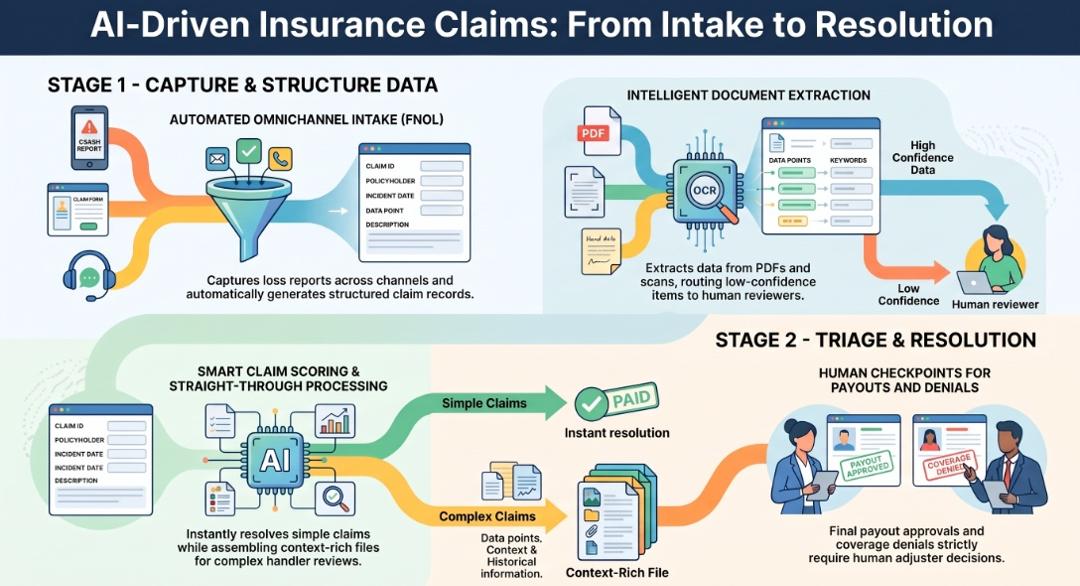
What it does. Claims files and submissions are mostly unstructured: PDFs, scans, photos, medical bills, adjuster reports and broker emails. Document AI reads layouts and tables, extracts fields, validates them against business rules and sends clean structured data into the claims system.
Workflow. Read the document, extract the fields, check customer, date and amount rules, send low-confidence or missing items to human review, then write approved data to the system and archive the source with an audit record.
Autonomy: L2. KPIs: extraction accuracy by document type, percentage of documents needing manual correction, handling time per file. Public example: AXA XL has publicly described using AI to extract and analyse property risk engineering reports to speed up data capture for underwriting (AXA XL).
How we've delivered the equivalent. For a construction-sector client we deployed autonomous agents that retrieve, interpret and track revisions of complex tender documents, using vision-LLM extraction on difficult PDFs and syncing validated data into the operational system with audit logs. The system is engineered for up to ~90% faster document processing, with a ~95% extraction accuracy target for standard formats. Those are design targets, not guarantees, and they will vary by document mix. The Document AI capability applies the same approach to claims bundles.
3. Claims triage and straight-through processing
What it does. Agents score each claim for complexity and severity, route it to the right handler or queue, assemble the file and recommend a next step. Simple, low-risk claims can move straight through; everything else gets a prepared file for an adjuster.
Autonomy: L2. Payout approval and any denial remain human decisions. KPIs: cycle time by claim type, straight-through rate, reopen rate, leakage. Public example: Lemonade has publicly reported its AI claims bot resolving straightforward claims in seconds (Lemonade). Note this applies to simple cases at a digital-native insurer, not to complex or litigated claims.
Why the human checkpoint matters. The NAIC data above shows the industry's practice: AI informs adjusters far more often than it decides payouts. Design for that from day one, with explainable recommendations, source evidence on every suggestion and a clear override path.
Underwriting and risk
4. Underwriting submission intake and risk assessment assist
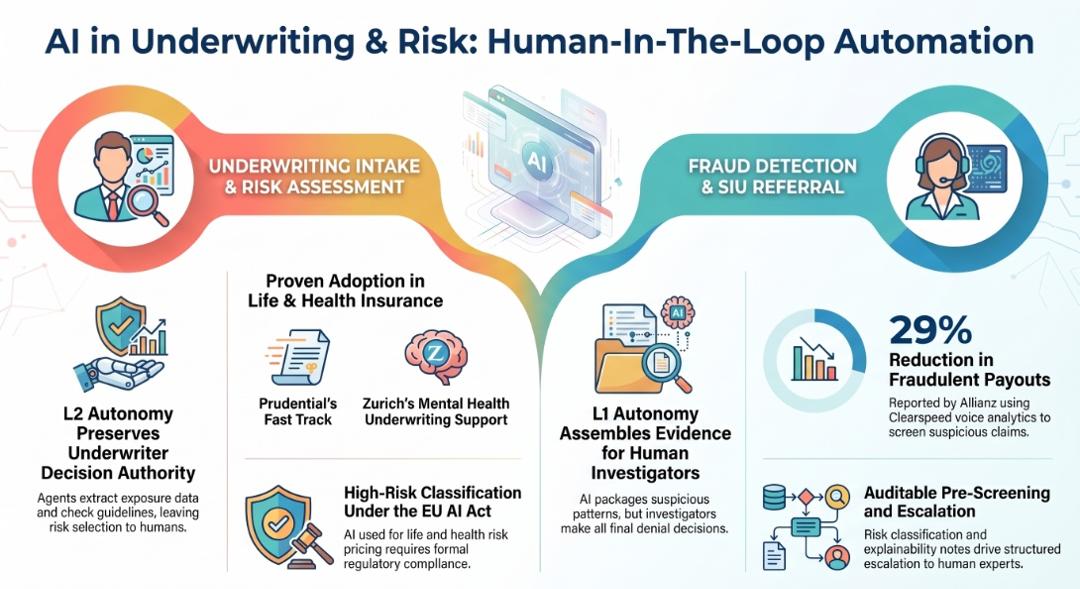
What it does. Agents classify inbound submissions, extract the exposure and loss-history data, populate the underwriting system and organise everything into a consistent file. They can then compare against appetite and guidelines and surface what is missing or inconsistent, so the underwriter spends time on judgment.
Autonomy: L2. Every risk-selection and pricing decision stays with the underwriter. KPIs: time to quote, submissions triaged per underwriter, share of submissions with complete data at first review. Public examples: Prudential has publicly described a "Fast Track" approach for eligible life applicants (Prudential), and Zurich has worked with a university partner on AI to support underwriting for applicants who disclose mental health conditions (Zurich Australia).
How we've delivered the equivalent. In tender management for a construction client, agents compare successive versions of a document, highlight what changed, route changes for human approval and then update the operational system with approved details. That change-detection pattern maps to endorsements, mid-term adjustments and resubmissions. Outcomes: reduced bid risk, visible revisions and auditability.
Regulatory flag. Under the EU AI Act, AI used for risk assessment and pricing in life and health insurance is treated as high-risk. Have counsel confirm obligations for your lines and markets.
5. Fraud detection and SIU referral
What it does. Models and agents flag anomalies and suspicious patterns, then assemble an evidence package for the special investigations unit. The goal is fewer false positives for genuine customers and better-prepared referrals for investigators.
Autonomy: L1. The AI scores, explains and packages; an investigator decides. Never auto-deny on a fraud score alone. KPIs: referral precision, investigator hours per referral, confirmed fraud avoided, false-positive rate. Public example: Allianz has reported a 29% reduction in fraudulent payouts using voice analytics from Clearspeed (Allianz UK).
How we've delivered the equivalent. For a tax-technology client we built transaction screening with risk classification, evidence collection, explainability notes and escalation to human experts, to flag cross-border risk early. We would describe that as pre-screening with an auditable rationale, not as fraud detection. The same screening-and-escalation workflow is the backbone of an SIU referral.
Policy service and customer experience
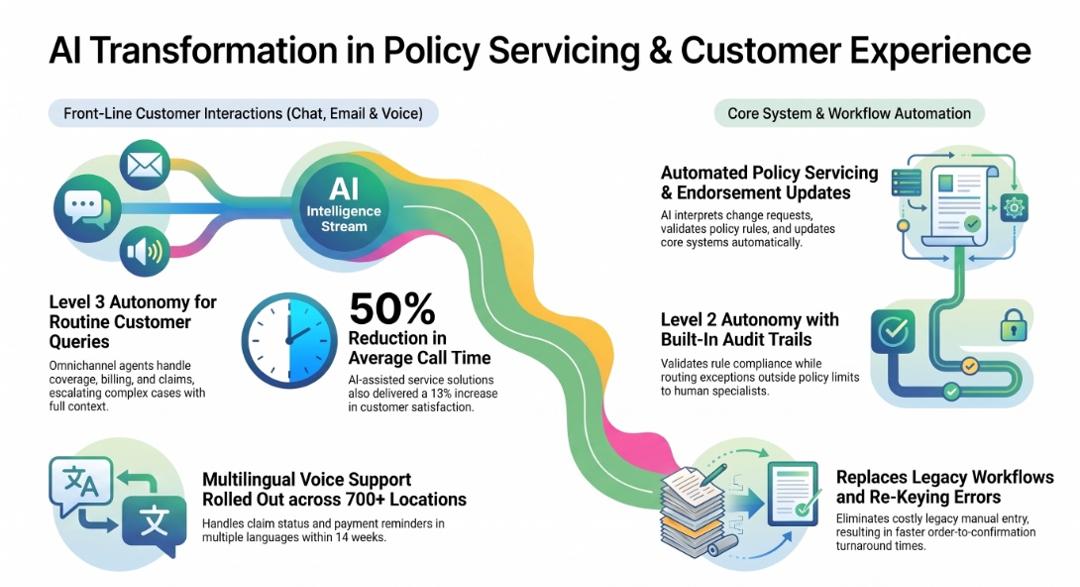
6. Policyholder chat and email agents
What it does. Agents answer coverage, billing and claim-status questions grounded in policy documents and live system data, with source citations. They create tickets, take approved actions and hand over to a person with full context.
Autonomy: L3 for routine requests; complex, sensitive or distressed customers go to a person. KPIs: first-contact resolution, containment rate, response time, escalation quality. Public example: MetLife has reported gains from an AI-assisted service solution, including a 50% reduction in average call time and a 13% rise in customer satisfaction (Emerj).
How we've delivered the equivalent. For a real-estate group we built an omnichannel customer service agent (web, WhatsApp and email) for tenant query triage, FAQs and payment support, with ticketing and escalation to human teams and a knowledge base over policies and SOPs. Result: faster response times, lower call-centre load, consistent 24×7 service and better SLA adherence. A tenant question about a payment is structurally the same as a policyholder question about a premium.
7. Multilingual voice AI
What it does. Inbound and outbound voice agents handle claim status, appointment booking, payment reminders and first notice of loss. They take approved actions during the call and summarise it afterwards, with a clear route to a human.
Autonomy: L3 with human handover. KPIs: containment rate, average handle time, abandonment rate, language coverage.
How we've delivered the equivalent. For a national retail chain we built a voice support agent (speech-to-text, LLM, text-to-speech) working in Hindi and English, alongside inventory and knowledge agents. The rollout covered 700+ stores in 14 weeks with store-level permission controls. See Voice AI and Voice AI for enterprise.
8. Policy servicing and endorsements into the core system
What it does. Agents interpret a change request, validate it against policy rules and authority limits, prepare the endorsement or document, and update the core system after approval. Typical tasks: address and coverage changes, certificates, cancellations and renewals.
Autonomy: L2. Changes outside policy go to a person. KPIs: turnaround time, re-keying errors, exceptions per hundred requests.
How we've delivered the equivalent. For a home-appliance manufacturer, agents interpret incoming order triggers, validate them against business rules, create the order in the ERP and flag exceptions for approval, with audit logs and reconciliation reporting. The design replaces a costly legacy workflow, which is also the situation many insurers face with ageing policy-admin tooling. The result: reduced manual processing, fewer data-entry errors and a faster order-to-confirm cycle. The insurance parallel is a validated endorsement written to the policy system with a traceable decision trail.
Insight, compliance and growth
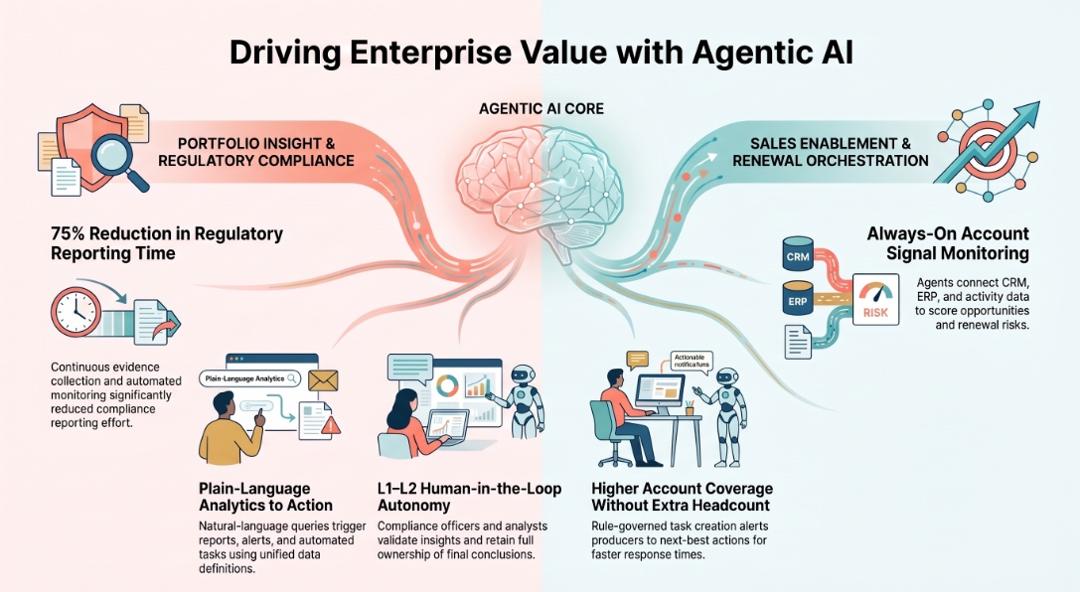
9. Natural-language BI and portfolio insight
What it does. Business users ask questions in plain language ("which lines have deteriorating loss ratios this quarter?") and get charts, reports and scheduled alerts, with consistent business definitions behind every number. Agentic BI then goes further and creates tasks from an insight.
Autonomy: L1. Analysts validate before decisions are made. KPIs: time to insight, analyst requests removed from the queue, alert-to-action time.
How we've delivered the equivalent. For an automotive lending client we built portfolio analytics covering risk, delinquency, maturity and residual KPIs, plus dealer-network performance and exception alerts. For a multi-entity group we standardised KPIs across entities with variance explanations and a governance layer. Outcome: better portfolio visibility and faster risk identification. Read more in our guide to agentic BI use cases.
10. Compliance, audit and regulatory monitoring
What it does. Agents continuously collect evidence, monitor policies and flag gaps. They also help with complaint handling, legal-notice review and audit-ready reporting.
Autonomy: L1–L2. The compliance officer owns every conclusion. KPIs: audit-preparation effort, evidence completeness, missed deadlines.
How we've delivered the equivalent. For a financial services enterprise, automated compliance monitoring with human-in-the-loop approval and continuous evidence collection reduced regulatory reporting time by 75% (an anonymised result from our customer outcomes). We have also shown a reusable pattern for monitoring multilingual legal notices; treat that one as an illustration of what the platform can do rather than a delivered engagement. See compliance agents.
11. Broker and agent enablement, renewals and next-best action
What it does. Agents monitor accounts, pick up signals (a quote request, a service case, a renewal date), score opportunities and risks, and create follow-up tasks for producers. The producer stays in charge of the relationship.
Autonomy: L1–L2. KPIs: accounts covered per producer, renewal retention, quote-to-bind time.
How we've delivered the equivalent. For an enterprise sales organisation we built an always-on account monitoring agent connected to the ERP, CRM, service and web activity, with rule-governed opportunity identification and follow-up orchestration. Outcome: higher account coverage without added headcount and faster response on renewals. See sales agents.
Beyond the 11: other AI use cases insurers are exploring
- Usage-based insurance and dynamic pricing. Telematics-driven pricing, as in programmes like Progressive Snapshot.
- Computer-vision damage assessment. Estimating vehicle or property damage from photos and aerial imagery.
- Catastrophe and predictive risk modelling. Combining claims history with weather and geographic data to forecast exposure.
- Personalised product recommendations. Matching coverage to customer needs and life events.
These are strong specialist areas, usually served by dedicated analytics or data vendors. They sit alongside the operational use cases above rather than replacing them.
How to choose which AI use case to start with
Score each candidate from 1 to 5 on three factors, then apply a risk gate.
| Factor | Question |
|---|---|
| Value | How many hours, errors or days does this remove? |
| Feasibility | Is the data accessible, and are the systems integrable? |
| Data readiness | Are the documents, rules and definitions clean and documented? |
| Risk gate | Does it touch sensitive data, face the customer or tolerate few errors? If yes, require controls before scaling. Don't reject it. |
Most insurers start with one of three: claims document extraction, FNOL intake or policyholder service, because volumes are high, rules are clear and a human checkpoint is easy to design. Use our AI agent ROI calculator to baseline the business case.
Governance, regulation and risk
Insurers carry duties that general business automation doesn't, so governance has to be built in from the start.
- Regulation. The NAIC expects decisions made or supported by AI to remain subject to existing insurance law. The EU AI Act and EIOPA guidance add obligations in Europe. Rules vary by state, country and line, so involve legal and compliance early.
- Permissions and authority limits. Agents should inherit the access controls of your source systems and act only within defined limits.
- Human approval. Define which actions need sign-off, and make denials and adverse decisions human-owned.
- Audit trail. Log every data access, decision and action with provenance so you can explain outcomes to customers, auditors and regulators.
- Bias and drift monitoring. Test outputs regularly, particularly in underwriting and claims.
- Data protection. Keep sensitive data inside approved boundaries and confirm that your data is not used for model training.
Our AI agent governance playbook covers the controls in detail, and the security and trust page lists certifications.
Build, buy or use a platform?
| Option | Best for | Trade-off |
|---|---|---|
| Insurance-specific point solutions | A single well-defined process, such as claims intake, with pre-built insurance models | Another vendor per process; may not cover documents, voice and analytics together |
| Core-platform add-ons | Insurers committed to one core-system vendor's ecosystem | Tied to that vendor's roadmap |
| General copilots and chat assistants | Individual productivity: drafting, summarising, research | Not designed to coordinate a process across systems with approvals and audit |
| Governed agent platform | Cross-system processes that mix documents, voice, analytics and workflow, with your rules and controls | Needs a clear first process and an integration plan |
| Build in-house | Unique requirements and a strong engineering team | Highest effort to build governance, integrations and monitoring |
The right answer is often a combination. For a comparison framework, see our enterprise AI buyer's guide.
Why assistents.ai for insurance AI
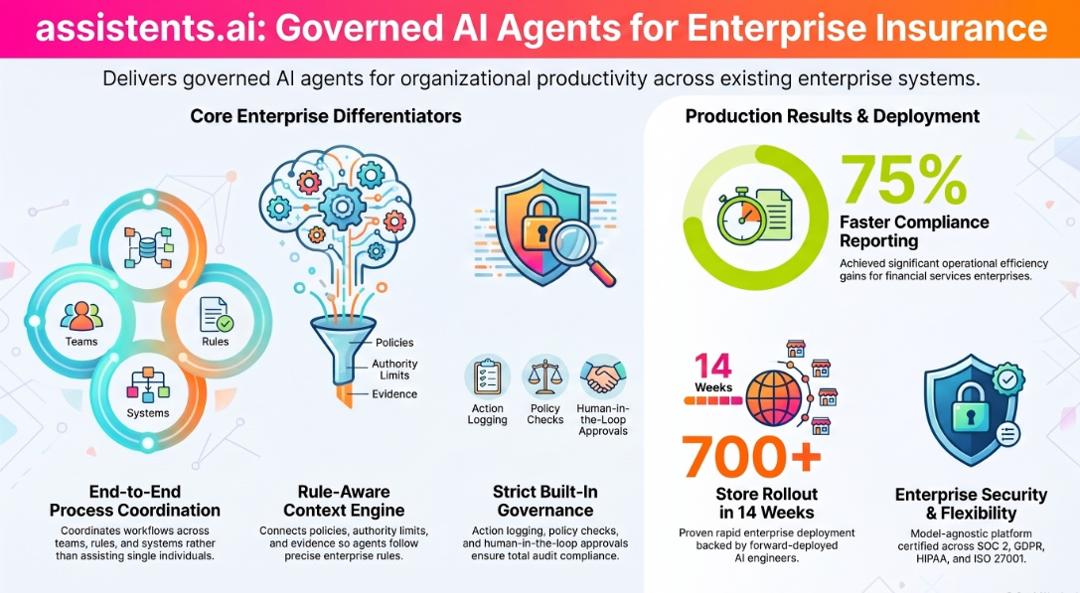
assistents.ai is a fit if you want governed AI agents that complete processes across your existing systems, not another assistant for individuals. Here is what that means in practice.
1. From personal productivity to organisational productivity. Copilots and chat assistants help one person finish a task. assistents.ai coordinates a process from trigger to verified outcome across teams, rules and systems, and measures cycle time, throughput and exceptions. Those tools also offer enterprise and agent features, so the useful question is which fits the process you need to run.
2. A context engine that knows your rules. The Context Engine connects entities, policies, definitions and source evidence, so agents work from your coverage rules and authority limits instead of guessing from a prompt.
3. Every action governed. Each action is permission-checked, evaluated against policy, routed for human approval when required and logged. That is the control model regulators and auditors ask for. See Agent Governance.
4. Documents, voice, analytics and workflows on one platform. Document AI, Voice AI, Agentic BI and autonomous workflows share one foundation, so a claims process doesn't need four separate tools.
5. Built to fit what you already run. Connectors, APIs and SDKs link ERP, CRM, document stores and databases, with no rip-and-replace. Ask us about the specific policy-admin and claims systems you use, and we'll confirm the integration path before you commit.
6. Model-agnostic, with flexible deployment. The AI Gateway routes between approved models with fallback and usage controls, and you can deploy in cloud, private cloud or on-premise infrastructure. Enterprise data is not used to train models, and we publish our SOC 2 Type II, GDPR, HIPAA and ISO 27001 status.
7. A delivery team, not just software. Forward-deployed engineers, AI engineers and data specialists in the USA, Australia and India configure agents around your process, validate on real cases and expand from there.
Proof from production. Our deployments span more than 30 engagements across more than 12 industries, including a national retail rollout across 700+ stores in 14 weeks and a 75% reduction in compliance reporting time for a financial services enterprise. Browse more customer outcomes.
When another option may be better. If you need only a specialist actuarial pricing model, telematics scoring or a single pre-built point solution for one process, a dedicated vendor may be a faster fit. assistents.ai is strongest when the work crosses documents, systems, voice, analytics and approvals.
A 90-day rollout plan
- Weeks 1–2: Select. Choose one high-volume process. Baseline cycle time, error rate and cost. Agree success measures and the human checkpoints.
- Weeks 2–4: Connect. Link the systems and documents the process touches. Define permissions, definitions and policies in the context layer.
- Weeks 4–6: Configure. Build the agents and workflow, set confidence thresholds and set up exception routing.
- Weeks 6–9: Validate. Run real cases in shadow mode, compare against human outcomes and tune.
- Weeks 9–12: Operate. Go live with monitoring, audit reporting and a feedback loop.
- Beyond day 90: Expand. Reuse the integrations and context for the next process, for example from claims intake to document extraction to servicing.
Pilots can reach production in weeks. Timelines depend on integration complexity and data readiness; the national retail rollout above took 14 weeks at scale.
Next step: start with one process
Pick the process that costs your team the most time, such as claims intake, document handling or policyholder service. Book a tailored walkthrough and bring one priority process; we'll map its systems, handoffs and approval points and agree how success will be measured.
Related reading
- AI Agent Use Cases in Fintech: 11 Real Examples Beyond Banking
- Agentic BI for Data Analysis: 32 Real Enterprise Use Cases
- AI Agents in Financial Services
- Multi-Agent Orchestration Guide
- HIPAA-Compliant AI Agents (relevant for health insurance)
Sources: WTW 2026 Advanced Analytics and AI Survey (via Captive.com); NAIC Private Passenger Auto AI/ML Survey (via The Wealth Advisor); company announcements cited inline. Statistics and public examples are as reported by the named sources and may have changed; check the originals before relying on them.
FAQs
How is AI used in insurance?
Insurers use AI to read and extract data from documents, triage and route claims, assist underwriters, flag potential fraud, answer policyholder questions by chat and voice, update policy systems after approval, monitor compliance and surface insights from portfolio data. Most uses keep a human accountable for consequential decisions.
What are the main use cases of AI in insurance?
The most common are claims processing, underwriting support, fraud detection, customer service, policy servicing and compliance monitoring. This guide covers 11 specific use cases across those areas, plus four specialist ones (usage-based pricing, damage assessment, catastrophe modelling and personalisation).
Can AI approve or deny insurance claims?
Technically it can handle simple, low-risk claims automatically, but best practice is to keep payout approval and every denial with a human. Survey evidence from the NAIC shows AI is used mostly to inform adjusters, rarely to approve claims, and in the survey not at all to deny them.
How does AI help detect insurance fraud?
AI finds anomalies and patterns across claims, documents and behaviour, scores them and assembles evidence for investigators. The most responsible setup treats the score as a referral signal with an explanation, and an investigator makes the call.
What is the difference between generative AI and agentic AI in insurance?
Generative AI produces content such as summaries, drafts and answers. Agentic AI plans and carries out multi-step work across systems, such as creating a claim, validating coverage and routing exceptions, within permissions and approval rules.
Will AI replace underwriters or claims adjusters?
The evidence points to augmentation. AI removes data entry, document reading and file preparation, so professionals spend more time on judgment, negotiation and complex cases. Regulatory expectations also keep people accountable for consequential decisions.
Do insurers need to replace their core systems to use AI?
Not necessarily. A governed agent platform can sit on top of existing claims, policy and CRM systems through APIs and connectors, then write approved results back. Legacy integration is usually the main effort, so confirm the connection path early.
How long does it take to implement AI in insurance?
A focused first process can reach production in weeks, and a 90-day plan is realistic for one governed use case. Enterprise-wide programmes take longer, depending on data quality, integrations and approvals.
Is AI in insurance regulated?
Yes, indirectly and increasingly directly. Existing insurance, privacy and anti-discrimination laws apply to AI-supported decisions, and rules such as the EU AI Act add obligations for high-risk uses. Requirements differ by jurisdiction and line of business, so consult legal and compliance advisers.