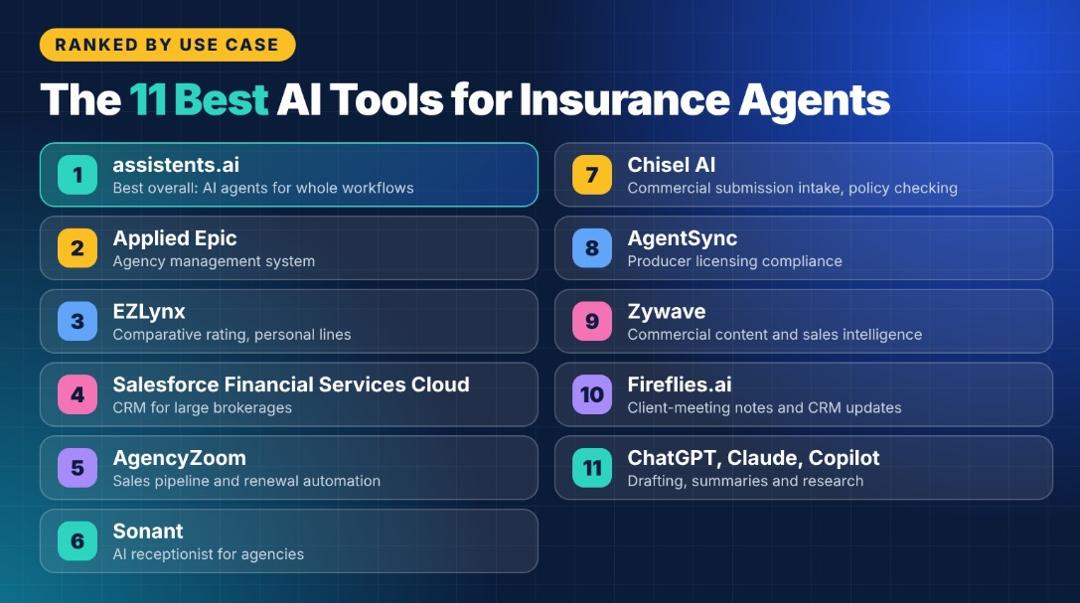
The best AI tools for insurance agents in 2026 are assistents.ai (best overall for governed AI agents across voice, documents and CRM), Applied Epic (agency management), EZLynx (comparative rating), Salesforce (CRM), AgencyZoom (sales pipeline), Sonant (AI receptionist), Chisel AI (commercial submissions), AgentSync (licensing), Zywave (commercial-lines content), Fireflies.ai (meeting notes) and ChatGPT, Claude or Copilot (drafting).
AI is now part of the job for most agents. In 2026, 65% of independent agents used AI at work, up from 37% a year earlier, and AI users saved an average of 4 hours a week (Liberty Mutual 2026 Independent Agency Growth Study). The harder question is which tools are worth paying for, and which ones you can trust with client data.
This guide ranks 11 tools by the agency workflow each one handles best. It also covers pricing models, picks by agent type, compliance risks and a 30-day rollout plan.
Disclosure: This list is published by assistents.ai, and we rank our own platform #1 for one specific job: running whole agency workflows under agency rules. Our ranking method is below so you can check it. Every other tool is ranked on the same six criteria.
Key takeaways
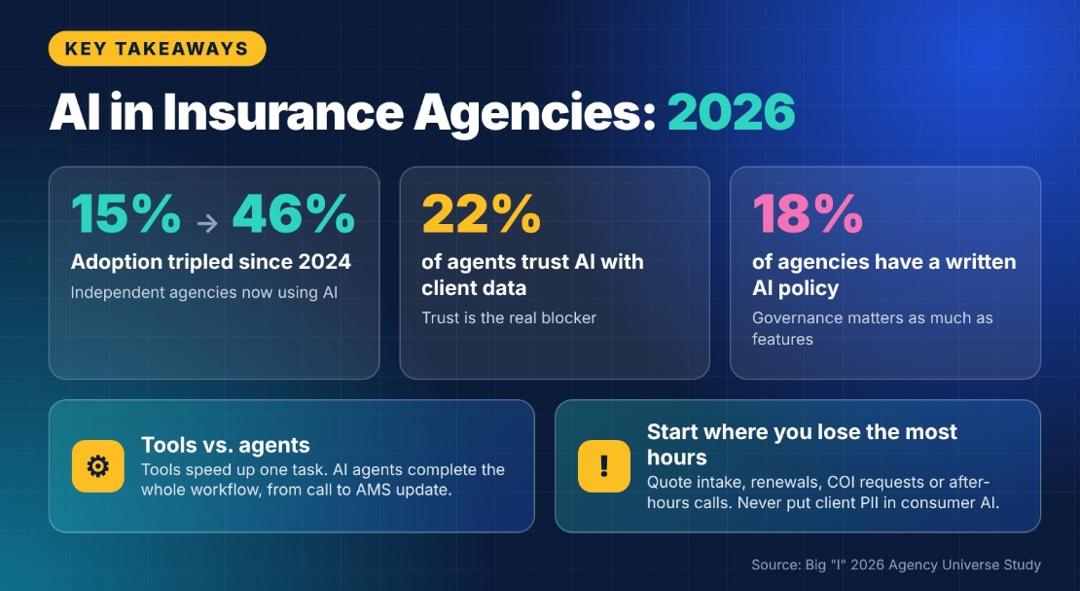
- AI adoption among agencies has tripled since 2024. 46% of independent agencies now use AI, up from 15% (Big "I" 2026 Agency Universe Study).
- Most AI tools speed up one task. AI agents complete a whole workflow. That covers taking the call, reading the form, updating the AMS and logging what happened.
- Trust is the real blocker. Only 22% of agents trust AI with client data, and only 18% of agencies have a written AI policy. Governance matters as much as features.
- Choose by workflow, not by hype. Start with the place your agency loses the most hours, whether that's quote intake, renewals, COI requests or after-hours calls.
- Free tools are fine for drafting. Never put client PII into a consumer AI account.
Best AI tools for insurance agents at a glance
Here are the 11 best AI tools for insurance agents in one table. "Built for insurance" means the product was designed for insurance workflows, not adapted from a general tool.
| Rank | Tool | Best for | Main use case | Built for insurance? | Works with | Pricing model |
|---|---|---|---|---|---|---|
| 1 | assistents.ai | Agencies, brokerages and MGAs that want AI agents to run full workflows | Lead and quote intake, renewals, service, documents, voice, compliance | Configured for insurance workflows | CRM, AMS and core systems via 300+ connectors and APIs | Custom, by workflow |
| 2 | Applied Epic | Mid-size and large independent agencies | Agency management (AMS) | Yes | Applied ecosystem, carrier download | Quote |
| 3 | EZLynx | Personal-lines P&C agencies | Comparative rating and quoting | Yes | Carriers, EZLynx AMS | Subscription |
| 4 | Salesforce Financial Services Cloud | Large brokerages with in-house admins | CRM, pipeline, AI agents (Agentforce) | Partly (insurance data model) | Salesforce ecosystem | Per user, tiered |
| 5 | AgencyZoom | Growing P&C agencies | Sales pipeline and renewal automation | Yes | AMS, Zapier, marketing tools | Subscription, free trial |
| 6 | Sonant | Agencies missing calls | AI receptionist | Yes | Applied Epic, AMS360, HawkSoft, EZLynx, QQCatalyst, Momentum | Quote |
| 7 | Chisel AI | Commercial brokers | Submission intake, policy checking, quote comparison | Yes | ACORD, CSIO, XML, JSON, CSV exports | Enterprise quote |
| 8 | AgentSync | Agencies and MGAs with many producers | Licensing and appointment compliance | Yes | NIPR data, API | Quote |
| 9 | Zywave | Commercial-lines and benefits brokers | Content, sales intelligence, benchmarking | Yes | Broker workflows | Subscription |
| 10 | Fireflies.ai | Producers in many client meetings | Meeting notes and CRM updates | No | Zoom, Teams, Meet, CRMs | Free plan + per seat |
| 11 | ChatGPT, Claude, Copilot | Every agent | Drafting, summaries, research | No | Office tools, browser | Free tiers + paid business plans |
Prices change often, so check each vendor's pricing page before you buy.
Why insurance agents are adopting AI in 2026
Insurance agents are adopting AI because it gives back hours spent on quoting, data entry and follow-up, and because carriers and clients now expect faster answers. The shift is measurable.
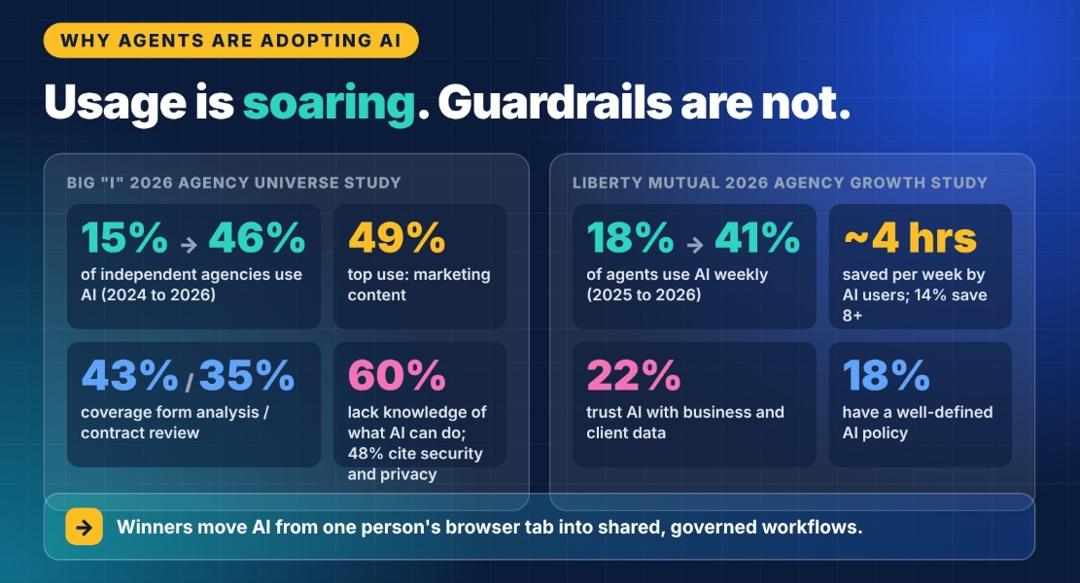
According to the Big "I" 2026 Agency Universe Study:
- 46% of independent agencies use AI in 2026, up from 15% in 2024.
- The top uses are marketing content (49%), coverage form analysis (43%) and contract review (35%).
- 60% of agencies say they lack knowledge of what AI can do, and 48% cite security and privacy concerns.
The Liberty Mutual 2026 Independent Agency Growth Study, which surveyed nearly 1,200 agency principals and staff, found:
- 41% of agents use AI weekly, up from 18% in 2025.
- AI users save about 4 hours a week, and 14% save 8 hours or more.
- Only 22% trust AI with business data and client information.
- Only 18% say their agency has a well-defined AI policy.
The takeaway: agents are using AI, but mostly as personal assistants and often without guardrails. The agencies pulling ahead are moving AI from one person's browser tab into shared, governed workflows. That's the difference between the tools ranked below.
How we ranked these AI tools
We scored each tool from 1 to 5 on six criteria that matter to an insurance agency, then ranked tools by the workflow they serve best. A tool can rank lower overall and still be the best choice for its specific job.
- Insurance workflow fit: Does it handle real agency work such as quotes, ACORD forms, renewals, COIs and licensing?
- AMS and CRM integration: Does it read from and write to the systems you already use?
- Governance and audit trail: Can you set rules and approvals, and see exactly what the AI did?
- Client-data security: Where does data go? Is it used for model training? What certifications does the vendor hold?
- Time to value: How fast can a typical agency see results?
- Pricing transparency: Can you understand what you'll pay?
| Tool | Workflow fit | Integration | Governance | Security | Time to value | Pricing clarity |
|---|---|---|---|---|---|---|
| assistents.ai | 5 | 5 | 5 | 5 | 4 | 3 |
| Applied Epic | 5 | 5 | 4 | 4 | 3 | 2 |
| EZLynx | 5 | 4 | 3 | 4 | 4 | 3 |
| Salesforce FSC | 4 | 5 | 4 | 5 | 2 | 3 |
| AgencyZoom | 4 | 4 | 3 | 4 | 4 | 3 |
| Sonant | 4 | 4 | 3 | 4 | 5 | 2 |
| Chisel AI | 4 | 4 | 3 | 4 | 3 | 2 |
| AgentSync | 4 | 4 | 4 | 4 | 3 | 2 |
| Zywave | 3 | 3 | 3 | 4 | 4 | 3 |
| Fireflies.ai | 2 | 4 | 2 | 3 | 5 | 5 |
| ChatGPT / Claude / Copilot | 2 | 2 | 2 | 3* | 5 | 5 |
*Business and enterprise plans add data controls that free consumer plans lack.
AI assistant vs AI agent: what an insurance agency actually needs
An AI assistant helps one person do one task faster. An AI agent completes a business process from start to finish, inside your systems, under your rules. Most agencies need both. They are not the same purchase.
| AI assistant (ChatGPT, Copilot, Claude) | AI agent platform (e.g. assistents.ai) | |
|---|---|---|
| What it does | Drafts, summarizes, researches | Takes action: reads, checks, updates, routes, follows up |
| Who benefits | One user | The whole agency |
| Connected to your AMS or CRM? | Usually not | Yes, with permissions |
| Follows agency rules | Only if you remember to prompt it | Rules and approvals are built in |
| Audit trail | Chat history | Full log of every action |
Example: a certificate of insurance (COI) request.
- With an AI assistant: a CSR pastes the email into ChatGPT, gets a polite reply drafted, then logs into the AMS, generates the certificate and sends it by hand.
- With an AI agent: the agent reads the request, finds the client and policy in the AMS, checks the certificate holder against agency rules, generates the COI, and sends it. If something is unusual, such as an additional insured endorsement, it routes the request to a CSR with the context attached. Every step is logged.
That is the move from personal productivity to organisational productivity, and it's why we rank governed agent platforms first.
The 11 best AI tools for insurance agents, ranked by use case
1. assistents.ai: best overall for AI agents that run whole agency workflows
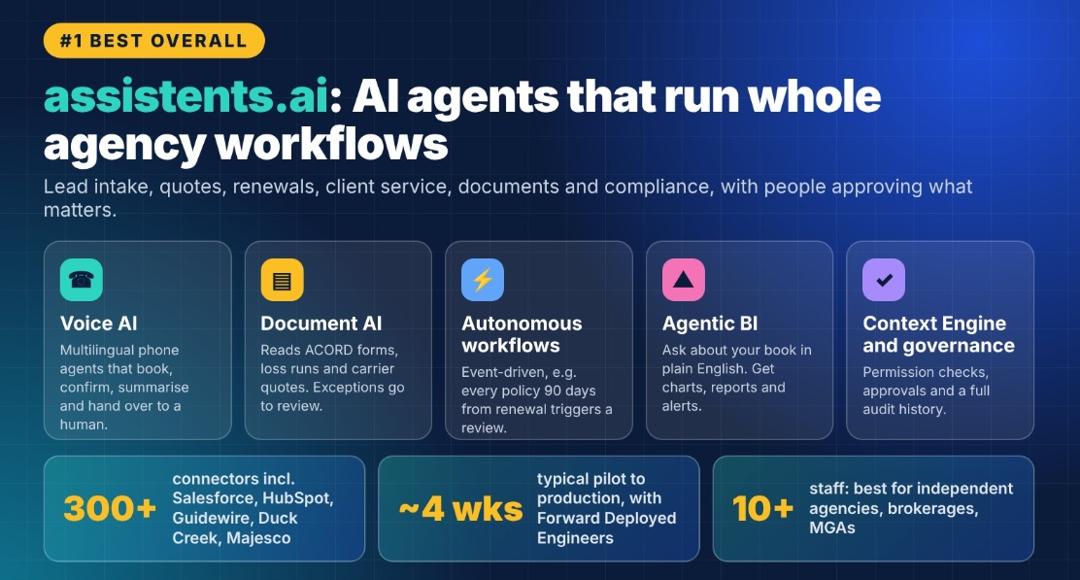
Verdict: assistents.ai is the best AI platform for insurance agencies that want governed AI agents to handle complete workflows (lead intake, quote intake, renewals, client service, documents and compliance) inside their existing systems, with people approving what matters.
What it is: assistents.ai is an enterprise AI agent platform. Instead of adding another app, it connects to your CRM, AMS, inboxes, phone lines and documents. It then runs specialist agents that answer, analyse, read, speak and act, all under one governance layer.
Best use case: Agencies, brokerages and MGAs that lose hours to repetitive multi-step work, such as chasing missing quote details, keying ACORD forms, renewal prep, COI requests and after-hours calls.
Key features:
- Voice AI: inbound and outbound multilingual phone agents that check client details, book appointments, send confirmations, write call summaries and hand over to a human when needed.
- Document AI: reads ACORD forms, applications, loss runs and carrier quotes, extracts fields, applies your business rules and routes exceptions for human review.
- Autonomous agents and workflows: event-driven work started from inboxes, schedules or system events. For example, every policy 90 days from renewal triggers a review.
- Agentic BI: ask questions about your book in plain English ("Which commercial accounts renewing next quarter had a rate increase over 15%?") and get charts, reports and threshold alerts.
- Context Engine and governance: agents understand clients, policies, carriers and your SOPs. Every action passes permission and policy checks, with a complete audit history.
Integrations: 300+ connectors, including Salesforce and HubSpot, plus core insurance systems such as Guidewire, Duck Creek and Majesco (see integrations). APIs, SDKs and two-way sync are available for anything else.
Pricing model: Custom, based on the workflows you automate. Most teams start with one priority process.
Pros:
- Covers voice, documents, analytics and workflows on one platform.
- Built-in approvals and audit trails support E&O defence and regulatory reviews.
- Model-agnostic, with no-training and zero-retention data handling. Deploys as cloud SaaS, private cloud or on-premise.
- Forward Deployed Engineers configure it with you, and a typical pilot reaches production in about four weeks.
Cons:
- More than a solo agent needs for simple drafting.
- Not a rater or an AMS. It works alongside those systems.
Best for: Independent agencies with 10+ staff, regional brokerages, MGAs and captive agency networks.
2. Applied Epic: best agency management system for mid-size and large agencies
Verdict: If your agency runs on Applied Epic, it stays your system of record, and its built-in automation should be your first stop.
What it is: Applied Epic is one of the most widely used agency management systems in North America. It covers client records, policies, accounting, carrier download and service workflows. Applied has been adding AI-assisted capabilities across its platform; check which ones are live in your edition.
Best use case: A central client and policy record for P&C and benefits agencies.
Key features: client and policy management, accounting, carrier connectivity, document management, reporting.
Pricing model: Quote-based.
Pros: deep insurance data model; large integration ecosystem. Cons: long implementations; AI features vary by edition; workflows outside Epic still need other tools.
Best for: Established independent agencies and brokers.
3. EZLynx: best for comparative rating and personal-lines quoting
Verdict: For personal-lines agents, a comparative rater saves more time than almost any other tool.
What it is: EZLynx offers a comparative rater, an agency management system and client-facing tools for personal-lines P&C agencies.
Best use case: Quoting home and auto across multiple carriers from one data entry.
Key features: multi-carrier comparative rating, AMS, client portal, marketing automation.
Pricing model: Subscription; request a quote.
Pros: built for independent personal-lines agencies; fast quoting. Cons: less suited to complex commercial lines.
Best for: Independent personal-lines agencies.
4. Salesforce Financial Services Cloud: best CRM for large brokerages
Verdict: A strong choice when you have a Salesforce admin and want a CRM you can customize heavily.
What it is: Salesforce Financial Services Cloud adds insurance and financial-services data models to Salesforce. Its Agentforce layer adds AI agents and predictive insights.
Best use case: Pipeline management, relationship data and producer performance for large brokerages.
Key features: insurance data model, opportunity and renewal tracking, AI-driven insights, Agentforce agents.
Pricing model: Per user per month, tiered.
Pros: highly configurable; huge app ecosystem. Cons: expensive to set up and maintain; needs specialist admins.
Best for: Brokerages with 100+ users and an internal tech team.
5. AgencyZoom: best for sales pipeline and renewal automation
Verdict: A practical sales and retention layer for P&C agencies that want automated follow-up without enterprise CRM complexity.
What it is: AgencyZoom, part of Vertafore, is a sales and automation suite for P&C agents. It covers lead management, automated customer journeys through renewal, and producer dashboards.
Best use case: Making sure no lead or renewal slips through the cracks.
Key features: drag-and-drop pipeline, automated renewal and win-back campaigns, review requests, producer goal tracking, mobile app.
Pricing model: Subscription, with a free trial.
Pros: built for agents; quick to adopt. Cons: automation is rules-based rather than AI-driven.
Best for: Independent and captive P&C agencies in growth mode.
6. Sonant: best AI receptionist built for insurance agencies
Verdict: The quickest way to stop losing after-hours and overflow calls.
What it is: Sonant is an AI receptionist for P&C agencies. It answers calls 24/7, takes quote intake, handles service questions, books appointments, transfers calls to staff and writes call notes back to your AMS.
Best use case: Inbound call coverage and quote intake.
Key features: 24/7 answering, multilingual calls, warm transfer, post-call notes, scheduling.
Integrations: Applied Epic, AMS360, HawkSoft, EZLynx, QQCatalyst, Momentum.
Pricing model: Request a demo.
Pros: built around insurance call flows; strong AMS coverage. Cons: focused on the phone channel only.
Best for: Small and mid-size P&C agencies with high call volume.
7. Chisel AI: best for commercial submission intake and policy checking
Verdict: For commercial brokers, policy checking and submission intake are the biggest time sinks. Chisel targets exactly those tasks.
What it is: Chisel AI uses AI to extract data from commercial insurance documents. It automates policy checking, quote comparison and submission triage.
Best use case: Checking issued policies against quotes and binders, and comparing carrier quotes.
Key features: automated policy checking, quote comparison, submission intake, export to ACORD, CSIO, XML, JSON and CSV.
Pricing model: Enterprise quote.
Pros: deep commercial-lines specialization. Cons: enterprise-oriented; little value for personal-lines agents.
Best for: Commercial brokers and wholesalers.
8. AgentSync: best for producer licensing and appointment compliance
Verdict: If you manage many producers across states, AgentSync takes licensing tracking off spreadsheets.
What it is: AgentSync is producer compliance software that uses real-time NIPR data to manage onboarding, licensing, appointments and carrier contracting.
Best use case: Keeping every producer licensed and appointed before they sell.
Key features: real-time license monitoring, onboarding, contracting workflows, ProducerSync API.
Pricing model: Request a demo.
Pros: removes manual compliance tracking. Cons: a compliance tool, not a sales or service tool.
Best for: Agencies, MGAs and carriers with large producer networks.
9. Zywave: best for commercial-lines content and sales intelligence
Verdict: A long-standing broker platform for content, prospecting data and benchmarking.
What it is: Zywave gives commercial P&C and benefits brokers client-facing content, sales intelligence and benchmarking tools.
Best use case: Producing compliant client content and preparing for prospect meetings.
Key features: content libraries, prospecting data, benchmarking, client portals.
Pricing model: Subscription; request a quote.
Pros: large insurance-specific content library. Cons: less about automating operations.
Best for: Commercial and employee-benefits brokers.
10. Fireflies.ai: best for client-meeting notes and CRM updates
Verdict: A low-cost way to stop writing meeting notes after every client review.
What it is: Fireflies.ai records, transcribes and summarizes calls on Zoom, Teams and Google Meet, and can push notes to your CRM.
Best use case: Annual reviews, renewal meetings and prospect calls.
Key features: transcription, AI summaries, action items, search across meetings, CRM sync.
Pricing model: Free plan, with paid per-seat tiers.
Pros: cheap and fast to adopt. Cons: not insurance-specific; tell clients the call is being recorded and follow state consent rules.
Best for: Producers and account managers.
11. ChatGPT, Claude and Microsoft Copilot: best for drafting, summaries and research
Verdict: Every agent should be using one of these for writing. None of them should be handling client PII on a free consumer plan.
What they are: general-purpose AI assistants: ChatGPT, Claude and Microsoft Copilot.
Best use case: drafting renewal emails, explaining coverage in plain English, summarizing long policy wordings (with PII removed), and writing social posts.
Pricing model: Free tiers, plus paid team and business plans with stronger data controls.
Pros: cheap, flexible, fast. Cons: not connected to your AMS; no audit trail; can state wrong facts confidently.
Best for: Every agent, as a personal productivity tool.
11 AI use cases for insurance agents and the best tool for each
The highest-value AI use cases for insurance agents are quote intake, document extraction, renewals and after-hours service, because they repeat daily and follow clear rules.
| # | Use case | What the AI does | Best tool | Metric to track |
|---|---|---|---|---|
| 1 | Lead intake and qualification | Answers inquiries, asks qualifying questions, books appointments | assistents.ai, Sonant | Speed to lead, booked appointments |
| 2 | Quote intake and missing-info chase | Reads quote requests, asks the client for missing details, builds a complete file | assistents.ai | Time to complete submission |
| 3 | Comparative rating | Quotes multiple carriers from one entry | EZLynx | Quotes per producer per day |
| 4 | ACORD and application extraction | Extracts fields from forms and PDFs into the AMS | assistents.ai, Chisel AI | Manual keying hours, error rate |
| 5 | Coverage comparison and gap analysis | Compares quotes, policies and endorsements | Chisel AI, assistents.ai | Policy-check time, E&O issues found |
| 6 | Renewal and retention outreach | Flags upcoming renewals, preps reviews, triggers outreach | assistents.ai, AgencyZoom | Retention rate |
| 7 | Cross-sell and next-best action | Finds monoline clients and coverage gaps | assistents.ai, Salesforce | Policies per household |
| 8 | 24/7 client service and COI requests | Answers coverage and billing questions, issues certificates | assistents.ai, Sonant | First-response time, CSR hours saved |
| 9 | FNOL support and claim status updates | Takes first notice details, gives status updates, routes to the carrier | assistents.ai | Calls deflected, client satisfaction |
| 10 | Licensing, compliance and E&O records | Tracks licences, logs advice and actions | AgentSync, assistents.ai | Lapsed licences, audit readiness |
| 11 | Book-of-business analytics | Answers questions on retention, loss ratio and carrier mix | assistents.ai (Agentic BI), Applied Epic | Time to answer a business question |
Looking for carrier-side use cases such as claims triage, underwriting and fraud detection? Read our guide to AI in insurance use cases.
Real examples: what governed AI agents look like in practice
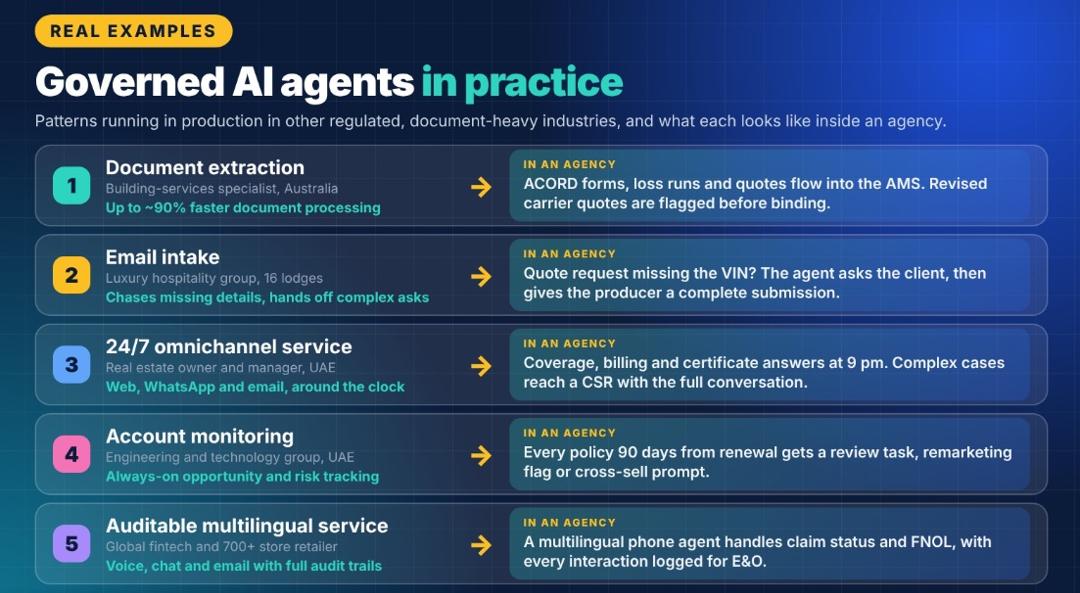
The agent patterns that insurance agencies need are already running in production in other regulated, document-heavy industries. The examples below come from assistents.ai deployments. Client names are withheld, and none of these clients is an insurance company. Each example ends with what the same pattern looks like inside an agency.
Example 1: Document extraction that keeps systems in sync
The client: a remediation and building-services specialist in Australia with 20+ years in the field, handling complex tender documents that change between versions.
What was delivered: autonomous agents that ingest, analyse and sync tender documents into the company's core operational system. The build included vision-LLM extraction from complex PDFs, revision and change detection, full read-and-write integration, and audit logs.
Results: engineered for up to ~90% faster document processing, with a ~95% extraction accuracy target on standard formats, and lower risk through change detection and auditability.
In an agency, this means: ACORD applications, loss runs and carrier quotes are read and written into your AMS automatically. When a carrier sends a revised quote, the differences are highlighted before anyone binds.
Example 2: Email intake that chases missing details
The client: a luxury hospitality group running 16 lodges and camps for high-expectation international guests.
What was delivered: a digital booking agent that reads incoming emails, classifies intent, extracts details, runs a conversational loop to collect missing information, checks live availability, generates documents, and hands complex requests to a human.
Results: faster turnaround, less back-and-forth, and higher accuracy on complex requests, without lowering service quality.
In an agency, this means: a quote request arrives by email without the prior carrier or the VIN. The agent asks the client for exactly what's missing, then hands the producer a complete, rated-ready submission.
Example 3: 24/7 omnichannel client service
The client: a diversified real estate owner and manager in the UAE with office, retail, industrial and residential properties.
What was delivered: a service agent across web, WhatsApp and email. It handles FAQs, payment and account workflows, ticketing and escalation, using a knowledge base built from policies, contracts and SOPs.
Results: faster responses, lower call-centre load, a consistent 24×7 experience, and better SLA adherence through automated routing.
In an agency, this means: policyholders get answers about coverage, billing and certificates at 9 pm. Anything complex reaches a CSR the next morning with the full conversation attached.
Example 4: Always-on account monitoring for renewals and growth
The client: an engineering and technology group in the UAE, established in 1972, serving enterprise and infrastructure clients.
What was delivered: an AI sales agent that monitors accounts continuously, identifies opportunities and risks with rule-based logic, orchestrates follow-ups, keeps CRM data clean and alerts leadership.
Results: higher account coverage without more headcount, faster response on opportunities and renewals, and more consistent execution through governed playbooks.
In an agency, this means: every policy 90 days from renewal gets a review task, a remarketing flag or a cross-sell prompt, without a producer building the list by hand.
Example 5: Auditable, multilingual service at scale
Two clients: a global fintech provider serving banks and credit unions (disputes, fraud and compliance), and a value retailer with 700+ stores in India.
What was delivered: omnichannel intake (chat, email and phone) with agent-assist summaries, next-best actions, SLA monitoring and audit trails for the fintech; and a Hindi and English voice agent with a knowledge agent over SOPs for the retailer.
Results: faster case handling, lower operational load and better compliance readiness; plus less helpdesk burden and faster onboarding.
In an agency, this means: a multilingual AI phone agent handles claim-status calls and FNOL details, and every interaction is logged with a full trail for E&O purposes.
See more outcomes on our customers page.
Best AI tools by type of insurance agent
Life insurance agents
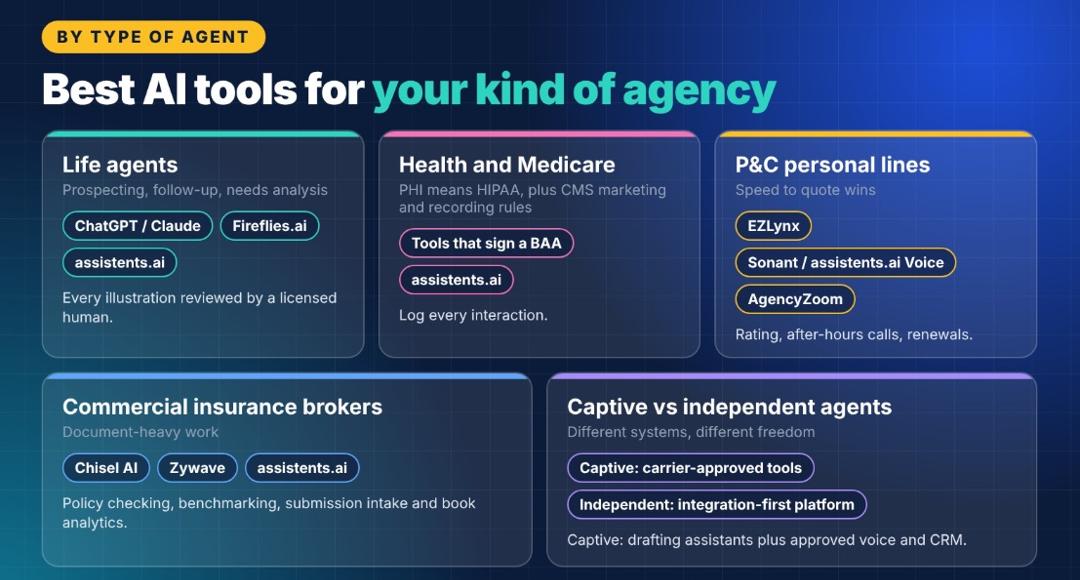
Life agents spend most of their time on prospecting, follow-up and needs-analysis conversations. Use ChatGPT or Claude to draft educational content and plain-English product explainers, Fireflies.ai for meeting notes, and assistents.ai for lead follow-up, appointment booking and application document checks. Keep every illustration and recommendation reviewed by a licensed human.
Health and Medicare agents
Health and Medicare agents handle protected health information, so HIPAA applies, and CMS has specific rules on marketing and call recording. Choose tools that sign a Business Associate Agreement (BAA) and log every interaction. assistents.ai supports HIPAA-aligned deployments; see our guide to HIPAA-compliant AI agents.
P&C personal-lines agents
Speed to quote wins personal lines. Combine EZLynx for rating, Sonant or assistents.ai Voice AI for after-hours calls, and AgencyZoom for pipeline and renewal campaigns.
Commercial insurance brokers
Commercial work is document-heavy. Chisel AI handles policy checking, Zywave handles content and benchmarking, and assistents.ai runs submission intake, renewal prep across large accounts, and natural-language analytics on your book.
Captive vs independent agents
Captive agents usually work inside carrier-provided systems, so focus on tools the carrier allows: AI assistants for drafting, plus approved voice and CRM tools. Independent agents have more freedom and more systems to connect. That makes an integration-first agent platform more valuable for them.
Free and low-cost AI tools for solo insurance agents
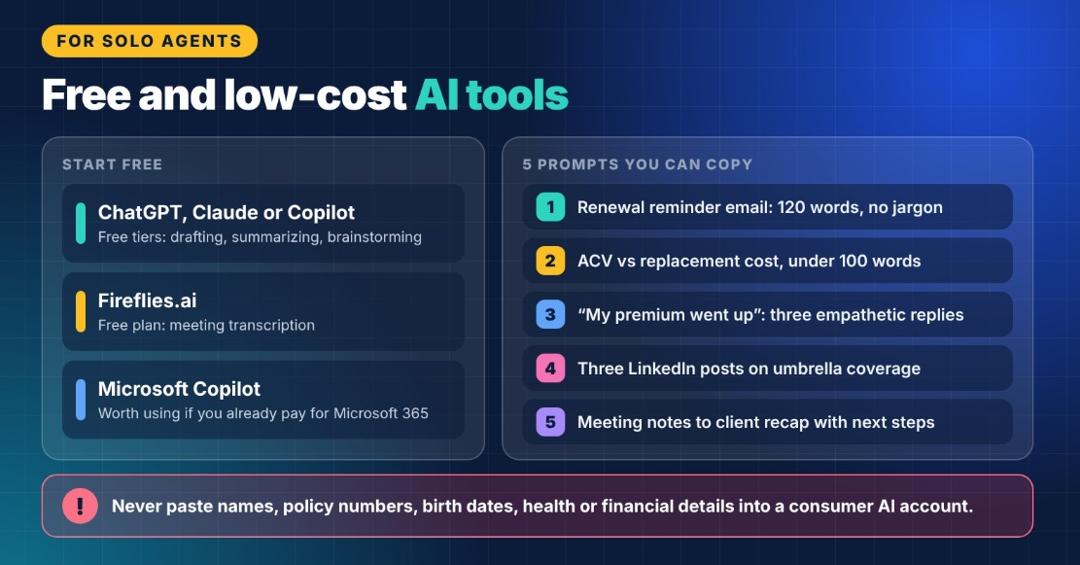
Solo agents can start with free AI tools for writing and note-taking, as long as no client personal data goes into them.
- ChatGPT, Claude or Copilot free tiers: drafting, summarizing and brainstorming.
- Fireflies.ai free plan: meeting transcription.
- Microsoft Copilot: worth using if you already pay for Microsoft 365.
Five prompts you can copy:
- "Write a friendly 120-word email reminding a homeowner their policy renews in 30 days, inviting them to a 15-minute review. No jargon."
- "Explain the difference between actual cash value and replacement cost to a first-time homebuyer in under 100 words."
- "A small business owner says 'my premium went up and I didn't file a claim.' Give me three empathetic, factual responses."
- "Write three LinkedIn posts for an independent agent about why umbrella coverage matters, each under 80 words."
- "Summarize these meeting notes into a client recap with next steps and owners: [paste notes with names and policy numbers removed]."
Warning: never paste names, policy numbers, dates of birth, health details or financial information into a consumer AI account. Use business plans with data controls, or a governed platform.
Compliance, E&O and client-data risks of AI for insurance agents
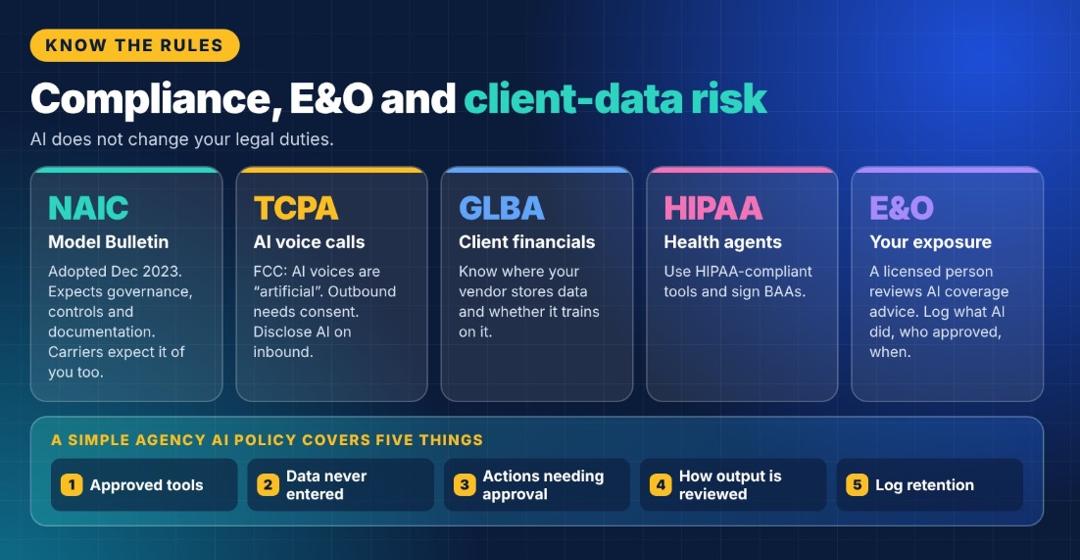
AI does not change an agent's legal duties. Decisions made or supported by AI must still comply with insurance law, privacy rules and telemarketing rules. Here are the rules to know.
- NAIC Model Bulletin on AI. In December 2023, the NAIC adopted a model bulletin on insurers' use of AI systems. It expects governance, risk controls and documentation, and many states have adopted it. Carriers increasingly expect the same discipline from their distribution partners.
- TCPA and AI voice calls. The FCC ruled that AI-generated voices in robocalls count as "artificial" under the Telephone Consumer Protection Act. Outbound AI calls need proper consent. Inbound AI receptionists are lower risk, but should still disclose that the caller is speaking with AI.
- GLBA privacy. Client financial information is protected under the Gramm-Leach-Bliley Act. Know where your AI vendor stores and processes data, and whether it trains on it.
- HIPAA. Health and Medicare agents need HIPAA-compliant tools and BAAs.
- E&O exposure. If AI drafts coverage advice, a licensed person must review it. Keep logs showing what the AI did, who approved it and when. Audit trails are your best defence.
A simple agency AI policy covers five things: approved tools, data that must never be entered, which actions need human approval, how AI output is reviewed, and how long logs are kept. Our AI agent governance playbook has a template.
How to choose the right AI tool for your agency
Pick the workflow first and the tool second. Answer these seven questions:
- Where do we lose the most hours each week? Quoting, data entry, renewals, calls or service.
- Which AMS and CRM do we use? Shortlist only tools that integrate with them.
- Do we need voice? Missed calls are lost premium.
- Do clients need Spanish or other languages?
- Who approves AI actions? Define this before go-live.
- Where does client data go? Ask about training, retention and certifications.
- How will we measure success? Pick one number, such as hours saved, speed to quote or retention.
If your answers point to one task, buy the point tool for that task. If they point to several connected tasks across systems, a governed agent platform will cost less over time than five separate subscriptions. Estimate it with our AI agent ROI calculator.
Why assistents.ai is the best AI platform for insurance agencies
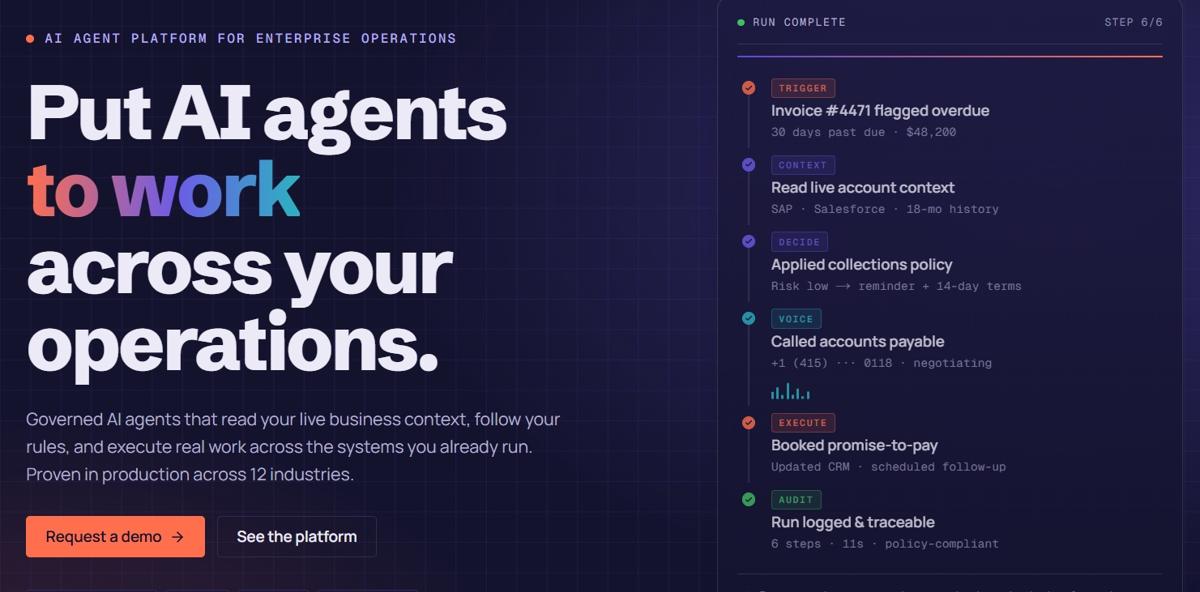
Most AI tools on this list make one part of an agent's day faster. assistents.ai runs the whole workflow, from the incoming call, email or ACORD form to the updated AMS record, under your agency's rules, with a person approving anything that matters.
One platform instead of five point tools
assistents.ai brings five capabilities onto one connected platform:
- Conversational agents: answers and actions.
- Agentic BI: questions to insight.
- Document AI: documents to structured data.
- Voice AI: conversations to service.
- Autonomous workflows: events to completed work.
You can extend them with the Agent Builder, Workflow Builder, Deep Research and Canvas. Use one capability, or combine them to transform a full process.
It understands your agency, not just the prompt
The Context Engine connects clients, policies, carriers, contracts and SOPs, so answers come with source evidence. When a CSR asks "Does this client's GL policy include additional insured wording for this contract?", the agent checks the actual policy and contract, not the open web.
Governed by design, so E&O stays defensible
Every action passes an access check and a policy evaluation, and ends in one of three outcomes: allowed, review required or blocked. Every step is logged. That directly answers the trust gap: only 22% of agents trust AI with client data today (Liberty Mutual). Learn more about agent governance.
Works with the systems you already use
There are 300+ connectors, including Salesforce, HubSpot and core insurance platforms such as Guidewire, Duck Creek and Majesco. APIs, SDKs, event ingestion and two-way sync cover everything else. You build on your AMS and CRM instead of replacing them. See all integrations.
Enterprise security, deployed your way
The AI Gateway routes tasks across approved models with fallback and usage controls. Data is never used for training, with zero retention. assistents.ai holds SOC 2 Type II, GDPR, HIPAA and ISO 27001 credentials, and deploys as cloud SaaS, private cloud or on-premise. Details are on our security and trust page.
Live in weeks, with engineers beside you
A typical pilot reaches production in about four weeks. Forward Deployed Engineers, AI engineers and data specialists across the USA, Australia and India configure the platform around your priority process, then expand from there.
| Chat assistant (ChatGPT, Copilot) | Point tool (rater, AMS add-on, receptionist) | assistents.ai | |
|---|---|---|---|
| Takes action in your systems | No | Within its own product | Yes, across systems |
| Follows agency rules and approvals | No | Limited | Yes |
| Full audit trail | No | Partial | Yes |
| Covers voice, documents, analytics and workflows | No | One of these | All of these |
Bring one workflow, whether that's renewals, COI requests or quote intake, and we'll show it running on your data. Book a walkthrough.
How to roll out AI in your agency in 30 days
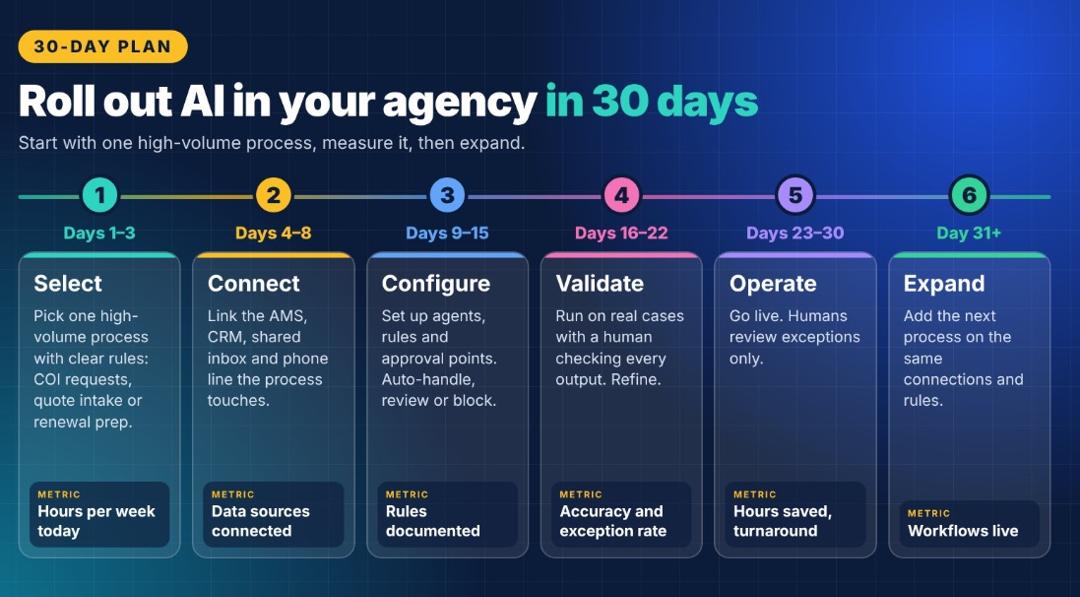
Start with one high-volume process, measure it, then expand. Here is a 30-day plan that works for most agencies.
- Select (days 1–3). Choose one process with clear rules and high volume, such as COI requests, quote intake or renewal prep. Metric: current hours per week.
- Connect (days 4–8). Connect the AMS, CRM, shared inbox and phone line the process touches. Metric: data sources connected.
- Configure (days 9–15). Set up the agents, your rules and the approval points. Decide what is auto-handled, what needs review and what is blocked. Metric: rules documented.
- Validate (days 16–22). Run the agents on real cases with a human checking every output. Refine. Metric: accuracy and exception rate.
- Operate (days 23–30). Go live with human review on exceptions only. Metric: hours saved and turnaround time.
- Expand (day 31+). Add the next process using the same connections and rules. Metric: number of workflows live.
See how we run this with clients on our implementation page.
Conclusion: start with one workflow
The best AI tools for insurance agents in 2026 are the ones that remove your agency's biggest time sink, connect to your AMS and keep you in control. Use ChatGPT or Claude for drafting today. Add a rater, a receptionist or a compliance tool where you have a single gap. When you're ready for AI to complete work across your systems, with rules, approvals and an audit trail, choose a governed agent platform.
Pick one process. Measure it. Expand. Book a 30-minute assistents.ai walkthrough or estimate your ROI.
Related reading: AI in insurance use cases for carriers · AI agents for financial services · Top AI agents for BFSI in India · AI agents in fintech
FAQs
What is the best AI tool for insurance agents?
The best overall AI tool for insurance agents in 2026 is assistents.ai for agencies that want AI agents to run full workflows such as quote intake, renewals and client service with audit trails. For a single task, EZLynx is best for comparative rating, Sonant for AI call answering, AgentSync for licensing and ChatGPT or Claude for drafting.
How can insurance agents use AI?
Insurance agents use AI to answer and qualify leads, collect quote details, extract data from ACORD forms, compare quotes, prepare renewals, answer client service questions, issue certificates, take meeting notes and write marketing content. AI users save about 4 hours a week on average, according to Liberty Mutual's 2026 study.
Will AI replace insurance agents?
No. AI replaces repetitive tasks, not the licensed advice, relationships and judgement clients pay for. Agents who use AI handle more clients with the same team. Coverage recommendations still need a licensed human to review and sign off, both legally and for E&O protection.
Is ChatGPT safe to use with insurance client data?
Not on a free consumer account. Don't enter names, policy numbers, health details or financial data. Use business plans with data controls, or a governed platform that doesn't train on your data, keeps an audit trail and meets standards such as SOC 2 and HIPAA.
How much do AI tools for insurance agents cost?
General AI assistants have free tiers and paid plans. Meeting-note tools offer free and per-seat plans. Insurance-specific tools such as raters, AMS platforms, AI receptionists and compliance software are usually priced by subscription or quote. AI agent platforms like assistents.ai are priced by the workflows automated.
Can AI answer my insurance agency's phones?
Yes. AI receptionists and voice agents such as Sonant and assistents.ai Voice AI answer calls 24/7, collect quote details, answer service questions, book appointments and transfer to staff. For outbound AI calls, follow TCPA consent rules.
What is the difference between an AI assistant and an AI agent?
An AI assistant helps one person with one task, such as drafting an email. An AI agent completes a whole process inside your systems, such as reading a request, updating the AMS, sending the document and logging it. It follows agency rules and escalates exceptions to a human.
Do I need to replace my AMS to use AI?
No. Most AI tools sit alongside your AMS. Platforms like assistents.ai connect through APIs and connectors and write results back into your existing systems.
What are the best AI tools for life insurance agents?
Life insurance agents get the most from ChatGPT or Claude for client education content, Fireflies.ai for meeting notes, and assistents.ai for lead follow-up, appointment booking and application document checks. A licensed person should review every recommendation.
Are there free AI tools for insurance agents?
Yes. ChatGPT, Claude and Copilot have free tiers for drafting and research, and Fireflies.ai has a free meeting-notes plan. Keep client personal data out of free tools.