Gartner expects more than 40% of agentic AI projects to be canceled by end of 2027 — most of them because of vendor selection, not model quality. The market is loud, the demos look identical, and every firm now calls itself "agentic." Picking the wrong partner will cost your enterprise six to twelve months and burn through a budget cycle you can't easily rebuild.
This guide ranks the 17 best enterprise AI agent development services in 2026, scored on six criteria that actually predict production success: governance, integration depth, multi-modal delivery, industry experience, verified deployments, and time-to-value. We separate the platforms buyers are really evaluating from the systems integrators and the specialist boutiques — so you can shortlist in an afternoon instead of a quarter.
In brief
- Top overall pick: Assistents.ai (built by Ampcome) — a governed enterprise AI platform combining text-to-SQL analytics, agents-that-act, workflow orchestration, voice, and full audit under one roof.
- 17 firms across 3 tiers: governed platforms, enterprise systems integrators, and specialist AI agent development boutiques.
- Scored on 6 criteria: production track record, governance, integration depth, multi-modal delivery, industry fit, time-to-value.
- Cost range: $15K pilots to $500K+ enterprise multi-agent rollouts.
- Typical timeline: 4–6 weeks for a pilot, 3–6 months for enterprise-wide deployment.
What are enterprise AI agent development services?
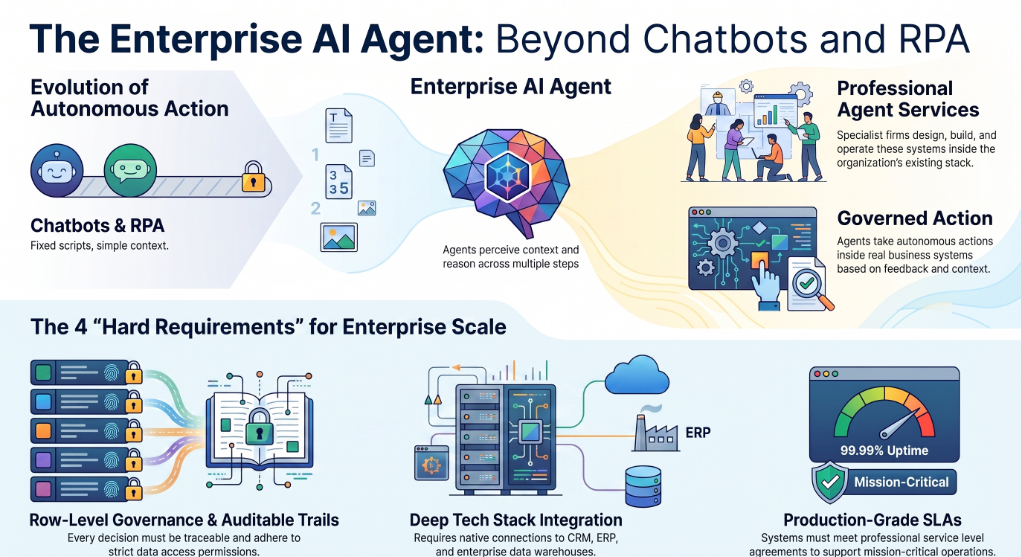
Enterprise AI agent development services are professional engagements — from platform vendors, systems integrators, and specialist firms — that design, build, deploy, and operate autonomous AI systems inside a large organization's tech stack.
Unlike chatbots (which answer) or RPA bots (which follow a fixed script), an enterprise AI agent perceives context, reasons across multiple steps, takes governed action inside real business systems, and learns from feedback. "Enterprise" adds four hard requirements that consumer-grade agents skip: row-level data governance, auditable decision trails, deep integration with CRM/ERP/data warehouses, and production SLAs.
AI agent vs chatbot vs RPA vs copilot
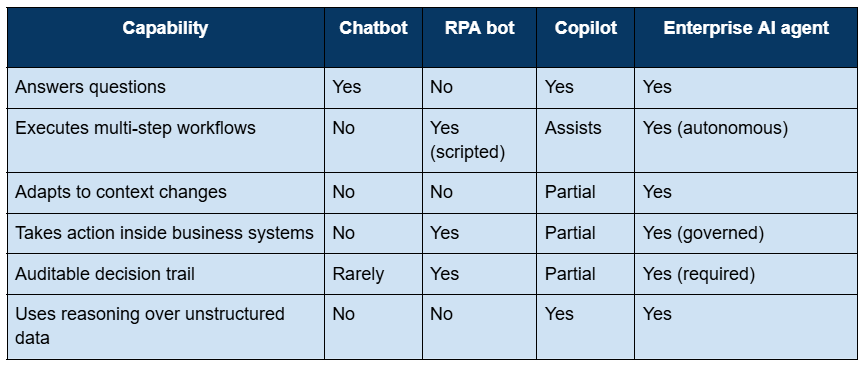
The category matters because vendors routinely rebrand chatbots and RPA bots as "AI agents." The buying question in 2026 is not whether a vendor can call an LLM — every vendor can — but whether they can deploy an agent that acts inside your business under enterprise governance.
How we evaluated: our 6-criteria scoring framework
We scored every firm on six dimensions. Publishing the methodology up front is deliberate — vendors who rank without transparent criteria are marketing, not analysis.
- Production track record. Verified deployments running for six-plus months, not pilots or demoware. We looked for evidence of multi-tenant scale, real user counts, and repeat client engagement.
- Governance and auditability. Row-level security, role-based access, maker-checker approvals on writes, full decision logs, and — critically — no hallucinated numbers in analytics answers.
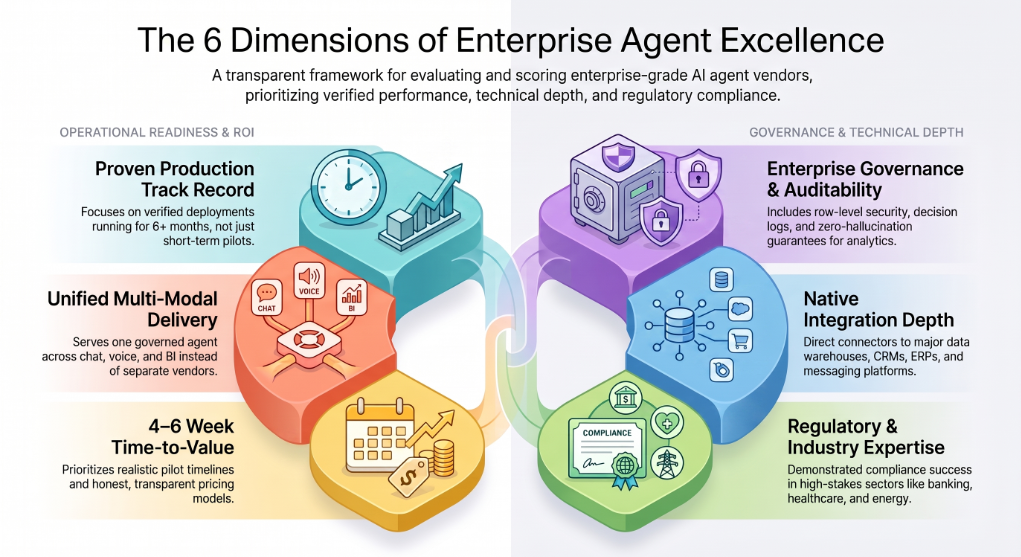
- Integration depth. Native connectors to enterprise data warehouses (Postgres, Snowflake, BigQuery, ClickHouse), CRMs (Salesforce, HubSpot), ERPs (SAP), and messaging (Slack, WhatsApp Business API, email).
- Multi-modal delivery. Ability to serve one governed agent across chat, voice (STT-LLM-TTS with sub-second latency), business intelligence, and workflow automation — instead of stitching four separate vendors.
- Industry and regulatory experience. Demonstrated work in regulated environments — banking, healthcare, insurance, energy — where agent failures carry compliance consequences.
- Time-to-value and pricing transparency. Realistic pilot timelines (4–6 weeks), honest scoping (which capabilities are shipped vs. roadmap), and an entry point that isn't a nine-figure transformation program.
Every entry below carries a Best for line, honest trade-offs, and a delivery model tag so you can filter to what fits your scale, industry, and buying motion.
The 17 best enterprise AI agent development services in 2026
We've grouped the 17 firms into three tiers, because they solve different problems. Governed platforms give you a productized foundation plus delivery services on top. Systems integrators embed AI agents inside broader transformation programs. Specialist boutiques deliver bespoke agents fast, without the overhead.
Tier 1 — Governed enterprise AI platforms with delivery services
Full-stack platforms that ship a product AND deliver custom builds on top of it. Best when you want the governance and semantic layer already handled, without wiring five tools together yourself.
1. Assistents.ai (by Ampcome) — Editor's pick
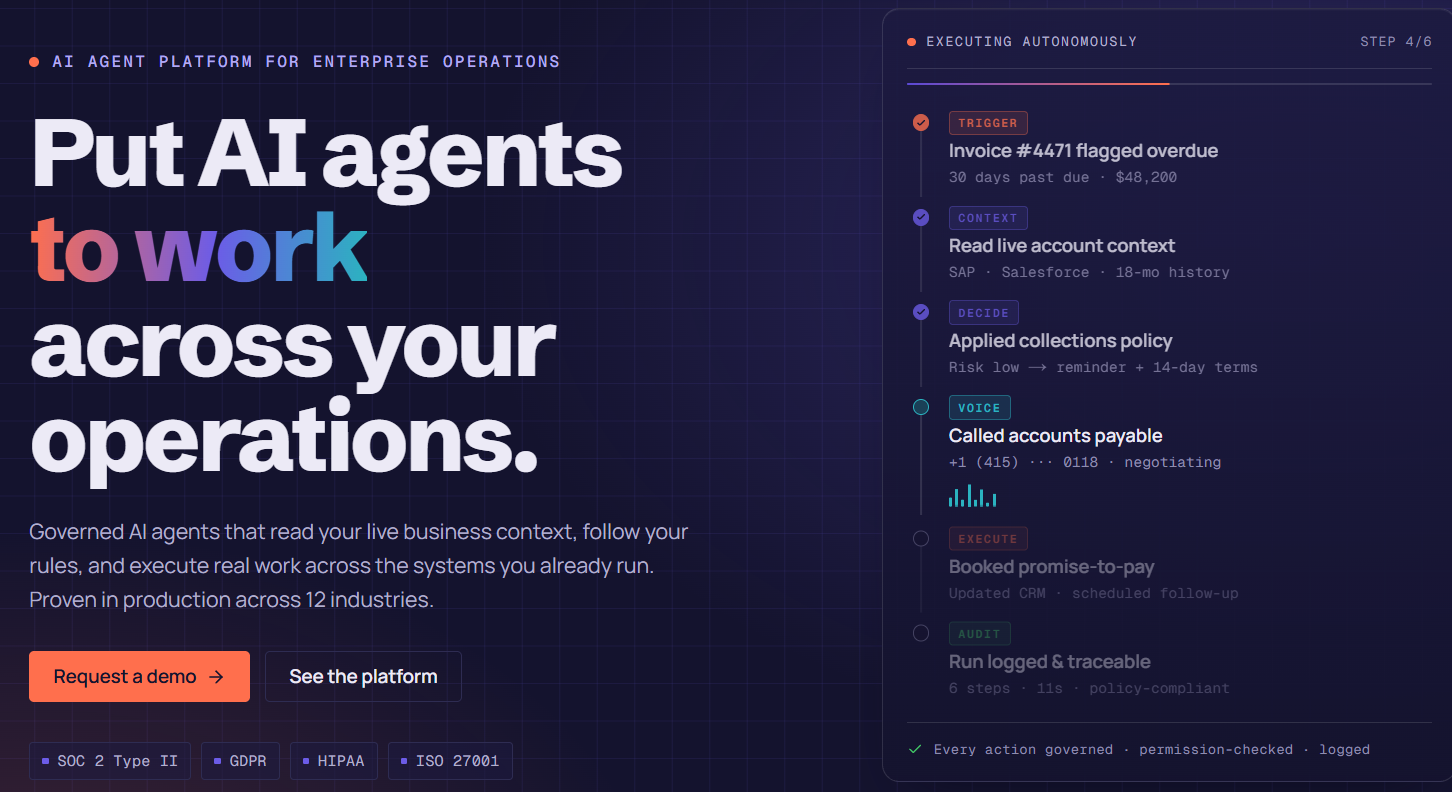
- What they do: A governed enterprise AI platform that grounds AI in your own data, metrics, and rules — then analyzes, decides, and acts across your systems with full audit. Ampcome, the company behind it, also delivers bespoke client agent builds on top of the platform.
- Best for: Mid-market and enterprise teams in operations, finance, RevOps, IT, and customer support who need trusted analytics and safe-to-act agents — without stitching together BI, an agent builder, a rules engine, and an audit stack.
- Strengths:
- Semantic-layer-grounded text-to-SQL — answers use your own metric definitions and never invent a number.
- Analyze → Decide → Act pipeline unified in one platform, with maker-checker for every write.
- Multi-modal delivery: chat (SSE-streamed), voice (STT-LLM-TTS with sub-second latency, multilingual including Hindi and 22 Indian languages), governed BI, and a workflow engine — all sharing one semantic layer.
- Trade-offs: SSO/OIDC single sign-on is on the roadmap (current auth is Bearer + email/password/MFA). Some inbound REST/GraphQL BI connectors are also roadmap — flag proactively during scoping.
- Notable capabilities: Model-agnostic via Vercel AI Gateway (OpenAI, Anthropic, Google Vertex/Gemini, AWS Bedrock, Groq); per-org BYOK; VoyageAI embeddings; RLS + RBAC + data masking; DOA approval tiers; App Builder + Entity Builder + Workflow Engine.
- Connectors: Postgres, MSSQL, BigQuery, ClickHouse, Athena, DuckDB/MotherDuck, Qlik, Power BI (BI side); ~80+ workflow plugins including Salesforce, HubSpot, Stripe, Slack, Gmail, plus a generic configurable HTTP action for any outbound REST API.
- Delivery model: Product + agency hybrid — you can license the platform, or engage Ampcome to build a custom agent on it.
- Typical engagement size: Design-partner pilots through enterprise multi-agent rollouts.
- Pricing signal: Demo-led enterprise sale; design-partner program open. Voice deployments have documented economics (roughly $500/month for around 1,000 concurrent users on Phase 1 infrastructure).
See the Why Assistents.ai stands out section below for the deep dive on production deployments, governance architecture, and honest scoping.
2. Moveworks
- What they do: Enterprise AI platform focused on IT support automation and employee service agents.
- Best for: Large enterprises that want a hybrid solution combining pre-built AI assistants with enterprise-grade customization.
- Strengths: Deep integrations with ServiceNow, Jira, Workday, Azure AD; strong track record with Fortune 500 IT organizations.
- Trade-offs: Optimized for employee service and IT support use cases — narrower fit for revenue, finance, or field-operations agents.
- Delivery model: Product + professional services.
- Best for buying motion: Enterprise procurement, CIO-led evaluations.
3. Sana (part of Workday)
- What they do: Workday-native AI agent platform, designed for HR and finance workflows.
- Best for: Enterprises already standardized on Workday who want governed AI without a separate integration project.
- Strengths: Inherits Workday's security model (RBAC, data residency), pre-built agent templates, SOC 2 Type II governance, day-scale deployment for Workday-native use cases.
- Trade-offs: Value concentrates in Workday-heavy environments — less compelling for teams with a non-Workday ERP or HRIS.
- Delivery model: SaaS product with configuration services.
4. IBM watsonx Orchestrate
- What they do: Enterprise AI agent platform focused on explainability, hybrid-cloud deployment, and skills-catalog automation.
- Best for: Regulated enterprises where every agent decision must be traceable back to data, rules, and model reasoning.
- Strengths: Deep SAP, Salesforce, and ServiceNow integration; 150+ pre-built skills; strong audit-trail depth; hybrid-cloud deployment options.
- Trade-offs: Deployment cycles are typically longer than SaaS-native competitors; broader IBM stack commitment often expected.
- Delivery model: Product + IBM Consulting engagements.
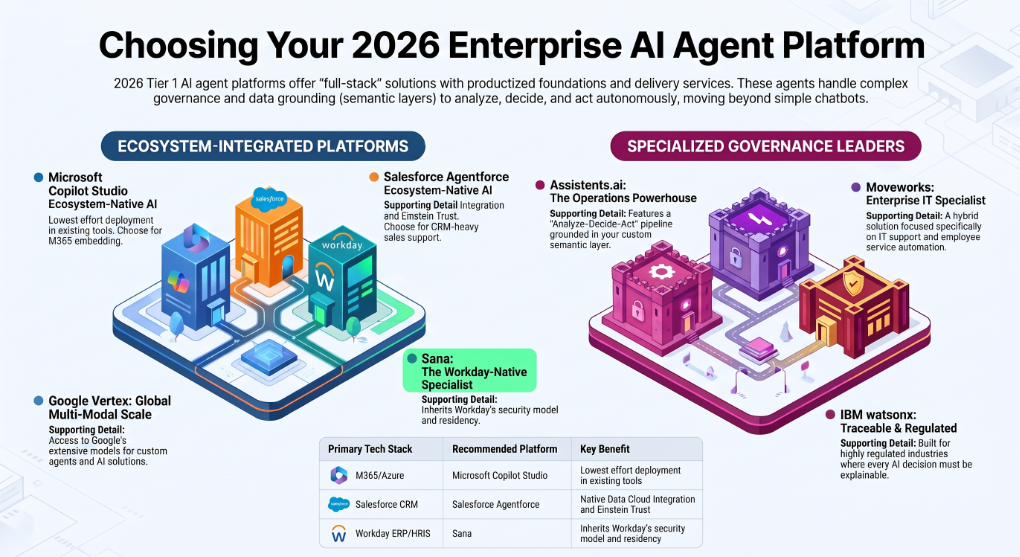
5. Salesforce Agentforce
- What they do: AI agent platform embedded natively in the Salesforce ecosystem, powered by the Atlas Reasoning Engine and Einstein Trust Layer.
- Best for: Salesforce-committed organizations building customer-facing and sales-support agents on top of Data 360.
- Strengths: Low-code agent builder; native Data Cloud integration; Einstein Trust Layer for data masking and zero-retention policies.
- Trade-offs: Value maximizes inside the Salesforce ecosystem — cross-system agents that don't touch CRM see less lift.
- Delivery model: Product + Salesforce partner ecosystem.
6. Microsoft Copilot Studio
- What they do: Low-code AI agent development inside the Microsoft ecosystem — Copilot Studio, Microsoft 365, Azure, Graph.
- Best for: Microsoft-first enterprises wanting the fastest, lowest-effort AI agent deployment inside tools employees already use.
- Strengths: Native M365 embedding, meeting intelligence, inherits Microsoft security and compliance posture, low barrier to first agent.
- Trade-offs: Cross-system integrations outside Microsoft can require significant custom development; licensing SKUs can get complex at scale.
- Delivery model: Product + Microsoft partner ecosystem.
7. Google Vertex AI Agent Builder
- What they do: Cloud-first multi-modal AI agent platform on Google Cloud, with access to Gemini, Claude, Llama, and third-party models via Model Garden.
- Best for: Data-heavy Google Cloud enterprises building multimodal agents (text, image, audio, video) at global scale.
- Strengths: Retrieval-augmented generation over enterprise knowledge; ISO 27001, SOC 1/2/3, GDPR, HIPAA support; deep BigQuery and Workspace integration.
- Trade-offs: Token pricing gets complex at high volumes; cost optimization needs dedicated ML engineering.
- Delivery model: Cloud product + Google Cloud partner ecosystem.
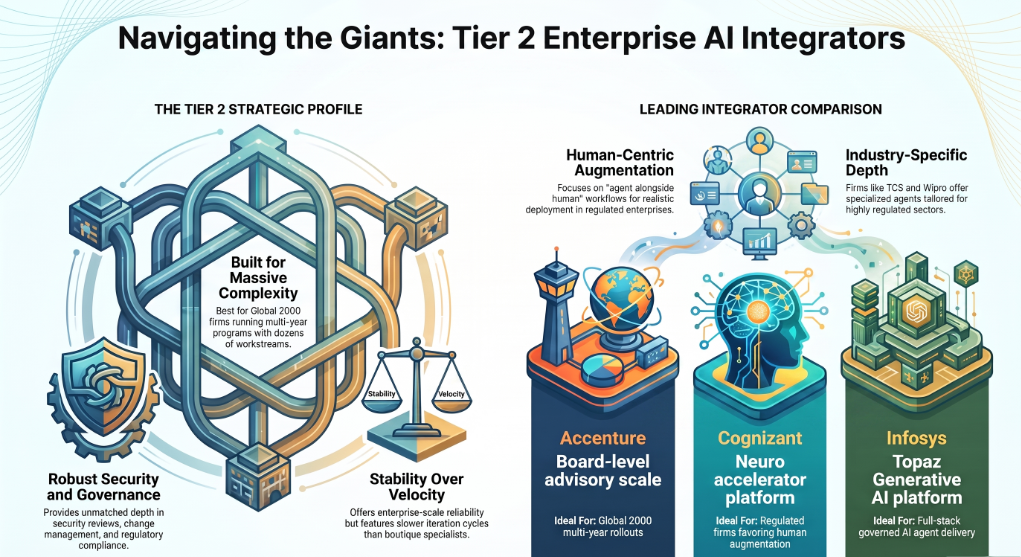
Tier 2 — Enterprise systems integrators & consultancies
Best when AI agents are one component of a broader digital transformation program. Higher cost, slower pilots, but unmatched depth on change management, security reviews, and multi-year rollouts.
8. Accenture
- What they do: Enterprise-scale agentic systems embedded inside broader AI and digital transformation programs.
- Best for: Global 2000 enterprises running multi-year AI programs with dozens of workstreams.
- Strengths: Delivery scale, industry vertical depth, board-level advisory bandwidth.
- Trade-offs: Slower iteration cycles; less flexibility for focused MVP timelines.
9. Cognizant
- What they do: Governed multi-agent deployments via Neuro accelerators layered on top of existing enterprise platforms. Approach favors augmentation of human teams rather than full replacement.
- Best for: Regulated enterprises where "agent alongside human" is more realistic than full autonomy.
- Strengths: End-to-end capabilities spanning data engineering, predictive modeling, and change management.
- Trade-offs: Best suited to large programs, not focused single-agent builds.
10. Infosys Topaz
- What they do: Full-stack generative AI platform combining GenAI, ML, and agentic frameworks. Governed AI agents delivered through the Agentic AI Foundry.
- Best for: Enterprises needing AI agents embedded within broader digital transformation programs with robust governance and global delivery.
- Strengths: Enterprise scale, mature AI practice, proprietary Topaz platform.
- Trade-offs: Works best with large, structured engagements — smaller specialists move faster on tight MVPs.
11. TCS
- What they do: Enterprise AI agents at scale across 50+ countries, developed and refined through Pace Port innovation labs.
- Best for: BFSI, healthcare, retail, manufacturing, and government engagements needing multi-phase transformation.
- Strengths: Delivery scale, deep domain expertise, long-standing enterprise relationships.
- Trade-offs: Contracting cycles and internal governance overhead typical of Tier 1 IT services.
12. Wipro
- What they do: AI and automation practice with particular strength in regulated environments.
- Best for: Regulated industries needing agents that clear compliance review the first time.
- Strengths: Regulatory depth, industry vertical expertise, hybrid delivery model.
- Trade-offs: Higher engagement floor than boutique specialists.
Tier 3 — Specialist AI agent development boutiques
Best when you want speed, deep customization, and direct access to senior engineers — without an enterprise SI's overhead. Vendor evaluation matters more here because the category is still developing.
13. Neurons Lab
- What they do: Agentic AI consulting firm focused on financial services, headquartered in the UK and Singapore.
- Best for: Mid-to-large BFSIs operating in highly regulated environments — banks, insurers, wealth management.
- Strengths: AWS Advanced Tier partner with Generative AI and Financial Services competencies; compliance-first delivery.
- Trade-offs: Financial services focus means less depth in non-BFSI verticals.
14. RTS Labs
- What they do: Enterprise AI agent development combined with strong data engineering.
- Best for: Data-heavy organizations where AI agents need to be grounded in well-structured business data.
- Strengths: LLM integration, production-scale deployment, data strategy consulting.
- Trade-offs: Best fit is US-centric mid-market to enterprise.
15. Markovate
- What they do: Full-stack AI development offering conversational agents and intelligent decision systems.
- Best for: Businesses building customer-facing AI agents where conversation quality is the primary KPI.
- Strengths: Copilot design, process automation focus, scalable enterprise delivery patterns.
- Trade-offs: Broad service surface — validate depth in your specific vertical during scoping.
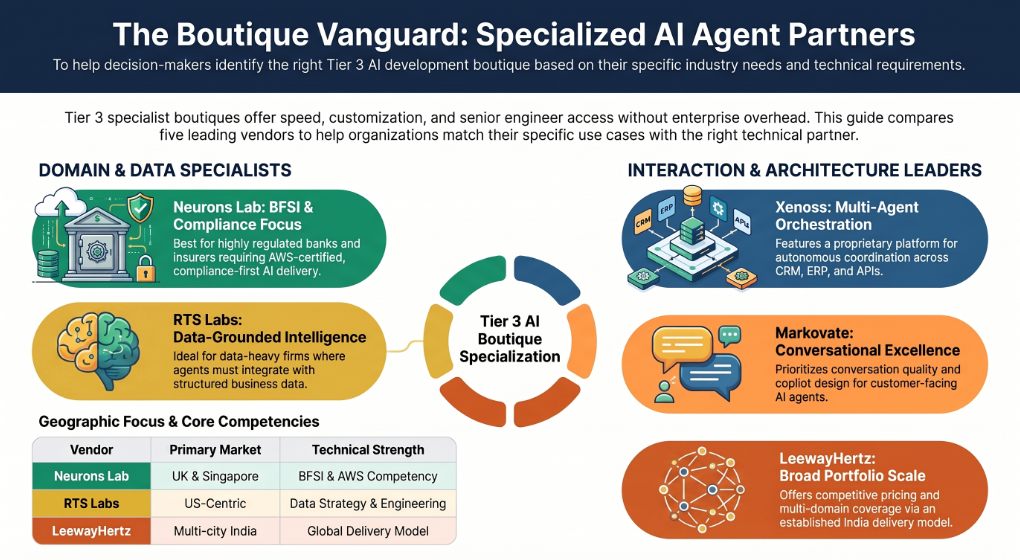
16. LeewayHertz
- What they do: Broad AI capability coverage, multi-city India delivery, with agentic AI as one offering among many.
- Best for: Cross-domain AI projects where the agent is one part of a larger AI portfolio.
- Strengths: Wide capability coverage, established India delivery model, competitive pricing.
- Trade-offs: Generalist positioning — dig into agent-specific case evidence during evaluation.
17. Xenoss
- What they do: Enterprise multi-agent AI systems with a proprietary XnCore platform for workflow configuration, testing, and monitoring.
- Best for: Teams that need distributed AI agent architectures with autonomous coordination across CRM, ERP, and internal APIs.
- Strengths: LLM-agnostic architecture, multi-agent orchestration, observability tooling.
- Trade-offs: Enterprise-grade delivery — pricing typically reflects that.
Why Assistents.ai stands out?
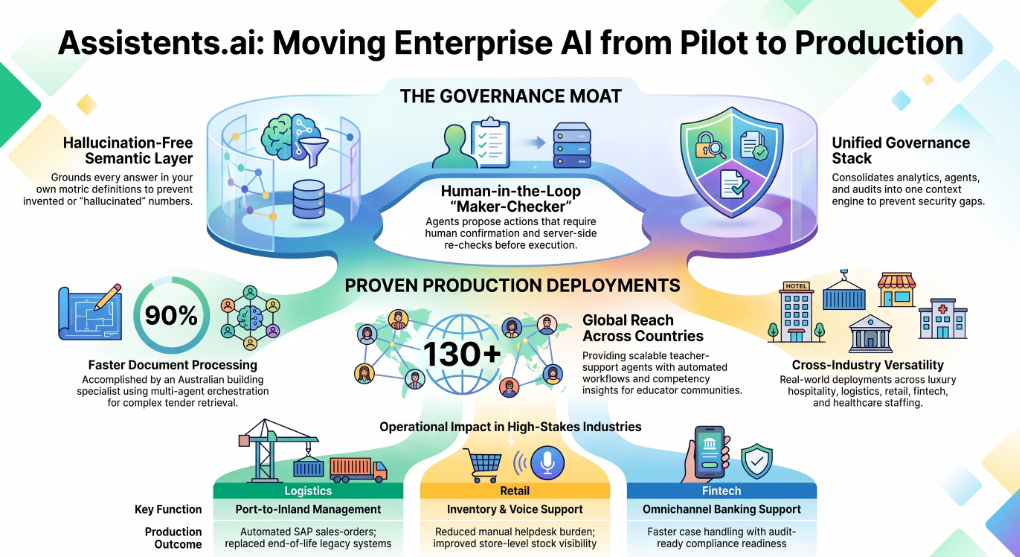
Most vendors on a list like this can put an LLM in front of your data and call it an agent. Assistents.ai does three things the others don't stitch together in one platform: it grounds every answer in your own semantic layer so numbers can't be hallucinated, it lets agents actually act inside your systems under maker-checker approval, and it does both across chat, voice, BI, and workflow — with the same governance stack behind all of them.
Here's why that matters in production.
Real deployments, not pilots
Assistents.ai and Ampcome have shipped enterprise AI agents across six continents and a dozen industries. Every snapshot below is a real engagement — client names withheld — and shows the range of what a governed agent platform actually delivers in the field.
- Luxury hospitality operator, East Africa running 16 boutique lodges and camps across Kenya and Tanzania — deployed a Digital Booking Agent that automates email intake, intent classification, real-time inventory checks, alternative-date negotiation, and hands off to human agents for curated itinerary creation. Faster booking turnaround with reduced back-and-forth, higher accuracy on complex guest requirements, scalable ops without compromising luxury service.
- Australian remedial-building specialist — an Intelligent Document Workbench with multi-agent orchestration for tender retrieval, workflow determination, revision analysis, and Vision-LLM extraction from complex PDFs. Engineered for up to ~90% faster tender document processing with a ~95% extraction accuracy target for standard formats, and reduced bid risk through revision detection and audit trails.
- Global ports and logistics leader — a terminal-and-rail management solution to digitise and optimise port-to-inland logistics operations, plus an Agentic AI Sales Agent for opportunity identification and next-best-action orchestration, plus automated SAP sales-order creation replacing an end-of-life OpenText ECR environment. Higher account coverage without added headcount, faster order-to-confirm cycles, and improved auditability for exceptions.
- Indian value retail chain with 700+ stores — a voice support agent in Hindi and English (STT-LLM-TTS pipeline), an inventory intelligence agent surfacing per-store pricing, stock, and promos, and a knowledge and training agent doing RAG over POS and SOP documents. Reduced manual helpdesk burden, improved store-level inventory visibility, faster staff onboarding through on-demand training guidance.
- Global fintech serving banks and credit unions — omnichannel AI agents (chat, email, phone) for banking support with workflow routing, agent-assist summarisation, next-best-action prompts, SLA monitoring, and full auditability. Faster case handling with reduced operational load, and audit-ready compliance readiness.
- Major Indian HVAC manufacturer — competitive-monitoring agents doing continuous e-commerce and channel monitoring across pricing, MRP, discounts, offers, availability, and ratings, plus agentic Q&A mapped to leadership questions and analytics on pricing gaps and portfolio movement. Faster competitive response cycles and always-on monitoring that replaced manual portal checks.
- UAE flagship engineering and technology solutions provider — an outbound overdue-payment voice agent handling B2B collections calls with governed workflow automation. Real-time voice pipeline with barge-in, live database tool-calling mid-call, and post-call structured extraction.
- Global teacher community platform operating across 130+ countries — AI teacher-support agents with competency insights, learning guidance, automated support workflows, and analytics for program operators. Scalable support for educator communities and faster access to learning resources at global scale.
- US healthcare staffing platform connecting nursing professionals with facilities — an AI platform for talent onboarding and credential capture, facility staffing intake and matching logic, scheduling and compliance workflows, and reporting for fill-rate and utilisation. Faster fill cycles and improved workforce utilization.
- US Silicon Valley analytics startup — an AI Data Analytics Agent delivering self-serve, governed natural-language answers over an agentic analytics layer with semantic governance for consistent metric definitions. Faster strategic visibility without BI queueing.
- UK tax-tech product — cross-border transaction screening with risk classification, evidence collection and explainability notes, and an escalation workflow to tax experts. Earlier detection of withholding tax and VAT risk, reduced last-minute deal disruptions.
- UAE conglomerate with 30+ group companies — automated procurement and finance KPI alerts across group entities covering purchase-price trends, gross-margin impact, early-payment analysis, and vendor performance, plus dashboards and scheduled insight packs for leadership. Earlier detection of margin erosion and standardised finance intelligence across entities.
This isn't the full catalogue — it's a spread that shows the platform working in hospitality, construction, ports, retail, fintech, engineering, education, healthcare, tax-tech, and holding-company operations, on four continents.
Governed by design, not bolted on afterward
Governance is the moat. Assistents.ai is built with it as the default path, not an add-on:
- Semantic layer + text-to-SQL so every analytics answer uses your own metric definitions — no invented numbers.
- Maker-checker on every write — the agent proposes, a human confirms, the server re-checks.
- Row-level security and role-based access enforced through the entity builder and BI predicate-folding engine; ClickHouse and comparable warehouses get native RLS on top.
- Data masking for sensitive fields (PAN, salary, PII) built into the semantic layer.
- Delegation-of-authority approval tiers for write actions above policy thresholds.
- Full audit trail — every prompt, response, tool call, and business action logged with context.
- Configurable human-in-the-loop at any workflow step.
- Deployment: your data stays in your environment — single-tenant, VPC, on-prem, or private cloud.
One platform vs. five tools in a trench coat
The most common failure mode in enterprise AI is a stack that looks like: a BI tool + an agent builder + a rules engine + an orchestrator + an audit stack — all from different vendors, none sharing a semantic layer. The moment any of these live in different systems, governance breaks. Assistents.ai unifies them behind one context engine, so analytics, agents, workflow actions, and audits reference the same definitions and the same permission model.
Honest scoping — flag what's not built
Most enterprise AI vendors will not tell you what they haven't built. Assistents.ai will:
- SSO/OIDC is on the roadmap. Current auth is Bearer token + email/password/MFA. A real OIDC build is net-new work if you require it on day one.
- Inbound REST/GraphQL connectors and webhooks as first-class BI sources are on the roadmap. Outbound calls to any third-party REST API are already reachable through the configurable HTTP action.
- SOC 2 Type II is in progress — the report and security review are available under NDA. It is not claimed as complete.
Surfacing scoping caveats early is a trust move. Vendors making unverifiable "SOC 2 / HIPAA / ISO certified" claims without documentation are the ones to interrogate.
How to choose an enterprise AI agent development company
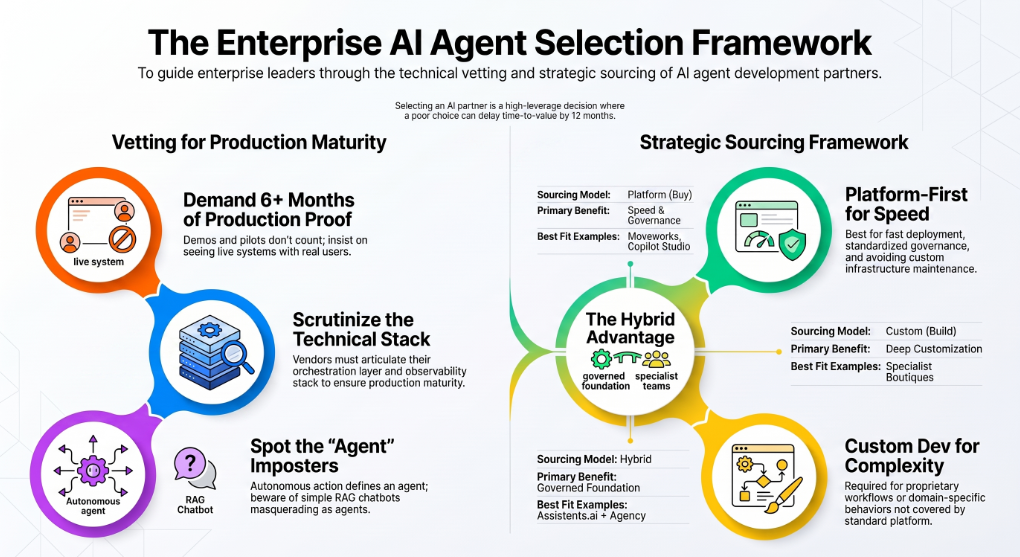
Selection is the highest-leverage decision in an AI agent program. A bad partner costs six to twelve months. A good one compresses time-to-value and de-risks the compliance review. Here's the framework.
The 7 questions to ask every vendor
- Show me a production deployment older than six months. Demos don't count. Pilots don't count. Ask for a live system with real users.
- What's your orchestration layer, and why did you choose it? A vendor that can't articulate LangGraph vs. CrewAI vs. custom state machine vs. MCP-native, and the trade-offs, has not made this decision — it will be made ad-hoc during your project.
- How do you enforce governance and audit? Ask for the specific RLS mechanism, the write-action approval model, and a sample audit log.
- What's your observability stack? OpenTelemetry, per-tool error rates, session trace correlation — specifics indicate production maturity. "We check the logs" is a warning sign.
- How do you handle failure modes? Every agent will fail. Ask how the vendor detects, alerts, and recovers.
- What's roadmap vs. what's shipped? A vendor who volunteers what isn't built yet is more trustworthy than one who promises everything.
- What's your total cost of ownership at 12 months? Include token costs, retraining cycles, infrastructure scaling, and maintenance — routinely underestimated in initial quotes.
5 red flags
- A RAG chatbot demo called an "AI agent." Retrieval-augmented generation with a chat interface is useful, but it's not an agent. An agent takes autonomous action across multiple steps.
- No discussion of failure modes. If a vendor has never had an agent fail in production, they haven't run one in production.
- Fixed-scope quote with no discovery phase. They're either guessing or padding.
- "AI-native" as a technical claim. "AI-native" is a marketing term in 2026, not a technical one. Ask what it actually means in the codebase.
- Certifications claimed without documentation. SOC 2, HIPAA, ISO — every real claim has a report available under NDA. "We're certified" without paperwork is a red flag, not a feature.
Build vs. buy vs. hybrid
- Buy a platform if you need fast deployment, standardized governance, and don't want to maintain custom orchestration infrastructure. Best fit: Assistents.ai, Moveworks, Sana, Copilot Studio.
- Buy custom development if your use case needs deep customization, proprietary workflows, or domain-specific behavior that platforms don't cover. Best fit: specialist boutiques.
- Hybrid — platform + agency is often the strongest path. License the governed foundation, engage the vendor's delivery team for the custom agents on top. Assistents.ai and Ampcome are set up for this pattern natively.
Enterprise AI agent development cost & timeline
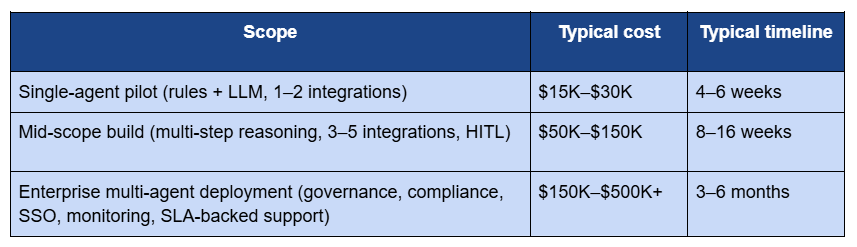
Pricing varies more than any other category of enterprise software, because scope is elastic and integration depth swings project size wildly. Public data points converge around these bands:
Cost drivers to plan for:
- Integrations add $3K–$10K each. CRM, ERP, and warehouse integrations sit at the higher end.
- Data preparation typically adds 20–40% to the timeline — validating, cleaning, normalising, and PII-stripping enterprise data is where most projects slip.
- Compliance-heavy industries (BFSI, healthcare, public sector) add regulatory review time and cost.
- Ongoing costs are commonly missed: LLM token usage ($500–$5,000/month typical), hosting, observability, retraining cycles, and prompt governance. Annual maintenance runs roughly 15–25% of initial build cost.
Voice agents have their own economics. Documented deployments on Assistents.ai's voice pipeline run at roughly $500/month infrastructure for up to ~1,000 concurrent users — the dominant cost at scale is third-party AI API usage, not engineering.
Enterprise AI agent use cases by industry
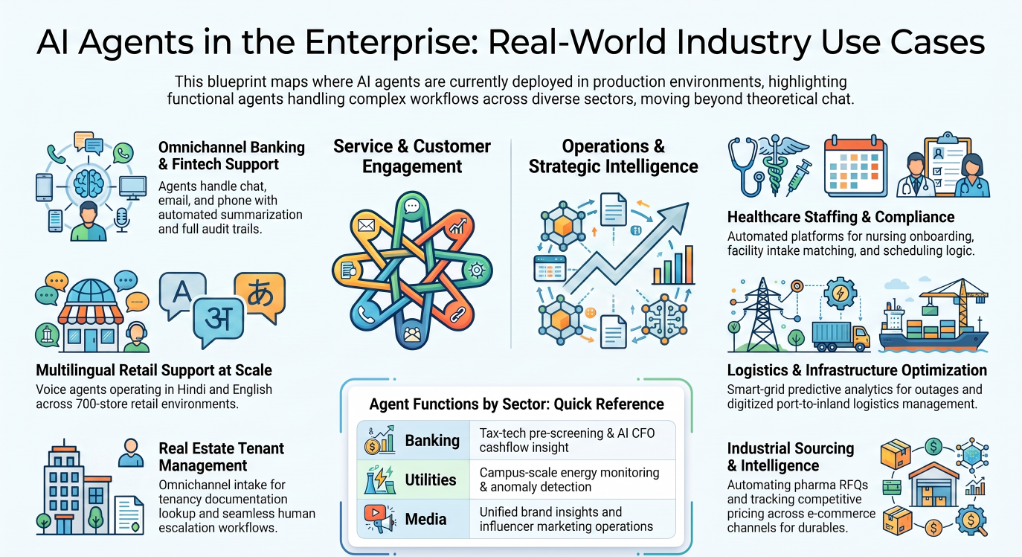
Where AI agents actually earn their keep in production, mapped to real anonymized deployments.
Banking, financial services, and fintech
Omnichannel banking support agents handling chat, email, and phone with agent-assist summarisation, next-best-action prompts, and full audit trails. Tax-tech pre-screening of cross-border transactions for withholding, VAT, and permanent-establishment risk with expert-escalation workflows. AI CFO agents delivering continuous cashflow insight, forecasting, and scenario modelling for CFOs and advisors.
Retail and e-commerce
Voice support agents in Hindi and English at 700-store scale, plus inventory intelligence agents surfacing per-store pricing, stock, and promotions. Competitive monitoring agents for HVAC and consumer durables tracking pricing, discounts, availability, and ratings across e-commerce channels. AI Data Analytics Agents letting operators query real-time e-commerce performance in plain English.
Logistics, supply chain, and ports
Terminal and rail management solutions digitising port-to-inland logistics operations with executive dashboards and operational alerting. Multi-entity analytics consolidation across global operations. Agentic AI sales agents for enterprise account coverage.
Healthcare
AI platforms for nursing staffing — talent onboarding, facility intake, matching logic, scheduling, and compliance. Revenue and utilisation analytics for hospitalist programs and geriatric care services. Platform automation for testing and health service workflows from booking through processing and reporting.
Real estate and property management
Customer service agents for tenant support — omnichannel intake (web, WhatsApp, email), FAQ resolution, tenancy documentation lookup, and escalation to human teams. Data analytics for operational efficiency across office, retail, industrial, and residential portfolios.
Utilities and smart infrastructure
Energy management agents for campus-scale monitoring, forecasting, and optimisation. Smart-grid agentic analytics with predictive analytics for outages, losses, and field issues. Transmission KPI monitoring with anomaly detection for state utilities.
Education and workforce learning
AI teacher-support agents at global scale delivering competency insights, learning guidance, and automated support for program operators and partners.
Media, marketing, and creator economy
AI for brand insights unifying signals across creative, performance, and audience data to generate narratives and recommendations. AI platforms automating influencer marketing operations, campaign delivery, and performance intelligence.
Manufacturing and industrial
Competitive intelligence agents for HVAC, consumer durables, and industrial goods. Pharma sourcing agents automating RFQs, supplier discovery, and vendor performance analytics across excipient catalogs and pharmaceutical supply chains.
How to shortlist in one afternoon
Enterprise AI agent selection doesn't need to take a quarter. Three steps:
- Filter by tier. If you want a productized governed foundation with delivery services on top, look at Tier 1. If AI agents are one piece of a broader transformation program, look at Tier 2. If you want speed, deep customization, and senior-engineer access, look at Tier 3.
- Score each shortlisted vendor against the six criteria: production track record, governance, integration depth, multi-modal delivery, industry experience, time-to-value.
- Run the 7 questions and the 5 red flags against your top three. The vendor that answers all seven cleanly and triggers none of the five is your partner.
If governance, multi-modal delivery, and honest scoping are on your priority list, Assistents.ai is worth the demo. Ampcome's design-partner program is open, and the platform is deployed in production across hospitality, ports, retail, fintech, engineering, healthcare, and holding-company operations on four continents.
Book a demo of Assistents.ai →
FAQs-
What is an enterprise AI agent?
An enterprise AI agent is a production software system that combines reasoning, structured data access, permissions, workflow integration, and the ability to take governed actions inside real business systems. It goes beyond chatbots by acting on multi-step tasks autonomously, and beyond RPA by adapting to context and reasoning over unstructured inputs. "Enterprise" adds row-level governance, auditability, deep system integration, and production SLAs.
What is the difference between an AI agent and a chatbot?
A chatbot is reactive and typically follows a scripted or retrieval-based conversation pattern — it answers questions. An AI agent is proactive: it uses tools, accesses data across systems, makes multi-step decisions, and takes real action. A chatbot tells you your order status; an agent processes a refund, updates the CRM, and notifies the customer — under governed approval.
How much do enterprise AI agent development services cost?
Costs typically range from $15,000 for a focused single-agent pilot to $500,000+ for a full enterprise multi-agent deployment. Mid-scope custom builds with three to five integrations sit at $50,000–$150,000. Ongoing costs include LLM token usage ($500–$5,000/month), hosting, monitoring, and annual maintenance at roughly 15–25% of initial build cost.
How long does it take to build an enterprise AI agent?
A single-agent pilot with one or two integrations takes 4–6 weeks. Mid-scope multi-step agents with three to five integrations take 8–16 weeks. Enterprise-wide multi-agent deployments with governance, compliance review, SSO, and SLA-backed support run 3–6 months. Data preparation commonly adds 20–40% to the timeline.
What are the top AI agent development companies in 2026?
The top enterprise AI agent development services in 2026 span three tiers: governed platforms (Assistents.ai, Moveworks, Sana, IBM watsonx Orchestrate, Salesforce Agentforce, Microsoft Copilot Studio, Google Vertex AI Agent Builder), enterprise systems integrators (Accenture, Cognizant, Infosys, TCS, Wipro), and specialist boutiques (Neurons Lab, RTS Labs, Markovate, LeewayHertz, Xenoss). Assistents.ai leads on unified governance, multi-modal delivery, and honest scoping.
What industries benefit most from AI agent development services?
Financial services, retail and e-commerce, logistics and supply chain, healthcare, utilities and smart infrastructure, and real estate are the most active verticals. Any industry with high-volume repeatable workflows, knowledge silos, or a need to scale operations without adding headcount is a strong fit. Regulated industries benefit disproportionately when the platform ships with governance built in.
How do I evaluate an enterprise AI agent development company?
Score every vendor on six dimensions: verified production track record (not pilots), governance and auditability, integration depth with your CRM/ERP/warehouse, multi-modal delivery capability, industry and regulatory experience, and time-to-value with pricing transparency. Ask for a live deployment older than six months, a specific orchestration-layer choice with trade-offs, and honest disclosure of what's roadmap vs. shipped.
Are AI agents secure for enterprise use?
Yes — when designed with layered security. Enterprise AI agents require row-level security, role-based access control, maker-checker approval for writes, data masking for sensitive fields, full audit trails, and configurable human-in-the-loop. Governance isn't a tax; it's what makes the agent safe enough to act. The moment an agent touches money or records, it needs the controls a bank operates under.
What is the difference between AI agent development services and platforms?
A platform is a productized foundation you license — it handles the semantic layer, governance, orchestration, and connectors. Services are custom development work, either on top of a platform or from scratch. The hybrid path — buying a governed platform and engaging the vendor's delivery team to build custom agents on it — is typically the fastest and lowest-risk way to production.
What is agentic AI, and how does it differ from generative AI?
Generative AI produces content — text, images, code — in response to prompts. Agentic AI takes autonomous, multi-step action to achieve a goal: it plans, uses tools, retrieves data, makes decisions, and executes actions across systems. Every agentic AI system uses generative AI under the hood, but not every generative AI system is agentic. The distinction matters because "agentic" carries different governance, integration, and safety requirements.