Healthcare organizations are under pressure from every direction. Patients expect 24/7 responsiveness. Clinical staff are buried in administrative work. And regulatory scrutiny around data privacy has never been higher. AI chatbots look like an obvious fix — until you realize that deploying the wrong one can cost you six figures in HIPAA fines before your first audit.
The global healthcare chatbot market is on track to grow from $2.1 billion in 2025 to over $17.7 billion by 2035. But most of what's driving that growth isn't simple FAQ bots. It's a governed, enterprise-grade AI that can handle the complexity of real healthcare operations — staffing workflows, inpatient care programs, omnichannel patient support — while maintaining airtight compliance at every step.
This guide is for healthcare leaders, digital transformation teams, and compliance officers who need more than a scheduling bot. If you're evaluating HIPAA compliant AI for serious enterprise use — across departments, systems, and workflows — this is where to start.
What Is a HIPAA Compliant AI Chatbot? (And What It Isn't)
A HIPAA compliant AI chatbot is a conversational AI system specifically engineered to handle Protected Health Information (PHI) in accordance with the Health Insurance Portability and Accountability Act. That means every message, every interaction, and every data point involving patient information is processed under a defined framework of technical, physical, and administrative safeguards.
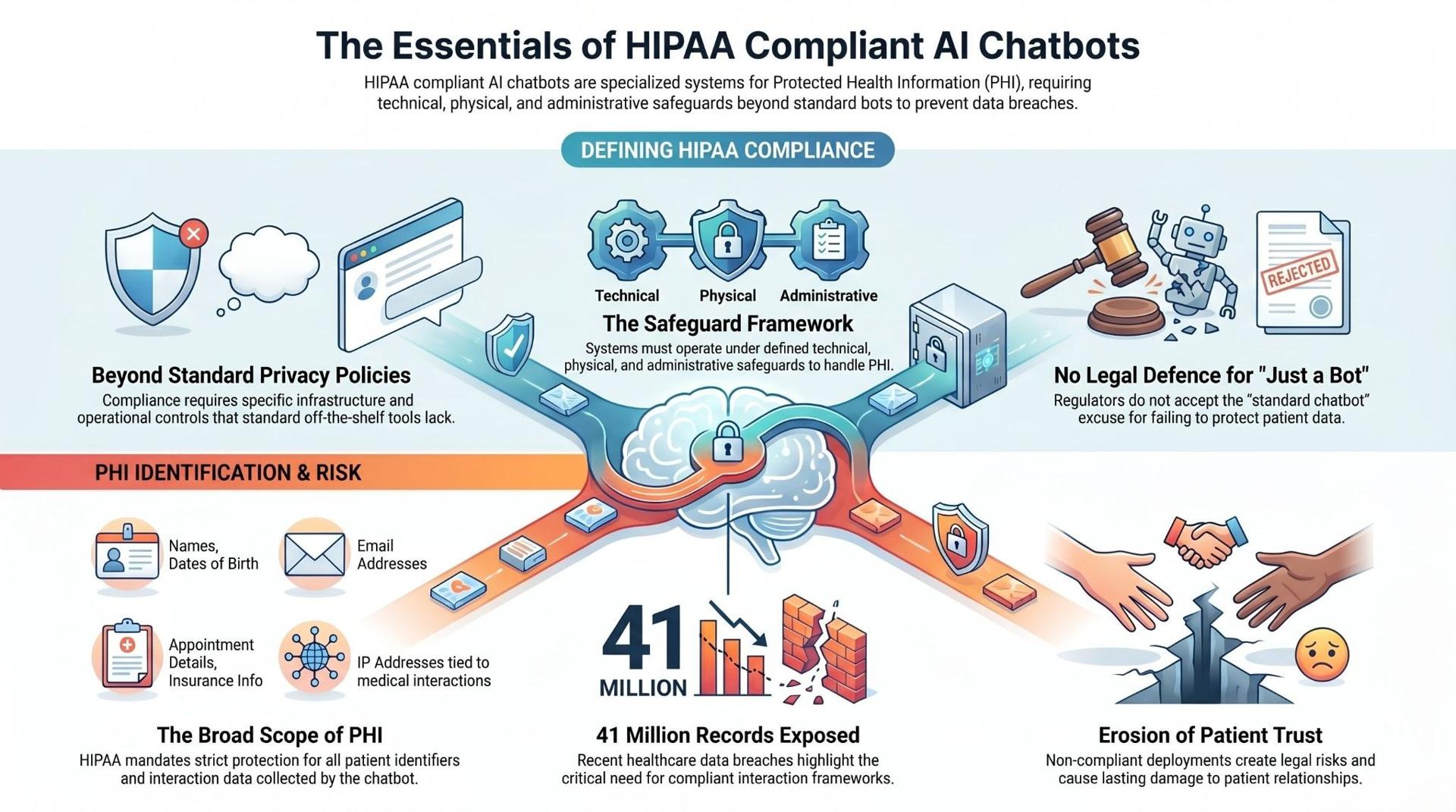
PHI includes more than just medical records. Patient names, dates of birth, email addresses, appointment details, insurance information, and even IP addresses tied to a medical interaction all count as PHI. If your chatbot collects, processes, or transmits any of this — and most healthcare chatbots do — HIPAA applies. "It's just a chatbot" is not a compliance defence, and courts and regulators have made that clear.
What a HIPAA compliant chatbot is not: a standard customer service bot with a privacy policy attached. The compliance requirements go far deeper than policy documents. They require specific infrastructure, legal agreements, and operational controls that most off-the-shelf chatbot tools simply don't have.
The distinction matters because a non-compliant deployment doesn't just create legal risk. It exposes patients, damages trust, and — with over 41 million patient records exposed in recent healthcare data breaches — it contributes to a problem the industry can't afford to ignore.
The 5 Non-Negotiable Requirements for HIPAA Compliance
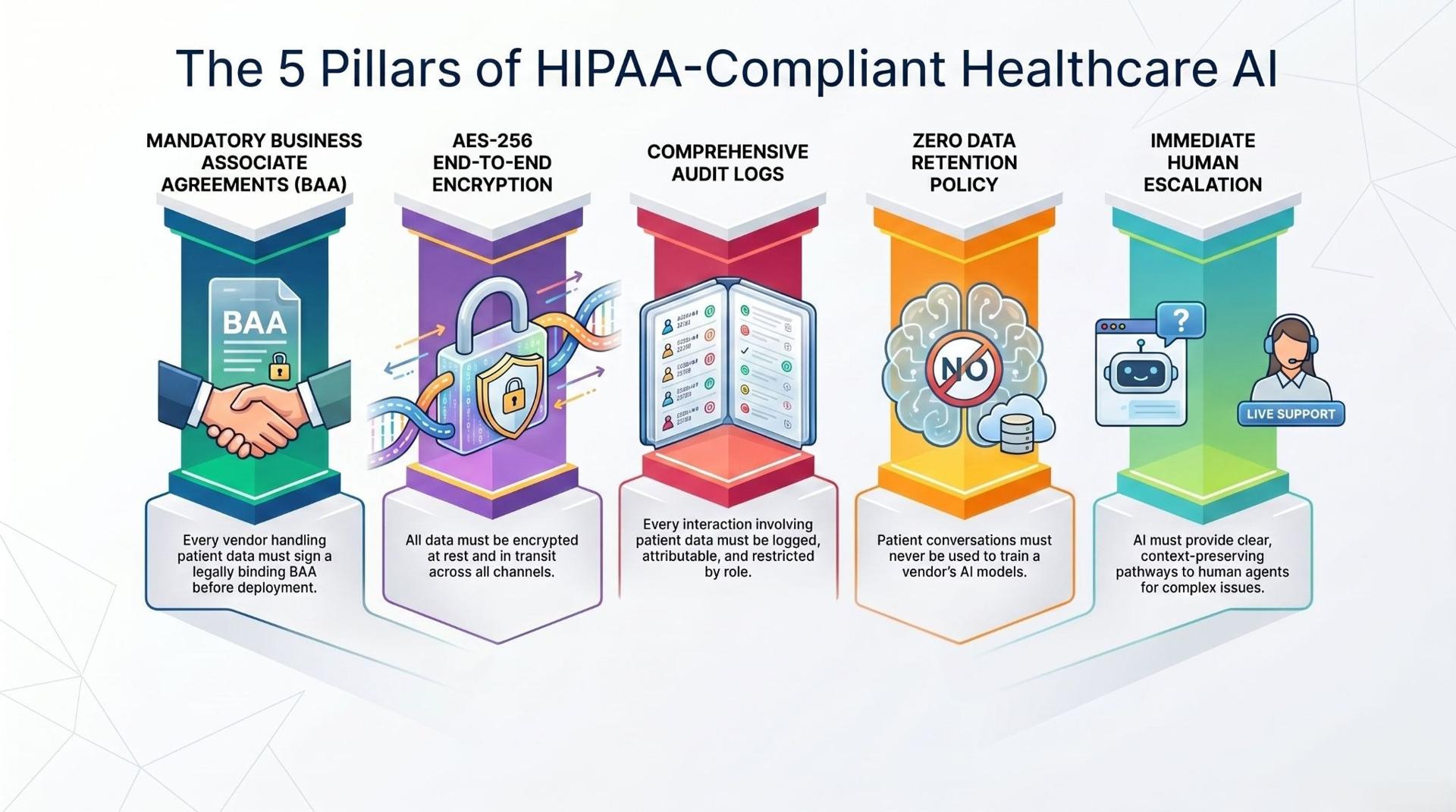
If you're evaluating any AI chatbot for healthcare use, these five requirements are baseline. Miss one, and the entire compliance structure collapses.
1. Business Associate Agreement (BAA)
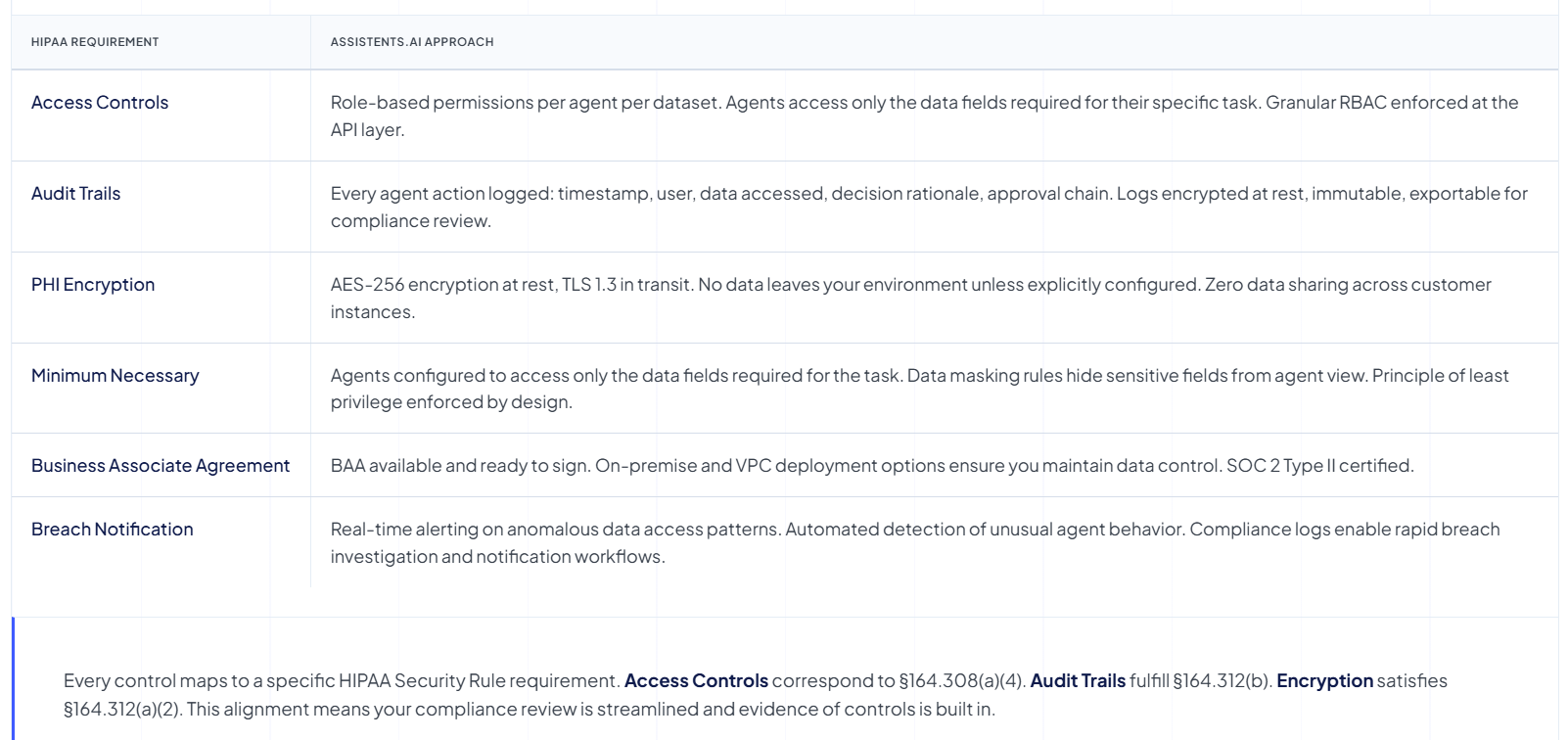
A BAA is a legally binding contract between a healthcare organization (the covered entity) and any vendor that handles PHI on its behalf (the business associate). Without a signed BAA, deploying a chatbot that touches patient data is a direct HIPAA violation — regardless of how many security certifications the vendor displays on their website.
Every AI vendor you use in a patient-facing or clinically adjacent workflow must sign a BAA. That includes the underlying AI model provider, not just the chatbot interface layer.
2. End-to-End Encryption
All PHI must be encrypted in transit and at rest. AES-256 encryption is the current standard. Data moving between a patient's browser and your server, between your server and an AI model, and while stored in any database must all be protected. Unencrypted channels — even briefly — represent a breach risk and a compliance failure.
3. Comprehensive Audit Logs and Access Controls
HIPAA requires that every access to PHI be logged, attributable, and reviewable. For AI chatbots, this means detailed records of every interaction involving patient data — who accessed it, when, what was done with it, and what the system decided. Role-based access controls must ensure that only authorised personnel can view or export these logs. Without this, you have no way to demonstrate compliance during an audit or investigate a suspected breach.
4. Data Residency and Zero Data Retention
Where your data lives matters legally. US-based data centres are standard for most US healthcare organisations, but the more critical question is whether the AI model vendor uses your data to train their models. Consumer AI tools frequently do. Enterprise-grade HIPAA compliant platforms operate on a zero data retention policy — your patient conversations never feed back into model training.
5. Human Escalation Pathways
A well-designed HIPAA compliant AI chatbot always has a clear, reliable route to a human agent. For urgent symptoms, sensitive disclosures, billing disputes, or anything the AI cannot resolve with confidence, escalation must be immediate, context-preserving, and logged. This "human in the loop" design is both a clinical best practice and a regulatory expectation.
Regular Chatbot vs HIPAA Compliant AI Agent: The Real Difference
Most organisations don't realise how wide the gap is between a standard chatbot and a genuinely compliant enterprise AI agent. Here's what that gap looks like in practice:
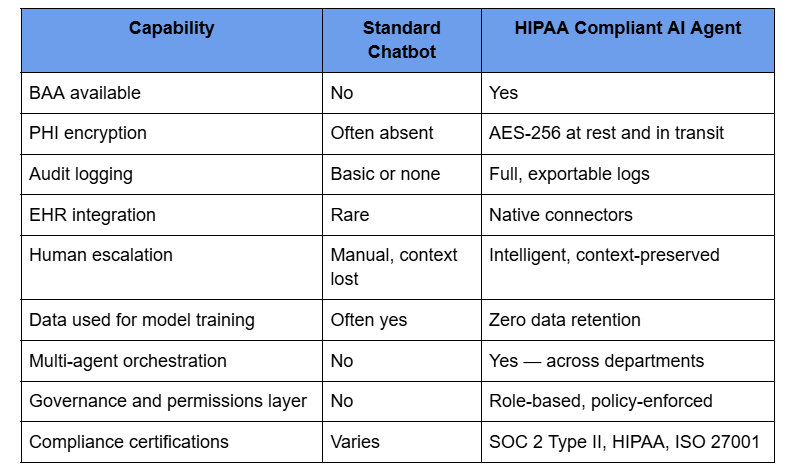
The difference isn't just technical — it's operational. A compliant enterprise AI agent isn't a chatbot that's been retrofitted with a few security features. It's a system built from the ground up around governance, auditability, and the complex reality of healthcare workflows.
Where HIPAA Compliant AI Delivers the Most Value in Healthcare Enterprises
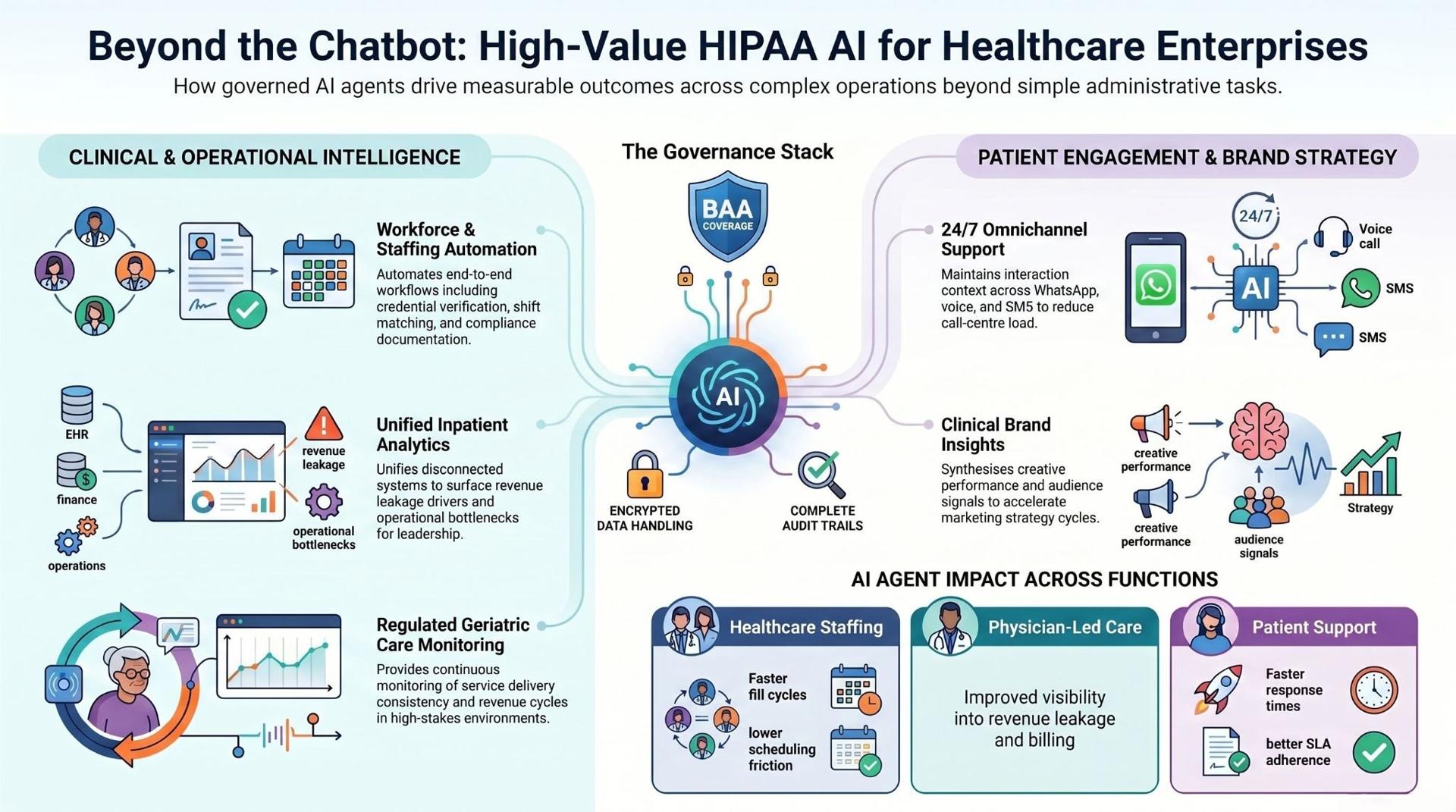
The highest-value use cases for HIPAA compliant AI in 2026 are not the obvious ones. Yes, appointment scheduling and FAQ deflection are useful — but enterprises that stop there are leaving most of the value on the table. Here's where governed AI agents create measurable outcomes across healthcare operations.
Healthcare Staffing and Workforce Management
Healthcare staffing is one of the most operationally complex functions in any clinical enterprise. Credential verification, shift matching, compliance documentation, scheduling coordination across facilities, and fill-rate reporting — all of it runs on manual processes that don't scale.
A healthcare staffing platform deployed AI agents to automate the end-to-end staffing workflow: talent onboarding, credential capture, facility request intake, intelligent candidate matching, shift scheduling, compliance tracking, and reporting dashboards for fill-rate and utilisation. The results were measurable and rapid — faster fill cycles, lower scheduling friction, better workforce utilisation, and improved staffing responsiveness for the facilities being served.
For staffing organisations operating under HIPAA (handling worker health records, patient-facing staff credentials, and facility compliance data), this kind of agentic automation requires the full compliance stack: BAA coverage, encrypted data handling, and complete audit trails on every workflow action.
Inpatient and Physician-Led Care Programs
Physician-led inpatient enterprises face a specific operational challenge: the data they need to run effectively — revenue analytics, care program performance, staffing patterns, billing exceptions — lives across multiple disconnected systems. Getting a coherent operational picture requires hours of manual reporting that, by the time it's ready, is already stale.
A physician-led clinical organisation deployed AI agents to unify their operational and revenue analytics, track care program performance, surface billing workflow exceptions, and give leadership faster, more reliable decision inputs. Outcomes included improved visibility into revenue leakage drivers, faster identification of operational bottlenecks, and better decision support for leadership — with all of it running on a governed, audit-ready infrastructure.
This is what HIPAA compliant AI looks like at its most impactful: not a patient-facing chatbot, but an operational intelligence layer that accelerates clinical and administrative decision-making while keeping every data interaction traceable.
Geriatric and Long-Term Care Services
Geriatric care providers serving patients across assisted living and long-term care settings operate in one of the most tightly regulated environments in healthcare. Staffing performance, service delivery consistency, and revenue cycle management all require continuous monitoring — and the stakes of getting it wrong are high, both clinically and financially.
An organisation providing physician-led geriatric programs deployed AI agents to improve visibility into care program operations, surface staffing and service delivery analytics, and provide revenue cycle monitoring with exception alerts. The outcomes included faster identification of operational bottlenecks, improved transparency into service performance, and better decision support for leadership — all within a fully governed, compliance-ready framework.
Patient Scheduling and 24/7 Omnichannel Support
The most visible use case — and still a genuinely high-value one when done at enterprise scale. Patients attempting to reschedule appointments after hours, get answers to billing questions, or understand a care plan shouldn't have to wait until Tuesday morning for a callback.
Enterprise-grade HIPAA compliant AI handles this across every channel — web chat, WhatsApp, voice, email, and SMS — with full context preserved across interactions. Intelligent escalation routes sensitive cases to human agents immediately, with the full conversation history intact. Every interaction is logged, encrypted, and reportable.
The operational impact is real: faster response times, lower call-centre load, consistent 24/7 availability, and better SLA adherence through automated routing and tracking.
Clinical Brand Insights and Marketing Operations
Healthcare enterprises also have a less-obvious AI use case in brand intelligence and marketing operations. A brand insights and creative studio with deep healthcare and enterprise experience deployed AI agents to unify creative performance signals, audience data, and engagement metrics — producing actionable insight narratives for marketing teams. The result: faster creative strategy cycles, deeper signal synthesis across channels, and better clarity on what to do next for campaigns.
In a healthcare context where marketing communications must be carefully governed and brand integrity is non-negotiable, AI agents with built-in governance and audit trails offer a meaningful advantage over generic marketing tools.
Are All Popular AI Tools HIPAA Compliant?
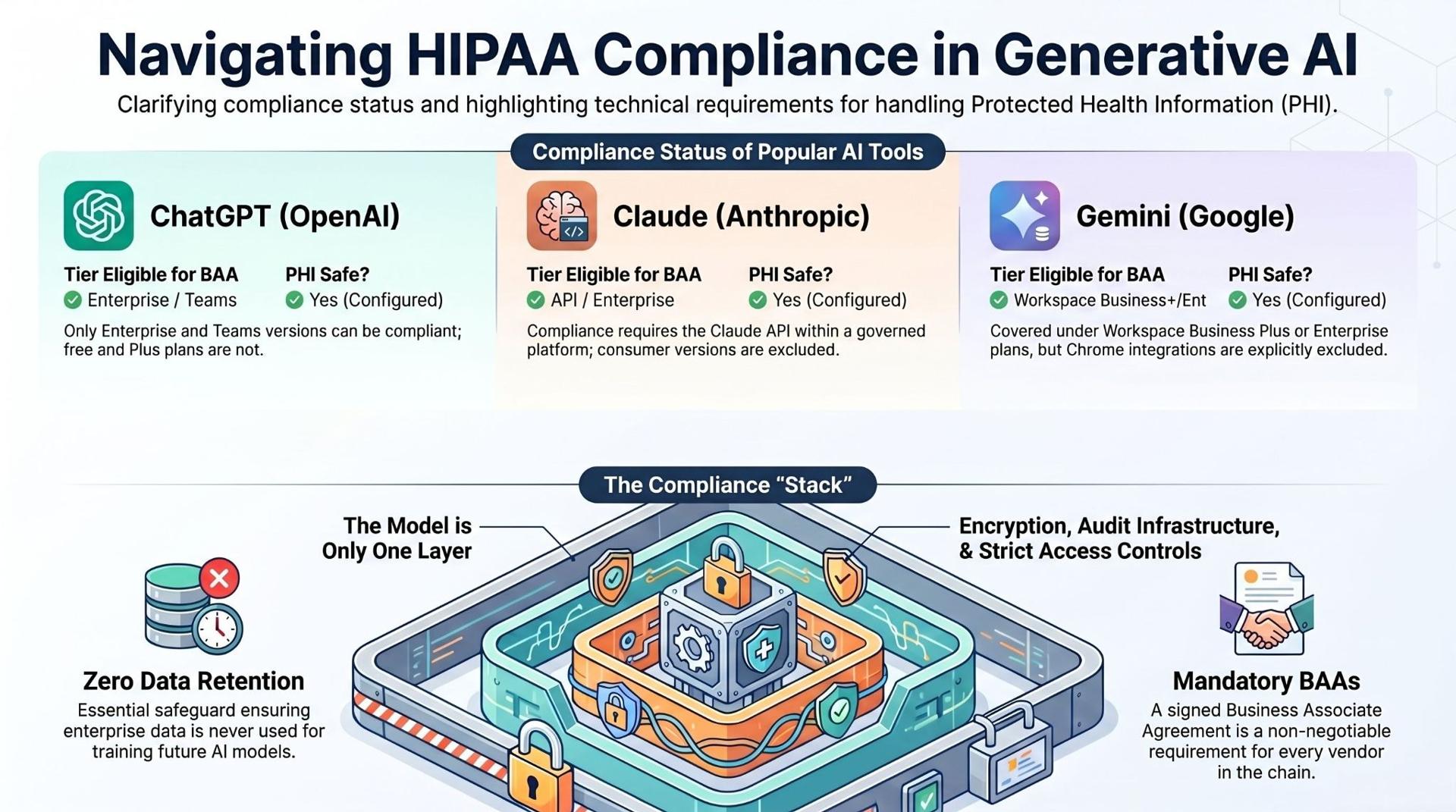
This is one of the most searched questions in healthcare IT right now — and the answer is consistently more nuanced than the vendors' homepage claims.
ChatGPT (OpenAI): The free and Plus plans are not HIPAA compliant. OpenAI does not sign BAAs for these versions, and user data may be used for model training. ChatGPT Enterprise and Teams can be HIPAA compliant under a signed BAA — but only when properly configured and managed.
Claude (Anthropic): The consumer Claude.ai interface is not HIPAA compliant. Enterprise customers using the Claude API can configure a HIPAA-compliant deployment under a signed BAA. When deployed inside a governed enterprise platform with proper encryption, access controls, and zero data retention, Claude can meet HIPAA's technical and administrative safeguard requirements.
Gemini (Google): Gemini within Google Workspace Business Plus or Enterprise can be compliant with a signed BAA. The Gemini-in-Chrome integration is explicitly excluded from BAA coverage and should not be used with PHI.
The key insight here is that the underlying AI model is only one layer of the compliance picture. What makes a deployment truly HIPAA compliant is the platform surrounding the model: the encryption layer, the audit infrastructure, the access controls, the BAA with every vendor in the chain, and the governance rules enforced at every workflow step.
Platforms like assistents.ai are built to manage this entire stack — deploying best-in-class models (across Bedrock, Azure, Vertex AI, and OpenAI) inside a governed, HIPAA-certified infrastructure where enterprise data is never used for model training and zero data retention is enforced by design.
What to Look for in an Enterprise HIPAA Compliant AI Platform
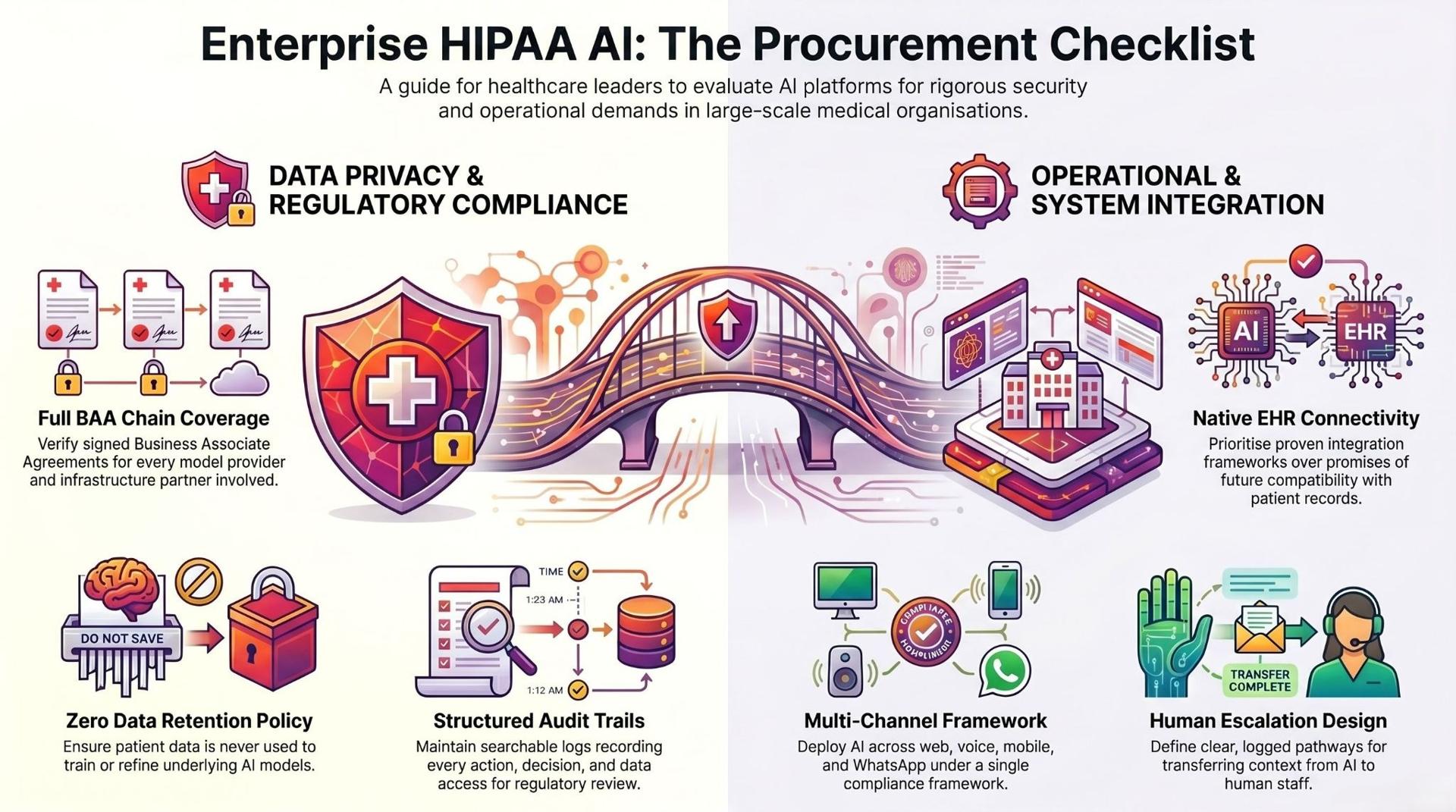
Most buying guides for HIPAA chatbots focus on small to mid-sized practices. Enterprise healthcare organisations have different requirements — and most of the tools reviewed in those guides don't meet them. Here's what to evaluate when the stakes are real.
BAA coverage across the full vendor chain. Not just with the chatbot interface vendor — with every AI model provider, data processor, and infrastructure partner involved. Ask for the full list and confirm each one has signed.
Zero data retention and model training policy. Your patient conversations must never feed back into model training. Get this in writing, and verify it applies to every model in the stack — not just the primary one.
Audit trail depth and exportability. For enterprise deployments, you need logs that are not just stored but searchable, exportable, and structured enough to support regulatory review. Timestamp, user, action, data accessed, decision made — every step.
Multi-channel deployment. Enterprise patients and staff communicate across web, voice, mobile, WhatsApp, and email. Your AI platform needs to handle all of them under the same compliance framework, not just web chat.
EHR and core system integration. A chatbot that can't read from or write to your patient record system creates more work, not less. Look for native connectors or a proven integration framework — not a promise that "it can connect to anything."
Governance and role-based permissions. Who can access what, under what conditions, with what approval flows. In a clinical environment, this is non-negotiable. Every action the AI agent takes should be policy-checked before execution.
Human escalation design. How does the system identify when to escalate? How is context transferred to the human agent? Is the escalation logged? These design questions determine whether your escalation pathway is actually useful or just a liability disclaimer.
Scalability from PoC to production. Many platforms demo beautifully but struggle at scale. Ask about production deployments in healthcare at comparable complexity and volume. Request audit logs and governance documentation, not just demo environments.
Real-World Results: What HIPAA Compliant AI Agents Deliver
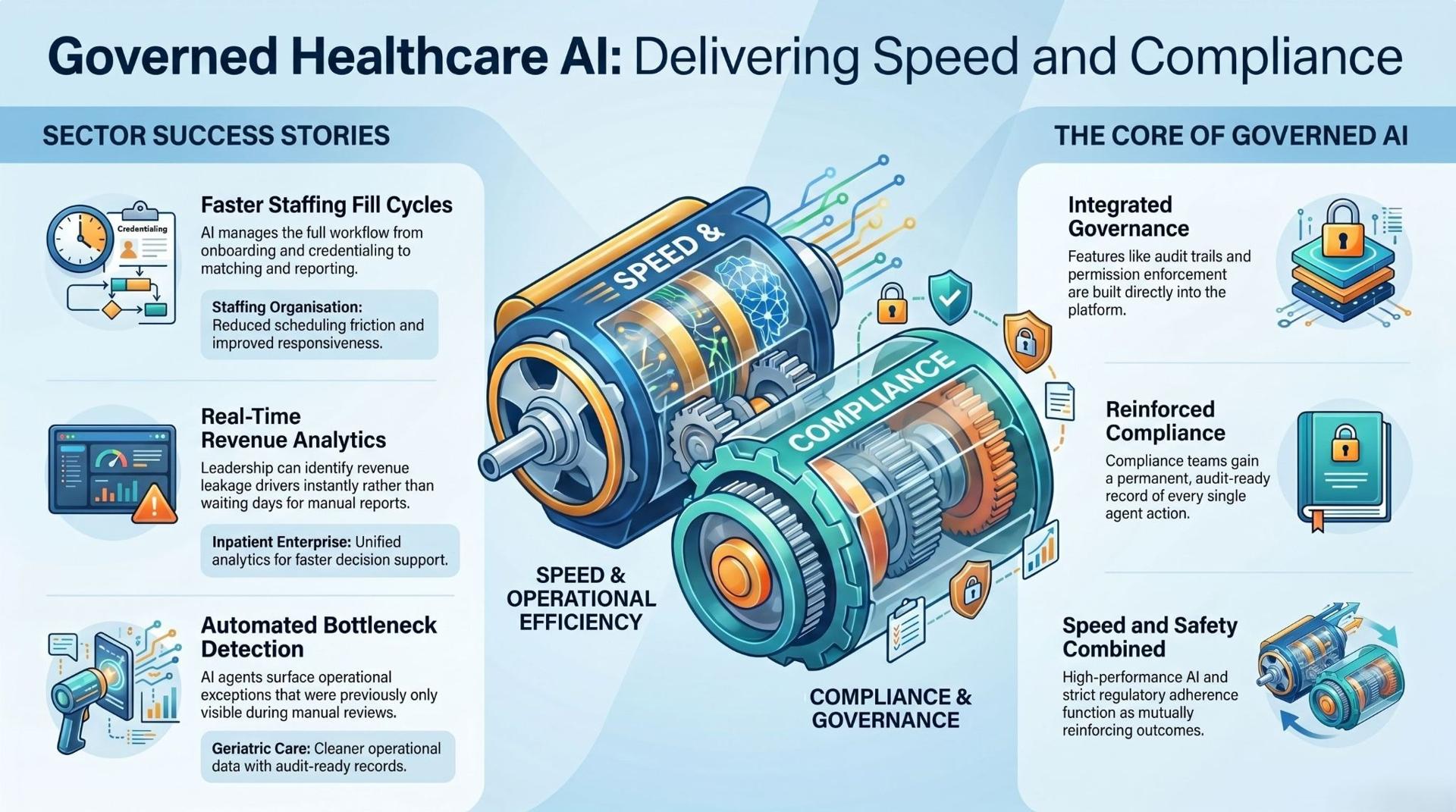
The case for enterprise HIPAA compliant AI isn't theoretical. Across healthcare staffing, inpatient operations, and geriatric care programs, governed AI agents have delivered measurable outcomes — without compromising compliance.
A healthcare staffing organisation achieved faster fill cycles and lower scheduling friction, while improving staffing responsiveness for the facilities it serves. The AI agents handled the full workflow: onboarding, credentialing, matching, scheduling, compliance documentation, and reporting — all within a HIPAA-compliant framework with full audit trails.
A physician-led inpatient clinical enterprise deployed agentic AI to unify revenue and operational analytics across its programs. The result was faster identification of revenue leakage drivers, improved transparency into service performance, and better decision support for leadership — with reporting that previously took days now available in real time.
A geriatric care provider improved visibility into care program operations and revenue cycle performance, with AI agents surfacing exceptions and bottlenecks that were previously only visible during manual reviews. Leadership gained cleaner, more reliable operational data — and the compliance team gained an audit-ready record of every agent action.
Across these deployments, the consistent theme is not just that AI makes things faster. It's that governed AI — with audit trails, permission enforcement, and escalation design built in — makes things faster and more compliant. These two outcomes are not in tension. In a well-architected enterprise AI platform, they reinforce each other.
Next Step: Deploy a HIPAA Compliant AI Agent Built for Healthcare Enterprises
Basic HIPAA chatbots solve a narrow problem. Enterprise healthcare organisations need something with more depth — AI agents that operate across staffing, care programs, revenue cycle, and patient support, all within a single governed platform that compliance teams can actually trust.
assistents.ai is a SOC 2 Type II, HIPAA, GDPR, and ISO 27001-certified enterprise AI agent platform. It deploys Conversational Agents, Voice AI, Document AI, and Agentic BI across Finance, Operations, Customer Support, HR, and healthcare-specific workflows — connected to 300+ enterprise systems, with zero data retention and a full audit trail on every action.
Production-proven across 12 industries and 6 continents. Most enterprises go from discovery calls to a custom PoC plan within 48 hours.
If your organisation is ready to move beyond basic chatbots and deploy AI that actually runs healthcare workflows — compliantly, at scale — book a 30-minute discovery call with the assistents.ai team. Bring the workflow that's costing you the most. We'll show you exactly what governed AI can do with it.
FAQs
What makes an AI chatbot HIPAA compliant?
A HIPAA compliant AI chatbot must meet four categories of safeguards under HIPAA: technical (encryption, access controls, audit logs), physical (secure data centre environments), administrative (policies, staff training, risk assessments), and organisational (signed Business Associate Agreements with all vendors). Meeting one or two of these categories is not sufficient — all four must be in place.
Do I need a BAA with every AI vendor I use?
Yes. If a vendor handles, processes, or has access to PHI as part of the service you're deploying, they are a business associate under HIPAA and a BAA is required. This applies to the chatbot interface vendor, the underlying AI model provider, cloud infrastructure providers, and any third-party integrations that touch patient data.
Can AI chatbots handle PHI directly?
Yes — when deployed correctly. The chatbot must operate within a HIPAA-compliant infrastructure that includes encryption at rest and in transit, access controls, audit logging, and BAA coverage at every layer. The AI model itself must be deployed under a BAA and configured with zero data retention.
What happens if a non-compliant chatbot processes patient data?
HIPAA violations range from $100 to $50,000 per violation, with annual maximums up to $1.9 million per violation category. Beyond financial penalties, breaches require notification to affected patients, the HHS Office for Civil Rights, and in some cases the media. Reputational damage and patient trust loss are often the more lasting consequences.
What is the difference between a chatbot and an AI agent in healthcare?
A chatbot answers questions based on pre-defined flows or a knowledge base. An AI agent executes multi-step workflows — it can read from and write to your systems, trigger approvals, route tasks, update records, and coordinate across departments. In healthcare, this distinction matters because the highest-value use cases (staffing workflows, care program management, revenue cycle operations) require action execution, not just question answering.
How do audit logs work in a HIPAA compliant AI platform?
Every interaction involving PHI is recorded with a timestamp, the user or agent identity, the action taken, the data accessed, and the outcome. Logs are stored in encrypted, access-controlled environments and can be exported for compliance review, breach investigation, or regulatory audit. In an enterprise platform, these logs cover not just patient-facing chat interactions but every backend workflow action the AI agent takes.
How much does a HIPAA compliant AI chatbot cost?
Pricing varies widely. Simple HIPAA compliant chatbots for small practices start around $39–$200 per month. Enterprise AI agent platforms — with multi-channel deployment, EHR integration, multi-agent orchestration, and full governance infrastructure — are priced based on deployment scope, number of agents, and workflow complexity. For enterprises, the ROI calculation matters more than the headline cost: a platform that reduces manual staffing work, accelerates revenue cycle reporting, and catches compliance gaps before audits typically achieves measurable ROI within the first quarter.
Can a HIPAA compliant AI chatbot integrate with EHR systems?
Yes — when the platform has the right integration architecture. Look for platforms with native connectors to major EHR systems and a proven track record of production EHR integrations, not just API documentation. The integration must be bidirectional — the AI agent needs to read patient context and write structured data back — and all data movement must occur within the HIPAA-compliant infrastructure, not through unencrypted APIs.