AI agents are no longer experimental. Across retail, logistics, healthcare, finance, real estate, energy, hospitality, construction, and more — autonomous AI agents are being deployed right now, handling complex multi-step workflows, connecting to core business systems, and delivering measurable operational results. \
This blog documents 35+ real-world deployments so you can see exactly what is being built, what it connects to, and what changes.
What Is an AI Agent? (And How It Differs From a Chatbot)
Most "AI agent examples" articles open with a Netflix recommendation or an email spam filter and call it done. That is not what this article is about.
An AI agent is a system that perceives its environment, makes decisions, takes actions across multiple steps, and works toward a defined goal — often by connecting to external tools, databases, APIs, and business systems. It does not just answer questions. It acts.
Here is how AI agents compare to the technologies most people already know:
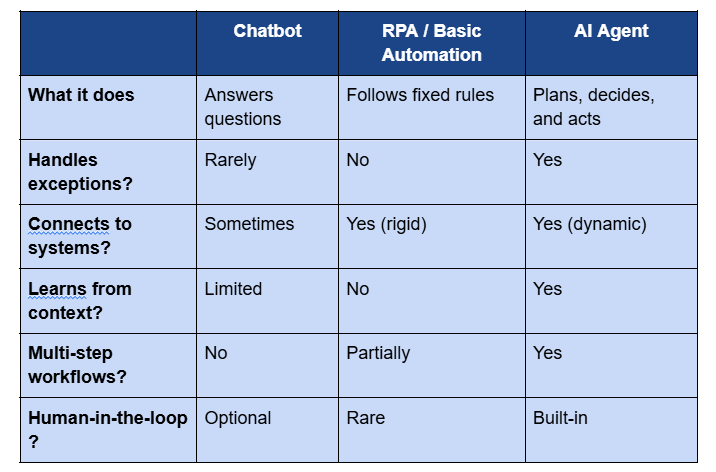
The shift from passive AI (analyse data, surface insights) to agentic AI (take action, complete workflows, escalate intelligently) is what makes the examples below significant. These are not demos. These are production deployments with real business outcomes behind them.
AI Agents in Retail and E-Commerce
Retail was one of the earliest industries to feel the operational pressure that AI agents are now solving — high transaction volume, fragmented inventory data, multilingual customer bases, and under-resourced store-level support teams.
Enterprise Store Support Agent (National Retail Scale)
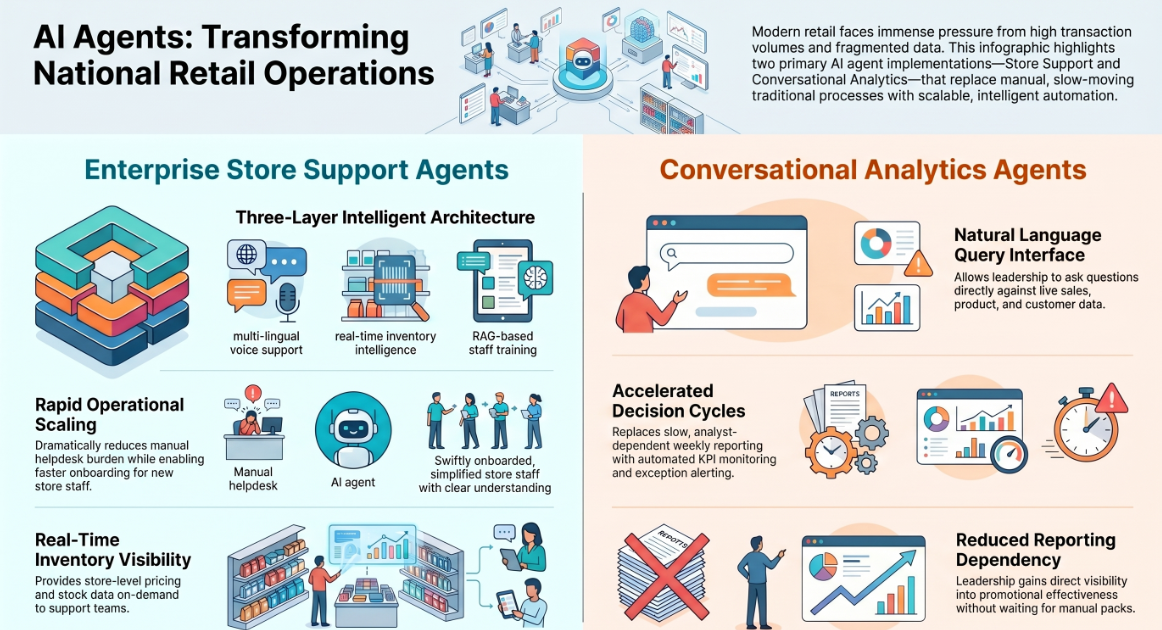
A large national retail chain operating hundreds of stores across multiple cities deployed a three-layer AI agent system to replace a manual helpdesk that could not scale.
What was built:
- A voice support agent operating in both Hindi and English, powered by a speech-to-text, LLM, and text-to-speech pipeline
- An inventory intelligence agent providing real-time pricing, stock availability, and promotional data at the individual store level
- A knowledge and training agent built on retrieval-augmented generation (RAG) over point-of-sale documentation and standard operating procedures
- An admin console with ticketing integration and analytics
What changed: Store teams could access answers on-demand without waiting for centralized support. New staff could onboard faster. Inventory visibility improved at the store level. Manual helpdesk burden dropped significantly, and the system was architected to handle high-volume concurrent queries without degradation.
Conversational Analytics Agent (Value Retail)
A value retail operation with a pan-India footprint deployed a conversational analytics agent to replace slow, analyst-dependent reporting cycles.
What was built:
- Data ingestion across sales, product, inventory, promotions, and customer behaviour
- A natural language query interface allowing leadership to ask questions directly against live operational data
- Automated KPI monitoring with exception alerting
What changed: Analysis cycles shortened significantly. Dependency on analysts for recurring reports was reduced. Leadership gained direct visibility into product performance and promotional effectiveness without waiting for weekly packs.
AI Agents in Logistics and Supply Chain
Logistics is one of the most data-dense, exception-heavy environments in any business. The volume of signals — terminal operations, rail scheduling, inland transport, customs coordination — creates exactly the conditions where agentic AI creates genuine leverage.
Terminal and Rail Management Agent (Global Ports Operator)
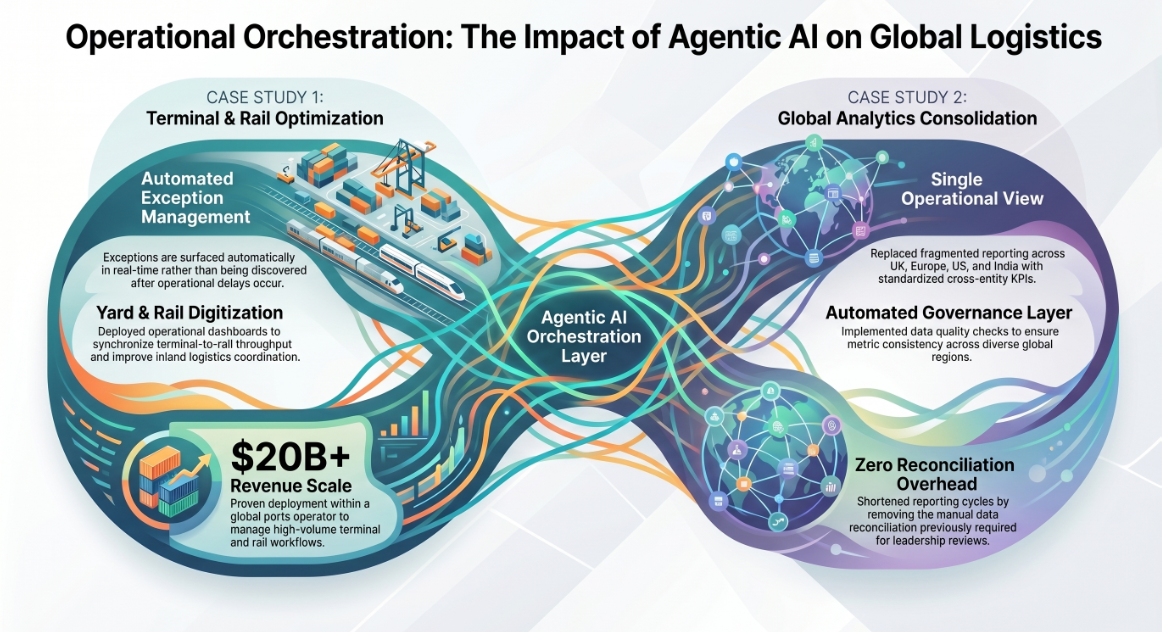
A global ports and logistics leader with reported revenues exceeding $20 billion deployed an agentic operations layer across terminal and inland logistics.
What was built:
- Terminal workflow digitisation with yard and rail operational dashboards
- Rail scheduling and visibility with automated exception management
- Executive dashboards and operational alerting
What changed: Terminal-to-rail throughput became more predictable. Coordination across terminal and inland logistics improved. Operational visibility that previously required manual aggregation became available in real time, with exceptions surfaced automatically rather than discovered after the fact.
Multi-Entity Analytics Consolidation (Indian Multinational Logistics)
An Indian multinational logistics and warehousing company serving customers across India, UK, Europe, and the US struggled with fragmented reporting across a multi-entity global operation.
What was built:
- Cross-entity KPI standardisation
- Consolidated operational dashboards with variance explanations
- Data quality checks and a governance layer
What changed: Leadership gained a single operational view across entities. Reporting cycles shortened. The consistency of operational metrics improved across regions, removing the reconciliation overhead that had previously consumed analyst time before every leadership review.
AI Agents in Finance and Banking
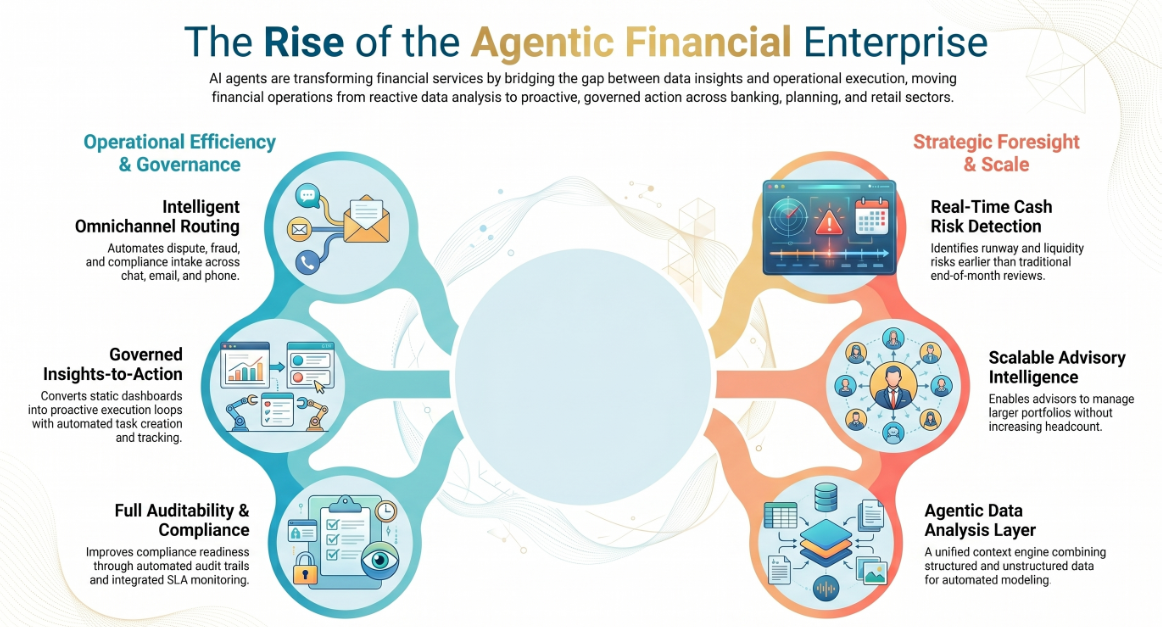
Financial services present a high-stakes, high-compliance deployment environment. The AI agents being used here are not running autonomously without oversight — they are designed with audit trails, escalation logic, and human-in-the-loop controls built from the start.
Omnichannel Banking Support Agent (Fintech / Credit Unions)
A global fintech provider serving banks and credit unions deployed an omnichannel AI agent to handle disputes, fraud, compliance queries, and operational support.
What was built:
- Omnichannel intake across chat, email, and phone with intelligent workflow routing
- Agent-assist summarisation and next-best action recommendations
- Full auditability, SLA monitoring, and reporting
- Voice support in Hindi and English with integration into core banking systems
What changed: Case handling became faster and more consistent. Automation reduced operational load on human teams. Audit trail completeness improved compliance readiness. The system was designed to be integration-ready with existing core systems rather than requiring replacement.
AI CFO Agent (Financial Planning Platform)
An AI CFO platform built for growing businesses, CFOs, and financial advisors deployed an agent that turns financial data into continuous, actionable intelligence.
What was built:
- A financial data connection layer covering accounting and banking exports
- Forecast and scenario modelling agents
- Alerting for runway and cash risks with recommended actions
- Portfolio views for advisors managing multiple clients
What changed: Analysis cycles became faster. Cash risks were detected earlier rather than surfacing in end-of-month reviews. Advisors could deliver insight at a scale that would previously have required additional headcount. The platform removed the gap between knowing what the numbers say and knowing what to do about them.
Agentic Data Analysis Layer (Privately-Held Retail Group)
A privately-held retail group with cross-functional intelligence needs across systems and documents deployed an agent designed to convert dashboard insights into governed, auditable actions.
What was built:
- A unified context engine combining structured and unstructured data
- A semantic governance layer covering rules, hierarchies, and formulas
- An active orchestrator integrating with core systems
- Insights-to-action agents layered on top of existing dashboards
What changed: The operation shifted from reactive reporting to proactive execution loops. Decision logic became standardised across teams. Task creation and completion tracking were automated, removing the gap between an insight being surfaced and someone acting on it.
AI Agents in Healthcare
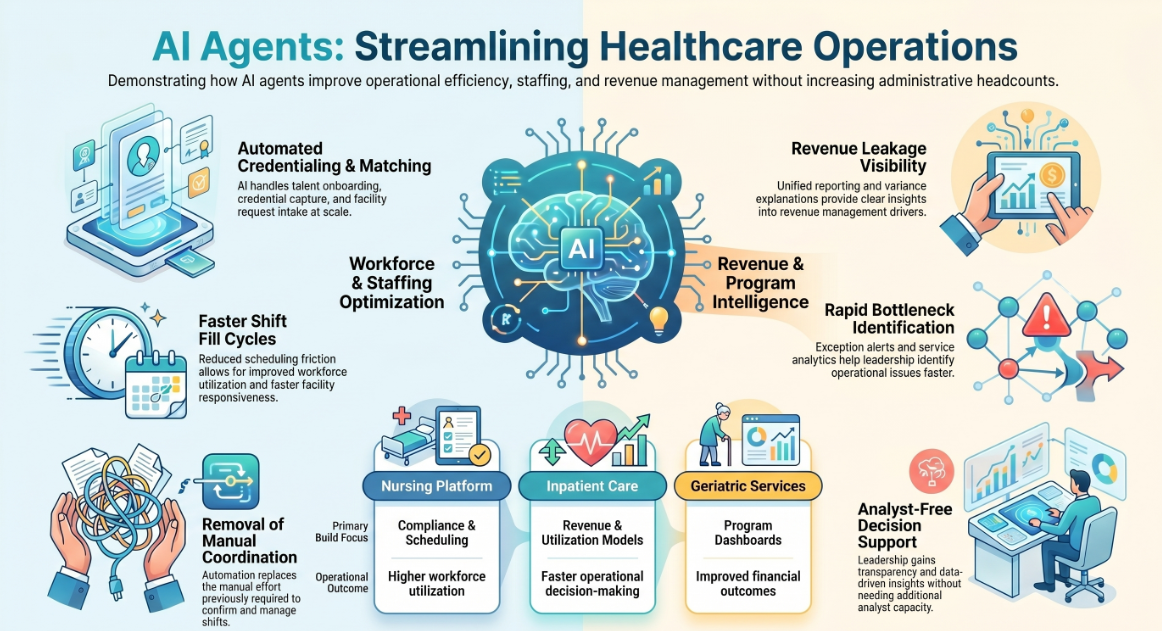
Healthcare AI agent deployments face a dual requirement: they must reduce administrative burden without compromising the accuracy or safety of patient-facing or clinician-facing processes. The deployments below are operational and back-office focused, not diagnostic.
Healthcare Staffing Agent (Nursing Platform)
A healthcare staffing platform connecting nursing professionals with facilities for flexible shifts deployed an AI agent to handle matching, scheduling, and compliance at scale.
What was built:
- Talent onboarding and credential capture workflows
- Facility staffing request intake and matching logic
- Scheduling, notifications, and compliance workflows
- Reporting for fill rate and workforce utilisation
What changed: Fill cycles became faster with lower scheduling friction. Workforce utilisation improved. Staffing responsiveness for facilities improved, removing the manual coordination that had previously limited how quickly shifts could be confirmed.
Revenue and Operations Analytics (Inpatient Care Provider)
A physician-led clinical enterprise operating hospitalist programs deployed an analytics agent to improve visibility into revenue management and operational performance.
What was built:
- Revenue and utilisation analytics model
- Performance dashboards with variance explanations
- Action lists for billing workflow and operational optimisation
What changed: Visibility into revenue leakage drivers improved. Operational decision-making became faster through unified reporting. Performance tracking became more reliable, giving leadership a consistent view rather than depending on manual reconciliation.
Geriatric Care Operations Agent (Greater Boston Care Services)
A geriatric care services provider delivering physician-led programs across assisted living and long-term care deployed an agent to improve care-program performance and financial outcomes.
What was built:
- Program operations dashboards
- Staffing and service delivery analytics
- Revenue cycle visibility with exception alerts
What changed: Operational bottlenecks were identified faster. Transparency into service performance improved. Leadership gained better decision support without requiring additional analyst capacity.
AI Agents in Real Estate
Real estate operations generate a continuous stream of repetitive, high-volume interactions — tenant queries, payment questions, lease terms, maintenance escalations. This is exactly the environment where AI agents deliver consistent value.
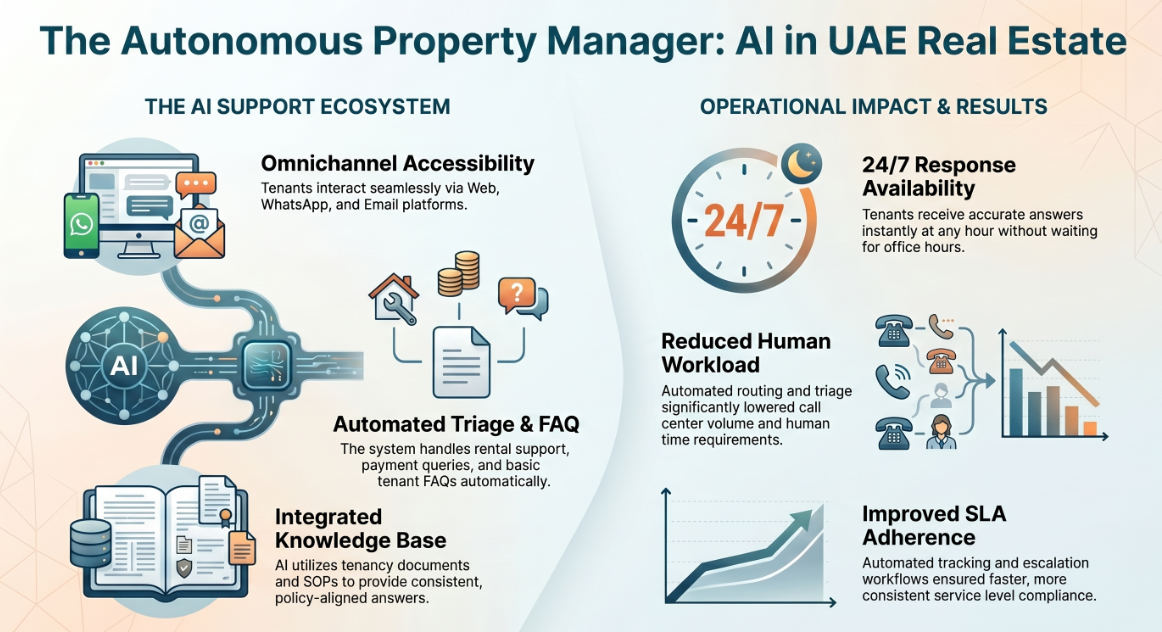
24/7 Tenant Support Agent (UAE Real Estate Portfolio)
A major UAE real estate portfolio owner managing diversified office, retail, industrial, and residential assets across multiple emirates deployed an omnichannel customer service agent to automate tenant and customer support.
What was built:
- An omnichannel service agent accessible via web, WhatsApp, and email
- Tenant query triage, FAQ handling, and rental and payment support workflows
- Ticketing and escalation to human teams
- A knowledge base over policies, tenancy documents, and standard operating procedures
What changed: Response times dropped. Call centre load reduced. Tenants received consistent, accurate answers at any hour without waiting for office hours. SLA adherence improved through automated routing and tracking. The system handled the high volume of routine queries that had previously required disproportionate human time.
AI Agents in Energy and Smart Grid Operations
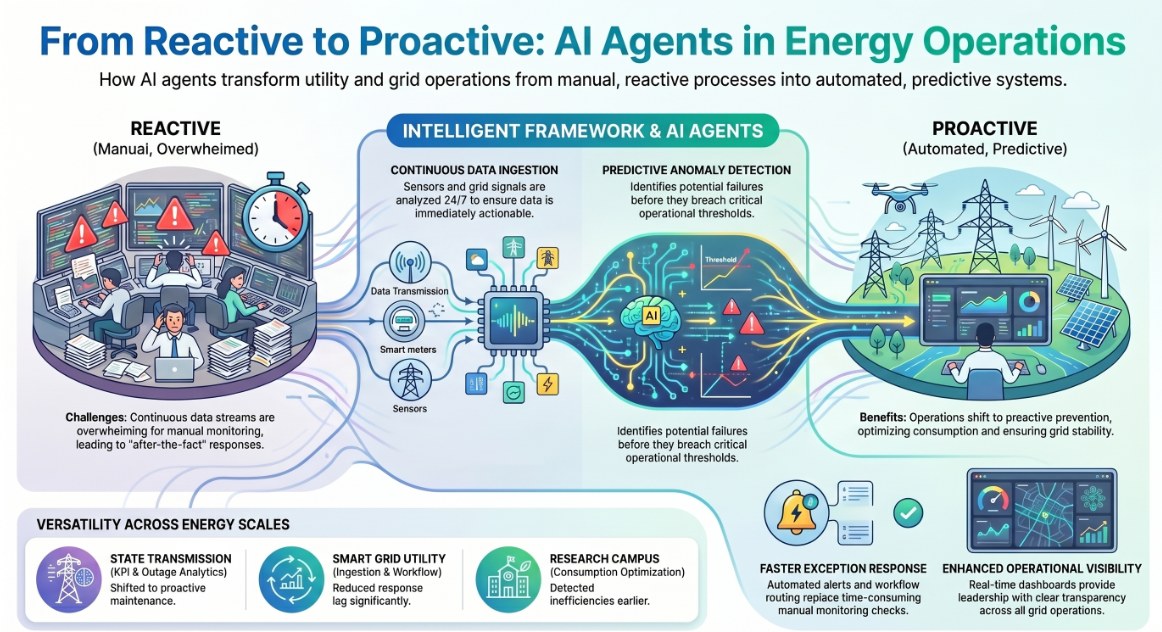
Energy and utility operations are data-continuous environments — sensors, grid signals, transmission telemetry, and consumption data are being generated around the clock. The challenge is not data collection; it is making that data actionable in time to prevent problems rather than respond to them.
Grid Operations Agent (State Power Transmission Utility)
A state power transmission utility responsible for operating and maintaining transmission systems deployed an AI agent to shift grid operations from reactive to proactive.
What was built:
- Transmission KPI monitoring and anomaly detection
- Loss and outage analytics with predictive maintenance indicators
- Dashboards and automated alerts for field operations
What changed: Grid exceptions were identified faster. Reliability improved through proactive monitoring. Operational transparency increased for leadership. The agent moved the team from discovering problems after the fact to being alerted before failure thresholds were breached.
Smart Grid Analytics Agent (Separate Utility Deployment)
A second energy utility deployment focused on smart grid data ingestion and operational performance management.
What was built:
- Smart grid data ingestion and operational dashboards
- Predictive analytics for outages, losses, and field issues
- Automated alerts and workflow routing for resolution
What changed: Operational visibility across grid operations increased substantially. Exception detection and response coordination became faster. Continuous monitoring replaced the manual checks that had previously created response lag.
Campus Energy Management Agent (Indian Research Institute)
A premier Indian research institute in astronomy and astrophysics deployed an AI agent to monitor and optimise campus-scale energy consumption.
What was built:
- Utility and sensor data ingestion with anomaly detection
- Forecasting and optimisation recommendations
- Dashboards and proactive alerting
What changed: Energy visibility improved and inefficiencies were detected earlier. Manual monitoring effort was reduced. Operations became more predictable through early alerts rather than post-hoc discovery of consumption anomalies.
AI Agents in Hospitality and Travel
Luxury hospitality presents a specific challenge: the expectations of the guest are extremely high, and the cost of an operational error — a missed booking detail, a wrong date, a misunderstood requirement — is felt directly in brand reputation. AI agents in this context must be accurate, fast, and able to handle graceful escalation when the situation calls for a human.
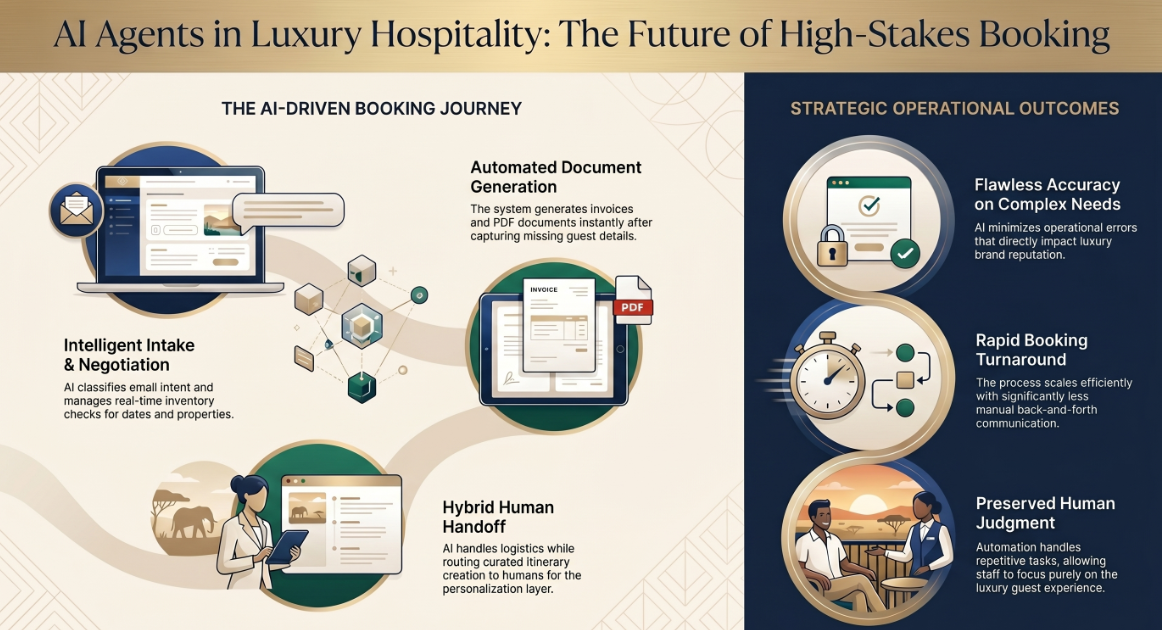
Digital Booking Agent (Luxury Safari Lodges, Africa)
A luxury hospitality brand operating 16 boutique lodges, camps, and hotels across iconic safari locations in Kenya and Tanzania deployed a digital booking agent to automate end-to-end luxury travel booking.
What was built:
- Email intake, intent classification, and data extraction
- A conversational loop to capture missing booking details
- Real-time inventory checks with alternative date and property negotiation
- A hybrid handoff for curated itinerary creation — keeping humans in the loop for the personalisation layer
- Automated invoice and PDF document generation
What changed: Booking turnaround became significantly faster with less back-and-forth. Accuracy on complex guest requirements improved. The operation scaled without compromising the quality of service that defines the brand. The human-in-the-loop design preserved the judgment that luxury travel requires while automating everything that did not require it.
AI Agents in Construction and Infrastructure
Document-heavy industries like construction are a natural fit for AI agents with vision and extraction capabilities. Tender documents, engineering specifications, and compliance requirements are voluminous, time-sensitive, and full of structured data trapped in unstructured formats.
Intelligent Tender Processing Agent (Australian Commercial Works Specialist)
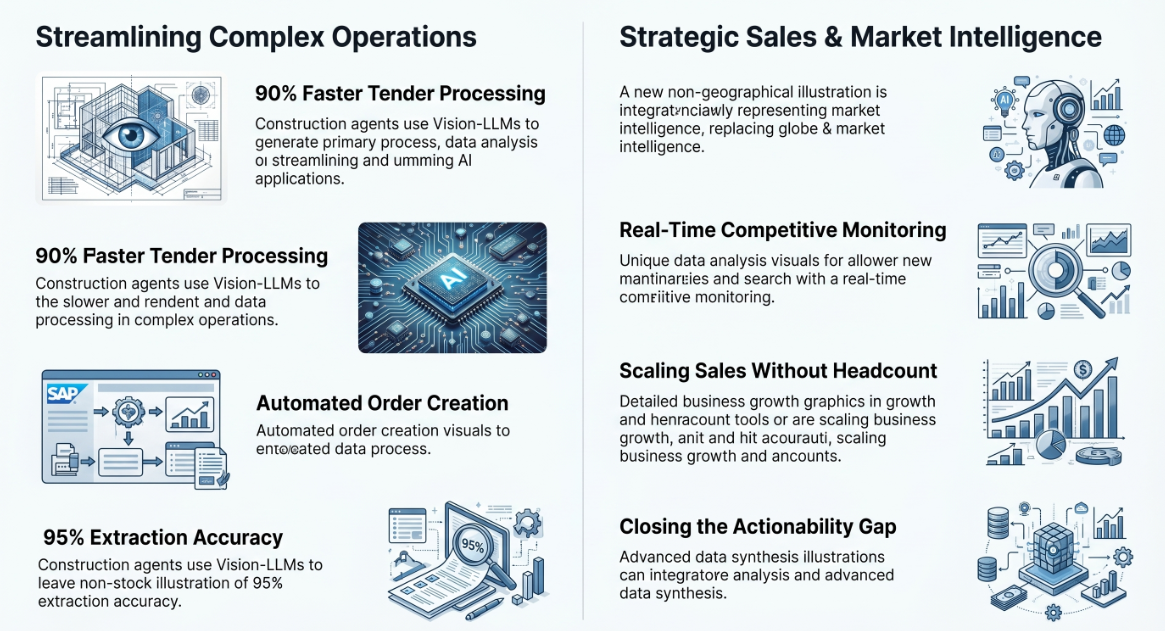
A commercial waterproofing, diagnostics, and remediation specialist known for high-integrity delivery on complex projects deployed an intelligent document workbench to automate tender processing.
What was built:
- Multi-agent orchestration for intelligent document processing
- Tender retrieval, workflow determination, and revision analysis
- Vision-LLM extraction from complex PDFs — handling documents that standard text extraction cannot parse cleanly
- Deep ERP integration with full create, read, update, and delete capability, quote locking, and audit logs
What changed: Tender document processing was engineered for up to approximately 90% speed improvement. Extraction accuracy targeted approximately 95% for standard formats. Bid risk was reduced through automated revision and change detection. The audit trail gave the team confidence and accountability across every processed document.
AI Agents in Sales and Marketing
Sales and marketing AI agents are most valuable when they handle the high-volume, repetitive work — monitoring, scoring, alerting, drafting — so that human teams can focus on the decisions and relationships that actually require them.
Competitive Monitoring Agent (Indian HVAC and Consumer Electronics)
A major Indian HVAC and consumer electronics player competing in highly price-sensitive markets deployed an agent to convert market signals into instant answers and proactive alerts.
What was built:
- Continuous e-commerce and channel monitoring across pricing, discounts, offers, availability, and ratings
- Agentic Q&A mapped directly to leadership questions
- Analytics views for pricing gaps, competitive threats, and portfolio movement
- Scalable architecture from proof-of-concept to production with governance and audit trails
What changed: Competitive response cycles became faster. Pricing gaps and promotional shifts were identified earlier. Always-on monitoring replaced manual checks across multiple portals that had previously consumed analyst time daily.
Agentic Sales Agent (UAE Engineering Solutions Provider)
A flagship UAE engineering and technology solutions provider deployed an AI sales agent to improve account coverage and pipeline execution.
What was built:
- Always-on account monitoring and signal capture
- Rule-governed opportunity identification and follow-up orchestration
- CRM-integration-ready workflows with pipeline hygiene
- Sales dashboards and leadership alerts
What changed: Account coverage increased without adding headcount. Response cycles on opportunities and renewals became faster. Execution became more consistent through governed playbooks rather than depending on individual rep discipline.
Automated SAP Order Creation Agent (UAE Kitchen and Appliance Retailer)
A premium UAE kitchen and home-appliances retailer deployed an agentic automation system to replace an end-of-life document processing environment that carried high licensing costs.
What was built:
- Agentic automation to interpret order triggers, validate data, and create SAP sales orders
- Rules and governance for exceptions and approvals
- Audit logs and reconciliation reporting
- Integration-ready replacement for the legacy workflow
What changed: Manual order processing was reduced. The order-to-confirm cycle became faster with fewer data entry errors. Auditability for sales order creation and exceptions improved. The business freed itself from a high-cost legacy dependency.
Influencer Marketing Intelligence Agent (Creator Economy Platform)
A creator economy platform bringing brands and creators together deployed an AI platform to automate influencer marketing operations and performance intelligence.
What was built:
- Creator discovery enrichment and campaign workflow automation
- Automated reporting summaries and insight generation
- Content KPI monitoring and brand safety checks
- Analytics for campaign ROI and engagement
What changed: Manual operations across campaigns were reduced. Performance visibility became faster. Reporting became more consistent across brand programs, removing the variation that had made cross-campaign learning difficult.
Brand Insights Agent (Creative Strategy Studio)
A brand insights and creative execution studio deployed an AI agent to unify signals and generate actionable insight narratives for marketing teams.
What was built:
- Multi-source ingestion covering creative, performance, and audience signals
- Insight agents producing themes, narratives, and recommendations
- Reporting packs for leadership
What changed: Creative strategy cycles became faster and more consistent. Signal synthesis across channels deepened. The clarity on what to do next — the actionability gap that most analytics tools leave open — improved.
AI Agents in Tax, Legal, and Compliance
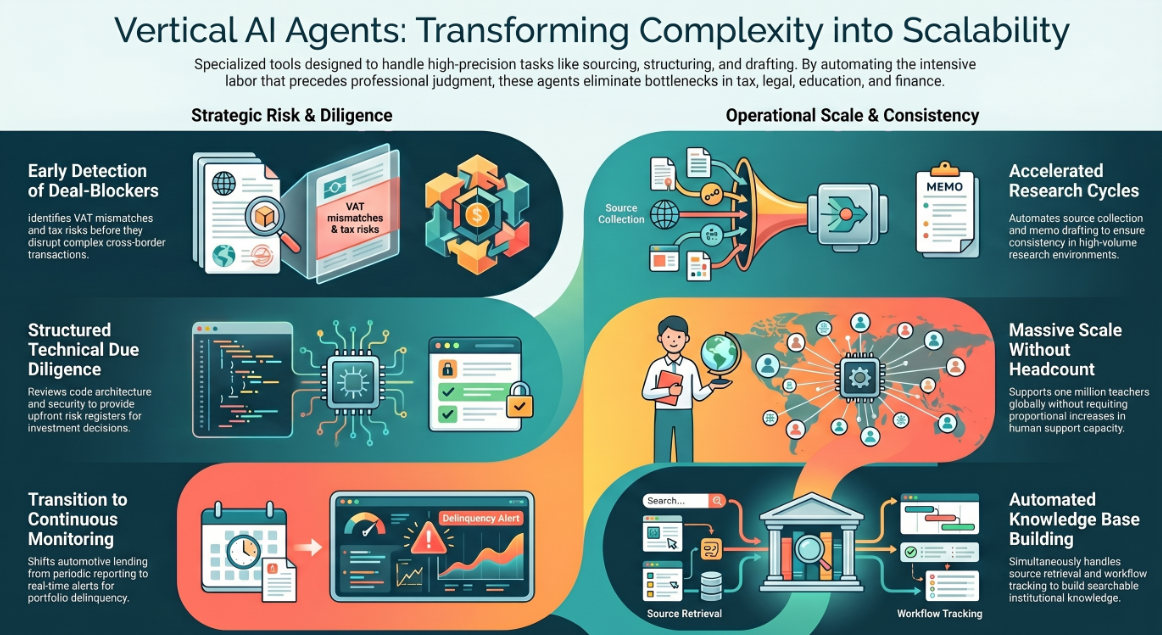
These are fields where precision, auditability, and citation matter more than speed. The AI agents deployed here are not replacing professional judgment — they are doing the sourcing, structuring, and drafting work that precedes it.
Cross-Border Tax Risk Screening Agent (Tax-Tech Platform)
A tax-tech product focused on early screening of cross-border transactions deployed an agent to identify withholding tax, VAT mismatches, and permanent establishment risks before they become deal-blockers.
What was built:
- Transaction screening workflows and risk classification
- Evidence collection and explainability notes
- Escalation workflow to tax experts
What changed: Withholding and VAT risks were identified earlier. Last-minute deal disruptions were reduced. Pre-compliance review became faster and more consistent — removing the bottleneck that had slowed down deal timelines.
Tax Research Automation Agent (Sales and Use Tax Platform)
A specialised sales and use tax research automation tool deployed an AI agent to handle source retrieval, summarisation, and drafting at scale.
What was built:
- Automated source collection and summarisation
- Draft memo and position output generation with citations
- Workflow tracking and knowledge base building
What changed: Research cycles became faster. Manual source-hunting time was reduced significantly. Research outputs became more consistent — a persistent challenge in any high-volume tax research environment where quality can vary by researcher.
Technical Due Diligence Agent (Long-Term Holding Company)
A long-term holding company that partners with founders and family businesses deployed an AI agent to conduct rigorous technical diligence for investment and acquisition decisions.
What was built:
- Code and architecture review
- Infrastructure and security assessment
- Scalability, resilience, and integration readiness analysis
- Risk register and remediation roadmap generation
What changed: Investment decisions became faster with clear, structured technical risk visibility. Post-deal surprises were reduced through upfront remediation planning. Confidence in scalability and security posture improved — a direct input to deal pricing and structure.
AI Agents in Education
Education platforms face a scale problem that is structurally similar to enterprise support: too many users with legitimate needs, not enough human capacity to serve them all with the speed and consistency they expect.
AI Agent for Global Teacher Community (131 Countries)
A global teacher community and learning platform with over one million teachers across 131 countries deployed an AI agent to provide competency insights, learning guidance, and automated support workflows at scale.
What was built:
- Teacher profiles with competency insights
- A support agent for programme and learning queries
- Analytics for programme operators and partners
What changed: Support for the educator community scaled without proportional increases in human support capacity. Access to learning resources and guidance became faster. Engagement and outcomes became measurable in ways that had not previously been visible to programme operators.
AI Agents in Automotive and Leasing
Portfolio Analytics Agent (Canadian Automotive Leasing Provider)
An independent Canadian automotive leasing provider offering manufacturer and dealer network programmes deployed an AI agent for lending performance and portfolio intelligence.
What was built:
- Portfolio KPIs covering risk, delinquency, maturity, and residual values
- Dealer network performance analytics
- Alerts for exceptions and early risk signals
What changed: Portfolio visibility improved. Risk identification became faster. Management moved from periodic reporting to continuous monitoring, allowing more proactive handling of exposure before it crystallised.
Multi-Agent AI Systems: Advanced Real-World Deployments
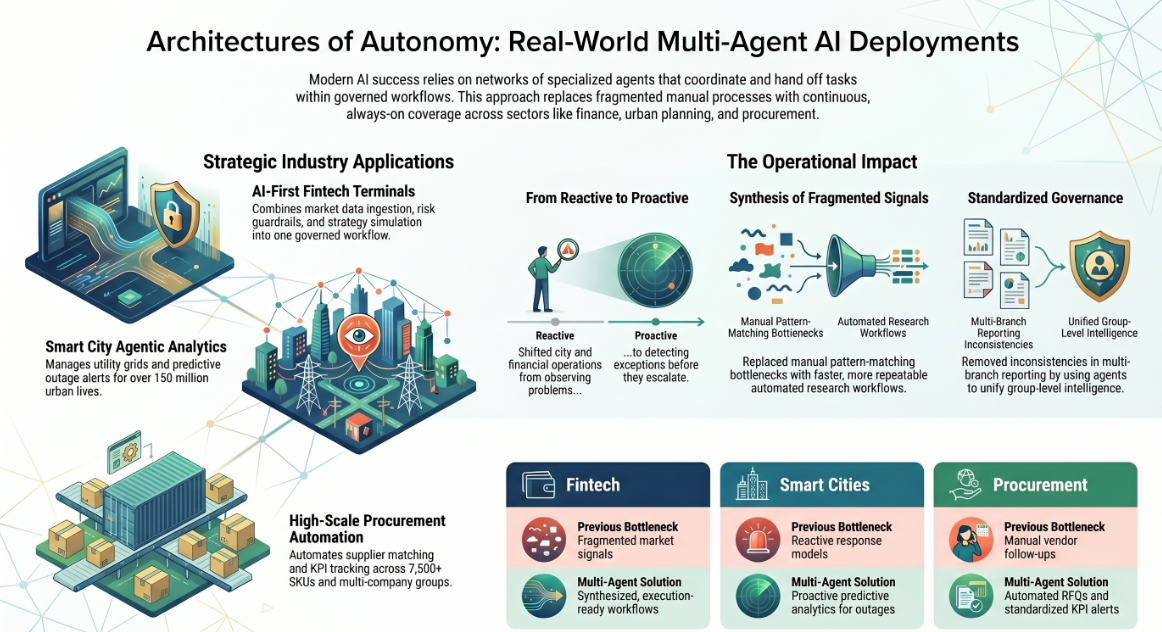
The most sophisticated deployments are not single agents. They are networks of specialised agents that coordinate, escalate, and hand off between each other — each handling the part of a workflow it is best suited for.
Multi-Agent Trading Terminal (AI-First Fintech)
An AI-first trading terminal positioned around a network of specialised agents deployed a system that combines research, analysis, signals, and execution into one governed workflow.
What was built:
- Market data ingestion with indicator and pattern analysis
- Strategy simulation with risk guardrails
- Alerting and recommendation summaries
- Execution-ready workflow integration
- Crypto trading insights and strategy automation with built-in guardrails
What changed: Fragmented market signals were synthesised faster. Decision-making became more disciplined through governed workflows. Manual monitoring effort was replaced by continuous, always-on agent coverage.
Smart City Agentic Analytics (150M+ Urban Lives)
A smart infrastructure unit operating at city scale — running 25+ smart city operation centres and connecting over two million assets and applications — deployed an agentic analytics and operational alerting layer on top of existing smart utility systems.
What was built:
- Smart grid data ingestion and operational dashboards
- Predictive analytics for outages, losses, and field issues
- Automated alerts and workflow routing for resolution
What changed: Operational visibility across interconnected urban systems increased. Exception detection and response coordination became faster. The system moved city operations from reactive to proactive — a meaningful shift when the operational footprint spans more than 150 million urban lives.
Pharma Sourcing and Procurement Agent (Specialised Excipients Platform)
A pharma sourcing and excipients platform marketing over 1,800 rare excipients and 7,500+ SKUs deployed an AI agent to automate procurement and supplier discovery.
What was built:
- RFQ automation and supplier matching workflows
- Quality and regulatory document handling support
- Analytics on price, lead time, and vendor performance
What changed: Procurement cycles became faster. Vendor coordination and manual follow-ups were reduced. Price and lead-time competitiveness improved through continuous insight rather than periodic reviews.
Group-Wide Procurement and Finance KPI Agent (Family Business Group)
One of the UAE's most prominent family business groups — comprising 30+ companies across retail, building, industrial, and services — deployed an agent to automate procurement and finance KPI alerts across group entities.
What was built:
- Automated alerts covering purchase price trends, gross margin impact, early payment analysis, and vendor performance
- Dashboards and scheduled insight packs for leadership
- Group-wide KPI standardisation
What changed: Margin erosion and vendor slippage were detected earlier. Finance and procurement intelligence was standardised across entities, removing the inconsistency that had previously made group-level analysis unreliable. Variance surprises were reduced through continuous monitoring.
Stock Market Research Automation (Elliott Wave Analytics Platform)
A market research and technical analysis platform using Elliott Wave theory and related indicators deployed an AI agent to automate research workflows and insight generation.
What was built:
- Data ingestion and indicator pipelines
- Research automation and insight generation
- Alerts and thematic dashboards
What changed: Market insight packs were produced faster. Research workflows became more repeatable and consistent. Signal visibility improved through automated analytics, replacing the manual pattern-matching that had been the bottleneck in the previous research process.
Driving School Operations Agent (Dubai Driving Institute)
A Dubai-based driving institute with multi-branch operations deployed an AI analytics agent to improve operational efficiency and customer experience.
What was built:
- Funnel analytics covering enrolment, lessons, and tests
- Instructor utilisation and slot optimisation
- Customer experience dashboards and alerts
What changed: Operational bottlenecks were reduced. Scheduling efficiency improved. Visibility into conversion and performance drivers gave management the data to act on problems rather than observe them.
What Results Can You Realistically Expect From AI Agents?
Across these 35+ deployments, the results follow consistent patterns. Here is an honest summary by outcome category:
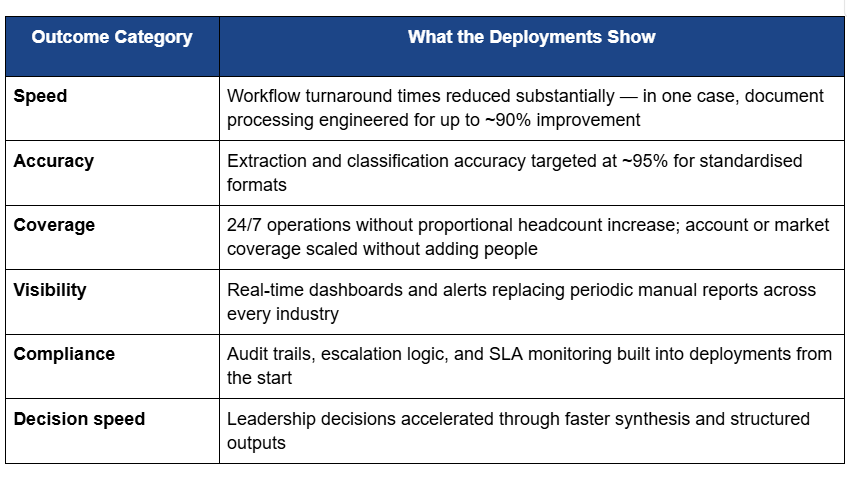
These are not the results of AI agents running autonomously without oversight. Every mature deployment described here includes human-in-the-loop design, escalation paths, governance layers, and measurable KPIs. That combination — autonomy where appropriate, human judgment where required — is what makes the difference between a demo and a deployment.
How to Choose the Right AI Agent for Your Business
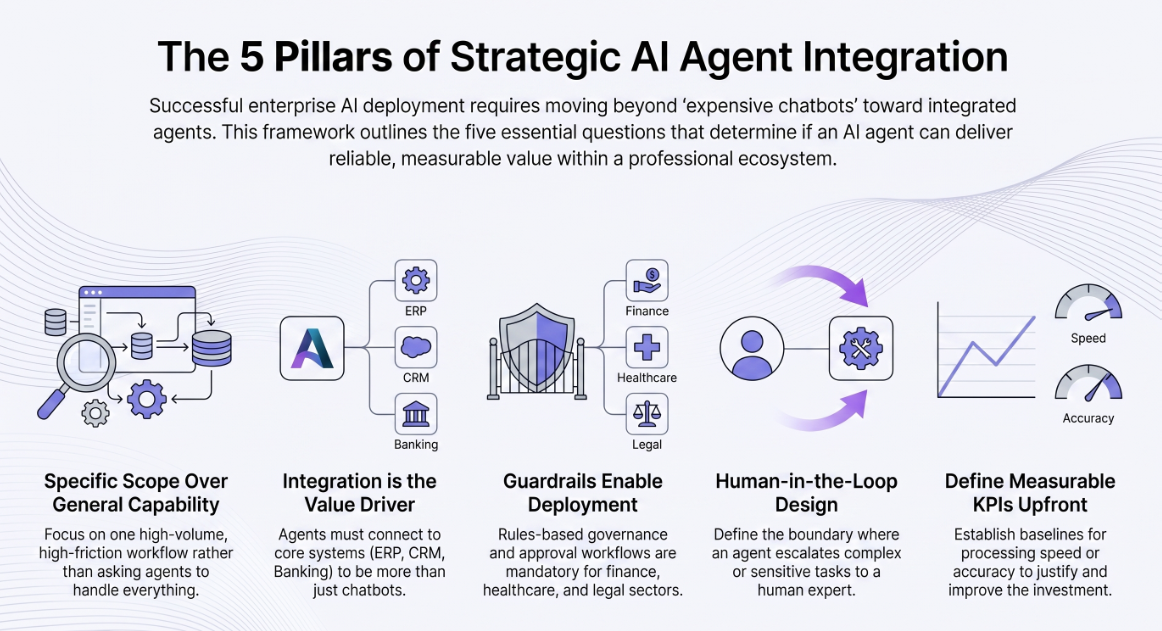
The pattern across successful deployments is consistent. Before building or buying, five questions determine whether an AI agent deployment will succeed:
1. Is the scope clear?
Every working AI agent described in this article does one category of work well. Agents that are asked to "handle everything" typically handle nothing reliably. Start with a specific, high-volume, high-friction workflow.
2. Can it connect to your actual systems?
The agents delivering results here are connected to ERP systems, CRMs, core banking platforms, sensor networks, and document stores. An AI agent without system integration is an expensive chatbot. Integration is not optional — it is where the value lives.
3. Does it have guardrails?
Every deployment in finance, healthcare, legal, and compliance includes rules-based governance, exception handling, and approval workflows for sensitive actions. Guardrails are not limitations — they are what makes enterprise deployment possible.
4. Does it know when to escalate?
The best deployments include human-in-the-loop design from the beginning — not as an afterthought. The luxury hospitality booking agent escalates for curated itinerary creation. The banking agent escalates for complex compliance decisions. Knowing the boundary between agent and human is a design requirement, not an edge case.
5. Is there a measurable outcome defined upfront?
Every deployment worth pointing to has a defined KPI — processing speed, extraction accuracy, fill rate, response time, margin alert frequency. Without a measurement baseline, you cannot improve. Without improvement, you cannot justify the investment.
The Bottom Line
Most AI agents' articles describe what is theoretically possible. This one documents what has actually been built, deployed, and measured across industries, geographies, and business types — from a luxury safari booking agent in Kenya to a smart grid operations platform serving 150 million urban lives.
The common thread is not technology. It is the design principle: a specific workflow, connected to real systems, with defined escalation logic, governed outputs, and a measurable outcome.
If you are evaluating AI agents for your business, the question is not whether this technology works. The evidence above is the answer to that. The question is where in your operation the highest-value workflow sits — and what it would mean to run it continuously, accurately, and at scale.
Frequently Asked Questions
What is a real-world example of an AI agent?
A real-world AI agent example is a booking automation system deployed by a luxury safari lodge group that reads incoming booking emails, identifies intent, checks inventory, negotiates alternative dates, and generates invoices — all without human involvement until the itinerary creation stage. Another example is a retail chain's voice support agent that answers stock queries in Hindi and English across hundreds of store locations simultaneously.
How are businesses using AI agents in 2026?
Businesses are deploying AI agents to automate high-volume workflows that previously required human attention: customer support, document processing, competitive monitoring, financial alerting, staffing and scheduling, procurement, and compliance. The pattern across deployments is the same — identify the highest-friction, highest-volume workflow, connect an agent to the relevant systems, define escalation logic, and measure outcomes against a baseline.
What is the difference between an AI agent and a chatbot?
A chatbot answers questions within a conversation. An AI agent takes actions, executes multi-step workflows, connects to external systems, handles exceptions, and works toward a defined goal without requiring a human to direct every step. A chatbot tells you your order is delayed. An AI agent detects the delay, updates the relevant systems, notifies the customer, and routes the exception to the right team.
What industries use AI agents the most?
Based on current production deployments, the industries with the most active AI agent adoption are financial services, retail and e-commerce, logistics and supply chain, healthcare operations, real estate management, and energy and utilities. Hospitality, construction, legal and compliance, and education are close behind.
What results do AI agents typically deliver?
Across real deployments: processing speed improvements of up to 90% for document-heavy workflows, extraction accuracy targets of 95% or higher, 24/7 operational coverage without headcount increase, earlier detection of financial and operational exceptions, and faster leadership decision-making through structured, always-on insight.
What is a multi-agent AI system?
A multi-agent AI system is a network of specialised agents that coordinate with each other to complete complex workflows. Rather than one agent handling everything, different agents handle different parts — one ingests and classifies, another analyses, another drafts or acts, another escalates. The AI-first trading terminal described in this article is an example: separate agents handle research, analysis, signal generation, and execution within a single governed workflow.
How long does it take to deploy an AI agent?
Deployment timelines vary based on scope, system integration complexity, and governance requirements. Simple agents with limited system connections can go from proof-of-concept to production in weeks. Enterprise deployments involving core banking systems, ERP integration, or multi-agent orchestration typically take longer and require iterative testing. The proof-of-concept phase is usually where scope and feasibility are confirmed before full production investment.
Are AI agents safe for enterprise use?
Yes, when designed correctly. Enterprise-grade AI agent deployments include audit trails, role-based access controls, human-in-the-loop escalation, rules-based governance for sensitive actions, and measurable SLAs. The deployments described in this article span financial services, healthcare, government utilities, and global logistics — all environments with significant compliance and operational risk requirements. Safety is a design choice, not a default.