Your support team is underwater. Ticket volumes are up. Customers expect answers in seconds, not hours. And somewhere between the fifth tab your agents have open and the third escalation of the morning, the question stops being "should we look at AI?" and becomes "why haven't we moved faster?"
AI agents for customer service are no longer a pilot project. In 2026, production deployments are resolving 55–70% of support tickets autonomously — handling the full resolution loop, not just deflecting queries to a help doc. The best of them work across chat, email, voice, and WhatsApp. They pull live data from your CRM, knowledge base, and ticketing system. They escalate to humans with full context. And they do it at a scale no headcount increase can match.
This guide ranks the top 7 AI agents for customer service in 2026. We evaluated each platform against six criteria that actually matter to support leaders making real purchasing decisions: resolution depth, omnichannel coverage, integration ecosystem, deployment speed, governance and auditability, and real-world outcomes. We also pull from enterprise deployments across retail, real estate, healthcare, banking, hospitality, and logistics — industries where the operational stakes are high and the margin for error is low.
What you'll find in this guide:
- A clear definition of what AI agents actually are (and why they're different from chatbots)
- The six criteria we used to rank each platform
- Honest assessment of the top 7 tools — including their strengths and limitations
- A side-by-side comparison table
- Deployment outcomes from real enterprise use cases
- FAQ answers to the questions every support leader asks before signing a contract
Let's get into it.
What Are AI Agents for Customer Service? (And Why They're Not Chatbots)
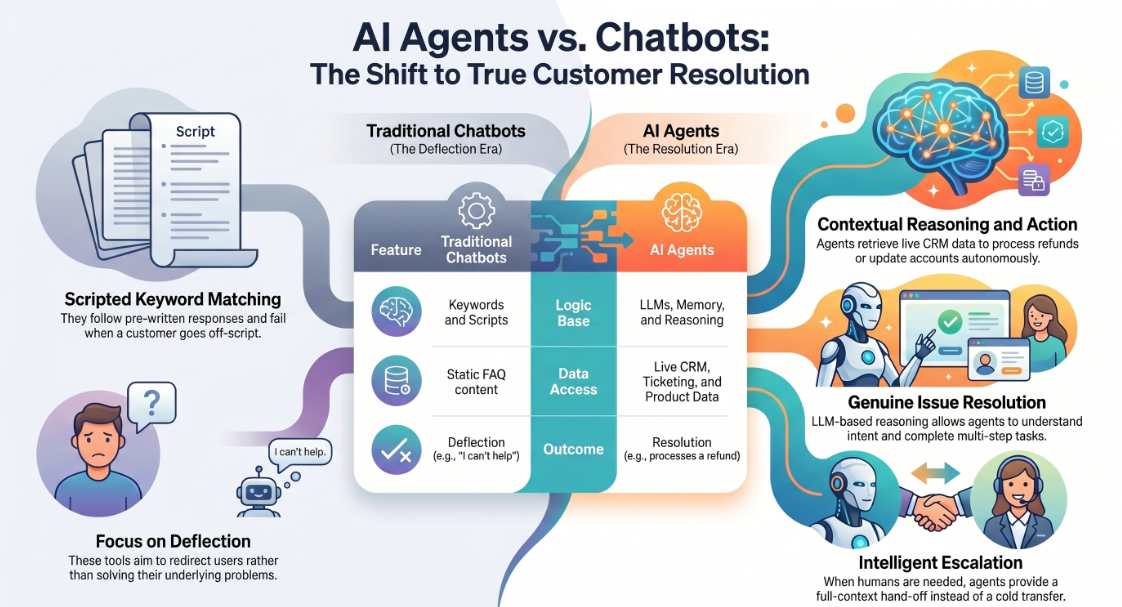
Before we rank anything, this distinction matters: AI agents and chatbots are not the same product. Calling them both "AI" is like calling a calculator and a data analyst both "math."
Traditional chatbots match keywords to pre-written responses. They follow scripts. When a customer asks something off-script, they say "I didn't understand that" or redirect to a human. They deflect. They don't resolve.
AI agents are fundamentally different. They're built on large language models (LLMs) with tool access, memory, and reasoning capability. When a customer submits a request, an AI agent:
- Understands the intent — not just the keywords
- Retrieves live context from your CRM, ticketing system, knowledge base, and product data
- Reasons through the right resolution path
- Takes action — updating an account, logging a ticket, issuing a refund, scheduling a callback
- Knows when to escalate — and hands off with full context, not a cold transfer
The result is genuine resolution, not deflection. A chatbot tells a customer "I can't help with that." An AI agent checks the order history, sees the item was delivered three days late, finds the refund policy in your knowledge base, processes the refund, and sends the confirmation — all without a human touching it.
That's the operational shift companies are deploying in 2026. And the gap between companies doing this and those still running traditional chatbots is widening every quarter.
How We Evaluated These AI Agents
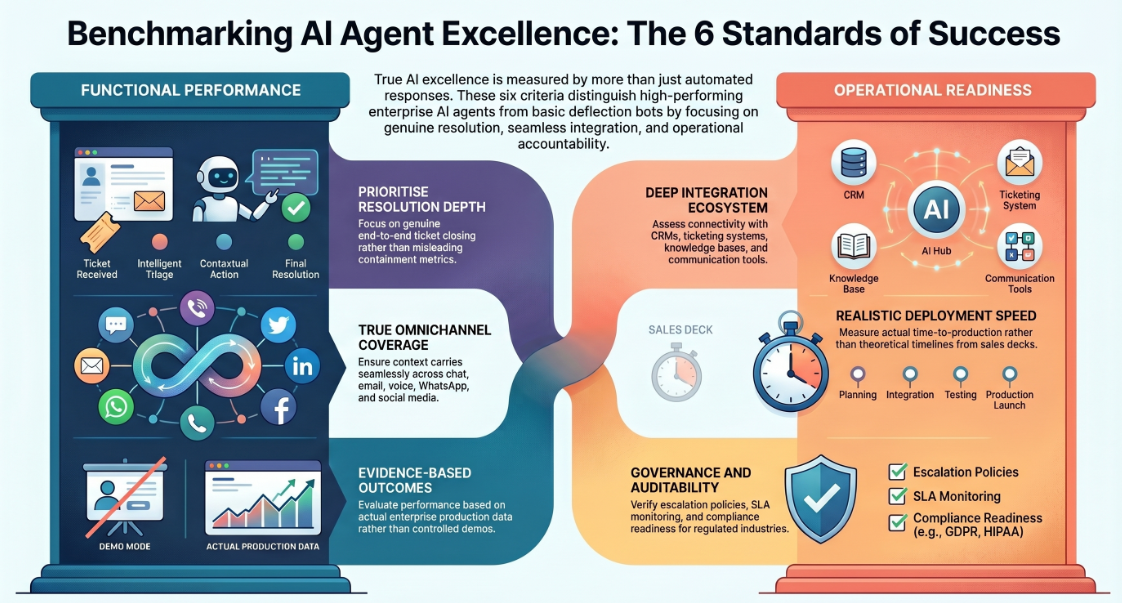
Every "best of" list has a methodology. Here's ours — and why each criterion matters.
1. Resolution Depth Does the platform actually close tickets, or does it route and deflect? We looked for genuine end-to-end resolution rates, not containment metrics that inflate the numbers.
2. Omnichannel Coverage Real customer service doesn't happen on one channel. We evaluated whether each platform handles chat, email, voice, WhatsApp, and social — and whether context carries across them.
3. Integration Ecosystem An AI agent is only as useful as the systems it connects to. We assessed depth of integration with CRM (Salesforce, HubSpot), ticketing (Zendesk, Freshdesk, ServiceNow), knowledge bases (Confluence, Notion), and communication tools (Slack, Teams, Intercom).
4. Deployment Speed Time-to-production matters. A platform that takes six months to go live isn't solving your problem this quarter. We noted realistic deployment timelines, not sales-deck estimates.
5. Governance and Auditability For regulated industries and enterprise operations, this is non-negotiable. We looked for escalation policies, SLA monitoring, audit logs, and compliance readiness.
6. Real-World Outcomes This is the most important criterion and the one most competitor guides skip. We drew from actual enterprise deployments across multiple verticals to benchmark what these platforms deliver when they're in production — not in a demo environment.
Top 7 AI Agents for Customer Service in 2026
1. assistents.ai — Best for Enterprise Omnichannel Resolution at Scale
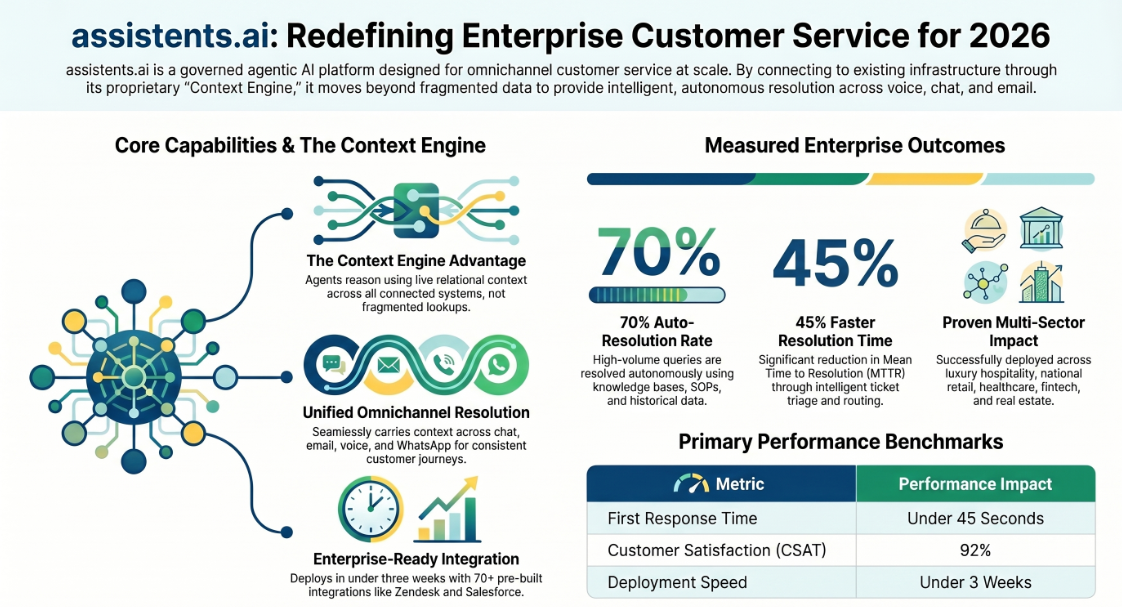
What it is: assistents.ai is an enterprise agentic AI platform that deploys governed AI agents across customer support, finance, sales, HR, and operations. The customer support offering combines conversational agents, voice AI, document AI, and autonomous workflow execution — connected to your existing systems, operating with full audit trails.
Best for: Mid-market to enterprise teams that need omnichannel support automation across complex environments, especially where multiple systems, languages, or geographies are involved.
Key capabilities:
- Omnichannel intake across chat, email, voice, and WhatsApp — with context carrying across every channel
- Intelligent ticket triage: sentiment detection, urgency classification, category routing
- Knowledge-powered auto-resolution: agents search your knowledge base, SOPs, and historical tickets to resolve issues without human involvement
- Automated escalation with full context handoff — no cold transfers, no lost history
- 70+ pre-built integrations: Zendesk, Freshdesk, ServiceNow, Salesforce, HubSpot, Confluence, Notion, Twilio, Five9, and more
- Full audit logs, SLA monitoring, and CSAT tracking built in
- Production-ready in under three weeks
Standout feature: The Context Engine. Rather than searching one system at a time, assistents builds a live semantic understanding across all connected systems — meaning agents reason with full relational context, not fragmented point-in-time lookups. A customer's ticket history, open orders, entitlements, and communication preferences are all available in a single unified view before the agent responds.
Measured outcomes: 70% auto-resolution rate, 45% faster mean time to resolution (MTTR), 92% CSAT score, first response under 45 seconds.
Limitation: Best suited for organisations with existing system infrastructure (CRM, ticketing, knowledge base). Smaller teams with minimal tooling may not unlock the full depth of integration capability on day one.
Real deployment evidence (industries, no client names):
A luxury hospitality brand operating 16 boutique properties deployed an AI booking and support agent that handled end-to-end guest inquiry workflows — from availability queries to itinerary generation to invoice creation — with human-in-the-loop quality control at defined handoff points. The result was faster booking turnaround, higher accuracy on complex guest requirements, and scalable operations without compromising service quality.
A national retail chain with 700+ stores deployed three integrated agents: a voice support agent (in both Hindi and English), an inventory intelligence agent with real-time pricing and stock visibility per store, and a knowledge and training agent built on RAG over internal SOPs and POS documentation. The result was a meaningful reduction in manual helpdesk burden, improved store-level inventory visibility, and faster onboarding through on-demand training guidance.
A UK private healthcare provider with high-volume consumer workflows automated the full service delivery cycle — booking, processing, and reporting — and added operational analytics on top. The result was faster customer communications, fewer missed handoffs, and unified service visibility across the operation.
A major UAE real estate portfolio owner deployed an omnichannel customer service agent across web, WhatsApp, and email to handle tenant queries, rental and payment support, maintenance requests, and FAQ resolution — with automated escalation and SLA tracking. The result was 24×7 tenant coverage, consistent service quality, and reduced call-centre load.
A global banking fintech with operations spanning disputes, fraud, and compliance deployed omnichannel AI agents with auditable workflow automation — including voice support, case handling, and SLA monitoring — achieving faster case resolution and improved compliance readiness.
2. Zendesk AI — Best for Teams Already Invested in the Zendesk Ecosystem
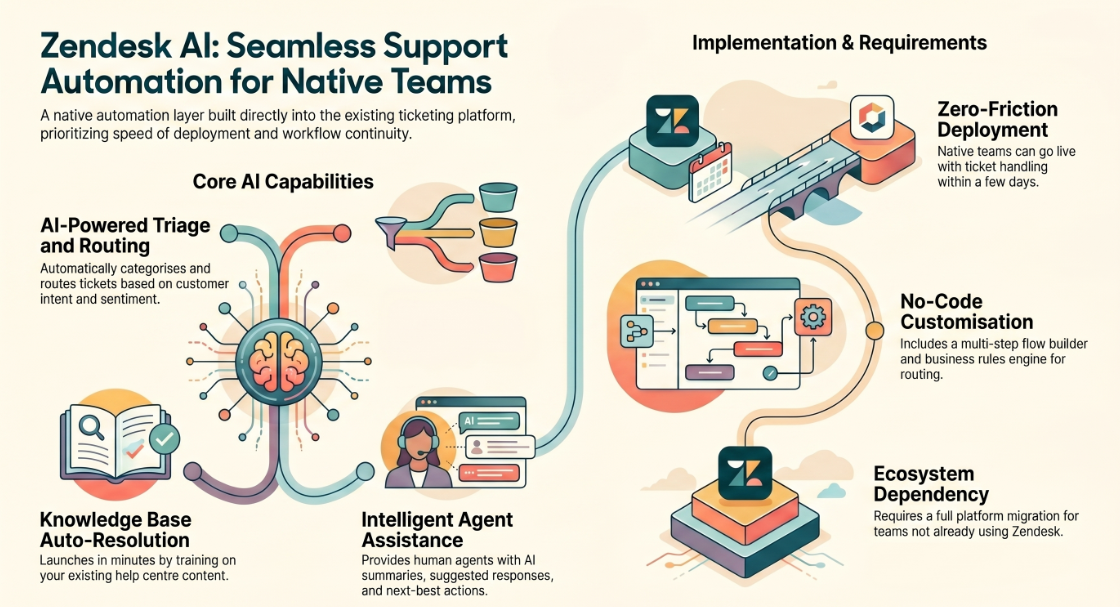
What it is: Zendesk's AI layer sits natively on top of its market-leading ticketing platform, offering automated triage, knowledge base search, AI-generated draft responses, and agent assist tools.
Best for: Support teams already operating on Zendesk who want to add AI capability without changing their core workflow.
Key capabilities:
- AI-powered triage: automatic categorisation and priority routing based on customer intent and sentiment
- Knowledge base-trained auto-resolution — launched in minutes from existing help content
- Agent assist: suggested responses, next-best actions, and AI summaries for human agents
- No-code flow builder for multi-step automated workflows
- Business rules engine for trigger-based routing and escalation
Standout feature: Zero-friction deployment for Zendesk-native teams. If your knowledge base is already in Zendesk, the AI can be live handling tickets within days — no complex integration required.
Limitation: Value is heavily gated by your existing Zendesk investment. Teams not already on Zendesk face a full platform migration before they can access the AI layer. Voice automation and cross-channel context are less mature than AI-native platforms.
3. Intercom Fin — Best for SaaS and Mid-Market Customer Support
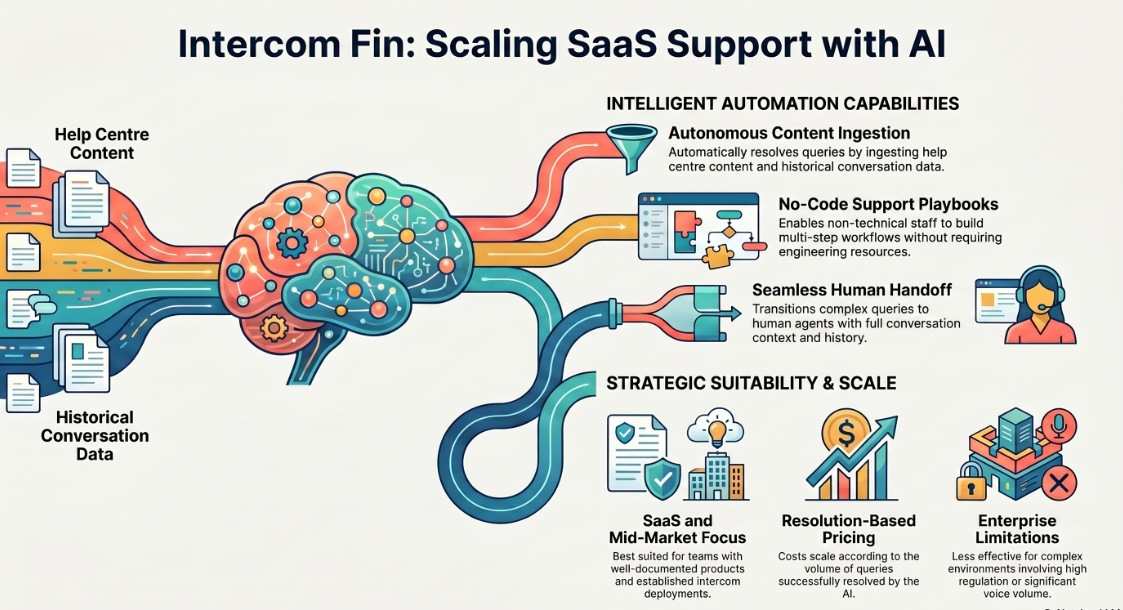
What it is: Fin is Intercom's AI agent product, built on top of its established customer messaging platform. It ingests your help centre content, product documentation, and historical conversations to resolve customer queries autonomously.
Best for: SaaS companies and mid-market teams with well-documented products and established Intercom deployments.
Key capabilities:
- Ingests existing help centre content for immediate deployment
- Can take autonomous actions — not just answer questions — based on configured workflows
- Smooth handoff to human agents with full conversation context
- Integration with Intercom's inbox, live chat, and ticketing infrastructure
- Answer quality monitoring and feedback loops for continuous improvement
Standout feature: Playbooks that let non-technical team members build multi-step support workflows — enabling product and support leaders to iterate without engineering involvement.
Limitation: Designed primarily for structured SaaS support contexts. Less suited to complex enterprise environments with multiple systems, high regulatory requirements, or significant voice channel volume. Pricing scales with resolution volume, which can become significant at enterprise scale.
4. Replicant — Best for Voice-First Contact Center Automation
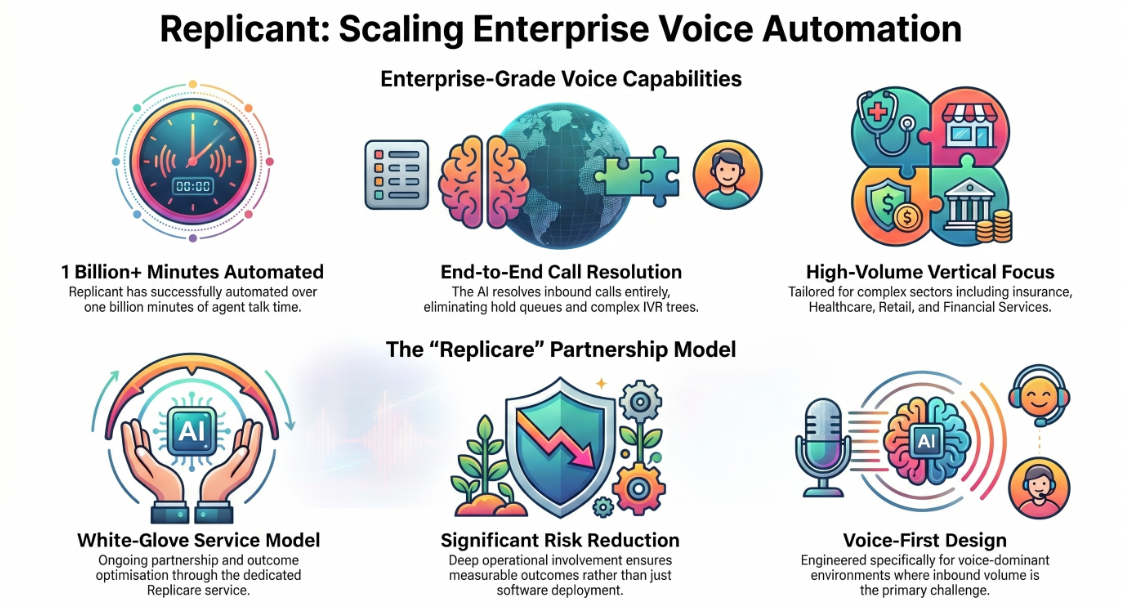
What it is: Replicant automates customer conversations across voice and chat, with a strong focus on contact centre environments where inbound call volume is the primary operational challenge. The company has crossed one billion agent minutes automated.
Best for: Enterprise contact centres where voice is the dominant support channel — insurance, healthcare, home services, retail, and financial services.
Key capabilities:
- Voice AI that resolves calls end-to-end, without IVR trees or hold queues
- Chat automation with consistent resolution quality
- Proven playbooks across high-volume verticals
- Replicare: a white-glove service model that includes ongoing partnership and outcome optimisation
- Strong performance analytics and conversation intelligence
Standout feature: Depth of operational partnership. Rather than deploying software and stepping back, Replicant works alongside enterprise clients to drive measurable outcomes — which reduces deployment risk significantly.
Limitation: Voice-led by design. Teams looking for deep omnichannel automation across chat, email, WhatsApp, and CRM workflows will find the platform less native to those use cases. Pricing reflects enterprise positioning and partnership model.
5. Kore.ai — Best for Large Enterprises Needing Structured Agentic Workflows
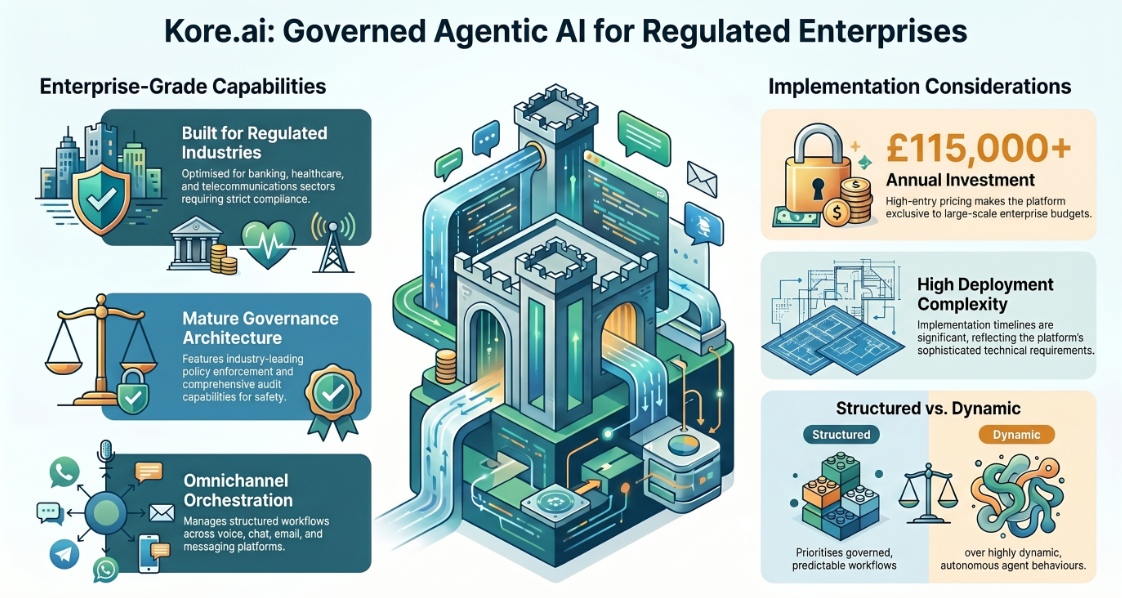
What it is: Kore.ai is an enterprise-grade agentic AI platform that balances structured, governed workflows with conversational AI. It's recognised in both the Gartner Magic Quadrant and the Forrester Wave for Conversational AI Platforms.
Best for: Large enterprises — particularly in banking, healthcare, and telecommunications — that need robust governance, compliance controls, and structured workflow orchestration alongside conversational capability.
Key capabilities:
- Agentic AI with both structured workflow and free-form conversational handling
- Strong compliance and governance architecture for regulated industries
- Omnichannel deployment across voice, chat, email, and messaging
- Extensive enterprise integration library
- Advanced analytics and performance management tools
Standout feature: Governance architecture. For enterprises operating in regulated environments — banking, insurance, healthcare — Kore.ai's policy enforcement and audit capabilities are among the most mature in the market.
Limitation: Complexity is high and deployment timelines reflect it. Enterprise contracts are estimated at $150,000+ annually, making it inaccessible for mid-market teams. The platform can also feel less flexible for building highly dynamic autonomous agent behaviours compared to newer AI-native platforms.
6. Yellow.ai — Best for Global Enterprises Requiring Multilingual Omnichannel Support
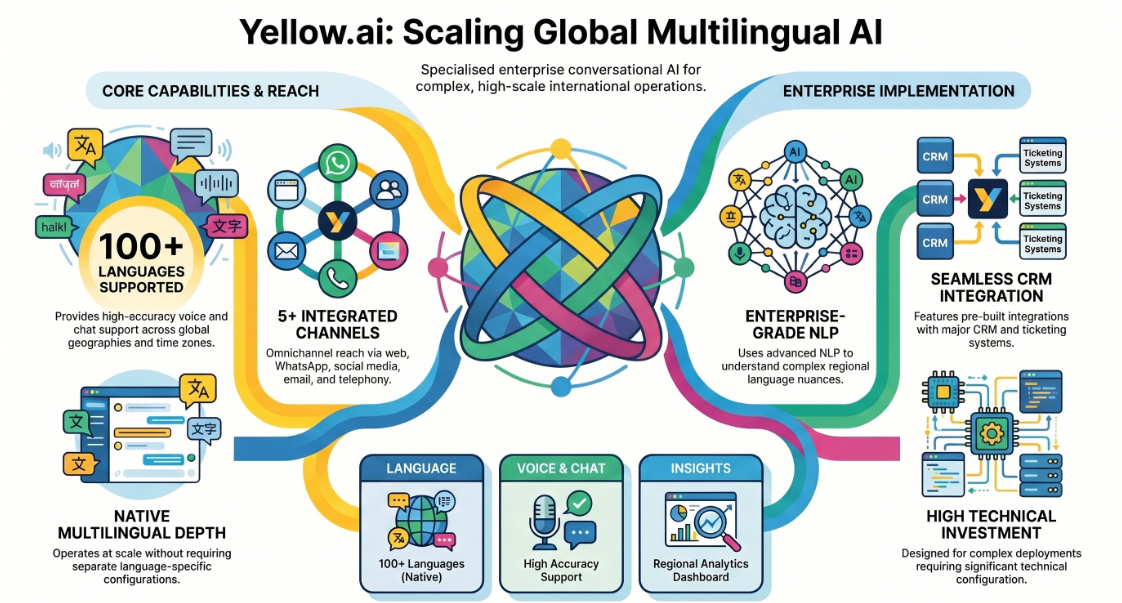
What it is: Yellow.ai is an enterprise conversational AI platform supporting 100+ languages across voice and chat, designed for global operations with high multilingual support complexity.
Best for: Multinational enterprises serving diverse customer bases across geographies, languages, and time zones.
Key capabilities:
- 100+ language support with high accuracy across voice and chat
- Omnichannel: web, WhatsApp, social, email, and telephony
- Enterprise-grade NLP for understanding regional language nuance
- Pre-built integrations with major CRM and ticketing systems
- Analytics dashboard across regions and channels
Standout feature: Multilingual depth at scale. For global enterprises where language complexity is the primary challenge, Yellow.ai's native multilingual capability outperforms most competitors without requiring separate language-specific configurations.
Limitation: Platform configuration for highly complex deployments can require significant technical investment. Teams with simpler environments may find the feature set heavier than needed. Less optimised for real-time omnichannel context continuity compared to AI-native platforms built around context engines.
7. Cognigy (NiCE) — Best for Enterprise Contact Centres Modernising Legacy IVR
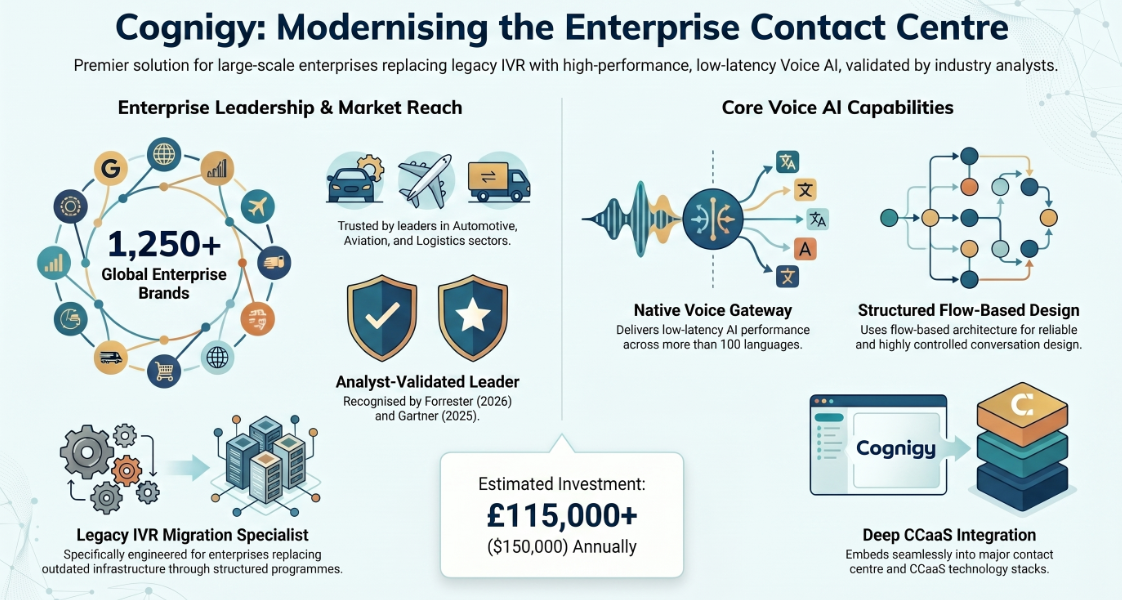
What it is: Cognigy is an enterprise conversational AI platform acquired by NiCE, deeply embedded in large contact centre environments. It was named a Leader in the Forrester Wave for Conversational AI Platforms in Q2 2026 and recognised in the Gartner Magic Quadrant in 2025.
Best for: Large enterprise contact centres — particularly those running legacy IVR systems — looking for a proven, analyst-validated platform with deep voice gateway capability.
Key capabilities:
- Native Voice Gateway supporting 100+ languages with low-latency voice AI
- Flow-based agent building for structured conversation design
- Deep integration with major CCaaS and contact centre stacks
- Strong analytics and operational reporting tools
- Serves 1,250+ enterprise brands in automotive, aviation, logistics, and more
Standout feature: Voice modernisation depth. For enterprises replacing legacy IVR infrastructure, Cognigy's native Voice Gateway and enterprise contact centre integrations make it a natural fit for structured migration programmes.
Limitation: The flow-based architecture, while reliable, can feel less flexible for building highly dynamic or autonomous agent behaviours compared to LLM-native platforms. Pricing is custom enterprise-level, estimated at $150,000+ annually. Forrester also notes gaps in reporting, administration, and escalation-to-live-agent capabilities that matter for teams managing large contact centre operations.
Head-to-Head Comparison Table
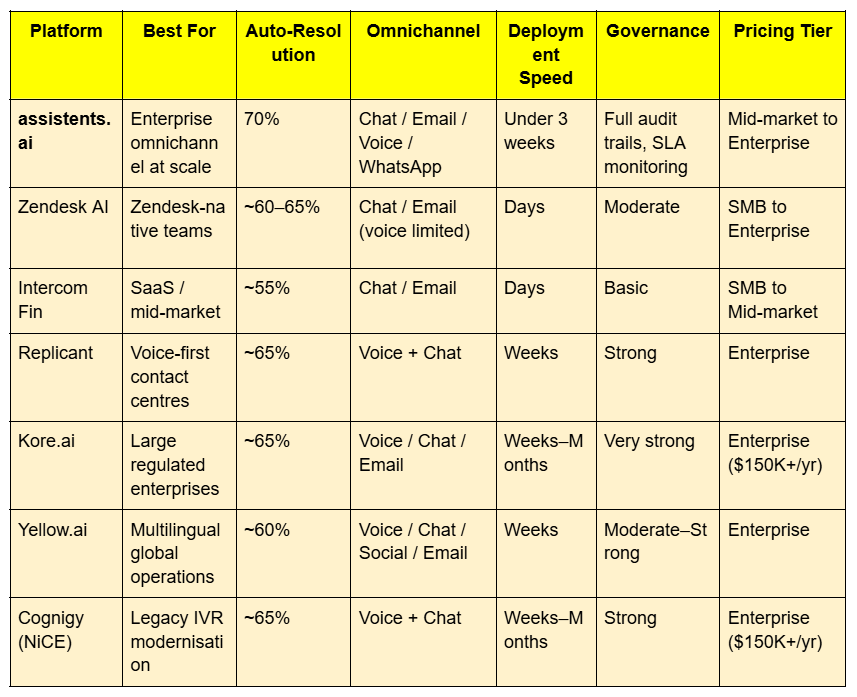
What to Look for When Choosing an AI Agent for Customer Service
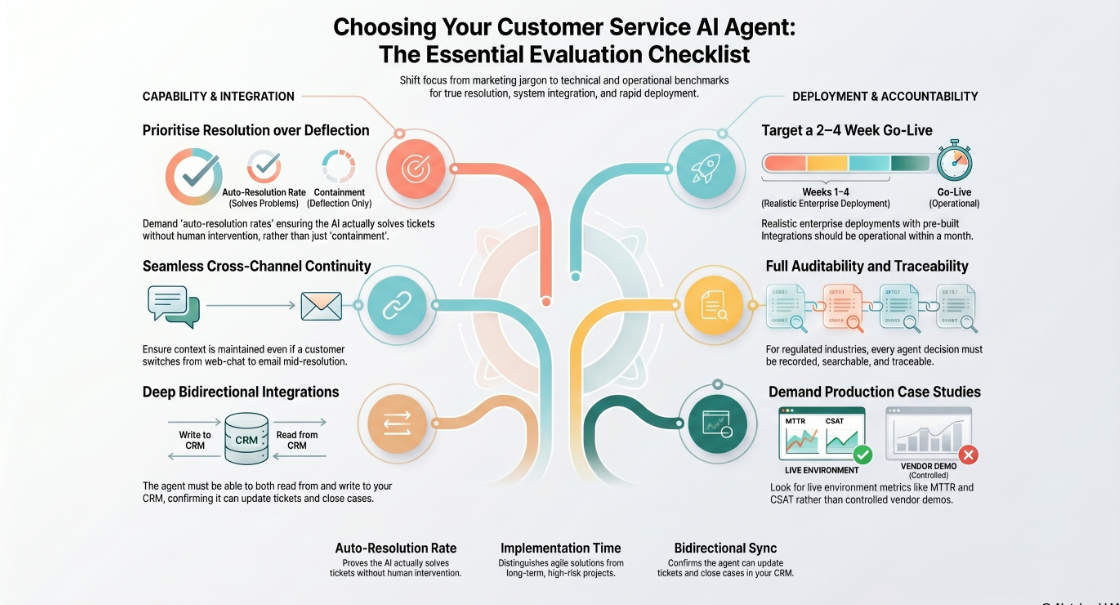
The comparison table tells you what each platform does. These questions help you figure out which one fits your operation.
Does it actually resolve, or just deflect?
This is the most important question and the easiest one to obscure with marketing language. "Containment rate" and "deflection rate" are not the same as "resolution rate." Containment means the customer didn't ask for a human — it doesn't mean their issue was solved. Before you sign anything, ask for the vendor's auto-resolution rate on your ticket category mix. If they can't give you that number, push harder.
Will it work across every channel your customers use?
Customers don't choose channels based on what's convenient for your AI deployment. They start on your website, follow up on WhatsApp, and call in when they're frustrated. A platform that handles chat well but loses context the moment a customer emails you is creating a fragmented experience. Push vendors on cross-channel context continuity — specifically, what happens to a conversation when a customer switches channels mid-resolution.
How deep are the integrations?
An AI agent that can't access your CRM, order management system, or knowledge base isn't a resolution engine — it's an expensive FAQ bot. Ask specifically about bidirectional sync: can the agent both read from and write to your systems? Can it update a ticket, close a case, or log a resolution note without a human doing it manually?
How fast can you actually go live?
Sales timelines and implementation timelines are different things. A platform that promises results in six months is not solving your Q3 problem. Realistic enterprise deployments with pre-built integrations and experienced implementation teams can go live in two to four weeks. That should be your benchmark.
Can you audit what the agent does?
For any regulated industry — healthcare, financial services, real estate, utilities — this is non-negotiable. You need to know what the agent said, what decision it made, and why. Escalation policies should be configurable. SLA thresholds should be monitored. Every resolution should be traceable. If a vendor can't show you their audit trail in a demo, assume it doesn't exist.
What do real deployments look like — not demos?
Ask for production case studies in your industry, with specific outcome metrics. If the only proof a vendor can offer is a controlled demo environment, that tells you something. The platforms worth deploying in 2026 have production evidence — auto-resolution rates, MTTR improvements, CSAT scores, and time-to-value metrics from live enterprise environments.
Real-World Results: What AI Agents Actually Deliver in Production
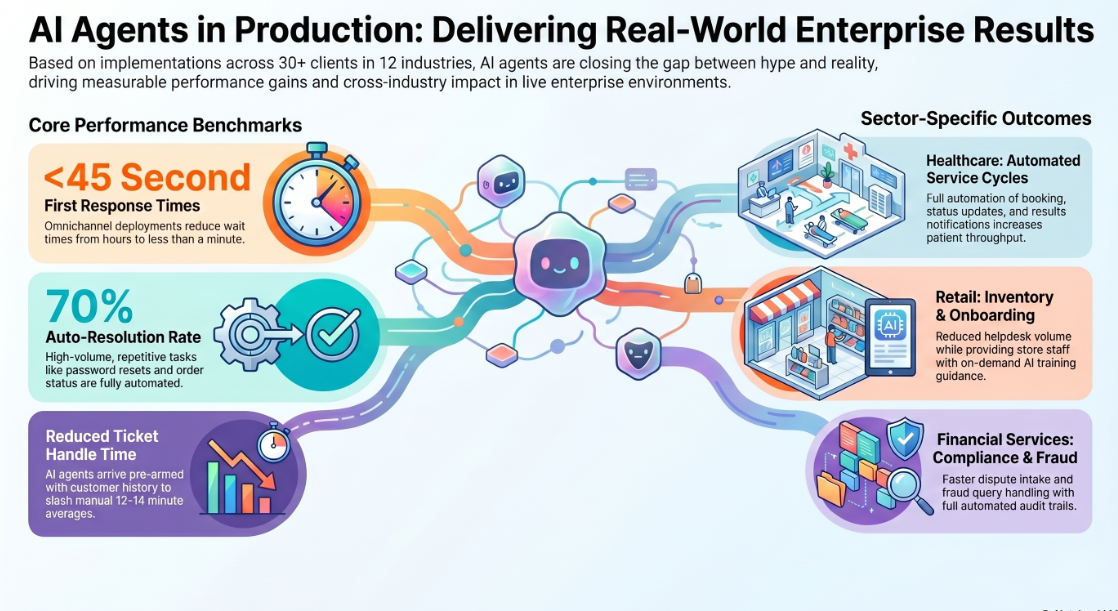
The gap between what AI agents promise and what they deliver in production is where most procurement decisions go wrong. Here is what enterprise deployments across multiple verticals are actually achieving — drawn from assistents.ai implementations across 30+ clients in 12 industries.
Speed
Support teams deploying AI agents are seeing first response times drop from minutes or hours to under 45 seconds across omnichannel deployments. Ticket handle time — which averages 12–14 minutes in manual environments — reduces significantly when agents arrive at every ticket pre-armed with customer history, relevant knowledge articles, and suggested resolution actions.
Automation Depth
The 70% auto-resolution benchmark is achievable for structured, repetitive workflows — which typically represent the majority of any support team's ticket volume. The key is identifying the right ticket categories first: order status, account queries, FAQ resolution, password resets, booking confirmations, and maintenance request intake are consistently the highest-volume, highest-automation-rate categories across industries.
Vertical Evidence
Retail: A national retailer with hundreds of stores deployed integrated support agents across voice, inventory, and training workflows. The outcome was a measurable reduction in helpdesk ticket volume, improved store-level inventory visibility, and faster onboarding for new store staff through on-demand AI-powered training guidance.
Real estate: A major property portfolio operator deployed an omnichannel tenant support agent handling lease enquiries, payment queries, maintenance requests, and FAQs across web and WhatsApp. The result was 24×7 availability, consistent service quality, and a significant reduction in call-centre volume — with automated escalation ensuring complex cases reached the right human team immediately.
Healthcare: A high-volume private healthcare provider automated the full service cycle — booking intake, status updates, result notifications, and customer communications — through a unified AI agent layer. The result was fewer missed communications, faster throughput, and a consolidated operational view that previously required manual aggregation.
Hospitality: A luxury travel brand automated guest booking enquiries through an AI agent handling availability checks, alternative date negotiation, itinerary assistance, and invoice generation. The result was faster turnaround on complex bookings and consistent service quality across a high-expectation guest base.
Financial services: A global fintech deployed AI agents across customer dispute intake, fraud query handling, and compliance workflow routing — with full audit trails and bidirectional integration with core banking systems. The result was faster case handling, reduced operational load, and improved compliance readiness ahead of regulatory reviews.
Logistics: A global ports and logistics enterprise deployed a terminal and rail management solution integrating AI agents for operational visibility, exception management, and executive reporting. The result was higher predictability of throughput and more efficient coordination across terminal and inland logistics operations.
Conclusion: Choosing the Right AI Agent for Your Customer Service Team
The market for AI customer service agents in 2026 is real, mature, and producing measurable outcomes in production. The key is choosing a platform aligned with your operational reality — not the one with the most impressive demo.
Here's a quick decision framework:
- If you're already on Zendesk and want fast, low-risk AI addition → Zendesk AI is the natural starting point
- If you're a SaaS company with a well-documented product and existing Intercom deployment → Intercom Fin solves your problem quickly
- If voice is your primary support channel and you're running a high-volume contact centre → Replicant's operational depth and partnership model is worth the investment
- If you're a large regulated enterprise — banking, insurance, healthcare — and governance is the primary requirement → Kore.ai or Cognigy are the analyst-validated choices
- If you're a global enterprise with multilingual complexity across multiple geographies → Yellow.ai's language depth is genuinely differentiated
- If you need omnichannel resolution at enterprise scale — across chat, email, voice, and WhatsApp — with deep system integrations, fast deployment, and real-world outcome evidence → assistents.ai is built for exactly this
The platforms that will separate from the field over the next 18 months are those that go beyond answering questions — to actually executing resolutions, across every channel, with full auditability. That's the standard worth holding every vendor to.
Ready to see what 70% auto-resolution looks like in your environment?
assistents.ai deploys enterprise AI agents for customer service in under three weeks — connected to your systems, working across your channels, with full audit trails from day one.
Schedule a Demo → | See the Customer Support Platform →
Frequently Asked Questions
What is an AI agent for customer service?
An AI agent for customer service is an autonomous software system that understands customer queries, retrieves context from your live systems — CRM, knowledge base, ticketing platform, order management — reasons through the right resolution path, and takes action without human involvement. Unlike traditional chatbots that match keywords to pre-written responses, AI agents complete multi-step tasks end-to-end: updating accounts, processing requests, logging resolutions, and escalating complex cases with full context.
How is an AI agent different from a chatbot?
A chatbot follows a script. An AI agent reasons. Chatbots deflect — they redirect customers to a help article or a human when they can't match a keyword. AI agents resolve — they access live data, make decisions, take action, and close the ticket. In practice, a chatbot might handle 20–30% of incoming queries before hitting its limits. A well-deployed AI agent handles 55–70% of tickets autonomously, with genuine resolution, not deflection.
Can AI agents replace human customer service agents?
No — and the best deployments aren't designed to. AI agents handle the high-volume, repetitive queries that represent 60–70% of most support teams' ticket load. This frees human agents to focus on complex, emotionally sensitive, or high-stakes interactions where human judgement and empathy matter. The result is a better job for human agents and a faster, more consistent experience for customers. It's augmentation, not replacement.
What is a realistic auto-resolution rate for AI agents?
Production deployments in 2026 are consistently landing between 55–70% for structured, repetitive workflows. Chat tends to reach the higher end; voice and email vary depending on ticket complexity. The important metric is genuine resolution rate — not containment or deflection. When evaluating vendors, always ask for resolution rate on your specific ticket category mix, not a blended platform average.
How quickly can an AI customer service agent be deployed?
With pre-built integrations and a structured implementation process, production-ready deployments can go live in two to three weeks. This includes connecting to your ticketing system, ingesting your knowledge base and SOPs, configuring escalation policies, and deploying across your priority channels. More complex environments — multiple geographies, legacy system integrations, heavily regulated industries — may require four to eight weeks.
Do AI agents work across WhatsApp, voice, email, and chat simultaneously?
Yes — with the right platform. True omnichannel means context carries across every channel: a customer who starts a chat, follows up by email, and then calls in doesn't repeat their issue at each touchpoint. When evaluating platforms, test this specifically. Many tools handle individual channels well but lose context at channel boundaries — which creates exactly the kind of fragmented experience that drives customers to competitors.
How do AI agents handle complex or sensitive issues?
Through configurable escalation policies. AI agents continuously monitor conversation signals — sentiment shifts, complexity indicators, compliance flags, and urgency markers. When a situation exceeds their resolution threshold, they trigger a governed handoff to a human agent — with full conversation history, suggested resolution context, and relevant customer data attached. This means human agents inherit context, not confusion.
What industries use AI agents for customer service?
AI agents are production-deployed across retail and e-commerce, real estate and property management, financial services and banking, healthcare and patient services, luxury hospitality and travel, logistics and supply chain, energy and utilities, and professional services. The common denominator is high-volume, structured ticket workflows — which exist across virtually every industry with a customer-facing operation.
How much do AI customer service agents cost?
Pricing varies significantly by platform and scale. SMB-focused platforms like Intercom Fin typically charge per resolution volume. Enterprise platforms like Kore.ai and Cognigy are estimated at $150,000+ annually. Mid-market to enterprise platforms like assistents.ai offer deployment-based pricing with outcomes tied to production metrics. In evaluating cost, the right comparison is total cost against current support cost — including agent headcount, handle time, and the cost of slow resolution (customer churn, CSAT decline, and re-open rates).