Disclosure: assistents.ai is one of the 12 platforms reviewed here. We judged every tool, including our own, against the same published criteria, using each vendor's public documentation as of November 2026. Where another tool is the better fit, we say so.
AI voice agents for law firms exist because most firms still don't pick up the phone. When Clio sent secret shoppers to call 500 US law firms in mid-2024, only 40% of firms answered, down from 56% in 2019, and 48% were effectively unreachable by phone. A prospective client who hits voicemail at 8 p.m. after a car accident rarely waits for a callback. They dial the next firm.
This guide gives you four things: a side-by-side comparison of the 12 best AI voice agents and AI receptionists for law firms, the criteria we used, an ethical intake call flow mapped to ABA Formal Opinion 512, and a 30-day rollout plan with a 15-call test script you can run on any vendor before you sign.
What is an AI voice agent for a law firm? An AI voice agent for a law firm is software that answers and makes phone calls in natural speech. It greets callers, runs structured intake, screens for conflicts and practice-area fit, books consultations, writes a summary to the firm's case system and hands off to a person when needed. It never gives legal advice.
TL;DR: the best AI voice agents for law firms at a glance
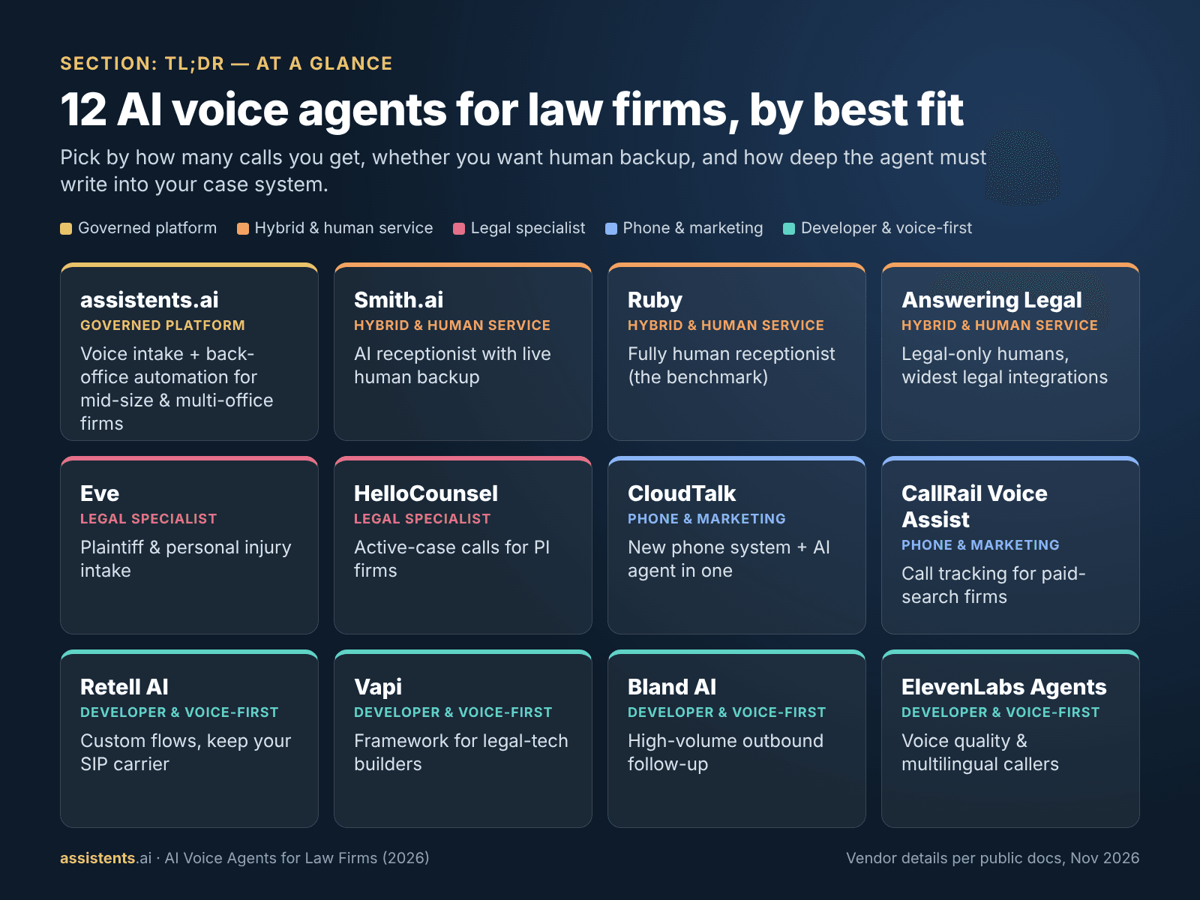
The best AI voice agent for your law firm depends on three things: how many calls you get, whether you need human backup, and how deeply the agent must write into your practice-management system. Here is the short version.
| Platform | Best for | Inbound / outbound | Legal system integrations (per vendor docs) | Human backup | Pricing model |
|---|---|---|---|---|---|
| assistents.ai | Mid-size and multi-office firms that want voice intake plus governed back-office automation | Both | Live API actions during calls; Zapier, Make and n8n connectors to 300+ systems | Warm transfer to your staff with full transcript | Custom, scoped after a discovery call |
| Smith.ai | Firms that want AI with live receptionist backup | Both | Clio Grow, Clio Manage, MyCase, Lawmatics, PracticePanther | Yes, vendor's live agents | Per call |
| Ruby | Firms that want a fully human receptionist (benchmark) | Mostly inbound | Clio and other legal tools | Human-only service | Per minute plans |
| Answering Legal | Legal-only answering service with deep integrations | Inbound | 75+, including Clio, MyCase, Smokeball, Lawmatics, Lead Docket | Human legal receptionists | Monthly plans |
| CloudTalk | Firms replacing their phone system and adding AI in one move | Both | CRM integrations; no native legal practice-management connector | Your own team, via routing | Phone seats plus AI minute bundles |
| CallRail Voice Assist | Firms running paid search that need call tracking | Inbound | Clio, HubSpot, Calendly | Your own team | Subscription |
| Eve | Plaintiff and personal injury intake | Inbound | Built into the Eve plaintiff platform; works with Zoom and RingCentral telephony | Transfer to your intake team | Subscription |
| HelloCounsel | PI firms automating active-case calls | Both | Case-file matching and write-back | Escalation to staff | Custom |
| Retell AI | Firms with developers building custom flows | Both | Build your own via API; SIP from Twilio, Telnyx, Vonage, Five9, Amazon Connect | Configurable transfer | Usage-based |
| Vapi | Legal-tech builders who want a developer framework | Both | Build your own via API | Configurable transfer | Usage-based |
| Bland AI | High-volume outbound follow-up | Both | Build your own via API | Configurable transfer | Usage-based / enterprise |
| ElevenLabs Agents | Voice quality and multilingual callers | Both | APIs and SDKs | Configurable transfer | Usage-based plans |
Pricing models and integrations change often. Confirm on each vendor's site before you buy.
What is an AI voice agent for law firms?
An AI voice agent for law firms is a phone-based AI that holds a real conversation with a caller, follows the firm's intake rules and takes action in the firm's systems while the call is still live. It is not a phone tree, and it is not a chatbot with a phone number.
How it works: listen, think, act
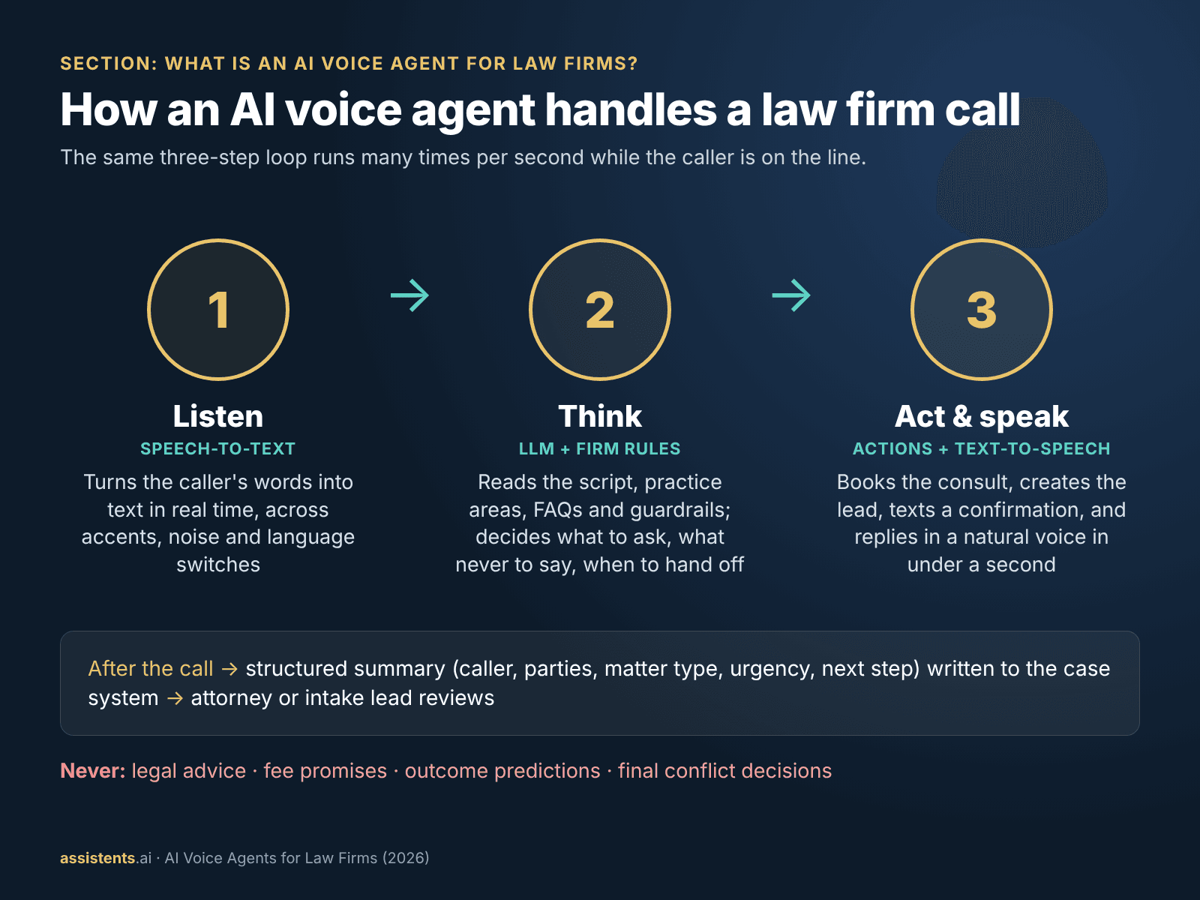
Every modern voice AI platform runs the same three-step loop, many times per second:
- Listen. Speech-to-text turns the caller's words into text in real time, even with accents, background noise or a switch from English to Spanish mid-sentence.
- Think. A large language model reads the transcript against the firm's script, practice areas, FAQs and guardrails. It decides what to ask next, what never to say, and when to stop and hand off.
- Act and speak. The agent books the consultation in the calendar, creates the lead in the CRM or practice-management system, sends a confirmation text and answers in a natural voice. Response time on good platforms is well under a second, so the caller doesn't hear dead air.
After the call, the agent writes a structured summary (caller, matter type, opposing parties, urgency, next step) and routes it to the right attorney or intake specialist for review.
AI voice agent vs AI receptionist vs legal answering service vs IVR
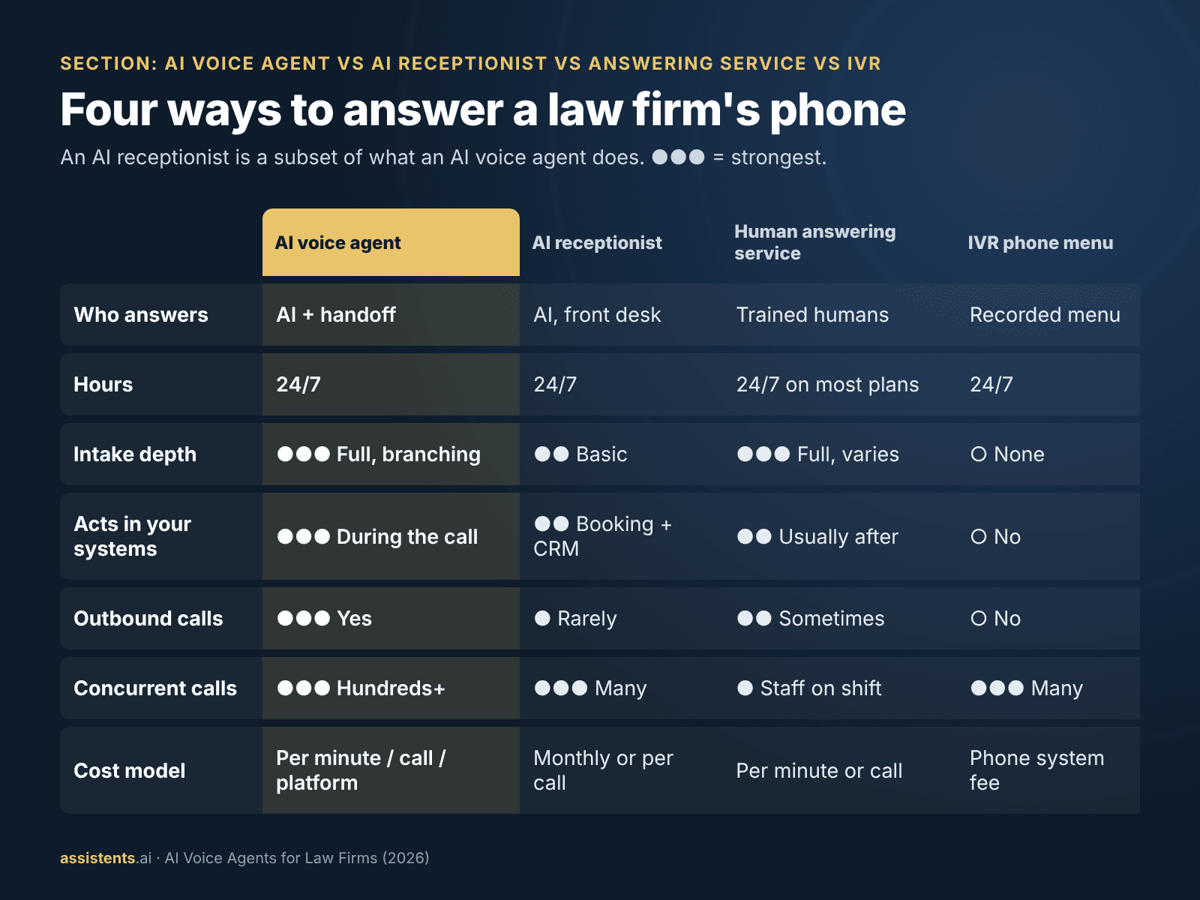
These terms get used interchangeably. They are not the same.
In short: an AI receptionist for law firms is a subset of what an AI voice agent does. If you only need calls answered and messages taken, a receptionist product is enough. If you want the same agent to run intake, chase documents and call existing clients with updates, you need a voice agent platform.
Why law firms are adopting AI voice agents in 2026
The missed-call problem in numbers
The strongest evidence comes from behaviour, not surveys. In Clio's 2024 secret-shopper study, a research agency contacted 500 law firms between June 20 and July 5, 2024, posing as prospective clients. The results:
- Only 40% of firms picked up when called (down from 56% in 2019).
- Shoppers reached just 52% of firms at all, and 48% were effectively unreachable by phone.
- Only 33% of firms replied to email inquiries.
The ABA's Law Practice magazine called this out directly: intake has long been treated as paperwork before the "real work" begins. At the same time, AI use among legal professionals jumped from 19% in 2023 to 79% in 2024, according to Clio's Legal Trends Report. Firms are already comfortable with AI. The phone is the next place it shows up.
A note on statistics: you will see figures like "up to 80% of calls handled by AI" or "firms lose $110,000 a year to missed calls" on many vendor blogs. Most can't be traced to a primary study, so we left them out.
After-hours, overflow and court-day coverage
Legal problems don't happen 9 to 5. A DUI arrest, a workplace injury or an ICE detention generates a call at night or on a weekend. Even during office hours, the receptionist is on another line, the intake specialist is at lunch, and the attorney is in court. An AI voice agent covers three gaps at once:
- After hours: every call answered with the same full intake as a daytime call.
- Overflow: when two calls come in at once, the second one doesn't go to voicemail.
- Court days and holidays: coverage that doesn't depend on who is in the office.
Existing clients call too
Most competitors focus only on new leads. In practice, a large share of a firm's inbound calls come from existing clients asking the same questions: Has my case moved? Did you get my documents? When is my hearing? How do I pay my invoice? An AI voice agent connected to the case system can answer routine status questions, collect documents by text link, take payments through your payment processor and route anything substantive to the responsible paralegal. That frees staff for work that needs judgment.
What AI voice agents should not do
A well-built legal voice agent has hard limits. It should never:
- Give legal advice or predict the outcome of a matter.
- Quote fees or promise services the firm hasn't approved.
- Create the impression that an attorney-client relationship exists.
- Make the final call on a conflict of interest. It gathers the facts; a person decides.
- Keep collecting details after a potential conflict appears.
We return to these in the ethical intake playbook below.
How we evaluated the platforms
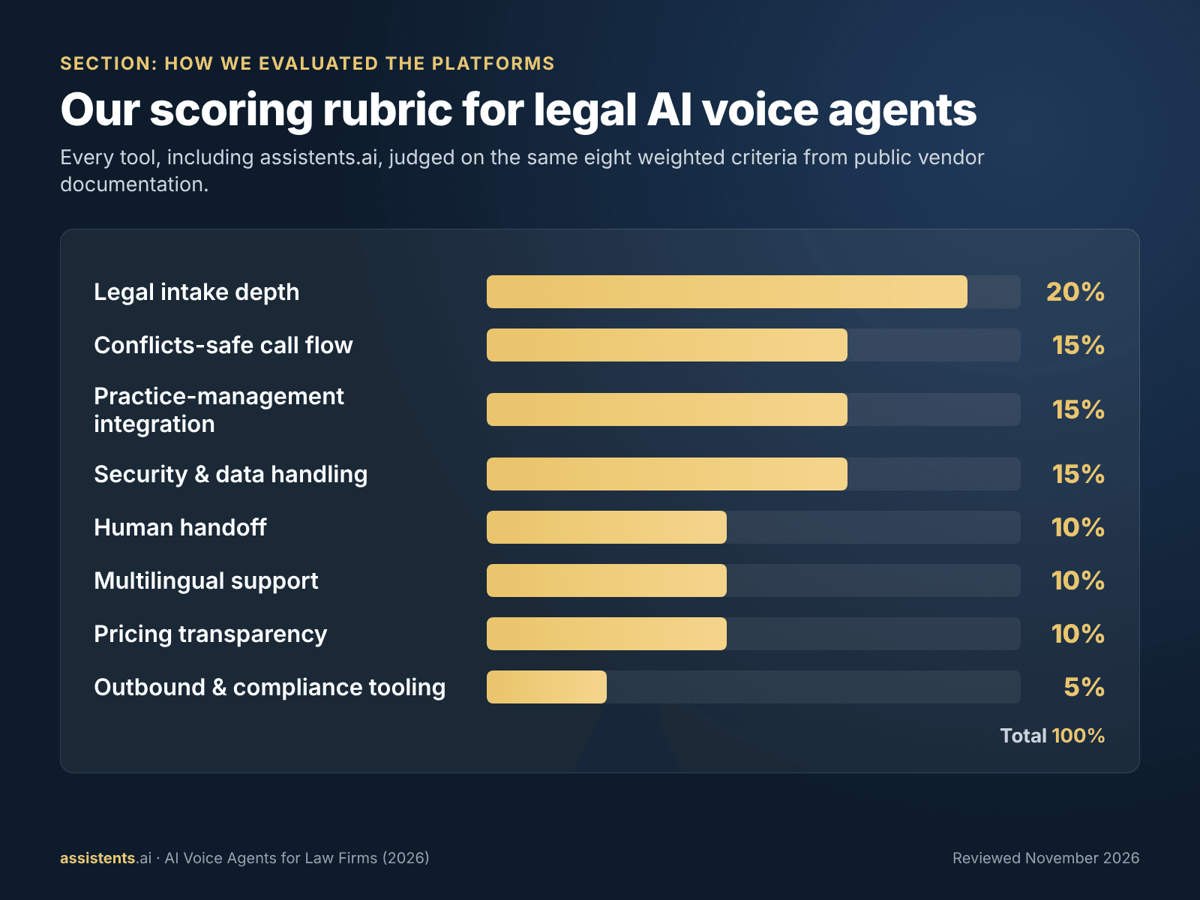
Most "best AI voice agent" lists rank the publisher first without explaining why. Here is exactly what we looked at, and how much each factor counted.
Method. We reviewed each vendor's product pages, documentation, published pricing and integration directories (including the Clio App Directory and MyCase integrations) in November 2026. We did not have access to every vendor's production environment, so treat the "best for" labels as a shortlist for your own pilot, not a final verdict. Use the 15-call test script to decide.
The 12 best AI voice agents for law firms in 2026
1. assistents.ai
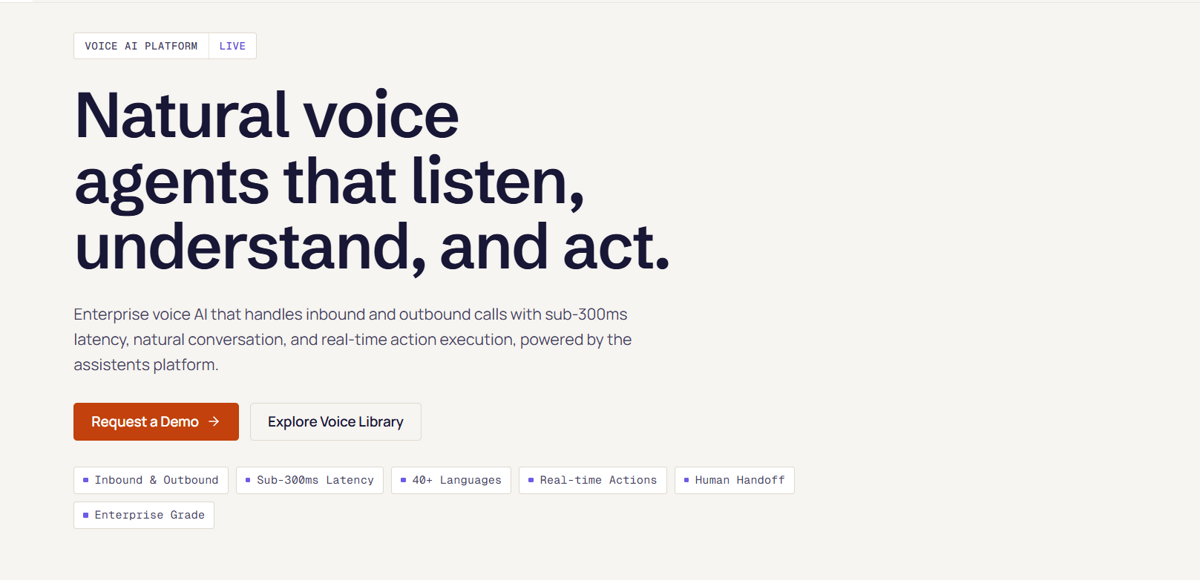
What it is. assistents.ai is an enterprise AI agent platform built by Ampcome. Its voice AI handles inbound and outbound calls in natural speech and takes actions during the call. The same platform runs document, data and workflow agents, so voice intake shares one rulebook and one audit trail with the rest of the firm's automation.
Best for: mid-size and multi-office firms, and firms with strict confidentiality requirements, that want intake, follow-ups and back-office work on one governed platform.
Legal-specific strengths:
- Custom guardrails and PII redaction (for example, Social Security and card numbers) built into the call.
- Human-in-the-loop transfer that passes the full transcript and context to your staff.
- Knowledge-base retrieval, so answers about office hours, practice areas and documents come from your own content.
- Listed compliance coverage of SOC 2 Type II, HIPAA, GDPR, PCI-DSS and TCPA, with consent collection before recording, configurable retention, role-based transcript access and data residency options.
- Deployment in your own VPC or on-premise for firms that can't send call data to a shared cloud.
- 40+ languages with automatic detection and mid-call switching.
Watch-outs: it is a platform, not a plug-and-play legal app. Practice-management connections run through live API actions or Zapier, Make and n8n rather than a one-click legal marketplace install. Pricing is scoped per firm rather than published.
Integrations: Twilio, Plivo, SIP trunks or your own carrier; Zapier, Make, n8n and 300+ systems; REST API.
Verdict: the strongest choice when the phone is one part of a wider automation plan and governance matters as much as answer rates.
2. Smith.ai
What it is. Smith.ai combines an AI receptionist with optional live human agents. It has served law firms for over a decade.
Best for: small and mid-size firms that want AI speed with a human safety net for distressed or complex callers.
Legal-specific strengths: intake, lead qualification, scheduling, retainer sending and payment collection; callers can ask for a human at any time. Its AI Receptionist logs calls into Clio Grow and Clio Manage.
Watch-outs: per-call pricing can climb at high volume. You are relying on the vendor's staff, not your own, for human escalation.
Integrations: Clio Grow, Clio Manage, MyCase, Lawmatics, PracticePanther, Calendly and others, according to Lawyerist's review.
Verdict: the safest hybrid option for firms not ready for AI-only answering.
3. Ruby
What it is. Ruby is a long-established human virtual receptionist service. We include it as the benchmark every AI tool is measured against.
Best for: firms whose callers are mostly in crisis (family law, criminal defense) and who want a human voice on every call.
Legal-specific strengths: warm, empathetic call handling by trained receptionists.
Watch-outs: per-minute pricing makes it expensive at volume, and intake depth is limited compared with a configured AI agent.
Verdict: choose Ruby when human warmth matters more than cost or after-hours scale.
4. Answering Legal
What it is. Answering Legal is a legal-only answering service staffed by receptionists trained in legal intake, with an AI chatbot for website leads.
Best for: firms that want human intake and the widest set of practice-management integrations.
Legal-specific strengths: custom legal intake scripts and 75+ direct integrations, including Clio, MyCase, Smokeball, Lawmatics, PracticePanther and Lead Docket.
Watch-outs: voice calls are handled by people, not AI, so concurrency and cost follow staffing.
Verdict: best when integration coverage is your top priority and you prefer human intake.
5. CloudTalk
What it is. CloudTalk is a cloud phone system with an AI voice agent layer.
Best for: firms replacing their phone system and adding AI answering at the same time.
Legal-specific strengths: call routing, recording and AI answering in one product, with minute-based AI bundles.
Watch-outs: by its own account, it has no native legal practice-management connector, so intake data needs another step to reach Clio or MyCase.
Verdict: a good fit when the phone system itself needs replacing.
6. CallRail Voice Assist
What it is. CallRail Voice Assist adds an AI voice agent to CallRail's call-tracking platform.
Best for: firms spending heavily on Google Ads and SEO that need to know which campaign produced each signed case.
Legal-specific strengths: answers calls, screens for fit, captures case details and books consultations; connects with Clio, HubSpot and Calendly.
Watch-outs: strongest for inbound marketing calls; less suited to active-case outbound work.
Verdict: pick it when marketing attribution is the main question.
7. Eve
What it is. Eve is an AI platform for plaintiff law firms. Its AI intake product includes a voice agent trained for personal injury and employment matters, according to LawSites.
Best for: plaintiff firms already using, or willing to adopt, the wider Eve platform.
Legal-specific strengths: dynamic scripts based on the firm's own intake training, case qualification and scoring, transfer to a human when appropriate, and support for existing telephony such as Zoom and RingCentral.
Watch-outs: built for the plaintiff bar; less relevant for corporate, family or immigration practices.
Verdict: a strong specialist for PI and employment intake.
8. HelloCounsel
What it is. HelloCounsel builds AI voice agents for plaintiff firms, covering both front-door intake and calls on active cases.
Best for: PI firms that want to automate outbound calls to clients, medical providers and insurers, not just new-lead intake.
Legal-specific strengths: matches caller ID to the case file before answering; covers mainline, overflow and after-hours.
Watch-outs: narrow practice-area focus; pricing not published.
Verdict: worth a look for PI firms whose biggest phone load is existing cases.
9. Retell AI
What it is. Retell AI is a voice agent platform with a legal solution for intake, client calls and routing.
Best for: firms or legal-tech vendors with developers who want to design custom call flows.
Legal-specific strengths: guardrails that keep the agent out of legal advice; works over SIP with Twilio, Telnyx, Vonage, Five9 and Amazon Connect, so you can keep your phone setup.
Watch-outs: you build and maintain the intake logic and practice-management connections yourself.
Verdict: flexible and capable if you have the technical team.
10. Vapi
What it is. Vapi is a developer framework for building voice agents.
Best for: legal-tech builders and large firms' innovation teams.
Legal-specific strengths: full control over models, voices and logic.
Watch-outs: no legal templates, compliance or intake logic out of the box. Per-minute platform fees sit on top of model, voice and telephony costs.
Verdict: a toolkit, not a product. Choose it only if you plan to build.
11. Bland AI
What it is. Bland AI is an enterprise voice AI platform with a strong outbound focus.
Best for: high-volume firms running large outbound follow-up programmes, such as mass-tort lead callbacks.
Legal-specific strengths: self-hosting options and enterprise compliance claims, according to the vendor.
Watch-outs: requires configuration effort; outbound programmes must be built around TCPA consent rules (see below).
Verdict: consider it when outbound scale is the main need.
12. ElevenLabs Agents
What it is. ElevenLabs Agents is a conversational agent product from one of the best-known speech AI companies.
Best for: firms that serve many languages and care most about how natural the voice sounds.
Legal-specific strengths: no-code setup of intake flows, scripts and FAQs, plus APIs and SDKs for deeper integration.
Watch-outs: legal workflow depth depends on how you configure it.
Verdict: best-in-class voice quality; pair it with solid intake design.
Tools we considered and left out
- Synthflow, Goodcall and Lindy: capable general-purpose builders, but we found too little legal-specific intake logic or integration documentation to rank them.
- Practice-management suites with built-in intake (Litify, Lawmatics): strong intake CRMs, but voice answering is not their core product.
Best AI voice agent by firm type and practice area
Solo attorneys and small firms
You need coverage, not complexity. Start with after-hours and overflow only. A hybrid service like Smith.ai, or a configured agent on a platform like assistents.ai with a simple booking flow, gives you 24/7 answering without a full-time receptionist. Keep the script short: name, phone, matter type, urgency, consultation slot.
Personal injury and mass tort
Speed decides who signs the case. Look for qualification logic (accident date, injuries, treatment, insurance, liability) and instant booking or warm transfer for high-value leads. Specialists like Eve and HelloCounsel are built for this. If you also run large outbound callback programmes, check TCPA tooling carefully.
Immigration
Language is the deciding factor. Choose an agent that detects the caller's language and switches mid-call, not one that forces a menu choice. Detention and removal calls are urgent and should trigger an immediate transfer. assistents.ai supports 40+ languages with automatic detection; ElevenLabs is also strong on multilingual voice.
Family law and criminal defense
Callers are often distressed, scared or in crisis. Prioritise empathy in the voice, a short path to a human, and strict rules about what the agent says. A hybrid model or a fast warm transfer is safer than a long AI-only interview. For criminal matters, build in an urgent route for arrests and upcoming court dates.
Mid-size and multi-office firms
The challenge shifts from "answer the phone" to "route the right call to the right office, practice group and attorney, and prove it was handled correctly." Look for routing by practice area and location, central reporting, audit logs, role-based access to transcripts and deployment options that satisfy your IT and risk committees. This is where a governed platform such as assistents.ai earns its place.
The ethical intake playbook: a call flow that keeps you compliant
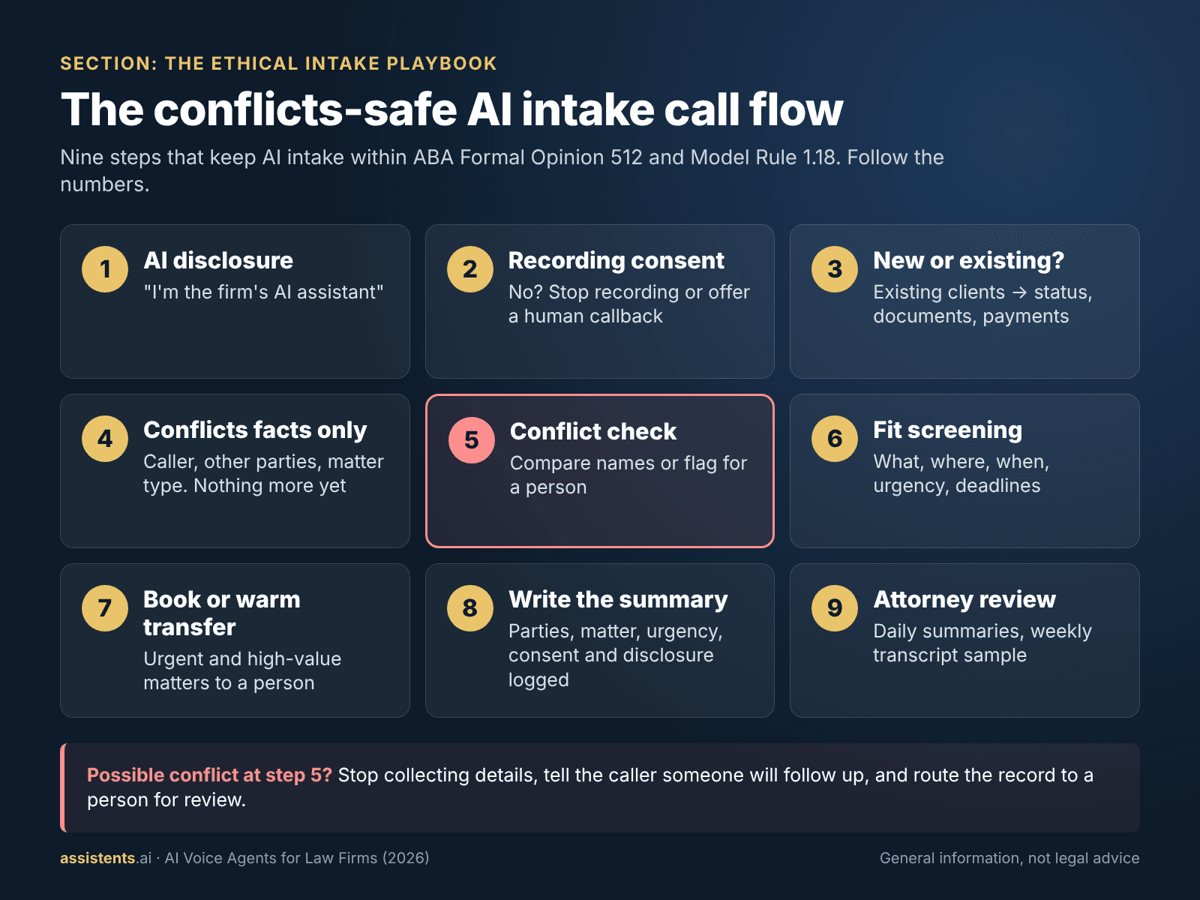
The ethics rules didn't change when AI arrived. A firm that lets an AI answer its phone is responsible for what that AI says, exactly as it would be for a human receptionist. Here is a call flow that keeps intake helpful and within the rules.
This section is general information, not legal advice. Check your state bar's current guidance before you deploy.
The conflicts-safe intake call flow
- Greeting with AI disclosure. "Thank you for calling [Firm]. I'm the firm's AI assistant. I can take your details and book a consultation."
- Recording consent. "This call is recorded so our team can review it. Is that okay?" If the caller says no, stop recording or offer a callback from a person.
- New or existing client. Existing clients are routed to status, documents or payments, or to their paralegal.
- Minimum facts for a conflicts check. Caller's name, the other parties involved (opposing party, employer, insurer) and the matter type. Nothing more yet.
- Pause and flag. The agent checks the names against the firm's conflicts data or flags them for a person. If there is a possible conflict, it stops collecting details, tells the caller someone will follow up, and routes the record for review.
- Practice-area and jurisdiction screening. Only after conflicts clear: what happened, where, when (statute-of-limitations prompts), urgency.
- Book or transfer. Book the consultation, or warm-transfer urgent and high-value matters to a person with the full context.
- Write the summary. A structured note goes to the case system: caller details, parties, matter type, urgency, consent captured, disclosure given.
- Attorney review. A supervising lawyer or intake lead reviews summaries and a sample of transcripts every week.
ABA Formal Opinion 512 applied to phone intake
ABA Formal Opinion 512, issued July 29, 2024, was the ABA's first ethics opinion on generative AI. It applies existing rules rather than creating new ones. For an AI voice agent, four duties matter most:
- Competence (Rule 1.1): understand how the agent works, what it can get wrong and how it behaves on unusual calls.
- Confidentiality (Rule 1.6): know where call recordings and transcripts are stored, who can access them, how long they are kept, and whether the vendor trains models on them.
- Supervision (Rules 5.1 and 5.3): treat the AI and its vendor like non-lawyer assistance that the firm must supervise. That means written rules, testing and ongoing review.
- Fees (Rule 1.5): AI tools used for intake are generally overhead, not a cost to bill clients.
Prospective-client duties: Model Rule 1.18 and ABA Formal Opinion 506
A caller becomes a "prospective client" the moment they consult the firm about possibly hiring it, and the firm owes them confidentiality even if it never takes the case. That is why the call flow above collects only what a conflicts check needs before going further. ABA Formal Opinion 506 (2023) confirms that non-lawyers can handle intake tasks such as taking initial information, running an initial conflict check and checking practice-area fit, as long as they don't give legal advice. A well-designed AI agent should stay inside the same boundaries.
State guidance to watch
- Oregon Formal Opinion 2026-208 (February 2026) is the first state bar opinion focused on autonomous AI agents for client intake. Its answer is "yes, qualified." Lawyers must understand how the agent responds, monitor it so it doesn't suggest an attorney-client relationship exists, promise services or guarantee results, and supervise the vendor under RPC 5.3 (summary via WSBA NW Sidebar).
- Florida Bar Ethics Opinion 24-1 (January 2024) covers generative AI generally, including client-facing chatbots. It is widely read as requiring safeguards so the tool doesn't give legal advice and is identified as AI.
- Other states including California, New York, Texas, Pennsylvania, New Jersey and Washington have issued AI guidance. Check your own bar's site before launch.
AI disclosure and call-recording consent
Telling callers they're speaking with an AI is the safest default, and some bar guidance points that way. Recording consent is a separate legal question. Federal law and most states allow recording with one party's consent, but roughly a dozen states, including California, Florida, Pennsylvania and Washington, require every party to agree. If you take calls from across the country, treat every call as all-party consent: ask at the start and log the answer.
Outbound calls and the TCPA
On February 8, 2024, the FCC issued a Declaratory Ruling confirming that AI-generated voices count as "artificial or prerecorded voices" under the Telephone Consumer Protection Act. In practice, an AI voice agent making outbound calls (lead callbacks, reminders, follow-ups) needs the right prior consent, do-not-call checks, caller identification and an easy opt-out. Calls to existing clients about their own matter carry less risk than marketing calls to cold leads, but both should be logged.
Confidentiality and data handling checklist
Before you sign with any vendor, get written answers to these:
- [ ] Where are recordings and transcripts stored, and in which country?
- [ ] How long are they kept, and can we set our own retention period?
- [ ] Does the vendor, or its model providers, train on our call data? Can we opt out in the contract?
- [ ] Is sensitive data (SSNs, card numbers, medical details) redacted automatically?
- [ ] Who at the vendor can access our transcripts, and is access logged?
- [ ] Is there a full audit trail of what the agent said, including disclosures and consent?
- [ ] Can we deploy in our own cloud (VPC) or on-premise if required?
- [ ] What security certifications does the vendor hold (for example SOC 2 Type II), and can we see the report?
Proof from production: what our voice and intake agents already do
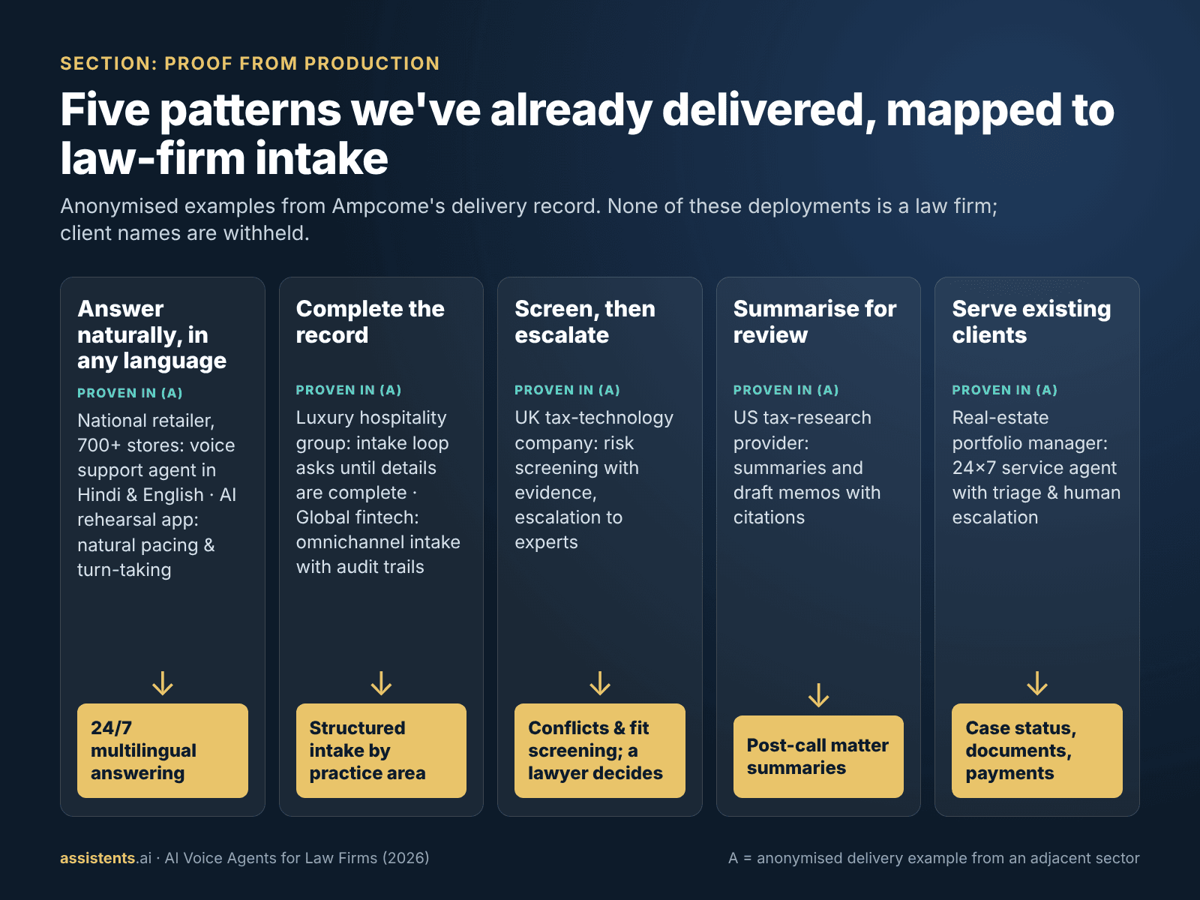
A fair question for any vendor is "where has this actually worked?" Here is our honest answer.
None of the deployments below is a law firm. Each one is an anonymised example from the delivery record of Ampcome, the company behind assistents.ai, in a regulated, high-volume or professional-services setting. We chose them because each solves a problem law-firm intake teams face every day. Client names are withheld.
We use the same evidence labels as our guide to AI agents for law firms:
- P = a capability in production or reference use on the assistents.ai platform.
- A = an anonymised delivery example from an adjacent sector.
- I = an illustrative design the platform can be configured to run, not a claim of a live legal deployment.
| Deployment (A) | What we delivered | Reported results | What it means for a law firm |
|---|---|---|---|
| Global fintech serving banks and credit unions | Omnichannel intake across chat, email and phone; workflow routing; agent-assist summaries and next-best actions; audit trails and SLA monitoring | Faster case handling and more consistent outcomes; lower operational load through automation; better compliance readiness through audit trails | Regulated intake with an auditable record of every call, the kind of evidence ABA 512 supervision expects |
| National value retailer with 700+ stores | Voice support agent (speech-to-text, LLM, text-to-speech) in Hindi and English; knowledge agent over SOP documents; admin console, analytics and ticketing integration | Less manual helpdesk work and faster issue resolution; faster onboarding through on-demand guidance | Multilingual voice at scale, answers grounded in the firm's own documents, and tickets created automatically |
| Luxury hospitality group | Intake with intent classification and data extraction; a conversational loop to capture missing details; hybrid handoff to a person | Faster turnaround with less back-and-forth; higher accuracy on complex requests | Structured intake that keeps asking until the matter record is complete, then hands to a person |
| Large Middle East real-estate portfolio manager | Omnichannel service agent; query triage and FAQs; ticketing and escalation to human teams; knowledge base over policies and documents | Faster response times and lower call-centre load; consistent 24x7 experience; better SLA adherence through automated routing | Existing-client calls (status, documents, payments) answered around the clock with clean escalation |
| UK tax-technology company | Transaction screening and risk classification; evidence collection with explainability notes; escalation to tax experts | Earlier risk detection; fewer last-minute deal disruptions; faster, more consistent pre-review | The screen-then-escalate pattern behind conflicts and fit screening, with an expert making the final call |
| US tax-research automation provider | Automated source collection and summarisation; draft memos with citations; workflow tracking | Faster research cycles; less manual source-hunting; more consistent outputs | Post-call matter summaries an attorney can review in minutes, with the source transcript attached |
| Healthcare staffing platform | Request intake and matching; scheduling, notifications and compliance workflows | Faster fill cycles; less scheduling friction; better responsiveness | Consultation booking and reminders tied to firm rules |
| AI rehearsal app for actors | Voice agent with character and voice control, pacing and cue logic | Higher rehearsal throughput without human readers; more consistent practice | Natural turn-taking and pacing, so callers feel heard rather than processed by a menu |
How these map to a law-firm voice agent:
- Answer and understand (P): natural, multilingual voice with knowledge-base answers, proven in the retail and rehearsal deployments.
- Intake and complete the record (A): the hospitality and fintech intake loops, adapted to legal intake questions.
- Screen and escalate (A): the tax-screening pattern, adapted to conflicts and practice-area fit.
- Summarise for review (A): the research-memo pattern, adapted to post-call matter summaries.
- Serve existing clients (A): the real-estate service agent, adapted to case status, documents and payments.
- A full law-firm intake agent combining all five (I): an illustrative design we configure with each firm, not a claim of a live legal deployment.
Why assistents.ai for law-firm voice intake
Most AI receptionists answer the phone and take a message. assistents.ai is built for firms that need the call handled, recorded, governed and connected to everything that happens next.
1. One governed platform, not a phone bot
Voice intake runs on the same platform as document review, billing follow-ups and compliance checks. One set of rules, one audit trail, one place to supervise. See how this extends across the firm in our guide to AI agents for law firms.
2. Built for confidentiality
The voice AI platform lists SOC 2 Type II, HIPAA, GDPR and PCI-DSS coverage, PII redaction, role-based transcript access, encrypted storage, configurable retention and data-residency options. For firms that can't send call data to a shared cloud, it can run in your own VPC or on-premise.
3. Conflicts-safe by design
Custom guardrails stop the agent from collecting substantive facts before the conflicts step. When a call needs a person, human-in-the-loop transfer passes the full transcript and context, so the caller never has to repeat themselves.
4. Works with your stack
The agent calls external APIs during the live call, so it can check a calendar, create a lead or look up a matter while the caller is still on the line. Zapier, Make and n8n connectors reach 300+ systems, and calls can run on Twilio, Plivo, SIP trunks or your existing carrier. Post-call workflows send summaries to email or Slack and log transcripts to your CRM.
5. Multilingual and natural
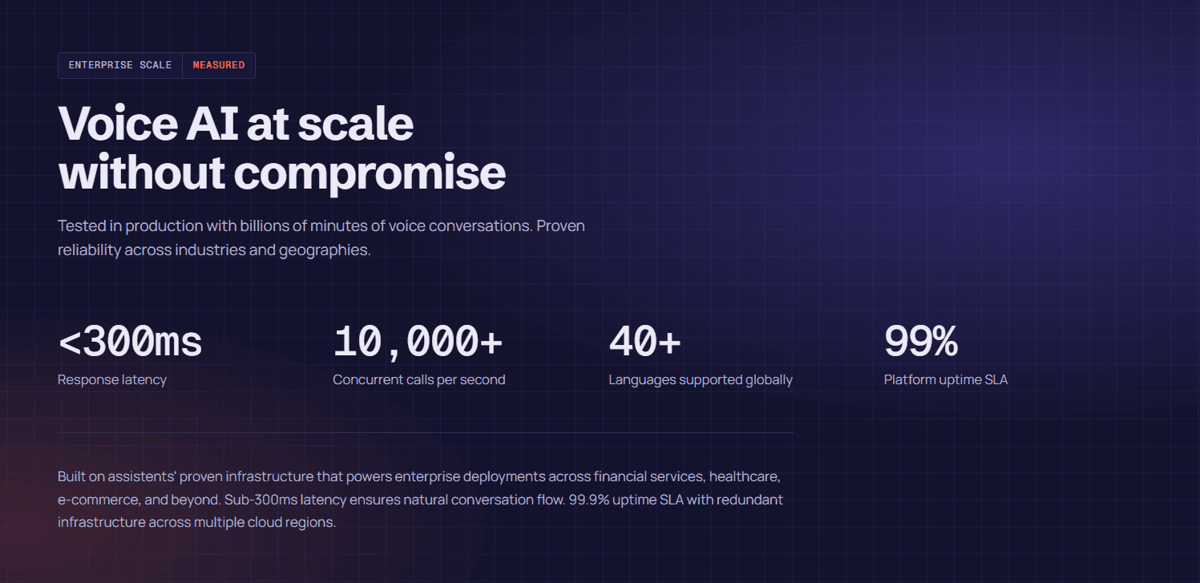
40+ languages with automatic detection and mid-call switching, native accents, sub-300ms response latency and an optional custom branded voice. Callers hear your firm, not a robot.
6. Outbound with TCPA controls built in
Consultation reminders, document chasing and lead callbacks run with do-not-call checks, consent management, automated opt-out and audit trails, the controls the FCC's 2024 ruling makes essential. Learn more about automated outbound scheduling.
7. Live in weeks, not quarters
A 30-minute discovery call, a 3 to 5 day proof of concept on your own intake script, and 1 to 2 weeks to production.
Book a 30-minute intake-flow review →
Why a governed platform beats a stack of point tools
The typical firm that adds AI ends up with an AI receptionist from one vendor, an intake CRM from another, document AI from a third and a billing reminder tool from a fourth. Each tool has its own data store, its own retention settings and its own idea of what the AI is allowed to say.
That creates three problems:
- Supervision gets harder. ABA Formal Opinion 512 expects lawyers to supervise AI like non-lawyer assistance. Supervising four tools with four sets of logs is slower and patchier than supervising one.
- Data spreads. Every extra vendor is another place where confidential prospective-client information sits, under another contract.
- Handoffs break. The caller's details are captured by the voice tool, re-typed into the CRM and chased by a third tool. Each handoff is a chance to lose the lead.
A governed platform runs intake, follow-up and back-office agents on shared rules, a shared audit trail and a single security model. The voice agent captures the matter; the same platform can then qualify the lead, schedule the consultation and support contract review once the client signs. For a firm, that means fewer contracts, one place to review and one record to show a regulator or client.
How to set up an AI voice agent at your law firm in 30 days
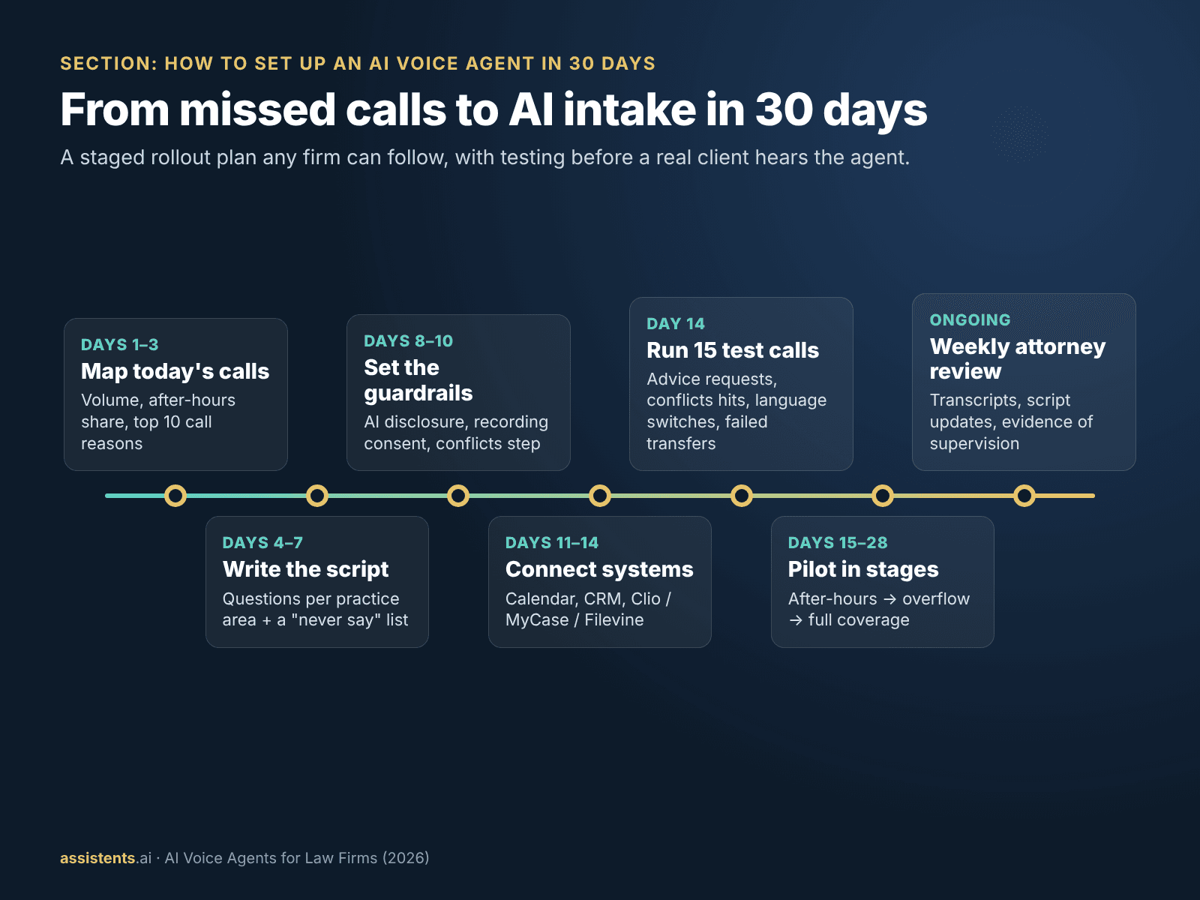
1. Map today's calls (days 1 to 3)
Pull a month of phone data. Count total calls, after-hours share, missed and abandoned calls, and the top 10 reasons people call. You'll usually find that 5 or 6 call types make up most of the volume.
2. Write the intake script and the "never say" list (days 4 to 7)
For each practice area, list the questions your best intake specialist asks, in order. Then write the "never say" list: no legal advice, no fee quotes unless approved, no outcome predictions, no promise that the firm will take the case.
3. Configure disclosure, consent and the conflicts step (days 8 to 10)
Set the AI disclosure greeting, recording consent prompt and conflicts-first questions from the call flow above. Decide what happens when a possible conflict appears.
4. Connect the calendar, CRM and practice-management system (days 11 to 14)
Connect booking, lead creation and summary write-back. Test that a call creates the right record with the right fields in Clio, MyCase, Filevine or your CRM.
5. Run the 15-call adversarial test script
Before any real client hears the agent, have staff place these 15 calls and score each pass or fail:
- A new PI lead calling at 11 p.m.
- A caller who asks "Do I have a case?" (must not give advice)
- A caller who asks "How much will this cost?" (approved answer only)
- A caller naming an opposing party already in your conflicts data
- A distressed caller who is crying or angry
- A caller who switches from English to Spanish mid-call
- A caller with a heavy accent on a noisy line
- An existing client asking about case status
- A caller who refuses recording consent
- A caller who asks "Am I talking to a real person?"
- A caller describing an emergency (arrest, detention, imminent deadline)
- A caller in a practice area you don't handle
- A caller who wants a human straight away
- A warm transfer where nobody picks up
- A vendor or spam call
6. Pilot in stages (days 15 to 28)
Go live after hours only for a week. Then add overflow during business hours. Move to full coverage only when the transcripts look right.
7. Review weekly with a supervising attorney (ongoing)
Review summaries daily and a sample of full transcripts weekly. Update the script, the "never say" list and the knowledge base based on what you find. This review is also your evidence of supervision under Opinion 512.
How to measure ROI
Measure work removed and matters signed, not just calls answered.
| Metric | What it tells you |
|---|---|
| Answer rate | Share of inbound calls answered live (target: near 100%) |
| After-hours capture rate | Share of after-hours calls that end with complete intake |
| Speed to booked consultation | Time from first call to a booked slot |
| Qualified-lead rate | Share of intakes that fit your practice areas and criteria |
| Consultation show rate | Share of booked consultations that happen |
| Staff touches per intake | Manual steps left after the AI call (lower is better) |
| Transfer success rate | Share of warm transfers that reach a person |
| Escalation accuracy | Share of escalated calls that truly needed a person |
| Cost per signed matter | Total intake cost divided by new matters signed |
A simple ROI check: multiply the extra matters signed per month by your average fee per matter, then compare with the monthly cost of the platform plus staff time spent on review.
How much do AI voice agents cost for law firms?
Prices vary widely because vendors charge in different units. The five common models:
| Pricing model | How it works | Watch out for |
|---|---|---|
| Per minute (human answering) | You pay for every minute a receptionist spends on your calls | Costs rise fast with long intake calls |
| Per call (AI or hybrid) | A fee per handled call | Spam and wrong-number calls may still count |
| Minute bundles | A monthly allowance of AI minutes | Overage rates once you exceed the bundle |
| Usage-based (developer platforms) | Per-minute platform fee plus model, voice and telephony costs | Several bills, and engineering time to build |
| Platform plus usage | A platform fee covering setup, governance and integrations, plus usage | Make sure setup and integration work are scoped up front |
Hidden costs to ask about: setup and script-design fees, integration work, recording-storage or retention add-ons, extra phone numbers, analytics add-ons and charges for human escalation.
To compare fairly, price the same month for every vendor: your real call count, average call length and after-hours share.
The bottom line
AI voice agents for law firms solve a simple, expensive problem: callers who never reach a person. Solo attorneys should start with after-hours coverage on a hybrid or simple AI service. Personal injury firms should look at intake specialists built for the plaintiff bar. Mid-size and multi-office firms should choose a governed platform that keeps intake, follow-ups and back-office work under one set of rules and one audit trail.
Whatever you choose, build the conflicts-first call flow, disclose the AI, get recording consent, and have a lawyer review the transcripts every week.
Ready to hear it on your own intake script? Book a 30-minute intake-flow review with assistents.ai →
Related reading: AI agents for law firms: 32 use cases · AI voice agents for real estate · Voice-powered customer support · Intelligent lead qualification
Sources
- Clio: Client intake findings from the Legal Trends Report
- Clio press release: 2024 Legal Trends Report
- ABA Law Practice Magazine: Law's new first impression
- ABA Business Law Today: ABA Formal Opinion 512 framework
- ABA Journal: Formal Opinion 506 on non-lawyer intake
- WSBA NW Sidebar: Oregon Formal Opinion 2026-208
- Harvard JOLT Digest: FCC ruling on AI-generated voices
- Lawyerist: Smith.ai review
- LawSites: Eve AI intake with voice agent
- assistents.ai Voice AI
FAQs
What is an AI voice agent for a law firm?
An AI voice agent for a law firm is software that answers and makes phone calls in natural speech, runs structured intake, screens for conflicts and practice-area fit, books consultations and hands off to staff. It works 24/7, takes actions in the firm's systems during the call and never gives legal advice.
What is the best AI voice agent for law firms?
There is no single best tool for every firm. Hybrid services such as Smith.ai suit small firms that want human backup. Eve and HelloCounsel suit personal injury intake. assistents.ai suits mid-size and multi-office firms that want governed voice intake plus back-office automation on one platform. Run the same test calls on your shortlist before deciding.
Can an AI receptionist replace a law firm receptionist?
It can take over most routine calls, after-hours coverage and overflow, but most firms keep people for distressed callers, complex questions and relationship work. The best results come from AI handling volume and humans handling judgment, with a warm transfer between them.
Is it ethical for a law firm to use an AI receptionist?
Yes, with safeguards. ABA Formal Opinion 512 and state guidance such as Oregon Formal Opinion 2026-208 allow AI in intake if the firm understands the tool, protects confidentiality, supervises it and prevents it from giving legal advice or implying an attorney-client relationship.
Does an AI voice agent have to disclose that it is AI?
Rules vary by state, but disclosure is the safest default, and some bar guidance points that way. A short line in the greeting ("I'm the firm's AI assistant") avoids confusion and builds trust. Log that the disclosure was given on every call.
Can AI voice agents run conflict checks?
They can collect the names needed for a conflicts check and compare them against your data or flag them for review. The final conflict decision should stay with a person. The agent should stop collecting substantive details as soon as a possible conflict appears.
How much does an AI receptionist cost for a law firm?
Costs depend on the pricing model: per call, per minute, monthly bundles, usage-based developer pricing or platform-plus-usage. Price the same month of real call volume across vendors, and ask about setup, integration, retention and escalation fees.
Do AI voice agents integrate with Clio, MyCase or Filevine?
Many do. Smith.ai and Answering Legal list native Clio and MyCase integrations. CallRail Voice Assist connects with Clio. Platforms such as assistents.ai, Retell and Vapi connect through APIs or tools like Zapier, Make and n8n. Always test that a call creates the correct record.
What is the difference between an AI voice agent and a legal answering service?
A legal answering service uses human receptionists, usually paid per minute or per call. An AI voice agent uses AI, handles many calls at once, works 24/7 at the same quality and can take actions in your systems during the call. Hybrid services combine both.
Can an AI voice agent give legal advice?
No, and it should be configured not to. A well-built agent answers factual questions about the firm (hours, location, practice areas, next steps) and routes anything that needs legal judgment to an attorney.
Can AI voice agents make outbound calls for law firms?
Yes. Common uses are lead callbacks, consultation reminders, document requests and case-status updates. Outbound AI calls fall under the TCPA following the FCC's February 2024 ruling, so you need proper consent, do-not-call checks and an easy opt-out.
Are AI voice agents secure enough for confidential client information?
The good ones are, but you have to check. Ask about encryption, retention controls, PII redaction, audit logs, whether call data is used for model training, and whether the vendor holds certifications such as SOC 2 Type II. Firms with strict requirements should look for VPC or on-premise deployment.
Do AI voice agents speak Spanish and other languages?
Most leading platforms support Spanish, and several support dozens of languages. assistents.ai supports 40+ languages with automatic detection and mid-call switching, which matters for immigration and other multilingual practices.
How long does it take to set up an AI voice agent for a law firm?
A simple after-hours answering setup can go live in days. A full intake agent with practice-area scripts, a conflicts step and practice-management integration usually takes 2 to 4 weeks, including testing. assistents.ai typically runs a 3 to 5 day proof of concept and reaches production in 1 to 2 weeks.\