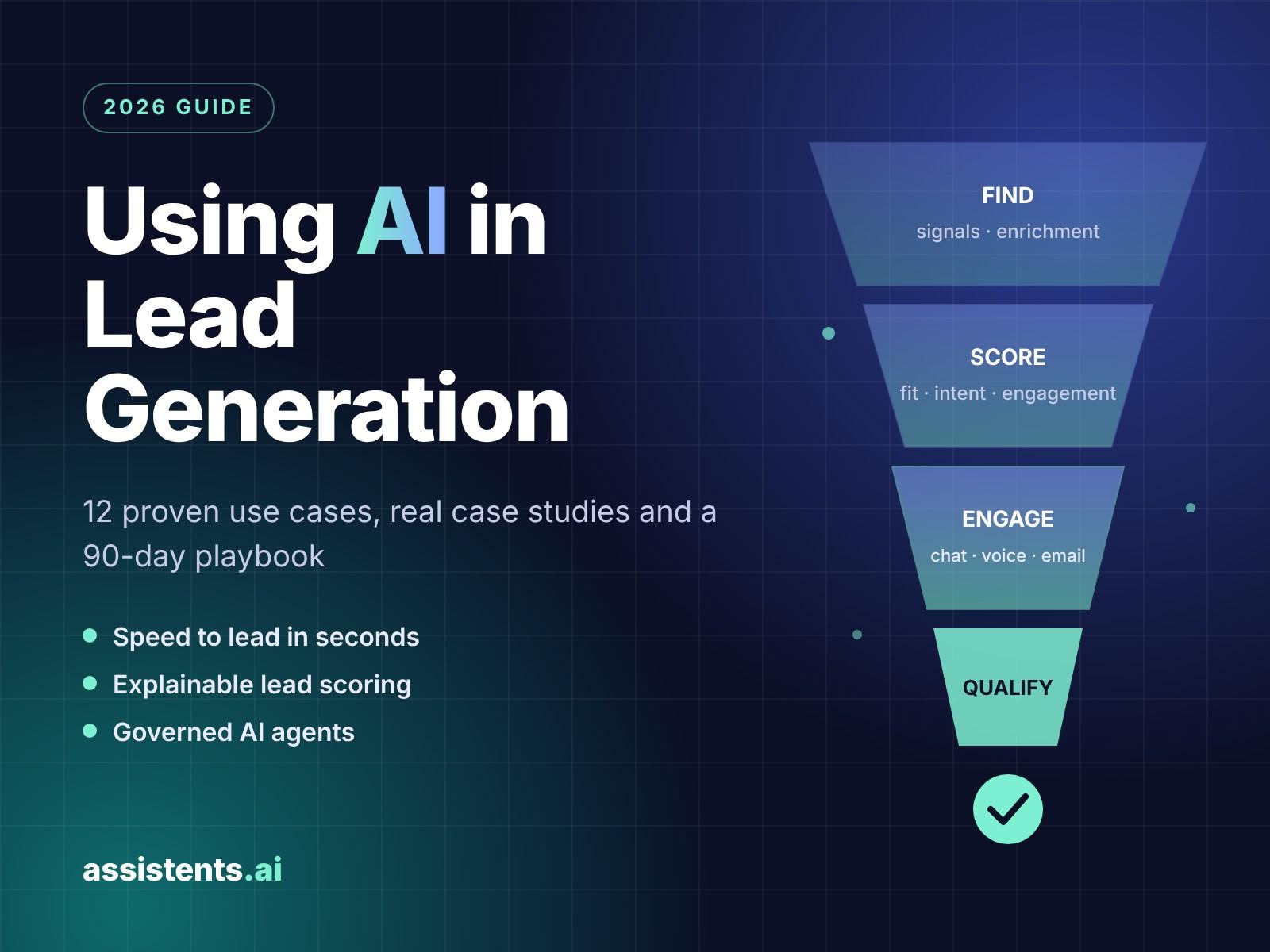
Using AI in lead generation no longer means bolting a chatbot onto your website and hoping for better leads. In 2026 it means AI agents that find the right accounts, enrich and score every lead, reply in seconds on any channel, and pass sales-ready context to your reps, with an audit trail on every decision.
Most teams still lose leads in the same places: slow first responses, inconsistent qualification, dirty CRM data and reps buried in admin. This guide shows exactly where AI fixes each of those leaks. It draws on more than 30 enterprise AI deployments that the assistents.ai team has delivered across hospitality, real estate, engineering, retail, healthcare and financial services.
Key takeaways
- AI lead generation uses machine learning, large language models (LLMs) and AI agents to find, enrich, score, engage, qualify, nurture and route prospects with minimal manual work.
- Speed is still the biggest lever. Firms that contact a lead within an hour are nearly 7x more likely to qualify it than firms that wait longer (Harvard Business Review).
- The biggest gains come from 12 use cases across the funnel. Start with one, such as instant response or explainable lead scoring, and expand from there.
- Governance is the difference between a pilot and production: explainable scoring, human hand-offs, consent management and audit logs.
- A focused rollout can reach production in about 90 days if you measure a baseline first and track speed to lead, MQL→SQL conversion and cost per qualified lead.
What is AI lead generation?
AI lead generation is the use of artificial intelligence (machine learning, natural language processing, LLMs and autonomous AI agents) to identify, attract, enrich, score, engage, qualify and route potential customers with little manual effort. It replaces static rules and slow manual follow-up with systems that learn from your data and act in real time.
In practice, using AI in lead generation covers three layers:
- Intelligence: predicting which accounts and contacts are most likely to buy (ICP modelling, intent signals, predictive scoring).
- Engagement: talking to prospects instantly and personally across web chat, WhatsApp, email and voice.
- Orchestration: updating the CRM, routing leads to the right rep, triggering nurture and reporting on what works.
AI lead generation vs traditional lead generation
| Dimension | Traditional lead generation | AI-powered lead generation |
|---|---|---|
| Speed to lead | Hours to days, during business hours | Seconds, 24×7, on every channel |
| Lead scoring | Static points set once a year | Predictive and explainable, retrained on win/loss data |
| Personalisation | First-name merge fields | Context from firmographics, behaviour and intent |
| Coverage | Limited by SDR headcount | Every inbound lead and every target account |
| Qualification | Varies by rep | Same criteria (BANT, MEDDIC, ICP fit) every time |
| CRM data quality | Manual entry, frequent gaps | Automatic enrichment, de-duplication and sync |
| Cost per qualified lead | Rises with volume | Falls as volume grows |
| Auditability | Notes scattered across tools | Every action logged and explainable |
Why using AI in lead generation matters in 2026
Buyers are researching on their own, funnels are leaking more, and response windows are shrinking. AI is the only practical way to respond instantly and qualify consistently at scale.
The data is clear:
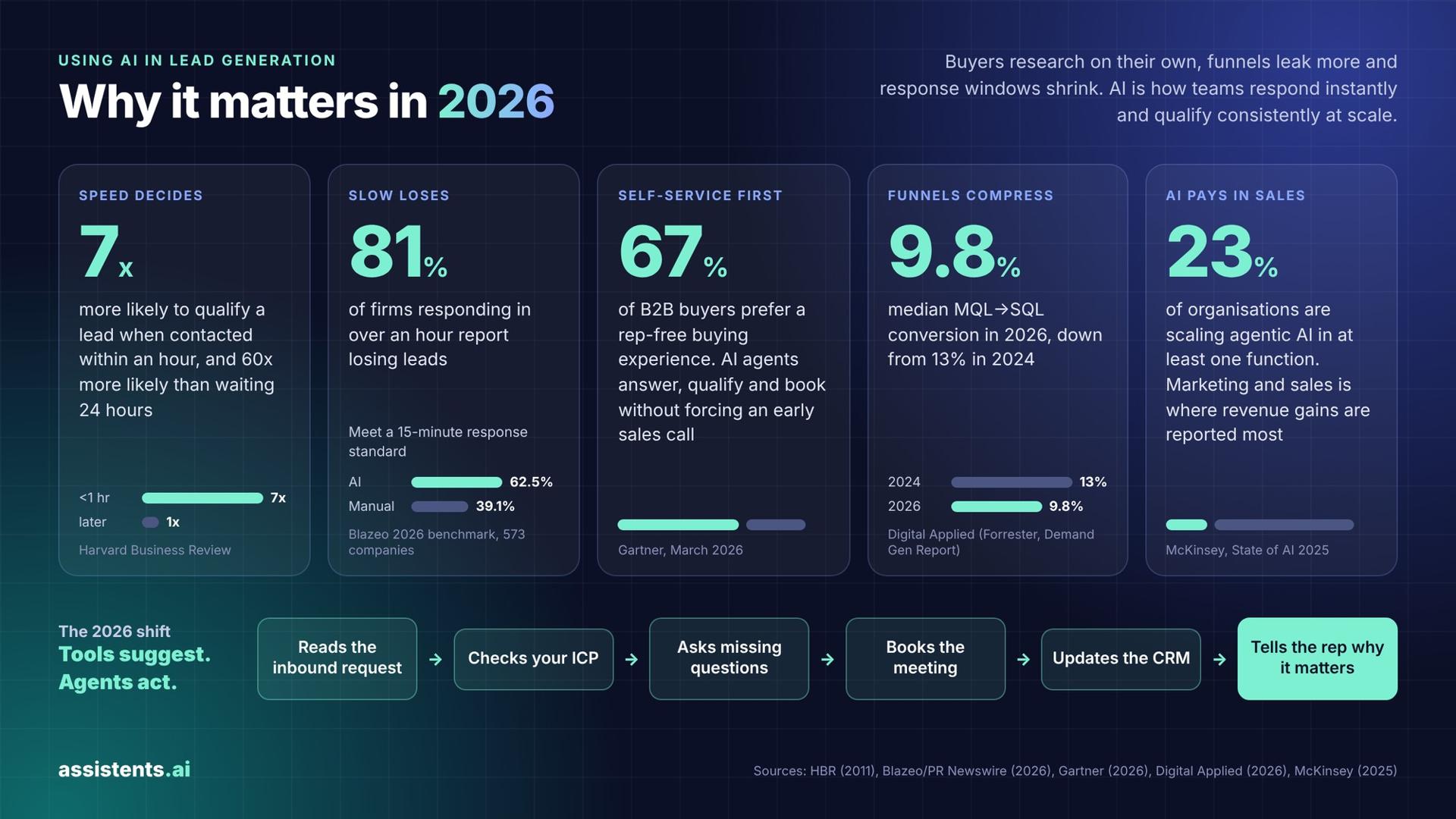
- Speed decides outcomes. In a study of 2,241 US companies, firms that tried to contact a lead within an hour were nearly 7x more likely to qualify it than firms that waited even an hour longer, and over 60x more likely than firms that waited 24 hours (Harvard Business Review).
- Slow responders lose deals. In the 2026 Speed-to-Lead Benchmark Report (573 companies), 81.2% of firms that respond in over an hour report losing leads. 62.5% of companies using AI and automation meet a 15-minute response standard, against 39.1% of manual-only teams (Blazeo via PR Newswire).
- Buyers want self-service first. 67% of B2B buyers say they prefer a rep-free buying experience (Gartner, March 2026). AI agents can answer, qualify and book meetings without forcing a sales call too early.
- Funnels are compressing. Median MQL→SQL conversion fell from 13% in 2024 to 9.8% in 2026 (Digital Applied, citing Forrester and Demand Gen Report).
- Marketing and sales is where AI pays. Respondents to McKinsey's global survey most often report revenue gains from AI in marketing and sales. Agentic AI is now being scaled in at least one function by 23% of organisations (McKinsey, The State of AI 2025).
The shift in 2026 is from AI tools that suggest to governed AI agents that act. A tool drafts an email. An agent reads the inbound request, checks your ICP, asks the missing questions, books the meeting, updates the CRM and tells the rep why the lead matters.
The Governed Lead Engine: a stage model for AI lead generation
Every effective AI lead generation program follows the same nine stages, with governance and human review running underneath all of them. We call this the Governed Lead Engine.
| Stage | What AI does | Output |
|---|---|---|
| 1. Target | Learns your ideal customer profile from closed-won and closed-lost deals | A data-backed ICP |
| 2. Find | Monitors intent, hiring, funding, competitor and renewal signals | Prioritised account lists |
| 3. Enrich | Fills gaps, de-duplicates and standardises records | Clean, complete lead data |
| 4. Score | Predicts likelihood to convert and explains why | Ranked, explainable scores |
| 5. Engage | Responds instantly on web, WhatsApp, email and voice | Conversations, not forms |
| 6. Qualify | Asks discovery questions against BANT, MEDDIC or your criteria | Sales-ready leads with context |
| 7. Nurture | Adapts sequences to behaviour and stage | Re-engaged leads |
| 8. Route | Assigns to the right rep and syncs the CRM | Fast, fair hand-offs |
| 9. Measure | Explains where and why leads drop | Continuous improvement |
Governance layer: consent checks, human-in-the-loop approvals, audit logs and explainable decisions at every stage.
How to use AI in lead generation: 12 use cases
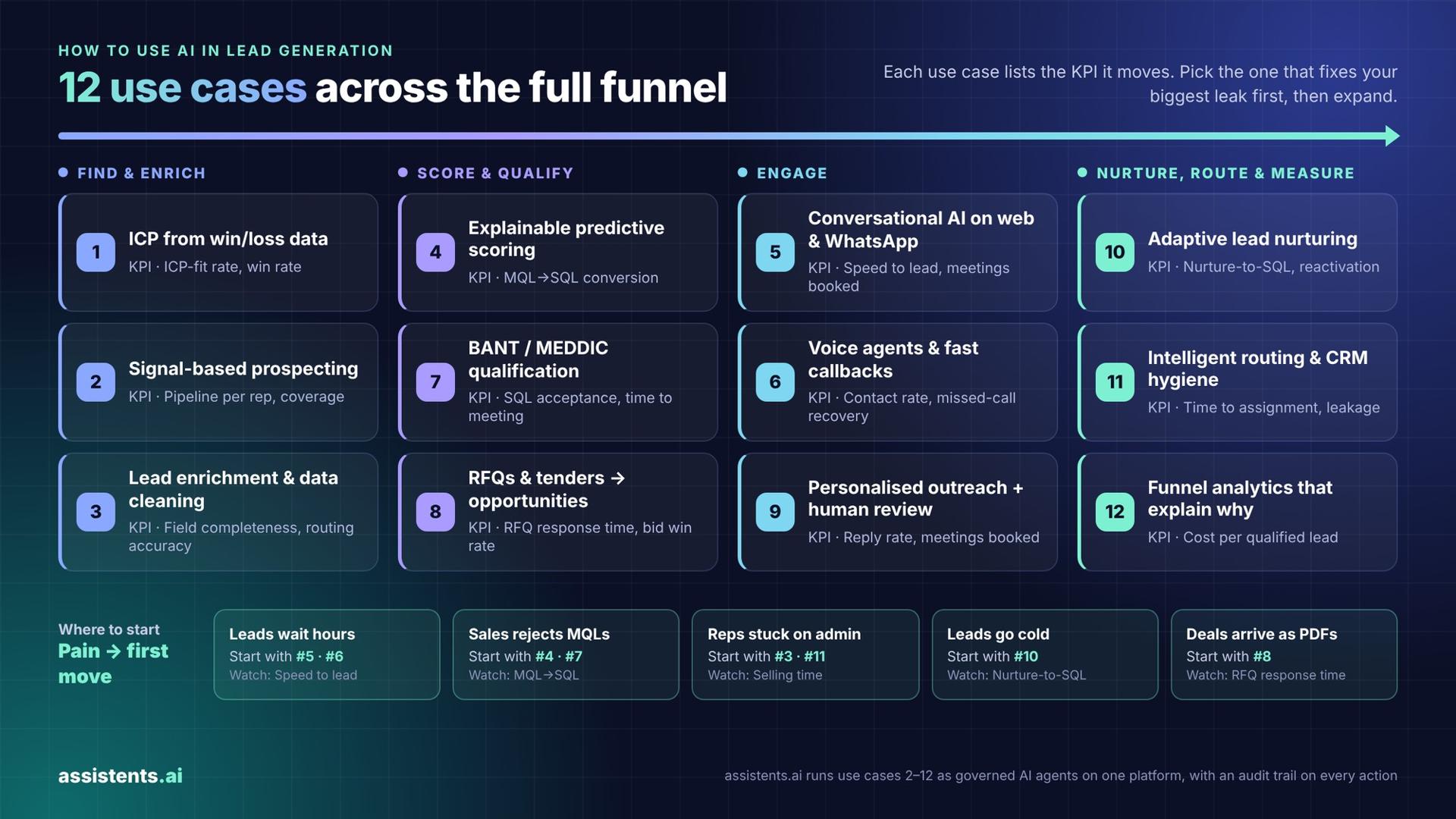
The 12 use cases below cover the full funnel. Each one lists what the AI does, the data it needs and the KPI it moves. Pick the one that fixes your biggest leak first.
1. Build your ideal customer profile from win/loss data
Most ICPs are written in a workshop and never updated. AI analyses your closed-won and closed-lost opportunities to find the traits that predict a deal: industry, company size, tech stack, buying committee, deal velocity and source.
- Data needed: 12–24 months of CRM opportunities with outcomes.
- KPI it moves: ICP-fit rate of new leads, win rate.
- Tip: Rebuild the model every quarter. Your best customers change as your product does.
2. Signal-based prospecting and account monitoring
Instead of buying static lists, AI agents watch for buying signals: website visits from target accounts, hiring for relevant roles, funding rounds, competitor price changes, contract renewals and expansion triggers. They turn those signals into prioritised accounts and next-best actions.
- Data needed: CRM accounts, web analytics, intent data and market or competitor feeds.
- KPI it moves: pipeline per rep, account coverage.
- In practice: see Case study 1 and Case study 4.
3. AI lead enrichment and data cleaning
Bad data breaks every downstream step. AI agents enrich records with firmographics and role data, standardise job titles, merge duplicates and flag stale contacts before they reach a rep. Read more in our guide to AI agents for data cleaning.
- Data needed: CRM and marketing automation records, plus enrichment sources.
- KPI it moves: field completeness, bounce rate, routing accuracy.
- In practice: see Case study 5.
4. Predictive lead scoring you can explain
Rule-based scores reward activity, not intent. Predictive scoring blends fit (who they are), intent (what they are researching) and engagement (what they do with you), then shows reps why a lead scored high. Black-box scores are one of the most common reasons reps stop trusting AI.
Example scoring model (100 points)
| Category | Signal | Points |
|---|---|---|
| Fit (40) | Industry and company size match ICP | 20 |
| Decision-maker or influencer role | 12 | |
| Compatible tech stack (e.g. Salesforce or HubSpot) | 8 | |
| Intent (35) | Visited pricing or demo page in the last 7 days | 15 |
| Third-party intent on relevant topics | 12 | |
| Asked a buying question in chat or email | 8 | |
| Engagement (25) | Attended a webinar or downloaded a guide | 10 |
| Replied to outreach | 10 | |
| Multiple contacts from the same account active | 5 |
Thresholds: 75–100 → route to a rep within 5 minutes · 50–74 → AI-led nurture · under 50 → recycle and keep monitoring.
- KPI it moves: MQL→SQL conversion, rep time on qualified leads.
5. Instant capture with conversational AI on web and WhatsApp
Forms are where intent goes to die. A conversational AI agent greets visitors, answers product questions from your knowledge base, collects contact details naturally and books meetings, at 2 a.m. as easily as at 2 p.m. On WhatsApp it can pick up enquiries from ads and listings in seconds.
- Data needed: product and pricing knowledge base, calendar access, CRM.
- KPI it moves: speed to lead, visitor-to-lead conversion, meetings booked.
- In practice: see Case study 2 and Case study 3.
6. AI voice agents for inbound calls and fast callbacks
Many high-value leads still pick up the phone. Voice AI agents answer inbound calls, call back web leads within minutes, ask qualification questions in several languages and transfer warm calls to a rep with a summary.
- Data needed: call scripts, qualification criteria, CRM and telephony integration.
- KPI it moves: contact rate, missed-call recovery, after-hours conversion.
- Compliance note: follow consent and calling-hour rules such as the TCPA in the US.
7. Conversational qualification with BANT or MEDDIC
Qualification varies by rep, so your SQL definition drifts. An AI lead qualification agent asks the same discovery questions every time, adapts follow-ups to each answer and writes a structured summary to the CRM. Reps start the first call already knowing budget, timeline, use case and stakeholders.
- Data needed: your qualification framework, ICP, past win/loss patterns.
- KPI it moves: SQL acceptance rate by sales, time to first meeting.
8. Turn RFQs, tenders and inbound emails into qualified opportunities
In B2B, some of the best leads arrive as PDFs: RFQs, tenders, bid packs and long emails. Document AI reads them, extracts requirements and deadlines, checks fit and flags changes between revisions. Your team can then respond faster and bid on the right opportunities.
- Data needed: inbound documents, bid/no-bid criteria, CRM or ERP.
- KPI it moves: response time to RFQs, bid win rate, opportunities missed.
- In practice: see Case study 6.
9. Personalised outreach at scale, with human review
Generative AI can research each account and draft outreach that refers to the prospect's real situation, not just their first name. The best programs keep a human in the loop: reps approve the first messages, and AI learns from their edits.
- Data needed: enriched lead data, approved messaging, brand guardrails.
- KPI it moves: reply rate, positive reply rate, meetings booked.
10. Adaptive lead nurturing
Static drip campaigns send the same email to everyone. AI-led nurture watches opens, clicks, site visits and replies, then changes content, channel and timing for each lead. When it spots a hand-raise, it alerts sales. See how automated lead nurture campaigns work in practice.
- Data needed: content library, engagement data, scoring model.
- KPI it moves: nurture-to-SQL conversion, reactivation rate.
11. Intelligent routing and CRM hygiene
The fastest response fails if the lead reaches the wrong rep. AI routes leads by territory, segment, language, capacity and expertise, then logs every touch to the CRM. Reps spend less time on data entry, and leaders get a pipeline they can trust.
- Data needed: routing rules, rep capacity, CRM.
- KPI it moves: time to assignment, lead leakage, data completeness.
12. Funnel analytics that explain why leads drop
Dashboards show what happened. Agentic analytics explains why: which sources produce SQLs, where leads stall and which messages convert. Leaders can ask questions in plain English and get governed answers.
- Data needed: CRM, marketing automation, web analytics.
- KPI it moves: cost per qualified lead, channel ROI.
- In practice: see Case study 7.
Where to start: pick your first AI lead generation workflow
| Your biggest pain point | First AI workflow | KPI to watch |
|---|---|---|
| Leads wait hours for a reply | Conversational or voice agent for instant response (#5, #6) | Speed to lead |
| Sales rejects most MQLs | Explainable predictive scoring (#4) plus AI qualification (#7) | MQL→SQL and SQL acceptance |
| Reps spend hours on research and data entry | Enrichment and CRM hygiene (#3, #11) | Rep selling time |
| Leads go cold after the first touch | Adaptive nurture (#10) | Nurture-to-SQL conversion |
| Big opportunities arrive as documents | Document AI for RFQs and tenders (#8) | RFQ response time |
Where assistents.ai fits: assistents.ai runs use cases 2–12 as governed AI agents on one platform, covering conversational, voice, document and analytics agents, with an audit trail on every action. See AI agents for sales and revenue ops →
AI tools vs chatbots vs AI agents for lead generation
AI tools assist a person with one task, chatbots follow scripted flows on one channel, and AI agents pursue a goal across systems and channels with defined guardrails. For lead generation, the difference shows up in how much of the funnel runs without manual work.
| AI point tools | Rule-based chatbots | AI agents | |
|---|---|---|---|
| What it does | Writes copy, finds emails, scores a list | Answers FAQs, captures form fields | Engages, qualifies, books, updates CRM, routes |
| Autonomy | Low: a human runs each step | Low: fixed decision trees | High, within governed rules |
| Channels | One | Usually web chat | Web, WhatsApp, email, voice |
| Context | Single task | Session only | CRM history, knowledge base, intent signals |
| Governance | Varies | Limited | Audit logs, approvals, explainability |
| Best for | Individual productivity | Simple FAQs | End-to-end lead generation at scale |
Most teams end up with a mix: data providers for contacts, a sequencer for outbound email, and an agent platform that ties capture, qualification, routing and analytics together. For a deeper look at agent-led selling, read our guide to the AI sales agent for lead generation.
Real case studies: AI lead generation in production
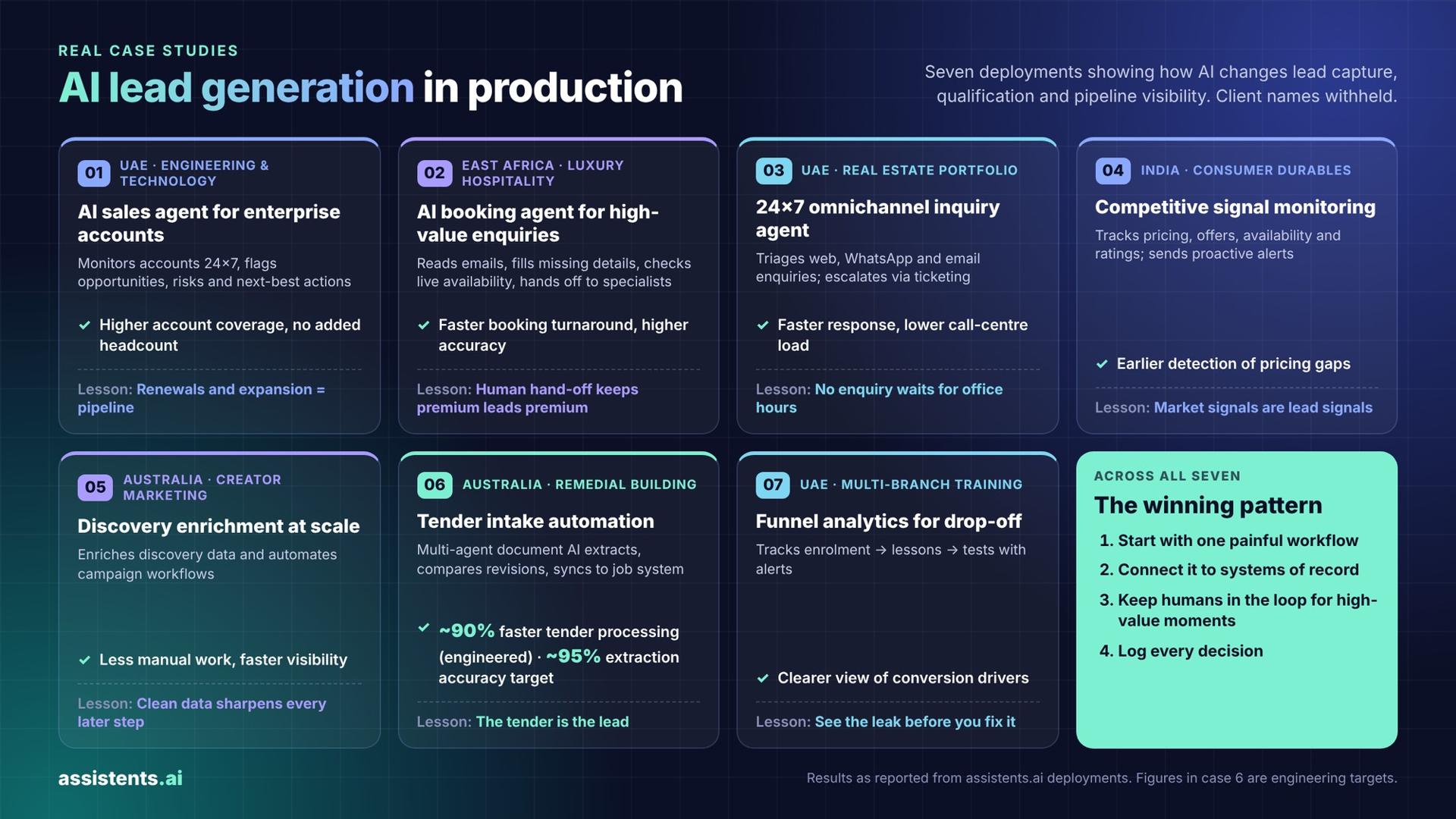
These seven deployments show how AI changes lead capture, qualification and pipeline visibility in real businesses. Client names are withheld. Each case follows the same format: context, what the AI does, results and the lesson for lead generation.
Case study 1: AI sales agent for enterprise account monitoring
Context: A long-established engineering and technology solutions provider in the UAE serves large enterprise and infrastructure clients. Its sales team needed to cover more accounts and spot opportunities and risks earlier, without adding headcount.
What the AI does: An agentic AI sales agent monitors enterprise accounts around the clock and captures signals. It identifies opportunities, risks and next-best actions using governed rules. It orchestrates follow-ups, keeps the pipeline clean through CRM-ready workflows and sends alerts and dashboards to sales leadership.
Results:
- Higher account coverage without increasing headcount
- Faster response cycles on opportunities and renewals
- More consistent execution through governed playbooks
Lead-gen lesson: The best leads are often inside accounts you already have. Signal-based monitoring turns renewals and expansion triggers into pipeline.
Case study 2: AI booking agent for a luxury hospitality brand
Context: A luxury hospitality brand runs a portfolio of boutique safari lodges and camps in East Africa, serving demanding international travellers. Every enquiry is a high-value lead, but complex requests meant slow back-and-forth by email.
What the AI does: A digital booking agent reads incoming emails, classifies intent and extracts trip details. It runs a conversation to collect missing information, checks live availability and suggests alternative dates or properties. It hands curated itineraries to human specialists and generates invoices and documents automatically.
Results:
- Faster booking turnaround with less back-and-forth
- Higher accuracy on complex guest requirements
- Operations that scale without compromising luxury service
Lead-gen lesson: AI qualification doesn't have to feel robotic. A human-in-the-loop hand-off keeps premium leads premium while removing the delay.
Case study 3: 24×7 omnichannel inquiry agent for a real estate portfolio
Context: A diversified real estate owner and manager in the UAE handles office, retail, industrial and residential assets across several emirates. Prospective and current tenants send enquiries at all hours on many channels.
What the AI does: An omnichannel service agent, ready for web, WhatsApp and email, triages enquiries and answers FAQs from a knowledge base of policies and tenancy documents. It handles routine requests and escalates to the right human team through ticketing.
Results:
- Faster response times and lower call-centre load
- A consistent 24×7 experience
- Better SLA adherence through automated routing and tracking
Lead-gen lesson: In real estate, speed to lead is the whole game. An always-on agent makes sure no enquiry waits for office hours.
Case study 4: Competitive signal monitoring for a consumer durables leader
Context: A major cooling and appliances manufacturer in India competes in price-sensitive markets where competitor pricing and promotions change daily.
What the AI does: AI agents continuously monitor e-commerce and channel data, including pricing, discounts, offers, availability and ratings. They map leadership questions to instant answers and send proactive alerts on pricing gaps and portfolio threats.
Results:
- Faster competitive response cycles
- Earlier detection of pricing gaps and promotion shifts
- Always-on monitoring that replaced manual checks across portals
Lead-gen lesson: Market signals are lead signals. The same monitoring pattern can flag accounts or regions where a competitor is weak and your offer is strong.
Case study 5: Discovery enrichment for a creator marketing platform
Context: An Australian creator-economy platform connects brands with creators across very large datasets. Matching the right creators to each campaign took heavy manual work.
What the AI does: AI enriches creator discovery and automates campaign workflows. It produces reporting summaries and insights, and it monitors content KPIs and brand safety.
Results:
- Less manual work across campaigns
- Faster visibility into performance and more scalable execution
- More consistent reporting and learnings across brand programs
Lead-gen lesson: Enrichment is where AI saves the most hours. Clean, matched data makes every later step, from scoring to outreach, more accurate.
Case study 6: Tender intake automation for a remedial building contractor
Context: An Australian remedial building and waterproofing specialist with more than 20 years in the market wins work through tenders. Each tender arrives as complex, frequently revised documents.
What the AI does: A multi-agent document workbench retrieves tenders, decides the workflow and analyses revisions. It extracts data from complex PDFs with vision-capable LLMs and syncs everything into the core job-management system, with quote locking and audit logs.
Results:
- Engineered for up to ~90% faster tender document processing
- ~95% extraction accuracy target for standard formats
- Lower bid risk through revision detection and auditability
Lead-gen lesson: For many B2B firms, an RFQ or tender is the lead. Processing it in a fraction of the time means you can bid on more of the right opportunities.
Case study 7: Funnel analytics for a multi-branch training institute
Context: A Dubai-based driving institute runs several branches and digital customer journeys. It needed to see where students dropped off between enquiry and qualification.
What the AI does: AI funnel analytics tracks every step from enrolment to lessons to tests. It also covers instructor utilisation, slot optimisation and customer experience dashboards with alerts.
Results:
- Clearer view of what drives conversion and performance
- Fewer operational bottlenecks and better scheduling efficiency
Lead-gen lesson: You can't fix a leak you can't see. Analytics that explain drop-off show where AI engagement will pay back first.
Across all seven: the winning pattern is the same. Start with one painful workflow, connect it to the systems of record, keep humans in the loop for high-value moments and log every decision. Explore more on our customers page and in our use-case library.
Human + AI: what to automate and what to keep
AI should own speed, consistency and volume. Humans should own trust, judgement and complex negotiation. AI won't replace good SDRs and account executives, but it will replace the manual parts of their day.
| Let AI handle | Keep with humans |
|---|---|
| First response on every channel, 24×7 | Discovery calls with senior buyers |
| Research, enrichment and data entry | Relationship building and multi-threading |
| Standard qualification questions | Reading politics and unstated objections |
| Scoring, routing and CRM updates | Pricing, negotiation and custom proposals |
| Nurture sequences and reminders | Strategic account plans |
| Meeting booking and follow-up summaries | Final approval of messaging and offers |
This matches what buyers say. Gartner predicts that by 2030, 75% of B2B buyers will prefer sales experiences that prioritise human interaction over AI (Gartner, August 2025). Buyers want AI for speed and self-service, and humans for the moments that build trust.
How to implement AI in lead generation: a 30-60-90 day playbook
A focused rollout reaches production in about 90 days: measure and prepare in month one, pilot with human review in month two, and scale in month three.
Days 1–30: audit, clean and choose one workflow
- Map your current funnel and record a baseline for speed to lead, MQL→SQL, SQL→opportunity and cost per qualified lead.
- Clean the CRM: de-duplicate, standardise fields and close stale records.
- Pick one high-impact workflow from the "Where to start" table.
- Agree on qualification criteria and hand-off rules with sales.
- Review data privacy, consent and security requirements with legal and IT.
- Owners: RevOps (lead), Marketing Ops, IT/Security.
Days 31–60: pilot with a human in the loop
- Connect the agent to your CRM, calendar, knowledge base and channels.
- Run the pilot on one segment, region or channel.
- Have reps review AI qualification summaries and outreach drafts, and feed their edits back.
- A/B test against your current process.
- Owners: Sales lead (lead), RevOps, Marketing Ops.
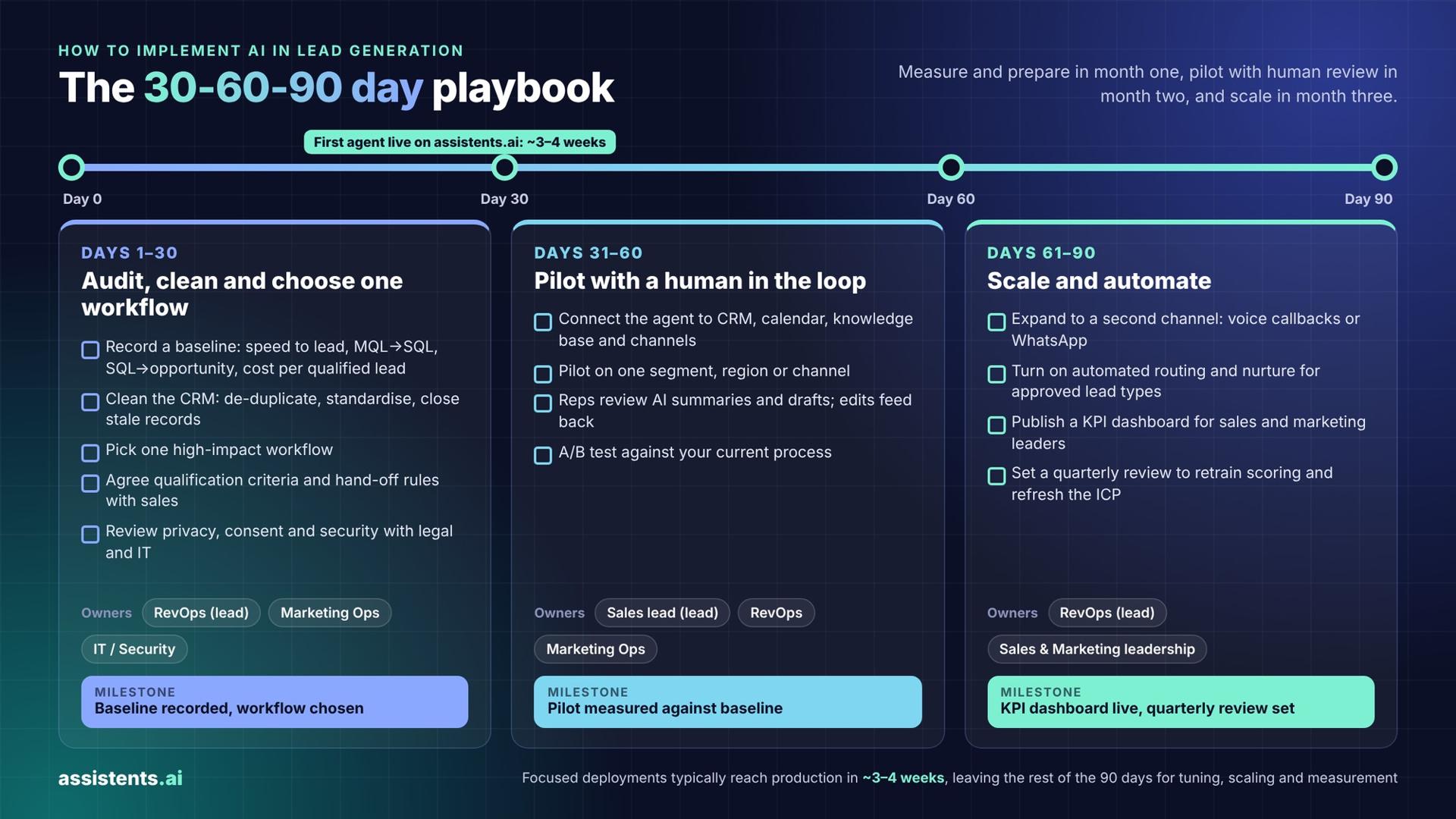
Days 61–90: scale and automate
- Expand to a second channel, such as voice callbacks or WhatsApp.
- Turn on automated routing and nurture for approved lead types.
- Publish a KPI dashboard for sales and marketing leadership.
- Set a quarterly review to retrain scoring and refresh the ICP.
- Owners: RevOps (lead), Sales and Marketing leadership.
On the assistents.ai platform, focused deployments typically reach production in about 3–4 weeks. That leaves the rest of the 90 days for tuning, scaling and measurement. See our implementation approach.
KPIs and ROI: how to measure AI lead generation
Track speed to lead, conversion at each stage and cost per qualified lead against the baseline you recorded before launch.
| KPI | Formula | What good looks like |
|---|---|---|
| Speed to lead | Time from lead creation to first meaningful response | Under 5 minutes; under 1 minute with AI |
| Contact rate | Leads reached ÷ leads created | Rising month on month |
| MQL→SQL conversion | SQLs ÷ MQLs | Above your baseline; top quartile is about 16% (Digital Applied) |
| SQL acceptance rate | SQLs accepted by sales ÷ SQLs sent | Above 80% |
| SQL→opportunity | Opportunities ÷ SQLs | Above your baseline |
| Cost per qualified lead | Total lead-gen cost ÷ SQLs | Falling quarter on quarter |
| Rep selling time | Hours on selling ÷ total hours | Rising as admin is automated |
| Pipeline per rep | Pipeline value ÷ number of reps | Rising without extra headcount |
A simple ROI formula
AI lead generation ROI = (Added pipeline value × win rate + Cost savings − AI program cost) ÷ AI program cost
Illustrative example (round numbers, not a benchmark): suppose faster response and better qualification add $1,000,000 in pipeline per year. At a 20% win rate, that is $200,000 in new revenue. Add $60,000 in saved rep and ops time, for $260,000 in total benefit. Against an 80,000programcost,ROI=(260,000 − $80,000) ÷ $80,000 = 2.25x. Plug in your own figures with our AI agent ROI calculator.
Governance, privacy and compliance in AI lead generation
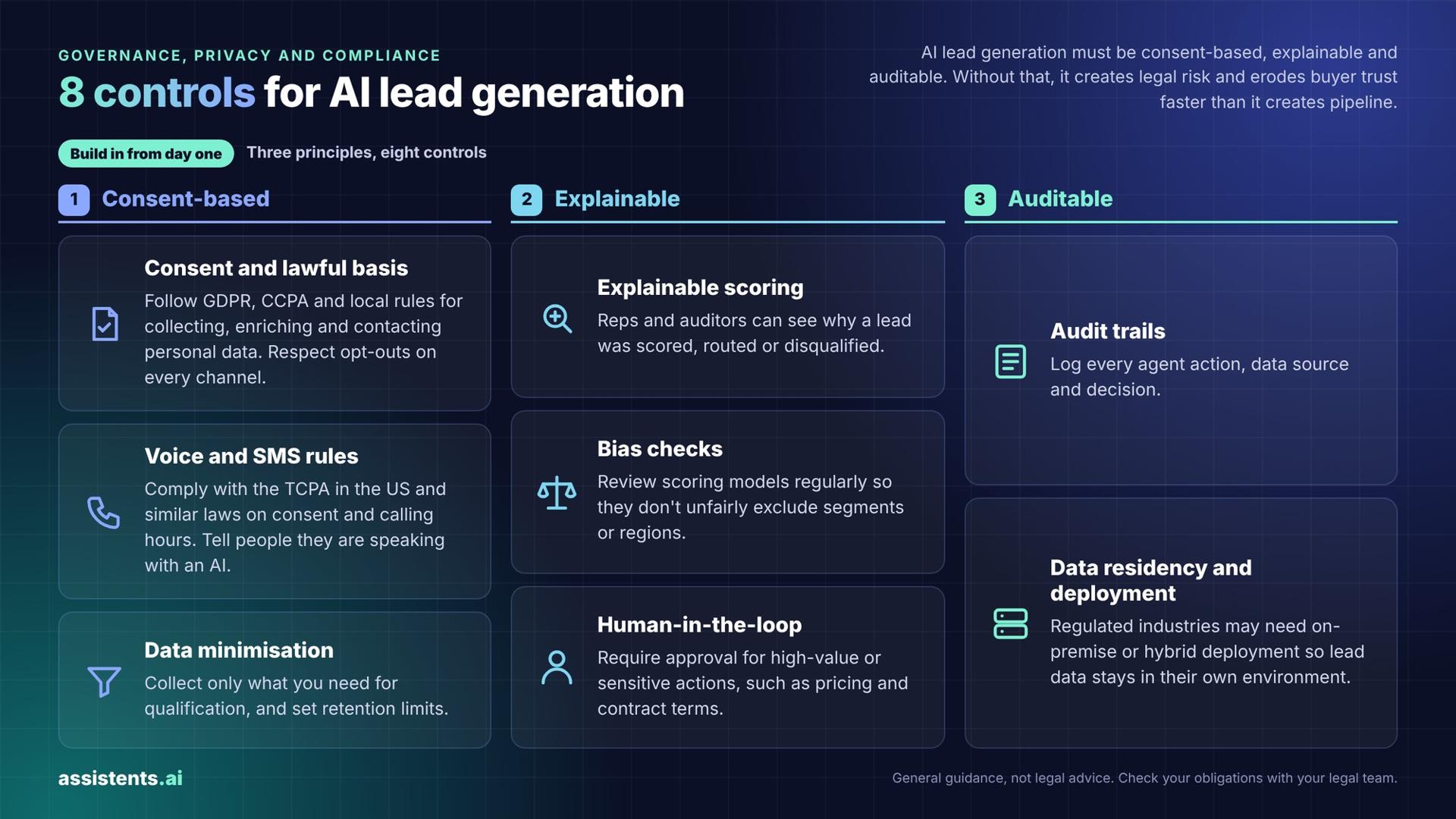
AI lead generation must be explainable, consent-based and auditable. Without that, it creates legal risk and erodes buyer trust faster than it creates pipeline.
Build these controls in from day one:
- Consent and lawful basis: follow GDPR, CCPA and local rules for collecting, enriching and contacting personal data. Respect opt-outs on every channel.
- Voice and SMS rules: comply with the TCPA in the US and similar laws elsewhere on consent and calling hours. Tell people when they are speaking with an AI.
- Explainable scoring: reps and auditors should be able to see why a lead was scored, routed or disqualified.
- Bias checks: review scoring models regularly so they don't unfairly exclude segments or regions.
- Human-in-the-loop: require approval for high-value or sensitive actions, such as pricing and contract terms.
- Audit trails: log every agent action, data source and decision.
- Data residency and deployment: regulated industries may need on-premise or hybrid deployment so lead data stays in their own environment.
- Data minimisation: collect only what you need for qualification, and set retention limits.
Read the AI agent governance playbook for a full checklist, or see our security and trust approach.
This section is general guidance, not legal advice. Check your obligations with your legal team.
6 common mistakes when using AI in lead generation
- Automating a broken process. If your qualification criteria are unclear, AI will apply unclear criteria faster. Fix the process first.
- Feeding the AI dirty data. Duplicate, stale and incomplete CRM records produce bad scores and misrouted leads.
- Trusting black-box scores. If reps can't see why a lead scored 82, they will ignore the score.
- No human hand-off. Leads that ask for a person and can't reach one are lost leads.
- Chasing volume over quality. More AI-generated emails won't fix a weak ICP. Measure SQLs and pipeline, not sends.
- No baseline. Without before-and-after numbers, you can't prove ROI or know what to scale.
How to choose an AI lead generation platform
Choose a platform that covers more than one stage of the funnel, connects to your CRM in both directions and gives you control over data and decisions. Use this 8-point checklist:
- CRM integration: two-way sync with Salesforce, HubSpot, Dynamics 365 or your CRM.
- Channel coverage: web chat, WhatsApp, email and voice from one agent.
- Explainability: visible reasons behind every score and routing decision.
- Governance: audit logs, role-based permissions and approval workflows.
- Deployment options: cloud, on-premise or hybrid for regulated data.
- Time to production: weeks, not quarters, with a clear implementation plan.
- Pricing model: predictable costs that don't punish growth in lead volume.
- Proof in production: real deployments in your industry, not just demos.
For a broader framework, download the enterprise AI buyer's guide or compare platforms on our comparison hub.
Why assistents.ai for AI lead generation
assistents.ai is an agentic AI platform for enterprises. It runs governed AI agents across the whole lead engine, from first signal to sales-ready hand-off, on infrastructure you control.
- One platform for the full funnel. Autonomous and conversational agents, Voice AI, Document AI and Agentic BI cover all 12 use cases in this guide, so you don't have to stitch together separate tools.
- Governed by default. Every agent action has an audit trail, scoring is explainable, and human-in-the-loop hand-offs are built in through agent governance.
- Runs where your data lives. Deploy in the cloud, on-premise or hybrid, which suits financial services, healthcare and other regulated industries.
- Plugs into your revenue stack. 90+ integrations, including Salesforce, HubSpot, Dynamics 365, Zoho, Marketo, Outreach, Salesloft, Gong, Slack and Teams, with two-way CRM sync.
- Fast to value. Lead response in under 90 seconds, lead-to-score in about 2.3 seconds, and production in about 3–4 weeks (platform figures).
- Proven in production. 30+ deployments across hospitality, real estate, engineering, retail, logistics, healthcare and financial services, including the case studies above.
- Context that makes agents smarter. The Context Engine gives agents your CRM history, product knowledge and policies, so answers are accurate and on-brand.
| Typical AI lead-gen tool | assistents.ai | |
|---|---|---|
| Funnel coverage | One stage (e.g. email or chat) | Target to measure, all 9 stages |
| Channels | Usually one | Web, WhatsApp, email, voice, documents |
| Governance | Basic logs | Audit trail, approvals, explainable scoring |
| Deployment | Vendor cloud only | Cloud, on-premise or hybrid |
Ready to see it on your own funnel? Book a sales-agent demo →
Conclusion: start with one workflow, then scale
Using AI in lead generation works best when it is focused, measured and governed. Pick the leak that costs you the most, whether that is slow response, weak scoring or messy data. Fix it with one AI workflow, measure speed to lead and MQL→SQL against your baseline, then expand across the funnel.
The teams pulling ahead in 2026 aren't the ones with the most AI tools. They are the ones with governed AI agents working across the whole lead engine, and with reps who spend their time on the conversations that close.
See how assistents.ai can run your lead engine. Explore AI agents for sales → · Book a demo →
Related reading
- AI Sales Agent for Lead Generation: The Enterprise Playbook
- 12 Best AI Agent Use Cases for Sales Teams
- AI Agent Use Cases in Marketing
- Autonomous AI Agents Examples
FAQs
What is AI lead generation?
AI lead generation is the use of artificial intelligence, including machine learning, LLMs and AI agents, to find, enrich, score, engage, qualify and route potential customers. It replaces manual research, static lead scoring and slow follow-up with systems that learn from your data and act in real time across web, email, WhatsApp and voice.
How is AI being used in lead generation?
Companies use AI to build ICPs from win/loss data, monitor buying signals, enrich and clean CRM records, score leads predictively, respond instantly through chat and voice agents, qualify leads with consistent questions, personalise outreach, run adaptive nurture, route leads to the right rep and explain funnel drop-off with analytics.
Can AI generate leads on its own?
AI can find prospects, start conversations and qualify inbound leads with little human effort. It still needs a clear ICP, good data, approved messaging and human oversight. The strongest results come when AI handles speed and volume, and people handle trust-building conversations and complex deals.
Can ChatGPT generate leads?
ChatGPT can help research accounts, draft outreach and brainstorm campaigns. On its own, it isn't connected to your CRM, can't monitor signals, can't respond to website visitors and has no audit trail. For production lead generation, teams use AI agent platforms that combine LLMs with integrations, workflows and governance.
What is the best AI tool for lead generation?
The best tool depends on your bottleneck. Data providers help with contact discovery, sequencers help with outbound email, and AI agent platforms such as assistents.ai cover capture, qualification, routing and analytics across channels. Judge each option on CRM integration, explainability, governance, deployment options and proof in production.
Will AI replace SDRs?
AI will replace much of an SDR's manual work: research, data entry, first responses and standard qualification. It is unlikely to replace the human judgement needed for complex discovery, relationship building and negotiation. Most teams are moving to a hybrid model where AI handles volume and SDRs focus on high-value conversations.
How do you qualify leads with AI?
Define your criteria, such as BANT, MEDDIC or ICP fit. Give an AI agent your knowledge base and CRM access. Let it ask discovery questions in chat, email or voice, adapting follow-ups to each answer. The agent scores the lead, writes a structured summary to the CRM and routes sales-ready leads to the right rep.
How much does AI lead generation cost?
Costs vary by scope, channels, volume and deployment model. Point tools may charge per seat or per contact, while enterprise agent platforms usually price by usage or by agents and workflows. Compare total cost against added pipeline, rep hours saved and lower cost per qualified lead, using an ROI calculator.
How long does it take to implement AI for lead generation?
A focused first workflow can go live in a few weeks. On assistents.ai, deployments typically reach production in about 3–4 weeks. A full rollout across channels usually takes about 90 days: one month to prepare data and pick a workflow, one month to pilot and one month to scale.
Is AI lead generation GDPR compliant?
It can be, if it is designed for compliance. You need a lawful basis for processing, clear consent and opt-outs, data minimisation, retention limits, explainable decisions and audit logs. Deployment choice also matters: on-premise or regional hosting helps meet data residency requirements. Always confirm your obligations with legal counsel.
What is the difference between an AI agent and a chatbot for lead generation?
A chatbot follows scripted flows, usually on one channel, and mostly collects form data. An AI agent pursues a goal, such as qualifying and booking a lead. It understands free-form questions, uses CRM and knowledge-base context, works across channels and takes actions like updating records and routing leads.
What KPIs show that AI lead generation is working?
Track speed to lead, contact rate, MQL→SQL conversion, SQL acceptance by sales, SQL→opportunity conversion, cost per qualified lead, rep selling time and pipeline per rep. Compare each against a baseline recorded before launch, and review them monthly.