Autonomous AI agents are AI systems that start work on their own, from an event, a schedule or a threshold rather than a prompt. They plan multi-step tasks, act inside business systems, and hand off to a human only when something falls outside their limits.
That last part is what most lists of autonomous AI agents examples leave out. In real businesses, autonomy is never all or nothing. Every agent that works has a clear boundary: what it may decide alone, what it may never do, and when it must ask a person.
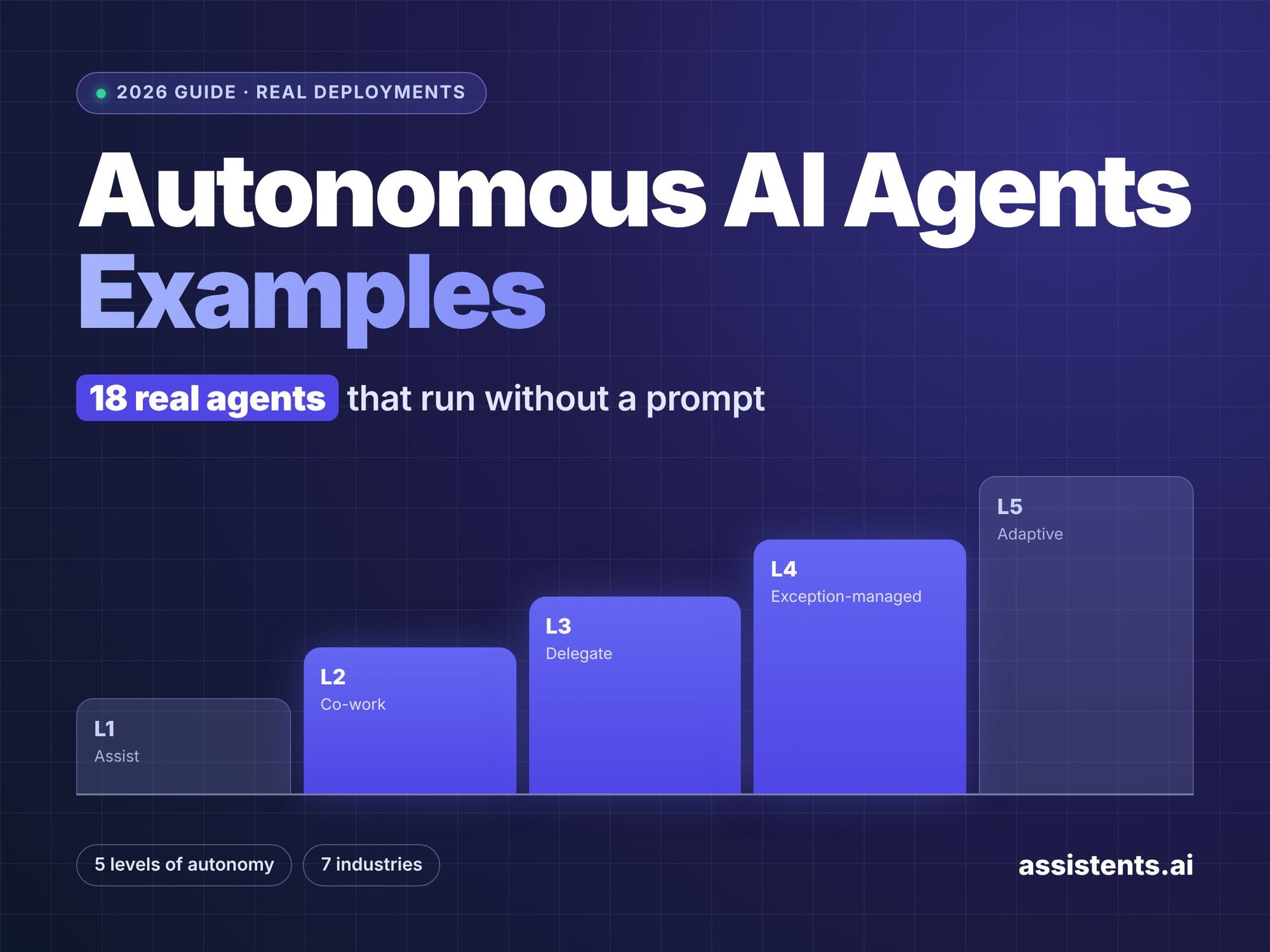
This guide shows 18 autonomous AI agents running in real organisations across retail, finance, energy, real estate, healthcare, logistics and hospitality. Each example comes with an autonomy card that shows exactly how much the agent is trusted to do. The examples are sorted using the 5 levels of AI agent autonomy, so you can see what "autonomous" looks like at each stage.
Why this matters now: Gartner expects that by 2028, 15% of routine work decisions will be made autonomously by agentic AI, and 33% of enterprise software applications will include agentic AI (SD Times on Gartner).
Key takeaways
- An autonomous AI agent starts itself, plans its own steps, acts in real systems and escalates exceptions. If a human has to prompt it every time, it is an assistant, not an autonomous agent.
- Autonomy comes in 5 levels: Assist, Co-work, Delegate, Exception-managed and Adaptive. Most production agents today run at Levels 2 to 4.
- The best autonomous agents are defined as much by what they never do as by what they do.
- Autonomy is earned: replay on history, shadow mode, limited activation, then expansion.
- Platforms like assistents.ai let you set the autonomy level per agent, so you get value early without handing over control.
Autonomous AI agents examples at a glance
All 18 examples below are real deployments delivered on assistents.ai. Client names are withheld; each is described by industry, region and scale.
| # | Autonomous AI agent | Industry | What triggers it | Autonomy level | Headline result |
|---|---|---|---|---|---|
| 1 | Competitive price-monitoring agent | Consumer durables (India) | Continuous channel monitoring | 4 – Exception-managed | Always-on monitoring replaced manual portal checks |
| 2 | Group procurement and finance KPI agent | Diversified conglomerate (UAE) | KPI thresholds across 30+ companies | 4 – Exception-managed | Earlier detection of margin erosion and vendor slippage |
| 3 | Grid-exception agent | Power transmission utility (India) | Sensor and KPI anomalies | 4 – Exception-managed | Faster exception detection and response |
| 4 | Campus energy agent | Research institute (India) | Utility and sensor data | 4 – Exception-managed | Faster detection of energy inefficiencies |
| 5 | 24/7 tenant service agent | Real estate portfolio (UAE) | Tenant messages on any channel | 4 – Exception-managed | Lower call-centre load, 24×7 service |
| 6 | AI CFO cashflow agent | Finance software | Live accounting and banking data | 4 – Exception-managed | Earlier detection of cash risks |
| 7 | Account-monitoring sales agent | Engineering and technology (UAE) | Account and market signals | 4 – Exception-managed | Higher account coverage without more headcount |
| 8 | Insights-to-action agent | Retail holding group (India) | Dashboard changes | 4 – Exception-managed | Reactive reporting became proactive execution |
| 9 | Tender-document agent | Building remediation (Australia) | New tender documents | 3 – Delegate | Engineered for up to ~90% faster processing |
| 10 | Purchase-order-to-SAP agent | Home appliances distribution (UAE) | Incoming purchase orders | 3 – Delegate | Faster order-to-confirm, fewer entry errors |
| 11 | Luxury booking agent | Safari hospitality (East Africa) | Guest booking emails | 3 – Delegate | Faster booking turnaround |
| 12 | Healthcare staffing agent | Nurse staffing (US) | Facility shift requests | 3 – Delegate | Faster fill cycles |
| 13 | Pharma sourcing RFQ agent | Pharma supply (India) | Buyer RFQs | 3 – Delegate | Faster procurement cycles |
| 14 | Cross-border tax-risk agent | Tax technology (UK) | New transactions | 3 – Delegate | Earlier detection of withholding and VAT risk |
| 15 | Banking disputes agent | Fintech for banks and credit unions | Customer cases on any channel | 3 – Delegate | Faster, more consistent case handling |
| 16 | Guardrailed trading-insight agent | Trading technology | Market data | 3 – Delegate | More disciplined, governed decisions |
| 17 | Bilingual store-support voice agent | Value retail, 700+ stores (India) | Store staff calls | 2 – Co-work | Faster store issue resolution |
| 18 | AI scene-partner voice agent | Consumer app for actors | Actor starts a rehearsal | 2 – Co-work | More rehearsal without a human reader |
What makes an AI agent autonomous? (the 4-part test)
An AI agent is autonomous only if it passes all four of these tests:
- It starts itself. It is triggered by an event, a schedule or a threshold, not by someone typing a prompt.
- It plans and adapts. It breaks a goal into steps and changes course when the evidence changes.
- It acts in real systems. It reads from and writes to the ERP, CRM, ticketing or email systems a business already runs, through permitted actions.
- It works inside an authority envelope. It knows the limits of its value, scope and confidence, and it escalates anything outside them.
Fail test 1 and you have an AI assistant. Fail test 3 and you have an analytics tool. Fail test 4 and you have a risk.
Autonomous agents vs AI agents vs copilots vs chatbots vs RPA
| Who starts the work? | Who decides the steps? | Who takes the action? | Handles exceptions? | |
|---|---|---|---|---|
| Chatbot | User | Script | User | No |
| Copilot / AI assistant | User | AI suggests, user decides | User | No |
| RPA bot | Schedule or trigger | Fixed rules | Bot | Breaks or stops |
| AI agent (semi-autonomous) | User or trigger | AI | AI, with approval | Asks the user |
| Autonomous AI agent | Event, schedule or threshold | AI, within policy | AI, within limits | Escalates by rule |
For a deeper look at the classic categories, see our guide to 15 types of AI agents explained with real-world examples. In one line each: simple reflex agents react to rules, model-based agents track state, goal-based agents plan toward a target, utility-based agents weigh trade-offs, and learning agents improve from feedback. Autonomous enterprise agents usually combine all five.
Agent washing: what is not an autonomous agent
Gartner estimates that of the thousands of vendors selling "agentic AI", only about 130 are real. The rest are practising "agent washing": relabelling chatbots, assistants and RPA as agents (SD Times).
Quick checks:
- If it only answers questions, it is not autonomous.
- If it follows a fixed script with no reasoning, it is automation, not an agent.
- If it can take any action with no limits or audit trail, it is not enterprise-ready.
The 5 levels of AI agent autonomy
Autonomy is a scale, not a switch. The model below comes from the assistents.ai Autonomous Enterprise framework. It works like the levels of self-driving cars: each level gives the agent more responsibility and the human a different job.
| Level | Operating model | Human role | Agent role | Example in this guide |
|---|---|---|---|---|
| 1. Assist | AI prepares information | Starts, checks and acts | Advises | Conversational analytics |
| 2. Co-work | Human and agent share tasks | Owns the work | Does bounded steps | #17 store-support voice agent |
| 3. Delegate | Agent owns bounded tasks | Sets the goal, handles escalations | Plans and completes the task | #9 tender-document agent |
| 4. Exception-managed | Agents run the normal path | Manages policy and exceptions | Owns the standard process | #1 price-monitoring agent |
| 5. Adaptive | Agents propose process improvements | Approves goals, policy and releases | Optimises under controlled release | Receivables workcell |
If you use the simpler Ask → Execute → Autonomous ladder from our enterprise AI use cases guide, Ask maps to Level 1, Execute to Levels 2–3, and Autonomous to Levels 4–5.
The mature target is not "a human approves every step", because that keeps the old bottleneck. Nor is it "unrestricted autonomy", because that creates unacceptable risk. It is exception-managed operations: agents run the normal path inside a defined envelope, humans define that envelope and handle the material exceptions, and the platform watches both.
Human-led strategy. Human-owned accountability. Agent-operated processes. Exception-managed control.
5 well-known autonomous AI agents you've heard of
Before the enterprise examples, here are five public autonomous agents that shaped the category. They are useful benchmarks, and they also show why enterprises need more than a capable model.
| Agent | What it does on its own | Where it falls short in an enterprise |
|---|---|---|
| AutoGPT (2023) | Open-source project that chained LLM calls to pursue a goal: it set sub-tasks, searched the web and wrote files without a prompt at each step | No business permissions, approvals or audit trail; prone to loops |
| BabyAGI (2023) | A compact task-creation and prioritisation loop that showed how an agent can manage its own to-do list | A research pattern, not a governed production system |
| Devin by Cognition | An autonomous AI software engineer that plans, writes, tests and submits code changes | Limited to software engineering work |
| Manus | A general-purpose agent that researches, browses and builds outputs end to end; acquired by Meta in a reported ~$2B deal | Consumer and prosumer focus; not built around enterprise systems and policy |
| OpenAI Codex | A cloud software-engineering agent that runs multiple coding tasks in parallel in sandboxes | Coding only; enterprise actions sit outside its scope |
The pattern: public agents prove that models can plan and act. What they don't provide is the business layer: who the agent is allowed to act as, which systems it can touch, what it may never do, and who reviews exceptions. That layer is what turns an impressive demo into the 18 production examples below.
More famous examples, including ChatGPT agent and Waymo, are covered in 21 artificial intelligence agents examples, explained step by step.
Level 4 examples: exception-managed agents that run on their own
Level 4 agents run the normal path of a process with no human in the loop. People only see the exceptions. These are the clearest autonomous AI agents examples in business today.
1. Competitive price-monitoring agent (consumer durables brand, India)
A leading cooling and appliances brand competes in a price-sensitive market where a competitor's discount can shift share within days. Before the agent, analysts checked e-commerce portals by hand.
| Trigger | Decides alone | Never does | Hands off when | Result |
|---|---|---|---|---|
| Continuous monitoring of pricing, MRP, discounts, offers, availability and ratings across e-commerce channels | Which changes matter, which gaps to flag, and the answers to leadership questions | Changes the brand's own prices or promotions | A pricing gap or threat crosses a defined threshold | Faster competitive response, earlier detection of pricing gaps and promo shifts, and no more manual portal checks |
The agent also answers leadership's questions directly ("Where are we undercut this week?") with analytics views of pricing gaps, threats and portfolio movement. It moved from proof of concept to production with governance and audit trails.
2. Group procurement and finance KPI agent (family conglomerate, 30+ companies, UAE)
One of the UAE's largest family business groups needed one view of procurement and finance across more than 30 operating companies.
| Trigger | Decides alone | Never does | Hands off when | Result |
|---|---|---|---|---|
| KPI movements across group entities | Flags purchase-price trends, gross-margin impact, early-payment economics (notional finance cost) and vendor delivery and returns performance | Pays, renegotiates or changes vendor terms | Margin erosion or vendor slippage crosses policy limits | Earlier detection of margin erosion and vendor slippage, standardised intelligence across entities, fewer variance surprises |
Leadership receives scheduled insight packs instead of waiting for month-end. See how the same pattern applies to AI agents for accounts payable.
3. Grid-exception agent (state power transmission utility, India)
A state transmission utility runs a large network where outages and losses must be caught fast.
| Trigger | Decides alone | Never does | Hands off when | Result |
|---|---|---|---|---|
| Anomalies in transmission KPIs, loss and outage data | Detects anomalies, raises predictive maintenance indicators, routes alerts to the right field team | Operates or switches grid equipment | An exception needs field action or a judgement call | Faster exception detection, more reliable operations through proactive monitoring, clearer visibility for leadership |
4. Campus energy agent (national astrophysics research institute, India)
A premier research institute needed reliable monitoring of campus-scale infrastructure.
| Trigger | Decides alone | Never does | Hands off when | Result |
|---|---|---|---|---|
| Utility and sensor data | Detects anomalies, forecasts consumption, recommends optimisations | Directly controls building systems | A recommendation needs facilities approval | Better energy visibility, faster detection of inefficiencies, less manual monitoring |
5. 24/7 tenant service agent (real estate portfolio, UAE)
A major UAE owner of office, retail, industrial and residential assets needed consistent tenant support around the clock.
| Trigger | Decides alone | Never does | Hands off when | Result |
|---|---|---|---|---|
| Tenant messages on web, WhatsApp or email | Triages queries, answers FAQs from policies and tenancy documents, handles rental and payment support workflows | Changes lease terms or waives charges | A request needs a person, through ticketing and escalation | Faster responses, lower call-centre load, consistent 24×7 tenant experience, better SLA adherence |
More examples in 15 AI use cases in real estate.
6. AI CFO cashflow agent (finance platform for growing businesses)
An AI CFO platform needed continuous financial insight for businesses and the advisors who serve them.
| Trigger | Decides alone | Never does | Hands off when | Result |
|---|---|---|---|---|
| Live accounting and banking data | Runs forecasts and scenarios, flags runway and cash risks, recommends actions | Moves money | A cash risk needs a CFO or advisor decision | Faster analysis cycles, earlier detection of cash risks and anomalies, advisory-level insight without added headcount |
Related: AI solutions for CFOs and agentic AI in finance and accounting.
7. Account-monitoring sales agent (engineering and technology group, UAE)
A long-established UAE engineering and technology solutions provider wanted full coverage of its enterprise accounts without adding sales headcount.
| Trigger | Decides alone | Never does | Hands off when | Result |
|---|---|---|---|---|
| Account and market signals | Identifies opportunities, risks and next-best actions; orchestrates follow-ups under rule-governed playbooks | Commits to pricing or contract terms | An opportunity or risk needs an account owner | Higher account coverage without more headcount, faster response on opportunities and renewals, more consistent execution |
8. Insights-to-action agent (retail holding group, India)
Leadership at a retail holding group had dashboards, but insight rarely turned into action quickly.
| Trigger | Decides alone | Never does | Hands off when | Result |
|---|---|---|---|---|
| Changes in dashboards and metrics | Creates governed, auditable tasks from insights and tracks them to completion | Bypasses the semantic rules, hierarchies and formulas that define the business | A task needs an owner's decision | Shift from reactive reporting to proactive execution, standardised decision logic across teams |
This is agentic BI at Level 4: the agent doesn't just explain the numbers, it creates the work that changes them.
Level 3 examples: delegated agents that own a task end to end
Level 3 agents own a defined task from start to finish. A human sets the goal and handles escalations, and the agent does everything in between.
9. Tender-document agent (building remediation specialist, Australia)
A waterproofing and remediation specialist with 20+ years in complex commercial projects received long, revision-heavy tender documents that had to be re-keyed into its job-management system.
| Trigger | Decides alone | Never does | Hands off when | Result |
|---|---|---|---|---|
| A new or revised tender document | Classifies the document, extracts data from complex PDFs with vision LLMs, detects revisions, syncs records into the core system | Releases a quote without a lock and audit log | Extraction confidence is low or a revision changes scope | Engineered for up to ~90% faster tender processing, a ~95% extraction-accuracy target on standard formats, lower bid risk |
This is a multi-agent system. See the step-by-step walkthrough below, and our guide to AI agents for document processing.
10. Purchase-order-to-SAP sales-order agent (home appliances distributor, UAE)
A premium home-appliance distributor needed to replace an end-of-life, high-licence-cost order capture tool.
| Trigger | Decides alone | Never does | Hands off when | Result |
|---|---|---|---|---|
| An incoming purchase order | Interprets the order, validates it, creates the SAP sales order | Skips the approval rules for exceptions | An order breaks a rule or needs approval | Less manual order processing, a faster order-to-confirm cycle, fewer data-entry errors, better auditability |
11. Luxury booking agent (safari hospitality group, East Africa)
A luxury collection of 16 lodges, camps and hotels serves high-expectation global travellers who book by email.
| Trigger | Decides alone | Never does | Hands off when | Result |
|---|---|---|---|---|
| A guest booking email | Classifies intent, extracts details, asks for missing information, checks live inventory, proposes alternative dates or properties, generates invoices | Finalises a curated itinerary without a travel expert | The trip needs a curated, personal itinerary | Faster booking turnaround, higher accuracy on complex requests, scalable operations without diluting luxury service |
See more in agentic AI in the hospitality industry.
12. Healthcare staffing agent (nurse staffing platform, US)
A healthcare staffing platform connects nurses with facilities for flexible shifts, where speed decides who wins the shift.
| Trigger | Decides alone | Never does | Hands off when | Result |
|---|---|---|---|---|
| A facility's staffing request | Captures credentials, matches nurses to shifts, schedules, sends notifications, runs compliance workflows | Places a nurse whose credentials are not verified | A match fails compliance or needs a coordinator | Faster fill cycles, less scheduling friction, better workforce utilisation |
13. Pharma sourcing RFQ agent (excipients marketplace, India)
A pharma sourcing platform with 1,800+ rare excipients and 7,500+ SKUs needed to speed up procurement for its buyers.
| Trigger | Decides alone | Never does | Hands off when | Result |
|---|---|---|---|---|
| A buyer's request for quotation | Automates the RFQ, matches suppliers, supports quality and regulatory documents, analyses price, lead time and vendor performance | Approves a supplier that fails quality checks | Regulatory or commercial judgement is needed | Faster procurement cycles, fewer manual follow-ups, better price and lead-time competitiveness |
14. Cross-border tax-risk screening agent (tax technology, UK)
A tax-tech product screens cross-border transactions for withholding tax, VAT mismatches and permanent-establishment risk.
| Trigger | Decides alone | Never does | Hands off when | Result |
|---|---|---|---|---|
| A new cross-border transaction | Classifies risk, collects evidence, writes explainability notes | Gives a final tax opinion | Risk is material, through an escalation workflow to tax experts | Earlier detection of withholding and VAT risk, fewer last-minute deal disruptions, faster pre-compliance review |
15. Banking disputes and support agent (fintech for banks and credit unions)
A global fintech provider builds cloud automation for banks and credit unions, focused on disputes, fraud and compliance.
| Trigger | Decides alone | Never does | Hands off when | Result |
|---|---|---|---|---|
| A customer case on chat, email or phone | Takes intake, routes the case, summarises it, suggests next-best actions, monitors SLAs | Acts outside the audit trail | A case needs a human decision | Faster, more consistent case handling, less operational load, better compliance readiness |
See how AI is used in fintech.
16. Guardrailed trading-insight agent (AI-first trading terminal)
An AI-first trading terminal combines research, analysis, signals and execution through a network of specialised agents.
| Trigger | Decides alone | Never does | Hands off when | Result |
|---|---|---|---|---|
| Market data | Analyses indicators and patterns, simulates strategies, produces alerts and recommendations | Breaches its risk guardrails | A signal falls outside the risk envelope | Faster synthesis of fragmented signals, more disciplined decisions through governed workflows, less manual monitoring |
This example shows a key principle: the agent's autonomy is bounded by explicit risk limits, not by the model's judgement. More in agentic AI in quant trading.
Level 2 examples: co-working agents that act alongside people
Level 2 agents share work with people in real time. The human owns the outcome, and the agent handles well-defined steps instantly.
17. Bilingual store-support voice agent (national value retailer, 700+ stores, India)
A fast-growing value retailer with 700+ stores across hundreds of cities had a central helpdesk overwhelmed by store calls.
| Trigger | Decides alone | Never does | Hands off when | Result |
|---|---|---|---|---|
| A store staff member calls | Answers in Hindi or English; looks up pricing, stock and promotions for that store; answers training and SOP questions from POS and SOP documents | Changes prices or stock records | An issue needs a ticket, through ticketing integration | Smaller helpdesk burden, faster store issue resolution, better store-level inventory visibility, faster onboarding |
More in retail inventory AI agents and AI voice agent services for businesses.
18. AI scene-partner voice agent (acting app, iOS and Android)
An AI-powered self-tape app gives actors a scene partner whenever they need one.
| Trigger | Decides alone | Never does | Hands off when | Result |
|---|---|---|---|---|
| An actor starts a rehearsal | Reads the other lines with chosen character voices, pacing and cue logic | Replaces the actor's own performance choices | The actor stops or changes the scene | More rehearsal without human readers, more consistent audition practice |
Level 5 in practice: from one agent to an autonomous workcell
Level 5 is where single agents become a team. In the assistents.ai model, this is an Agentic Workcell: a governed group of humans and agents that owns one business operation and its outcome.
Here is an illustrative accounts-receivable workcell, a pattern that builds on assistents.ai's production experience in receivables follow-up.
Objective: reduce overdue receivables and DSO while protecting customer relationships.
| Role | Type | What it does |
|---|---|---|
| Prioritisation Agent | Agent | Ranks accounts by risk and value |
| Receivables Agent | Agent | Runs the normal follow-up path |
| Invoice Reconciliation Agent | Agent | Matches payments and finds mismatches |
| Voice/Email Communication Agent | Agent | Sends approved reminders and makes calls |
| Promise-to-Pay Monitor | Agent | Tracks commitments and flags broken promises |
| Outcome Analyst | Agent | Measures what worked and proposes improvements |
| Collections manager | Human | Owns policy, approves credits and waivers, handles disputes |
The key rule: agents may propose credits or waivers, but never issue them alone. At Level 5, the Outcome Analyst suggests better playbooks, and humans approve them before release. Autonomy expands only when the outcome data justifies it.
How a multi-agent autonomous system works: one tender, start to finish
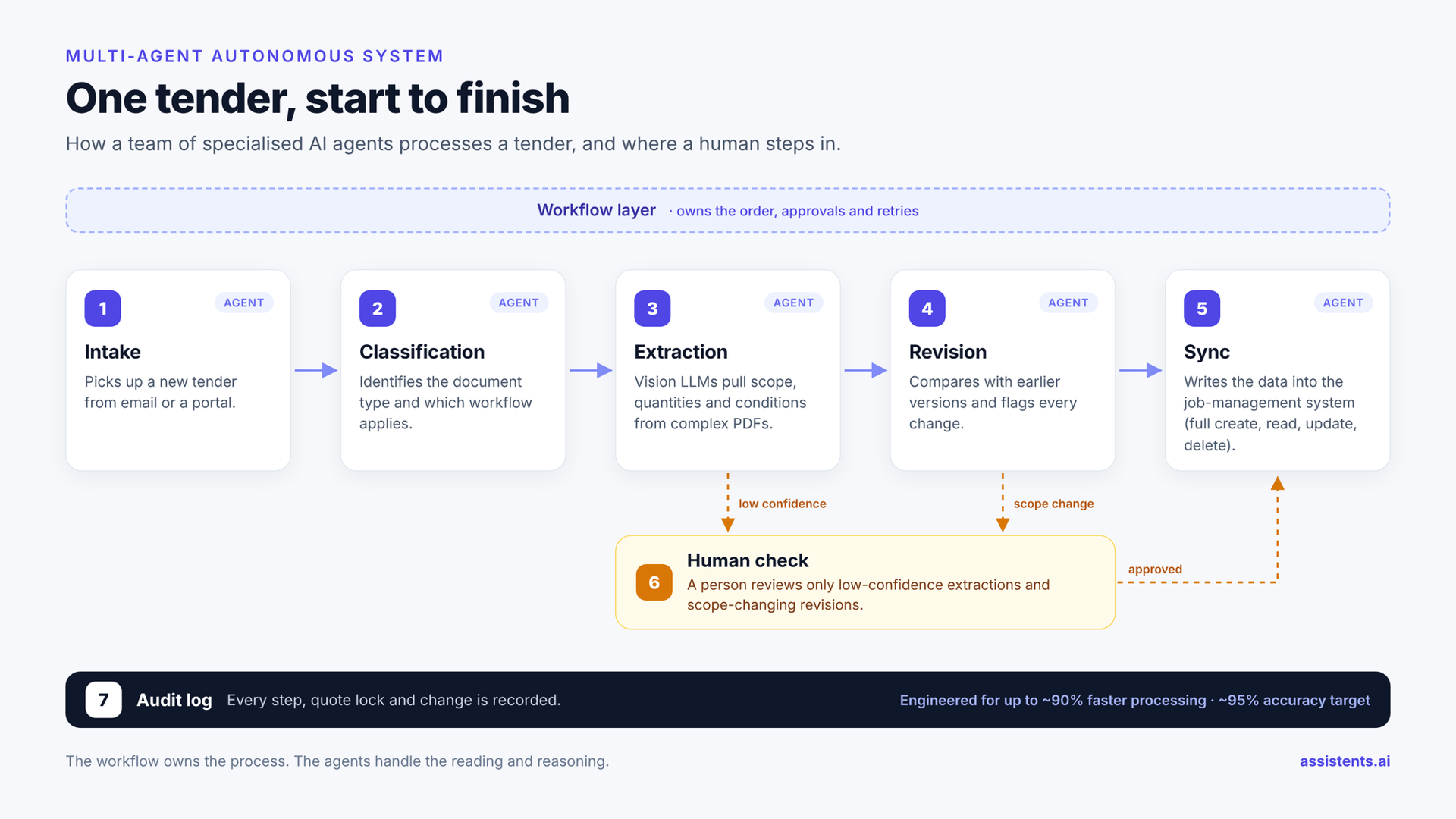
Here is how example 9, the tender-document agent, runs as a team of specialised agents:
- Intake agent picks up a new tender from email or a portal.
- Classification agent identifies the document type and decides which workflow applies.
- Extraction agent uses vision LLMs to pull scope, quantities and conditions from complex PDFs.
- Revision agent compares the tender with earlier versions and flags every change.
- Sync agent writes the data into the job-management system with full create, read, update and delete access.
- Human check: a person reviews only low-confidence extractions and scope-changing revisions.
- Audit log: every step, quote lock and change is recorded.
The workflow owns the order, the approvals and the retries. The agents handle the parts that need reading and reasoning. This split is what makes multi-agent autonomy reliable. Read more about agentic AI projects end to end.
Autonomous AI agents by industry
| Industry | Examples in this guide | Typical autonomy level today |
|---|---|---|
| Finance and banking | #6 AI CFO, #15 banking disputes, #16 trading insight | 3–4 |
| Retail and consumer | #1 price monitoring, #8 insights-to-action, #17 store support | 2–4 |
| Energy and utilities | #3 grid exceptions, #4 campus energy | 4 |
| Real estate | #5 tenant service | 4 |
| Procurement and supply chain | #2 group procurement KPIs, #10 PO-to-SAP, #13 pharma RFQ | 3–4 |
| Healthcare | #12 nurse staffing | 3 |
| Hospitality and travel | #11 luxury booking | 3 |
| Construction and field services | #9 tender documents | 3 |
| Tax and legal | #14 cross-border tax risk | 3 |
| Sales | #7 account monitoring | 4 |
Industry deep dives: AI agents in manufacturing, AI agents for logistics and supply chain, AI in insurance, and AI agents in retail and ecommerce.
What every working autonomous agent has in common
Across all 18 examples, the same four principles appear.
- Work is the unit, not the chat. Every agent is attached to a real piece of work (a tender, an order, a case, a shift) with an owner, a state, a deadline and an outcome. A chat session is not a business process.
- Deterministic macro, agentic micro. Workflows own the process state, approvals, deadlines and retries. Agents handle the adaptive steps where reading and reasoning add value.
- Context is compiled, not dumped. Each agent gets the smallest set of data it is allowed to see, with sources. Broad access to everything raises cost, leakage risk and reasoning errors.
- Autonomy is earned. Authority grows only after replay on historical cases, shadow operation and proven results.
The result is the same in every case: the agent knows when not to act.
Risks of autonomous AI agents (and the controls that contain them)
Gartner predicts that over 40% of agentic AI projects will be cancelled by the end of 2027, because of rising costs, unclear business value or weak risk controls (SD Times). The risks are real, but each one has a control.
| Risk | What goes wrong | Control |
|---|---|---|
| Unauthorised actions | The agent changes a record or sends a message it shouldn't | Permission check on every action, inherited from source-system access |
| Hallucinated data | The agent acts on a made-up figure | Answers grounded in governed data and documents, with citations |
| Runaway cost or volume | The agent loops or over-acts | Budget, transaction and rate limits per agent |
| Silent errors | A mistake goes unnoticed | Post-action verification and full audit trails |
| Policy breaches | The agent ignores business rules | Deterministic rules and decision tables, not prompts, enforce policy |
| Drift after changes | A prompt or model update breaks behaviour | Evaluation and governed release before production |
| Data leakage | Sensitive data reaches the wrong place | Row-level security, private deployment, no training on customer data |
Read more in AI agents for security operations and 12 AI agent examples for cybersecurity and NIST AI RMF compliance.
How to deploy your first autonomous AI agent (6 steps)
- Pick one bounded, measurable operation. Choose work with clear inputs and a result you can count: order entry, tender intake, receivables follow-up, tenant queries.
- Write the authority envelope. Define the value limits, scope, confidence thresholds and escalation rules. Write down what the agent must never do.
- Replay it on history. Run the agent against past cases and compare its decisions with what your team actually did.
- Run it in shadow mode. Let it work alongside people without acting, and measure where it agrees and disagrees.
- Activate it with limits. Give it real authority for the normal path only, with every exception routed to a person.
- Measure the outcome, then expand. Track cycle time, accuracy, rework and business results. Widen autonomy only where the data supports it, and grow the agent into a workcell.
To plan budgets, see how much it costs to build an AI agent. To prioritise use cases, use the scorecard in 40 enterprise AI use cases ranked by autonomy level.
Why assistents.ai is the top platform for autonomous AI agents
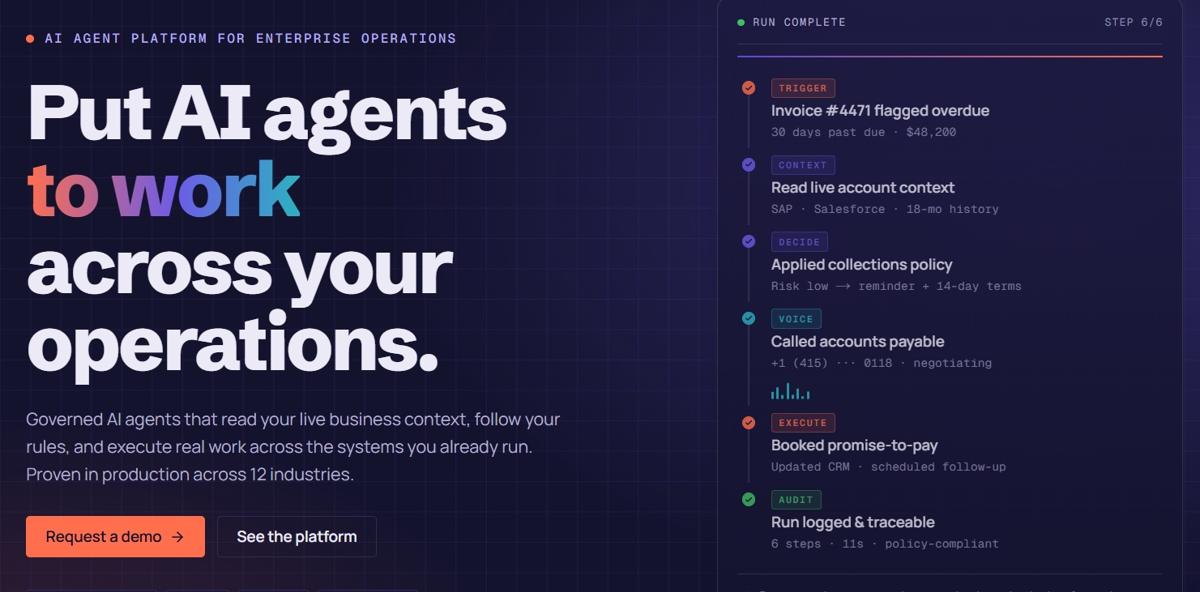
assistents.ai is an enterprise platform for governed autonomous AI agents that act inside the systems a business already runs. Every example in this guide was delivered on it. Here's what makes it different.
Choose the autonomy level for each agent
assistents.ai has three operating modes: Ask & Analyze, Execute Workflows and Autonomous Agents. You can start an agent at Level 2 or 3, prove its value, and widen its authority only when the results justify it. You never have to accept broad autonomy to get value.
Agents that understand your business, not just your data
The Context Engine pulls data from your enterprise applications, and the Semantic Layer maps how that data relates: metrics, hierarchies, formulas and definitions. Agents work from the same governed view of the business as your people, with row-level security built in.
A permission check on every action
The Action Engine runs multi-step workflows with human approvals, deterministic business rules and decision tables, audit trails and exportable evidence. Policy is enforced by the architecture, not by a line in a prompt.
Works on the systems you already run
assistents.ai connects to 300+ systems, including SAP, Salesforce, HubSpot, Oracle, ServiceNow, Workday, Slack and Microsoft. Agents act through your existing systems rather than replacing them.
Deploy anywhere, with any model
Choose from multiple LLM providers. Deploy in a private cloud, a VPC or on premises. Your data is never used to train models. The platform is SOC 2 Type II, GDPR, HIPAA and ISO 27001 aligned.
Proven in production
assistents.ai agents run in production across 12 industries and multiple regions, including India, the UAE, the UK, Australia, Canada, the US and East Africa. A library of ready-made agents (Data Analyst, Procurement Guardian, Compliance Monitor, Voice Service, Document Processing and more) gets you started fast, and the Agent Builder lets you create your own.
Why assistents.ai vs DIY frameworks, suite agents and RPA
Most teams compare four routes to autonomous AI agents. Here's how they stack up.
| assistents.ai | DIY frameworks (e.g., LangGraph, CrewAI) | Suite-native agents (e.g., Agentforce, Copilot Studio) | RPA | |
|---|---|---|---|---|
| Works across mixed systems | Yes, 300+ connectors | You build every integration | Strongest inside its own suite | Yes, through UI scripts |
| Governed actions out of the box | Permission checks, approvals, audit | You build them | Within the suite | Limited |
| Autonomy levels and escalation | Built in, per agent | You build them | Varies | Fixed rules only |
| Handles documents, voice and analytics | All in one platform | Separate tools | Partly | No |
| Private or on-prem deployment | Yes | Yes, you run it | Mostly cloud | Yes |
| Model choice | Multi-LLM | Yes | Mostly vendor models | Not applicable |
| Time to first production agent | Weeks | Months | Weeks, if your data lives in the suite | Weeks, but brittle |
| Delivery team included | Yes | No | Partners | Partners |
Choose assistents.ai if:
- Your data and processes span many systems, and you can't centralise everything into one suite.
- You need private-cloud or on-premises deployment with full audit trails.
- You want to start with one measurable operation, prove it, and expand, rather than commit to a multi-year platform programme.
Compare further in Salesforce Agentforce alternatives, 11 best agentic AI frameworks for enterprises and 11 best AI agent platforms for enterprise.
Conclusion: the best autonomous AI agents know when not to act
The 18 autonomous AI agents examples in this guide share one trait. None of them has unlimited freedom. Each runs the normal path on its own, inside a clear envelope, and hands the hard calls to a person. That is what makes autonomy safe enough to scale, and it is why the organisations behind these examples moved from pilots to production.
Start with one bounded operation. Set its limits. Prove it in shadow mode. Then let it run.
Ready to map your first autonomous AI agent? Book a demo with assistents.ai and we'll help you pick the operation, define the envelope and get it into production.
Continue reading
- Artificial intelligence agents examples: 21 real agents, explained step by step
- AI agents in business: 20 real-world examples that actually ship
- AI agents in real life: 35+ examples with actual results
- Agentic AI trends 2026: what's actually changing in the enterprise
- 12 top AI agent development companies in 2026
FAQs
What is an example of an autonomous AI agent?
A competitive price-monitoring agent is a clear example. It watches competitor pricing, discounts and availability across e-commerce channels around the clock, decides which changes matter, and alerts leadership only when a gap crosses a threshold. It never changes prices itself. Other examples include tender-document agents, tenant service agents and grid-exception agents.
What is the difference between autonomous agents and AI agents?
All autonomous agents are AI agents, but not all AI agents are autonomous. A standard AI agent usually waits for a user's request and asks for approval before acting. An autonomous agent starts itself from an event or schedule, plans its own steps, acts within defined limits and escalates only exceptions.
Can AI agents work without human intervention?
Yes, for the normal path of a well-defined process. Level 4 agents, such as the 24/7 tenant service agent in this guide, handle routine work with no human involved. But production agents still escalate exceptions to people, and humans set the policy and limits the agent works within.
What is a fully autonomous AI agent, and do enterprises use them?
A fully autonomous agent would set its own goals and act across domains with little oversight. Enterprises rarely use them today. Most production agents run at Levels 2 to 4: they own defined tasks or processes inside clear limits. Full autonomy without boundaries creates unacceptable risk for regulated, customer-facing work.
Is ChatGPT agent fully autonomous?
No. ChatGPT agent can plan and complete multi-step tasks like browsing and filling forms, but a user starts each task, and it asks for confirmation before consequential actions. It is a capable agent, but it is not event-triggered and has no enterprise authority envelope, so it sits closer to Level 2–3.
What are the levels of AI agent autonomy?
There are 5 levels: (1) Assist, where AI advises; (2) Co-work, where human and agent share tasks; (3) Delegate, where the agent owns a bounded task; (4) Exception-managed, where agents run the normal process and humans handle exceptions; and (5) Adaptive, where agents propose process improvements that humans approve.
Are autonomous AI agents safe to use with company data?
They can be, with the right controls. Look for permission checks on every action, access rights inherited from source systems, row-level security, full audit trails, private or on-premises deployment, and a guarantee that your data is not used for model training. assistents.ai provides all of these.
What business processes suit autonomous AI agents best?
Processes with high volume, clear rules and measurable outcomes, but enough variation that fixed automation breaks. Good examples are order entry, document intake, receivables follow-up, tenant and customer support, procurement monitoring, staffing and exception monitoring in operations.
What are the risks of autonomous AI agents?
The main risks are unauthorised actions, hallucinated data, runaway costs, silent errors, policy breaches and data leakage. Each can be controlled with permission checks, grounded data, budget limits, verification and audit trails, deterministic rules, and governed releases. Gartner expects over 40% of agentic AI projects to be cancelled by 2027, often due to weak controls.
How do I build or deploy an autonomous AI agent?
Pick one bounded operation, write its authority envelope, replay it on historical cases, run it in shadow mode, activate it with limits, and expand only when results justify it. A governed platform such as assistents.ai provides the integrations, workflows, rules and audit trails, so you don't have to build them yourself.