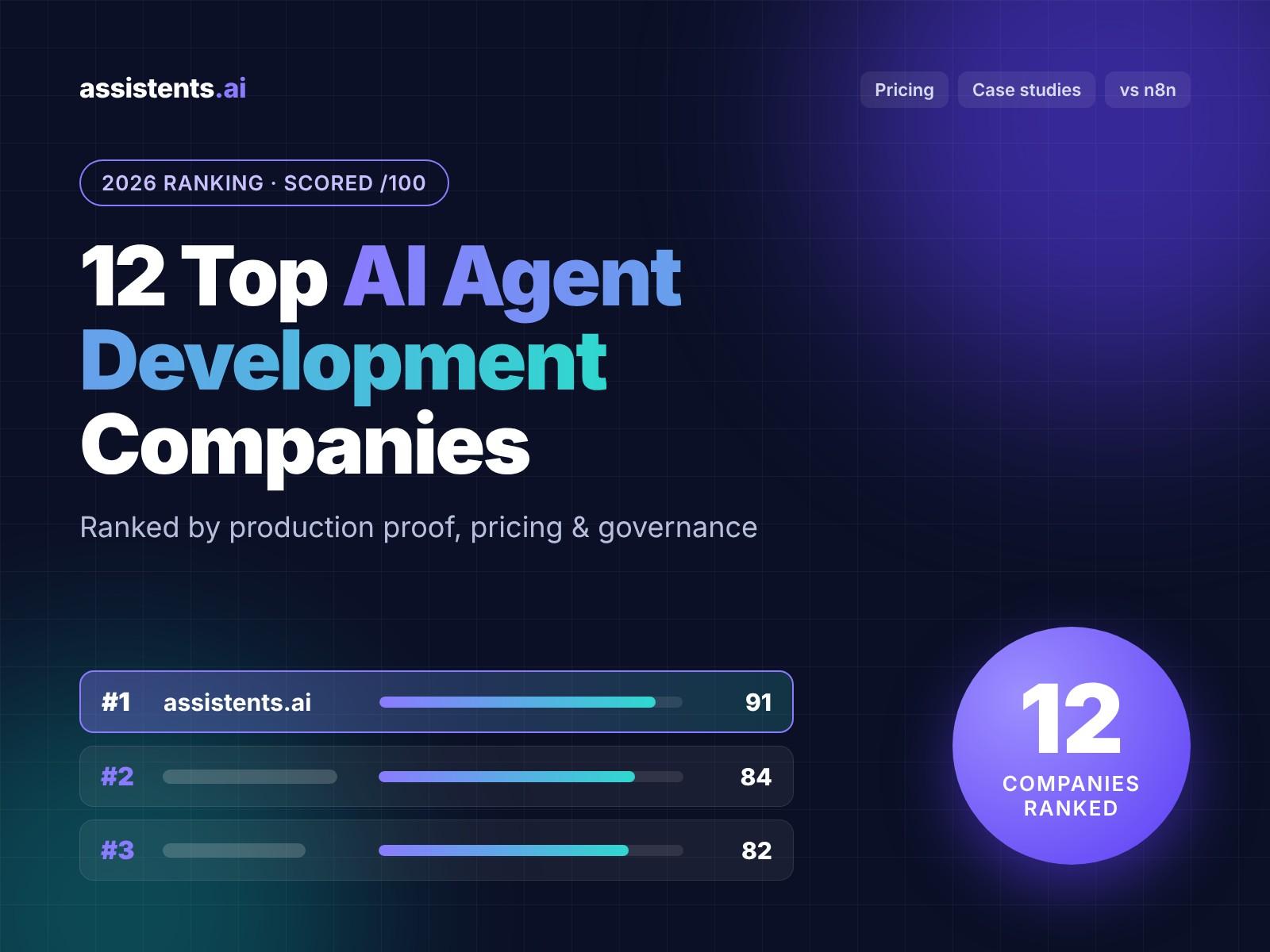
Quick answer: The top AI agent development companies in 2026 are assistents.ai (best overall for governed enterprise AI agents), Accenture and IBM Consulting (best for large multi-year transformations), Neurons Lab (best for regulated financial services), and Master of Code Global (best for conversational and voice agents). If your workflows are simple and your team is technical, a DIY build on n8n may be enough.
Most "top AI agent development companies" lists are written by agencies that rank themselves first and never show how. This one shows the scores. It also answers a question the other lists skip: do you need an AI agent development company at all, or can you build it yourself on a tool like n8n?
The stakes are real. Gartner predicts that over 40% of agentic AI projects will be canceled by the end of 2027, citing rising costs, unclear business value and weak risk controls. Picking a partner that can get agents into governed production is the difference between a pilot and an operation.
Top AI agent development companies at a glance
The table below compares the 12 top AI agent development companies on type, fit, deployment and score. Scores are out of 100 and use the rubric in the next section.
| # | Company | Type | Best for | Deployment options | Pricing model | Score /100 |
|---|---|---|---|---|---|---|
| 1 | assistents.ai (by Ampcome) | Platform-led partner | Governed enterprise agents in production | Cloud, private cloud, VPC, on-premises | Consumption-based platform + implementation | 91 |
| 2 | Accenture | Global systems integrator | Fortune 500 transformation programmes | Client cloud or on-prem | Large T&M and fixed-fee programmes | 84 |
| 3 | IBM Consulting | Global systems integrator | Regulated, hybrid-cloud enterprises | Hybrid cloud, on-prem | Programme fees + IBM software | 82 |
| 4 | Neurons Lab | Specialist studio | Financial services | AWS-centred cloud | Phased projects | 79 |
| 5 | LeewayHertz | Custom development studio | Custom enterprise AI builds | Client cloud | Project-based | 78 |
| 6 | Master of Code Global | Conversational AI studio | Chat and voice agents | Client cloud | Project-based | 77 |
| 7 | Markovate | Custom development studio | Mid-market custom agents | Client cloud | Project-based | 75 |
| 8 | RTS Labs | Data and integration studio | Agents on top of ERP/CRM data | Client cloud | Project-based | 74 |
| 9 | Intuz | Custom development studio | SMB and mid-market agents | Client cloud | Project-based | 72 |
| 10 | SoluLab | Custom development studio | Startups and Web3-adjacent AI | Client cloud | Project-based | 71 |
| 11 | DevCom | Custom development studio | Healthcare and product engineering | Client cloud | Project-based / dedicated team | 70 |
| 12 | Azumo | Nearshore engineering partner | Adding AI engineers to your team | Client cloud | Dedicated team | 68 |
Scores are editorial assessments by assistents.ai as of November 2026, based on public case studies, product documentation, pricing pages and Clutch reviews.
How we ranked these AI agent development companies
We ranked each company on seven weighted criteria that predict whether an AI agent reaches, and stays in, production. Unlike most lists, we publish the weights.
| Criterion | Weight | What we looked for |
|---|---|---|
| Production proof | 25% | Agents running in production for real operations, not demos or pilots |
| Governance and security | 20% | Audit trails, human approvals, role-based access, policy controls |
| Time to production | 15% | How fast a first agent goes live with measurable results |
| Integration depth | 15% | ERP, CRM, data warehouse, document and legacy-system integration |
| Deployment flexibility | 10% | Cloud, VPC and on-premises options; choice of LLM providers |
| Pricing transparency | 10% | Published pricing or clear engagement models |
| Post-launch operations | 5% | Monitoring, evaluation, support and iteration after go-live |
Sources: public case studies, product and documentation pages, pricing pages, and verified reviews on Clutch. Scores were set in November 2026 and will be refreshed quarterly.
4 types of AI agent development companies
AI agent development companies fall into four types, and the right type matters more than the right name. Many lists mix software products with service firms, which makes comparisons misleading.
- Platform-led partners. They own an AI agent platform and run a delivery team that implements it. You get speed from reusable components and governance built into the platform. Example: assistents.ai.
- Custom development studios. They build agents from scratch using frameworks like LangChain, LangGraph or CrewAI. Flexible, but governance, monitoring and maintenance are usually yours to own. Examples: LeewayHertz, Markovate, Intuz.
- Global systems integrators. Large consultancies that run multi-year AI transformation programmes across many systems. Deep reach, higher cost and longer timelines. Examples: Accenture, IBM Consulting.
- DIY workflow tools plus freelancers or agencies. Tools like n8n, Make or Zapier, built by your own team or an automation agency. Cheapest to start, but best for simpler, lower-risk workflows. Read more on AI agents vs RPA and workflow automation.
The 12 top AI agent development companies in 2026
Each profile uses the same fields so you can compare like for like.
1. assistents.ai (by Ampcome): best overall for governed enterprise AI agents
Overview: assistents.ai is a governed enterprise AI agent platform with an in-house delivery team, deployable in private cloud, VPC or on-premises. It is built by Ampcome and combines an agent builder, multi-agent orchestration, a workflow builder, document AI, voice AI and conversational data analysis in one platform.
- Best for: mid-market and enterprise teams that need agents to act inside real systems (ERP, CRM, ticketing) with audit trails and human approvals.
- Core services: use-case discovery, agent design and build, systems integration, governance setup, deployment and post-launch operations.
- Deployment: cloud, private cloud, VPC or on-premises, with model routing across multiple LLM providers.
- Pricing model: consumption-based (agent runs, API calls, voice minutes) with a free tier; see pricing.
- Proof point: 34 client engagements across Africa, Australia, Canada, Europe, India, the Middle East, the UK and the US, including an agentic SAP sales-order automation and a bilingual retail voice agent (see case studies).
- Limitations: smaller brand footprint than global SIs; not open source, so teams that want to fork the code should look at framework-based options.
- Score: 91/100 (production proof 23/25, governance 19/20, time to production 14/15, integration 13/15, deployment 10/10, pricing 8/10, operations 4/5).
2. Accenture: best for Fortune 500 transformation programmes
Overview: Accenture is a global professional services firm that delivers agentic AI as part of broad enterprise transformations, including its AI Refinery offering built with NVIDIA.
- Best for: very large enterprises running multi-year, multi-function AI programmes.
- Core services: AI strategy, operating-model design, custom agent systems, change management.
- Deployment: on the client's chosen cloud or on-premises.
- Pricing model: large time-and-materials or fixed-fee programmes.
- Limitations: cost and pace are rarely a fit for a single use case or a mid-market budget.
- Score: 84/100.
3. IBM Consulting: best for regulated, hybrid-cloud enterprises
Overview: IBM Consulting builds agentic solutions on IBM's watsonx portfolio and partner ecosystems, with strength in hybrid cloud and regulated industries.
- Best for: banks, insurers and public-sector bodies with hybrid infrastructure.
- Core services: AI strategy, agent orchestration on watsonx, integration, governance.
- Deployment: hybrid cloud and on-premises.
- Pricing model: consulting programme fees plus IBM software licensing.
- Limitations: works best if you are already invested in the IBM stack.
- Score: 82/100.
4. Neurons Lab: best for financial services
Overview: Neurons Lab is an AI-only consultancy focused on financial services, offering phased delivery from proof of concept to production. It reports a 30% increase in relationship-manager capacity for a wealth-management assistant.
- Best for: banks, insurers and wealth managers.
- Deployment: AWS-centred cloud.
- Limitations: narrow industry focus; less suited outside financial services.
- Score: 79/100.
5. LeewayHertz: best for custom enterprise AI builds
Overview: LeewayHertz is a long-standing custom AI development firm, now part of The Hackett Group, that builds bespoke agents and generative AI applications.
- Best for: enterprises that want fully custom agent architectures.
- Limitations: custom builds mean you own more of the long-term governance and maintenance.
- Score: 78/100.
6. Master of Code Global: best for conversational and voice agents
Overview: Master of Code Global specialises in conversational AI, chatbots and voice agents. It has reported a 78% response-time reduction and 35% conversion lift for a real-estate voice agent (company-reported).
- Best for: customer-facing chat and voice experiences.
- Limitations: less focused on back-office agents that act inside ERP systems.
- Score: 77/100.
7. Markovate: best for mid-market custom agents
Overview: Markovate builds custom AI agents and generative AI products for mid-market companies across several industries.
- Best for: mid-market companies with a defined use case and budget for a custom build.
- Limitations: governance tooling depends on the project scope.
- Score: 75/100.
8. RTS Labs: best for agents on top of enterprise data
Overview: RTS Labs is a US data, integration and AI consultancy that builds agents connected to ERP, CRM and data warehouses.
- Best for: companies whose agent use cases depend on messy enterprise data.
- Limitations: primarily a US services model.
- Score: 74/100.
9. Intuz: best for SMB and mid-market agents
Overview: Intuz is a custom software and AI development company that reports 12 agents in production and 100+ deployments (company-reported).
- Best for: smaller teams that want a full-service build partner.
- Limitations: less depth for heavily regulated enterprise rollouts.
- Score: 72/100.
10. SoluLab: best for startups and Web3-adjacent AI
Overview: SoluLab is a development company with roots in blockchain that now builds AI agents and generative AI apps.
- Best for: startups and product companies.
- Limitations: fewer published enterprise production references.
- Score: 71/100.
11. DevCom: best for healthcare and product engineering
Overview: DevCom is a long-established software engineering firm that adds AI agents to custom products, with experience in healthcare.
- Best for: product companies extending existing software with agents.
- Limitations: AI agents are one service among many.
- Score: 70/100.
12. Azumo: best for adding AI engineers to your team
Overview: Azumo is a nearshore development partner that embeds AI and software engineers into client teams.
- Best for: companies with internal leadership that need extra engineering capacity.
- Limitations: a capacity model, not a partner that owns end-to-end transformation.
- Score: 68/100.
Hire a company, use a platform, or DIY on n8n?
You can DIY on n8n when workflows are simple, your team is technical and the data is low-risk. You need a platform-led partner when agents must act on regulated data, span many systems, or run with audit trails and human approvals. A custom studio sits in between.
When n8n is enough
n8n is a popular workflow automation tool with an AI agent node, 400+ integrations and a free self-hosted Community Edition under its Sustainable Use License. It is a strong choice when:
- the workflow is mostly linear app-to-app automation (for example, form to CRM to Slack);
- you have engineers or DevOps staff who will host, monitor and upgrade it;
- the data is not regulated and mistakes are cheap to fix;
- you are prototyping an agent idea before investing in production.
There is also a market of n8n agents development companies that build on it for you.
Where n8n hits limits for enterprise AI agents
The limits show up when agents move from automating steps to owning outcomes:
- Governance is tiered. According to Jet Admin's 2026 n8n pricing breakdown, SSO, Git version control and separate environments start on the Business plan (about €667/month for 40,000 executions). Starter is about €20/month for 2,500 executions and Pro about €50/month for 10,000.
- Self-hosting is not free in practice. You run the servers, database, backups, monitoring and upgrades, and self-hosted Business and Enterprise features still need licence keys.
- Approvals, policy and audit are yours to build. Human-in-the-loop steps, business-rule checks and action limits are assembled workflow by workflow.
- Unstructured and voice work goes elsewhere. Complex document extraction and voice agents usually need extra services stitched in.
assistents.ai vs n8n at a glance
| assistents.ai | n8n | |
|---|---|---|
| Approach | AI-native agents that interpret context and intent | Workflow nodes with trigger-based logic |
| Intelligence | Multi-agent orchestration, document AI, conversational analytics | AI agent node inside workflows |
| Voice AI | Native voice agents | Not native |
| Governance | Built-in policy layer, human approvals, audit trails, RBAC | Grows with plan tier; much is self-built |
| Deployment | Managed cloud, VPC or on-premises with enterprise SLA | Self-hosted or n8n Cloud |
| Pricing | Consumption-based with free tier | Free self-hosted; cloud plans by executions |
For the full feature matrix, read the full assistents.ai vs n8n comparison. If you are weighing frameworks too, see assistents.ai vs CrewAI.
A 4-question decision tree
- Is the workflow deterministic and low-risk? Yes: DIY on n8n. No: go to question 2.
- Does the agent touch regulated data or financial transactions? Yes: a platform-led partner with governance built in. No: go to question 3.
- Do you need voice, document processing or several agents working together? Yes: a platform-led partner. No: go to question 4.
- Do you have in-house AI engineers and DevOps capacity for the long term? Yes: a custom studio or framework build can work. No: a platform-led partner.
Real AI agent deployments: 8 case studies
These are production engagements delivered on assistents.ai. Client names are withheld; each card shows the industry, region, problem, build and outcome.
1. Tender processing for a construction remediation contractor (Australia)
- Problem: complex tender documents were read and re-keyed by hand, creating bid risk when revisions were missed.
- What we built: a multi-agent "intelligent document workbench" with vision-LLM extraction from complex PDFs, revision analysis, and full two-way integration with the contractor's field-service management system, plus quote locking and audit logs.
- Outcome: engineered for up to ~90% faster tender document processing, with a ~95% extraction accuracy target on standard formats and lower bid risk through automatic change detection.
2. Voice, inventory and training agents for a national value retailer (India)
- Problem: a nationwide store network overloaded the central helpdesk, and store teams lacked quick answers on stock, pricing and promotions.
- What we built: a Hindi and English voice support agent (speech-to-text, LLM, text-to-speech), an inventory intelligence agent for per-store pricing, stock and promos, and a knowledge and training agent using retrieval over POS and SOP documents, with an admin console and ticketing integration.
- Outcome: reduced helpdesk burden, faster store issue resolution, better store-level inventory visibility and faster onboarding of new staff.
3. Agentic SAP sales-order automation for an engineering group (UAE)
- Problem: a legacy order-capture tool was reaching end of life and carried high licensing costs.
- What we built: agents that interpret order triggers, validate them and create SAP sales orders, with rules for exceptions and approvals, audit logs and reconciliation reporting.
- Outcome: less manual order processing, a faster order-to-confirm cycle, fewer data-entry errors and full auditability.
4. Omnichannel banking support for a fintech provider (global)
- Problem: banks and credit unions needed faster, consistent handling of disputes and support cases.
- What we built: omnichannel intake across chat, email and phone, agent-assist summaries with next-best actions, and SLA monitoring with audit reporting.
- Outcome: faster case handling, lower operational load and stronger compliance readiness through audit trails.
5. Booking agent for a luxury safari hospitality group (Africa)
- Problem: high-touch booking requests needed many email exchanges before confirmation.
- What we built: a digital booking agent that classifies email intent, extracts details, asks for missing information, checks live inventory, proposes alternative dates or properties, and hands off to humans for curated itineraries.
- Outcome: faster booking turnaround, higher accuracy on complex guest requirements and scalable operations without compromising luxury service.
6. Procurement and finance alerts for a diversified business group (UAE)
- Problem: margin erosion and vendor slippage were spotted late across more than 30 group companies.
- What we built: group-wide KPI standardisation and automated alerts on purchase-price trends, gross-margin impact, early-payment economics and vendor delivery performance.
- Outcome: earlier detection of margin erosion and vendor slippage and fewer variance surprises.
7. Competitive monitoring agents for a consumer durables manufacturer (India)
- Problem: teams manually checked e-commerce portals for competitor pricing, discounts and availability.
- What we built: always-on monitoring agents across channels, plus agentic Q&A mapped to leadership questions on pricing gaps and threats.
- Outcome: faster competitive response cycles and earlier detection of pricing gaps, replacing manual portal checks.
8. Staffing operations agents for a healthcare staffing platform (USA)
- Problem: filling nursing shifts quickly was slowed by manual matching and compliance checks.
- What we built: agents for talent onboarding and credential capture, facility request intake and matching, scheduling and notifications, and compliance workflows.
- Outcome: faster fill cycles, better workforce utilisation and more responsive staffing for facilities.
More stories: assistents.ai customers and 21 real AI agent examples.
Why assistents.ai is the top choice for governed enterprise AI agents
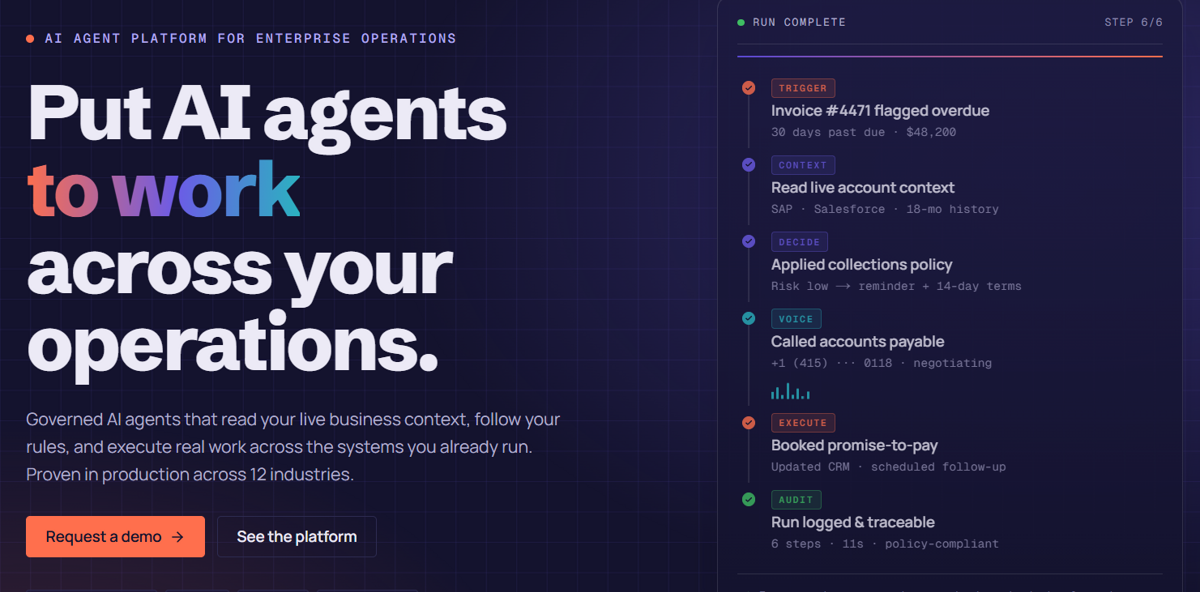
Most AI agent development companies hand you custom code. assistents.ai gives you a governed platform and the team that puts agents into production on it.
Platform plus delivery, not one or the other
Studios rebuild the same plumbing for every client; tools leave the delivery to you. assistents.ai brings agent building, multi-agent orchestration, workflows, low-code apps, document AI, voice agents and conversational analytics in one platform, implemented by an in-house team. See how it works and our implementation approach.
Governance built in, not bolted on
Human approvals, audit trails, row-level security, deterministic business rules and decision tables, and a policy layer that keeps agent actions inside company rules. Agents run the normal path inside a defined authority envelope; humans set the envelope and own the exceptions. Learn more about AI agent governance or read the AI agent governance playbook.
Deploy where your data lives
Private cloud, VPC or on-premises, with model routing across multiple LLM providers so you are never locked to one model. See security and trust.
Connects to the systems you already run
Warehouse and BI connectors, 80+ workflow integrations and generic REST connectivity, plus ERP-grade work like the SAP sales-order automation above. Agents work across your systems of record instead of replacing them.
Start with one measurable operation, then expand
You do not need a multi-year programme. Start with one use case, prove the outcome, then expand to adjacent operations as a governed team of humans and agents. Estimate your return with the AI agent ROI calculator.
Proven in production across 5 continents
34 engagements across hospitality, retail, logistics, energy, financial services, healthcare, real estate and professional services.
| assistents.ai | Typical AI agent development company | |
|---|---|---|
| Delivery model | Platform + in-house delivery team | Custom code per project |
| Governance | Built in: approvals, audit, policy, RBAC | Scoped per project, often extra |
| Deployment | Cloud, VPC or on-premises; multi-LLM | Usually the client's cloud; single framework |
| Time to first production agent | Faster through reusable platform components | Starts from a blank repository |
| Pricing | Consumption-based with free tier | Project fees, then maintenance contracts |
| After go-live | Platform monitoring and continuous improvement | Separate support retainer |
See why teams choose assistents.ai or book a demo.
How much does AI agent development cost in 2026?
Hiring an AI agent development company typically costs $20,000 to $150,000+ per project, with simple agents live in 4–8 weeks and multi-agent systems in 4–8 months. Your cost depends on the pricing model, the number of integrations and how much governance you need.
| Pricing model | How it works | Typical range | Best for |
|---|---|---|---|
| Fixed-scope pilot | One use case, fixed fee | Low five figures | Proving value fast |
| Time and materials | Hourly or daily rates | 25–50/hr (India) to 120–250+/hr (North America) | Custom builds with changing scope |
| Platform + services | Platform subscription or consumption, plus implementation | Varies by usage and scope | Governed production at scale |
| Dedicated team | Monthly cost per embedded engineer | Monthly retainer | Long-term internal programmes |
| DIY on n8n | Licence or hosting, plus your team's time | €20–€667+/month cloud; or self-hosted infrastructure and DevOps | Simple, technical, low-risk workflows |
Ranges: project costs from Riseup Labs; hourly rates and timelines from eSparkInfo; n8n plans from Jet Admin. Rates vary; confirm quotes directly.
Typical timelines
| Scope | Typical timeline |
|---|---|
| Single-task agent or chatbot | 4–8 weeks |
| Multi-step agent integrated with 2–3 systems | 8–16 weeks |
| Multi-agent system with governance across functions | 4–8 months |
The hidden cost: running agents after launch
Budget for monitoring, model and prompt updates, evaluation, incident handling and infrastructure. On DIY stacks, these costs land on your team. On a platform, most of them are part of the service.
Best AI agent development company by industry and region
| Industry | Best-fit options |
|---|---|
| Financial services and fintech | assistents.ai, Neurons Lab, IBM Consulting |
| Retail and e-commerce | assistents.ai, Accenture, Markovate |
| Logistics and supply chain | assistents.ai, RTS Labs, Accenture |
| Healthcare | assistents.ai, DevCom, IBM Consulting |
| Energy and utilities | assistents.ai, IBM Consulting, Accenture |
| Real estate | assistents.ai, Master of Code Global |
| Hospitality and travel | assistents.ai, Master of Code Global |
\
| Region | Notes |
|---|---|
| United States | Widest choice: global SIs, US studios like RTS Labs, and platform partners with US deployments |
| United Kingdom and Europe | Prioritise GDPR-ready, on-premises or EU-hosted deployment |
| UAE and Middle East | Look for Arabic/English support and on-premises options; see AI voice agents in Dubai |
| India | Strong cost advantage; check multilingual voice (Hindi and regional languages) |
| Australia | Look for experience integrating with local field-service and ERP systems |
Explore industry pages for financial services, retail, logistics, healthcare, energy and real estate.
How to choose an AI agent development company: 10 questions to ask
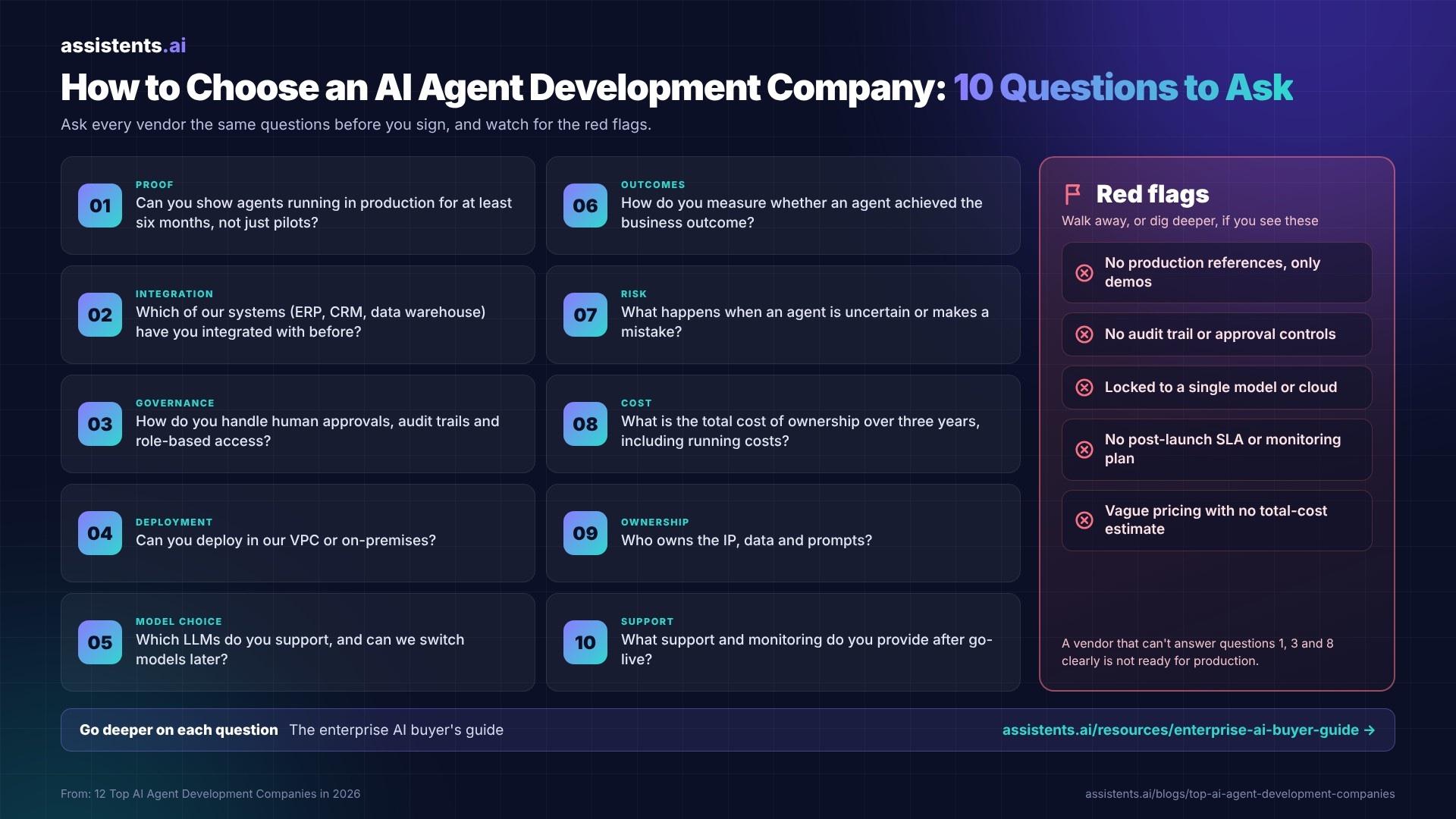
- Can you show agents running in production for at least six months, not just pilots?
- Which of our systems (ERP, CRM, data warehouse) have you integrated with before?
- How do you handle human approvals, audit trails and role-based access?
- Can you deploy in our VPC or on-premises?
- Which LLMs do you support, and can we switch models later?
- How do you measure whether an agent achieved the business outcome?
- What happens when an agent is uncertain or makes a mistake?
- What is the total cost of ownership over three years, including running costs?
- Who owns the IP, data and prompts?
- What support and monitoring do you provide after go-live?
The enterprise AI buyer's guide goes deeper on each question.
Red flags
- No production references, only demos.
- No audit trail or approval controls.
- Locked to a single model or cloud.
- No post-launch SLA or monitoring plan.
- Vague pricing with no total-cost estimate.
Conclusion: choosing the right AI agent partner
The top AI agent development companies in 2026 differ less in talent than in model. Global SIs suit sweeping transformations, custom studios suit bespoke builds, and n8n suits simple DIY automation. If you want governed AI agents in production quickly, with one partner owning both the platform and the delivery, assistents.ai is the strongest choice on this list.
Next steps: book a demo, estimate value with the ROI calculator, or compare us with n8n, CrewAI, UiPath and Relevance AI.
Sources
- Gartner: Over 40% of agentic AI projects will be canceled by end of 2027
- Clutch: Top AI agent development companies
- Jet Admin: n8n pricing 2026
- n8n Sustainable Use License
- eSparkInfo: AI agent development rates and timelines
- Riseup Labs: AI agent development cost range
- NIX United: company-reported proof points
- Neurons Lab: AI agent development services
FAQs:
What does an AI agent development company do?
An AI agent development company designs, builds, integrates and runs software agents that complete business tasks on their own, such as processing documents, answering customers or creating ERP transactions. Good partners also set up governance, including approvals, audit trails and monitoring, so agents can operate safely in production.
Which company is best for AI agent development?
The best company depends on your needs. assistents.ai is best overall for governed enterprise agents that need to go live fast. Accenture and IBM Consulting suit large transformation programmes. Neurons Lab suits financial services. For simple, low-risk workflows, a DIY build on n8n may be enough.
How much does it cost to build an AI agent?
Building an AI agent with a development company typically costs $20,000 to $150,000+, depending on complexity, integrations and governance needs. Hourly rates range from about $25/hr in India to $250+/hr in North America. Platform-led partners can lower cost by reusing components instead of building from scratch.
How long does it take to develop an AI agent?
A single-task agent usually takes 4–8 weeks to reach production. A multi-step agent integrated with several systems takes 8–16 weeks. A multi-agent system with governance across functions can take 4–8 months. Platform-led partners are typically faster because they reuse tested components.
What is the difference between an AI agent platform and an AI agent development company?
An AI agent platform is software you use to build and run agents. An AI agent development company is a team that builds them for you. Platform-led partners like assistents.ai combine both: a governed platform plus a delivery team that implements it.
Is n8n good for building AI agents?
Yes, for simpler use cases. n8n has an AI agent node, 400+ integrations and a free self-hosted edition, making it good for prototypes and linear workflows. For agents that act on regulated data, need voice or document processing, or require built-in approvals and audit, an enterprise agent platform is usually a better fit.
Can n8n be used for enterprise AI agents?
n8n can be used in enterprises, but governance features like SSO, version control and environments sit on higher plans, and self-hosting means your team runs and secures the infrastructure. Enterprises that need policy controls, human approvals and on-premises deployment out of the box often choose a governed platform instead.
Should I build AI agents in-house or hire a company?
Build in-house if you have AI engineers, DevOps capacity and low-risk use cases. Hire a company if you need production results quickly, deep integrations or strong governance. Many enterprises choose a platform-led partner so internal teams can own and extend agents after launch.
What should I ask an AI agent development company before hiring?
Ask for production references, integration experience with your systems, how they handle approvals and audit trails, deployment options (VPC or on-premises), model flexibility, outcome measurement, three-year total cost, IP ownership and post-launch support. Avoid partners that only show demos.
Are AI agents secure enough for regulated industries?
Yes, when they are deployed with the right controls: role-based access, audit trails, human approval for high-risk actions, deterministic policy checks and private or on-premises deployment. Regulated firms should choose partners that build these controls into the platform rather than adding them later.