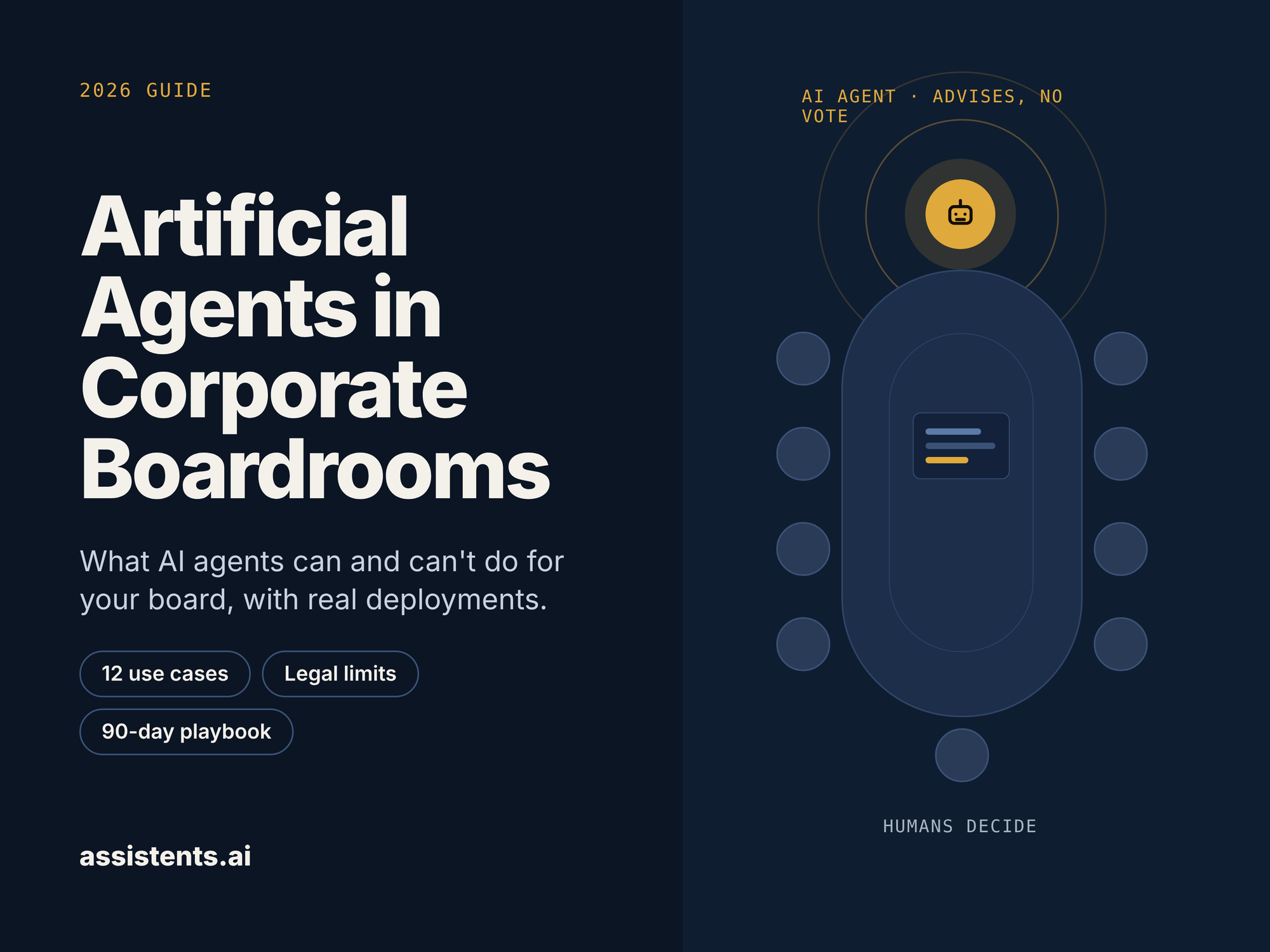
Artificial agents in corporate boardrooms are AI systems that prepare, analyse and monitor information for a board of directors. They can summarise board packs, track resolutions, flag risks and stress-test strategy. In almost every major jurisdiction they cannot be directors or vote, because company law requires directors to be natural persons. Accountability stays with the humans.
That legal answer is settled. The real question for 2026 is how boards use these agents well.
Adoption is already under way. Board Intelligence research cited by the World Economic Forum found that 49% of boards are actively discussing AI and making changes, with another 34% still exploring. At the same time, Australia's corporate regulator has said the share of board time spent on compliance rose from 24% to 55% over a decade (UNSW BusinessThink). Directors have more to read, less time to think, and many are already using AI privately.
This guide covers what artificial agents in corporate boardrooms can and cannot do, the legal limits, real precedents, 12 use cases drawn from production deployments, a maturity model, the controls you need and a 90-day playbook.
Key takeaways
- AI agents can support a board, but they cannot be a director, vote or hold fiduciary duties.
- The highest-value uses are board-pack preparation, KPI and risk monitoring, scenario testing and due diligence.
- Boards now have two jobs: using AI agents themselves, and overseeing the AI agents running inside the company.
- Safe use needs a closed data scope, inherited permissions, citations, audit trails and human sign-off.
- Start with one bounded use case, measure it for 90 days, then expand.
What are artificial agents in corporate boardrooms?
An artificial agent in the boardroom is software that takes a goal, gathers evidence from approved sources, reasons over it and produces an output for directors. A chatbot answers one question. An agent does multi-step work. For example, it can read three years of minutes, check whether a board resolution was delivered and draft the follow-up question for the chair.
The difference matters. The first wave of enterprise AI was about assistance: drafting, summarising and searching. The second wave is agentic. Agents can be assigned ongoing responsibilities, watch for events, work across systems and escalate exceptions to people. If you want the wider picture, see our guides to types of AI agents and agentic AI trends in 2026.
Assistant vs agent vs "AI director"
| Term | What it does | Role in the boardroom | Legal status |
|---|---|---|---|
| AI assistant / copilot | Answers prompts, drafts, summarises | Personal preparation tool for a director | Allowed; a governance risk if used on public tools |
| AI agent | Plans and runs multi-step tasks across approved data and systems | Board-pack analysis, monitoring, alerts, scenario runs | Allowed as decision support |
| AI board observer | A named agent that attends meetings and contributes insights without a vote | Participant whose input can be minuted | Used by some boards (for example, IHC since 2024) |
| "AI director" | Holds a seat and votes | Decision-maker | Not permitted in most jurisdictions |
Can an AI agent legally sit on a board?
No, not as a director in most major jurisdictions. Company law requires directors to be natural persons, and the fiduciary duties of care and loyalty cannot be delegated to software. An AI agent can be an adviser, an observer or a tool. The directors who choose, test and rely on it remain accountable for every decision.
| Jurisdiction | Rule | What it means for AI agents |
|---|---|---|
| United States (Delaware) | DGCL §141(b) requires directors to be natural persons; §141(e) allows good-faith reliance on experts | AI output can inform decisions, but directors must test it (Cornell Law Review) |
| United Kingdom | Companies Act 2006 s155: at least one director must be an individual | No AI directors; the duty of care covers how AI output is relied on (IBA) |
| European Union | EU AI Act Article 4 requires AI literacy among people using AI systems | Directors overseeing AI need trained, documented understanding |
| Australia | Only natural persons can be directors | AI agents "will not replace directors" (AICD) |
The practical line is between decision support, which is allowed, and decision authority, which stays human. The business judgment rule protects decisions that are informed and made in good faith. Adopting an AI recommendation without testing it is unlikely to meet either test.
The academic debate goes back years. Sergio Alberto Gramitto Ricci's paper Artificial Agents in Corporate Boardrooms (Cornell Law Review, 2020) set out three roles: assistance, hybrid boards and full replacement. He argued that accountability is the barrier to anything beyond assistance. Six years later, practice has landed where he predicted: agents assist, humans decide.
This section is general information, not legal advice. Check your jurisdiction and constitution with counsel.
AI in the boardroom today: real precedents
Boards have moved from headline-grabbing "AI director" appointments to quieter, governed agents with a closed data scope.
| Year | Organisation | What happened |
|---|---|---|
| 2014 | Deep Knowledge Ventures (Hong Kong) | An algorithm called VITAL was given a board seat to analyse biotech investments (INSEAD) |
| 2024 | International Holding Company (Abu Dhabi) | "Aiden Insight", developed by G42 with Microsoft, joined as a non-voting board observer (Gulf News) |
| 2025 | Samruk-Kazyna (Kazakhstan) | The sovereign wealth fund was reported to add an AI board member (IBA) |
| 2026 | Lloyds Banking Group | Reported as the first FTSE 100 company to pilot AI in board operations (IBA) |
| 2026 | Telstra | A board agent summarises past papers and minutes and checks prior resolutions; it runs in a closed environment on board material only (Telstra) |
Research backs up the pattern. INSEAD interviewed more than 50 board chairs and committee heads. It found directors using AI to prepare questions, model acquisitions and test strategy conclusions, while very few had built it into formal board work (INSEAD).
The lesson: the agents that last are scoped to approved material, run in a secure environment, cite their sources and never vote.
The two lenses: AI agents for the board, and board oversight of AI agents
Most writing on AI in the boardroom covers only half of the job. Boards now carry two responsibilities.
- AI agents for the board. Agents that help directors prepare, monitor the business and challenge management.
- Board oversight of AI agents. Companies are deploying agents in finance, sales, procurement, HR and customer service. The board must know which agents exist, what authority they hold and whether they deliver outcomes safely.
The second lens is growing fast. Large enterprise software vendors now treat agents as a managed workforce, with identity, access controls and audit. A board that cannot see its company's digital workforce cannot govern it.
The best boardroom agents serve both lenses. They brief the board, and they report on the agents operating below it. Our AI agent governance playbook covers the oversight side in more depth.
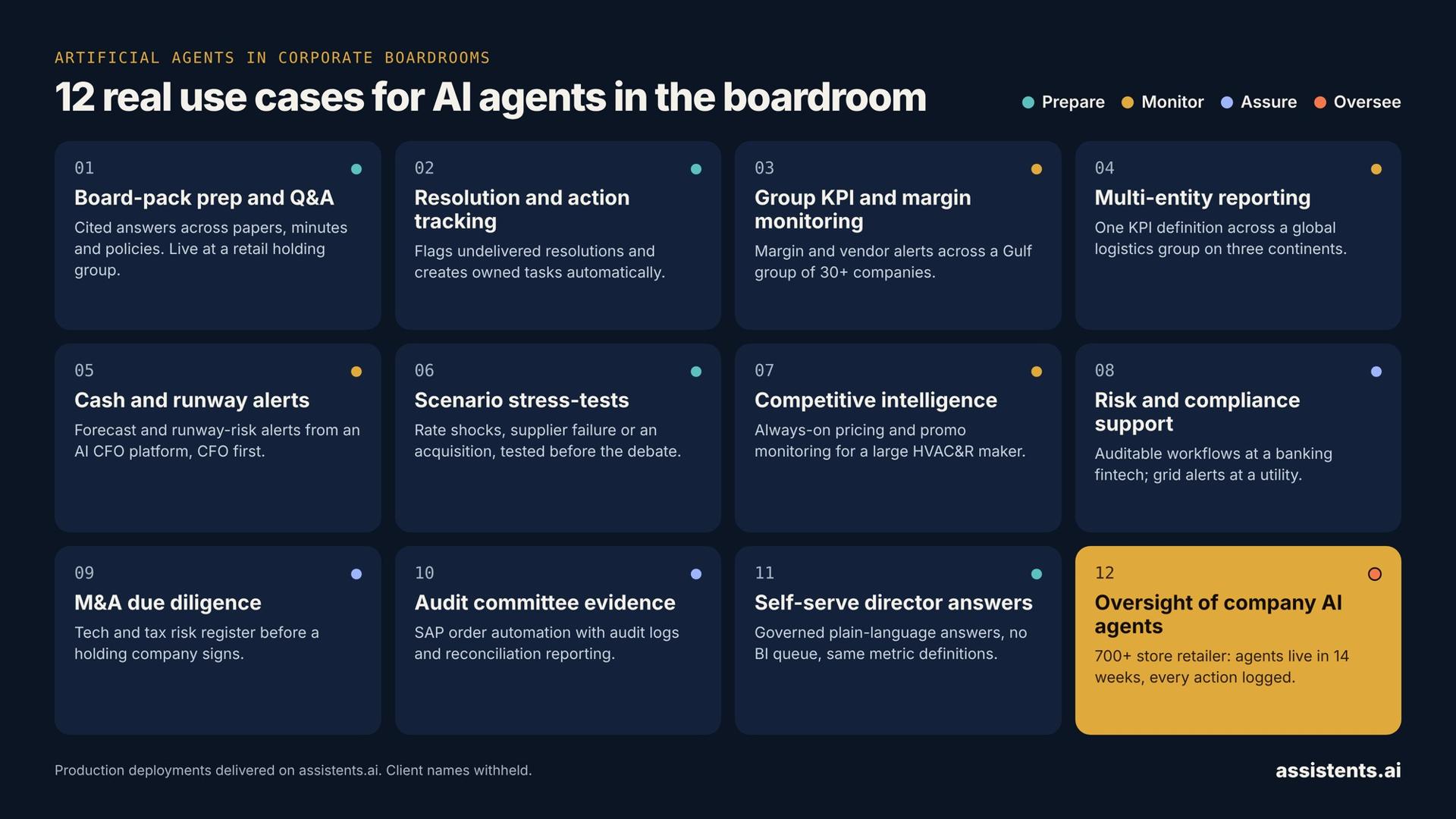
12 real use cases for AI agents in the boardroom
Each use case below names the board question it answers, the control it needs and a production deployment delivered on assistents.ai. Client names are withheld. Results are as reported for each deployment.
1. Board-pack preparation and Q&A
The agent reads the current board pack alongside prior papers, minutes and policies. Directors ask "What changed since last quarter?" or "Where does this paper contradict the risk register?" and get answers with citations.
- Control: the data scope is limited to material already provided to the board.
- In production: a privately held retail holding group uses a unified context engine that reads both structured data and documents. Leadership gets governed, cross-functional answers in one place instead of waiting on separate reports.
2. Resolution and action tracking
The agent checks every resolution and board request against later papers, and flags anything that has not been delivered.
- Control: read-only access, plus a named human owner for every open item.
- In production: the same retail holding group added insights-to-action agents on top of its existing dashboards. They create tasks automatically and track completion, which moved leadership from reactive reporting to proactive follow-through, with consistent decision logic across teams.
3. Group-wide KPI and margin monitoring
Instead of a static quarterly deck, an agent watches the KPIs the board cares about and raises an alert when they drift.
- Control: thresholds and definitions are set by management and approved by the relevant committee.
- In production: a Gulf family business group with more than 30 companies runs automated alerts on purchase-price trends, gross-margin impact, early-payment economics and vendor delivery and returns across entities. Leadership receives scheduled insight packs. Result: earlier detection of margin erosion and vendor slippage, and fewer variance surprises.
4. Consolidated multi-entity reporting
In a group, each subsidiary often defines its metrics differently, so the board compares numbers that do not match.
- Control: a governed semantic layer holds one definition per metric.
- In production: a global logistics and warehousing company operating across India, the UK, Europe and the US standardised its KPIs across entities, with variance explanations and data-quality checks. Result: a single operational view, faster leadership reporting and more consistent metrics.
5. Cash, liquidity and runway alerts
An agent monitors cash position and forecasts, and escalates risks with recommended actions before they reach the board as surprises.
- Control: recommendations go to the CFO first; the board sees escalations and trends.
- In production: an AI CFO platform uses forecasting and scenario-modelling agents with runway-risk alerts. Result: earlier detection of cash risks and anomalies, and faster analysis cycles. Read more in AI solutions for CFOs and agentic AI in finance and accounting.
6. Scenario testing and strategy stress-tests
Agents run "what if" cases on a strategy before the board debates it: an interest-rate shock, a supplier failure, a price war or an acquisition.
- Control: every assumption is logged and visible to all directors.
- In practice: INSEAD reports that one chair used an AI model to analyse a proposed acquisition, and the board concluded it exceeded its risk appetite. Management now includes scenario analysis as standard (INSEAD). The same forecasting and scenario agents described in use case 5 bring this into the board's regular cycle.
7. Competitive and market intelligence
Boards often hear about competitor moves late, filtered through management.
- Control: sources are listed with every insight.
- In production: a large Indian HVAC&R manufacturer runs always-on monitoring of e-commerce pricing, MRP and discounts, offers, availability and ratings. Agentic Q&A is mapped directly to the questions leadership asks. Result: faster competitive response, earlier detection of pricing gaps and promotional shifts, and always-on monitoring in place of manual checks across portals.
8. Risk and compliance committee support
Agents keep audit trails, monitor service levels and surface exceptions for the risk committee.
- Control: every automated step is logged and reportable.
- In production: a fintech serving banks and credit unions uses auditable workflow automation for disputes, fraud and compliance. Result: faster case handling and better compliance readiness through audit trails. A state power-transmission utility uses agents for anomaly detection and automated operational alerts. Result: faster identification of operational risks and better transparency for leadership.
See our compliance and risk solutions.
9. M&A and investment due diligence
Boards approve deals with incomplete visibility of technology and tax risk.
- Control: findings feed a risk register that the board can interrogate.
- In production: a long-term holding company that partners with founders and family businesses uses structured technical due diligence covering architecture, scalability and security, producing a risk register and remediation roadmap. Result: faster investment decisions and fewer post-deal surprises. Separately, a tax-tech product screens cross-border transactions early for withholding-tax, VAT and permanent-establishment risk. Result: fewer last-minute deal disruptions and faster pre-compliance review.
10. Audit committee evidence
Agents compare audit reports and financial papers to spot trends and anomalies, a use case the AICD highlights for audit committees.
- Control: the committee agrees parameters before the agent runs.
- In production: a diversified Gulf group automated SAP sales-order creation with rule-governed approvals, exception handling, audit logs and reconciliation reporting. Result: improved auditability, fewer data-entry errors and a faster order-to-confirm cycle.
More examples: AI use cases in internal audit.
11. Self-serve answers for directors without the analyst queue
Directors ask questions in plain language and get governed answers, with the same metric definitions management uses.
- Control: row-level security means each director sees only what they are entitled to see.
- In production: a Silicon Valley analytics company deployed an agentic analytics layer with semantic governance and a natural-language interface. Result: faster strategic visibility without BI queues, and better alignment through consistent metric definitions.
Explore AI data analysis agents and our guide to agentic BI.
12. Oversight of the company's own AI agents
The board sees a register of every agent: who owns it, what it can access, what actions it has taken, its exceptions and its outcomes.
- Control: agents inherit source-system permissions, and every action is logged.
- In production: a national value retailer with more than 700 stores deployed voice support, inventory intelligence and knowledge agents across its network in 14 weeks, with an admin console, analytics and ticketing integration. Leadership can see what each agent does and how it performs. That is exactly the visibility a board needs to oversee AI risk.
The boardroom AI maturity model
Autonomy is earned, not switched on. Most boards today sit at Level 1. The value lies in reaching Levels 2 to 4 with controls in place. Humans keep strategic and accountable authority at every level.
| Level | Operating model | Board's role | Agent's role | Example |
|---|---|---|---|---|
| 0. Digitised | Board portal and PDFs | Reads everything manually | None | Static board packs |
| 1. Assist | AI summarises and answers | Asks, checks and decides | Advises | Board-pack Q&A |
| 2. Co-work | Agents prepare committee work | Owns the agenda, reviews drafts | Performs bounded steps | Resolution tracking, draft questions |
| 3. Delegate | Agents own monitoring tasks | Sets thresholds, handles escalations | Monitors and alerts | KPI, cash and risk alerts |
| 4. Exception-managed | Agents run management processes | Sets the authority envelope, reviews exceptions | Runs the normal path | Board oversees the company's digital workforce |
| 5. Adaptive | Agents propose process improvements | Approves policy and releases | Optimises within controls | Governed continuous improvement |
The principle behind the model is simple: agents do the normal work inside a defined authority envelope; humans define the envelope and manage material exceptions. Requiring human approval on every step keeps the old bottleneck. Unrestricted autonomy creates unacceptable risk. Exception-managed operation sits between the two.
Risks and the controls that answer them
| Risk | What goes wrong | Control |
|---|---|---|
| Confidential data leakage | Directors paste board papers into public chatbots ("shadow AI") | An approved, closed-scope tool; zero data retention; no training on your data |
| Hallucination | A wrong figure enters a board decision | Citations on every answer; human verification of material numbers |
| Over-reliance | Directors defer to the agent's view | AI informs and humans decide; record reasoning and dissent in the minutes |
| Access creep | The agent sees more than a director should | Agents inherit source-system permissions and row-level security |
| No audit trail | You can't show a regulator how a conclusion was reached | Logged sources, prompts, actions and approvals with exportable evidence |
| Privilege and discoverability | AI-generated notes become discoverable | Legal review of retention policies; delete raw recordings after minutes are approved |
| Vendor or model lock-in | The board depends on a single model provider | A model-agnostic platform with private or on-prem deployment |
The AICD describes a "two-speed dynamic" in which individual directors' private AI use runs ahead of collective board use (AICD). The fastest way to reduce shadow AI is to give directors an approved tool that is better than the public one.
A 90-day governed playbook for boards
- Days 1 to 15: set the policy. Adopt a board AI policy covering approved tools, data scope, retention and who verifies outputs. Ban unapproved tools for board papers.
- Days 1 to 30: take inventory. Ask management for a register of AI agents in use, with owner, permissions, actions and outcomes for each.
- Days 15 to 45: pick one use case. Start with board-pack Q&A or resolution tracking, with read-only access to board material only.
- Days 30 to 60: run in shadow mode. The agent prepares; the company secretary verifies. Track accuracy, time saved and director usage.
- Days 60 to 90: review and expand. If accuracy and controls hold, add one monitoring use case, such as KPI or cash alerts, and report results to the full board.
- Ongoing: build literacy. Run director AI training, which also supports EU AI Act Article 4 obligations, and review the agent register every quarter.
Use our AI agent ROI calculator to size the business case before step 3.
How to choose a boardroom AI agent platform
Use this checklist when you assess vendors:
- [ ] Runs in a closed environment: private cloud, VPC or on-premises
- [ ] SOC 2 Type II and ISO 27001 certified; GDPR and HIPAA where relevant
- [ ] Zero data retention and no model training on your data
- [ ] Inherits existing permissions, with row-level security
- [ ] Cites sources for every answer
- [ ] Keeps a full audit trail of data access, actions and approvals
- [ ] Supports human-in-the-loop approvals and escalation
- [ ] Connects to ERP, CRM, finance and document systems, not just the board portal
- [ ] Model-agnostic, with no single-LLM lock-in
- [ ] Goes live in weeks, not a multi-year programme
Board-portal tools are strong at Level 1: summaries inside the portal. Boards that want Levels 2 to 4, where agents monitor the live business and report on the company's own agents, need an enterprise agent platform connected to operating systems. Our enterprise AI buyer's guide and ranking of AI agent platforms for enterprise go deeper.
Why assistents.ai for boardroom AI agents
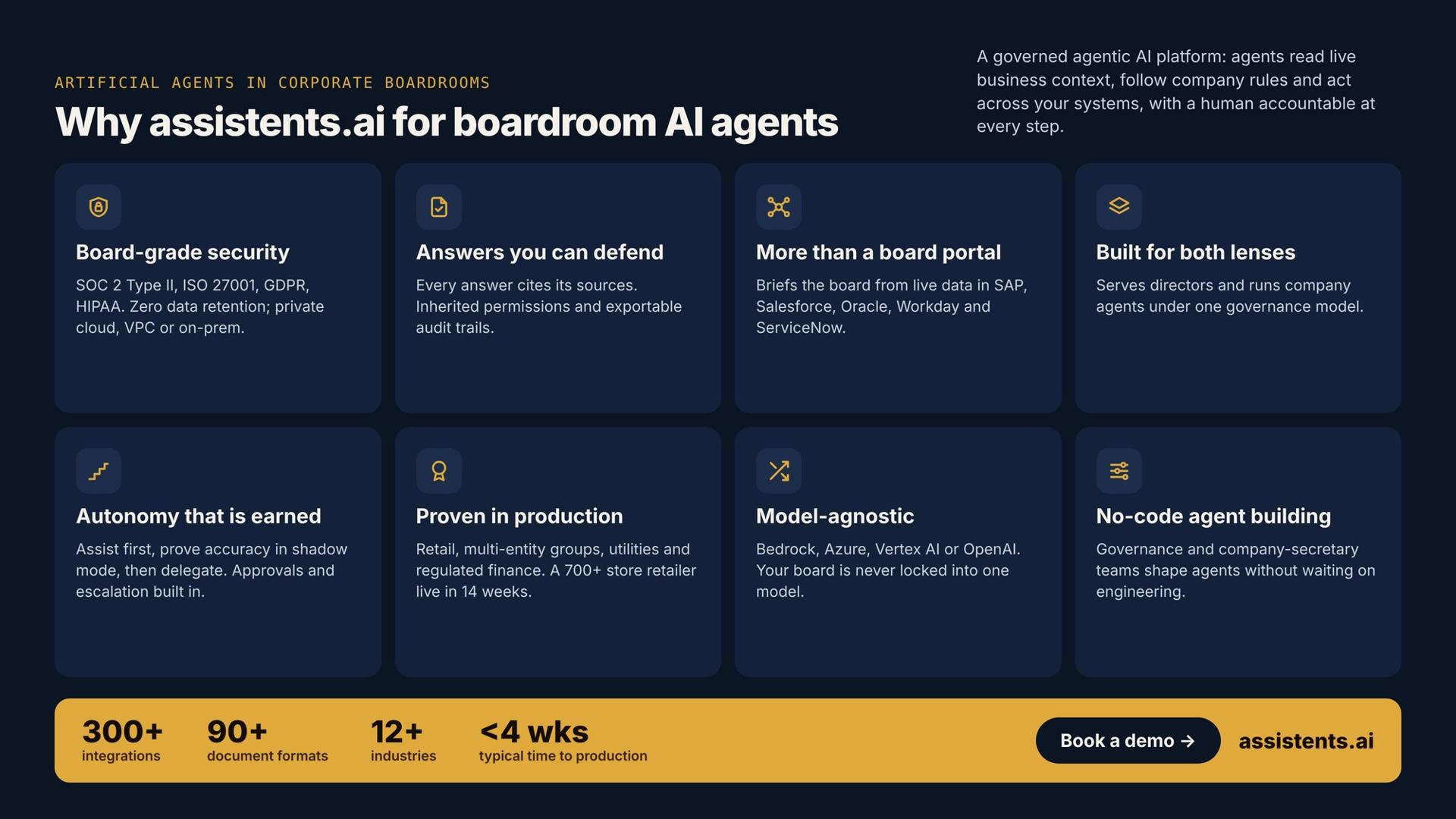
assistents.ai is a governed enterprise agentic AI platform. It gives boards and leadership teams agents that read live business context, follow company rules and act across existing systems, with a human accountable at every step.
- Board-grade security. SOC 2 Type II, ISO 27001, GDPR and HIPAA. Zero data retention, no training on your data, and private-cloud, VPC or on-prem deployment for confidential board material. See Security & Trust and Compliance.
- Answers you can defend. Every answer cites its sources. Agents inherit source-system permissions, and audit trails log data access, decisions and actions with exportable evidence.
- More than a board portal. 300+ integrations, including SAP, Salesforce, Oracle, Workday and ServiceNow, plus document AI across 90+ formats. Agents brief the board from live operating data, not just the papers.
- Built for both lenses. The same platform that serves directors also runs the company's finance, procurement, sales and service agents under one governance model, so the board can oversee the digital workforce it is accountable for.
- Autonomy that is earned. Start at assist, prove accuracy in shadow mode, then delegate bounded monitoring. Human approvals, deterministic business rules and escalation are built in. See how it works.
- Proven in production. Deployments across 12+ industries, including a 700+ store retailer live in 14 weeks, multi-entity groups, utilities and regulated finance. Typical time to production is under four weeks. See our customers.
- Model-agnostic. Works across Amazon Bedrock, Azure, Google Vertex AI and OpenAI, so your board is never locked into one model.
- No-code agent building. Governance and company-secretary teams can shape agents with the Agent Builder without waiting on engineering.
Ready to bring governed AI agents to your boardroom? Book a demo or download the AI Agent Governance Playbook.
Conclusion
Artificial agents in corporate boardrooms will not take a seat or cast a vote. What they will change is how well directors prepare, how early they see risk and how clearly they can oversee the AI running their company. Boards that start now, with one bounded use case and strong controls, will govern better than boards that wait or let shadow AI fill the gap.
FAQs
Can an AI be a member of a board of directors?
No, not as a legal director in most jurisdictions. Delaware, the UK and Australia require directors to be natural persons, and fiduciary duties cannot be delegated. An AI agent can serve as an adviser or non-voting observer, while human directors remain accountable for every decision.
Has any company appointed an AI to its board?
Yes, in advisory roles. Deep Knowledge Ventures gave an algorithm called VITAL a board seat in 2014. Abu Dhabi's International Holding Company added "Aiden Insight" as a non-voting board observer in 2024. In 2026, Telstra launched a board agent to help directors prepare for meetings.
How is AI used in corporate governance?
Boards use AI agents to summarise board packs, track resolutions, monitor KPIs and cash, stress-test strategy, support audit and risk committees, and speed up due diligence. Governance teams also use AI to oversee the company's own AI agents through registers, permissions and audit trails.
What are the risks of AI in the boardroom?
The main risks are confidential data leakage through public tools, hallucinated figures, over-reliance on AI recommendations, excessive access and missing audit trails. Closed-scope platforms, citations, inherited permissions, human verification and logged actions address each one.
Will AI replace board directors?
No. AI takes over information gathering and monitoring, which makes human judgment, ethics and accountability more important, not less. Directors spend less time reading and more time challenging management and making decisions.
How should boards oversee AI agents in their company?
Ask management for a register of every agent, with its owner, permissions, actions and outcomes. Set authority limits and escalation rules. Review exceptions and performance every quarter, as the board would for any other material risk.
Is it safe to upload board papers to ChatGPT?
Not to a public consumer tool. Board papers are confidential and may be retained or exposed. Use an approved platform with zero data retention, no model training on your data, inherited permissions and private or on-prem deployment.
What questions should a board ask about AI?
Which AI agents do we run, and who owns them? What can they access and do? How are their outputs verified? Where is the audit trail? What value have they delivered relative to cost and risk? Are directors trained to oversee AI?