TL;DR: Trading AI automation uses AI agents, business rules and governed workflows to run trading work end to end: research, signals, risk checks, surveillance, reconciliation, settlement and reporting. Most guides stop at trading bots. The biggest and safest gains sit in the middle and back office, where work is repetitive, rule-bound and audited. The winning approach is to start with read-only research and monitoring, prove accuracy in shadow mode, then expand to approved actions and bounded autonomy. assistents.ai is a governed AI agent platform built for exactly that path.
Key takeaways
- Trading AI automation is bigger than a trading bot. It covers the full trade lifecycle across front, middle and back office, not just order placement.
- Execution is already automated; the work around it is not. Algorithms handle an estimated 60–73% of US equity volume, and 63% of hedge funds route more than half their traded value through algos (The TRADE). Research, controls and post-trade work are still largely manual.
- The market is growing fast. The AI trading platform market is projected to grow from USD 11.2 billion in 2024 to USD 33.5 billion by 2030, a 20% CAGR (Grand View Research).
- Regulators expect oversight. FINRA's 2026 report says autonomous AI agents "may require novel oversight, including tracking actions and restricting system access" (Sidley summary).
- Autonomy should be earned, not switched on. Move each workflow from analysis → shadow mode → approved actions → bounded autonomy only after it hits your accuracy targets.
What is trading AI automation?
Trading AI automation is the use of AI agents, deterministic rules and governed workflows to perform trading work with minimal manual effort: gathering market data, generating and testing signals, checking risk, monitoring compliance and processing trades after execution, while humans approve material decisions.
It spans the three layers of any trading business:
| Layer | What gets automated | Who benefits |
|---|---|---|
| Front office | Research synthesis, signal generation, sentiment analysis, market monitoring, strategy simulation, execution support | Traders, portfolio managers, research analysts |
| Middle office | Pre-trade risk checks, limit and exposure monitoring, trade surveillance, best-execution analysis | Risk, compliance and trading-control teams |
| Back office | Confirmations, reconciliation, settlement-break handling, regulatory and client reporting, client servicing | Operations, finance and client-service teams |
How trading AI automation differs from algorithmic trading
Classic algorithmic trading follows fixed instructions: buy when this indicator crosses that line, slice this order by VWAP. It is fast and precise but blind to anything outside its rules.
AI agents add a different capability. They can read news, filings, chats and PDFs; reason over context; choose which tools to call; and explain what they did and why. That makes it possible to automate knowledge work around the trade that could never be written as rigid code.
The best systems combine both: deterministic rules control the process, limits and approvals; AI agents handle the adaptive steps inside those boundaries. We call this "deterministic macro, agentic micro."
AI trading bot vs AI trading agent vs trading AI automation
Searchers often use these terms interchangeably. They are not the same thing.
| AI trading bot | AI trading agent | Trading AI automation platform | |
|---|---|---|---|
| Scope | One strategy, one account | One goal, several tools | Many workflows across the trade lifecycle |
| Inputs | Price and indicator data | Prices, news, filings, social data | Market data plus OMS/EMS, custodians, CRM, ledgers, documents and policies |
| Decision style | Fixed rules or a single model | Plans and adapts within a task | Agents + deterministic rules + human approvals |
| Typical user | Retail and active traders | Quant teams, fintech builders | Brokers, prop firms, asset managers, crypto exchanges, fintechs |
| Governance | Stop-loss settings | Prompt-level guardrails | Permissions, approval tiers, kill switches, full audit trail |
| Output | Orders | Signals, research, orders | Completed, logged work: from research note to settled trade |
- Want a single strategy engine? Read our deep dive on the AI agent for trading strategy.
- Comparing retail tools? See our ranking of the best AI for stock market analysis and trading.
- Running a trading business? Keep reading. This guide is about automating the whole operation.
Why trading firms are adopting AI automation in 2026
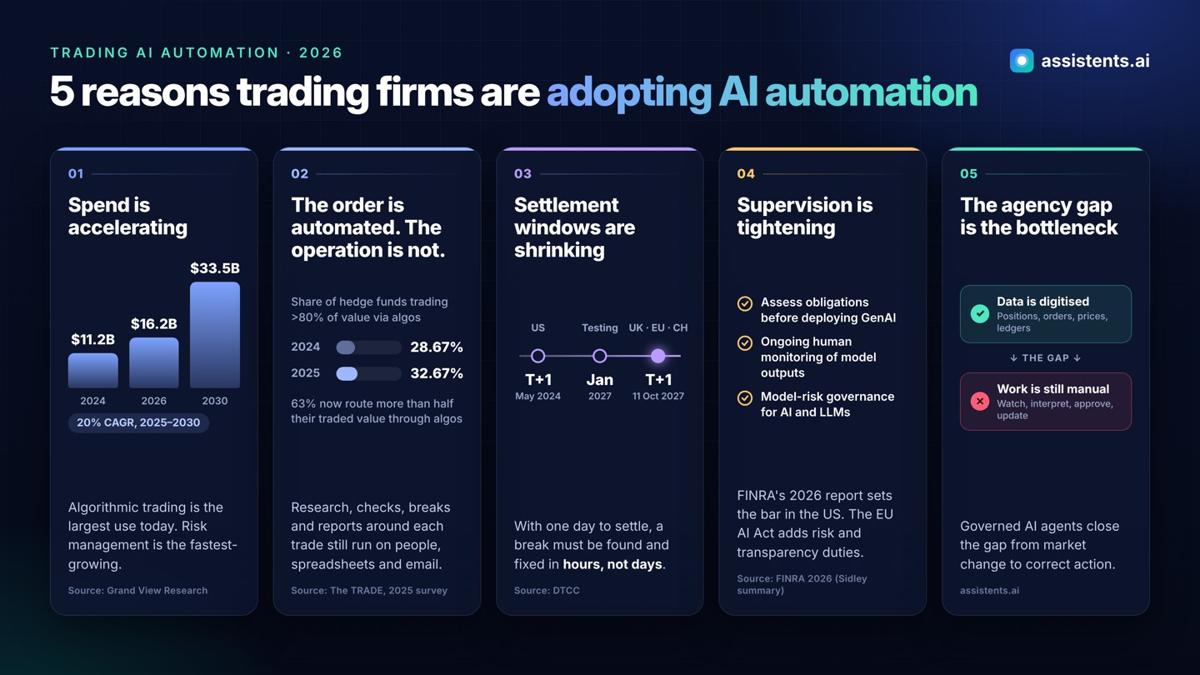
1. Spend is accelerating. Grand View Research values the global AI trading platform market at USD 11.2 billion in 2024 and projects USD 33.5 billion by 2030. Algorithmic trading is the largest application today, while risk management is expected to grow fastest (Grand View Research).
2. The order is automated; the operation is not. Hedge-fund algo usage keeps climbing: the share of funds trading more than 80% of value via algos rose from 28.67% in 2024 to 32.67% in 2025 (The TRADE). Yet the work around each trade (research, checks, breaks, reports) still runs on people, spreadsheets and email.
3. Settlement windows are shrinking. The US moved to T+1 in May 2024. The UK, EU and Switzerland target T+1 on 11 October 2027, with readiness testing planned for January 2027 (DTCC). With one day to settle, a break must be found and fixed in hours.
4. Supervision is tightening. FINRA expects firms to assess regulatory obligations before deploying generative AI, keep "ongoing human monitoring of model outputs," and apply model-risk governance to AI and LLM use (Sidley summary of FINRA's 2026 report). In Europe, the EU AI Act adds risk-management and transparency duties.
5. The agency gap is now the bottleneck. Trading firms have digitised their data: positions, orders, prices and ledgers. What they have not digitised is the work of moving from a changing market state to a correct action. People still watch screens, interpret exceptions, gather context, chase approvals and update multiple systems. AI agents can now close that gap, safely, if they are governed.
15 trading AI automation workflows across the trade lifecycle
Front office: research, signals and monitoring
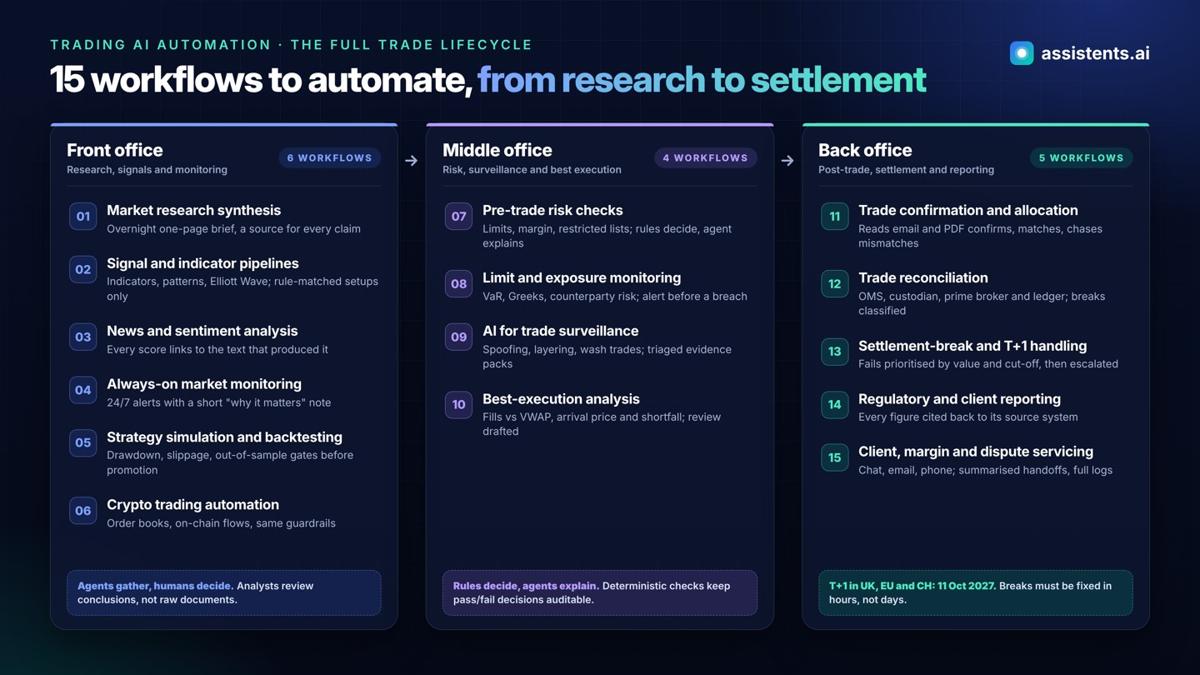
1. Market research synthesis Agents ingest filings, earnings-call transcripts, macro releases and broker notes overnight, then deliver a one-page brief with a source link for every claim. Analysts start the day reviewing conclusions, not hunting for documents.
2. Signal generation and indicator pipelines Agents compute technical indicators and pattern analysis (moving averages, momentum, volatility regimes, Elliott Wave counts) across your watchlist and flag only the setups that match your rules. Each alert explains which conditions fired.
3. News and sentiment analysis Language models score headlines, social posts and transcripts for sentiment and relevance to your book. Unlike black-box sentiment feeds, every score links back to the exact text that produced it.
4. Always-on market monitoring and alerts Agents watch prices, spreads, funding rates, liquidity and volatility around the clock and push alerts with a short "why it matters" note. Traders get fewer, better alerts instead of a wall of notifications.
5. Strategy simulation and backtesting Agents run backtests and paper trades, report drawdown, slippage and out-of-sample performance, and block promotion of any strategy that fails your thresholds. This guards against the overfitting most retail guides ignore.
6. Crypto trading automation Crypto markets never close, so monitoring cannot either. Agents track exchange data, order-book depth, on-chain flows and wallet activity under the same guardrails as traditional assets. For a build guide, see crypto AI agent development.
Middle office: risk, surveillance and best execution
7. Pre-trade risk checks Before an order is released, an agent checks position limits, concentration, margin and restricted lists. Deterministic rules make the pass/fail decision; the agent explains it and routes exceptions to the right person.
8. Limit and exposure monitoring Agents continuously monitor VaR, Greeks, counterparty exposure and liquidity, and alert the named risk owner when a threshold approaches, not after it is breached.
9. AI for trade surveillance Agents review orders, trades and communications for patterns such as spoofing, layering, wash trades and insider risk. Instead of dumping thousands of raw alerts on compliance, they triage, de-duplicate and assemble an evidence pack for each case.
10. Best-execution analysis Agents compare fills against VWAP, arrival price and implementation shortfall, explain outliers and draft the periodic best-execution review for sign-off.
Back office: post-trade, settlement and reporting
11. Trade confirmation and allocation Agents read confirmations arriving by email, PDF or portal, match them to booked trades and chase mismatches with counterparties. Document AI handles the unstructured formats rules engines struggle with.
12. Trade reconciliation automation Agents reconcile positions and cash across the OMS, custodian, prime broker and general ledger, classify each break by cause and propose the fix, with an audit trail of every step.
13. Settlement-break and T+1 exception handling Agents prioritise fails by value and deadline, draft counterparty messages, update the break log and escalate whatever they cannot resolve before cut-off. This is where T+1 makes automation essential.
14. Regulatory and client reporting Agents compile transaction reports, risk packs and investor updates from governed data. Every figure carries a citation back to its source system, so reviewers can verify rather than rebuild.
15. Client, margin and dispute servicing Omnichannel agents answer account, margin and dispute queries across chat, email and phone; summarise complex cases for human handoff; and log every interaction for compliance. See more in our guide to AI agent use cases in banking.
Trading AI automation in production: 5 real deployments
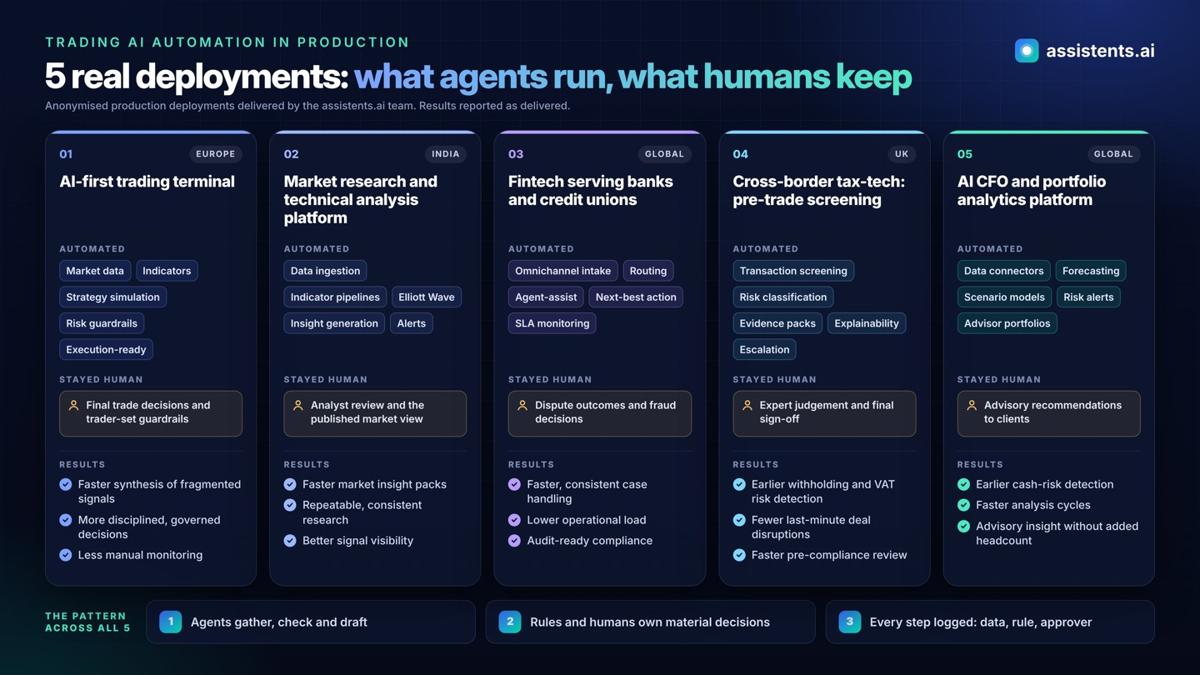
The following are anonymised production deployments delivered by the assistents.ai team. Client names are withheld. Results are reported as delivered.
1. AI-first trading terminal (Europe): multi-agent research-to-execution workflow
The challenge: An AI-first trading terminal wanted to combine research, analysis, signals and execution into one workflow for active crypto and equity traders, without turning the product into an ungoverned black box.
What was automated: A network of specialised agents for market data ingestion, indicator and pattern analysis, strategy simulation with risk guardrails, alerting and recommendation summaries, and execution-ready workflow integration.
What stayed human: Final trade decisions and the risk guardrails each trader sets.
Results:
- Faster synthesis of fragmented market signals
- More disciplined decision-making through governed workflows
- Reduced manual monitoring effort
2. Market research and technical analysis platform (India): research automation at scale
The challenge: A research platform publishing Elliott Wave–based forecasts and insights for Indian markets needed to produce more analysis, more consistently, without adding analysts.
What was automated: Market data ingestion and indicator pipelines, research automation and insight generation, plus alerts and thematic dashboards.
What stayed human: Analyst review and the published market view.
Results:
- Faster production of market insight packs
- More repeatable and consistent research workflows
- Better signal visibility through automated analytics
3. Global fintech serving banks and credit unions: governed omnichannel operations
The challenge: A cloud fintech provider focused on disputes, fraud and compliance needed to handle high case volumes across channels while staying audit-ready.
What was automated: Omnichannel intake across chat, email and phone; workflow routing; agent-assist summaries and next-best actions; reporting and SLA monitoring, all integration-ready with core systems.
What stayed human: Dispute outcomes and fraud decisions.
Results:
- Faster case handling and improved consistency
- Lower operational load through automation
- Better compliance readiness through complete audit trails
4. Cross-border tax-technology product (UK): pre-trade compliance screening
The challenge: A tax-tech product needed to screen cross-border transactions early for withholding-tax, VAT and permanent-establishment risk, before issues surfaced late in a deal.
What was automated: Transaction screening with risk classification, evidence collection and explainability notes, plus an escalation workflow to tax experts.
What stayed human: Expert judgement and final sign-off.
Results:
- Earlier detection of withholding and VAT risk
- Fewer last-minute deal disruptions
- Faster, more consistent pre-compliance review
This is the same pattern trading firms need for pre-trade compliance: agents screen and gather evidence, experts decide.
5. AI CFO and portfolio analytics platform (global): continuous risk alerts
The challenge: A platform serving growing businesses, CFOs and advisors wanted to turn financial data into real-time monitoring, forecasting and scenario planning.
What was automated: A financial data connection layer, forecasting and scenario-modelling agents, alerts for cash and runway risk with recommended actions, and portfolio views for advisors managing multiple clients.
What stayed human: Advisory recommendations to clients.
Results:
- Earlier detection of cash risks and anomalies
- Faster analysis cycles and improved decision cadence
- Advisory-grade insight at scale without added headcount
The pattern across all five deployments
- Agents do the gathering, checking and drafting.
- Deterministic rules and humans own material decisions.
- Every step is logged with the data used, the rule applied and the person who approved it.
That is what separates a production trading AI automation from a demo. Explore more use cases and customer stories.
What to automate first: the autonomy ladder for trading
Autonomy is not a switch. It is a ladder, and each workflow should climb it only after proving itself on the rung below.
| Stage | Agent role | Human role | Trading workflows that fit |
|---|---|---|---|
| 1. Ask & analyse | Reads data, answers with citations | Decides and acts | Research synthesis, sentiment, best-execution analysis, report drafts |
| 2. Shadow mode | Runs the workflow in parallel, takes no live action | Compares agent output with human output | Reconciliation, surveillance triage, pre-trade checks |
| 3. Execute with approval | Prepares the action and waits for sign-off | Approves or rejects in one click | Settlement-break messages, client replies, limit escalations |
| 4. Bounded autonomy | Acts alone inside set limits, escalates exceptions | Manages exceptions and adjusts limits | Monitoring alerts, confirmation matching, low-value break fixes |
How to pick your first workflow. Score each candidate on three questions:
- Volume: Does it happen hundreds of times a week?
- Rules: Can a good analyst explain the correct outcome in a checklist?
- Blast radius: If the agent is wrong, is the damage small and reversible?
Workflows that score high on all three, typically reconciliation, research synthesis, monitoring and reporting, are your fastest wins. Order-touching actions come later.
Risks and guardrails for trading AI automation
Every competitor guide warns about risk in general terms. Here is what the controls actually look like.
| Risk | What can go wrong | Guardrail |
|---|---|---|
| Hallucination and model error | An agent states a wrong number or invents a source | Ground answers in governed data; require citations; keep limits and eligibility in deterministic rules |
| Runaway actions | An agent repeats an order or message in a loop | Transaction and rate limits, idempotency keys, kill switches, approval tiers for anything touching money or orders |
| Overfitted strategies | A backtest looks great and fails live | Out-of-sample tests, paper trading, slippage and fee modelling before promotion |
| Excess data access | An agent sees data its task does not need | Agents inherit source-system permissions and receive only task-scoped context |
| Prompt injection and tool misuse | Malicious text in a document or email hijacks an agent | Tool-argument validation, signed capabilities, deterministic controls between reasoning and action (see OWASP GenAI Security Project) |
| Regulatory exposure | A firm cannot explain who did what, and why | Exportable audit trail of data, prompts, decisions, approvals and actions, mapped to FINRA, SEC, MiFID II and EU AI Act expectations |
| Scams | "AI bots" promising guaranteed returns | US regulators have issued alerts on AI investment fraud (summarised here); no legitimate platform guarantees profit |
A useful test: authority should be computed, not asserted in a prompt. An agent's right to act should be the overlap of its identity, its role, the human who delegated the work, the purpose of the task, its permitted capabilities, business policy and its risk budget. If any one of those says no, the action does not happen.
For a full control framework, download the AI agent governance playbook.
This article is for information only and does not constitute investment advice.
Build vs buy: choosing a trading AI automation platform
| Option | Best for | Strengths | Limits for a trading business |
|---|---|---|---|
| Retail AI trading bots (e.g. Trade Ideas, TrendSpider, Cryptohopper) | Individual traders | Fast setup, low monthly cost | One strategy; no back-office scope; limited audit, team and permission controls |
| DIY stacks (n8n, LangChain, CrewAI + broker APIs) | Prototypes, small quant teams | Flexible, cheap to start | You must build governance, permissions, monitoring and audit yourself (see assistents.ai vs CrewAI) |
| Custom agency build | Unique proprietary strategies | Fully bespoke | Long timelines, high cost, you own all maintenance |
| Governed agent platform (assistents.ai) | Brokers, prop firms, asset managers, crypto exchanges, fintechs | Full lifecycle coverage, governance, model choice, private deployment, delivery team | Built for teams, not single-user signal apps |
Evaluation checklist
Before you choose a trading AI automation platform, confirm it can:
- [ ] Connect to your OMS/EMS, custodians, prime brokers, ledgers and data warehouse (integrations)
- [ ] Enforce permissions per agent, inherited from source systems
- [ ] Combine AI agents with deterministic business rules
- [ ] Support approval tiers, limits and kill switches
- [ ] Log every action in an exportable audit trail (security and trust)
- [ ] Let you choose your LLM and your deployment (cloud, VPC or on-premise)
- [ ] Show production references in financial services
- [ ] Prove ROI before you scale (AI agent ROI calculator)
Wondering about budget? See how much it costs to build an AI agent.
Why assistents.ai is the top choice for trading AI automation
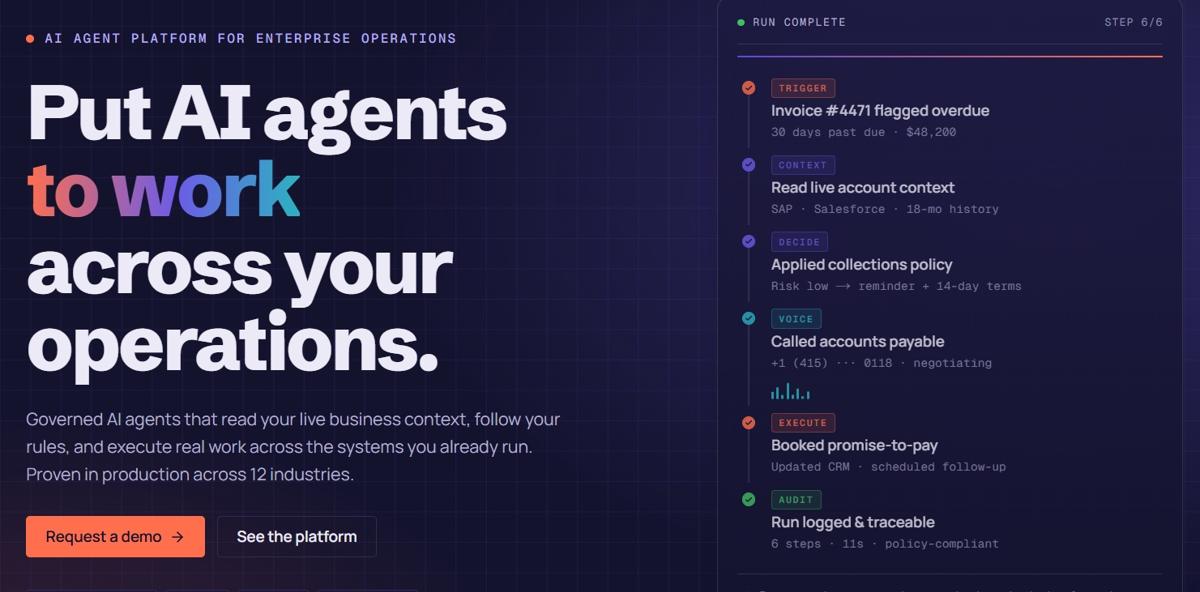
assistents.ai is a governed AI agent platform for enterprise operations. It is built for the part of trading most tools ignore: running the whole operation, safely, at scale.
One platform for the whole trade lifecycle. Research, monitoring, risk, surveillance, reconciliation and client service run as coordinated agents, not a patchwork of point tools. Learn how in our multi-agent orchestration guide.
Live context, not stale exports. The Context Engine connects to 300+ business applications, and a semantic layer maps how positions, trades, clients, limits and policies relate. Agents reason over your real books, not a copy from last night.
Governance built in, not bolted on. Agents inherit source-system permissions. Every action is permission-checked and logged. Audit trails export for SOC 2, GDPR, HIPAA and ISO 27001 reviews. Agents escalate when behaviour drifts from their intended purpose.
Three operating modes, chosen per workflow.
- Ask & Analyze: cited answers from live data
- Execute Workflows: approvals, record updates and document generation with human sign-off
- Autonomous Agents: guardrailed, high-volume work that escalates exceptions
Deterministic where it matters. Business rules own limits, eligibility and approvals. Agents own interpretation, research and drafting. You get adaptability without giving up control.
Your models, your infrastructure. Use models from AWS Bedrock, Azure, Google Vertex AI or OpenAI. Deploy in your private cloud or on-premise. Your data is never used to train models.
Proven in financial operations. Production deployments span an AI-first trading terminal, a market research platform, a banking fintech, a tax-screening product and a CFO analytics platform, part of live use across 12 industries.
How to automate trading with AI: a 90-day governed rollout
Step 1 — Days 1–15: Pick one workflow and define success. Choose a high-volume, rule-bound task such as reconciliation or the morning research brief. Set targets for accuracy, time saved and exception rate before any build starts.
Step 2 — Days 16–30: Connect data and write the controls. Connect sources using existing permissions. Write the business rules, limits and approval tiers before any agent is allowed to act.
Step 3 — Days 31–50: Run in shadow mode. Let the agent work in parallel with your team, taking no live actions. Compare outputs daily and close the gaps.
Step 4 — Days 51–75: Go live with approvals. Switch on actions with one-click human sign-off. Track exceptions, overrides and the audit log weekly.
Step 5 — Days 76–90: Expand what works. Grant bounded autonomy where targets are consistently met, then add the next adjacent workflow, for example from reconciliation to settlement-break handling.
Need help scoping? See our implementation approach or build AI agents without code.
Why trading teams choose assistents.ai
| What matters to a trading team | Retail bots | DIY stack | assistents.ai |
|---|---|---|---|
| Covers front, middle and back office | ✗ | Only what you build | ✓ |
| Permission-aware agents | ✗ | Build it yourself | ✓ Inherited from source systems |
| Deterministic rules + AI agents | Partial | Build it yourself | ✓ |
| Human approvals and escalation | ✗ | Build it yourself | ✓ Built in |
| Exportable audit trail | Limited | Build it yourself | ✓ Built in |
| Model choice | Vendor's model | ✓ | ✓ Bedrock, Azure, Vertex AI, OpenAI |
| Private cloud or on-prem | ✗ | Self-managed | ✓ |
| Production references in finance | Retail users | None | ✓ Trading, research, banking, tax-tech, CFO analytics |
| Delivery team to help you ship | ✗ | ✗ | ✓ |
Start small, prove value. Launch with read-only research or monitoring, then expand to approved actions. You never have to accept broad autonomy to get value on day one.
No rip-and-replace. Agents work over the OMS, custodians, CRM and data warehouse you already run.
A delivery team, not just a toolkit. The team that shipped the deployments above helps you scope, build, govern and scale yours.
Ready for the regulator's questions. Every agent action answers four questions: who did it, with what data, under which rule, and who approved it.
Compare us directly with other platforms on our comparison hub, or read why teams choose assistents.ai.
See trading AI automation on your own workflows. Book a demo and we will map your first three automation candidates in a single session.
Conclusion: automate the operation, not just the order
Trading AI automation is no longer about a single bot placing trades. The firms pulling ahead automate the whole operation, from research to settlement, with AI agents that act inside clear limits and leave a complete audit trail. Start with one high-volume workflow, prove it in shadow mode, then expand.
assistents.ai gives trading teams the platform, the controls and the delivery team to do it safely. Book your demo or explore pricing.
Related reading
- AI Agent for Trading Strategy: From Market Signal to Executed Decision
- 16 Best AI for Stock Market Analysis and Trading in 2026
- Crypto AI Agent Development: The 2026 Guide
- 25+ AI Agent Use Cases in Banking
- Agentic AI in Finance and Accounting
- AI Agents in Financial Services
Sources
- Grand View Research, AI Trading Platform Market Report
- The TRADE, Hedge fund algorithmic usage shifting from optimal to essential
- DTCC, Navigating T+1 in Europe: comparing UK and EU roadmaps
- Sidley Austin, FINRA Issues 2026 Regulatory Oversight Report
- OWASP, GenAI Security Project
- EU Artificial Intelligence Act
Frequently asked questions
What is trading AI automation?
Trading AI automation uses AI agents, business rules and workflows to handle trading work such as research, signal generation, risk checks, trade surveillance, reconciliation and reporting. Humans set the limits and approve material decisions, while agents do the repetitive gathering, checking and drafting.
Can AI automate trading completely?
Technically yes, but it is rarely wise. Most professional firms automate the normal path and keep humans in charge of exceptions, limit changes and material trades. Regulators, including FINRA, also expect ongoing human oversight of AI outputs.
Does AI trading automation actually make money?
No tool guarantees profit. The most dependable gains come from lower operating costs, faster research, fewer errors and faster exception handling, not from a magic signal. Treat any promise of guaranteed returns as a red flag.
Is AI automated trading legal?
Yes. Automated and algorithmic trading is legal in major markets. Firms must still meet rules on supervision, market abuse, best execution and record-keeping, such as FINRA and SEC rules in the US and MiFID II in Europe.
What is the difference between an AI trading bot and an AI trading agent?
A trading bot runs fixed rules on price data for one strategy. An AI trading agent can read unstructured data, plan steps, call tools and explain its output. A trading AI automation platform governs many agents across the whole trade lifecycle.
Which trading workflows should be automated first?
Start with high-volume, rule-bound, low-risk work: research synthesis, market monitoring, trade reconciliation and report drafting. Move to order-related or money-moving actions only after a period of successful shadow testing.
How much does AI trading automation cost?
Retail trading bots typically cost tens to a few hundred dollars a month. Enterprise trading AI automation depends on the number of workflows, integrations and the deployment model. Most firms start with one governed workflow and expand once ROI is proven.
How do you keep AI trading automation compliant?
Use permission-aware agents, deterministic rules for limits, human approval tiers, kill switches and a full audit trail of data, decisions and actions. Review AI vendors and models under your model-risk management framework.
Can ChatGPT automate trading?
A general-purpose chatbot can help with research, but by default it has no live market data, broker connection, risk limits or audit trail. Production trading automation needs those controls built around the model.
How does T+1 settlement affect trade operations automation?
T+1 leaves hours, not days, to find and fix breaks. With the UK, EU and Switzerland targeting T+1 on 11 October 2027, automated confirmation matching, reconciliation and exception handling are becoming essential.