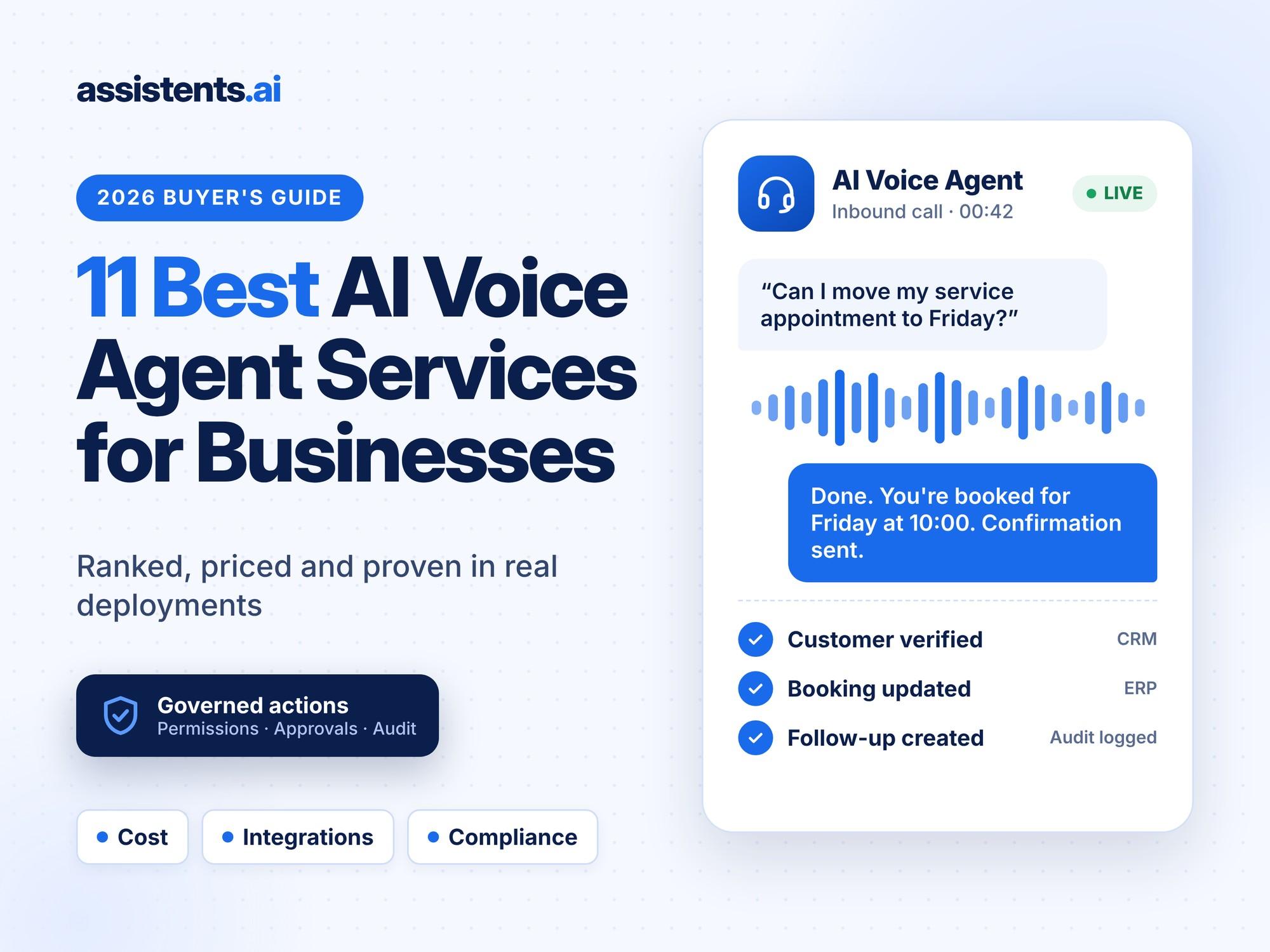
AI voice agent services for businesses answer, make and act on phone calls. They book appointments, resolve tickets and update ERP or CRM records while the caller is still on the line. We ranked 11 providers on cost, latency, integrations, compliance and proven outcomes. Assistents.ai ranks first for businesses that need voice agents connected to their systems, governed by their rules and delivered by a dedicated team. Here is how all 11 compare.
Key takeaways
- AI voice agent services come in three types: managed enterprise services, developer platforms and no-code tools. Pick the type before you pick the vendor.
- The biggest difference between providers isn't voice quality. It's whether the agent can complete work in your systems under your rules.
- Pricing runs from about 0.05–0.15 per minute on self-serve platforms to custom annual contracts for managed enterprise services. Telephony, model and integration costs often sit on top.
- Governance matters as much as conversation: permissions, approvals, audit trails and human handoff decide whether a voice agent is safe to scale.
- Start with one high-volume, well-defined call type, measure it, then expand.
TL;DR: The best AI voice agent services at a glance
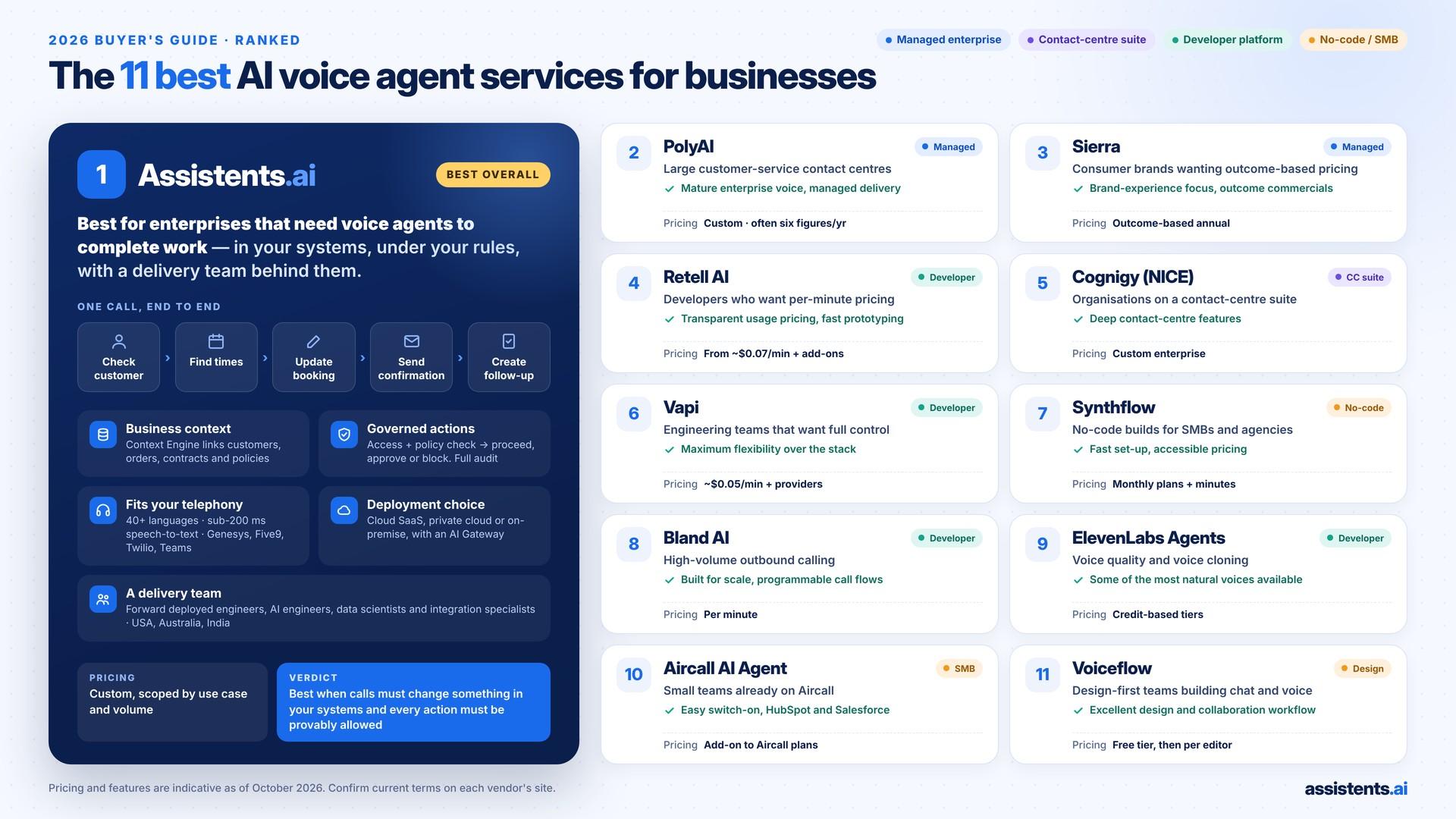
| Rank | Service | Best for |
|---|---|---|
| 1 | Assistents.ai | Enterprises that need voice agents to complete work in ERP, CRM and booking systems, with governance and a delivery team |
| 2 | PolyAI | Large customer-service contact centres |
| 3 | Sierra | Consumer brands that want outcome-based pricing |
| 4 | Retell AI | Developers who want low-latency, per-minute pricing |
| 5 | Cognigy (NICE) | Organisations standardised on a contact-centre suite |
| 6 | Vapi | Engineering teams that want full control of the stack |
| 7 | Synthflow | SMBs and agencies that want no-code set-up |
| 8 | Bland AI | High-volume outbound calling programs |
| 9 | ElevenLabs Agents | Teams that put voice quality and cloning first |
| 10 | Aircall AI Voice Agent | Small teams already using Aircall |
| 11 | Voiceflow | Design-first teams building chat and voice together |
What are AI voice agent services for businesses?
An AI voice agent service gives your business software that holds natural phone conversations and completes tasks in your systems, such as checking an order, rescheduling a booking or creating a ticket. Unlike a phone menu, the caller speaks normally and the agent understands intent, asks follow-up questions and takes action.
For a deeper explainer, see our guide to voice AI agents.
AI voice agent vs IVR vs chatbot
| Traditional IVR | Chatbot | AI voice agent | |
|---|---|---|---|
| Channel | Phone | Web, app, messaging | Phone and voice |
| How callers interact | Press 1, press 2 | Typed messages | Natural speech, interruptions, follow-ups |
| What it can do | Route calls | Answer questions, some actions | Understand intent, act in business systems, hand off with context |
| Typical result | Callers wait for an agent | Deflects simple web queries | Resolves the call or passes a complete case to a person |
If you're replacing an old phone menu, read our explainer on conversational IVR.
How an AI voice agent works
A voice agent turns speech into text, uses a language model plus your business context to decide what to do, takes permitted actions through your systems, and replies in a natural voice. The quality of the outcome depends less on the voice and more on the business context and actions behind it.
What are the three types of AI voice agent services?
AI voice agent services fall into three types: managed enterprise services, developer platforms and no-code tools. Each suits a different buyer, and choosing the wrong type is the most common reason voice projects stall.
1. Managed enterprise services
You get a platform and a team that connects it to your systems, configures the agents, tests them on real calls and supports them after launch. This suits mid-market and enterprise businesses where calls touch ERP, CRM, billing or booking systems. Examples: Assistents.ai, PolyAI, Sierra.
2. Developer platforms
You get APIs and building blocks for speech, models and telephony. Your engineers build the logic, integrations, testing and monitoring. This suits product teams embedding voice in their own software. Examples: Vapi, Retell AI, Bland AI.
3. No-code and SMB tools
You get templates and a visual builder you can set up in hours or days. This suits simple call flows such as FAQs, lead capture or basic appointment booking. Examples: Synthflow, Aircall, Voiceflow.
| Managed enterprise service | Developer platform | No-code / SMB tool | |
|---|---|---|---|
| Who builds it | Vendor delivery team with your team | Your engineers | Your ops or marketing team |
| Time to first live calls | Weeks, scoped to one process | Weeks to months | Hours to days |
| Integration depth | Deep: ERP, CRM, ticketing, custom systems | As deep as you build | Mostly pre-built connectors |
| Governance and audit | Built in | You build it | Basic |
| Typical pricing | Annual platform plus delivery | Per minute plus usage | Monthly plan plus minutes |
How we ranked these AI voice agent services
We ranked each service on seven criteria that predict whether a voice agent works in production, not just in a demo. Our assessment draws on public documentation, published pricing and product demos as of October 2026, plus what we've learned from our own deployments. Treat third-party details as indicative and confirm them with each vendor.
- Actions in business systems. Can the agent read and write to ERP, CRM, booking and ticketing systems during the call?
- Governance. Are there role-based permissions, policy checks, human approvals and a full audit trail?
- Latency and conversation quality. Does it respond quickly, handle interruptions and sound natural?
- Multilingual support. Can it handle languages beyond English, including Hindi, Arabic and mixed-language calls? (See multilingual voice AI.)
- Human handoff. Does a person receive the call with the full context and a summary?
- Deployment options. Is it SaaS only, or can it run in a private cloud or on-premise?
- Proven outcomes and support. Is there evidence of production results and a team to help you get there?
Comparison table: 11 AI voice agent services compared
| Service | Type | Best for | Pricing model | Actions in ERP/CRM | Governance and audit | Deployment |
|---|---|---|---|---|---|---|
| Assistents.ai | Managed enterprise | Process-heavy enterprises | Custom platform plus delivery | Deep (SAP, CRM, files, databases, APIs) | Built in: permissions, approvals, audit | SaaS, private cloud, on-premise |
| PolyAI | Managed enterprise | Large contact centres | Custom | Strong for customer service | Enterprise controls | Cloud |
| Sierra | Managed enterprise | Consumer brands | Outcome-based, annual | Strong for customer service | Enterprise controls | Cloud |
| Retell AI | Developer platform | Developers and BPOs | Per minute | Via APIs and webhooks | You configure | Cloud |
| Cognigy (NICE) | Enterprise suite | Contact-centre suites | Custom | Strong within the suite | Enterprise controls | Cloud, some private options |
| Vapi | Developer platform | Engineering teams | Per minute plus providers | You build | You build | Cloud |
| Synthflow | No-code | SMBs and agencies | Monthly plans plus minutes | Pre-built connectors | Basic | Cloud |
| Bland AI | Developer platform | Outbound at scale | Per minute | Via APIs | You configure | Cloud |
| ElevenLabs Agents | Developer platform | Voice quality | Credit-based | Via APIs | Basic | Cloud |
| Aircall AI Voice Agent | SMB add-on | Aircall customers | Add-on to Aircall plans | Aircall integrations | Basic | Cloud |
| Voiceflow | Design platform | Chat and voice design | Per editor | Via APIs | Basic | Cloud |
The 11 best AI voice agent services for businesses in 2026
1. Assistents.ai: best for enterprises that need voice agents to complete work
Assistents.ai is an enterprise AI agent platform where voice agents don't just answer calls, they complete business processes in your systems, under your rules, with a delivery team behind them.
Most voice tools stop at the conversation. Assistents.ai connects the conversation to the work. When a caller asks, "Can I change my service appointment?", the voice agent checks the customer's details, finds available times, updates the booking, sends a confirmation and creates a follow-up task, all in the same call. If something needs a person, it hands over with the full context and a call summary.
What it does
- Inbound and outbound voice agents with natural, multilingual conversations.
- In-call actions across ERP (including SAP), CRM, booking, ticketing, files and databases.
- Contextual human handoff, call summaries and voice analytics.
- Runs on the same platform as conversational agents, agentic BI, document AI and autonomous workflows, so a call can start a process that finishes elsewhere.
Key strengths
- Business context built in. A Context Engine links customers, orders, contracts, products and policies, so the agent knows what it's looking at and what it's allowed to do.
- Governed actions. Every action passes an access check and a policy check, then proceeds, goes to a person for approval, or is blocked and logged. See our voice AI guardrails guide.
- Fits your telephony. The platform lists support for 40+ languages, sub-200 ms speech-to-text latency and integrations with systems such as Genesys Cloud, NICE CXone, Five9, Talkdesk, Twilio, Microsoft Teams, Zoom Phone and RingCentral. See Voice AI for the Enterprise.
- Deployment choice. Cloud SaaS, private cloud or on-premise, with an AI Gateway for approved model choice, fallback and usage control.
- A delivery team. Forward deployed engineers, AI engineers, data scientists and integration specialists across the USA, Australia and India take you from configuration to production.
Limitations: Assistents.ai is built for business processes. If you only need a single phone line answered with a few FAQs, a no-code tool will be faster and cheaper.
Pricing model: Custom, based on use cases, volume and deployment model. Book a walkthrough for a scoped estimate.
Verdict: The best choice when your calls need to change something in your systems, and you need to prove every action was allowed.
2. PolyAI: best for large customer-service contact centres
PolyAI builds customer-service voice assistants for large enterprises in sectors such as hospitality, retail and financial services. It's known for natural conversations and handling noisy or messy calls.
- Strengths: Mature enterprise voice experience and a managed delivery model.
- Limitations: Focused on customer service rather than wider back-office processes. Contracts are typically sized for large enterprises.
- Pricing model: Custom. Third-party guides report annual contracts often starting around six figures.
3. Sierra: best for consumer brands that want outcome-based pricing
Sierra offers conversational AI agents for customer experience across voice and chat, with pricing tied to outcomes such as resolved conversations.
- Strengths: A strong brand-experience focus and outcome-based commercials.
- Limitations: Aimed at large consumer brands. Less suited to operational processes outside customer service.
- Pricing model: Outcome-based annual contracts. Not publicly listed.
4. Retell AI: best for developers who want per-minute pricing
Retell AI is a voice agent platform with low latency, a visual builder and APIs, popular with developers, BPOs and agencies.
- Strengths: Transparent usage pricing, fast prototyping and good call quality.
- Limitations: Your team owns the integrations, business logic, governance and ongoing tuning.
- Pricing model: Per minute, listed from about $0.07 per minute before telephony and model add-ons (as of October 2026).
5. Cognigy (NICE): best for contact-centre suites
Cognigy, now part of NICE, provides conversational AI for enterprise contact centres across voice and digital channels.
- Strengths: Deep contact-centre features and a natural fit for NICE customers.
- Limitations: Heavier implementation, and strongest inside its own ecosystem.
- Pricing model: Custom enterprise contracts.
6. Vapi: best for engineering teams that want full control
Vapi is a developer platform for building voice agents, where you choose your own speech, model and telephony providers.
- Strengths: Maximum flexibility and fine-grained control of the stack.
- Limitations: You build almost everything: integrations, testing, monitoring and compliance. Total cost depends on the providers you choose.
- Pricing model: A per-minute platform fee (about $0.05 per minute) plus third-party model, voice and telephony costs.
7. Synthflow: best no-code option for SMBs and agencies
Synthflow lets non-technical teams build phone agents with templates and a visual builder.
- Strengths: Fast set-up and accessible pricing for small teams and agencies.
- Limitations: Less suited to complex, multi-system enterprise processes and strict governance needs.
- Pricing model: Monthly plans with included minutes, plus pay-as-you-go options.
8. Bland AI: best for high-volume outbound calling
Bland AI is an API-first platform focused on running large volumes of automated calls.
- Strengths: Built for scale and programmable call flows.
- Limitations: Developer-led, and outbound programs need careful consent management (see the limitations section below).
- Pricing model: Per minute.
9. ElevenLabs Agents: best for voice quality and cloning
ElevenLabs is best known for lifelike text-to-speech and voice cloning, and offers a conversational agents product built on it.
- Strengths: Some of the most natural voices available, with wide language coverage.
- Limitations: Strongest as a voice layer. Business actions and governance depend on what you build around it.
- Pricing model: Credit-based plans, from a free tier up to enterprise.
10. Aircall AI Voice Agent: best for small teams already on Aircall
Aircall adds an AI voice agent to its cloud phone system for after-hours coverage, call qualification and routing.
- Strengths: Simple to switch on if you already use Aircall, with CRM integrations such as HubSpot and Salesforce.
- Limitations: Tied to the Aircall phone system. Limited depth for complex processes.
- Pricing model: An add-on to Aircall plans.
11. Voiceflow: best for design-first teams building chat and voice
Voiceflow is a collaborative platform for designing conversational agents across chat and voice.
- Strengths: An excellent design and collaboration workflow.
- Limitations: Not a full telephony stack on its own. Production voice usually needs extra components.
- Pricing model: Free tier, then per-editor plans.
Third-party pricing and features change often. Figures are indicative as of October 2026; confirm current terms on each vendor's site.
Why Assistents.ai ranks #1 for AI voice agent services
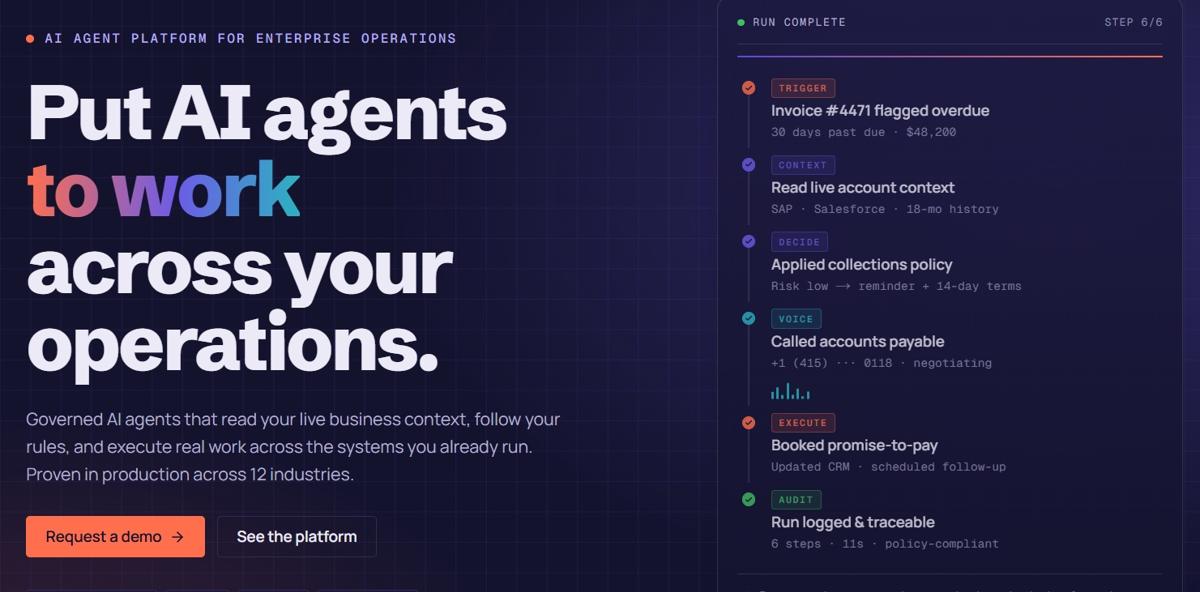
Assistents.ai ranks first because it treats voice as the start of a business process, not the end of a phone call. Here's what that means in practice.
Voice that moves work forward, not just answers calls
Every conversation can end in a completed action: a booking updated, a ticket created, an order checked, a confirmation sent. The agent works from source-backed answers and only takes permitted actions, then records the outcome.
One platform, five capabilities
Voice is one of five capabilities on the same platform: Ask (conversational agents), Analyse (agentic BI), Read (document AI), Speak (voice AI) and Act (autonomous workflows). Use one capability, or combine them to transform a whole process. For example, a caller's request can trigger a multi-agent workflow where a data agent validates the details and a communication agent sends the confirmation.
Business context built in
Generic voice bots don't know your business. The Assistents.ai Context Engine connects entities (customers, orders, contracts, invoices), business definitions, policies and real-time data, so the agent understands, for example, that a customer's credit limit requires approval before an order change.
Governed by your rules
Every action follows the same path:
- Access check: Is this user and agent allowed to do this?
- Policy evaluation: Does the action meet your rules and limits?
- Outcome: Allowed actions go ahead and are recorded. Actions that need review go to a person for approval. Blocked actions don't happen and are logged for review.
That gives you permissions, business rules, human approvals and a complete audit history. Read more in our AI agent governance playbook.
Fits your enterprise and keeps your options open
Connect SAP and other ERPs, CRM, documents and databases through secure APIs, SDKs and connectors, with event ingestion and two-way sync. Choose approved models through the AI Gateway, with task routing, fallback and usage management. Deploy as cloud SaaS, in a private cloud or on-premise.
Real results: AI voice and conversational agents in production
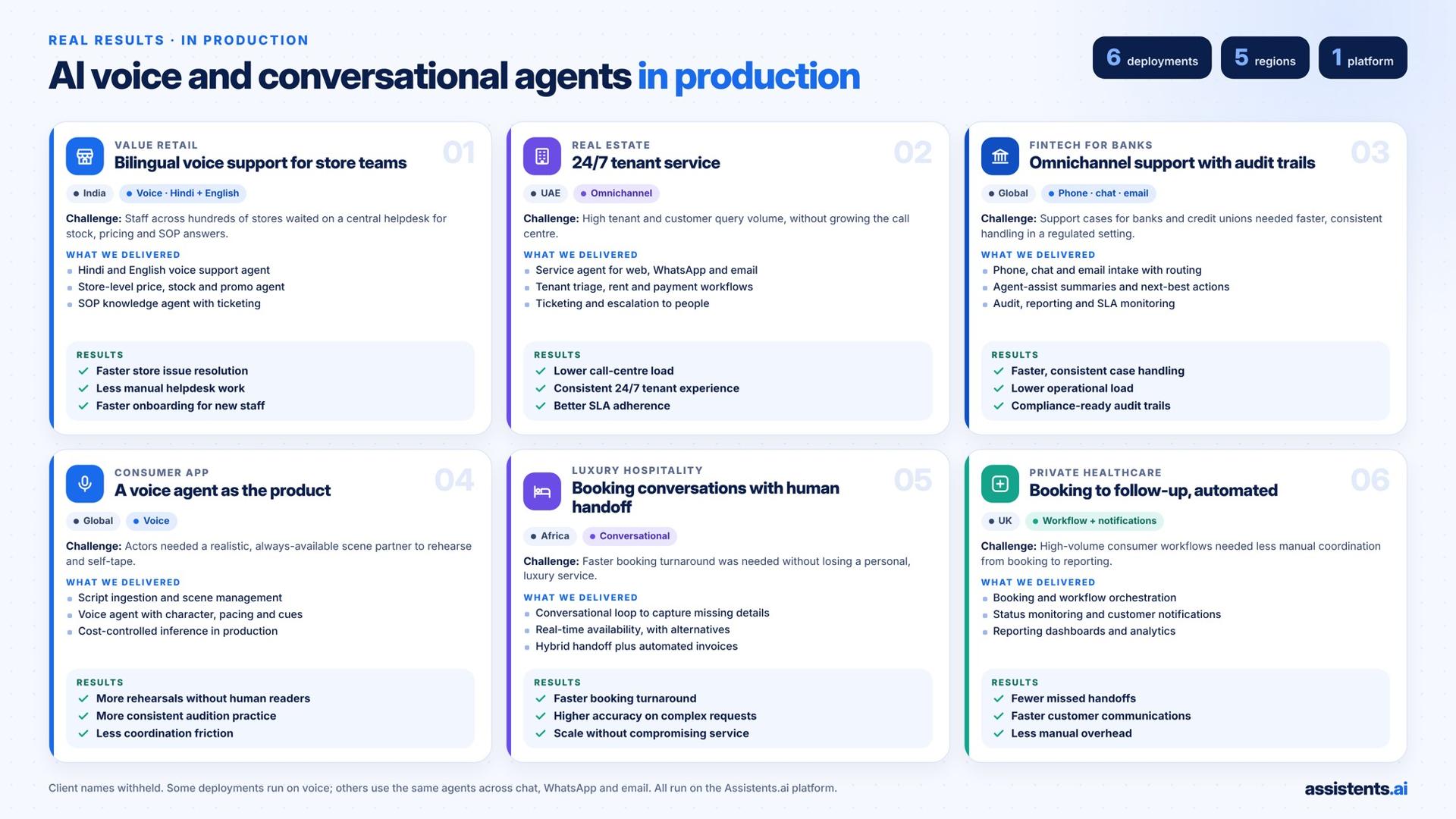
These six deployments show what AI voice and conversational agents deliver when they're connected to real systems and real processes. Client names are withheld. Some deployments run on voice; others use the same agents across chat, WhatsApp and email. All run on the Assistents.ai platform.
1. National value retailer (India): bilingual voice support for store teams
Situation: A fast-growing value retailer with hundreds of stores across India had store staff waiting on a central helpdesk for answers about stock, pricing, promotions and procedures.
What was delivered:
- A voice support agent in Hindi and English (speech-to-text, language model, text-to-speech).
- An inventory intelligence agent for price, stock and promotions per store.
- A knowledge and training agent over POS and SOP documents.
- An admin console, analytics and ticketing integration.
Results: Less manual helpdesk work and faster resolution of store issues. Store-level inventory visibility improved, and new staff onboarded faster with on-demand guidance.
Capabilities used: Voice AI, conversational agents, knowledge retrieval, workflow and ticketing integration.
2. Real estate portfolio manager (UAE): 24/7 tenant service
Situation: A diversified real estate owner and manager with office, retail, industrial and residential assets across the UAE needed to handle a high volume of tenant and customer queries without growing its call centre.
What was delivered:
- An omnichannel customer service agent (web, WhatsApp and email-ready).
- Tenant query triage, FAQs, and rent and payment support workflows.
- Ticketing and escalation to human teams.
- A knowledge base over policies, tenancy documents and SOPs.
Results: Faster responses and lower call-centre load, a consistent 24/7 tenant experience and better SLA adherence through automated routing and tracking.
Capabilities used: Conversational agents, workflows, human escalation. Teams in the region can also see our AI voice agent use cases in Dubai.
3. Fintech provider to banks and credit unions (global): omnichannel support with audit trails
Situation: A cloud fintech provider serving banks and credit unions needed faster, more consistent handling of support cases across channels, in a regulated environment.
What was delivered:
- Omnichannel intake across phone, chat and email, with workflow routing.
- Agent-assist summaries and next-best actions.
- Auditability, reporting and SLA monitoring, ready to integrate with core systems.
Results: Faster, more consistent case handling, less operational load through automation, and better compliance readiness through audit trails.
Capabilities used: Voice and conversational agents, autonomous workflows, governance.
4. AI rehearsal app for actors (global): a voice agent as the product
Situation: An AI-powered app for actors needed a realistic, always-available scene partner so users could rehearse and self-tape without a human reader.
What was delivered:
- Script ingestion and scene management.
- A voice agent with character and voice control, pacing and cue logic.
- Self-tape workflow support and rehearsal analytics.
- Cost-controlled inference in production.
Results: More rehearsals without human readers, more consistent audition practice and less coordination friction for users.
Capabilities used: Voice AI at consumer scale, with real-time turn-taking and managed inference cost.
5. Luxury hospitality group (Africa): booking conversations with human handoff
Situation: A luxury safari hospitality group serving demanding international travellers needed faster booking turnaround without losing its personal service.
What was delivered:
- Intent classification and data extraction from incoming requests.
- A conversational loop to capture missing details.
- Real-time availability checks, with alternative dates and properties offered.
- A hybrid handoff to people for curated itineraries, plus automated invoice and document generation.
Results: Faster booking turnaround with less back-and-forth, higher accuracy on complex guest requirements, and the ability to scale without compromising luxury service.
Capabilities used: Conversational agents, document AI, workflows, human-in-the-loop.
6. Private healthcare provider (UK): booking to follow-up, automated
Situation: A UK private healthcare and testing provider with high-volume consumer workflows needed to reduce manual coordination from booking through to reporting.
What was delivered:
- Booking and workflow orchestration.
- Status monitoring and customer notifications.
- Reporting dashboards and operational analytics.
Results: More scalable operations with less manual overhead, faster customer communications and fewer missed handoffs.
Capabilities used: Autonomous workflows, notifications, analytics: the process layer that a voice agent plugs into.
Results at a glance
| Industry and region | Channel | Process | Outcome |
|---|---|---|---|
| Value retail, India | Voice (Hindi and English) | Store support, inventory, SOP answers | Faster store issue resolution, less helpdesk load |
| Real estate, UAE | Omnichannel | Tenant support and payments | Lower call-centre load, 24/7 service |
| Fintech, global | Phone, chat, email | Banking support cases | Faster handling, audit-ready |
| Consumer app, global | Voice | Real-time scene partner | More rehearsals without human readers |
| Hospitality, Africa | Conversational | Luxury bookings | Faster turnaround, higher accuracy |
| Healthcare, UK | Workflow and notifications | Booking to reporting | Fewer missed handoffs |
What are the top use cases for AI voice agents?
The best use cases are high-volume, repeatable calls with a clear outcome and data the agent can check. These are the patterns we see most often.
Customer service and tenant support
Answer account, order and policy questions, take payments-related queries and open tickets 24/7, then escalate complex cases with full context.
Appointment booking and rescheduling
Check the customer, find open slots, update the booking, send a confirmation and create a follow-up, all in one call.
Retail and frontline staff support
Give store and field teams instant spoken answers on stock, pricing, warranty and procedures, in their own language.
Sales qualification and follow-up
Respond to new leads in seconds, qualify them, book meetings and log everything in the CRM. Pair it with AI-driven sales signals so reps know who to call next.
Collections and payment reminders
Run compliant reminder calls, confirm payment plans and route disputes to the right team.
AI receptionist and after-hours coverage
Route calls, take messages and handle common requests outside working hours, so no lead or customer is lost.
Internal IT and HR helpdesks
Reset passwords, answer policy questions and log requests for employees by phone.
Voice is often the front door to a bigger process. For example, an order query by phone can connect to sales order automation behind the scenes.
How much do AI voice agent services cost?
AI voice agent services cost anywhere from about 0.05–0.15 per minute on self-serve platforms to custom annual contracts for managed enterprise services, before telephony, model and integration costs. The right comparison is total cost per resolved call, not price per minute.
The four pricing models
| Model | How it works | Watch out for |
|---|---|---|
| Per minute | Pay for connected call minutes | Telephony, LLM and voice fees billed separately |
| Per agent or seat | Monthly fee per AI agent or user | Minute caps and overage charges |
| Platform licence | Annual fee for the platform and volume tiers | Implementation not always included |
| Managed service | Platform plus delivery team, priced by scope | Make sure success metrics are in the contract |
Worked example: 5,000 calls a month
Assume 5,000 calls at an average of 3 minutes, so 15,000 minutes a month.
- At a headline $0.07 per minute, the platform fee is about $1,050 a month.
- Add telephony, speech and model usage, and all-in rates often land between $0.10 and $0.25 per minute, or about 1,500–3,750 a month.
- Then add integration build, testing, monitoring and ongoing tuning, which your team carries on a self-serve platform and the vendor carries on a managed service.
Compare that with your own fully loaded cost per call today. Gartner has projected that conversational AI will cut contact-centre agent labour costs by $80 billion in 2026.
Hidden costs to plan for
- Phone numbers and carrier fees
- Model and voice usage above plan limits
- Integration work with ERP, CRM and ticketing systems
- Compliance add-ons (for example, HIPAA or data residency)
- Prompt and flow tuning after launch
For a broader breakdown, read how much it costs to build an AI agent.
How do you choose and roll out an AI voice agent service?
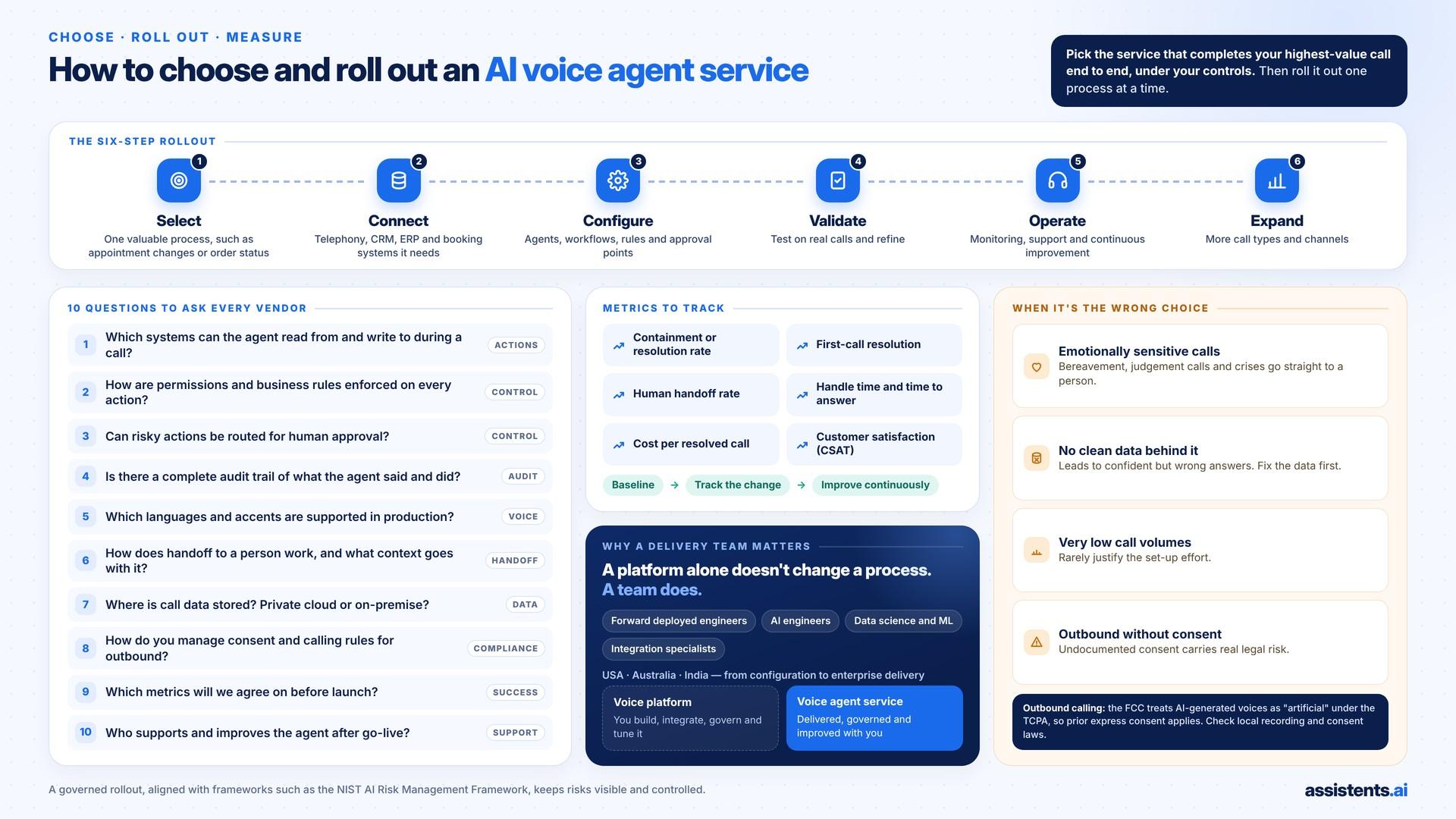
Choose the service that can complete your highest-value call type end to end under your controls, then roll it out one process at a time.
10 questions to ask every vendor
- Which systems can the agent read from and write to during a call?
- How are permissions and business rules enforced on every action?
- Can risky actions be routed for human approval?
- Is there a complete audit trail of what the agent said and did?
- Which languages and accents are supported in production?
- How does handoff to a person work, and what context goes with it?
- Where is call data stored, and can you deploy in a private cloud or on-premise?
- How do you manage consent and calling rules for outbound campaigns?
- Which metrics will we agree on before launch?
- Who supports and improves the agent after go-live?
The six-step rollout
- Select one valuable process, such as appointment changes or order status.
- Connect the systems it needs: telephony, CRM, ERP and booking.
- Configure the agents, workflows, rules and approval points.
- Validate on real calls and refine.
- Operate with monitoring, support and continuous improvement.
- Expand to more call types and channels.
Why a delivery team matters
A platform alone doesn't change a process. Assistents.ai pairs the platform with forward deployed engineers, AI engineers, data science and machine learning experts and enterprise integration specialists across the USA, Australia and India, from configuration to enterprise delivery. That's the difference between a voice platform and a voice agent service.
Metrics to track
Baseline each metric before launch, track the change, then improve continuously:
- Containment or resolution rate
- First-call resolution
- Human handoff rate
- Average handle time and time to answer
- Cost per resolved call
- Customer satisfaction (CSAT)
When is an AI voice agent the wrong choice?
An AI voice agent is the wrong choice when the call needs deep empathy, the data behind it is unreliable, or you can't prove consent. Be honest about these limits before you start:
- Emotionally sensitive calls, such as bereavement, complaints that need judgement or crisis situations, should go straight to a person.
- Processes with no clean data behind them produce confident but wrong answers. Fix the data first.
- Very low call volumes rarely justify the set-up effort.
- Outbound campaigns without documented consent carry legal risk. In the US, the FCC has confirmed that AI-generated voices count as "artificial" voices under the TCPA, so prior express consent rules apply. Check local recording and consent laws in every region you call.
A governed rollout, aligned with frameworks such as the NIST AI Risk Management Framework, keeps these risks visible and controlled.
Conclusion: start with one valuable call
The best AI voice agent services for businesses don't just sound human. They finish the job in your systems, follow your rules and prove what they did. Self-serve platforms work well for developers and simple flows. If your calls touch orders, bookings, payments or records, choose a service that brings business context, governance and a delivery team.
Start with one valuable process. Build from there. Book a tailored Assistents.ai walkthrough to see a voice agent complete a real workflow from your business, or explore Voice AI for the Enterprise.
FAQs
What is an AI voice agent for business?
An AI voice agent is software that answers or makes phone calls in natural language and completes tasks in your business systems, such as booking appointments, checking orders or creating tickets. Unlike an IVR, callers speak normally, and the agent hands off to a person with full context when needed.
How much does an AI voice agent cost?
Self-serve platforms usually charge about 0.05–0.15 per minute, plus telephony and model fees. No-code tools offer monthly plans, and managed enterprise services such as Assistents.ai are priced by scope. Compare the total cost per resolved call, including integration and support, not just the per-minute rate.
What is the best AI voice agent service for business?
It depends on your needs. For enterprises whose calls must update ERP, CRM or booking systems under strict governance, Assistents.ai is the strongest choice. Developers often choose Vapi or Retell AI, and small teams with simple call flows often choose Synthflow or Aircall.
Can AI voice agents replace call centre staff?
AI voice agents handle repetitive, high-volume calls such as status checks, bookings and FAQs, which frees people for complex and sensitive conversations. Most businesses use them to absorb volume and extend coverage to 24/7, not to remove human teams entirely.
What is the difference between an AI voice agent and an IVR?
An IVR routes callers through fixed menus ("press 1 for billing"). An AI voice agent understands natural speech, asks follow-up questions and completes the task in your systems. It escalates to a person only when needed. Learn more about conversational IVR.
Can AI voice agents make outbound calls legally?
Yes, with the right consent. In the US, the FCC treats AI-generated voices as artificial voices under the TCPA, so you generally need prior express consent for automated outbound calls. Other countries have their own rules, so check consent and recording laws for every market you call.
How long does it take to set up an AI voice agent?
No-code tools can go live in hours or days for simple flows. Enterprise voice agents connected to ERP, CRM and approval workflows typically take a few weeks for the first process when scoped tightly, then expand from there.
Are AI voice agents HIPAA and GDPR compliant?
Some are. Look for encryption, access controls, data residency options, audit trails and a signed business associate agreement where HIPAA applies. Assistents.ai supports private cloud and on-premise deployment for organisations with strict data requirements.
Can an AI voice agent transfer a call to a human?
Yes. A good voice agent transfers the call with the conversation history, the caller's details and a summary, so the person doesn't have to start again. Assistents.ai also routes actions that need approval to authorised people before they happen.
What languages can AI voice agents speak?
Leading services support dozens of languages. Assistents.ai lists support for 40+ languages and has run Hindi and English voice support in production. See multilingual voice AI.
How accurate are AI voice agents?
Accuracy depends on audio quality, the language model and, most of all, the business data behind the agent. Grounding answers in your own systems and policies, and routing uncertain cases to people, is what keeps accuracy high in production.
Do AI voice agents work with my CRM or ERP?
Most services integrate with popular CRMs such as Salesforce and HubSpot. Fewer can safely write to ERPs such as SAP. Assistents.ai connects to ERP, CRM, files, databases and APIs, with bidirectional sync and governed actions.