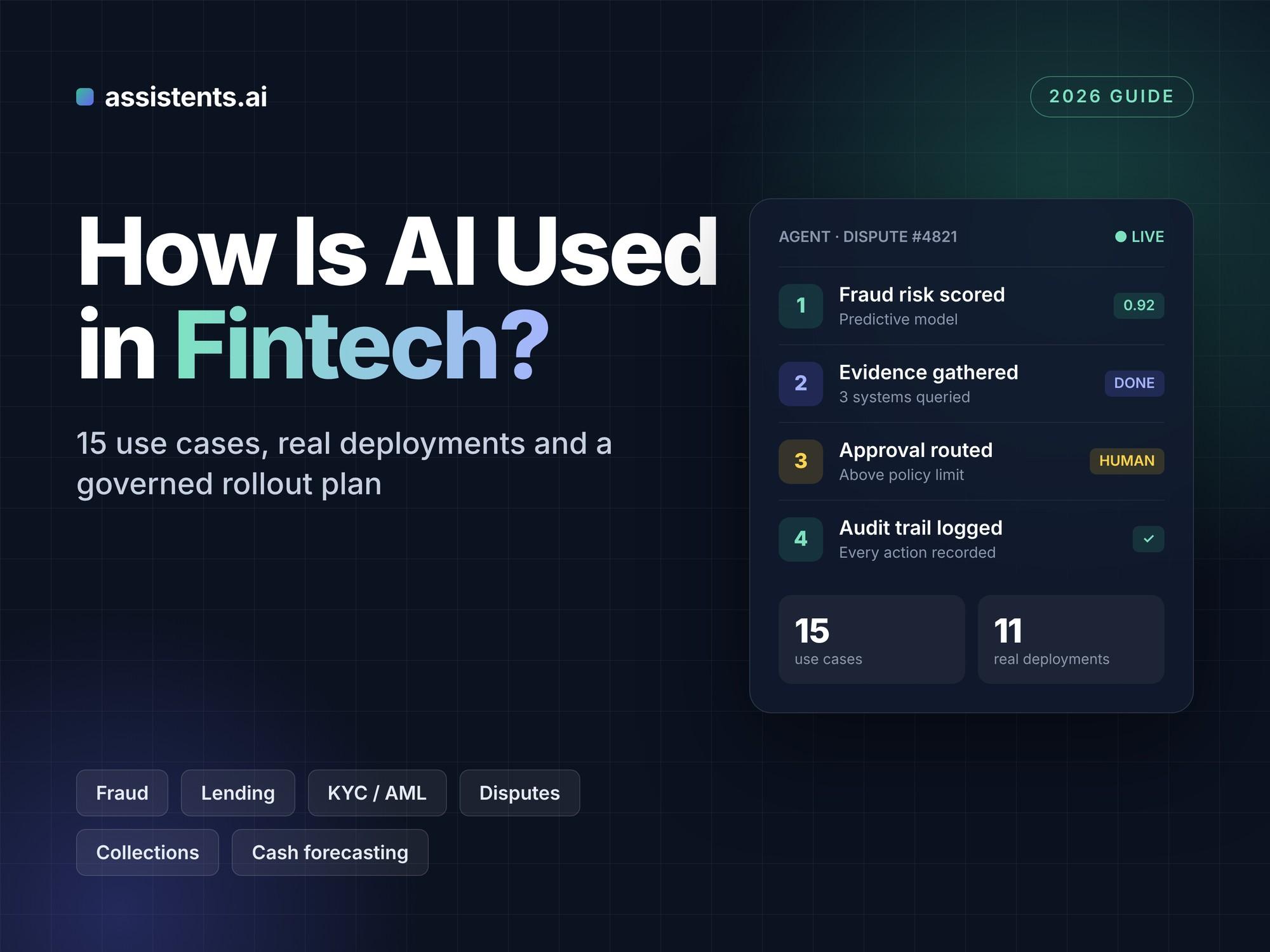
How is AI used in fintech? AI is used in fintech to detect fraud, score credit, verify customers, automate compliance, forecast cash, answer customers and run back-office finance work. For a decade, fintechs used machine learning to score things. In 2026 the shift is to AI agents that do the work: they gather evidence, take actions in core systems, route approvals and log every step for auditors.
This guide covers 15 ways AI is used in fintech, with real, anonymised deployments from assistents.ai, the risks and controls that matter in regulated finance, and a step-by-step plan for going from pilot to production.
Key takeaways
- AI in fintech has three layers: predictive AI (scores and forecasts), generative AI (reads and writes documents) and agentic AI (completes multi-step work under policy).
- The most common uses are fraud detection, credit underwriting, KYC/AML, customer support and trading. The fastest-growing uses are back-office: disputes, collections, cash-flow forecasting, tax screening and order-to-cash.
- The global AI in fintech market was about $28.8 billion in 2025 and is projected to reach $93.9 billion by 2032 (Research and Markets via Itransition).
- In regulated workflows, AI agents should prepare and execute the normal path while humans keep authority over credit decisions, waivers and exceptions.
- Start with one workflow that has a measurable outcome, run it in assist mode, then expand autonomy by segment and transaction value.
How is AI used in fintech?
AI is used in fintech to make faster, more accurate financial decisions and to automate the work around them. Fintech companies use AI to spot fraudulent transactions in milliseconds, assess credit risk with more data, verify identities, monitor compliance, forecast cash flow, support customers 24x7 and run finance operations such as collections, reconciliation and reporting.
Most uses fall into four buckets:
| Bucket | What AI does | Examples |
|---|---|---|
| Risk and fraud | Scores and flags unusual activity | Transaction monitoring, AML alert triage, fraud-ring detection |
| Credit and lending | Assesses applicants and monitors portfolios | Credit scoring, document verification, delinquency early warning |
| Customer experience | Answers, guides and resolves | Voice and chat agents, dispute intake, personalised advice |
| Finance operations | Executes back-office workflows | Collections, cash-flow forecasting, tax screening, order-to-cash |
Adoption is already mainstream. 81% of surveyed financial services organisations have adopted AI to some extent, and fintechs adopt it faster than traditional institutions (47% vs 30% at an advanced stage), according to University of Cambridge Judge Business School research cited by Itransition.
Predictive vs generative vs agentic AI in fintech
Predictive AI scores, generative AI writes, and agentic AI acts. Most fintechs now use all three, often inside the same workflow.
| Type of AI | What it does | Fintech example (a card dispute) | Who acts |
|---|---|---|---|
| Predictive AI / machine learning | Finds patterns and predicts outcomes from historical data | Scores the disputed transaction as 92% likely fraud | Human reads the score and acts |
| Generative AI | Reads and writes text, documents and summaries | Drafts the customer letter and summarises the case history | Human reviews and sends |
| Agentic AI | Plans and completes multi-step work using tools, within policy | Gathers evidence, files the chargeback, routes approval above a limit, notifies the customer and logs the audit trail | Agent runs the normal path; human handles exceptions |
The difference matters because the value of agentic AI in fintech comes from closing the loop. A fraud score that sits on a dashboard still needs someone to investigate, decide, act in three systems and check whether it worked. An agent can do most of that, as long as the platform controls what it is allowed to do. For a deeper look at agents in finance teams, read our guide to agentic AI in finance and accounting.
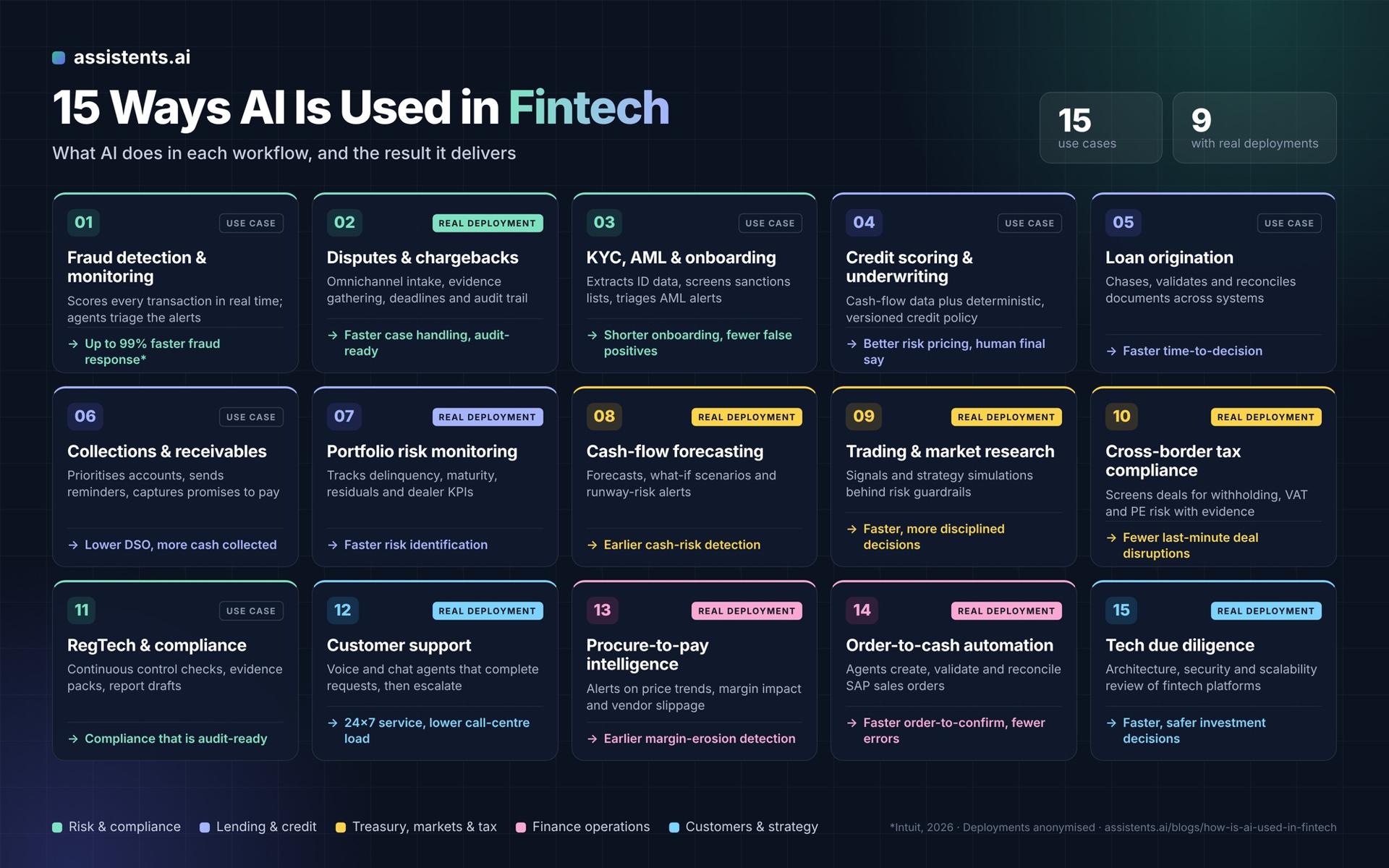
15 ways AI is used in fintech (with real examples)
Each use case below explains what AI does, shows a real or reference example, and links to a deeper guide where one exists. Case studies are from assistents.ai deployments and are anonymised.
1. Fraud detection and transaction monitoring
AI models score every transaction in real time using amount, location, device, merchant and behavioural signals. Graph models link accounts, devices and payees to expose fraud rings that rule-based systems miss. Agents then triage the alerts: they pull account history, group related alerts and escalate only the cases that need a human.
The stakes are rising. Consumers lost $12.5 billion to fraud in 2024, a 25% increase, and institutions using AI have cut fraud response time by as much as 99% (Intuit).
2. Disputes and chargeback handling
Disputes are high-volume, deadline-driven and heavily documented, which makes them a strong fit for AI agents. Agents capture the dispute from any channel, classify it, collect evidence, draft responses, track scheme deadlines and keep a complete audit trail.
Real example: A global fintech provider that serves banks and credit unions with cloud automation for disputes, fraud and compliance deployed omnichannel AI agents with assistents.ai. The agents handle intake across chat, email and phone, route each case into the right workflow, give human staff summaries and next-best actions, and monitor SLAs.
Results: faster case handling and more consistent outcomes, reduced operational load through automation, and better compliance readiness through end-to-end audit trails.
See more AI agent use cases in banking.
3. KYC, AML and customer onboarding
AI extracts data from ID documents and proofs of address, checks it against application data, screens names against sanctions and PEP lists, and triages AML alerts by risk. Generative AI writes the case narrative a compliance analyst would otherwise type up. Humans still approve high-risk customers and file suspicious activity reports.
The payoff is shorter onboarding and fewer false positives sitting in analyst queues. Read how this works in a regulated deployment in our AI agents for financial services guide.
4. Credit scoring and underwriting
AI credit models use more data than a bureau score: bank-statement cash flow, income stability, obligations and alternative data. The result is better risk pricing and credit access for thin-file borrowers.
In regulated lending, the best design keeps binding credit policy deterministic. Here is how assistents.ai structures lending operations:
- A Document Verification Agent checks submitted documents.
- A Bureau Agent and Income Assessment Agent analyse credit history, bank statements and obligations.
- A Policy Explanation Agent shows which eligibility rules passed or failed, and why.
- An Underwriting Memo Agent drafts the credit memo with evidence attached.
- A Deviation Agent prepares exception requests for approval.
Eligibility, pricing and authority rules stay executable and versioned. Humans keep final authority for credit decisions, high-risk deviations, sanction and disbursement.
5. Loan origination and document verification
A loan application is a case with many steps: lead, application, KYC and consent, document collection, bureau and banking analysis, policy checks, legal and technical review, underwriting, sanction, agreements and disbursement. AI moves the case forward. It chases missing documents, validates them, reconciles conflicting data and updates every system along the way.
This cuts time-to-decision without removing human control. For brokers and lenders, see AI agents for mortgage brokers.
6. Collections and accounts receivable
AI prioritises overdue accounts by risk and value, sends approved reminders, makes or logs calls, captures promises to pay, reconciles receipts and flags disputes. In a well-governed setup the agent proposes credits or waivers but never issues them on its own.
assistents.ai has production experience in overdue-payment follow-up. We measure the receivables workflow against business outcomes, not activity:
- cash collected
- promise-to-pay kept rate
- days sales outstanding (DSO)
- dispute resolution time
- customer complaint rate
- cost per dollar collected
7. Lease and loan portfolio risk monitoring
Portfolio managers need early warning, not month-end surprises. AI watches delinquency, maturity and residual-value trends and dealer or channel performance continuously, and alerts the team when something breaks pattern.
Real example: An independent automotive leasing provider, which runs manufacturer and dealer-network programs, used assistents.ai for portfolio intelligence. The platform tracks KPIs for risk, delinquency, maturity and residuals, measures dealer-network performance and alerts the team to exceptions and early risk signals.
Results: better portfolio visibility, faster risk identification, better decision support for program operations, and more proactive management through exception alerts.
8. Cash-flow forecasting and the AI CFO
AI connects to accounting and banking data, forecasts cash, runs what-if scenarios and warns about runway risk before it becomes a crisis. For advisors, one AI layer can watch many clients at once.
Real example: An AI CFO platform for growing businesses, CFOs and advisors built its product with assistents.ai. It includes a financial data connection layer for accounting and banking exports, forecasting and scenario-modelling agents, and runway and cash-risk alerts with recommended actions. Advisors get portfolio views across their clients.
Results: faster analysis cycles, earlier detection of cash risks and anomalies, and advisory-grade insight at scale without adding headcount.
Finance teams can go deeper in our agentic AI in finance and accounting guide.
9. Trading, market research and investment signals
AI ingests market data, computes indicators, detects patterns, runs strategy simulations and summarises what changed. The strongest setups put risk guardrails between the signal and the trade.
Real examples:
- An AI-first trading terminal built a network of specialised agents with assistents.ai. The agents combine market data ingestion, indicator analysis, strategy simulation with risk guardrails, alerting and execution-ready workflows. Results: faster synthesis of fragmented market signals, more disciplined decisions through governed workflows, and less manual monitoring.
- A market research and technical analysis platform for Indian equities automated its indicator pipelines, research workflows and thematic dashboards. Results: faster production of market insight packs, more consistent research, and better signal visibility.
Related reading: AI agent for trading strategy, best AI for stock market analysis and trading and crypto AI agent development.
10. Cross-border and indirect tax compliance
Tax risk often surfaces late in a deal, when it is most expensive. AI screens transactions early, classifies risk, collects evidence and writes explainable notes for tax experts.
Real examples:
- A tax-tech product that screens cross-border transactions used assistents.ai to build screening workflows and risk classification for withholding tax, VAT mismatches and permanent-establishment exposure. Every flag carries evidence and an explainability note, and complex cases go to tax experts. Results: earlier detection of withholding and VAT risk, fewer last-minute deal disruptions, and faster, more consistent pre-compliance review.
- A sales and use tax research tool automated source collection, summarisation and drafting of memos and position papers with citations. Results: faster research cycles, less manual source-hunting and more consistent outputs.
11. Regulatory reporting and compliance monitoring (RegTech)
AI monitors controls continuously instead of sampling them once a quarter. It checks transactions and processes against policy, assembles evidence packs, drafts regulatory reports and explains each exception in plain language.
This matters because regulation is the biggest brake on AI investment. 75% of financial services executives cite complex regulatory developments as the main factor undermining confidence in AI investments (KPMG via Itransition). AI that produces its own audit trail turns compliance from a blocker into a feature. See also AI use cases in internal audit.
12. Customer support and conversational finance
Voice and chat agents answer balance, payment, billing and account questions, update records and escalate to a human when a request is sensitive or unclear. Unlike scripted chatbots, AI agents can complete the request, not just answer it.
Real example: A major real-estate portfolio owner in the UAE, managing office, retail, industrial and residential assets, deployed an omnichannel service agent with assistents.ai across web, WhatsApp and email. It triages tenant queries, handles rental and payment support workflows, answers from a knowledge base of policies and tenancy documents, and escalates to human teams through ticketing.
Results: faster response times and lower call-centre load, a consistent 24x7 tenant experience, and better SLA adherence through automated routing and tracking.
Compare providers in our guide to AI voice agent services for businesses.
13. Procure-to-pay and working-capital intelligence
AI watches purchase prices, margins, payment terms and vendor performance across entities, and alerts finance before small leaks become big ones. It can quantify whether paying a supplier early is worth the financing cost.
Real example: One of the UAE's most prominent family business groups, with 30+ companies across retail, building, industrial and services, used assistents.ai to standardise procurement and finance KPIs group-wide. The agents send automated alerts on purchase-price trends and gross-margin impact, early-payment analysis (notional finance cost), and vendor delivery and returns performance. Leadership gets dashboards and scheduled insight packs.
Results: earlier detection of margin erosion and vendor slippage, standardised finance and procurement intelligence across entities, and fewer variance surprises.
For invoice-side automation, read AI agents for accounts payable.
14. Order-to-cash automation
Revenue leaks when orders are keyed in by hand. AI agents read incoming orders, validate them against rules, create the sales order in the ERP, route exceptions for approval and reconcile the results.
Real example: A UAE engineering and technology solutions group needed to replace an end-of-life legacy document system with high licensing costs. With assistents.ai, agents now interpret order triggers, validate them and create SAP sales orders automatically, with governed exception and approval rules, audit logs and reconciliation reporting.
Results: less manual order processing and legacy dependency, a faster order-to-confirm cycle with fewer data-entry errors, and better auditability for every sales order and exception.
See the full playbook in sales order automation AI.
15. Technical due diligence for fintech products
Investors and acquirers need to know if a fintech platform can scale securely before they buy it. AI speeds up code and architecture review, infrastructure and security assessment, and the risk register.
Real example: A long-term holding company that partners with founders and family businesses used assistents.ai for technical due diligence on a mobile banking platform. The work covered code and architecture review, infrastructure and security, scalability and resilience, integration readiness, and a risk register with a remediation roadmap.
Results: faster investment decisions with clear, structured tech-risk visibility, fewer post-deal surprises, and more confidence in the platform's scalability and security.
AI use cases by fintech segment
Different fintech models get value from AI in different places. Use this table to find where to start.
| Fintech segment | Top 3 AI use cases | Primary outcome |
|---|---|---|
| Payments and wallets | Real-time fraud scoring, dispute handling, merchant risk monitoring | Lower fraud loss, faster dispute resolution |
| Lending and BNPL | Credit underwriting, document verification, collections | Faster decisions, lower default and DSO |
| Leasing and asset finance | Portfolio risk monitoring, dealer analytics, residual-value forecasting | Earlier risk detection |
| Wealth, trading and crypto | Signal generation, strategy simulation with guardrails, research automation | Faster, more disciplined decisions |
| RegTech and tax-tech | Transaction screening, evidence collection, cited research memos | Earlier risk detection, audit-ready outputs |
| Banks and credit unions | Omnichannel service agents, disputes, KYC/AML triage | Lower cost per case, compliance readiness |
| B2B finance and CFO tools | Cash-flow forecasting, AR collections, procure-to-pay alerts, order-to-cash | Better cash visibility and working capital |
What real AI deployments in fintech deliver
Most articles about AI in fintech describe what AI could do. This table shows what anonymised assistents.ai deployments actually did.
| Organisation (anonymised) | Problem | AI agents deployed | Outcome |
|---|---|---|---|
| Global fintech provider for banks and credit unions | High-volume dispute, fraud and service cases | Omnichannel intake, routing, agent-assist, SLA monitoring | Faster case handling, lower ops load, audit-ready compliance |
| AI CFO platform | Slow, manual cash analysis | Forecasting, scenario and runway-alert agents | Earlier cash-risk detection, insight without added headcount |
| AI-first trading terminal | Fragmented market signals | Market analysis, strategy simulation with guardrails | Faster signal synthesis, governed decisions |
| Automotive leasing provider | Limited portfolio visibility | Portfolio KPI and exception-alert analytics | Faster risk identification |
| Cross-border tax-tech product | Late discovery of tax risk in deals | Screening, risk classification, evidence collection | Earlier withholding and VAT risk detection |
| Sales and use tax research tool | Manual source-hunting | Source collection, summarisation, cited drafting | Faster, more consistent research |
| Market research platform | Manual research production | Indicator pipelines, insight generation | Faster insight packs |
| Multi-company family business group | Margin erosion and vendor slippage | Procurement and finance KPI alerts | Earlier detection, standardised intelligence |
| Engineering and technology group | Manual SAP order entry on end-of-life system | Agentic sales-order creation and reconciliation | Faster order-to-confirm, fewer errors |
| Real-estate portfolio owner | High tenant and payment query volume | Omnichannel service agent with escalation | Lower call-centre load, 24x7 service |
| Long-term holding company | Tech risk in a mobile banking acquisition | AI-assisted technical due diligence | Faster investment decisions |
Why fintechs choose assistents.ai for production AI
assistents.ai is an enterprise agentic AI platform that runs governed AI agents for fintech and financial services. It is built for the part most AI projects never reach: production, inside regulated workflows, with an audit trail.
- Proven in production. assistents.ai is in production across 12 industries, including financial services, with the deployments shown above.
- Context, meaning and action in one platform. A Context Engine connects to 300+ business apps, a Semantic Layer maps how your data relates, and an Action Engine runs multi-step workflows in your systems (how the context engine works).
- Three operating modes. Ask & Analyze for natural-language questions with citations, Execute Workflows for approvals, record updates and documents, and Autonomous Agents that work within guardrails and escalate exceptions.
- Prebuilt finance-ready agents. Compliance Monitor, Document Processing, Voice Service, Revenue Intelligence, Procurement Guardian and Data Analyst agents, plus an Agent Builder for custom agents.
- Security for regulated data. SOC 2 Type II, ISO 27001 and GDPR, permission checks on every action, inherited access controls, zero data retention, and private or on-premise deployment.
- Model choice. Run on Bedrock, Azure, Vertex AI or OpenAI, without lock-in.
See how it works for your institution: AI agents for financial services.
Benefits of AI in fintech
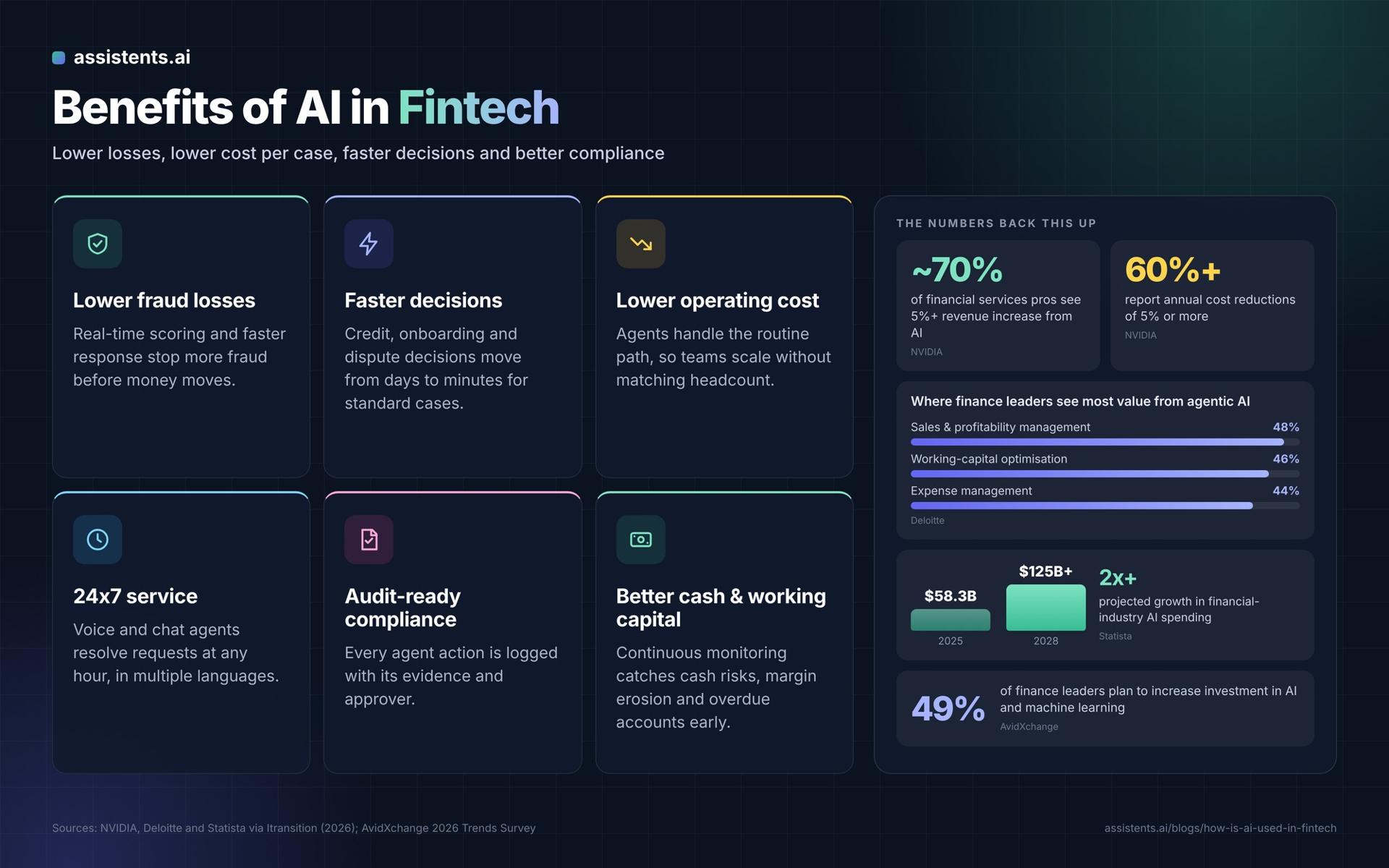
The benefits of AI in fintech show up as lower losses, lower cost per case, faster decisions and better compliance.
- Lower fraud losses. Real-time scoring and faster response stop more fraud before money moves.
- Faster decisions. Credit, onboarding and dispute decisions move from days to minutes for standard cases.
- Lower operating cost. Agents handle the routine path, so teams scale without matching headcount.
- 24x7 service. Voice and chat agents resolve requests at any hour, in multiple languages.
- Audit-ready compliance. Every agent action is logged with its evidence and approver.
- Better cash and working capital. Continuous monitoring catches cash risks, margin erosion and overdue accounts early.
The numbers back this up:
- About 70% of financial services professionals report revenue increases of 5% or more from AI, and over 60% report annual cost reductions of 5% or more (NVIDIA, via Itransition).
- Finance leaders see the most value from agentic AI in sales and profitability management (48%), working-capital optimisation (46%) and expense management (44%) (Deloitte, via Itransition).
- 49% of finance leaders plan to increase investment in AI and machine learning (AvidXchange).
- Financial industry AI spending is projected to grow from $58.29 billion in 2025 to over $125 billion in 2028 (Statista, via Itransition).
Want to estimate your own return? Try the AI agent ROI calculator.
Risks and challenges of AI in fintech (and how to control each)
The main risks of AI in fintech are biased decisions, hallucinated outputs, data leakage, model drift, regulatory exposure and over-automation. Each one has a practical control.
| Risk | What goes wrong | Control |
|---|---|---|
| Bias and fairness | Credit or fraud models disadvantage protected groups | Explainable features, fairness testing, human review of adverse decisions |
| Hallucination | Generative AI states something false in a customer letter or memo | Grounded retrieval with citations, deterministic rules for anything binding |
| Data leakage | Agents see or share data they shouldn't | Permission-aware retrieval, inherited access controls, zero data retention |
| Model drift | Fraud and credit patterns change and models degrade | Continuous monitoring and evaluation before each release |
| Regulatory exposure | Decisions can't be explained to a regulator | Full audit trail of evidence, policy version, action and approver |
| Over-automation | An agent takes an action it shouldn't, at scale | Approval thresholds, transaction and budget limits, human authority over regulated decisions |
The principle is simple: autonomy is earned. Agents should start with narrow authority and gain more only when their measured performance justifies it. Our AI agent governance playbook covers this in detail.
How to implement AI in a fintech company: a governed rollout plan
The safest way to implement AI in a fintech company is to start with one workflow, measure it, and expand autonomy in stages. You do not need to accept broad autonomy to get value.
The AI maturity ladder for fintech
| Level | Operating model | Human role | Agent role |
|---|---|---|---|
| 1. Assist | AI prepares information or content | Initiates, validates and acts | Advises |
| 2. Co-work | Human and agent share tasks | Owns the work, collaborates | Performs bounded steps |
| 3. Delegate | Agent owns bounded tasks | Sets the objective, handles escalation | Plans and completes assigned tasks |
| 4. Exception-managed | Agents run established processes | Manages policy and exceptions | Owns the normal operating path |
| 5. Adaptive | Agents propose improvements | Approves goals, policy and releases | Optimises work under controlled release |
A 30/60/90-day plan
Days 1–30: pick and prove one workflow
- Choose a workflow with a measurable outcome: disputes, collections, KYC triage or cash-flow alerts.
- Connect the data sources and define the outcome metric (for example, cost per case or DSO).
- Run in Assist mode: the agent prepares, humans act.
Days 31–60: co-work and measure
- Let the agent complete bounded steps (drafting, evidence gathering, routing).
- Set approval thresholds, limits and escalation paths.
- Compare outcomes against the baseline.
Days 61–90: delegate by segment
- Move low-risk segments to Delegate or Exception-managed mode, for example small-value disputes first.
- Expand autonomy by customer segment and transaction value, not with one global switch.
- Plan the next workflow using the same platform and governance.
Need help scoping a vendor? Use our enterprise AI buyer's guide.
The future of AI in fintech (2026–2028)
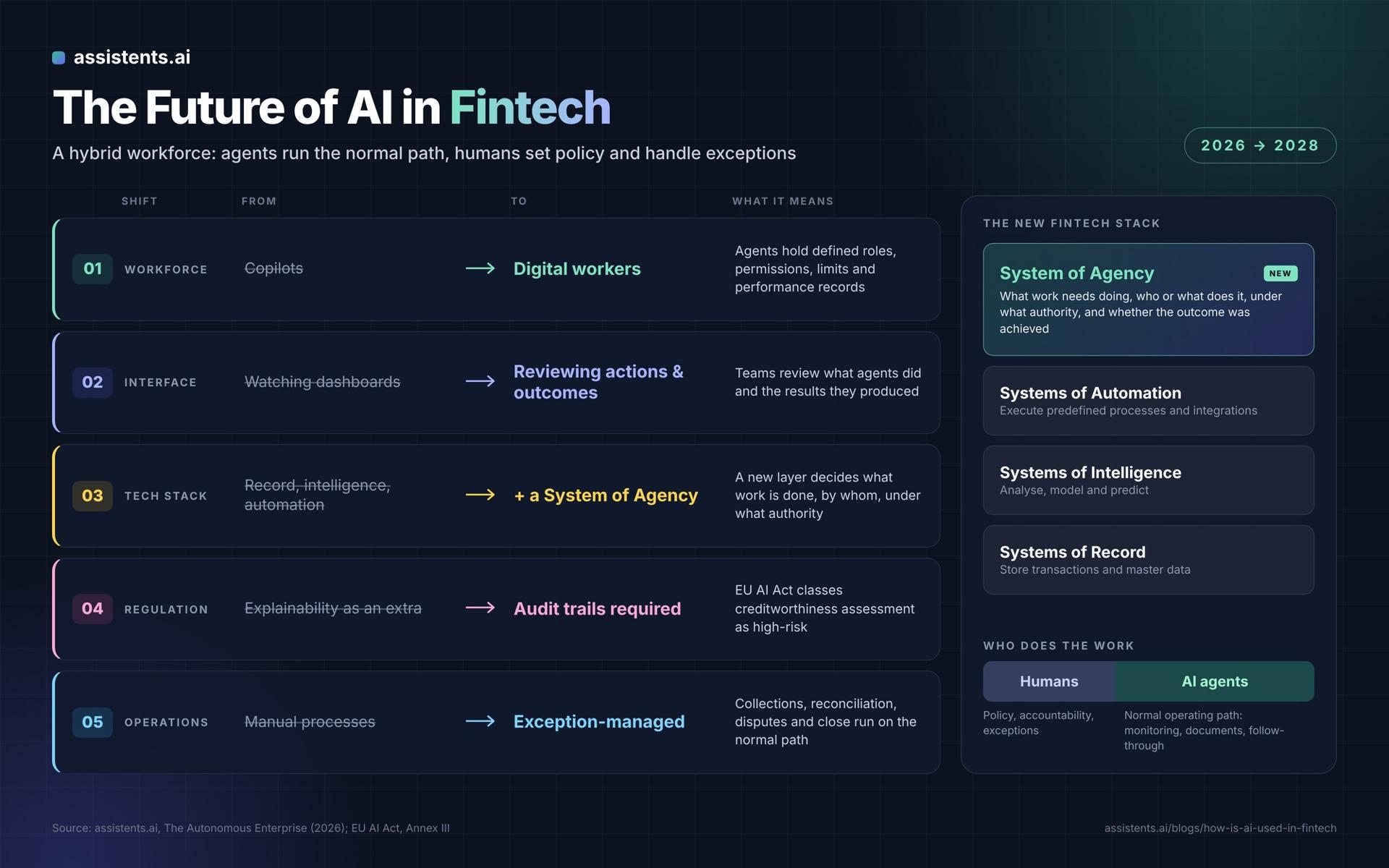
The future of AI in fintech is a hybrid workforce: AI agents running the normal path of financial operations, and humans setting policy and handling exceptions.
- From copilots to digital workers. Agents will hold defined roles, permissions, limits and performance records, much like employees.
- From dashboards to action. Instead of watching dashboards, teams will review the actions agents took and the outcomes they produced.
- A new layer in the fintech stack. Fintechs already have systems of record, intelligence and automation. The next layer decides what work needs doing, who or what does it, under what authority, and whether the outcome was achieved. At assistents.ai we call this a System of Agency.
- Tighter regulation. Credit scoring and other high-impact uses face growing scrutiny, including the EU AI Act's high-risk classification for creditworthiness assessment. Explainability and audit trails will become requirements, not extras.
- Autonomous finance operations. Collections, reconciliation, disputes and close will increasingly run as exception-managed processes.
Why assistents.ai is the best platform for AI in fintech
Fintechs have four other ways to add AI: point solutions, RPA, agent frameworks and generic copilots. Each solves part of the problem. assistents.ai is built to take governed AI agents into production across many finance workflows on one platform.
| Capability | assistents.ai | Point solutions (fraud, KYC) | RPA | Agent frameworks | Generic copilots |
|---|---|---|---|---|---|
| Takes governed actions in core systems | Yes | Within one product | Scripted only | Must be built | Limited |
| Full audit trail of every agent action | Yes | Partial | Partial | Must be built | Limited |
| Human approvals and exception routing | Built in | Varies | Limited | Must be built | No |
| Works across fraud, lending, ops and support | Yes | No | Process by process | Yes, with engineering | Partial |
| Private or on-premise deployment | Yes | Varies | Yes | Yes | Rarely |
| 300+ business app integrations | Yes | Limited | Via scripts | Must be built | Limited |
| Handles documents, voice and unstructured data | Yes | Varies | Weak | Must be built | Partly |
| Time to production | Weeks | Weeks to months | Months | Months | Days, but no actions |
What sets assistents.ai apart:
- Governed execution, not just answers. Every action passes permission checks, business rules, approvals and limits, and is logged.
- One platform, many workflows. The same context, governance and agents serve disputes, collections, forecasting, tax and order-to-cash.
- Built for regulated data. SOC 2 Type II, ISO 27001, GDPR, zero data retention and on-premise options.
- Proof, not promises. The deployments in this guide are running in production today. Platform-reported benchmarks include up to 90% faster processing and 97% agent task accuracy.
Compare the approaches in more depth: AI agents vs RPA and assistents.ai vs CrewAI.
Our operating model in one line: human-led strategy, human-owned accountability, agent-operated processes, exception-managed control and outcome-driven improvement.
Conclusion
AI in fintech has moved from scoring risk to running the work around it. The fintechs that win in 2026 will pick one measurable workflow, deploy governed AI agents, and expand autonomy as the results prove out.
Ready to put AI agents to work in your fintech? Talk to assistents.ai about a fintech AI workshop, explore AI agents for financial services, or estimate your return with the AI agent ROI calculator.
Sources
- Itransition: AI in fintech (Research and Markets, Statista, NVIDIA, Deloitte, KPMG, Cambridge Judge data)
- Intuit: How AI is transforming financial technology
- AvidXchange: The role of AI in fintech
- assistents.ai platform
FAQs
How is AI being used in fintech today?
AI is used in fintech today for fraud detection, credit scoring, KYC and AML checks, customer support, trading and back-office operations such as disputes, collections and cash-flow forecasting. The newest shift is AI agents that complete these workflows end to end, with humans approving exceptions and regulated decisions.
What is the role of AI in fintech?
The role of AI in fintech is to make financial decisions faster and more accurate and to automate the work around them. AI analyses large volumes of transaction and customer data, predicts risk, writes documents and, increasingly, takes governed actions in financial systems.
How is generative AI used in fintech?
Generative AI is used in fintech to read and summarise documents, draft customer letters and credit memos, answer questions in natural language, write compliance narratives and produce research with citations. It is most reliable when grounded in approved data and paired with deterministic rules for binding decisions.
What is agentic AI in fintech?
Agentic AI in fintech means AI agents that plan and complete multi-step financial work, such as handling a dispute or chasing an overdue invoice, using tools and systems within set permissions. They run the routine path, escalate exceptions and log every action for audit.
Which fintech companies use AI?
Almost every scaled fintech uses AI, especially in payments, lending, wealth and regtech. In this guide, anonymised examples include a provider of dispute and fraud automation for banks, an AI CFO platform, an AI-first trading terminal, a leasing provider and two tax-tech products.
How does AI detect fraud in fintech?
AI detects fraud by scoring each transaction against learned patterns of normal behaviour, using signals such as amount, location, device, merchant and timing. Graph models connect related accounts to expose fraud rings, and AI agents triage alerts so analysts focus on the highest-risk cases.
What are the risks of AI in fintech?
The main risks of AI in fintech are biased decisions, hallucinated outputs, data leakage, model drift, regulatory non-compliance and over-automation. They are controlled with explainable models, grounded retrieval, permission-aware access, continuous monitoring, audit trails and human approval for high-impact decisions.
Is AI in financial services regulated?
Yes. AI in financial services falls under existing rules on lending, consumer protection, data privacy and AML, and under new AI-specific rules such as the EU AI Act, which classes creditworthiness assessment as high-risk. Firms must be able to explain and audit AI-driven decisions.
Will AI replace jobs in fintech?
AI will change fintech jobs more than it replaces them. Agents take over routine monitoring, data gathering and document work, while people focus on judgement, relationships, policy and exceptions. Teams can grow volume without adding headcount at the same rate.
What is the future of AI in fintech?
The future of AI in fintech is governed AI agents working alongside people as a digital workforce. Expect autonomous, exception-managed finance operations, stronger explainability requirements, and platforms that measure whether each AI action delivered the intended business outcome.