Quick answer: The most common examples of AI in dentistry are X-ray analysis for cavities and bone loss, AI-assisted treatment planning for implants and orthodontics, automated clinical notes, insurance eligibility verification, patient communication and practice analytics. As of mid-2026, 43.3% of US dentists use AI for at least one task, and imaging and diagnostics is the leading use (ADA Health Policy Institute, July 2026).
AI in dentistry is no longer a research topic. It is in the X-ray software, the phone system, the insurance workflow and the monthly report. But most dentists still meet it one tool at a time, and many give up early. A 2026 survey of 300 dentists found that 40% of those who dropped an AI product did so within three months (Oral Health Group, May 2026).
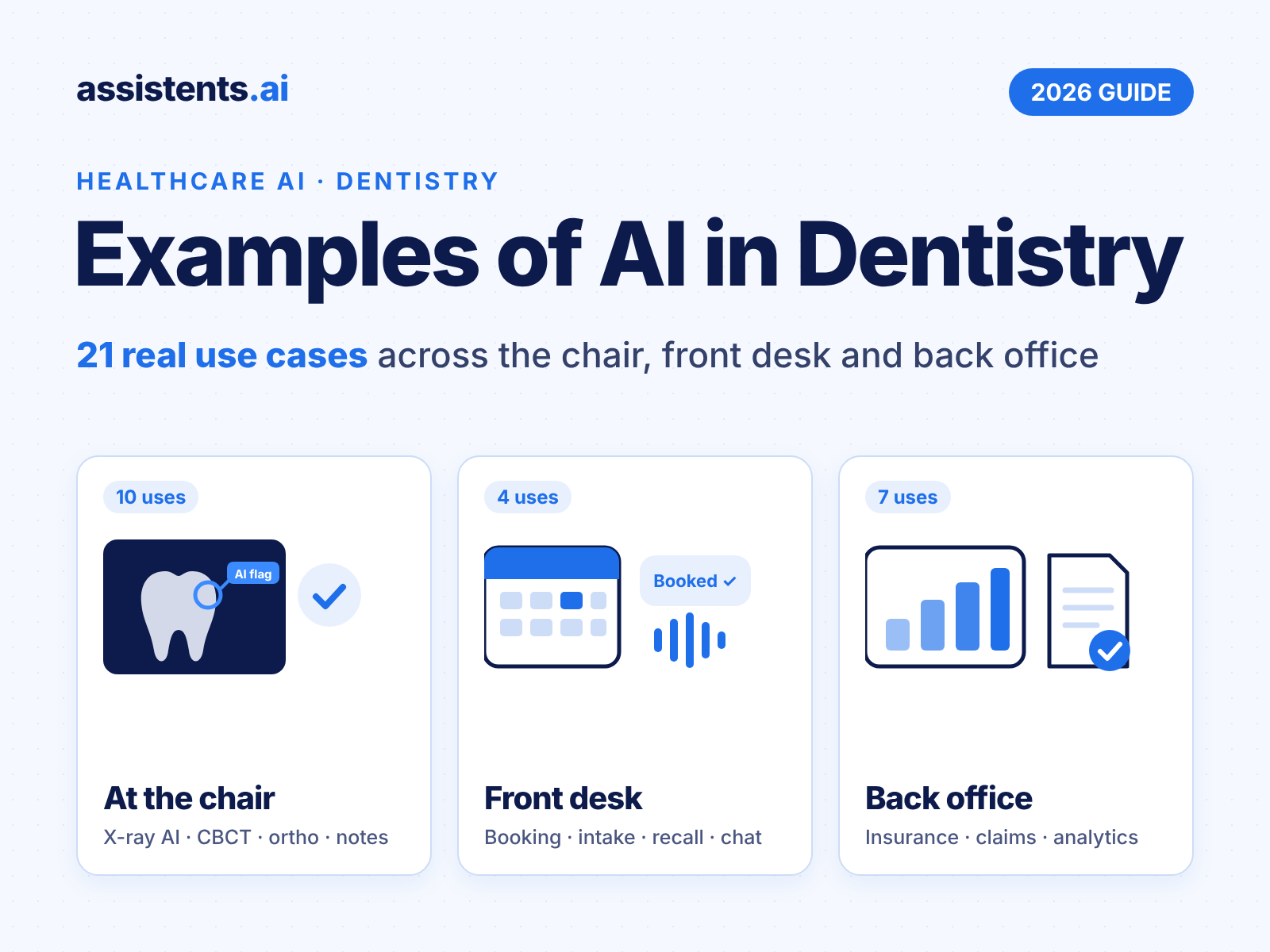
This guide covers 21 real examples of AI in dentistry. Each one comes with what it does, the evidence behind it and what to watch for. We group them by where the work happens:
- At the chair: clinical examples, 10 use cases
- At the front desk: patient-experience examples, 4 use cases
- In the back office: business and revenue examples, 7 use cases
You will also find anonymised results from healthcare AI deployments, a compliance checklist, 10 questions to ask vendors and a 90-day rollout plan.
Examples of AI in dentistry at a glance
The table below summarises all 21 examples of AI in dentistry. Maturity shows how widely each one is used in practices today: In use now (widely deployed, often FDA-cleared or commercially mature), Early adoption (available, growing) or Emerging (promising, limited evidence).
| # | Example of AI in dentistry | Where it's used | Maturity | Evidence / regulatory status |
|---|---|---|---|---|
| 1 | Caries detection on bitewing X-rays | Chair | In use now | Multiple FDA 510(k) clearances; meta-analysis sensitivity 0.94, specificity 0.91 |
| 2 | Periodontal bone-loss measurement | Chair | In use now | Review of 64 studies: 92.3% sensitivity |
| 3 | Periapical lesion detection | Chair | Early adoption | Review of 24 studies: sensitivity 0.94, specificity 0.96 |
| 4 | CBCT segmentation and implant planning | Chair | Early adoption | Pooled tooth-segmentation Dice score 0.95 |
| 5 | Cephalometric analysis and ortho planning | Chair | Early adoption | Mean 2D landmark error 1.39 mm |
| 6 | Remote orthodontic monitoring from photos | Chair / home | Early adoption | FDA De Novo (2024) |
| 7 | Oral cancer screening from intraoral photos | Chair | Emerging | Sensitivity 0.97 from only 8 studies |
| 8 | Smile design and cosmetic simulation | Chair | In use now | Patient-communication tool, not diagnostic |
| 9 | Ambient clinical notes and voice perio charting | Chair | Early adoption | 34.8% of non-users plan to adopt (ADA) |
| 10 | Explaining findings with annotated X-rays | Chair | In use now | 13.2% of dentists use AI for this (ADA) |
| 11 | 24/7 AI receptionist and booking | Front desk | In use now | 10.1% use AI at reception (ADA) |
| 12 | Digital intake and medical-history extraction | Front desk | Early adoption | Document AI with human review |
| 13 | Recall, reactivation and treatment follow-up | Front desk | In use now | Automated, rules-based outreach |
| 14 | Multilingual patient support (chat, WhatsApp) | Front desk | Early adoption | Conversational agents with handoff |
| 15 | Insurance eligibility and benefits verification | Back office | In use now | 13.6% use it; 32.6% of non-users plan to (ADA) |
| 16 | Claims preparation and denial management | Back office | Early adoption | Document AI + workflow automation |
| 17 | Revenue-cycle analytics and leakage detection | Back office | Early adoption | 10.1% use AI for business analytics (ADA) |
| 18 | Practice KPIs in plain English (agentic BI) | Back office | Early adoption | Natural-language analytics with alerts |
| 19 | Supply inventory and procurement | Back office | Early adoption | Procurement agents and price alerts |
| 20 | Hygienist and temp-staff scheduling | Back office | Early adoption | Matching and scheduling agents |
| 21 | Multi-location DSO reporting and audit trails | Back office | Early adoption | Governed KPI alerts across sites |
How many dentists use AI in 2026?
About four in ten US dentists now use AI for at least one task. The ADA Health Policy Institute reported in July 2026 that 43.3% of responding dentists use AI in their practice, and another 26.4% plan to (ADA HPI).
What dentists use AI for today (ADA, 2026):
| Current AI use | Share of dentists |
|---|---|
| Imaging and diagnostics | 22.8% |
| Insurance verification | 13.6% |
| Explaining clinical findings to patients | 13.2% |
| Social media | 10.7% |
| Business analytics | 10.1% |
| Reception / front-desk check-in | 10.1% |
| Patient treatment recommendations | Under 5% |
Among dentists who don't use AI yet, the top planned uses are charting and note-taking (34.8%), insurance verification (32.6%) and imaging and diagnostics (25.4%).
A separate international survey tells a similar story. Dental Reviewed surveyed 300 licensed dentists in the US, Canada and the UK between February and April 2026 (Oral Health Group):
- 32% currently use at least one AI tool, and 38% are considering it.
- 82% of AI users apply it to radiograph interpretation, and 36% to treatment planning.
- 52% see AI as a helpful second opinion. Only 2% trust it more than their own clinical judgment.
- 44% of users report better case acceptance (self-reported, not independently verified).
- 40% of dentists who dropped an AI product did so within three months.
The takeaway: getting started with AI is easy; keeping it is harder. Tools that don't connect to the practice's real workflow get abandoned. We come back to this in the rollout plan.
Clinical examples of AI in dentistry (at the chair)
Clinical AI in dentistry mostly means computer vision on radiographs and 3D scans. It finds and measures caries, bone loss and lesions, segments CBCT volumes and maps landmarks for orthodontic and implant planning. It works best as a second reader that a dentist confirms, not as a stand-alone diagnosis.
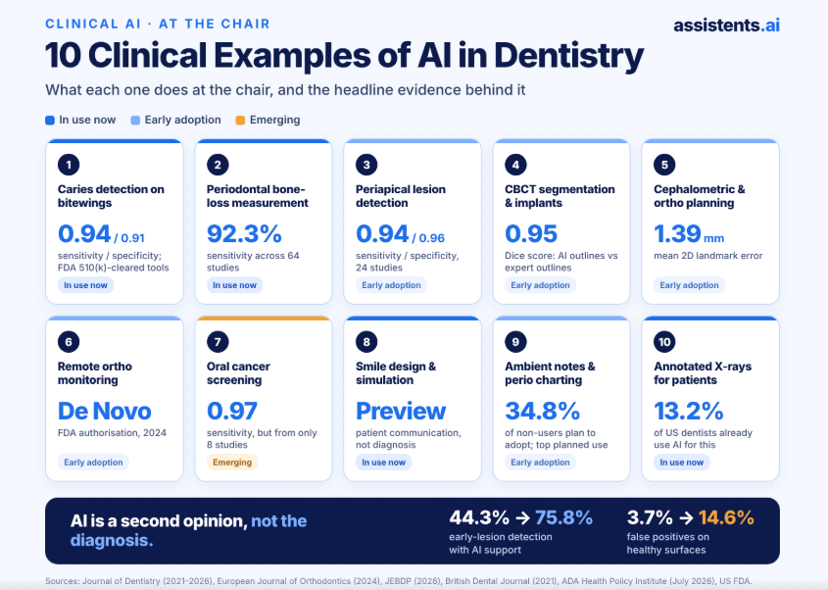
1. AI caries detection on bitewing X-rays
What it does: Deep-learning models highlight suspected caries on bitewing and periapical radiographs, usually as coloured overlays in the imaging software.
Evidence: This is the most established example of AI in dentistry. Several products hold FDA 510(k) clearance, including Pearl's Second Opinion (K210365), Videa Caries Assist (K213795) and Overjet Caries Assist (K212519). A 2024 bitewing meta-analysis reported sensitivity of 0.94 and specificity of 0.91 (Journal of Dentistry, 2024). In a cluster-randomised trial of 22 dentists, sensitivity rose from 0.72 to 0.81 with AI, with no significant loss of specificity (J Dent, 2021).
What to watch: Positive predictive value ranged widely, from 0.15 to 0.87 across studies, so results depend on the setting and the patient mix. A 2026 umbrella review concluded that the evidence does not yet support stand-alone use (J Dent, 2026).
2. Periodontal bone-loss measurement
What it does: AI measures alveolar bone levels on radiographs and flags sites with bone loss, which supports periodontal staging and patient education.
Evidence: A review of 64 studies found 92.3% sensitivity and 91.7% specificity (J Dent, 2025). A second review of 30 studies reported 87% sensitivity and 76% specificity (DMFR).
What to watch: None of the 64 studies tracked change over time or ran in a live clinic. Use AI measurements to support your charting, not to replace probing.
3. Periapical lesion detection in endodontics
What it does: AI flags periapical radiolucencies on periapical films, panoramics and CBCT.
Evidence: A review of 24 studies reported sensitivity of 0.94 and specificity of 0.96 (J Dent, 2024). In a 2025 trial with 30 dentists, accuracy rose from 91.6% to 93.3% and false positives fell from 4.3% to 2.0% with AI support (J Dent, 2025).
What to watch: Most studies tested models, not complete commercial software systems.
4. CBCT segmentation and implant planning
What it does: AI segments teeth, nerves, sinuses and bone in CBCT volumes in seconds, which speeds up implant planning and surgical guide design.
Evidence: Pooled tooth segmentation reached a Dice score of 0.95 (J Dent, 2024), meaning AI outlines overlap closely with expert outlines. Overjet's Iris imaging system received clearance for CBCT, panoramic and 3D imaging in 2026 (Mindbowser summary of FDA clearances).
What to watch: Always check nerve-canal tracing manually before you finalise a surgical guide.
5. Cephalometric analysis and orthodontic planning
What it does: AI places cephalometric landmarks automatically and supports aligner and orthodontic treatment planning.
Evidence: A systematic review found a mean 2D landmark error of 1.39 mm (European Journal of Orthodontics, 2024). An umbrella review noted that AI still exceeded the recommended error margin for most landmarks (J Dent, 2024).
What to watch: AI saves tracing time, but a clinician should review every landmark before it drives treatment.
6. Remote orthodontic monitoring from patient photos
What it does: Patients take smartphone photos at home. AI checks aligner fit and tooth movement, and flags who needs an in-person visit.
Evidence: In 2024 the FDA granted a De Novo authorisation (DEN230035) that created a new "dental image analyzer" classification for remote orthodontic monitoring (Mindbowser).
What to watch: Monitoring works only if patients send photos consistently, so pair it with automated reminders (see example 13).
7. Oral cancer screening from intraoral photos
What it does: AI reviews intraoral photos for suspicious lesions that may need a biopsy referral.
Evidence: A 2026 review reported sensitivity of 0.97 and specificity of 0.93, but from only 8 studies (JEBDP, 2026).
What to watch: This is an emerging example of AI in dentistry. Treat it as a prompt for closer examination, never as a diagnosis.
8. Smile design and cosmetic simulation
What it does: AI generates a preview of veneers, whitening or orthodontic results from a patient's photo or intraoral scan.
Why it matters: It is a communication tool rather than a diagnostic one. It helps patients see the outcome, which supports cosmetic and restorative case acceptance.
What to watch: Set expectations. Simulations are illustrations, not guarantees.
9. Ambient clinical notes and voice perio charting
What it does: AI listens to the appointment (with consent) or to dictated perio readings and drafts clinical notes and charts for the dentist to approve.
Evidence: Charting and note-taking is the top planned AI use among US dentists who don't use AI yet, at 34.8% (ADA HPI).
What to watch: Notes are legal records. Keep a sign-off step, get recording consent and make sure the vendor signs a Business Associate Agreement (BAA).
10. Explaining findings to patients with annotated X-rays
What it does: AI overlays turn a grey radiograph into a visual patients can understand: "this shaded area is decay."
Evidence: 13.2% of US dentists already use AI to explain clinical findings (ADA HPI), and 44% of AI users in one survey reported better case acceptance (Oral Health Group).
What to watch: 68.3% of dentists say they don't plan to use AI for this. Many prefer to keep the explanation personal, so position the overlay as a visual aid you narrate.
AI is a second opinion, not the diagnosis. In one study, AI raised early enamel-lesion detection from 44.3% to 75.8%, but false positives on healthy surfaces also rose from 3.7% to 14.6% (British Dental Journal, 2021). More findings can mean more treatment, so the dentist's judgment must stay in the loop.
Front-desk and patient-experience examples of AI in dentistry
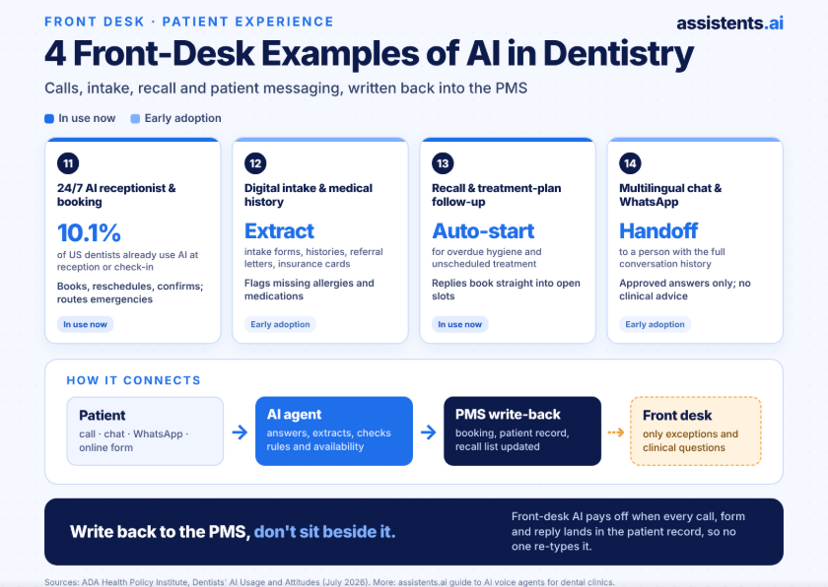
At the front desk, AI answers calls and messages, books appointments, collects intake data and runs recall. The goal is to stop losing patients to voicemail and to free staff from repetitive admin. These tools work when they write back into the practice management system (PMS), not when they sit beside it.
11. 24/7 AI receptionist and online booking
An AI voice agent answers calls after hours and during busy periods. It books, reschedules and confirms appointments, and routes emergencies to on-call staff. 10.1% of US dentists already use AI for reception or check-in (ADA HPI).
For a detailed comparison of 11 tools, pricing, PMS integration and HIPAA requirements, read our guide to AI voice agents for dental clinics.
12. Digital intake and medical-history extraction
What it does: Document AI reads intake forms, medical histories, referral letters and insurance cards. It extracts the fields, checks for missing data (allergies, medications, anticoagulants) and writes the record to the PMS. Anything unclear goes to staff for review.
Why it matters: It removes re-typing at check-in and catches risky gaps before the patient is in the chair. See how this works in our patient intake and triage use case.
13. Recall, reactivation and treatment-plan follow-up
What it does: AI finds patients overdue for hygiene and patients with unscheduled treatment, then sends personalised messages or makes outbound calls on a schedule. Responses book straight into open slots.
Why it matters: Unscheduled treatment is one of the largest sources of lost production in most practices. Follow-up should start automatically when a plan is presented, not when someone remembers to run a report.
14. Multilingual patient support on chat and WhatsApp
What it does: A conversational agent answers common questions in the patient's language: opening hours, post-op instructions, costs, financing and insurance. It books appointments and hands off to a person with the full conversation history.
What to watch: The agent should answer only from approved content and never improvise clinical advice. For compliance requirements, see our HIPAA compliant AI chatbot guide.
Back-office and business examples of AI in dentistry
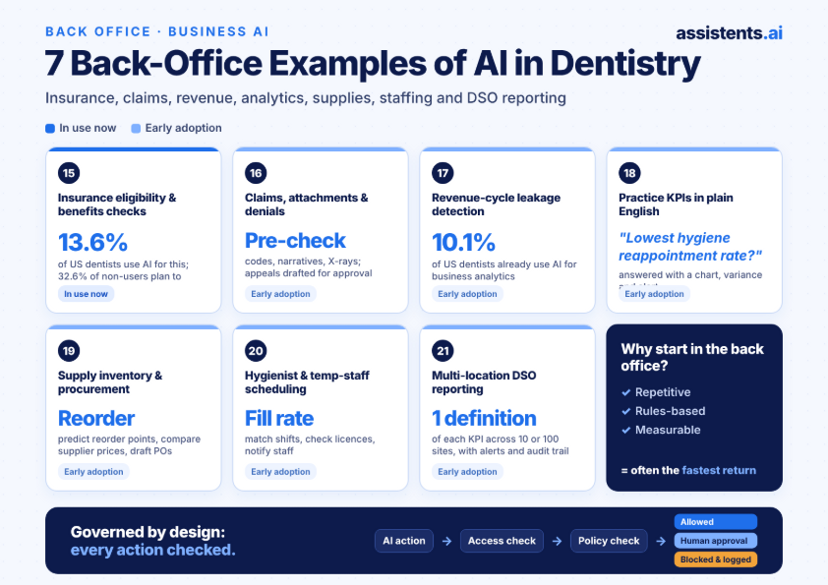
In the back office, AI verifies insurance, prepares claims, monitors revenue and answers business questions in plain English. These examples rarely make headlines, but they often deliver the fastest return because the work is repetitive, rules-based and measurable.
15. Insurance eligibility and benefits verification
What it does: Before each appointment, an AI agent checks eligibility, remaining benefits, frequencies and waiting periods across payer portals. It writes a summary to the patient record and flags problems to the front desk.
Evidence: This is the second most common AI use among US dentists (13.6%) and the second most planned (32.6%) (ADA HPI).
16. Claims preparation, attachments and denial management
What it does: AI checks that each claim has the right codes, narratives and attachments (X-rays, perio charts) before submission. When a denial arrives, it reads the explanation of benefits, classifies the reason and drafts an appeal for a person to approve.
Why it matters: Payers increasingly use automated review on their side. Practices need consistent, well-documented claims to keep up. Learn more about medical records processing with AI and AI agents for document processing.
17. Revenue-cycle analytics and leakage detection
What it does: AI compares scheduled, completed, billed and collected procedures to find where revenue leaks: unbilled work, write-offs above contract, slow-paying payers or rising adjustments.
Evidence: 10.1% of US dentists use AI for business analytics (ADA HPI). See a comparable healthcare deployment in the real results section below.
18. Practice KPIs in plain English (agentic BI)
What it does: Instead of building reports, the owner asks: "Which hygienists had the lowest reappointment rate last quarter?" or "What was our case acceptance for implants by provider?" The AI returns a chart, explains the variance and can schedule an alert when a metric crosses a threshold.
Why it matters: Most practices have the data in their PMS but no time to analyse it. Read more about agentic BI for data analysis and patient outcome analytics.
19. Supply inventory and procurement
What it does: AI tracks usage of consumables, predicts reorder points, compares supplier prices and drafts purchase orders for approval.
Why it matters: Supplies are one of the largest controllable costs in a practice, and price changes across distributors are easy to miss.
20. Hygienist and temp-staff scheduling
What it does: AI matches open hygiene and assistant shifts with available staff, checks credentials and licences, sends notifications and tracks fill rates.
Why it matters: Unfilled hygiene chairs are lost production. Faster fill cycles protect the schedule.
21. Multi-location DSO reporting, alerts and audit trails
What it does: For dental service organisations (DSOs) and groups, AI standardises KPI definitions across locations. It monitors production, collections and supply costs, sends exception alerts to the right manager and keeps an audit trail of every automated action.
Why it matters: Growth breaks spreadsheets. A shared definition of "case acceptance" or "net production" across 10 or 100 sites is what makes group-level decisions reliable.
Where assistents.ai fits: from single AI tools to a connected practice
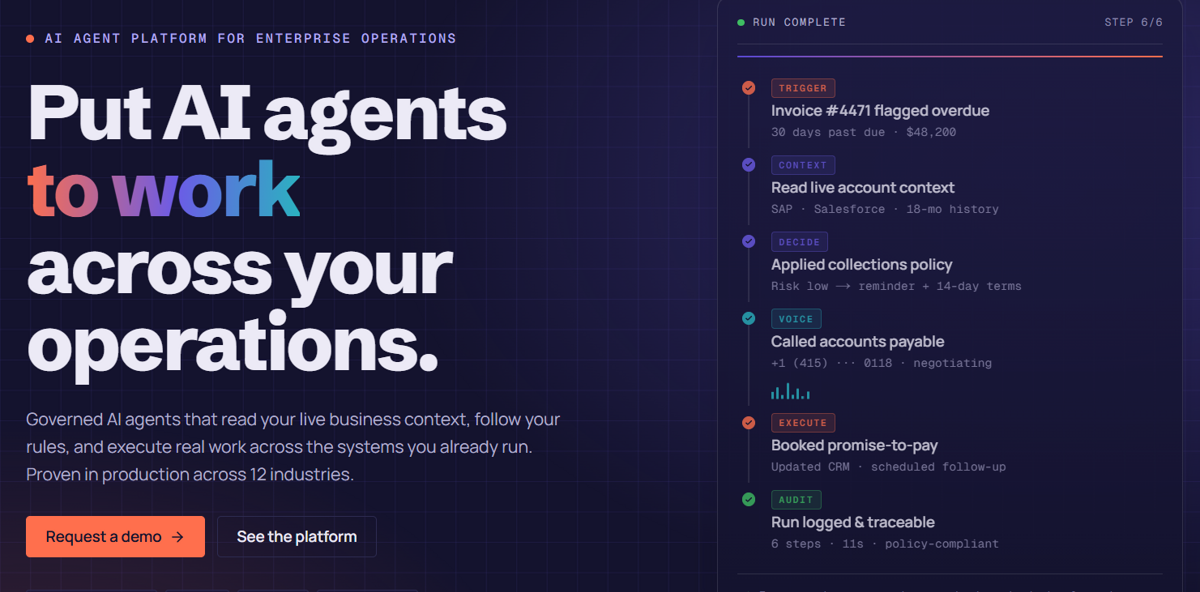
Most practices that adopt AI end up with several tools that don't talk to each other: an X-ray AI, a phone bot, an insurance checker and a spreadsheet. That is personal productivity. assistents.ai is built for organisational productivity. It is one governed platform that connects your practice systems, imaging AI, payer portals and analytics, so a process runs from trigger to verified outcome.
Five capabilities on one platform:
- Conversational Agents: source-backed answers for staff and patients, with permitted actions such as booking or creating a task.
- Agentic BI: ask business questions in natural language and get charts, reports, scheduled insights and threshold alerts.
- Document AI: read intake forms, explanations of benefits and referral letters; extract and validate fields; route exceptions to a person.
- Voice AI: natural, multilingual inbound and outbound calls that check details, find times, update bookings, send confirmations and create follow-ups.
- Autonomous Workflows: events, schedules and inboxes start the work; people approve what needs approval.
What this looks like in a dental practice:
- An FDA-cleared imaging tool flags a lesion.
- The dentist confirms the finding and presents a treatment plan.
- assistents.ai then:
- runs an insurance pre-check
- drafts the patient's cost estimate
- schedules a follow-up if the patient doesn't book
- updates the case-acceptance dashboard
assistents.ai does not replace FDA-cleared diagnostic tools. It connects their output to the rest of the practice.
See AI for healthcare operations →
Real results: what similar healthcare AI deployments delivered
The best predictor of AI success in a dental practice is a deployment that worked in a similar healthcare workflow. Below are anonymised assistents.ai implementations from healthcare and adjacent operations. Each one maps directly to a dental use case. Client names are withheld.
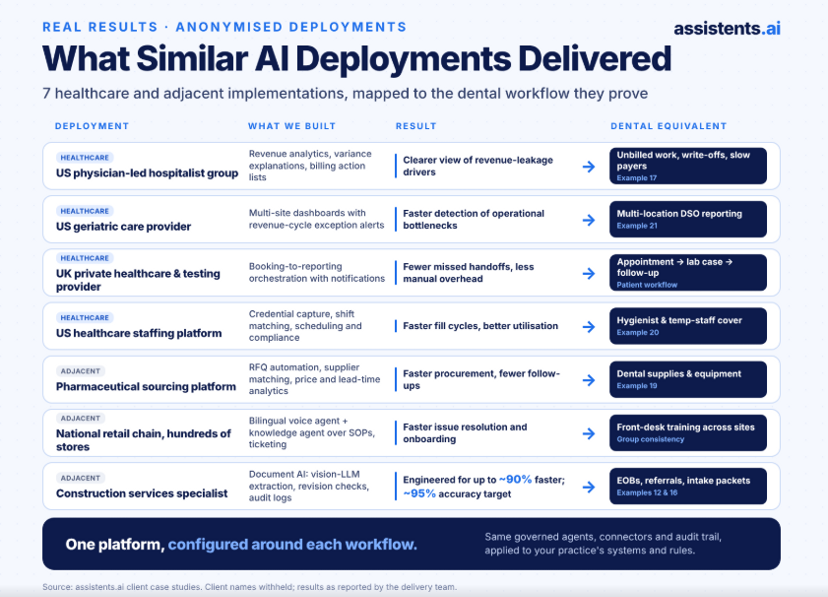
A US physician-led hospitalist group: finding revenue leakage
- Situation: Leadership needed clearer visibility into revenue and utilisation across inpatient programmes.
- What we built: A revenue and utilisation analytics model, performance dashboards with variance explanations, and action lists for billing workflows and operational optimisation.
- Result: Improved visibility into revenue-leakage drivers, faster operational decisions through unified reporting, and more reliable performance tracking.
- What this means for dentistry: The same pattern finds unbilled procedures, high write-offs and slow payers (example 17).
A US geriatric care provider: multi-site operational visibility
- Situation: A physician-led provider delivering programmes across assisted-living and long-term-care settings lacked a single operational view.
- What we built: Programme operations dashboards, staffing and service-delivery analytics, and revenue-cycle visibility with exception alerts.
- Result: Faster identification of operational bottlenecks, improved transparency into service performance and better decision support for leadership.
- What this means for dentistry: This is the DSO reporting model in example 21.
A UK private healthcare and testing provider: booking to reporting
- Situation: High-volume consumer workflows ran from booking through processing to results, with many manual handoffs.
- What we built: Booking and workflow orchestration, status monitoring with customer notifications, and reporting dashboards with operational analytics.
- Result: More scalable operations with less manual overhead, faster customer communications with fewer missed handoffs, and better service visibility.
- What this means for dentistry: The appointment → lab case → fit → follow-up workflow, with patients kept informed at each step.
A US healthcare staffing platform: faster shift fills
- Situation: The platform connects nursing professionals with healthcare facilities for flexible shifts, so speed of staffing is the product.
- What we built: Talent onboarding and credential capture, facility request intake with matching logic, scheduling with notifications and compliance workflows, and fill-rate reporting.
- Result: Faster fill cycles with less scheduling friction, better workforce utilisation and improved staffing responsiveness.
- What this means for dentistry: This is hygienist and temp-staff coverage (example 20).
A pharmaceutical sourcing platform: procurement automation
- Situation: Procurement across thousands of SKUs relied on manual RFQs and supplier follow-up.
- What we built: RFQ automation, supplier matching, support for quality and regulatory documents, and analytics on price, lead time and vendor performance.
- Result: Faster procurement cycles, fewer manual follow-ups and better price and lead-time competitiveness.
- What this means for dentistry: Consumables and equipment purchasing (example 19).
A national retail chain with hundreds of stores: multilingual frontline support
- Situation: Frontline teams needed fast answers on stock, procedures and issues across hundreds of locations.
- What we built:
- a bilingual voice support agent
- a knowledge and training agent over SOP documents
- ticketing integration with an admin console and analytics
- Result: Less manual helpdesk work, faster issue resolution and faster onboarding through on-demand training guidance.
- What this means for dentistry: Consistent answers and training for front-desk teams across every location in a group.
A construction services specialist: document AI at scale
- Situation: Complex PDF documents had to be read, compared across revisions and synced into an operational system.
- What we built: Multi-agent document orchestration, vision-LLM extraction from complex PDFs, revision analysis and audit logs.
- Result: The system is engineered for up to ~90% faster document processing, with a ~95% extraction accuracy target for standard formats.
- What this means for dentistry: The same Document AI pattern applies to explanations of benefits, referral letters and intake packets (examples 12 and 16).
Compliance and risk: HIPAA, FDA, insurers and patient trust
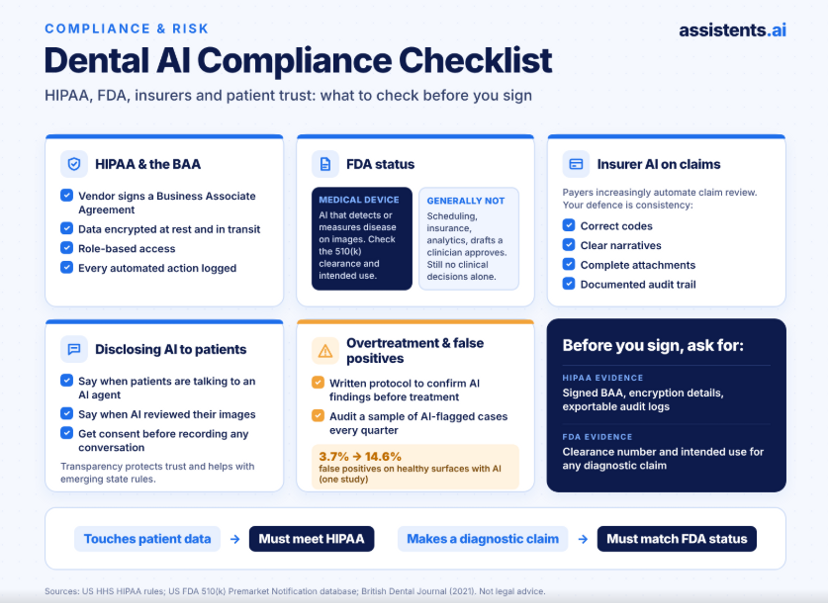
Every example of AI in dentistry that touches patient data must meet HIPAA, and every diagnostic claim must match the product's FDA status. Ask vendors for evidence on both before you sign.
HIPAA and the Business Associate Agreement
Any vendor that stores, processes or transmits protected health information (PHI) is a business associate under HIPAA. Before you go live, check four things:
- The vendor signs a BAA.
- Data is encrypted at rest and in transit.
- Access is role-based.
- Every automated action is logged.
Our HIPAA compliant AI chatbot guide covers the requirements in detail.
FDA 510(k) vs non-device software
AI that detects or measures disease on images is regulated as a medical device. Check the FDA 510(k) database for the exact clearance and its intended use.
Administrative AI is generally not a medical device. This includes scheduling, insurance, analytics and documentation drafts that a clinician approves. Even so, it must not make clinical decisions on its own.
Insurer AI on claims
Dental payers increasingly use automated tools to review claims and attachments. Your defence is consistency:
- correct codes
- clear narratives
- complete attachments
- a documented audit trail
Disclosing AI to patients
Tell patients when they are talking to an AI agent, and when AI was used to review their images. Get consent before recording any conversation. Transparency protects trust and helps you comply with emerging state rules.
Overtreatment and false positives
AI can increase detection and false positives at the same time. Write a protocol for how your practice confirms AI findings before treatment, and audit a sample of AI-flagged cases every quarter.
How to choose dental AI tools: 10 questions to ask vendors
Choose dental AI by what happens after the AI produces an output: where the result lands, who approves it and how it's audited. Use these questions in every demo.
| # | Question to ask | What a good answer looks like |
|---|---|---|
| 1 | Does it read and write to our practice management system? | Bidirectional integration via API or connector, not CSV exports |
| 2 | Will you sign a BAA? | Yes, before the pilot starts |
| 3 | What is the FDA status and intended use? | A specific 510(k) or De Novo number for any diagnostic claim |
| 4 | What evidence supports accuracy in practices like ours? | Peer-reviewed studies or measured pilot data, not "industry research" |
| 5 | Where do humans approve actions? | Configurable approval steps for clinical, financial and patient-facing actions |
| 6 | Is every action logged? | Immutable audit trail you can export |
| 7 | Where is our data stored and processed? | Clear data residency; private cloud or on-premise options |
| 8 | How is it priced? | Transparent per-location, per-provider or usage pricing |
| 9 | Who configures and supports it? | A named delivery team, not just a help-centre link |
| 10 | Can we export our data and leave? | Contractual data export and no lock-in |
A 90-day governed rollout plan for a dental practice
Start with one process that matters, prove it, then expand. This is how practices avoid becoming one of the 40% who drop an AI tool within three months. The plan below follows the six-step delivery approach assistents.ai uses with enterprise clients.
- Select (week 1-2): Pick one high-volume, measurable process, such as insurance verification, recall or claims attachments. Set a baseline, for example "staff minutes per verification" or "unscheduled treatment value".
- Connect (week 2-4): Connect the systems the process touches: PMS, payer portals, imaging and phone. Sign the BAA. Define who can approve which actions.
- Configure (week 4-6): Set up agents and workflows with your rules, fee schedules, templates and escalation paths. Give the AI your policies, not generic ones.
- Validate (week 6-8): Run the AI on real cases alongside staff. Compare outputs, fix exceptions and refine. Don't switch off the manual process until accuracy meets your threshold.
- Operate (week 8-12): Go live with human review on exceptions. Track cycle time, error rate, exception rate and staff hours saved every week.
- Expand (day 90+): Reuse the same integrations and context for the next process. Recall can follow insurance verification, and analytics can follow claims.
Limitations: what AI in dentistry still can't do
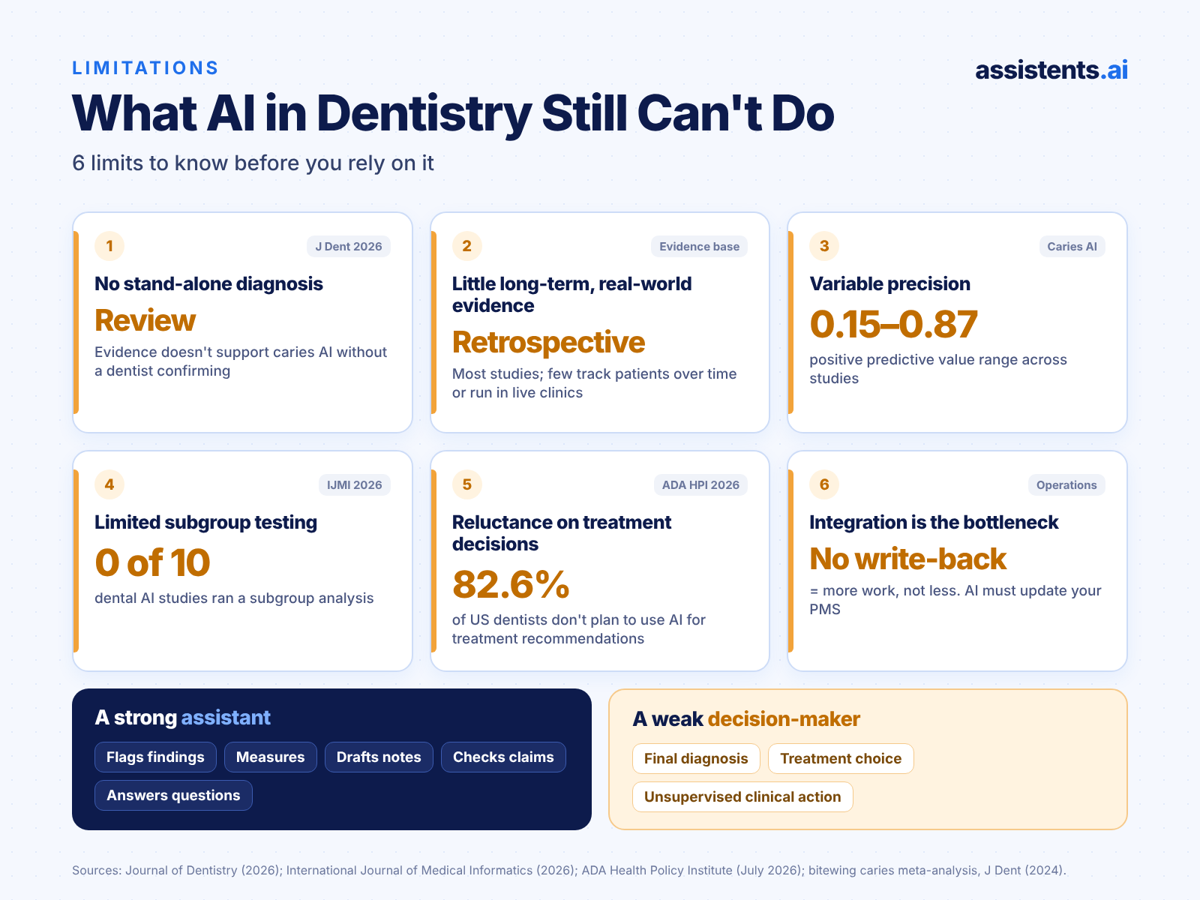
AI in dentistry is a strong assistant and a weak decision-maker. Know its limits before you rely on it:
- No stand-alone diagnosis: Current evidence does not support using AI caries detection without a dentist's review (J Dent, 2026).
- Little real-world, long-term evidence: Most accuracy studies are retrospective. Few track patients over time or run in live clinics.
- Variable precision: Positive predictive value for caries AI ranged from 0.15 to 0.87 across studies.
- Limited subgroup testing: In one 2026 analysis, 0 of 10 dental AI studies ran a subgroup analysis (IJMI, 2026).
- Clinician reluctance on treatment decisions: 82.6% of US dentists do not plan to use AI for treatment recommendations (ADA HPI).
- Integration is the real bottleneck: An AI that can't write back to your PMS creates more work, not less.
Why dental groups choose assistents.ai
Dental practices and DSOs choose assistents.ai when they want AI to run real workflows under their own rules, not add another disconnected tool.
- Built for healthcare governance: HIPAA guardrails, BAA available, data encrypted at rest and in transit, and immutable audit trails (healthcare solution).
- A Context Engine that knows your practice: Patients, providers, procedures, fee schedules and policies are connected, so agents act on your definitions, not generic ones.
- Human in the loop by design: Every action passes an access check and a policy check. Then it is allowed, sent for human approval, or blocked and logged.
- Works with the systems you already run: 80+ prebuilt connectors across EHR, payer, lab and imaging systems, plus open APIs for custom integrations.
- Deploy your way: Cloud SaaS, private cloud or on-premise. The AI Gateway handles approved models, fallback and usage control.
- A team, not just software: Forward Deployed Engineers, AI engineers and data specialists in the USA, Australia and India take your first process from configuration to production.
Healthcare teams already running on assistents.ai include a physician-led hospitalist group, a geriatric care provider, a UK private testing provider and a healthcare staffing platform.
Start with the process that matters most to your practice. Book a tailored walkthrough →
The future of AI in dentistry (2026-2030)
The next phase of AI in dentistry is connected, not just clever. Expect four shifts:
- From detection to workflow: Imaging AI findings will flow automatically into treatment plans, insurance pre-checks and patient follow-up.
- From dictation to ambient documentation: Notes and perio charts will be drafted during the appointment and signed by the clinician.
- From reports to agents: Owners will ask questions and get alerts instead of building dashboards.
- From pilots to governance: Groups will standardise how AI is approved, audited and measured across locations.
Adoption is moving fast: 26.4% of US dentists who don't use AI yet plan to (ADA HPI). The practices that benefit most will be the ones that connect AI to their operations.
Related reading
- 11 Best AI Voice Agents for Dental Clinics in 2026
- HIPAA Compliant AI Chatbot: The Enterprise Guide for Healthcare (2026)
- AI Agents for Document Processing
- Agentic BI for Data Analysis: Use Cases
- AI Agents Examples in Real Life
- More Healthcare AI articles
Sources
- American Dental Association Health Policy Institute. Dentists' AI Usage and Attitudes. July 2026.
- Oral Health Group. One-third of dentists in Canada, U.S. and U.K. now use AI. May 29, 2026 (Dental Reviewed survey, n=300).
- U.S. Food and Drug Administration. 510(k) Premarket Notification Database.
- Journal of Dentistry: bitewing caries meta-analysis (2024); caries umbrella review (2026); periodontal bone loss review (2025); periapical lesions review (2024); CBCT segmentation (2024); cluster-randomised trial (2021); periapical reader trial (2025).
- European Journal of Orthodontics. Cephalometric landmark systematic review (2024).
- British Dental Journal. Early enamel lesion detection with AI (2021).
- Mindbowser. AI in Dentistry: Evidence, FDA Clearances, Questions.
- assistents.ai. Healthcare solutions and internal client case studies (anonymised).
FAQs
How is AI used in dentistry?
AI is used in dentistry to analyse X-rays for cavities, bone loss and lesions, plan implants and orthodontic treatment, draft clinical notes, verify insurance, prepare claims, answer patient calls and messages, and analyse practice performance. Imaging and diagnostics is the most common use, followed by insurance verification and explaining findings to patients.
What percentage of dentists use AI?
According to the ADA Health Policy Institute (July 2026), 43.3% of responding US dentists use AI for at least one task, and another 26.4% plan to. A 2026 international survey of 300 dentists in the US, Canada and the UK found 32% use at least one AI tool.
Will AI replace dentists?
No. AI supports dentists by flagging findings, measuring structures and automating admin, but it cannot examine patients, take clinical responsibility or perform treatment. Only 2% of dentists using AI trust it more than their own judgment, and current evidence does not support stand-alone AI diagnosis.
Is dental AI FDA approved?
Some dental AI is FDA-cleared. Examples include Pearl's Second Opinion (K210365), Videa Caries Assist (K213795) and Overjet Caries Assist (K212519) for caries detection, and a 2024 De Novo for remote orthodontic monitoring. Administrative AI for scheduling, billing or analytics is generally not a regulated medical device.
How accurate is AI on dental X-rays?
A 2024 meta-analysis of caries detection on bitewings reported sensitivity of 0.94 and specificity of 0.91. Periapical lesion detection reached 0.94 sensitivity and 0.96 specificity. However, positive predictive value varies widely between studies, so AI findings should always be confirmed by a dentist.
Can AI detect cavities and gum disease?
Yes. AI can detect suspected caries on bitewing and periapical radiographs and measure periodontal bone loss. A review of 64 studies found 92.3% sensitivity for bone-loss detection. AI cannot replace periodontal probing or a clinical exam, but it is a useful second reader.
What are the disadvantages of AI in dentistry?
The main disadvantages are false positives that may lead to overtreatment, limited real-world and long-term evidence, variable accuracy across settings, HIPAA and data-privacy obligations, and tools that don't integrate with the practice management system. Many practices also abandon tools early: 40% who dropped one did so within three months.
Do dental insurers use AI to review claims?
Yes. Dental payers increasingly use automated tools to review claims and attachments. Practices can respond by using AI on their own side to check codes, narratives and attachments before submission, and to classify denials and draft appeals for staff approval.
How much does AI cost for a dental practice?
Costs depend on the use case and the pricing model. Imaging AI is usually priced per location or per provider each month. Front-desk and back-office AI may be priced per location, per user or by usage. Start with one process, measure staff hours and revenue recovered, and compare that with the subscription.
Is AI in dentistry HIPAA compliant?
It can be. A HIPAA-compliant dental AI vendor signs a Business Associate Agreement, encrypts data at rest and in transit, uses role-based access and logs every action. Always confirm these before sharing patient data. assistents.ai offers HIPAA guardrails, BAAs and immutable audit trails.
What is the best AI for dental practices?
The best AI for a dental practice depends on the problem. For radiograph analysis, choose an FDA-cleared imaging tool. To connect imaging, insurance, patient communication and analytics into governed workflows, choose a platform like assistents.ai that integrates with your existing systems and keeps humans in the loop.
What is the future of AI in dentistry?
The future of AI in dentistry is connected workflows. Findings from imaging AI will flow into treatment plans, insurance checks and patient follow-up. Notes will be drafted automatically, owners will get answers and alerts instead of reports, and DSOs will govern AI consistently across locations.