Out of every 100 people who call a dental practice, 31 hang up before they reach anyone, according to Patient Prism's 2025 Dental Patient Access Report, which analysed more than 11.5 million calls across 8,280 locations (summary of the data). AI voice agents for dental clinics close that gap. They answer every call, book appointments straight into your practice management system (PMS), and hand urgent or complex calls to your team with a summary attached.
This guide ranks the 11 best AI voice agents and AI receptionists for dental offices in 2026. It also covers what they cost, how to work out your ROI, what HIPAA and TCPA require, and how to roll one out in 30 days.
Quick answer: the best AI voice agent for each need
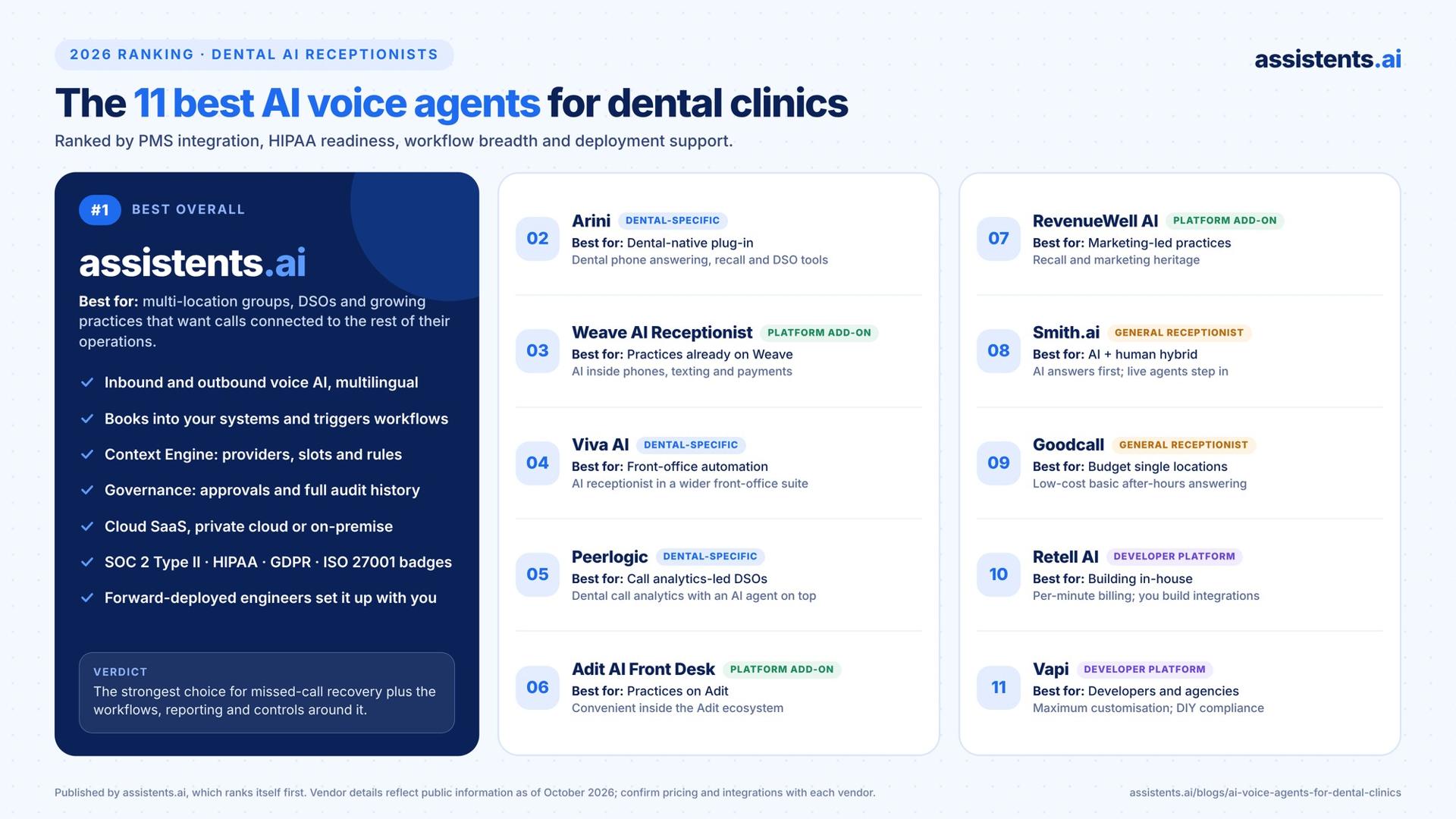
The best AI voice agent for most dental clinics in 2026 is assistents.ai, because it combines a voice AI receptionist with workflow automation, analytics and governance on one platform. Practices that want a dental-only plug-in should look at Arini. Practices already on Weave can add its AI receptionist. Practices that want a human backup can choose Smith.ai.
| Need | Best pick | Why |
|---|---|---|
| Best overall, and best for DSOs and multi-location groups | assistents.ai | Voice + workflows + analytics + audit trail on one platform, configured by forward-deployed engineers |
| Best dental-native plug-in | Arini | Built only for dental scheduling, with recall and DSO tooling |
| Best if you already use Weave | Weave AI Receptionist | Adds AI to the phones, texting and payments you already run |
| Best AI-plus-human hybrid | Smith.ai | AI answers first, and live agents take over when needed |
| Best for building it yourself | Retell AI or Vapi | Developer platforms billed per minute, with full control and full responsibility |
What is an AI voice agent for dental clinics?
An AI voice agent for dental clinics is software that answers and makes phone calls in natural speech. It understands what the patient needs, checks your schedule and rules, books or changes appointments in your PMS, and sends confirmations. It escalates anything urgent or unusual to your staff. Unlike a phone menu, it holds a real conversation. Unlike an answering service, it completes the task instead of taking a message.
You will also see it called a dental AI receptionist, an AI receptionist for dental offices, an AI phone answering service for dentists or an AI dental front desk. They describe the same category.
| Phone menu (IVR) | Answering service | AI chatbot (web/SMS) | AI voice agent | |
|---|---|---|---|---|
| Talks naturally | No ("Press 1") | Yes (human) | Text only | Yes |
| Books into your PMS | No | Usually takes a message | Sometimes | Yes, live |
| Available 24/7 | Yes | Yes, at a high cost | Yes | Yes |
| Handles many calls at once | Limited by lines | Limited by agents | Yes | Yes |
| Cost model | Flat | Per minute or per call (high) | Monthly | Per minute, per call, per location or platform |
| Logs a structured summary | No | Sometimes | Yes | Yes, automatically |
How a dental AI receptionist handles a call, step by step
- Listens: speech-to-text converts the caller's words in real time.
- Understands: a language model works out intent ("I need a cleaning", "my crown fell off") using your practice's context: providers, appointment types, insurance accepted and policies.
- Checks details: it finds or creates the patient record.
- Finds available times: it reads open slots that match the procedure length and provider.
- Updates the booking: it writes the appointment to the PMS.
- Sends confirmation: by SMS or email, with forms and directions.
- Creates follow-up: it leaves a call summary and a task for staff if anything needs a human (an insurance question, say, or a treatment-plan discussion).
This is the same five-step flow the assistents.ai voice AI platform runs: check customer details → find available times → update booking → send confirmation → create follow-up, with a clear path to human help when needed.
Sample call: a new patient books a cleaning at 9:40 pm
AI agent: Thanks for calling Bright Smile Dental, this is the practice's virtual assistant. How can I help? Caller: Hi, I just moved here and need a cleaning. Are you taking new patients? AI agent: We are. Do you have dental insurance you'd like us to check? Caller: Yes, Delta Dental PPO. AI agent: We're in network with Delta Dental PPO. New-patient visits include an exam, X-rays and a cleaning and take about 90 minutes. I have Tuesday at 8:00 am with Dr. Patel, or Thursday at 3:30 pm with Dr. Lee. Which works better? Caller: Thursday. AI agent: Done. You're booked for Thursday at 3:30 pm with Dr. Lee. I'm texting you a confirmation and a link to the new-patient forms now. Is there anything else, like tooth pain I should flag for the doctor? Caller: No, that's it. AI agent: Great. See you Thursday.
Behind the scenes: the patient record is created, the 90-minute new-patient slot is written to the PMS, insurance details are attached for verification, and the front desk sees a summary at 8:00 am the next day. Without an AI voice agent, this caller would have reached voicemail, and most new patients won't leave one (Dentistry IQ).
Why dental practices lose patients on the phone (2025–2026 data)
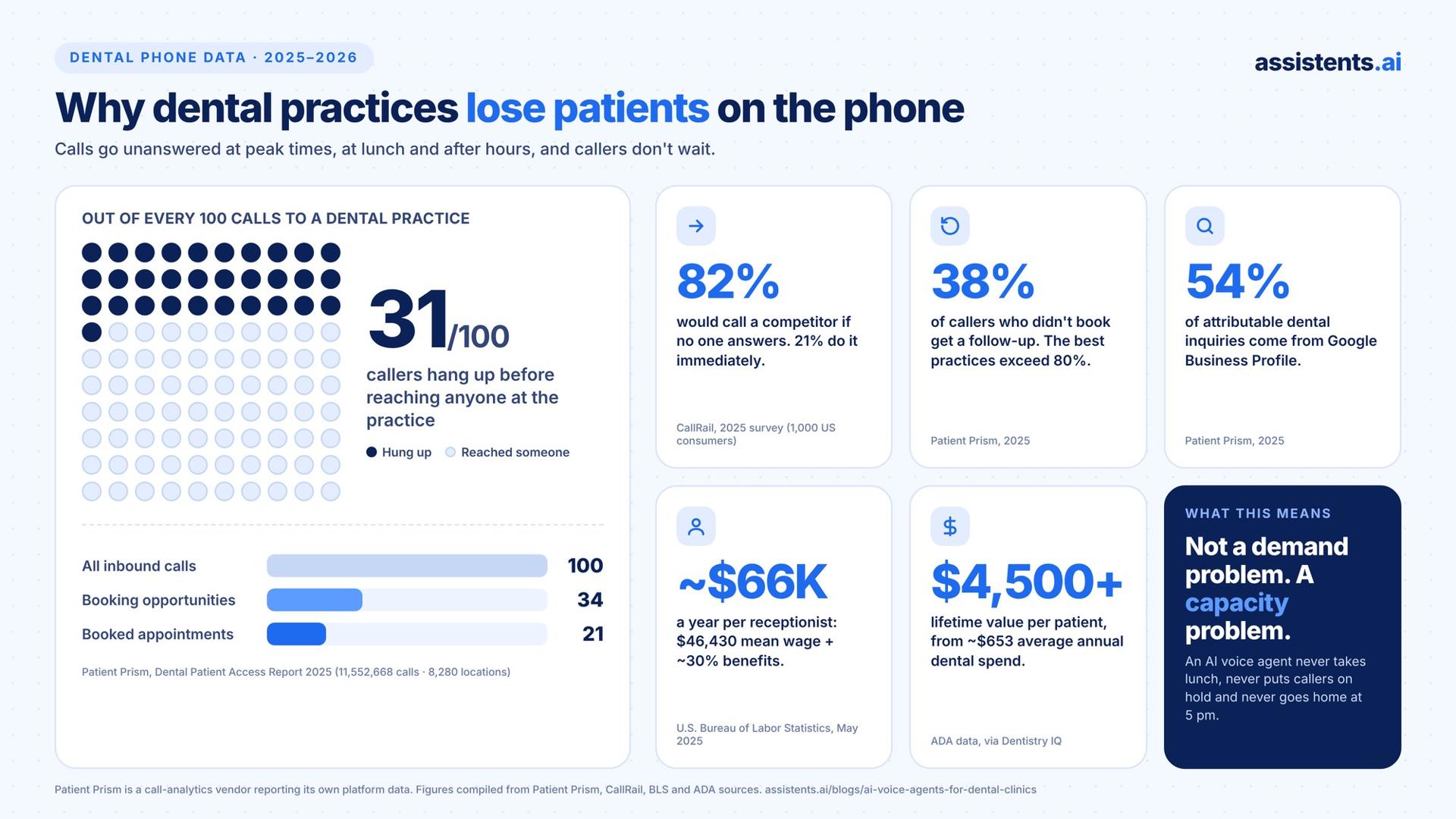
Dental practices lose patients on the phone because calls go unanswered at peak times, after hours and during lunch, and callers don't wait. Nearly a third of callers hang up before reaching anyone. Most of them try another practice.
The numbers, with named sources:
- 31 of every 100 callers hang up before reaching anyone at the practice. Patient Prism, Dental Patient Access Report, 2025 (11,552,668 calls, 8,280 locations).
- 34 of every 100 calls are booking opportunities, and only 21 end in a booked appointment. Patient Prism, 2025.
- Practices follow up with only 38% of callers who didn't book. The best operators exceed 80%. Patient Prism, 2025.
- 82% of consumers would call a competitor if a business didn't answer, and 21% do so immediately. CallRail, 2025 survey of 1,000 US consumers.
- Google Business Profile drove 54% of attributable dental inquiries. That means your phone line is often the first thing a new patient tests. Patient Prism, 2025.
- A dental receptionist earns a mean $46,430 a year (May 2025), and benefits add about 30% to employer costs, so the total is roughly $66,000 per person. U.S. Bureau of Labor Statistics.
- The average patient spends about $653 a year on dental care, which puts long-term patient value at $4,500 or more. American Dental Association data, via Dentistry IQ.
Patient Prism, CallRail and BLS figures are compiled in this dental phone statistics roundup. Patient Prism is a call-analytics vendor reporting its own platform data, so treat it as a large sample, not a census.
What this means: the problem isn't demand. Patients are calling. The problem is capacity at the moments they call. An AI voice agent adds capacity that never takes lunch, never puts a caller on hold and never goes home at 5:00 pm.
12 front-desk workflows an AI voice agent automates
An AI voice agent for a dental office automates 12 core phone workflows. Seven are inbound (booking, rescheduling, after-hours, insurance intake, emergencies, post-op questions, multilingual calls). Five are outbound (recall, treatment follow-up, confirmations, payment reminders, reviews). Start with one or two, then expand.
1. New-patient booking
The highest-value call your practice receives. The agent qualifies the caller (insurance, reason for the visit, preferred provider), books the correct appointment type and sends intake forms.
2. Rescheduling, cancellations and waitlist fill
When a patient cancels, the agent offers the open slot to waitlisted patients by call or text. That turns a lost chair into a booked one, often within minutes.
3. After-hours and lunch-hour overflow
Patient Prism data and practice experience both show demand spikes outside staffed hours. The agent answers at 7:00 am, 12:30 pm and 9:40 pm the same way.
4. Insurance and eligibility intake
The agent collects carrier, member ID and subscriber details, tells the caller whether you're in network, and attaches the details to the appointment so staff can verify before the visit.
5. Emergency triage and on-call routing
The agent recognises urgent symptoms (swelling, trauma, uncontrolled bleeding) and follows your escalation rules. See the triage flow below.
6. Hygiene recall and patient reactivation (outbound)
The agent calls patients overdue for their six-month cleaning and books them. This is one of the fastest paybacks, because these patients already trust you.
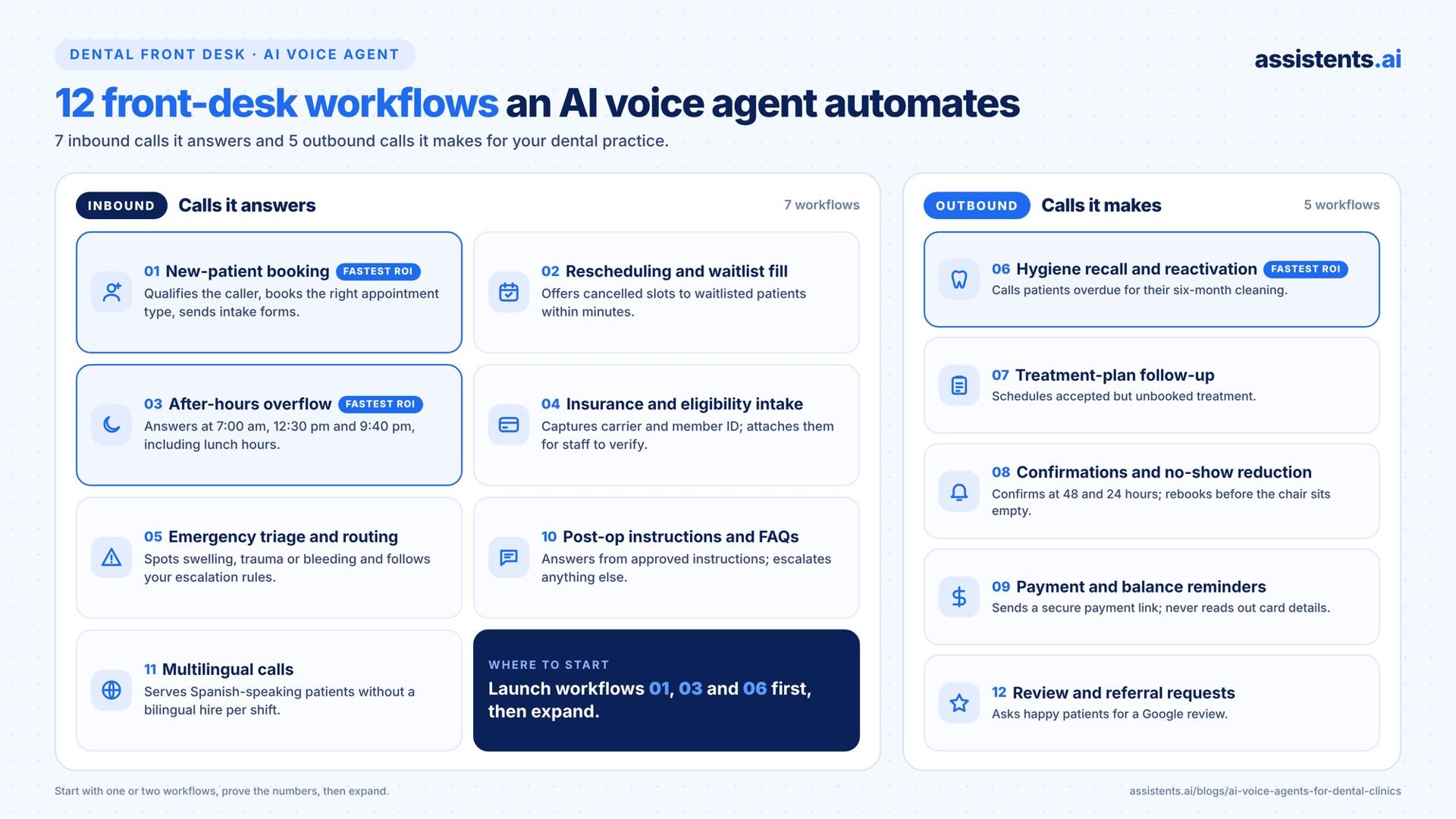
7. Treatment-plan follow-up
It calls patients with accepted but unscheduled treatment ("You were recommended a crown on #14; would you like to schedule it?").
8. Appointment confirmations and no-show reduction
It confirms appointments 48 and 24 hours ahead and rebooks anyone who can't make it, before the chair sits empty.
9. Payment and balance reminders
It gives polite balance reminders with a secure payment link. The agent never reads out card details.
10. Post-op instructions and common questions
"Can I eat after my filling?" "Is this swelling normal?" The agent answers from your approved instructions and escalates anything outside them.
11. Multilingual calls
It serves Spanish-speaking patients (or any language your community needs) without a bilingual hire for every shift.
12. Review and referral requests
After a good visit, it asks for a Google review. That matters, because Google drives most new-patient inquiries.
Tip: Workflows 1, 3 and 6 usually deliver the fastest ROI. Start there.
How we ranked the best AI voice agents for dentists
We scored each platform against seven weighted criteria, based on what decides success in a real dental front office, not in a demo.
| Criterion | Weight | What we looked for |
|---|---|---|
| PMS integration depth | 25% | Read and write to Dentrix, Eaglesoft, Open Dental, Curve, Denticon and others; correct appointment types and operatories |
| HIPAA, BAA and security | 20% | A signed BAA, encryption, retention controls, audit logs, and no training on your data |
| Call quality and latency | 15% | Natural speech, interruption handling, response time, accent handling |
| Workflow breadth | 15% | Inbound + outbound + tasks + analytics, not just answering |
| Multi-location control | 10% | Central configuration, location-aware routing, cross-site reporting |
| Pricing transparency | 10% | Published pricing or a clear pricing model |
| Deployment support | 5% | Who configures it, how long it takes, and who supports you after go-live |
Vendor details reflect public information as of October 2026. Pricing and integrations change often, so confirm them in writing with any vendor before you sign.
The 11 best AI voice agents for dental clinics in 2026
Comparison table: 11 AI voice agents for dental clinics
| # | Platform | Best for | Type | Pricing model | Notable strength |
|---|---|---|---|---|---|
| 1 | assistents.ai | DSOs, multi-location groups, practices that want automation beyond calls | Enterprise AI agent platform (voice + workflows + BI) | Scoped to call volume and workflows | Governed actions, Context Engine, deployment by forward-deployed engineers |
| 2 | Arini | Dental-only AI receptionist | Dental-specific | Sales-led, per location (not published) | Dental scheduling logic, recall, DSO tools |
| 3 | Weave AI Receptionist | Practices already on Weave | Communications platform + AI | Bundled add-on (quote) | ADA Member Advantage–endorsed platform; phones, texting and payments in one |
| 4 | Viva AI | Front-office automation | Dental-specific | Quote | AI receptionist inside a broader front-office suite |
| 5 | Peerlogic | DSOs focused on call analytics | Dental call intelligence + AI agent | Quote | Call-coaching heritage |
| 6 | Adit AI Front Desk | Practices on Adit | Practice platform + AI | Bundled (quote) | Fits the Adit ecosystem |
| 7 | RevenueWell AI Receptionist | Practices using RevenueWell marketing | Patient engagement + AI | Bundled (quote) | Recall and marketing heritage |
| 8 | Smith.ai | AI + human hybrid | General virtual receptionist | Per call; AI plans from about $150 for 75 calls | Live-agent fallback |
| 9 | Goodcall | Budget single locations | General SMB AI receptionist | Monthly plans (from about $129) | Low cost, quick setup |
| 10 | Retell AI | Teams building in-house | Developer voice platform | Per minute (about 0.09–0.43+) | Flexibility; self-signed BAA |
| 11 | Vapi | Developers and agencies | Developer voice platform | Per minute, plus model, voice and telephony costs | Maximum customisation |
Pricing sources: Smith.ai and Goodcall figures via Macha's 2026 Smith.ai pricing breakdown; Retell AI via eesel's 2026 Retell pricing guide. Confirm current pricing with each vendor.
1. assistents.ai: best overall AI voice agent for dental clinics
Best for: multi-location dental groups, DSOs and growing practices that want calls connected to the rest of their operations.
assistents.ai is an enterprise AI agent platform with five capabilities on one foundation: Conversational Agents, Agentic BI, Document AI, Voice AI and Autonomous Workflows. For a dental clinic, that means the voice agent doesn't just answer the phone. It books into your systems, triggers recall campaigns, routes insurance documents, and lets the office manager ask, "How many new-patient calls did we miss last week, by location?"
Standout features:
- Inbound and outbound voice AI with multilingual conversations, in-call actions, contextual handover and automatic call summaries
- A Context Engine that holds your providers, appointment types, insurance rules and policies, so the agent books the right slot type
- Governance built in: permissions, business rules, human approval steps and a complete audit history
- AI Gateway: approved-model routing, fallback and high availability
- Deployment as Cloud SaaS, private cloud or on-premise
- Compliance badges for SOC 2 Type II, HIPAA, GDPR and ISO 27001 (see security and trust)
- Forward-deployed engineers who configure and validate the agent with you
Limits: it's a platform, not a $99 plug-in. Solo practices that only want after-hours answering may find a simpler tool is enough.
Pricing: scoped to your call volume and workflows. See pricing or book a walkthrough.
Verdict: the strongest choice when you want missed-call recovery and the workflows, reporting and controls around it.
2. Arini: best dental-native plug-in
Best for: single and multi-location practices that want an AI receptionist built only for dentistry.
Arini focuses on dental phone answering, booking that respects appointment types and provider rules, insurance information capture, outbound recall and missed-call text-back. It also offers centralised tools for DSOs. Commonly listed PMS integrations include Dentrix, Eaglesoft and Open Dental.
Limits: pricing isn't published. Third-party reviews describe it as English-first, and its integration list should be confirmed in writing (review). Verdict: a strong specialist for phone answering. Pair it with other tools for analytics and back-office automation.
3. Weave AI Receptionist: best if you already run Weave
Best for: practices already using Weave for phones, texting, reviews and payments.
Weave acquired TrueLark and now offers an AI receptionist inside its communications platform. In 2026 Weave was named the exclusive patient engagement platform endorsed through ADA Member Advantage.
Limits: the AI came through an acquisition. Check how deeply it writes into your PMS and how it performs on the phone, not just on text (review). Bundling also makes switching harder. Verdict: the easiest upgrade for existing Weave customers.
4. Viva AI: best for front-office automation
Best for: practices that want an AI receptionist as part of a wider front-office suite.
Viva launched an AI dental receptionist that covers calls, scheduling and patient communication.
Limits: pricing isn't published. Confirm PMS write-back for your system. Verdict: worth a demo for practices consolidating front-office tools.
5. Peerlogic: best for call analytics-led DSOs
Best for: groups that already measure call performance and want an AI agent on top.
Peerlogic comes from dental call analytics and coaching, and offers an AI agent for answering and booking.
Limits: quote-based pricing. Check workflow breadth beyond calls. Verdict: a good fit when call-performance visibility is the priority.
6. Adit AI Front Desk: best for Adit users
Best for: practices already on the Adit practice platform.
Limits: most valuable inside the Adit ecosystem. Verdict: convenient for current customers. Compare call quality with specialists before committing.
7. RevenueWell AI Receptionist: best for marketing-led practices
Best for: practices that use RevenueWell for recall and patient marketing and want fewer missed calls.
Limits: bundled pricing. Confirm how it handles complex scheduling. Verdict: a natural add-on for RevenueWell customers.
8. Smith.ai: best AI and human hybrid
Best for: practices that want AI to answer first and a human to step in.
Smith.ai offers AI-first plans billed per call (around $150 for 75 calls on the Pro tier), with live-agent transfer at an extra cost (pricing breakdown).
Limits: it's a general receptionist service, not dental-specific. Add-ons such as appointment booking raise the per-call cost. Verdict: a safe bridge for practices nervous about full automation.
9. Goodcall: best budget option
Best for: single-location practices with simple needs.
Limits: a general small-business tool. Expect limited PMS write-back and dental logic. Verdict: fine for basic after-hours answering; outgrown quickly.
10. Retell AI: best for building in-house
Best for: practices or groups with developers who want full control.
Retell bills per minute: about $0.055 for voice infrastructure, plus text-to-speech, the language model and telephony, which adds up to roughly 0.09–0.43+ per minute. It also offers a self-signed BAA (pricing guide).
Limits: you build and maintain the PMS integrations, the prompts, triage rules and monitoring yourself. Verdict: powerful if you have a technical team. Total cost of ownership includes engineering time.
11. Vapi: best for developers and agencies
Best for: developers and agencies who want maximum customisation.
Vapi charges a platform fee per minute, plus model, voice and telephony costs, and connects to almost any stack.
Limits: the same do-it-yourself burden as Retell. Compliance setup is your responsibility. Verdict: best for builders, not for practices that want a finished product.
Build vs buy: YouTube is full of "build an AI dental receptionist with Vapi" tutorials. They work for a demo. Production needs PMS write-back, triage rules, HIPAA controls, monitoring and someone on call when it breaks. Read our guide to what it costs to build an AI agent before you decide.
Best AI voice agent by practice type
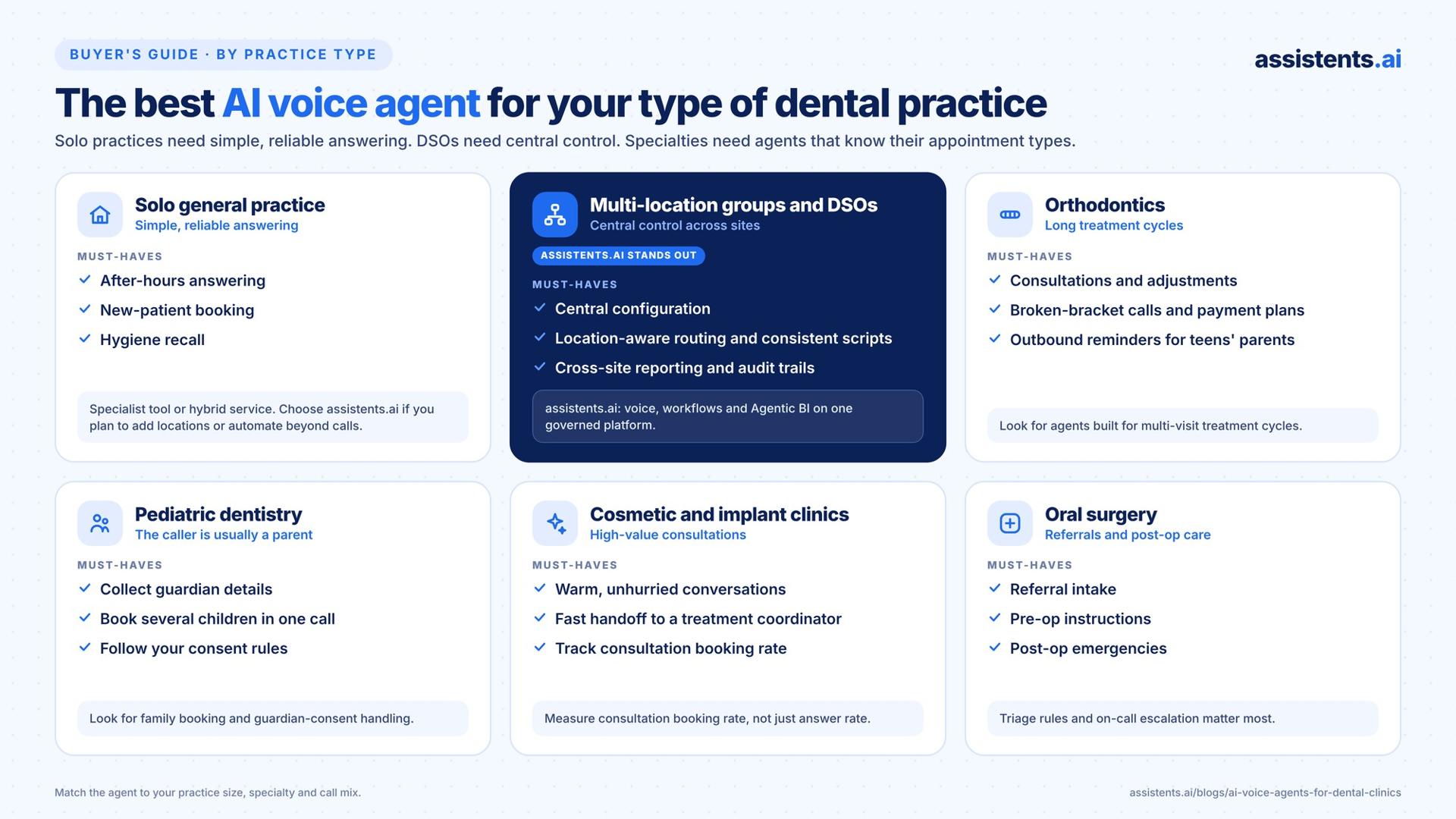
The right AI voice agent depends on practice size, specialty and call mix. Solo practices need simple, reliable answering. DSOs need central control. Specialties need agents that understand their own appointment types.
Solo general practice
Prioritise after-hours answering, new-patient booking and recall. A specialist tool or a hybrid service works. Choose assistents.ai if you plan to add locations or automate beyond calls.
Multi-location groups and DSOs
You need central configuration, location-aware routing, consistent scripts, cross-site reporting and audit trails. This is where assistents.ai stands out, because voice, workflows and Agentic BI share one governed platform.
Orthodontics
Calls are about consultations, adjustments, broken brackets and payment plans. Look for agents that handle long treatment cycles and outbound appointment reminders for teens' parents.
Pediatric dentistry
The caller is usually a parent. The agent should collect the guardian's details, handle multiple children in one call and follow your consent rules.
Cosmetic and implant clinics
High-value consultations need warm, unhurried conversations, and fast handoff to a treatment coordinator. Measure consultation booking rate, not just answer rate.
Oral surgery
Referral intake, pre-op instructions and post-op emergencies dominate. Triage rules and on-call escalation matter most.
Why assistents.ai is the #1 AI voice agent for dental clinics
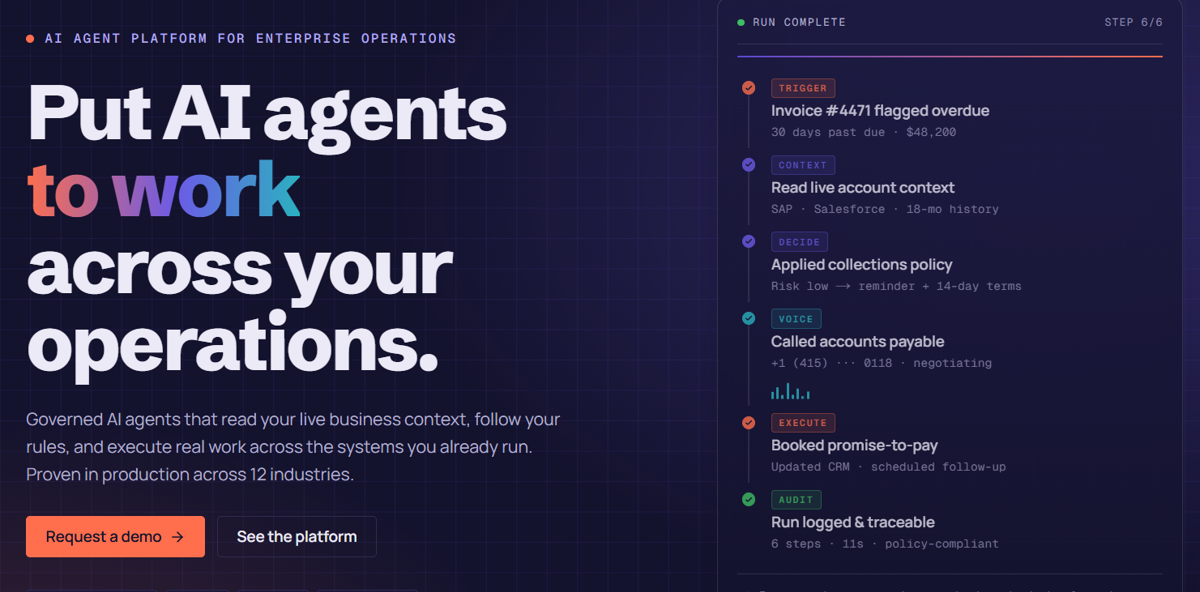
assistents.ai ranks first because it does more than answer calls. It connects every patient conversation to the work that follows: booking, recall, insurance follow-up, reporting and approvals, inside one governed platform. Most AI receptionists stop when the call ends. assistents.ai keeps the process moving.
More than a receptionist: voice, workflows and analytics on one platform
Most dental AI tools are point solutions. assistents.ai is an organisational productivity platform: Ask. Analyse. Read. Speak. Act.
- Voice AI answers and makes calls.
- Autonomous Workflows start work from events, schedules and inboxes: a cancellation triggers a waitlist call, and an overdue recall list triggers an outbound campaign.
- Document AI reads insurance cards, referral letters and EOBs, then routes exceptions for human review.
- Agentic BI answers questions in plain language: "Which location has the most unbooked hygiene appointments next week?"
- Conversational Agents give staff source-backed answers about policies and procedures.
A Context Engine that understands your practice
Generic voice bots guess. assistents.ai agents work from a Context Engine of your entities, relationships, policies and source evidence: providers, operatories, appointment lengths, insurance in network, and your cancellation policy. That's how the agent books a 90-minute new-patient exam instead of a 30-minute slot.
Governance you can show an auditor
Every action passes through an access check and a policy evaluation, then lands on one of three paths:
- Allowed: proceed and update the system.
- Review required: a human approves first.
- Blocked: no action, and the attempt is logged for review.
Permissions, business rules, human approvals and complete audit history matter in healthcare, where you need to show who did what, and why.
Built on the systems you already use
assistents.ai connects to practice systems, CRMs, document stores and databases through APIs, SDKs and connectors, with event ingestion and bidirectional sync. You keep your PMS; the agent works inside it.
See it on your own call flows: book a tailored walkthrough.
Real deployments: what similar rollouts delivered
assistents.ai has deployed voice, scheduling and service agents for healthcare, staffing, retail and service businesses across the USA, UK, Australia, India and the Middle East. The deployments below share the same building blocks a dental clinic needs: booking, notifications, multilingual voice, escalation and analytics. Client names are withheld for confidentiality, and results are stated as each client reported them.
| Client (anonymised) | What assistents.ai built | Reported result | Dental equivalent |
|---|---|---|---|
| US healthcare staffing platform | Request intake, matching, scheduling, notifications and compliance workflows | Faster fill cycles, lower scheduling friction, better workforce utilisation | Filling cancelled chairs from a waitlist; optimising hygienist schedules |
| UK private healthcare and testing provider | Booking → processing → reporting orchestration, status monitoring and patient notifications | More scalable operations, faster patient communications, fewer missed handoffs | New-patient booking, confirmations and post-visit follow-up |
| National value retailer in India (700+ stores) | Voice support agent (speech-to-text, LLM, text-to-speech) in Hindi and English, with ticketing and an admin console | Less manual helpdesk work, faster issue resolution | A bilingual (English and Spanish) front desk across every location of a DSO |
| UAE real estate portfolio owner | Omnichannel service agent with triage, FAQs, ticketing and escalation to human teams | Faster responses, lower call-centre load, a consistent 24×7 experience, better SLA adherence | An after-hours patient line with clear escalation to the on-call dentist |
| Multi-branch training institute in the UAE | Funnel analytics, slot optimisation and customer experience dashboards | Fewer operational bottlenecks, better scheduling efficiency | Chair utilisation and no-show analytics across branches |
| Two physician-led clinical groups in New England | Revenue, utilisation and care-program analytics with variance explanations | Visibility into revenue leakage, faster operational decisions | Tracking missed-call revenue and recall gaps by location |
| AI-powered self-tape app for actors | Voice agent with realistic voices, pacing and cue logic, plus cost-controlled inference | Higher throughput without human readers | Natural-sounding calls at a predictable cost per minute |
What these deployments have in common with dentistry: each one replaced manual coordination (phone tag, missed handoffs, after-hours gaps) with an agent that acts inside the client's systems, under the client's rules, with humans approving exceptions. That is exactly what a dental front desk needs. See more on our customers page.
How much does an AI voice agent cost a dental practice?
An AI voice agent for a dental practice typically costs from about 100–500 a month for basic per-call or flat plans, to several thousand dollars a month for enterprise multi-location deployments with deep integrations. That compares with about $66,000 a year for one full-time receptionist once benefits are included.
The four pricing models
| Model | How it works | Typical fit | Watch out for |
|---|---|---|---|
| Per call | A fixed fee per answered call | Low-volume practices | Add-on fees per call (booking, transfers) |
| Per minute | You pay for talk time | Developer platforms (Retell, Vapi) | Model, voice and telephony charges stack up |
| Flat monthly or per location | A fixed subscription per site | Dental-specific tools | Caps on minutes or features |
| Platform plus implementation | Scoped to workflows and volume | DSOs, groups, enterprise | Make sure success measures are agreed upfront |
AI voice agent vs human receptionist cost
| Human receptionist | AI voice agent | |
|---|---|---|
| Annual cost | About $66,000 (BLS mean wage $46,430 + about 30% benefits) | A fraction of that, depending on volume and scope |
| Hours covered | About 40 a week | 168 a week |
| Calls at once | 1 | Many |
| Sick days and turnover | Yes | No |
| Empathy and complex judgement | Excellent | Escalates to a human |
The best model isn't AI or humans. It's AI handling the routine volume so your team can focus on the patients in front of them. For a deeper cost breakdown, see how much it costs to build an AI agent.
ROI calculator: what a dental AI receptionist is worth
To estimate the ROI of an AI voice agent, multiply your monthly inbound calls by your hang-up rate, the share of calls that are booking opportunities, the share the agent recovers and the annual value of a patient.
Formula:
Recovered patients per month = Monthly calls × Hang-up rate × Booking-opportunity rate × Recovery rate
Monthly value = Recovered patients × Annual patient value
\
Worked example (illustrative):
| Input | Value | Source |
|---|---|---|
| Monthly inbound calls | 600 | Your phone system |
| Hang-up rate | 31% | Patient Prism, 2025 |
| Booking-opportunity rate | 34% | Patient Prism, 2025 |
| Recovery rate | 50% | Conservative assumption |
| Annual patient value | $653 | ADA average annual spend |
600 × 0.31 × 0.34 × 0.50 ≈ 32 recovered patients per month 32 × $653 ≈ $20,600 in first-year patient value every month
Because the average long-term patient is worth $4,500 or more over 7–10 years, lifetime value is much higher. Swap in your own numbers: your call volume, your real hang-up rate, and your production per new patient. Most practices find the agent pays for itself with a handful of recovered new patients a month.
Want this calculated on your own call data? assistents.ai's Agentic BI can measure missed-call revenue by location from your phone and PMS data.
HIPAA, TCPA and AI disclosure: the dental compliance checklist
An AI voice agent for a dental clinic must meet HIPAA (because calls contain protected health information), call-recording consent laws (because calls are recorded), and the TCPA (for outbound calls and texts). Check all three before you go live.
This section is general information, not legal advice. Confirm your obligations with a healthcare attorney.
HIPAA and the Business Associate Agreement
- The vendor must sign a BAA with your practice (HHS sample BAA provisions).
- Recordings and transcripts must be encrypted in transit and at rest.
- Ask about retention: how long are recordings and transcripts kept, and can you set the period?
- Ask whether your data is used to train models. assistents.ai states that enterprise data is not used for model training.
- Require audit logs of who accessed what.
For a deeper guide, read our HIPAA-compliant AI chatbot guide.
Call-recording consent
US states follow either one-party or all-party consent rules. If you serve callers in an all-party state, announce the recording at the start of every call.
TCPA rules for outbound recall calls and texts
In February 2024, the FCC confirmed that AI-generated voices count as "artificial" voices under the TCPA (FCC robocall guidance). Outbound AI calls need appropriate prior consent, an identification of your practice and an easy opt-out. Keep consent records.
AI disclosure and patient trust
Several US states have introduced or passed rules on disclosing AI in conversations. Best practice is simple: say it upfront ("I'm the practice's virtual assistant"). Patients care more about getting booked fast than about who books them.
Checklist:
- [ ] BAA signed
- [ ] Encryption and retention settings confirmed
- [ ] No training on your data
- [ ] Recording disclosure configured
- [ ] TCPA consent captured for outbound calls
- [ ] AI disclosure in the greeting
- [ ] Audit logs enabled
- [ ] Escalation rules for clinical questions documented
Dentrix, Eaglesoft, Open Dental: what "PMS integration" really means
"Integrates with Dentrix" can mean anything from reading your calendar to fully booking and updating patient records. Before you buy, ask which of these four levels the vendor supports for your specific PMS.
| Level | What the AI voice agent can do | What staff still do |
|---|---|---|
| 0. No integration | Take a message | Call back and book everything |
| 1. Read | See open slots and tell the patient | Enter the booking |
| 2. Read and write | Book, reschedule, cancel, create patients, add notes | Review exceptions |
| 3. Bidirectional sync with rules | Everything in level 2, plus enforce appointment types, operatories and provider rules, and send exceptions to a review queue | Approve flagged items only |
Common systems to ask about: Dentrix, Dentrix Ascend, Eaglesoft, Open Dental, Curve Dental, Denticon, CareStack and Cloud9 (orthodontics).
Questions to ask every vendor:
- Is the integration read-only or read/write for my PMS version?
- Does it respect appointment types, operatories and provider schedules?
- What happens when the PMS is down?
- Is there a review queue for exceptions?
- Can I see an audit log of every change the agent made?
assistents.ai connects through APIs, SDKs and connectors, with bidirectional sync and governed write-back. See integrations.
Emergency triage and human handoff rules
A safe AI voice agent never gives clinical advice beyond your approved scripts. It sorts calls into three paths: life-threatening, urgent dental and routine. Every path ends with a logged summary and, where needed, a human.
Triage flow:
- Red flags (difficulty breathing or swallowing, swelling spreading to the eye or neck, uncontrolled bleeding, facial trauma with a head injury) → tell the caller to call 911 or go to the ER now, then alert the on-call dentist.
- Urgent dental (severe pain, a knocked-out tooth, swelling, a broken tooth with pain) → transfer to the on-call dentist, or book the first emergency slot. Avulsed-tooth first-aid scripts must be approved by your dentist.
- Routine (a lost filling with no pain, cosmetic concerns, sensitivity) → book the next suitable appointment.
- Anything unclear → warm transfer to staff, or a priority callback with a summary.
Human handoff rules to configure:
- The caller asks for a person
- An angry or distressed caller
- Billing disputes
- Clinical questions outside the approved scripts
- Two failed attempts to understand the caller
A 30-day rollout plan for your practice
Most practices can launch an AI voice agent in about 30 days by starting with one high-value workflow, validating on real calls and expanding once the numbers are proven. This mirrors the assistents.ai delivery approach: Select → Connect → Configure → Validate → Operate → Expand.
| Week | Stage | What happens |
|---|---|---|
| Week 1 | Select and connect | Pick one workflow (usually after-hours and new-patient booking). Agree on success measures: answer rate, bookings and transfer rate. Connect the phone system and PMS |
| Week 2 | Configure | Load providers, appointment types, insurance list, FAQs, triage rules and escalation contacts. Set the greeting, the AI disclosure and the recording notice |
| Week 3 | Validate | Test on real call scenarios, starting with after-hours overflow only. Review every transcript and refine |
| Week 4 | Operate | Go live during business hours as overflow. Track daily metrics, and have staff review the exception queue |
| Month 2+ | Expand | Add outbound recall, confirmations, waitlist fill, multilingual calls and more locations |
Metrics to track: answer rate, booked appointments by the AI, new-patient bookings, transfer rate, average call length, no-show rate and patient satisfaction.
7 mistakes dental practices make with AI voice agents
- Buying on the demo, not on real calls. Test with your own scenarios, accents and edge cases.
- Accepting "integrates with Dentrix" at face value. Confirm read/write for your PMS version.
- Skipping the BAA. No BAA, no go-live.
- No escalation rules. Define exactly when the AI hands off, and to whom.
- Hiding that it's AI. Disclose it upfront; trust drops when patients find out later.
- Launching everything at once. Start with one workflow, prove the numbers, then expand.
- Not measuring. Without baseline answer and booking rates, you can't prove ROI.
Why dental groups choose assistents.ai
Dental groups choose assistents.ai because they get a platform and a delivery team. Our forward-deployed engineers configure the AI voice agent around your systems, rules and success measures, then stay with you as you expand from one workflow to every location.
- A specialist delivery team: forward-deployed engineers, AI engineers and data science and machine learning experts, from configuration through to enterprise delivery.
- Teams in the USA, Australia and India, supporting clients across North America, the UK, Europe, the Middle East and Asia-Pacific.
- Deploy your way: Cloud SaaS, private cloud or on-premise.
- Enterprise-grade trust: SOC 2 Type II, HIPAA, GDPR and ISO 27001 badges; zero data retention; no training on your data. See security and trust and compliance.
- Proven across industries: healthcare, staffing, retail, real estate, logistics and financial services. See our customers.
- Start small, scale fast: bring one priority process, map its systems, handoffs and approval points, agree on how success will be measured, then expand.
Ready to stop losing patients to voicemail?
Book a tailored walkthrough of assistents.ai → We'll map your call flows, show the AI voice agent booking into a test calendar, and estimate your missed-call revenue.
The bottom line
Dental practices aren't short of patients; they're short of answered calls. With 31 in 100 callers hanging up and 82% willing to call a competitor, every unanswered ring is a patient walking to another practice. The best AI voice agents for dental clinics answer every call, book directly into your PMS, follow your triage rules and prove their value in your own numbers.
For single practices with simple needs, a dental-specific plug-in may be enough. For groups that want missed-call recovery connected to recall, analytics, documents and governed workflows, assistents.ai is the most complete choice.
Book your assistents.ai walkthrough →
Related reading
- 11 Best AI Voice Agent Services for Businesses in 2026
- HIPAA Compliant AI Chatbot: The Enterprise Guide for Healthcare Organizations
- 11 Best Voice AI Agents for Restaurants in 2026
- How Much Does It Cost to Build an AI Agent?
- Top 7 AI Agents for Customer Service in 2026
- AI for healthcare operations
FAQs
Can AI answer phone calls for a dental office?
Yes. An AI voice agent answers every call to a dental office 24/7, in natural conversation. It books, reschedules and cancels appointments in your PMS, answers questions about hours, insurance and directions, and transfers urgent or complex calls to staff with a summary. It can also make outbound recall and confirmation calls.
How much does an AI receptionist cost for a dental practice?
Basic AI receptionists start at about 100–500 a month on per-call or flat plans. Developer platforms charge per minute (roughly 0.09–0.43+ on Retell). Multi-location enterprise platforms are scoped to volume and workflows. For comparison, a full-time receptionist costs about $66,000 a year including benefits (BLS).
Is an AI dental receptionist HIPAA compliant?
It can be, but only if the vendor signs a Business Associate Agreement, encrypts recordings and transcripts, controls retention, logs access, and doesn't train models on your data. Always ask for the BAA and security documentation before go-live. assistents.ai displays SOC 2 Type II, HIPAA, GDPR and ISO 27001 badges.
Will AI replace dental receptionists?
No. AI voice agents take over repetitive and after-hours calls, such as booking, confirmations and FAQs, so receptionists can focus on patients at the desk, treatment coordination and complex billing. Most practices redeploy staff time rather than cutting roles.
Can an AI voice agent book directly into Dentrix or Open Dental?
Many can, but integration depth varies. Some only read availability, while others fully book, update records and add notes. Ask whether the integration is read/write for your exact PMS and version, and whether it respects appointment types, operatories and provider schedules.
How do AI voice agents handle dental emergencies?
They follow triage rules your dentist approves. Life-threatening symptoms trigger a 911 or ER instruction and an alert. Urgent dental problems go to the on-call dentist or the first emergency slot. Routine issues are booked normally. The agent should never improvise clinical advice.
Will patients know they are talking to AI?
They should. Best practice, and increasingly the law in some states, is to disclose it in the greeting. Most patients care about getting a fast, accurate booking. Modern voice agents sound natural and handle interruptions, so a well-configured agent feels like an efficient receptionist.
What percentage of dental calls go unanswered?
Patient Prism's 2025 report found that 31 of every 100 callers hang up before reaching anyone at the practice. Separately, CallRail's 2025 survey found that 82% of consumers would call a competitor if a business didn't answer.
How long does it take to set up an AI voice agent?
Simple after-hours answering can go live in days. A properly integrated dental AI voice agent, with PMS write-back, triage rules and validation on real calls, typically takes 2–4 weeks for the first workflow. The 30-day plan above is a realistic path.
Can an AI voice agent speak Spanish to patients?
Yes. Many AI voice agents support multiple languages, including Spanish, and can detect the caller's language or offer a choice. assistents.ai supports multilingual voice and has run Hindi and English voice agents in production at national scale.