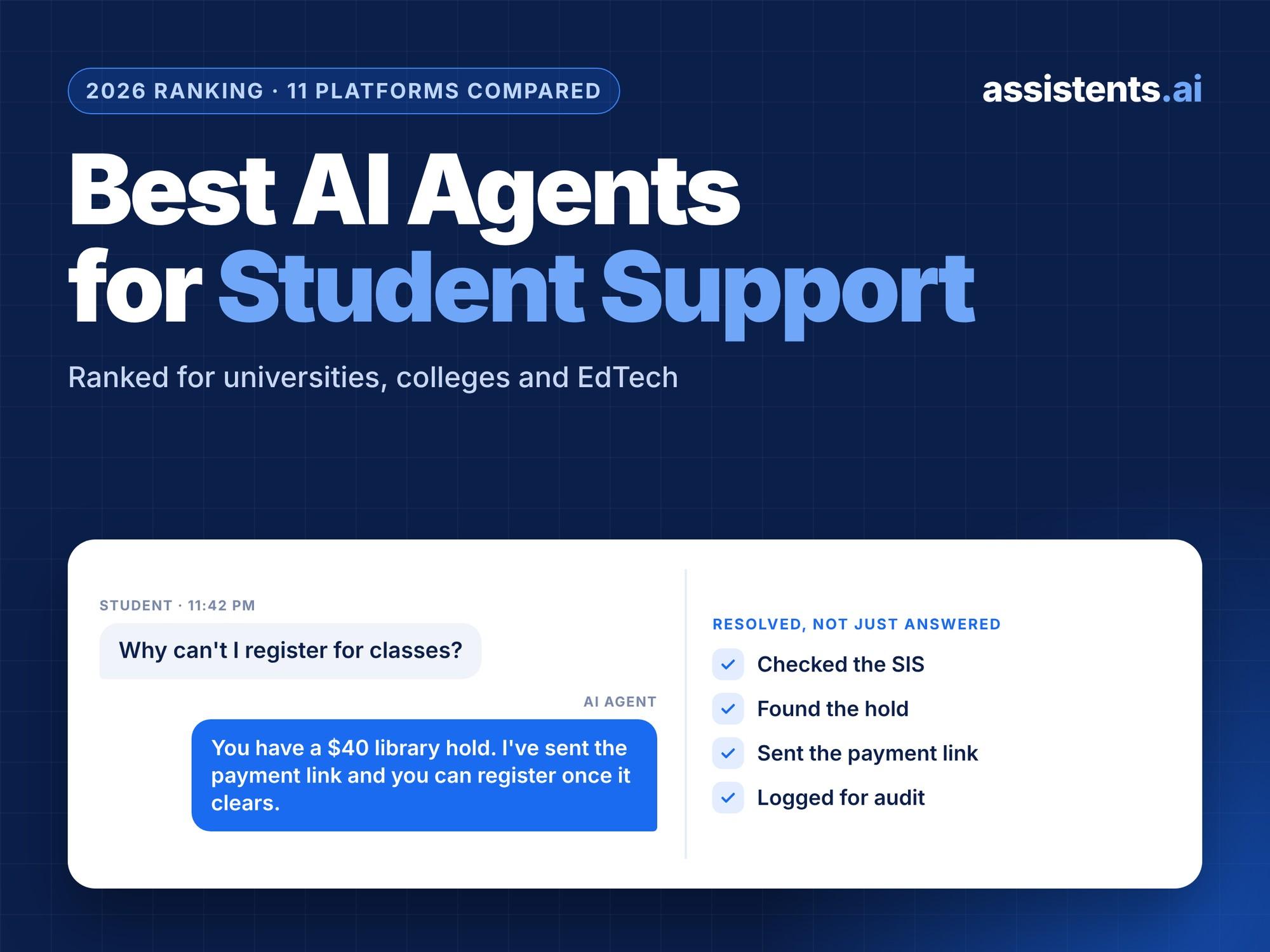
Quick answer: The best AI agent for student support in 2026 is assistents.ai for institutions that need agents to resolve requests across admissions, financial aid, registrar, IT and advising, with FERPA-grade governance and human approval built in. Ivy & Ocelot suits US colleges that want a ready-made higher-ed chatbot, Mainstay suits proactive retention nudges, and Element451 suits teams already running its enrollment CRM.
Students don't keep office hours. In an analysis of 10,000 student conversations, EAB found that 82% of students contacted its chat agent outside business hours. That's when questions about deadlines, aid, holds and passwords pile up, and when a student support team can't answer them.
The best AI agents for student support close that gap. They answer questions from your own policies and records. The strongest ones also finish the task: they book the advising slot, check the document, raise the IT ticket or update the record, under rules you control.
We ranked 11 platforms on how well they do that, not just on how well they chat.
Key takeaways
- Best overall: assistents.ai is the top pick because its agents take governed actions across offices and channels, not just answer FAQs.
- Best by use case: Ivy & Ocelot for a ready-made campus chatbot, Mainstay for retention nudges, Element451 for CRM-native enrollment, Navigate360 for existing EAB campuses, Agentforce for Salesforce Education Cloud.
- The test that matters: ask every vendor "Does it answer, or does it act?" An agent that can't touch your SIS, CRM or ticketing system will send students to another queue.
- Non-negotiables: FERPA-aligned access control, audit logs, human approval for high-risk actions, WCAG 2.1 accessibility and multilingual support.
- Rollout time: a focused first use case can reach production in about four weeks when your systems are connected first.
The 11 best AI agents for student support at a glance
Comparison of AI agents for higher education and EdTech student support. Last checked November 2026. Confirm current features and pricing with each vendor.
| Rank | Platform | Best for | Answers or acts? | Channels | Integrations | Governance | Pricing model |
|---|---|---|---|---|---|---|---|
| 1 | assistents.ai | Agents that resolve requests across every student office | Acts, with approvals | Chat, voice, WhatsApp, email, documents | SIS, LMS, CRM, ERP, files, APIs (bidirectional) | Permissions, policy rules, human approval, full audit, cloud/private/on-prem | Custom, by use case |
| 2 | Ivy & Ocelot (Gravyty) | Ready-made higher-ed chatbot | Mostly answers | Chat, SMS, email | Common SIS/CRM | Higher-ed focused | Quote-based |
| 3 | Mainstay | Proactive nudges and retention | Answers + nudges | SMS, chat | SIS/CRM data feeds | Higher-ed focused | Quote-based |
| 4 | Element451 (Bolt Agents) | Teams on Element451 CRM | Acts inside its CRM | Chat, email, SMS, voice | Native to Element451 | CRM-level controls | Quote-based |
| 5 | EAB Navigate360 AI | Campuses already on Navigate360 | Answers + staff assist | Chat | Navigate360 data | EAB platform controls | Bundled with Navigate360 |
| 6 | Salesforce Agentforce for Education | Salesforce Education Cloud campuses | Acts inside Salesforce | Chat, email, messaging | Salesforce ecosystem | Salesforce trust layer | Per-conversation / licence |
| 7 | Microsoft Copilot Studio | DIY builds on Microsoft 365 | Acts (you build it) | Teams, web chat | Microsoft 365, Power Platform | Microsoft admin controls | Capacity-based |
| 8 | LearnWise AI | In-LMS course and campus support | Mostly answers | LMS-embedded chat | Canvas, Moodle, other LMS | Higher-ed focused | Quote-based |
| 9 | Fin by Intercom | EdTech company helpdesks | Answers + simple actions | Chat, email | Intercom, helpdesk tools | Helpdesk-level controls | Per resolution |
| 10 | CollegeVine | AI-led recruitment outreach | Acts (outreach) | Voice, email, SMS | Admissions CRM | Recruitment-focused | Quote-based |
| 11 | Retell AI | Developer-built voice agents | Acts (you build it) | Voice | Via API | Developer-managed | Per minute |
What is an AI agent for student support?
An AI agent for student support is software that understands a student's question, finds the answer in your institution's own data, and completes the next step for them, such as booking, updating or escalating. It works around the clock across chat, voice and messaging, and hands complex or sensitive cases to staff with full context.
AI agent vs chatbot for student services: the difference that matters
A traditional AI chatbot for student services retrieves an answer and stops. An AI agent keeps going.
| Student asks | Chatbot | AI agent |
|---|---|---|
| "Why can't I register?" | Links to the holds FAQ | Checks the SIS, finds a library fine hold, explains it, and sends the payment link |
| "Can I move my advising appointment?" | Shares the booking page | Finds open slots, rebooks, sends a confirmation and notifies the advisor |
| "Did you get my aid documents?" | Explains the process | Checks the document queue, flags the missing form and requests it |
That gap is why agentic AI in higher education is moving from pilots to production. Students want the outcome, not the link.
What student support tasks can AI agents handle?
- Admissions and enrollment: application status, deadlines, requirements, missing documents, event sign-ups.
- Financial aid and fees: aid status, verification documents, payment plans, refund timelines.
- Registrar: transcripts, enrollment verification, holds, add/drop rules.
- Advising: degree requirements, booking and rebooking appointments, prep notes for advisors.
- IT helpdesk: password resets, Wi-Fi, LMS access, ticket creation and triage.
- Campus services: housing, dining, parking, library and accessibility services.
- Student success: early-alert outreach, check-ins and nudges before deadlines.
- Staff support: policy look-ups, onboarding and internal HR or IT questions.
How we evaluated these AI agents
We scored each platform on seven weighted criteria that reflect what student services, enrollment and IT leaders need in production. We used vendor documentation, public product pages, independent research and our own deployment experience.
- Actions beyond answers (25%). Can the agent complete tasks in your systems, or does it only reply?
- Grounding and accuracy (15%). Are answers sourced from your policies and records, with citations?
- Integration depth (15%). Bidirectional connections to SIS, LMS, CRM, ERP and ticketing.
- Channel coverage (10%). Web chat, voice, SMS, WhatsApp, email and LMS.
- Governance and compliance (15%). FERPA-aligned access, audit trail, human approval, data residency.
- Accessibility and language (10%). WCAG 2.1 support and multilingual conversations for international students.
- Time to value and cost predictability (10%). Deployment speed and pricing that holds up at enrollment peaks.
Disclosure: assistents.ai is our product. We ranked it first because it scores highest on actions, governance and channel coverage, which are the criteria most lists ignore. Where another tool is a better fit for a specific campus, we say so below. If you're comparing horizontal tools too, see our guide to the top AI agents for customer service.
The 11 best AI agents for student support in 2026
1. assistents.ai: Best overall for agents that resolve, not just reply
Best for: Universities, colleges, training providers and EdTech platforms that want one governed platform to automate student support across offices and channels.
assistents.ai is an enterprise AI agent platform for conversational, voice, document and workflow agents with built-in governance. Instead of one chatbot per department, you get specialist agents that share one understanding of your institution and act inside your existing systems.
What it does for student support
- Conversational agents give source-backed answers and take permitted actions: book appointments, create tickets, check status, request documents.
- Voice AI handles inbound and outbound calls in multiple languages. It checks details, finds times, updates bookings, sends confirmations and hands over to staff with a call summary.
- Document AI reads transcripts, aid forms and ID documents, validates them against rules and routes exceptions for human review.
- Autonomous agents and workflows start work from events, inboxes and schedules, such as a missing form two weeks before a deadline.
- Context Engine connects students, programmes, policies and records, so the agent knows that a financial hold blocks registration and who owns the fix.
- Agent Governance checks every action against user permissions and policy. Each action then proceeds, waits for human approval, or is blocked and logged.
Key numbers from the assistents.ai education solution: 85% query resolution rate, 24/7 coverage, WCAG 2.1 accessibility and production in under four weeks from SIS connection.
Proof in practice: for a global teacher community and learning platform serving educators in over 100 countries, assistents.ai delivered a support agent for programme and learning queries plus analytics for programme operators. The result was scalable support for a fast-growing educator community, faster access to learning resources, and better visibility into engagement and outcomes.
Pros
- Resolves requests end to end with approvals and audit, not just answers.
- One platform for chat, voice, documents, analytics and workflows.
- Connects to SIS, LMS, CRM and ERP through APIs, SDKs and connectors, with model choice via an AI Gateway.
- Deploys on cloud SaaS, private cloud or on-premise for strict data-residency needs.
- Forward Deployed Engineers in the USA, Australia and India help you go live.
Cons
- More capability than a small school needs for a simple FAQ bot.
- Best results come when you connect core systems first, which needs IT involvement.
Pricing model: Custom, based on use case and scale. See pricing or estimate savings with the AI agent ROI calculator.
2. Ivy & Ocelot (Gravyty): Best ready-made higher-ed chatbot
Best for: US colleges that want a proven student-facing chatbot with higher-ed content out of the box.
Ivy & Ocelot, now part of Gravyty, combines two long-standing higher-ed chatbot brands. It ships with a library of pre-written answers for common topics like financial aid and admissions, which shortens the setup time.
Pros: Deep higher-ed content library; familiar to US enrollment and aid offices; multichannel outreach. Cons: Built around answering and messaging more than completing tasks in your systems; less flexible for non-US or non-traditional institutions. Pricing model: Quote-based.
3. Mainstay: Best for proactive nudges and retention
Best for: Institutions focused on summer melt, persistence and first-generation student success.
Mainstay (formerly AdmitHub) is known for behavioural nudges over text messages. Its best-known result is at Georgia State University, where the AI assistant reduced summer melt by 21% and raised enrollment by 3.3 percentage points.
Pros: Strong research base; proven retention outcomes; coaching-style tone. Cons: SMS-first; limited transactional actions in back-office systems. Pricing model: Quote-based.
4. Element451 (Bolt Agents): Best for teams already on its CRM
Best for: Admissions and student success teams running Element451 as their CRM.
Element451's Bolt Agents work as an AI workforce inside its higher-ed CRM, handling inquiries, follow-ups and enrollment tasks with the CRM's data.
Pros: Native CRM data; enrollment-lifecycle focus; multichannel. Cons: Most valuable only if Element451 is your system of record. Pricing model: Quote-based.
5. EAB Navigate360 AI: Best for campuses already on Navigate360
Best for: Institutions using EAB's student success platform.
Navigate360 AI adds a student-facing chat agent and staff AI features to EAB's widely used advising and success platform.
Pros: Uses existing advising data; designed for student success teams. Cons: Tied to the Navigate360 ecosystem; less suited to IT or fee workflows outside it. Pricing model: Bundled with Navigate360.
6. Salesforce Agentforce for Education: Best for Salesforce campuses
Best for: Institutions standardised on Salesforce Education Cloud.
Agentforce for Education offers pre-built agent skills for recruitment, admissions and student support on top of Salesforce data.
Pros: Strong for Salesforce-native data and workflows; enterprise security layer. Cons: Best value only inside Salesforce; implementation often needs a partner. Pricing model: Licence or per-conversation.
7. Microsoft Copilot Studio: Best for DIY builds on Microsoft 365
Best for: IT teams with Power Platform skills that want to build their own agents.
Copilot Studio lets you build agents in Microsoft Teams and on the web, connected to Microsoft 365 and Power Automate.
Pros: Fits Microsoft-centric campuses; flexible; strong admin controls. Cons: You build and maintain the student support logic yourself; no higher-ed content out of the box. Pricing model: Capacity-based.
8. LearnWise AI: Best for in-LMS course support
Best for: Teaching and learning teams that want support inside Canvas or Moodle.
LearnWise AI embeds an assistant in the LMS for course and campus questions, with tutoring and feedback features.
Pros: Lives where students already study; academic and admin questions. Cons: Narrower outside the LMS; limited back-office actions. Pricing model: Quote-based.
9. Fin by Intercom: Best for EdTech company helpdesks
Best for: Online learning companies and EdTech platforms with an Intercom helpdesk.
Fin resolves customer support conversations from your help centre and can run simple actions.
Pros: Fast to launch; outcome-based pricing; strong for subscription and account questions. Cons: Built for customer service, not campus systems like SIS or financial aid. Pricing model: Per resolution.
10. CollegeVine: Best for AI-led recruitment outreach
Best for: Admissions teams that want AI to work the top of the funnel.
CollegeVine offers AI agents that act as recruiters, reaching prospective students by voice, email and text.
Pros: Recruitment-specific; scales outreach without new hires. Cons: Focused on prospects, not current-student support. Pricing model: Quote-based.
11. Retell AI: Best for developer-built voice agents
Best for: Technical teams that want to build a custom voice agent for enrollment or support calls.
Retell AI is a developer platform for building low-latency phone agents.
Pros: Flexible; natural-sounding voice; pay-as-you-go. Cons: You build the integrations, compliance controls and student logic yourself. Pricing model: Per minute.
Best AI agent by student support use case
| Use case | Best pick | Why |
|---|---|---|
| Support across all offices | assistents.ai | One governed platform that acts in SIS, CRM, LMS and ticketing |
| Ready-made FAQ chatbot | Ivy & Ocelot | Pre-built higher-ed content library |
| Retention nudges | Mainstay | Proven summer-melt research |
| CRM-native enrollment | Element451 | Agents inside the CRM |
| In-LMS help | LearnWise AI | Embedded in Canvas and Moodle |
| EdTech helpdesk | Fin by Intercom | Fast launch, per-resolution pricing |
| Voice at scale | assistents.ai or Retell AI | Managed governed voice vs developer build |
Admissions and enrollment questions
Prospective students ask the same 50 questions at 11 p.m. An AI agent answers from your admissions policies, checks application status, flags missing documents and books campus tours. assistents.ai and Element451 both act on these requests; CollegeVine focuses on outbound recruitment.
Financial aid, fees and payment queries
This is where answers alone fall short. An agent should check aid status, read submitted documents, flag what's missing and explain the next step. With Document AI, assistents.ai checks forms for completeness against your rules and sends exceptions to an aid officer before anything reaches the student record.
Registrar, transcripts and records
Holds, transcript requests and enrollment verifications are high-volume and rule-based. They're ideal for an agent that can check the SIS, explain the hold and trigger the request, with an audit log of every step.
Academic advising and appointment booking
The agent answers degree-requirement questions, books or moves advising appointments and prepares a summary for the advisor. Advisors spend their time on the conversation, not the calendar.
Campus IT helpdesk
Password resets, LMS access and Wi-Fi issues peak at the start of every term. An agent can triage by severity: auto-resolve low-risk issues, run standard fixes for medium ones and route high-severity cases to a technician. That pattern is built into the assistents.ai Workflow Builder.
Student success, early alerts and retention
Proactive outreach works. Georgia State's AI assistant cut summer melt by 21%. Modern agents go further by connecting attendance, LMS activity and fee data to trigger timely, personal check-ins and alert an advisor when a student needs a human.
International students and multilingual support
International students need answers in their language and time zone. Look for multilingual chat and voice, plus WhatsApp, which many international students prefer over email.
AI voice agents for student enrollment and support calls
Phone lines still carry the most urgent questions, especially from parents and adult learners. A voice agent should do more than talk: it should verify identity, update records and hand over to staff with a summary. Compare options in our guide to AI voice agent services.
Real results: how AI agents handle learner and support operations
These anonymised examples come from assistents.ai deployments. Each shows a pattern that applies directly to student support.
A global teacher community: learner support at scale
Situation: A global teacher community and learning platform serving educators in over 100 countries needed to support a fast-growing member base without growing its support team at the same rate. Solution: A support agent for programme and learning queries, teacher profiles with competency insights, and analytics for programme operators and partners. Results: Scalable support for the educator community, faster access to learning resources and guidance, and better visibility into engagement and outcomes. Lesson for universities: The same pattern handles programme questions, resource discovery and engagement tracking for students.
A multi-branch training institute: from enrollment to completion
Situation: A multi-branch training institute in the Middle East needed a clearer view of the learner journey and better use of instructor time. Solution: Funnel analytics from enrollment through lessons to tests, instructor utilisation and slot optimisation, and learner-experience dashboards with alerts. Results: Fewer operational bottlenecks, more efficient scheduling and better visibility into what drives conversion and completion. Lesson for universities: Track every stage of the student journey and act on drop-off points before they become attrition.
An AI practice partner for performing-arts learners
Situation: A mobile app for actors needed an always-available practice partner, because human readers are expensive and hard to schedule. Solution: A voice agent with character, pacing and cue logic, plus practice workflows and analytics. Results: Higher practice throughput without human readers, more consistent practice loops and better readiness. Lesson for universities: Voice agents can act as 24/7 tutors, language-practice partners or interview-prep coaches.
A national retail chain: multilingual helpdesk and onboarding
Situation: A value-retail chain with 700+ stores had a manual helpdesk overloaded with operational questions and slow onboarding for new staff. Solution: A Hindi and English voice support agent, a knowledge and training agent over standard operating procedures, and ticketing integration. Results: Less manual helpdesk work, faster issue resolution and faster onboarding through on-demand guidance. Lesson for universities: The same setup runs a multilingual campus IT helpdesk and onboards new staff and student workers.
A real-estate portfolio manager: 24×7 fees and service queries
Situation: A large property group needed to handle tenant questions about rent, payments and maintenance around the clock. Solution: An omnichannel service agent across web, WhatsApp and email, with query triage, payment support, ticketing and escalation to human teams, grounded in policies and tenancy documents. Results: Faster responses, lower call-centre load, a consistent 24×7 experience and better SLA adherence. Lesson for universities: This maps directly to student housing, fee payments and maintenance requests.
A fintech provider: auditable support in a regulated setting
Situation: A provider serving banks and credit unions needed automation that would stand up to compliance review. Solution: Omnichannel intake and routing, agent-assist summaries with next-best actions, and audit trails with SLA monitoring. Results: Faster case handling, lower operational load and better compliance readiness through audit trails. Lesson for universities: FERPA-sensitive support needs the same thing: every action traceable, every exception visible.
Explore more deployments in Agentic AI Projects End to End and real-world examples of AI agents in education.
Why assistents.ai is the top choice for student support
Most student support tools answer questions. assistents.ai resolves them, inside your rules, with a human in control of every high-risk step.
- From answers to completed work. Agents give source-backed answers and take permitted actions. Students get an outcome, not a link to another form.
- One platform for every office and channel. Chat, voice, documents, analytics and workflows share one foundation. Admissions, aid, the registrar and IT stop running four separate bots.
- It understands your institution. The Context Engine links students, programmes, policies and records, so answers reflect each student's situation.
- Governance built for student data. Every action passes an access check and a policy check. It then proceeds, waits for approval, or is blocked and logged. Read the AI agent governance playbook.
- Voice that does the work. Multilingual voice agents check details, update bookings, send confirmations and hand over with context.
- Fits the systems you already run. Connect your SIS, LMS, CRM, ERP and file stores with bidirectional sync. Choose approved AI models through the AI Gateway, with routing, fallback and usage control.
- Deploy where your data must live. Cloud SaaS, private cloud or on-premise.
- A delivery team behind it. Forward Deployed Engineers, AI engineers and data scientists take you from configuration to production, then help you expand.
At a glance: 85% query resolution · 24/7 coverage · WCAG 2.1 accessible · live in under 4 weeks · see the education solution
FERPA, privacy and governance: what to demand from any vendor
A FERPA-ready AI agent limits who sees student records, logs every access and action, and keeps a human in the loop for anything high-risk. Use this checklist in every RFP:
- [ ] Role-based access: the agent only sees and does what the signed-in user is allowed to.
- [ ] Identity verification before discussing any student record, in chat and on the phone.
- [ ] Policy rules that block or escalate actions outside policy.
- [ ] Human approval for high-risk actions such as record changes, refunds or aid decisions.
- [ ] Full audit trail of every question, source, action and approval.
- [ ] No training on your student data without explicit agreement.
- [ ] Data residency options, including private cloud or on-premise.
- [ ] Model choice and fallback so you aren't locked into one AI provider.
- [ ] WCAG 2.1 accessibility for students with disabilities.
- [ ] Clear handoff to a human, with the full conversation attached.
For a full vendor checklist, download the enterprise AI buyer's guide.
How to implement an AI agent for student support in 4 weeks
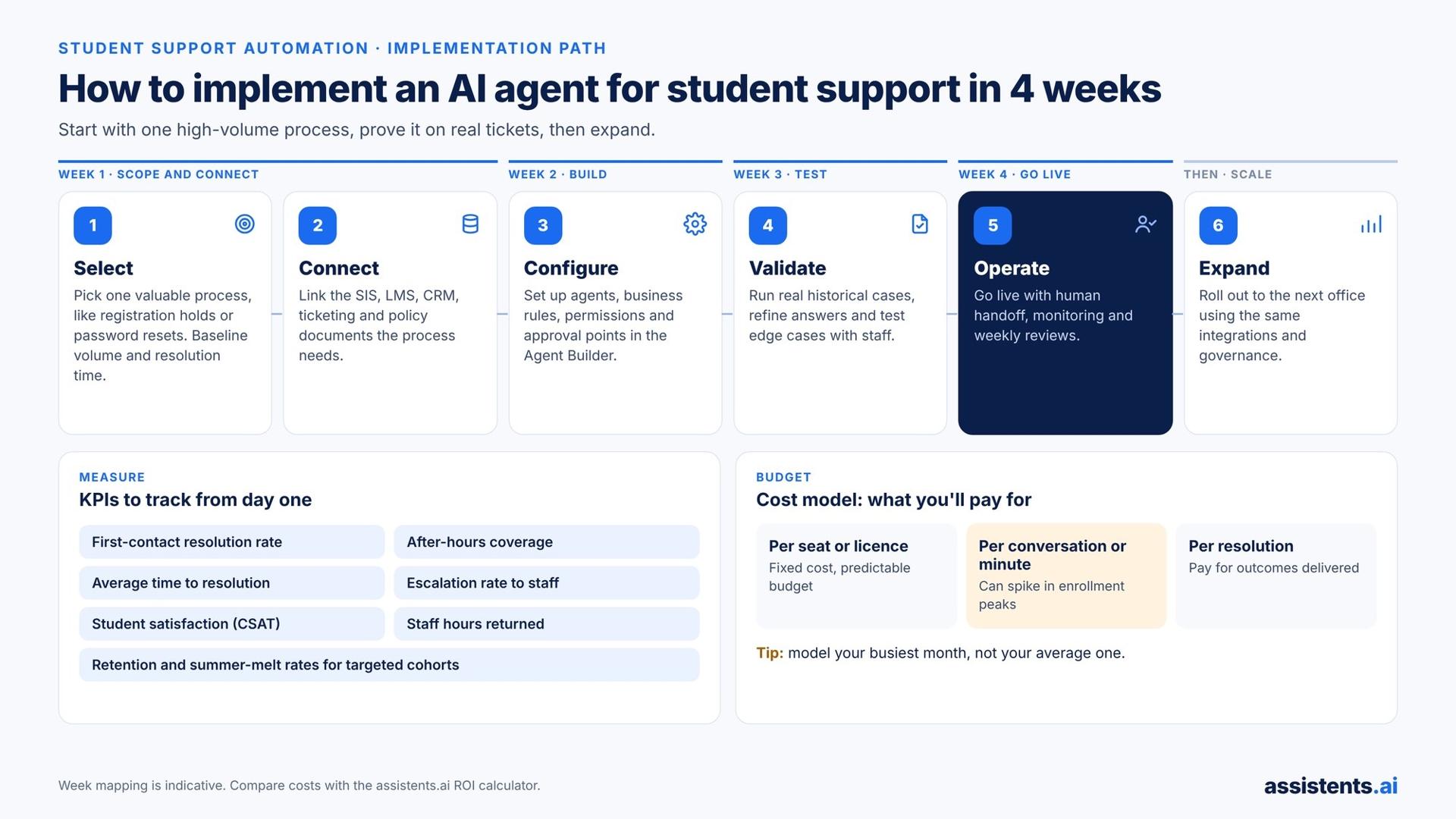
Start with one high-volume process, prove it on real tickets, then expand. This is the student support automation path we use in production:
- Select one valuable process, such as registration holds or IT password resets. Baseline today's volume and resolution time.
- Connect the systems and knowledge it needs: SIS, LMS, CRM, ticketing and policy documents.
- Configure agents, business rules, permissions and approval points in the Agent Builder.
- Validate on real historical cases, refine answers and test edge cases with staff.
- Operate live with human handoff, monitoring and weekly reviews.
- Expand to the next office using the same integrations and governance.
KPIs to track
- First-contact resolution rate
- After-hours coverage (share of questions resolved outside office hours)
- Average time to resolution
- Escalation rate to staff
- Student satisfaction (CSAT)
- Staff hours returned to high-value work
- Retention and summer-melt rates for targeted cohorts
Cost model: what you'll pay for
Vendors price AI agents for student support in three main ways: per seat or licence, per conversation or minute, and per resolution. Per-conversation pricing can spike during enrollment peaks, so model your busiest month, not your average one. Use the ROI calculator to compare.
How to choose the best AI agent for your institution
Ask these five questions in every demo:
- Does it act, or only answer? Ask the vendor to resolve a real registration hold live.
- Which of our systems can it write to, not just read from?
- What happens when it's unsure? Look for clear escalation with context.
- How is every action governed and logged?
- How fast can we reach production on one process?
Choose assistents.ai if you want one governed platform to resolve requests across offices and channels. Choose Ivy & Ocelot if you want a ready-made US higher-ed FAQ chatbot. Choose Mainstay if your priority is SMS nudges for retention. Choose Element451, Navigate360 or Agentforce if you're committed to that vendor's platform. Choose Copilot Studio or Retell AI if you have developers and want to build it yourself.
Final verdict
The best AI agents for student support don't just answer questions faster. They resolve them, safely, at any hour, in the student's language and channel.
- For most universities, colleges and EdTech platforms: assistents.ai delivers the broadest coverage, the deepest actions and the strongest governance.
- For a quick FAQ win: Ivy & Ocelot or LearnWise AI.
- For platform loyalists: Element451, Navigate360 or Agentforce inside their own ecosystems.
Ready to see it on your own process? Bring your highest-volume student support request and book a tailored walkthrough. We'll map the systems, handoffs and approval points, and agree how success will be measured.
Sources
- EAB: What 10,000 Student Conversations Reveal About the Role of AI Agents in Higher Ed (Aug 2026)
- Mainstay: AI Success Coaching at Georgia State University, Tackling Summer Melt
- Element451: Bolt AI Agents
- EAB: Navigate360 AI
- Salesforce: Agentforce for Education
- Gravyty: Ivy & Ocelot
- assistents.ai: AI Agents for Education
FAQs
What is the best AI agent for student support?
The best AI agent for student support in 2026 is assistents.ai for institutions that need agents to complete tasks across admissions, financial aid, registrar and IT with FERPA-grade governance. Ivy & Ocelot is a strong ready-made chatbot, and Mainstay is best for retention nudges.
Can AI agents replace student services staff?
No. AI agents handle repetitive, rule-based questions and tasks, especially after hours. That frees staff for complex, sensitive and high-value conversations. The best setups route anything unclear or high-risk to a human with the full context attached.
Is an AI chatbot FERPA compliant?
A chatbot isn't FERPA compliant on its own; the deployment is. Look for identity verification, role-based access, audit logs, data-residency options and a contract that stops the vendor from training on student data. assistents.ai enforces these through its governance layer.
What is the difference between an AI agent and a chatbot?
A chatbot answers questions. An AI agent answers and then acts: it can book appointments, update records, check documents or create tickets in your systems, under rules and approvals you set.
How much does an AI chatbot for a university cost?
Costs depend on scope and pricing model: per seat, per conversation or minute, or per resolution. Simple FAQ bots cost less; agents that integrate with your SIS and take actions cost more but return more staff time. Model your peak enrollment month.
How do AI agents improve student retention?
They spot risk earlier and reach students faster. Agents can send timely reminders, answer blocking questions instantly and alert advisors. Georgia State's AI assistant reduced summer melt by 21% and raised enrollment by 3.3 percentage points.
Can AI agents integrate with a student information system?
Yes. Enterprise platforms connect to SIS, LMS, CRM and ERP through APIs and connectors. Check whether the integration is read-only or bidirectional. Bidirectional access lets the agent resolve requests instead of just reporting on them.
Do students know they are talking to AI?
They should. Best practice is to say clearly that the student is talking to an AI agent and to offer an easy route to a human at any point. Clear disclosure builds trust and is increasingly expected by regulators.
How long does it take to deploy an AI agent on campus?
A focused first use case can reach production in about four weeks once core systems are connected. Wider rollouts across several offices usually follow in phases, reusing the same integrations and governance.
What are the best AI agents for students?
If you're a student looking for study help, tools like ChatGPT, Claude, Gemini and NotebookLM are popular. This guide covers AI agents that institutions use to support students across admissions, aid, advising and IT.