Gartner predicts that over 40% of agentic AI projects will be cancelled by the end of 2027, because of rising costs, unclear business value and weak risk controls. Most of those projects won't fail because the model was weak. They'll fail because they were never built end to end: no clear owner, no connection to the systems where work happens, no approvals, no audit trail and no way to prove the result.
This guide shows what agentic AI projects end to end actually look like. You'll get the 7-stage lifecycle we use to take an agent from idea to production, a reference architecture, and 12 real enterprise projects broken down from scope to outcome. All 12 are production deployments delivered on assistents.ai, anonymized by industry.
TL;DR: What is an end-to-end agentic AI project? An end-to-end agentic AI project is one where AI agents own a defined business outcome. They take in the work, gather governed context, decide, act inside enterprise systems under human-approved limits, and verify the result. A chatbot or proof of concept that only answers questions is not end to end.
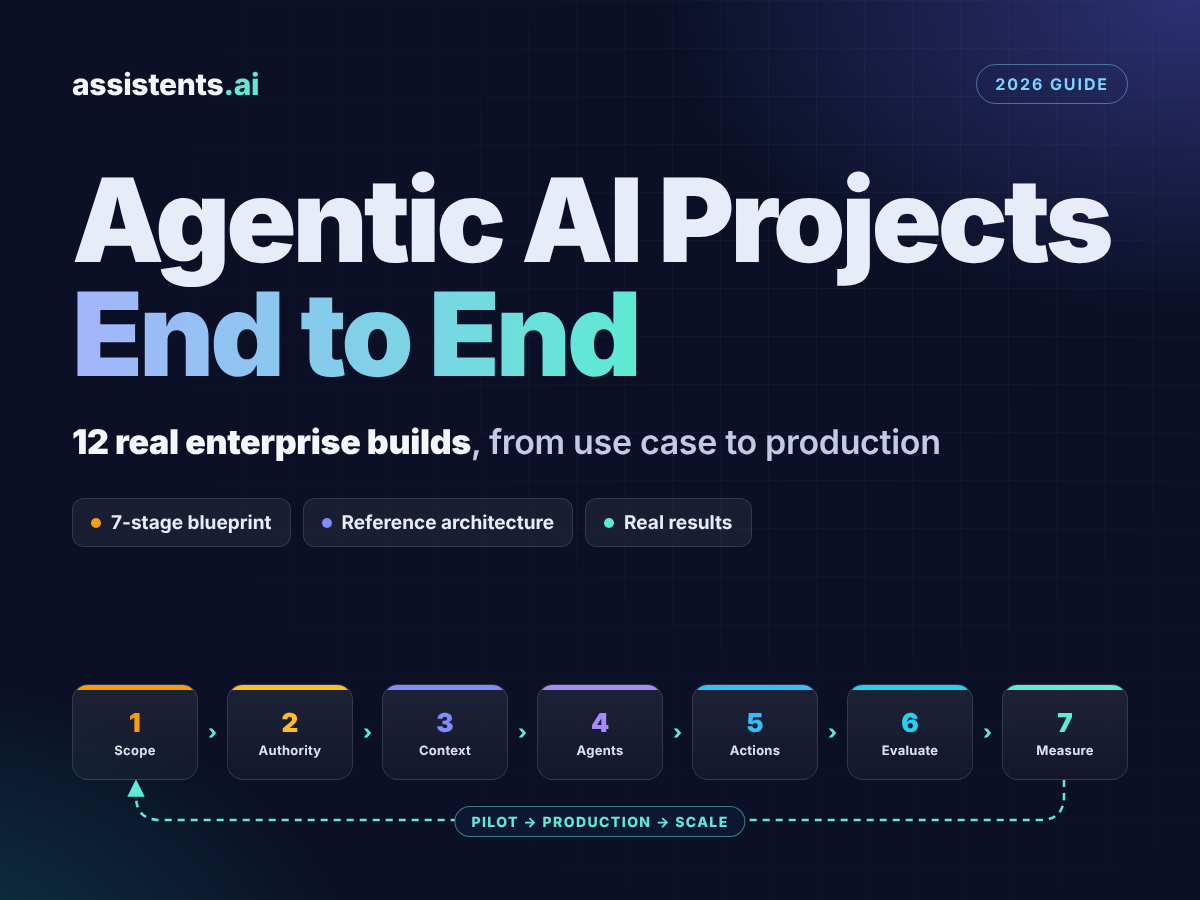
- The 7 stages: pick an outcome → map work and authority → assemble context → design agents and workflow → wire governed actions → evaluate and shadow → measure and expand.
- The 12 projects cover hospitality, construction, manufacturing, retail, banking, real estate, utilities, pharma, healthcare staffing and tax.
- The most common failure is shipping an agent that can talk but can't safely act.
- A realistic first milestone is one bounded workflow running in production with human approvals within about 90 days.
What "end to end" means in an agentic AI project
An end-to-end agentic AI project owns a business outcome from intake to verified result. It doesn't stop at a good answer. It completes the work: it reads the email, checks the inventory, creates the order in the ERP, asks a human to approve the exception, and records what happened.
The difference from a proof of concept is easiest to see side by side:
| Dimension | Proof of concept (PoC) | End-to-end agentic AI project |
|---|---|---|
| Scope | A demo task or a chat interface | One defined business operation with an owner and a KPI |
| Data | A sample file or a single database | Governed, permission-aware context across systems and documents |
| Actions | None, or simulated | Real writes into ERP, CRM, ticketing and field systems |
| Approvals | Not designed | Human-in-the-loop at defined risk thresholds |
| Audit | Chat logs | Full audit trail of context, decisions and actions |
| Evaluation | "It looks right" | Historical replay, shadow mode, accuracy targets |
| Outcome metric | None | Cycle time, accuracy, cost, SLA, revenue or risk |
| Owner after launch | The data science team | A business owner, with agents as part of the team |
The design principle behind every project in this guide is simple: deterministic macro, agentic micro. Durable workflows control process state, approvals, deadlines, retries and audit. Agents handle the adaptive steps inside those boundaries, such as reading a messy document, classifying intent, or choosing the next best action.
AI agent vs agentic AI: an AI agent is a single software worker that can plan and use tools. Agentic AI is the wider approach of building systems where one or more agents take goal-directed action. An agentic AI project usually combines several agents, deterministic rules and humans. For a full breakdown, see our guide to the 15 types of AI agents.
The 7-stage agentic AI project lifecycle
<!-- DESIGN: Horizontal 7-step flow diagram. Stages 1–7 left to right, with a feedback arrow from Stage 7 back to Stage 1 labelled "expand to adjacent work". Export as SVG. -->
Agentic AI project lifecycle: 7 stages from use case to production
Every project below followed the same seven stages. Skip one and the project usually stalls between pilot and production.
Stage 1: Pick a bounded, measurable work outcome
Start with one operation, one owner and one KPI. Good first projects have high volume, clear rules, messy inputs (emails, PDFs, calls) and a measurable result. Examples include order entry, tender processing, tenant support and procurement alerts.
- Deliverable: a one-page scope with the outcome metric and its baseline.
- Common mistake: starting with "an AI assistant for the whole company."
If you're a product leader, our playbook on building AI agents for product managers goes deeper on scoping.
Stage 2: Map the work and the authority
Write down what work exists, who does it today, and what the agent is allowed to decide. Represent the work as durable cases and tasks, not chat sessions. Then choose a target autonomy level:
| Level | Operating model | Human role | Agent role |
|---|---|---|---|
| 1. Assist | AI prepares information | Decides and acts | Advises |
| 2. Co-work | Human and agent share tasks | Owns the work | Performs bounded steps |
| 3. Delegate | Agent owns bounded tasks | Sets the goal, handles escalations | Plans and completes tasks |
| 4. Exception-managed | Agents run the normal path | Manages policy and exceptions | Owns routine execution |
- Deliverable: a process map with decision rights, approval thresholds and escalation paths.
- Common mistake: asking for full autonomy on day one, or requiring human approval on every step (which keeps the old bottleneck).
Stage 3: Assemble governed context
Give agents the smallest authorized context they need, not your whole data lake. That means certified metrics from a semantic layer, the relevant documents and policies, and permission-aware retrieval that respects row-level security. Context should be compiled, not dumped.
- Deliverable: connected data sources, a semantic model and a document knowledge base with access controls.
- Common mistake: pointing an LLM at raw tables and hoping it guesses your business definitions.
See how this works in our context engine architecture deep-dive.
Stage 4: Design the agents and the workflow
Split the work into specialist agents, and put policy in deterministic rules. A typical design has an intake agent, an extraction or analysis agent, a decision agent, and an action agent. A workflow engine coordinates them. Business rules, such as credit limits or pricing bands, stay in a rules engine, not in a prompt.
- Deliverable: an agent design, a workflow definition and a rules table.
- Common mistake: making every process multi-agent. Use the simplest design that works.
For patterns, read the multi-agent orchestration guide.
Stage 5: Wire governed actions
This is where most agentic AI projects stop being demos. Connect agents to the systems of record, such as SAP, Salesforce, Workday, field-service and ticketing tools. Every action goes through permissions, business rules, limits, approvals and an audit log.
- Deliverable: registered actions with typed inputs, approval rules and audit trails.
- Common mistake: giving an agent broad API keys instead of scoped, approved capabilities.
Our AI agent governance playbook covers the controls in detail.
Stage 6: Evaluate, shadow, then activate
Autonomy is earned, not configured. Replay historical cases, compare the agent's output to what humans did, then run the agent in shadow mode alongside the team. Turn on live actions for a limited slice only after it meets the accuracy target.
- Deliverable: an evaluation set, accuracy results and a staged rollout plan.
- Common mistake: going live after a handful of good demos.
Stage 7: Measure outcomes and expand
Tie every action to a business result, then grow from there. Once one workflow is proven, add adjacent work, more channels and more agents around the same operation. We call this an Agentic Workcell: a governed team of humans and agents that owns a business operation and its outcomes.
- Deliverable: an outcome dashboard and an expansion backlog.
- Common mistake: measuring token usage and chat volume instead of business impact.
12 agentic AI projects, built end to end
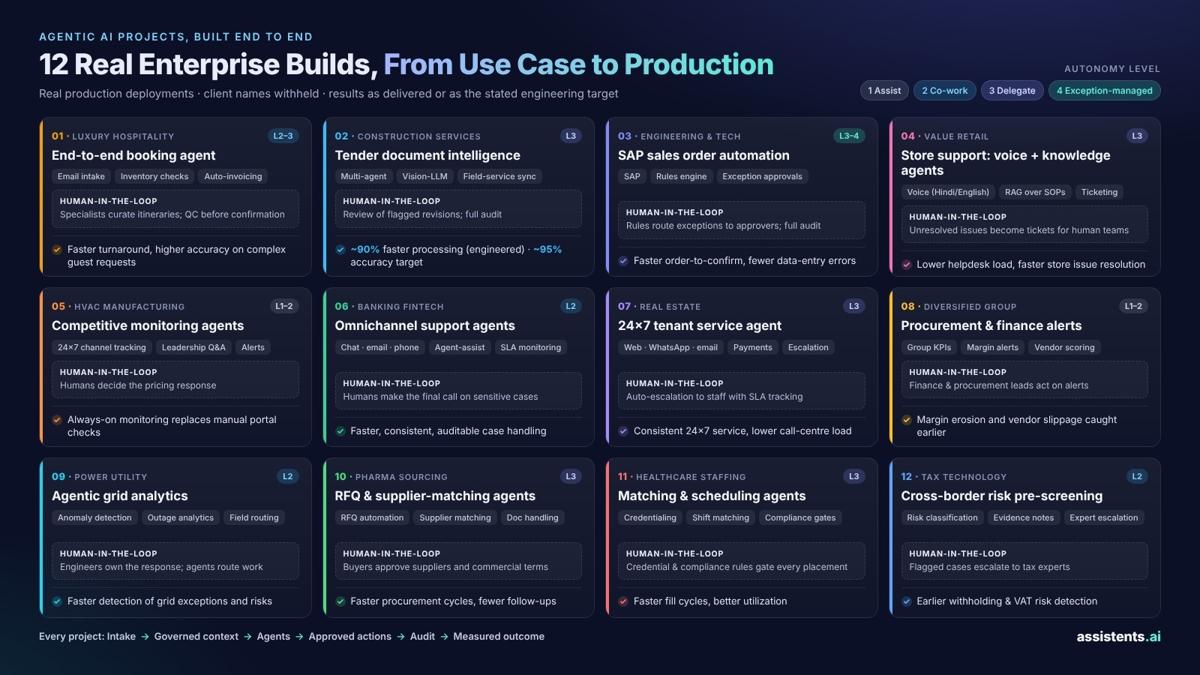
These are real production deployments delivered on assistents.ai. Client names are withheld; each project is described by industry and scope. Results are reported as delivered or as the engineering target where stated.
1. Luxury hospitality: an end-to-end booking agent
- Context: a luxury hospitality brand running a collection of boutique lodges and camps for high-expectation international travelers.
- Problem: booking requests arrived by email with missing details. Each one needed several rounds of back-and-forth, availability checks and manual invoicing.
- What the agents do: classify the intent of each email and extract details, run a conversation loop to collect missing information, check live inventory, and propose alternative dates or properties when the first choice is full. They then generate the invoice and booking documents automatically.
- Systems integrated: email, the reservations and inventory system, document generation.
- Guardrails and human-in-the-loop: a hybrid handoff lets travel specialists build curated itineraries, and humans control quality before confirmation.
- Autonomy level: 2 to 3 (co-work moving to delegate).
- Results: faster booking turnaround with less back-and-forth, higher accuracy on complex guest requirements, and the ability to scale without diluting a luxury service.
2. Remedial building contractor: tender document intelligence
- Context: a commercial waterproofing and remediation specialist with more than 20 years of complex project delivery.
- Problem: tender packs were large, inconsistent PDFs. Estimators spent hours extracting scope, tracking revisions and re-keying data into the field-service management system.
- What the agents do: a multi-agent "document workbench" retrieves tenders, decides which workflow applies, and extracts data from complex PDFs with vision-capable LLMs. It also detects revisions and changes between versions.
- Systems integrated: full create, read, update and delete sync with the company's field-service and job-management platform.
- Guardrails and human-in-the-loop: quote locking, audit logs and human review of flagged changes.
- Autonomy level: 3 (delegate).
- Results: engineered for up to ~90% faster tender document processing, a ~95% extraction accuracy target on standard formats, and lower bid risk through revision detection and auditability.
Read more about this pattern in our guide to AI agents for document processing.
3. Engineering and technology group: SAP sales order automation
- Context: an established engineering and technology solutions provider serving enterprise and infrastructure clients.
- Problem: sales orders depended on a legacy document-capture tool that was reaching end of life and carried high licensing costs.
- What the agents do: read incoming order triggers, validate them against master data and rules, and create SAP sales orders automatically.
- Systems integrated: SAP, plus inbound order channels.
- Guardrails and human-in-the-loop: rules route exceptions to approvers, and audit logs and reconciliation reports cover every order.
- Autonomy level: 3 to 4 (delegate moving to exception-managed).
- Results: less manual order processing and less dependence on legacy tools, a faster order-to-confirmation cycle with fewer data-entry errors, and better auditability for exceptions.
See the full playbook on sales order automation with AI.
4. National value-retail chain: store support with voice and knowledge agents
- Context: a fast-growing value retailer with hundreds of stores selling apparel, general merchandise and FMCG.
- Problem: store staff flooded a central helpdesk with questions about stock, pricing, promotions and procedures.
- What the agents do:
- A voice support agent (speech-to-text, LLM, text-to-speech) answers staff calls in Hindi and English.
- An inventory intelligence agent answers pricing, stock and promotion questions per store.
- A knowledge and training agent uses retrieval-augmented generation (RAG) over POS and SOP documents.
- Systems integrated: inventory and POS data, the ticketing system, and an admin console with analytics.
- Guardrails and human-in-the-loop: unresolved issues become tickets for human teams, and answers are grounded in approved documents.
- Autonomy level: 3 (delegate).
- Results: less manual helpdesk work, faster resolution of store issues, better store-level inventory visibility and faster onboarding for new staff.
5. HVAC manufacturer: competitive monitoring agents
- Context: a long-established HVAC and refrigeration brand in a highly price-sensitive market.
- Problem: teams checked e-commerce portals by hand to track competitor pricing, discounts and availability.
- What the agents do: watch channels around the clock for pricing, MRP and discounts, offers, availability and ratings. They answer leadership questions in plain language and send proactive alerts on pricing gaps and promotion shifts.
- Systems integrated: e-commerce and channel data sources, plus analytics views.
- Guardrails and human-in-the-loop: a governed architecture with audit trails, scaled from PoC to production. Humans decide the pricing response.
- Autonomy level: 1 to 2 (assist and co-work).
- Results: faster competitive response, earlier detection of pricing gaps and promotion shifts, and always-on monitoring in place of manual portal checks.
6. Fintech provider to banks and credit unions: omnichannel support agents
- Context: a cloud fintech provider that automates disputes, fraud and compliance work for banks and credit unions.
- Problem: high case volumes across chat, email and phone, with strict compliance and SLA requirements.
- What the agents do: take in cases from every channel and route them, summarize them for human agents, suggest next-best actions, and monitor SLAs.
- Systems integrated: omnichannel intake, case management and core banking-adjacent systems.
- Guardrails and human-in-the-loop: auditable workflows, reporting and agent-assist (humans make the final call on sensitive cases).
- Autonomy level: 2 (co-work).
- Results: faster, more consistent case handling, less operational load and better compliance readiness through audit trails.
Explore more in agentic AI use cases in customer service and AI agents for financial services.
7. Real estate portfolio owner: a 24×7 tenant service agent
- Context: a major real estate owner and manager with office, retail, industrial and residential assets across several cities.
- Problem: tenant questions about rent, payments, maintenance and policies overloaded the call centre.
- What the agents do: triage tenant queries on web, WhatsApp and email, answer FAQs, and run rent and payment support workflows. Answers come from a knowledge base of policies, tenancy documents and SOPs.
- Systems integrated: ticketing, payment workflows and messaging channels.
- Guardrails and human-in-the-loop: automatic escalation to human teams, with SLA tracking.
- Autonomy level: 3 (delegate).
- Results: faster response times, lower call-centre load, a consistent 24×7 tenant experience and better SLA adherence.
See more in AI use cases in real estate.
8. Diversified family business group: procurement and finance alerts
- Context: a large family business group with more than 30 companies across retail, building, industrial and services.
- Problem: each entity reported differently, so margin erosion and vendor slippage showed up too late.
- What the agents do: standardize KPIs across the group, then monitor them continuously. They send alerts on purchase-price trends, gross-margin impact, early-payment economics (notional finance cost) and vendor delivery and returns performance. Leadership also gets scheduled insight packs.
- Systems integrated: ERP and procurement data across group entities.
- Guardrails and human-in-the-loop: finance and procurement leads review alerts and decide the action.
- Autonomy level: 1 to 2 (assist and co-work).
- Results: margin erosion and vendor slippage caught earlier, standardized finance and procurement intelligence across entities, and fewer variance surprises.
Related: AI solutions for CFOs.
9. Power transmission utility: agentic grid analytics
- Context: a state power transmission utility responsible for reliable power across its region.
- Problem: operational exceptions were found late, after outages or losses had already happened.
- What the agents do: monitor transmission KPIs, detect anomalies, analyze losses and outages, and flag predictive-maintenance indicators. Automated alerts go straight to field operations.
- Systems integrated: smart grid and sensor data, operational dashboards and field workflows.
- Guardrails and human-in-the-loop: engineers own the response; the agents surface issues and route the work.
- Autonomy level: 2 (co-work).
- Results: faster identification of grid exceptions and risks, more reliable operations through proactive monitoring, and better transparency for leadership.
10. Pharma sourcing platform: RFQ and supplier-matching agents
- Context: a pharma excipient sourcing platform with thousands of SKUs.
- Problem: RFQs, supplier discovery and quality documents meant slow, manual coordination.
- What the agents do: automate RFQs, match suppliers to requirements, help process quality and regulatory documents, and analyze price, lead time and vendor performance.
- Systems integrated: the procurement platform, supplier records and document stores.
- Guardrails and human-in-the-loop: buyers approve supplier selection and commercial terms.
- Autonomy level: 3 (delegate).
- Results: faster procurement cycles, better sourcing visibility, fewer manual follow-ups, and stronger price and lead-time competitiveness.
11. Healthcare staffing platform: matching and scheduling agents
- Context: a platform that connects nursing professionals with healthcare facilities for flexible shifts.
- Problem: filling shifts quickly while keeping credentials compliant was a manual race.
- What the agents do: onboard talent and capture credentials, take in facility staffing requests, match and schedule staff, send notifications and run compliance workflows.
- Systems integrated: the staffing platform, scheduling and notification channels.
- Guardrails and human-in-the-loop: credential checks and compliance rules gate every placement.
- Autonomy level: 3 (delegate).
- Results: faster fill cycles, less scheduling friction, better workforce utilization and more responsive staffing for facilities.
For regulated healthcare deployments, see HIPAA-compliant AI agents.
12. Cross-border tax technology: a risk pre-screening agent
- Context: a tax-tech product that screens cross-border transactions early.
- Problem: withholding tax, VAT mismatches and permanent-establishment risks were found late in deals.
- What the agents do: screen transactions, classify risk, collect evidence and write explainability notes for each finding.
- Systems integrated: transaction data and tax research sources.
- Guardrails and human-in-the-loop: an escalation workflow sends flagged cases to tax experts.
- Autonomy level: 2 (co-work).
- Results: earlier detection of withholding and VAT risk, fewer last-minute deal disruptions, and faster, more consistent pre-compliance review.
And 20+ more. The same lifecycle has delivered AI CFO agents, sales account agents, port-to-rail logistics, campus energy optimization, healthcare operations analytics and education platforms. For a wider catalog, browse 35+ real-world AI agent examples and 40 enterprise AI deployments ranked by function.
The 12 projects at a glance
| # | Project | Industry | Agent type | Key integration | Human-in-the-loop point | Autonomy level | Headline result |
|---|---|---|---|---|---|---|---|
| 1 | Booking agent | Luxury hospitality | Email + workflow | Reservations, invoicing | Curated itineraries | 2–3 | Faster turnaround, higher accuracy |
| 2 | Tender intelligence | Construction services | Document AI, multi-agent | Field-service system (CRUD) | Flagged revisions | 3 | Up to ~90% faster processing (engineered) |
| 3 | Sales order automation | Engineering & technology | Workflow + rules | SAP | Exception approvals | 3–4 | Faster order-to-confirm, fewer errors |
| 4 | Store support | Value retail | Voice + RAG + analytics | POS, inventory, ticketing | Ticket escalation | 3 | Lower helpdesk load |
| 5 | Competitive monitoring | HVAC manufacturing | Monitoring + analytics | E-commerce channels | Pricing decisions | 1–2 | Faster competitive response |
| 6 | Omnichannel support | Banking fintech | Conversational + workflow | Case management | Final case decisions | 2 | Faster, auditable case handling |
| 7 | Tenant service | Real estate | Conversational + workflow | Ticketing, payments | Escalation to staff | 3 | Consistent 24×7 service |
| 8 | Procurement alerts | Diversified group | Continuous intelligence | Group ERP data | Finance review | 1–2 | Earlier margin-risk detection |
| 9 | Grid analytics | Power utility | Monitoring + alerting | Smart grid data | Field response | 2 | Faster exception detection |
| 10 | RFQ automation | Pharma sourcing | Workflow + document | Procurement platform | Supplier approval | 3 | Faster procurement cycles |
| 11 | Staffing operations | Healthcare staffing | Workflow + matching | Scheduling platform | Compliance gates | 3 | Faster fill cycles |
| 12 | Tax pre-screening | Tax technology | Research + classification | Transaction data | Expert escalation | 2 | Earlier risk detection |
The pattern: most projects run at Level 2 or 3, not full autonomy. Every one has a defined human-in-the-loop point and a system of record it writes to. That's what makes them end to end.
Reference architecture of an end-to-end agentic AI project
<!-- DESIGN: Layered architecture diagram, top to bottom: Channels → Work layer → Agents & orchestration → Context engine → Action gateway → Systems of record, with a vertical "Control tower" bar on the right spanning all layers. Export as SVG. -->
Reference architecture of an end-to-end agentic AI project
Every project above maps to the same seven layers:
| Layer | What it does | Examples |
|---|---|---|
| Channels | Where work arrives | Email, voice, chat, WhatsApp, documents, system events |
| Work layer | Turns requests into durable cases and tasks with owners, SLAs and approvals | Order case, tender case, tenant ticket |
| Agents and orchestration | Specialist agents plan and perform adaptive steps | Intake, extraction, analysis, decision, action agents |
| Context engine | Governed business context | Semantic metrics, documents, policies, memory, permissions |
| Action gateway | Safe execution | Scoped capabilities, rules, limits, approvals, audit |
| Systems of record | Where transactions stay authoritative | SAP, Salesforce, Workday, ticketing, field service |
| Control tower | Oversight across all layers | Observability, cost, risk, quality, business outcomes |
The architecture rests on five principles:
- Manage the work. Represent activity as durable cases and tasks, not chat sessions.
- Manage the workers. Give agents roles, identity, permissions, budgets and performance records.
- Give them context. Humans and agents share the same governed view of the business.
- Let them act safely. Production actions go through registered capabilities, rules, approvals and audit.
- Measure the outcome. Connect every action to a business result.
Why assistents.ai for end-to-end agentic AI projects
assistents.ai is a governed enterprise agentic AI platform that covers all seven stages in one system. You don't need to stitch together a framework, a vector database, a workflow tool, an integration layer and a governance product. Here's how each stage maps to the platform:
| Lifecycle stage | assistents.ai capability |
|---|---|
| 1. Pick the outcome | Use-case scoping with the AI agent ROI calculator |
| 2. Map work and authority | Workflow Builder with human tasks, approvals and escalation |
| 3. Assemble context | Context Engine, semantic layer, permission-aware retrieval, Document AI |
| 4. Design agents | Agent Builder (no-code), Agent Orchestration, Voice AI, deterministic rules |
| 5. Wire actions | AI Gateway and Agent Governance, connectors to 300+ systems including SAP, Salesforce and Workday, plus APIs and SDKs |
| 6. Evaluate and activate | Human-in-the-loop controls, audit trails, staged rollout |
| 7. Measure and expand | Business Intelligence, conversational analytics and outcome dashboards |
Three things set it apart in production:
- Proven delivery: 30+ deployments across hospitality, construction, retail, banking, real estate, utilities, pharma, healthcare and more.
- Deployment where your data lives: private cloud, VPC or on-premises deployment, with model routing across multiple LLM providers.
- Built-in governance: permission checks, approvals and audit trails on every action, not added later.
👉 See your use case mapped to the 7 stages: request a demo
Build it yourself, use a framework, or use a platform?
There are three realistic ways to run an agentic AI project end to end. The right one depends on whether you're learning, building a product, or running enterprise operations.
| Factor | DIY (open-source repo) | Framework + custom engineering | Governed platform (assistents.ai) |
|---|---|---|---|
| Time to first production run | Weeks to prototype; production is rare | Months | Weeks for a bounded workflow |
| Enterprise integrations | Build each one yourself | Build or buy each one | Prebuilt connectors plus APIs |
| Governance and audit | Mostly missing | Custom build | Built in |
| Human-in-the-loop | Manual | Custom build | Native approvals and escalation |
| Evaluation and shadow mode | Ad hoc | Custom harness | Part of the rollout process |
| Who maintains it | You | Your engineering team | Shared with the platform |
| Best for | Learning, portfolios | Product companies with large AI teams | Enterprises that need outcomes |
If you're building an agentic AI project to learn
Open-source tools are a great way to learn the full lifecycle. A typical learning stack maps to the seven stages like this:
- Scope: pick a real task with a clear success metric, such as "summarize and route support emails."
- Work and authority: model the flow as a state graph, for example in LangGraph.
- Context: use RAG over your documents with a vector store, plus a small SQL database.
- Agents: build specialist agents with a framework such as LangGraph, CrewAI or AutoGen.
- Actions: expose tools through an MCP server or function calling, and add a human approval step.
- Evaluation: build a test set, use an eval harness and add tracing.
- Deploy: wrap it in FastAPI, containerize it with Docker and deploy it to a cloud host.
This teaches you the mechanics. What it usually won't give you is what enterprises need in production: agent identity, scoped permissions, approval workflows, audit trails, connectors to systems like SAP, and outcome tracking. That gap is where most agentic AI projects get cancelled.
Comparing frameworks? Read the 11 best agentic AI frameworks for enterprises, or see our assistents.ai vs CrewAI comparison.
A 90-day plan for your first end-to-end agentic AI project
The fastest path to production is to land one workflow, prove it, then expand. Here is the plan we recommend for a first project:
| Weeks | Phase | What happens | Exit criteria |
|---|---|---|---|
| 1–2 | Scope and authority | Choose the workflow, baseline the KPI, map decision rights and approvals | Signed-off scope and autonomy level |
| 3–6 | Context and agents | Connect data and documents, build the semantic layer, design agents and rules | Agents perform correctly on test cases |
| 7–10 | Actions and evaluation | Wire integrations and approvals; replay historical cases; run in shadow mode | Accuracy target met in shadow mode |
| 11–13 | Activate and measure | Go live on a limited slice and track outcomes against the baseline | Measured improvement and a go/no-go to expand |
After day 90, the project grows into a full Agentic Workcell: more channels, adjacent tasks and higher autonomy as performance is proven. The commercial path looks like this:
Use case → operating workflow → Workcell → function → enterprise-wide
Why agentic AI projects fail, and the end-to-end controls that prevent it
Gartner names three reasons agentic AI projects get cancelled. It also warns about "agent washing": by its estimate, only about 130 of the thousands of vendors claiming agentic AI actually offer real agentic capabilities (source). Here's how an end-to-end approach addresses each risk:
| Failure cause | What it looks like | End-to-end control | Lifecycle stage |
|---|---|---|---|
| Rising costs | Token spend and engineering time grow with no ceiling | Bounded scope, compiled context, model routing, budgets per agent | 1, 3, 7 |
| Unclear business value | "The pilot worked" but nobody can show ROI | Baseline KPI before build, outcome dashboard after launch | 1, 7 |
| Weak risk controls | Agents with broad access and no audit trail | Scoped actions, approvals, rules engine, full audit | 2, 5 |
| Agent washing | A chatbot sold as an "agent" | Agents that write to systems of record under governance | 4, 5 |
| Everything multi-agent | Complex architectures that are hard to debug | Simplest design that works; deterministic workflows around agents | 4 |
| Autonomy too early | Live actions before evaluation | Historical replay, shadow mode, staged activation | 6 |
| LLM bypasses controls | Policy written in prompts | Policy enforced in a rules engine and the action gateway | 4, 5 |
The lesson is the same in every project above. An agent that can talk but can't safely act will not survive the CFO's review.
For the bigger picture, read agentic AI trends 2026: what's actually changing.
How to measure an agentic AI project's success
Usage metrics such as tokens, calls and chats are secondary. Measure these six things instead:
| Metric family | Example KPI |
|---|---|
| Quality and evidence | Extraction accuracy; share of answers with cited sources |
| Time saved | Cycle time per case (for example, order-to-confirm or tender processing time) |
| Action success | Percentage of agent actions completed without error or rollback |
| Human rework | Percentage of agent outputs edited or overridden by humans |
| Risk and compliance | Exceptions caught; audit findings; policy breaches (target: zero) |
| Business impact | Revenue protected, cost per case, SLA adherence, margin recovered |
What does it cost? It depends on scope, integrations and autonomy level. We've priced 11 common use cases in how much it costs to build an AI agent. You can model your own numbers with the ROI calculator.
Why enterprises choose assistents.ai to run agentic AI projects end to end
Most tools cover one or two stages of the lifecycle. assistents.ai is built to own the whole project: from the first email or call to the verified result in your system of record.
| Capability | assistents.ai | DIY frameworks | Point-solution agents | RPA + AI suites |
|---|---|---|---|---|
| Covers all 7 lifecycle stages | ✅ | ❌ (build it yourself) | ⚠️ One use case | ⚠️ Mostly execution |
| Governed actions in ERP/CRM | ✅ | ⚠️ Custom | ⚠️ Limited | ✅ For fixed flows |
| Handles unstructured docs, voice, email | ✅ | ⚠️ Custom | ⚠️ Varies | ⚠️ Limited |
| Native human-in-the-loop and audit | ✅ | ❌ | ⚠️ Varies | ⚠️ Partial |
| Private cloud / VPC / on-prem | ✅ | ✅ (self-managed) | ❌ Usually SaaS only | ⚠️ Varies |
| Model-agnostic | ✅ | ✅ | ❌ Often locked | ⚠️ Varies |
| Proven production deployments | ✅ 30+ | ❌ | ⚠️ Narrow | ✅ For rules-based work |
Five reasons teams choose assistents.ai:
- Outcomes, not demos. Every project starts with a baseline KPI and ends with a measured result.
- A governed digital workforce. Agents have roles, scoped permissions and audit trails, so they can be trusted with real transactions.
- A growing library of capabilities. Every integration, rule and approval you add makes the next project faster and safer.
- Reusable Workcells. Patterns proven in one operation, such as order entry, tenant service or procurement, transfer to the next.
- Your deployment, your models. Run it in your cloud or on-premises, with the LLMs you choose and no lock-in.
Global proof: assistents.ai projects are live across Africa, Australia, Canada, Europe, India, the Middle East, the UK and the US, in industries from luxury travel to power transmission.
Still comparing vendors? See our enterprise AI buyer's guide and the 11 best AI agent platforms for enterprise.
Bring one workflow. We'll take it end to end. Request a demo or check pricing.
Conclusion: build agentic AI projects end to end, or don't build them at all
The agentic AI projects that survive have one thing in common: they're built end to end. They start with one measurable outcome, run on governed context, act inside real systems with human approvals, and prove their value with business metrics. The 12 projects above show this works across very different industries.
Start with one workflow. Follow the seven stages. Expand once the results are in.
Ready to take your first agentic AI project end to end? Talk to the assistents.ai team.
FAQs
What is an end-to-end agentic AI project?
An end-to-end agentic AI project is one where AI agents own a business outcome from start to finish. They take in the request, gather governed context, decide, act inside enterprise systems under human-approved limits, and verify the result. It goes beyond a chatbot or proof of concept that only produces answers.
What are some examples of agentic AI projects?
Real examples include SAP sales order automation, tender document processing, 24×7 tenant service agents, voice support agents for retail stores, procurement and margin alerts, grid anomaly detection, healthcare shift matching and cross-border tax risk screening. This guide breaks down 12 of them, delivered on assistents.ai.
How do you build an agentic AI project step by step?
Follow seven stages:
- Pick a measurable outcome.
- Map the work and decision rights.
- Assemble governed context.
- Design the agents and the workflow.
- Wire governed actions into your systems.
- Evaluate in shadow mode before going live.
- Measure outcomes and expand to adjacent work.
Why do agentic AI projects fail?
Gartner cites rising costs, unclear business value and weak risk controls. In practice, projects fail when agents can't act safely in real systems, when no baseline KPI exists, or when teams grant autonomy before evaluating performance. An end-to-end lifecycle with approvals and audit addresses each of these risks.
How long does it take to implement an agentic AI project?
A bounded first workflow can typically reach limited production in about 90 days. That covers scoping, context and agent design, integration and shadow testing, then a staged go-live. Larger programs grow from there, one Workcell at a time, as each step proves its results.
How much does an agentic AI project cost?
Cost depends on scope, the number of integrations, the channels involved (voice adds complexity) and the autonomy level. We break down pricing for 11 common use cases in our AI agent cost guide.
What is the difference between an AI agent and agentic AI?
An AI agent is a single software worker that can reason, plan and use tools. Agentic AI is the wider approach of building systems where agents take goal-directed action, often several agents working with deterministic rules and humans. An agentic AI project usually combines both.
Which frameworks are used for agentic AI projects?
Common open-source frameworks include LangGraph, CrewAI and AutoGen, often with MCP for tool access and a vector store for RAG. Enterprises that need governance, integrations and audit out of the box often use a platform such as assistents.ai instead of assembling these pieces themselves.
Can agentic AI integrate with SAP, Salesforce or other ERP and CRM systems?
Yes. In an end-to-end project, agents read from and write to systems of record through governed actions. For example, one project above creates SAP sales orders automatically, with rules-based exception approvals and full audit logs. assistents.ai connects to 300+ systems, including SAP, Salesforce and Workday.
How do you keep humans in control of an agentic AI project?
Define an autonomy level for each task, route high-risk actions to human approvers, enforce policy in a rules engine rather than in prompts, and keep a full audit trail. The goal is exception-managed operations: agents run the normal path, and humans set the limits and handle exceptions.