Disclosure: assistents.ai publishes this guide and is ranked in it. We evaluated every other tool using public information from the vendor, the FDA and peer-reviewed sources. We have no commercial relationship with any other vendor listed.
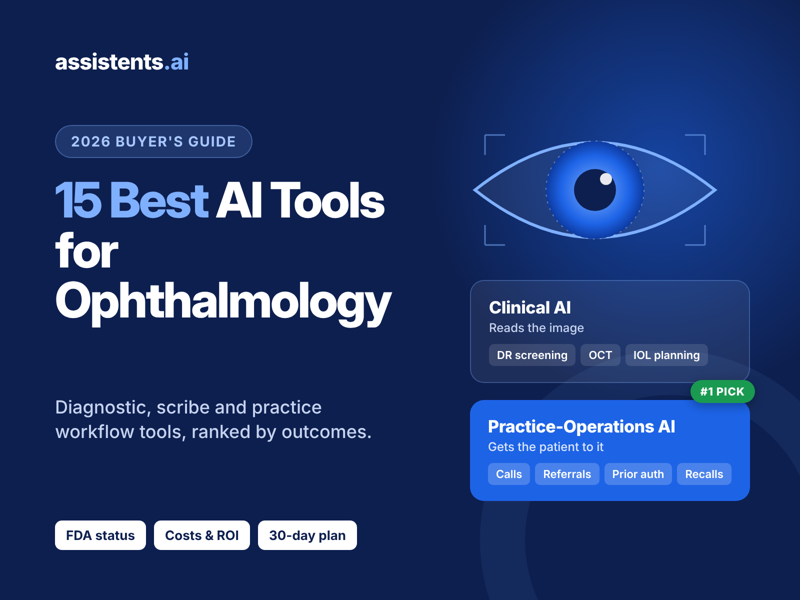
AI tools for ophthalmology fall into two layers. Clinical AI reads images and supports diagnosis: diabetic retinopathy screening, OCT analysis and IOL planning. Practice-operations AI runs everything around the exam: phones, referrals, prior authorization, documentation, recalls and revenue. Most eye practices need both.
Our picks for 2026:
- Best overall for ophthalmology practice operations: assistents.ai
- Best for autonomous diabetic retinopathy screening: LumineticsCore
- Best ambient scribe built for ophthalmology: Nextech Cora Scribe
Ophthalmology is one of the busiest outpatient specialties. Visits involve a lot of imaging. Anti-VEGF injections need constant prior authorization, and glaucoma and retina care depend on patients coming back on time. These pressures are why AI in ophthalmology has moved from research papers into everyday clinic work. This guide ranks the 15 best AI tools for ophthalmology, shows how we scored them, and covers cost, compliance, real deployment results and a 30-day rollout plan.
Quick answer: the best AI tool for ophthalmology by need
The best AI tool for ophthalmology depends on the job. Use this table to go straight to the right category.
| Need | Best tool | Why it wins |
|---|---|---|
| Best overall for practice operations and multi-location groups | assistents.ai | One governed platform for voice, documents, workflows, prior auth and analytics, with audit trails and EHR integration |
| Autonomous diabetic retinopathy (DR) screening | LumineticsCore | The first FDA-authorized autonomous AI diagnostic system; no specialist needs to read the image |
| DR screening across more camera types | EyeArt (Eyenuk) | FDA-cleared, works with several fundus cameras, results in about a minute |
| Portable or handheld DR screening | AEYE-DS (AEYE Health) | FDA-cleared, autonomous, works with a handheld camera |
| OCT interpretation support | Altris AI | Flags and segments OCT biomarkers and pathologies for clinician review |
| Retina imaging data and grading | RetinAI Discovery | FDA 510(k)-cleared data platform for AMD, glaucoma and DR monitoring |
| Home monitoring for neovascular AMD | Notal Vision (SCANLY Home OCT) | FDA De Novo-authorized AI home OCT between injection visits |
| Cataract and IOL planning | ZEISS Veracity | Data-driven surgical planning with AI-assisted IOL selection |
| Ambient scribe inside an ophthalmology EHR | Nextech Cora Scribe | Ophthalmology-native documentation for Nextech practices |
| Ambient scribe for ModMed practices | ModMed Scribe | Built into the EMA ophthalmology EHR |
| Enterprise ambient documentation | Microsoft Dragon Copilot | Health-system scale, broad EHR reach |
| Eye-care virtual assistant and billing help | EVAA.ai | Built for optometry and ophthalmology front and back office |
| Reminders and patient engagement | Luma Health | Mature scheduling, reminder and intake messaging |
| Voice scheduling for complex retina templates | Assort Health | AI phone scheduling designed for specialty rules |
| Simple 24/7 call answering | HelloMateAI | Quick-start AI receptionist for smaller practices |
What are AI tools for ophthalmology?
AI tools for ophthalmology are software systems that use machine learning, computer vision or large language models to support eye care. They do one of two things. They analyze clinical data, such as fundus photos, OCT scans and biometry. Or they automate the work around care, such as calls, documents, scheduling, authorizations and billing.
Most guides put these together in one list. That makes buying harder, because a diabetic retinopathy algorithm and a phone agent solve different problems, carry different regulatory risk and are bought by different people. We use a two-layer framework instead.
Two-layer framework of AI tools for ophthalmology: clinical AI and practice-operations AI Alt text: Diagram of AI tools for ophthalmology split into clinical AI (screening, OCT, IOL planning) and practice-operations AI (voice, documents, prior auth, analytics).
Clinical AI: screening, imaging and surgical planning
Clinical AI reads images or measurements and returns a finding, a grade or a recommendation. Examples include autonomous diabetic retinopathy screening, OCT fluid and biomarker detection, glaucoma risk scoring, and AI-assisted IOL calculation. When a tool makes a diagnostic claim, it is usually regulated as a medical device. Check its status on the FDA's AI-enabled medical device list.
Practice-operations AI: phones, intake, documents, prior auth and revenue
Practice-operations AI handles the administrative work that slows an eye practice down. That includes answering and booking calls, reading referral faxes, verifying insurance, assembling prior authorization packets for anti-VEGF injections, drafting notes, running recall campaigns and spotting denial patterns. These tools usually aren't medical devices. They do handle protected health information, so HIPAA safeguards, a signed BAA, audit trails and human review all matter.
The key point: clinical AI improves what happens in the exam. Practice-operations AI decides whether the patient gets to the exam, gets authorized, gets documented and gets billed correctly. Most practice bottlenecks are in the second layer.
Why ophthalmology practices are adopting AI now (2026 data)
Ophthalmology practices are adopting AI because patient demand is rising faster than they can hire. AI tools are also now mature enough to deploy in weeks, not years.
- Demand keeps climbing. At least 2.2 billion people worldwide have a near or distance vision impairment, according to the World Health Organization. Aging populations and diabetes keep pushing retina and glaucoma volume up.
- Documentation eats clinic time. At the 2026 ASCRS Binkhorst Lecture, Kerry D. Solomon, MD, estimated that ambient scribes could save 45 minutes per clinic day per provider. He urged practices to "try them in your office. Don't just look at a demo."
- Phones are a capacity limit. Eye practices run on scheduling, rescheduling, pre-op calls and recalls. Missed calls become missed appointments, and missed glaucoma or anti-VEGF follow-ups put vision at risk.
- Clinical AI is proven and reimbursable. Autonomous DR screening systems such as LumineticsCore, EyeArt and AEYE-DS are FDA-cleared. CPT code 92229 covers point-of-care automated retinal imaging analysis (coverage varies by payer).
- Professional bodies are engaging. The American Academy of Ophthalmology and ASCRS now run regular AI sessions. ASCRS 2026 had dedicated programming on putting AI to work in clinical practice.
The question has moved from whether to use AI to which tool, for which workflow, with what controls.
14 ophthalmology workflows AI can automate today
These are the ophthalmology workflows where AI pays off fastest. Most of them are in the practice-operations layer.
- Inbound scheduling and rescheduling. Voice AI answers around the clock, checks provider templates and books visits.
- Referral intake from optometrists and PCPs. Document AI reads faxed or emailed referrals, pulls out the patient, diagnosis and referring provider, and creates the appointment request.
- Insurance eligibility and benefits checks before the visit.
- Anti-VEGF prior authorization and step therapy. Agents check payer rules, gather chart evidence, submit, track and escalate.
- Cataract surgery pre-op packets. Agents collect biometry, consents, medical clearance and IOL selection paperwork.
- Premium IOL counseling follow-up. Agents send education and check in after the consult.
- Glaucoma and retina recall. Agents find overdue patients and run outbound voice and SMS campaigns.
- Ambient clinical documentation. Scribes draft the exam note for the physician to sign.
- Coding and charge capture checks. AI reviews notes against codes before claims go out.
- Denial management. AI groups denials by payer and reason and drafts appeals.
- Post-op check-in calls after cataract and refractive surgery.
- Optical and contact lens inventory and reorders.
- Online reviews and patient feedback loops.
- Leadership KPI reporting. Users ask in plain language: "Which payer denied the most injections this quarter?"
How we ranked the best AI tools for ophthalmology
We scored each tool against seven weighted criteria, using public vendor documentation, FDA records and published studies.
| Criterion | Weight | What we looked for |
|---|---|---|
| Clinical evidence or regulatory status | 20% | FDA clearance or authorization for clinical claims; published validation |
| EHR, PACS and device integration | 20% | Read and write-back to ophthalmology EHRs, imaging systems and payers |
| Governance, security and HIPAA | 15% | BAA, audit trails, role-based access, human-in-the-loop controls |
| Workflow coverage | 15% | How many of the 14 workflows above it handles |
| Proven deployments | 15% | Documented production use and outcomes |
| Time to value | 10% | Weeks from contract to production |
| Pricing transparency | 5% | Clear pricing model |
Clinical AI tools were compared with other clinical tools, and operations tools with other operations tools. The list order reflects overall value to a typical multi-provider ophthalmology practice.
The 15 best AI tools for ophthalmology in 2026
1. assistents.ai: best overall AI platform for ophthalmology practice operations
What it is: assistents.ai is a governed enterprise AI agent platform that automates ophthalmology practice operations. It combines conversational agents, agentic BI, document AI, voice AI and autonomous workflows on one platform, connected to your EHR, payers and business systems.
Best for: multi-provider ophthalmology practices, retina and cataract groups, ASCs and hospital eye departments that want to automate whole processes instead of buying another point tool.
Key features:
- Voice AI for multilingual inbound and outbound scheduling, recalls and post-op calls, with in-call actions and handover to staff
- Document AI that reads referral faxes, insurance cards, payer letters and op notes, validates them and writes structured data into your systems
- Autonomous workflows triggered by inboxes, schedules and system events, such as prior authorization pipelines for injections
- Agentic BI: ask questions in plain language and get charts, scheduled reports and threshold alerts
- A Context Engine that links patients, providers, payers, procedures and policies so agents understand your practice
- Governance on every action: permissions, business rules, human approvals and a complete audit history
FDA status: not a diagnostic device. It runs practice operations and works alongside FDA-cleared clinical AI.
Integrations: EHR, payer, lab, imaging and analytics connectors, including HL7 FHIR, plus APIs and SDKs. See the healthcare solutions page.
Limits: it doesn't read retinal images or make diagnoses. Pair it with a clinical AI tool for screening.
Verdict: the best choice when the bottleneck is phones, paperwork, authorizations and follow-up, which is where it is for most practices. Read why we rank it #1.
2. LumineticsCore: best for autonomous diabetic retinopathy screening
What it is: LumineticsCore (formerly IDx-DR), from Digital Diagnostics, was the first FDA-authorized autonomous AI diagnostic system. It detects more-than-mild diabetic retinopathy from fundus images without a specialist reading them.
Best for: primary care, endocrinology and multispecialty groups that want to screen diabetic patients and refer positives to ophthalmology.
Limits: it is a screening tool only and needs specific camera setups. It doesn't replace a comprehensive eye exam.
Verdict: the benchmark for autonomous DR screening and a strong source of referrals for eye practices.
3. EyeArt (Eyenuk): best for DR screening across camera types
What it is: EyeArt is FDA-cleared autonomous AI for detecting diabetic retinopathy. It returns results in about a minute and works with several fundus cameras.
Best for: screening programs that need flexible cameras.
Limits: limited to diabetic retinopathy indications.
Verdict: a mature, widely deployed alternative to LumineticsCore.
4. AEYE-DS (AEYE Health): best for portable DR screening
What it is: AEYE-DS is FDA-cleared autonomous AI that screens for referable diabetic retinopathy. It works with tabletop cameras and the Optomed Aurora handheld camera. Reported performance: 92–93% sensitivity and 89–94% specificity.
Best for: mobile screening, community outreach and sites without fixed cameras.
Limits: limited to DR indications.
Verdict: the leading choice when the camera has to travel.
5. Altris AI: best for OCT interpretation support
What it is: Altris AI analyzes OCT scans to detect and segment pathologies and biomarkers, helping clinicians read scans faster and more consistently.
Best for: optometry and ophthalmology practices with high OCT volume.
Limits: it supports clinicians rather than making decisions. Check current regulatory status for your region.
Verdict: a useful second reader for busy OCT workflows.
6. RetinAI Discovery: best for retina imaging data and grading
What it is: RetinAI Discovery is an AI and data-management platform with FDA 510(k) clearance and CE marking. It supports monitoring of AMD, glaucoma and diabetic retinopathy. EssilorLuxottica announced its acquisition of RetinAI's parent company in October 2025.
Best for: retina practices, research centers and groups that manage large image datasets.
Limits: it is a data and imaging platform, not a front-office tool.
Verdict: strong for practices that want imaging data organized, graded and trackable over time.
7. Notal Vision SCANLY Home OCT: best for home AMD monitoring
What it is: Notal Vision's SCANLY Home OCT received FDA De Novo marketing authorization in May 2024. Patients scan at home, and AI flags fluid changes between visits.
Best for: retina practices managing neovascular AMD patients on anti-VEGF therapy.
Limits: needs patient onboarding and a monitoring workflow.
Verdict: moves AMD monitoring toward treating based on disease activity rather than a fixed calendar.
8. ZEISS Veracity: best for cataract and IOL planning
What it is: ZEISS Veracity is a surgical planning platform that combines biometry, topography and patient history. It supports AI-assisted IOL selection.
Best for: cataract and refractive surgeons.
Limits: part of the ZEISS ecosystem.
Verdict: cited at ASCRS 2026 as an example of data-driven surgical planning in use today.
9. Nextech Cora Scribe: best ambient scribe built for ophthalmology
What it is: an ambient documentation assistant from Nextech, built for ophthalmology workflows and the Nextech EHR.
Best for: practices already on Nextech.
Limits: fits best inside the Nextech ecosystem.
Verdict: the natural first AI step for Nextech practices.
10. ModMed Scribe: best ambient scribe for ModMed EMA practices
What it is: an AI-powered scribe from ModMed that works inside the EMA ophthalmology EHR.
Best for: ModMed EMA ophthalmology practices.
Limits: tied to the ModMed platform.
Verdict: the simplest option if you already run EMA.
11. Microsoft Dragon Copilot: best for enterprise ambient documentation
What it is: Microsoft Dragon Copilot (which grew out of Nuance DAX) captures clinical conversations and drafts notes for health systems.
Best for: hospital eye departments and academic centers on enterprise EHRs.
Limits: not built specifically for ophthalmology. Enterprise procurement.
Verdict: a good fit when the health system has already standardized on it.
12. EVAA.ai: best eye-care virtual assistant
What it is: EVAA.ai, from the MaximEyes family, offers a virtual assistant, scribe and billing assistant for eye care.
Best for: optometry-led and smaller ophthalmology practices on MaximEyes.
Limits: closest fit within its own ecosystem.
Verdict: a solid all-in-one starter for smaller eye practices.
13. Luma Health: best for patient engagement and reminders
What it is: Luma Health automates reminders, intake forms, waitlists and two-way patient messaging.
Best for: practices that want to cut no-shows.
Limits: engagement-focused, without deep back-office automation.
Verdict: a reliable patient-engagement layer, also named at ASCRS 2026.
14. Assort Health: best for voice scheduling in complex retina templates
What it is: Assort Health provides AI phone agents for specialty scheduling. A published retina case study covers complex scheduling rules.
Best for: retina practices with complex scheduling rules.
Limits: voice-focused.
Verdict: worth a look if phones are your only bottleneck.
15. HelloMateAI: best for simple 24/7 call answering
What it is: HelloMateAI is an AI call agent that answers, books and routes calls for eye practices.
Best for: solo and small practices that need quick after-hours coverage.
Limits: narrow scope compared with platform tools.
Verdict: a quick, affordable starting point.
Comparison table: AI tools for ophthalmology at a glance
| Tool | Layer | Best for | FDA-cleared? | EHR integration | Typical pricing model |
|---|---|---|---|---|---|
| assistents.ai | Practice operations | Multi-workflow automation, groups | Not a device | EHR, payer, FHIR, APIs | Platform or workflow-based |
| LumineticsCore | Clinical | Autonomous DR screening | Yes | Via screening workflow | Per exam or subscription |
| EyeArt | Clinical | DR screening, many cameras | Yes | Via screening workflow | Per exam or subscription |
| AEYE-DS | Clinical | Portable DR screening | Yes | Via screening workflow | Per exam or subscription |
| Altris AI | Clinical | OCT interpretation | Varies by region | OCT devices | Subscription |
| RetinAI Discovery | Clinical | Retina data and grading | 510(k) | Imaging systems | Enterprise |
| Notal Vision SCANLY | Clinical | Home AMD monitoring | De Novo | Monitoring center | Per patient |
| ZEISS Veracity | Clinical | Cataract and IOL planning | Check per feature | ZEISS ecosystem | Enterprise |
| Nextech Cora Scribe | Documentation | Nextech practices | Not a device | Nextech | Per provider |
| ModMed Scribe | Documentation | EMA practices | Not a device | ModMed EMA | Per provider |
| Dragon Copilot | Documentation | Health systems | Not a device | Enterprise EHRs | Per provider |
| EVAA.ai | Operations + documentation | Smaller eye practices | Not a device | MaximEyes | Subscription |
| Luma Health | Engagement | Reminders, intake | Not a device | Many EHRs | Subscription |
| Assort Health | Voice | Specialty scheduling | Not a device | Many EHRs | Usage or subscription |
| HelloMateAI | Voice | 24/7 answering | Not a device | Limited | Subscription |
Confirm regulatory status and pricing directly with each vendor. Both change often.
Best AI tools by practice type
- Solo comprehensive practice: start with an AI scribe in your EHR (Nextech, ModMed or EVAA) and a simple call agent. Add assistents.ai when recalls and paperwork start to outgrow your staff.
- Cataract and refractive center: ZEISS Veracity for planning, plus assistents.ai to automate pre-op packets, IOL counseling follow-up and post-op calls.
- Retina practice: Notal Vision for home monitoring and RetinAI Discovery for imaging data, plus assistents.ai for anti-VEGF prior authorization, step therapy documentation and injection recall.
- Glaucoma practice: OCT support (Altris AI) plus automated recall campaigns so no patient misses a visual field or IOP check.
- Multi-location group or ASC: assistents.ai as the orchestration layer across sites, with standardized KPIs, governed workflows and one audit trail, connected to whichever clinical AI each site uses.
- Hospital or academic eye department: Dragon Copilot for documentation, an FDA-cleared DR screening tool for diabetic outreach, and assistents.ai for referral intake and operational analytics.
- Optometry-led practice: an FDA-cleared DR screening tool plus EVAA.ai or a call agent, with referrals routed to partner ophthalmologists automatically.
Why assistents.ai is the #1 AI platform for ophthalmology practices
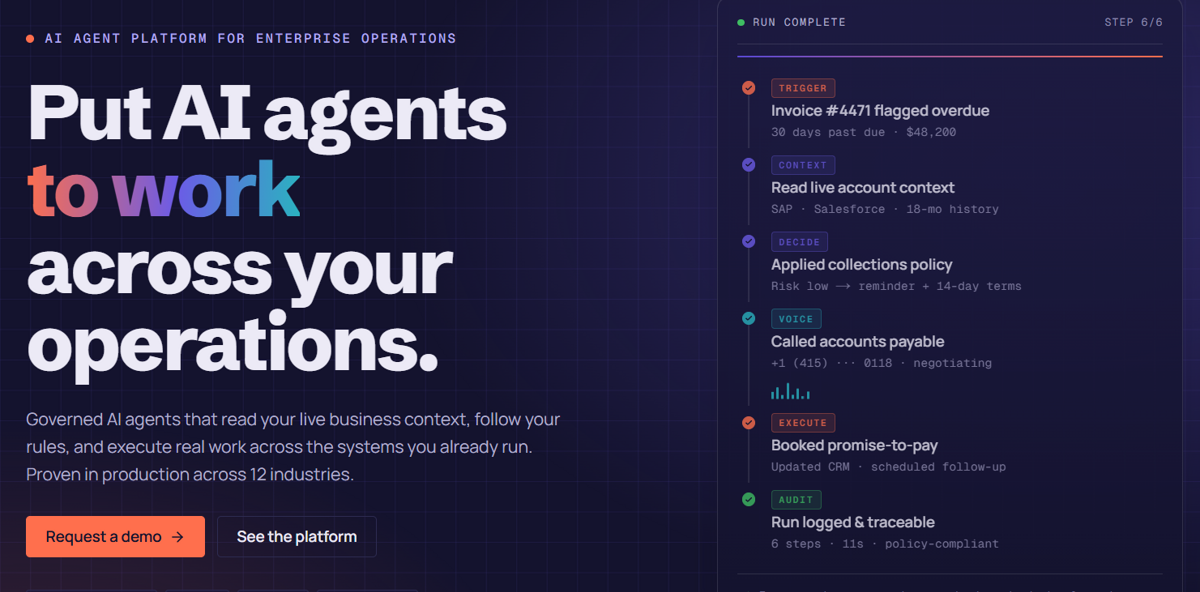
Diagnostic AI reads the image. assistents.ai runs the practice around it. Most eye practices end up with five disconnected point tools: a scribe, a phone bot, a fax inbox, a prior auth portal and a spreadsheet of recalls. assistents.ai replaces that patchwork with one governed platform connected to your EHR, payers and team.
One platform, five capabilities: Ask, Analyse, Read, Speak, Act
- Conversational Agents (Ask): staff ask "Is this patient's injection authorized?" and get a source-backed answer, plus the option to create a follow-up task.
- Agentic BI (Analyse): "Which payer has the highest anti-VEGF denial rate this quarter?" returns a chart and can send a threshold alert to the billing lead.
- Document AI (Read): referral faxes, insurance cards, payer letters and op notes go in, and validated, structured data comes out into your systems. Missing fields go to human review.
- Voice AI (Speak): multilingual inbound and outbound calls that check patient details, find available times, update the booking, send confirmation and create a follow-up. Patients always have a clear path to a person.
- Autonomous Workflows (Act): inbox emails, recurring schedules and system events start the work. Approvals are applied where needed, the system is updated and the outcome is recorded.
You can extend the platform with Deep Research, Canvas, Agent Builder and Workflow Builder. Start with one capability, or combine them to change a whole process.
What it looks like in an eye practice: referral to booked appointment
- A referral fax arrives from an optometrist.
- The Document agent extracts the patient, diagnosis codes, urgency and referring provider.
- The Context Engine checks eligibility and matches the right subspecialist and visit type.
- Rules flag an exception, for example a missing prior authorization for an anti-VEGF drug.
- An authorized staff member reviews and approves.
- The appointment is created in your EHR.
- The patient gets an SMS or voice confirmation, and the referring doctor gets an automatic update.
The result is less re-entry, clear exceptions and a result you can trace.
A Context Engine that understands your practice
General-purpose chatbots don't know your payer rules, provider templates or step therapy policies. The Context Engine links patients, providers, procedures, payers, contracts and policies, with source evidence for every answer. That lets an agent know that a Medicare Advantage patient starting a branded anti-VEGF drug may need step therapy documentation before the slot is confirmed.
Governance on every action
Every action passes an access check (user role and permissions) and a policy evaluation (rules and constraints). It is then allowed, sent for human approval or blocked and logged for review. Clinical decisions stay with clinicians, and every step is recorded. assistents.ai's security and compliance page lists HIPAA, SOC 2 Type II, ISO 27001 and GDPR, with BAAs available. See the AI agent governance playbook for the full model.
Built on the systems you already use
assistents.ai connects to EHRs, payer portals, labs, imaging and analytics tools through secure standard protocols, HL7 FHIR, APIs, SDKs and connectors. It supports event ingestion and two-way sync. The AI Gateway lets you choose approved models, with task routing, fallback, high availability and usage management. You can deploy on cloud SaaS, private cloud or on-premise infrastructure.
Works with your diagnostic AI, doesn't replace it
Already using LumineticsCore, EyeArt or an OCT tool? assistents.ai picks up the result and runs the next steps automatically: positive screens become scheduled referrals, overdue patients get recall calls, and results reach the referring provider.
Beyond ChatGPT, Claude and Copilot
Personal AI assistants help one person draft, summarize or research. assistents.ai delivers organizational productivity. It connects teams, business context, rules and systems, coordinates a process from trigger to verified outcome, and measures cycle time, throughput and exception handling. It builds on the AI your team already uses and puts shared processes to work.
A delivery team, not just software
assistents.ai deploys forward-deployed engineers, AI engineers, and data science and machine learning experts, with teams in the USA, Australia and India. The delivery approach is Select → Connect → Configure → Validate → Operate → Expand. You start with one valuable process, agree how success is measured, and grow from there. On its healthcare page, assistents.ai describes moving organizations from pilot to production in about three weeks.
Real deployments: what similar rollouts delivered
The platform that would run your ophthalmology workflows is already in production across healthcare and document-heavy operations. Client names are withheld. Results are as reported for each deployment.
| Deployment (anonymized) | What was delivered | Reported results | Ophthalmology parallel |
|---|---|---|---|
| A US physician-led inpatient care group | Revenue and utilization analytics model, performance dashboards with variance explanations, action lists for billing workflow | Better visibility into what drives revenue leakage, faster operational decisions, more reliable performance tracking | Injection and surgical revenue leakage, denial analytics |
| A US geriatric care services provider | Program operations dashboards, staffing and service delivery analytics, revenue cycle visibility with exception alerts | Bottlenecks found faster, clearer view of service performance, better decision support for leadership | Multi-site KPIs, recall compliance tracking |
| A UK private healthcare and testing provider | Booking → processing → reporting automation, status monitoring, customer notifications, reporting dashboards | Less manual overhead, faster customer communication, fewer missed handoffs, unified service reporting | Diagnostic testing scheduling and result notifications |
| A US healthcare staffing platform | Onboarding and credential capture, request intake and matching, scheduling, notifications, compliance workflows | Faster fill cycles, less scheduling friction, better use of the workforce | Technician and scribe coverage, clinic and OR scheduling |
| A building-services specialist with heavy document workloads | Multi-agent document workbench, vision-LLM extraction from complex PDFs, revision detection, two-way system integration, audit logs | Engineered for up to ~90% faster document processing, with a ~95% extraction accuracy target on standard formats | Referral faxes, payer letters, op notes, pre-op packets |
| A large multi-store retailer | Bilingual (Hindi and English) voice support agent, knowledge agent over SOPs, ticketing integration | Less helpdesk work, faster issue resolution, faster onboarding | Multilingual patient phone lines, front-desk SOP assistant |
| An enterprise manufacturer | Agentic automation that reads purchase orders, validates them and creates orders in SAP, with exception rules and audit logs | Less manual processing, faster order-to-confirmation, fewer data-entry errors | The same pattern: referral or order in → validated record in your EHR |
Ophthalmology-specific walkthroughs are available on request. Book a tailored platform walkthrough.
How much do AI tools for ophthalmology cost?
AI tools for ophthalmology use four main pricing models. Total cost depends on volume, integrations and how many workflows you automate.
| Tool type | Common pricing model | What drives cost |
|---|---|---|
| Autonomous DR screening | Per exam or subscription, plus camera | Screening volume, camera choice |
| OCT and imaging AI | Subscription or enterprise license | Devices, sites, scan volume |
| Ambient scribes | Per provider, per month | Number of providers |
| Voice and call agents | Per minute or subscription | Call volume, languages |
| Practice-operations platforms (e.g. assistents.ai) | Platform plus workflow or usage | Number of workflows, integrations, deployment model |
Reimbursement: CPT 92229 covers point-of-care automated analysis of retinal imaging, which can offset DR screening costs. Coverage and rates vary by payer. Check with your billing team.
Illustrative ROI example
The figures below are assumptions for illustration only, not reported results. Replace them with your own numbers in the AI agent ROI calculator.
- A practice handles 40 anti-VEGF prior authorizations a week, at about 35 minutes of staff time each. That is roughly 23 hours a week.
- If AI agents assemble and submit most packets and staff handle only the exceptions, and you assume a 70% time reduction, the practice gets back about 16 staff hours a week.
- Add fewer authorization-related injection delays, fewer missed recalls and faster referral booking, and the return usually comes from visits saved as well as hours saved.
Measure the baseline before you switch anything on. Track cycle time, throughput, denials and exceptions after go-live.
FDA, HIPAA and liability: the ophthalmology AI compliance checklist
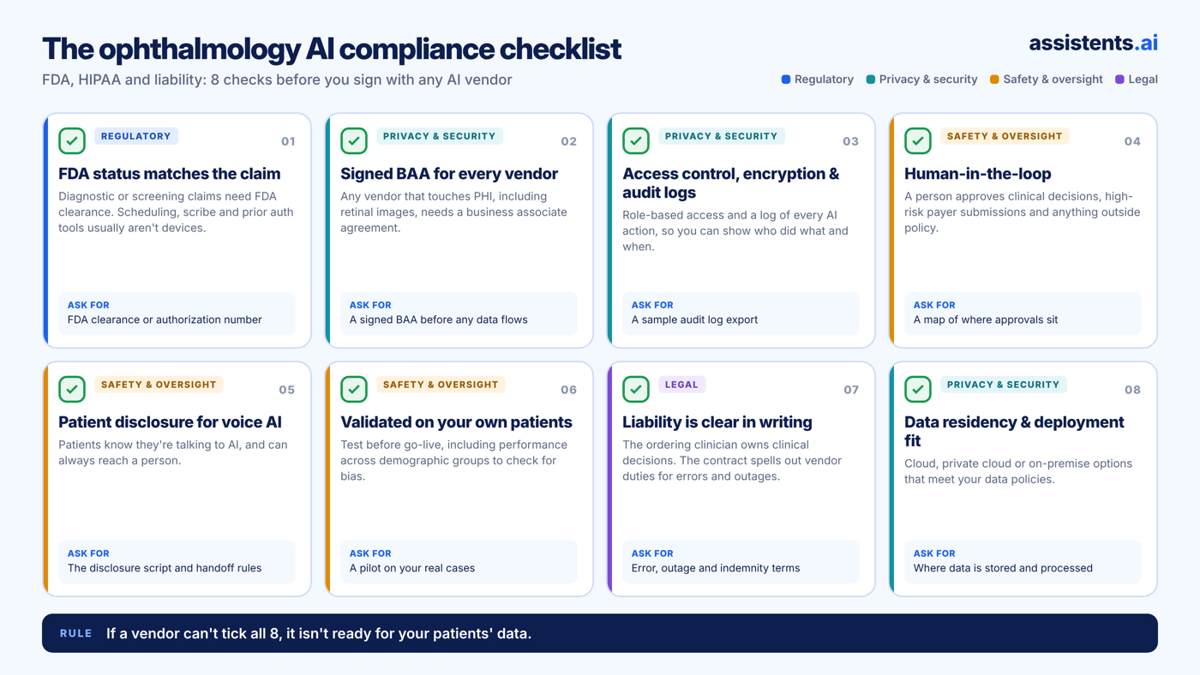
Use this checklist before you sign with any AI vendor.
- [ ] FDA status matches the claim. Diagnostic or screening claims need FDA clearance or authorization. Check the FDA AI-enabled device list. Scheduling, documentation and prior auth tools are usually not devices.
- [ ] A signed BAA covers every vendor that touches PHI, including retinal images.
- [ ] Role-based access, encryption and audit logs for every AI action. See our guide to HIPAA-compliant AI agents.
- [ ] Human-in-the-loop for clinical decisions, high-risk payer submissions and anything outside policy.
- [ ] Patient disclosure when patients talk to an AI voice agent, plus a clear path to a person.
- [ ] Validation on your own patients before go-live, including checks across demographic groups for bias.
- [ ] Liability is clear in writing. The ordering clinician stays responsible for clinical decisions. The contract states vendor obligations for errors and outages.
- [ ] Data residency and deployment options (cloud, private cloud or on-premise) meet your policies.
EHR and imaging integration: Nextech, ModMed, Compulink, NextGen and Epic
"Integrates with your EHR" can mean very different things. Ask vendors which of these three levels they support:
- Read-only: the AI can look up schedules and patient data.
- Write-back: the AI can create appointments, update records and attach documents.
- Full workflow: the AI runs multi-step processes across the EHR, payer portals, imaging/PACS and messaging, with approvals and audit trails.
Common ophthalmology systems include Nextech, ModMed EMA, Compulink, NextGen and Epic, along with imaging systems that store OCT and fundus images in DICOM. Look for HL7 FHIR support, secure APIs and event-based triggers. assistents.ai is built for level 3. See the healthcare integrations.
A 30-day AI rollout plan for your eye practice
Start with the one process that matters most, prove it, then expand.
| Week | Step | What happens |
|---|---|---|
| Week 1 | Select | Pick one high-volume, rules-based workflow (for example anti-VEGF prior auth or referral intake). Measure baseline cycle time, volume and error rate. |
| Week 2 | Connect | Connect the EHR, fax or inbox, payer portals and messaging. Sign BAAs. Set roles and permissions. |
| Week 3 | Configure and validate | Configure agents, rules and approval points. Test on real historical cases and refine. |
| Week 4 | Operate | Go live with human review on exceptions. Monitor daily. Compare against the baseline. |
| Day 30+ | Expand | Add the next workflow: recalls, pre-op packets, denial analytics. |
7 mistakes ophthalmology practices make with AI
- Buying point tools with no orchestration. Five tools that don't talk to each other create new manual handoffs.
- Treating a demo as proof. Test on your own patients, payers and templates.
- Not measuring a baseline. Without "before" numbers, you can't show ROI.
- No exception path. Every AI workflow needs a clear route to a person.
- Confusing FDA clearance with operational ROI. A cleared screening tool doesn't fix your prior auth backlog.
- Skipping staff training. Adoption depends on technicians and front-desk teams trusting the system.
- Using consumer chatbots with PHI. Personal AI tools without a BAA and governance don't belong in clinical workflows.
The future of AI in ophthalmology (2026–2030)
Over the next few years, AI in ophthalmology will become more multimodal, more home-based and more agentic.
- Multimodal foundation models that combine OCT, fundus photos and clinical records. See the research summarized in Frontiers in Ophthalmology.
- Home monitoring at scale, following home OCT for neovascular AMD.
- Oculomics: using retinal images to detect systemic disease, such as cardiovascular and neurodegenerative conditions.
- Agentic operations: AI agents that run complete administrative processes under governance, not just answer questions.
- Tighter rules on bias, transparency and post-market monitoring for clinical AI.
The bottom line
The best AI tools for ophthalmology work in two layers. FDA-cleared clinical AI, such as LumineticsCore, EyeArt, AEYE-DS and Notal Vision, improves screening and monitoring. A practice-operations platform makes sure patients are booked, authorized, documented and followed up. For most practices the biggest gains are in operations, and assistents.ai is our #1 pick because it brings voice, documents, workflows, prior auth and analytics together on one governed platform connected to the systems you already use.
Ready to start with your highest-value process? Book a tailored assistents.ai walkthrough.
Related reading:
- HIPAA-governed healthcare AI agents
- Voice AI for patient calls
- Multi-agent orchestration guide
- Examples of AI in dentistry
- Best AI voice agents for dental clinics
FAQs
How is AI used in ophthalmology?
AI is used in ophthalmology in two ways. Clinical AI screens and analyzes images: diabetic retinopathy screening, OCT interpretation, glaucoma risk and IOL planning. Practice-operations AI automates scheduling, referral intake, prior authorization, documentation, recalls and billing, so clinicians spend more time with patients.
What AI is FDA-approved for ophthalmology?
FDA-authorized ophthalmic AI includes autonomous diabetic retinopathy screening systems such as LumineticsCore, EyeArt and AEYE-DS, Notal Vision's SCANLY Home OCT (De Novo) and the RetinAI Discovery platform (510(k)). Scheduling, scribe and prior auth tools are usually not medical devices, but they still need HIPAA safeguards.
Will AI replace ophthalmologists?
No. AI handles screening triage, documentation and administrative work. It doesn't replace clinical judgment, surgery or the doctor-patient relationship. Licensed clinicians stay responsible for diagnosis and treatment, and well-designed AI keeps a person in the loop for clinical decisions.
What is the best AI scribe for ophthalmology?
The best AI scribe for ophthalmology usually depends on your EHR. Nextech Cora Scribe suits Nextech practices, ModMed Scribe suits EMA users, and Microsoft Dragon Copilot suits health systems. For workflows beyond notes, such as prior auth, recalls and referrals, add a platform like assistents.ai.
How accurate is AI at detecting eye disease?
FDA-cleared diabetic retinopathy systems report high accuracy in their pivotal studies. For example, AEYE-DS reported 92–93% sensitivity and 89–94% specificity. Real-world accuracy depends on image quality, camera and patient population, so validate tools in your own setting.
How much does AI cost for an ophthalmology practice?
Costs vary by tool type. Screening AI is often priced per exam, scribes per provider per month, voice agents per minute or subscription, and operations platforms by workflow or usage. Many practices measure ROI in staff hours saved and visits recovered. Try the assistents.ai ROI calculator.
Is AI in ophthalmology HIPAA compliant?
It can be, but compliance depends on the vendor and how you deploy it. Require a signed BAA, encryption, role-based access, audit logs and clear data-retention policies. Don't paste patient data into consumer chatbots that don't have a BAA.
What are the disadvantages of AI in ophthalmology?
The main risks are algorithm bias, weak performance on poor-quality images, unclear liability, integration gaps and staff over-relying on outputs. Reduce them with FDA-cleared tools for clinical claims, validation on your own patients, human review and clear governance.
Can AI automate prior authorization for eye injections?
Yes. Governed AI agents can check payer rules for anti-VEGF drugs, gather chart evidence, complete and submit requests, track status and flag denials or step therapy requirements. Staff approve exceptions. assistents.ai offers prior authorization automation for healthcare.
Can I use ChatGPT in my ophthalmology practice?
You can use ChatGPT for general tasks such as drafting patient education, but not with patient data unless the setup is covered by a BAA. ChatGPT helps individuals. Platforms like assistents.ai coordinate whole processes across your EHR, payers and team with governance and audit trails.