AI agents for big data are autonomous software agents that connect to large, fast-moving and mixed-format data, analyse it in context, and then take governed actions in business systems, such as raising an alert, creating a task or updating an ERP record. They close the gap between "the dashboard shows a problem" and "someone fixed it."
That gap is expensive. Most enterprises already have warehouses, lakehouses and BI tools. Yet insight still waits in a queue for an analyst, and action still waits for a person to notice. Agents promise to fix this, but not every project delivers: Gartner forecasts that over 40% of agentic AI projects will be canceled by the end of 2027 because of rising costs, unclear business value and weak risk controls.
This guide shows you how to avoid that outcome. You will get:
- A ranked list of the 10 best AI agents for big data in 2026, with "best for" labels
- A side-by-side comparison table
- 12 real, anonymised enterprise examples across utilities, logistics, retail, finance and SAP data
- A reference architecture, a selection checklist and a 4-week deployment plan
Looking for agents for everyday analytics rather than large-scale data? Read our companion guide, AI Agents for Data Analysis: The Complete Enterprise Guide.
Quick answer: the best AI agents for big data in 2026
The best AI agents for big data combine three things: a semantic layer that understands your business, real-time monitoring across many sources, and the ability to act safely in operational systems. Here is the short list:
- assistents.ai: best for turning big data into governed actions across ERP, CRM, documents and data warehouses
- Databricks Genie: best for teams whose data already lives in the Databricks lakehouse
- Snowflake Intelligence and Cortex Analyst: best for Snowflake-centric organisations
- Google Cloud data agents (BigQuery and Looker): best for Google Cloud stacks
- Microsoft Fabric Data Agent: best for Microsoft 365 and Power BI shops
- ThoughtSpot Spotter: best for search-driven self-service analytics
- Tellius: best for automated root-cause analysis
- DataRobot: best for predictive modelling at scale
- Dremio: best for open lakehouse and Apache Iceberg query federation
- LangChain or CrewAI (DIY): best for engineering teams building their own agents
What are AI agents for big data?
An AI agent for big data is software that pursues a goal on its own: it watches data, reasons about what it sees, decides what to do, and does it within rules you set. Unlike a chatbot, it does not wait for a question. Unlike a dashboard, it does not stop at a chart.
A typical big data AI agent can:
- Ingest data from warehouses, lakehouses, ERP, CRM, IoT sensors, documents and APIs
- Translate business questions into queries across many sources at once
- Detect anomalies, trends and threshold breaches continuously
- Explain why a metric moved, with citations back to the source data
- Trigger actions: alerts, tickets, approvals, record updates or reports
AI agents vs chatbots vs traditional BI tools
| Capability | Traditional BI dashboard | AI chatbot / copilot | AI agent for big data |
|---|---|---|---|
| Who starts the work | A person opens a dashboard | A person asks a question | Events, schedules or thresholds |
| Data scope | Pre-modelled datasets | Usually one tool or file | Many systems, joined in context |
| Output | Charts | Answers or drafts | Answers plus actions |
| Real-time monitoring | Limited, refresh-based | No | Yes, continuous |
| Governance | Report-level access | Varies | Permission check on every query and action |
| Audit trail | Partial | Rare | Full, per action |
Agentic analytics vs agentic BI
You will see both terms. Agentic analytics is the broad idea of agents that analyse data and act on it. Agentic BI is the business-intelligence form: ask questions in natural language, get charts, reports and alerts, and let agents carry insights into workflows. assistents.ai calls its product Agentic Business Intelligence.
Why big data needs agents: the 4 Vs problem
Big data is defined by its characteristics, usually summarised as the 4 Vs. Each one breaks the "human looks at a dashboard" model in a different way.
Volume, velocity, variety and veracity in big data
| Characteristic of big data | The challenge | What an AI agent does |
|---|---|---|
| Volume | Millions of rows and thousands of tables; no one can review it all | Monitors every metric continuously and surfaces only the exceptions |
| Velocity | Streaming sensor, transaction and event data changes by the minute | Fires alerts within minutes, not in next week's report |
| Variety | Structured tables mixed with PDFs, emails, contracts and logs | Reads documents and tables together through a shared context layer |
| Veracity | Duplicates, gaps, schema drift and stale pipelines | Runs data quality checks, flags drift and routes issues for fixing |
The types of big data follow the same split: structured (tables and transactions), semi-structured (JSON events, logs) and unstructured (documents, emails, call recordings). Good agents work across all three.
Why dashboards and copilots stall at scale
Personal assistants such as ChatGPT, Claude and Microsoft Copilot are excellent at helping one person draft, summarise or analyse. But big data problems are organisational. They span teams, systems and approvals.
As the assistents.ai team puts it: personal productivity helps an individual complete a task; organisational productivity connects teams, business context, rules and enterprise systems to coordinate a process from trigger to verified outcome. That shift, from answering to completing, is what AI agents for big data are built for.
How AI agents work with big data (reference architecture)
Most AI agents for big data follow the same five-layer pattern.
- Data sources. ERP (such as SAP), CRM, HR systems, data warehouses (Snowflake, BigQuery, Redshift, Databricks), files, IoT sensors and APIs.
- Context engine and semantic layer. Business definitions (what "revenue" or "churn" means), entity relationships (customer → contract → order → invoice) and policies. Learn more in our context engine architecture deep-dive.
- Specialist agents. A data agent queries and validates, a document agent extracts and interprets, a communication agent contacts people. An orchestrator coordinates them; see the multi-agent orchestration guide.
- Governance. Every action passes an access check and a policy evaluation, then is allowed, sent for human review, or blocked and logged.
- Actions and audit. Updates land in the system of record, people are notified, and every step is recorded.
How do agents handle datasets larger than an LLM's context window?
They don't load the data into the model. The language model reasons about the question; the data stays in your systems. The agent:
- Uses the semantic layer to map business terms to the right tables and columns
- Generates SQL or API calls and pushes computation down to the warehouse
- Retrieves only aggregates, samples or the relevant records
- Joins results across sources and cites where each number came from
This is why an agent can answer a question over billions of rows in seconds. On assistents.ai, for example, the average query response is under 2 seconds.
Real-time and streaming data: alerts in minutes, not reports in weeks
Agents watch thresholds and patterns continuously. In one manufacturing deployment, assistents.ai monitors 10M+ data points with under 5-minute alert latency (source). Agents also watch the pipelines themselves: freshness, failures and schema drift (VP Data & Analytics solution).
10 best AI agents for big data (ranked list)
We ranked these platforms on six criteria: big-data reach (sources and scale), semantic understanding, real-time monitoring, ability to take governed actions, deployment flexibility, and time to production. Product names and capabilities change fast; check each vendor's documentation before you buy.
1. assistents.ai: best for governed action on enterprise big data
assistents.ai is an enterprise agentic AI platform that runs governed AI agents across business operations. Where most tools on this list answer questions about data, assistents.ai also acts on it inside the systems where work happens.
Big-data fit: connects to 300+ enterprise systems, including Snowflake, BigQuery, Redshift and Databricks, plus SAP, Oracle, Salesforce, HubSpot and document stores (integrations). A Context Engine builds a live semantic model of your business across all of them.
Key capabilities:
- Agentic BI: natural-language questions answered with charts, citations and exportable reports
- Cross-system queries with automatic joins across databases, CRM, ERP and documents
- Scheduled insight reports, threshold alerts and anomaly detection
- Document AI for 90+ formats, so unstructured data joins the analysis
- Autonomous agents and a Workflow Builder that turn insights into tasks, approvals and record updates
- Agent Governance: role-based access inherited from source systems, PII masking, immutable audit trails
- AI Gateway: model-agnostic across Bedrock, Azure, Vertex AI and OpenAI
Pros: goes beyond answers to governed action; one platform for data, documents, voice and workflows; cloud, private cloud or on-premise deployment; forward-deployed engineers help you ship.
Cons: built for enterprises with multiple systems, so it is more than a solo analyst needs for a single spreadsheet.
Ideal for: CIOs, CDOs and VPs of Data & Analytics who want big data to drive operations, not just reports.
2. Databricks Genie: best for lakehouse-native teams
Databricks has consolidated its AI/BI tools under the Genie name: Genie agents turn natural-language questions into SQL over lakehouse data, Genie One is the business-user interface, and Genie Code helps developers write notebooks and pipelines.
Pros: runs where your Databricks data already lives; strong for data engineering and ML teams. Cons: value depends on your data being in Databricks; acting in ERP and CRM systems needs extra build work. Ideal for: organisations standardised on the Databricks lakehouse.
3. Snowflake Intelligence and Cortex Analyst: best for Snowflake-centric data
Snowflake's agentic layer lets business users ask questions in plain English over governed Snowflake data. Cortex Analyst converts questions to SQL grounded in semantic views.
Pros: keeps data and governance inside Snowflake; scales with the warehouse. Cons: best when most data is already in Snowflake; compute costs can grow with heavy agent usage. Ideal for: teams that have centralised on Snowflake.
4. Google Cloud data agents (BigQuery and Looker): best for GCP stacks
Google offers data agents through its Conversational Analytics API for BigQuery and Looker, alongside agents for data engineering and data science tasks.
Pros: native to BigQuery scale; integrates with Vertex AI and Looker's semantic model. Cons: strongest inside Google Cloud; cross-cloud and ERP actions need integration work. Ideal for: Google Cloud-first data teams.
5. Microsoft Fabric Data Agent: best for Microsoft shops
Fabric data agents are grounded in OneLake data and can be reused in Power BI, Teams and Microsoft 365 Copilot.
Pros: fits existing Microsoft licences and Power BI workflows. Cons: non-Microsoft sources and multi-step operational actions take more configuration. Ideal for: enterprises standardised on Microsoft 365, Fabric and Power BI.
6. ThoughtSpot Spotter: best for search-driven self-service analytics
Spotter is ThoughtSpot's AI analyst for natural-language questions over cloud warehouses.
Pros: mature search-based analytics; good business-user experience. Cons: focused on insight rather than executing work in operational systems. Ideal for: BI teams expanding self-service analytics.
7. Tellius: best for automated root-cause insights
Tellius focuses on agentic analytics that explain why metrics changed, with automated driver and root-cause analysis.
Pros: strong "why did this happen" analysis for commercial teams. Cons: narrower scope beyond analytics; fewer workflow and document capabilities. Ideal for: commercial analytics and pharma or CPG insight teams.
8. DataRobot: best for predictive modelling at scale
DataRobot is an enterprise AI platform known for building, deploying and monitoring predictive models, now with agent capabilities.
Pros: deep ML lifecycle tooling for forecasting and risk models. Cons: aimed at data science teams; business users need another layer. Ideal for: organisations where forecasting accuracy is the core goal.
9. Dremio: best for open lakehouse and Iceberg federation
Dremio is a lakehouse platform built around Apache Iceberg that federates queries across sources and adds agentic analytics on top.
Pros: query data in place across lakes and databases without copying it. Cons: a data platform first; business workflows need other tools. Ideal for: data engineering teams running open lakehouse architectures.
10. LangChain or CrewAI (DIY): best for engineering teams building their own
Open-source frameworks let developers assemble custom agents with their own tools, prompts and data connectors.
Pros: maximum flexibility; no platform licence. Cons: you build and maintain connectors, semantic layer, governance, audit and monitoring yourself. See our assistents.ai vs CrewAI comparison. Ideal for: teams with strong AI engineering capacity and a narrow use case.
Comparison table: AI agents for big data at a glance
| Platform | Best for | Data sources | Real-time alerts | Takes actions in ERP/CRM | Governance and audit | Deployment |
|---|---|---|---|---|---|---|
| assistents.ai | Governed action on enterprise big data | 300+ systems: warehouses, ERP, CRM, documents, APIs | Yes | Yes, with approvals | Per-action checks, full audit | Cloud, private cloud, on-prem |
| Databricks Genie | Lakehouse-native teams | Databricks lakehouse | Via platform features | Needs custom build | Unity Catalog | Cloud |
| Snowflake Intelligence | Snowflake-centric data | Snowflake | Via platform features | Needs custom build | Snowflake governance | Cloud |
| Google data agents | GCP stacks | BigQuery, Looker | Via platform features | Needs custom build | Google Cloud IAM | Cloud |
| Microsoft Fabric Data Agent | Microsoft shops | OneLake, Power BI | Via Power BI / Fabric | Within Microsoft ecosystem | Microsoft Purview | Cloud |
| ThoughtSpot Spotter | Self-service search analytics | Cloud warehouses | Yes (metric monitoring) | Limited | BI-level | Cloud |
| Tellius | Root-cause insights | Warehouses, files | Yes | Limited | BI-level | Cloud |
| DataRobot | Predictive modelling | Warehouses, lakes | Model monitoring | Via integrations | ML governance | Cloud, on-prem |
| Dremio | Open lakehouse federation | Lakes, databases, Iceberg | Limited | No | Data-level | Cloud, self-managed |
| LangChain / CrewAI | Custom builds | Whatever you connect | You build it | You build it | You build it | Self-hosted |
Capabilities summarised from vendor materials as of November 2026. Confirm details with each vendor.
Why assistents.ai ranks #1 among AI agents for big data
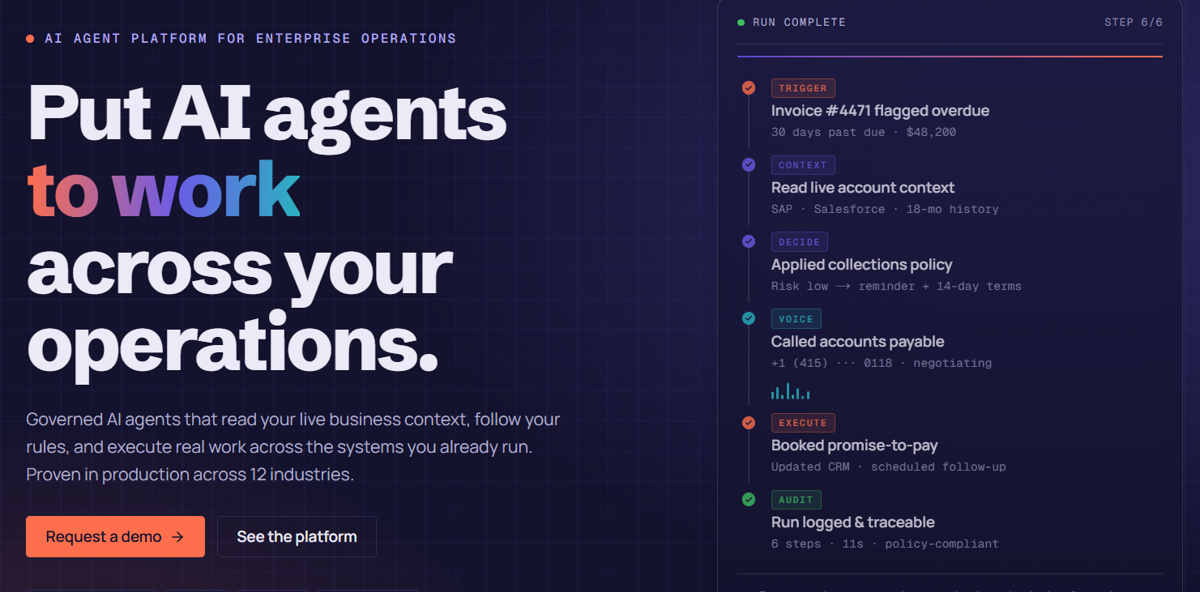
Most AI agents for big data stop at the answer. assistents.ai is built for what happens next. It connects data, documents, rules and people so an insight becomes a verified outcome in your systems.
- A Context Engine across 300+ systems. It maps relationships across enterprise data, such as vendors to contracts and deals to contacts, so agents understand your business, not just your tables.
- Ask, analyse, read, speak and act on one platform. Conversational agents, Agentic BI, Document AI, Voice AI and autonomous workflows share the same context and governance.
- Proven at big-data scale. 10M+ data points monitored with under 5-minute alert latency in manufacturing; 700+ retail stores live in 14 weeks (source).
- Accuracy you can audit. 97% agent task accuracy with audit trails, and up to 90% faster processing and workflow execution.
- Fast time to value. Production in 4 weeks on average. Data teams see about 10x faster insight delivery and 80% of analysis requests self-served (VP Data & Analytics).
| Typical BI copilot | assistents.ai | |
|---|---|---|
| Answers questions in natural language | Yes | Yes, with source citations |
| Joins data across ERP, CRM, warehouse and documents | Rarely | Yes |
| Monitors continuously and alerts | Sometimes | Yes |
| Takes actions in business systems | No | Yes, within policy |
| Human approval paths | No | Yes |
| Full audit trail per action | Partial | Yes |
| On-premise option | Rarely | Yes |
| Multi-agent orchestration | No | Yes |
12 real examples of AI agents for big data (with results)
These examples come from production deployments delivered on the assistents.ai platform. Client names are withheld; each is described by industry and scale.
Energy, utilities and smart cities
1. City-scale smart infrastructure operator
- Situation: A smart infrastructure unit running 25+ smart-city operation centres and connecting 2M+ assets and applications needed faster insight from its utility systems.
- Data: Smart utility and IoT data across millions of connected assets.
- What the agents do: Agentic analytics on top of the smart utility systems, with automated operational alerting and workflow routing.
- Result: Higher operational visibility and faster exception detection and response coordination.
2. State power transmission utility
- Situation: A state transmission utility needed to spot grid problems before they became outages.
- Data: Transmission KPIs, loss and outage data, field operations records.
- What the agents do: Monitor transmission KPIs, detect anomalies, analyse losses and outages, and surface predictive-maintenance indicators with automated alerts for field teams.
- Result: Faster identification of grid exceptions, improved reliability through proactive monitoring and better transparency for leadership.
3. National research institute campus
- Situation: A premier astronomy research institute needed reliable, efficient campus infrastructure.
- Data: Utility and sensor data across the campus.
- What the agents do: Ingest sensor data, detect anomalies, forecast consumption and recommend optimisations through dashboards and proactive alerts.
- Result: Better energy visibility, faster detection of inefficiencies and less manual monitoring.
See more in our energy and utilities solutions and the energy and grid analytics use case.
Logistics and supply chain
4. Global ports and logistics group
- Situation: A global ports and logistics leader needed to digitise and optimise port-to-inland operations.
- Data: Terminal, yard and rail operational data.
- What the agents do: Terminal workflow digitisation, rail scheduling visibility, exception management and executive alerts.
- Result: Higher predictability of terminal-to-rail throughput and more efficient coordination across terminal and inland logistics.
5. Multinational logistics and warehousing company
- Situation: A logistics company operating across India, the UK, Europe and the US had metrics defined differently in each entity.
- Data: Multi-entity operational and financial data.
- What the agents do: Standardise KPIs across entities, consolidate reporting, explain variances and run data quality checks under a governance layer.
- Result: A single operational view across entities, faster leadership reporting and more consistent metrics.
Explore logistics solutions and supply chain performance dashboards.
Retail and e-commerce
6. National value retailer with 700+ stores
- Situation: A fast-growing value retailer with a pan-India footprint needed store teams to get answers without calling a helpdesk.
- Data: Store-level pricing, stock and promotions, plus POS and SOP documents.
- What the agents do: An inventory intelligence agent answers pricing, stock and promotion questions per store; a knowledge agent uses retrieval over SOPs; a Hindi and English voice agent supports staff.
- Result: 700+ stores live in 14 weeks, a lighter helpdesk load, faster store issue resolution and better store-level inventory visibility.
7. UK e-commerce distributor with 800+ product lines
- Situation: A high-velocity e-commerce operation relied on analysts for every recurring question.
- Data: Sales, products, inventory, promotions and customer behaviour.
- What the agents do: An AI data analytics agent answers business questions conversationally and monitors KPIs with exception alerts.
- Result: Shorter analysis cycles, better visibility into product and promotion performance, and less reporting dependency on analysts.
8. Creator-economy platform with very large creator datasets
- Situation: A platform connecting brands and creators needed to run campaigns and reporting at scale.
- Data: Creator discovery, campaign, engagement and content data.
- What the agents do: Enrich creator discovery, automate campaign workflows, monitor content KPIs and brand safety, and generate reporting summaries.
- Result: Less manual campaign work, faster performance visibility and more consistent reporting across brand programmes.
Related: retail and e-commerce solutions.
Finance and markets
9. Market research and technical analysis platform
- Situation: A research platform publishing market forecasts needed to produce insight faster.
- Data: Stock market data and indicator pipelines.
- What the agents do: Ingest market data, run indicator pipelines, automate research and push thematic alerts and dashboards.
- Result: Faster production of market insight packs and more repeatable research workflows.
10. AI CFO platform for growing businesses
- Situation: Finance leaders and advisors needed continuous cash visibility, not month-end surprises.
- Data: Accounting and banking exports across many client businesses.
- What the agents do: Forecasting and scenario-modelling agents, plus alerts for runway and cash risks with recommended actions.
- Result: Faster analysis cycles, earlier detection of cash risks and advisory-grade insight without added headcount.
See AI agents in financial services and real-time revenue analytics.
Enterprise data and SAP
11. Retail holding group: from dashboards to action
- Situation: Leadership had dashboards but insights did not turn into accountable action across teams.
- Data: Structured and unstructured data across several core systems and documents.
- What the agents do: A unified context engine and semantic governance layer (rules, hierarchies, formulas) sit under insights-to-action agents layered on existing dashboards.
- Result: A shift from reactive reporting to proactive execution, standardised decision logic, and automated task creation with completion tracking.
12. Leading German premium automotive brand: SAP data migration
- Situation: The R&D organisation needed to make SAP ECC to SAP S/4HANA migration decisions reviewable.
- Data: Customer data, material master, vendor records, transactions and custom tables.
- What the agents do: Discover and profile data, check duplicates and inconsistencies, recommend mappings, and support specialist validation.
- Result: Mapped data, transformation rules, validation results and a retained decision trail for every migration choice.
More big data agent patterns in production: competitive price monitoring for an HVAC manufacturer, and group-wide procurement and finance KPI alerts for a 30+ company family business group. Both are explained in 21 real AI agent examples.
Summary of the 12 examples
| # | Industry | Big data source | Agent outcome |
|---|---|---|---|
| 1 | Smart cities | 2M+ connected assets | Automated operational alerting |
| 2 | Power transmission | Grid KPIs, outages | Earlier grid exception detection |
| 3 | Research campus | Sensor and utility data | Energy anomaly and forecast alerts |
| 4 | Ports and logistics | Terminal, yard, rail data | Predictable throughput |
| 5 | Multinational logistics | Multi-entity KPIs | Single operational view |
| 6 | Value retail | 700+ stores' stock and pricing | 700+ stores live in 14 weeks |
| 7 | E-commerce | Sales, inventory, behaviour | Shorter analysis cycles |
| 8 | Creator economy | Large creator datasets | Faster campaign visibility |
| 9 | Market research | Market data pipelines | Faster insight packs |
| 10 | Finance | Accounting and bank data | Earlier cash-risk alerts |
| 11 | Retail holding | Structured + unstructured | Insights turned into tasks |
| 12 | Automotive | SAP ECC tables | Reviewable migration decisions |
Applications of big data AI agents by function
| Function | Example agent | Trigger | Action |
|---|---|---|---|
| Finance | Cash and receivables agent | Overdue receivables cross a threshold | Alert credit control with the aging report |
| Sales | Revenue intelligence agent | Buying activity rises for an account | Create a follow-up task in CRM |
| Procurement | Procurement guardian | Purchase price trend erodes margin | Flag vendor and notify buyer |
| Operations | Operations coordinator | Pipeline or KPI anomaly | Route issue to the right team |
| Customer service | Customer health agent | Ticket spike on one product | Brief product team with evidence |
| Compliance | Compliance monitor | Transaction outside policy | Block, log and send for review |
| Data teams | Data quality agent | Schema drift or stale table | Alert data engineering and pause downstream reports |
Department-level examples on assistents.ai include finance report time cut from 4 hours to 30 seconds and attrition early warnings 60 days out (Agentic BI).
How to choose an AI agent for big data: 8-point checklist
Use this checklist when you evaluate vendors:
- Connectors: Does it connect to your warehouse and your ERP, CRM and document stores?
- Semantic layer: Can you define metrics, hierarchies and business rules once and reuse them everywhere?
- Real-time monitoring: Can it watch thresholds and anomalies continuously, including pipeline health?
- Action-taking: Can it create tasks, update records or trigger workflows, not just answer?
- Human approvals: Can risky actions route to a person before they execute?
- Audit trail: Is every query and action logged and exportable?
- Deployment and models: Can you run it in your cloud or on-premise, with the models you approve?
- Time to production: Can the vendor show production results in weeks, with a delivery team behind it?
For a full evaluation framework, download the Enterprise AI Buyer's Guide.
Secure and safe AI agents for big data infrastructures
Security is the main reason big data agent projects stall. A safe agent platform should provide:
- Inherited access: each query runs with the user's permissions from the source system, plus row-level security and column masking
- Permission checks on every action: access check, then policy evaluation, then allowed, review required or blocked
- Human-in-the-loop: exceptions and high-risk actions go to authorised reviewers
- Read-only by default: write access is gated behind governance controls
- Immutable audit logs and lineage for every answer
- No training on your data, with zero data retention
- Certifications: SOC 2 Type II, ISO 27001, GDPR and HIPAA
assistents.ai meets all of the above. See Security & Trust, Compliance and the AI Agent Governance Playbook.
Build vs buy: n8n, LangChain or an enterprise platform?
Many tutorials show how to build an AI agent for data analysis with n8n or LangChain. That works for a prototype. Big data in production is different.
| Factor | n8n / LangChain build | Enterprise platform (assistents.ai) |
|---|---|---|
| Time to first demo | Days | Days |
| Time to production | Months | About 4 weeks on average |
| Connectors to SAP, CRM, warehouses | Build and maintain yourself | 300+ pre-built |
| Semantic layer | Build yourself | Included |
| Governance and audit | Build yourself | Included |
| Monitoring and model fallback | Build yourself | Included via AI Gateway |
| Best for | Narrow experiments | Enterprise-wide big data agents |
Compare in detail: assistents.ai vs n8n and AI agents vs RPA.
How to deploy your first big data agent in 4 weeks
- Select one valuable, data-heavy process with a clear owner and measurable outcome.
- Connect the systems it needs: warehouse, ERP, CRM and documents.
- Configure agents, the semantic layer and approval rules.
- Validate on real cases and refine.
- Operate with monitoring and support.
- Expand to the next use case on the same foundation.
On assistents.ai, connecting sources takes about a day, configuring the semantic layer two to three days, and deployment about a week (source). For the full lifecycle, read Agentic AI Projects End to End or see how it works.
Why enterprises choose assistents.ai for big data agents
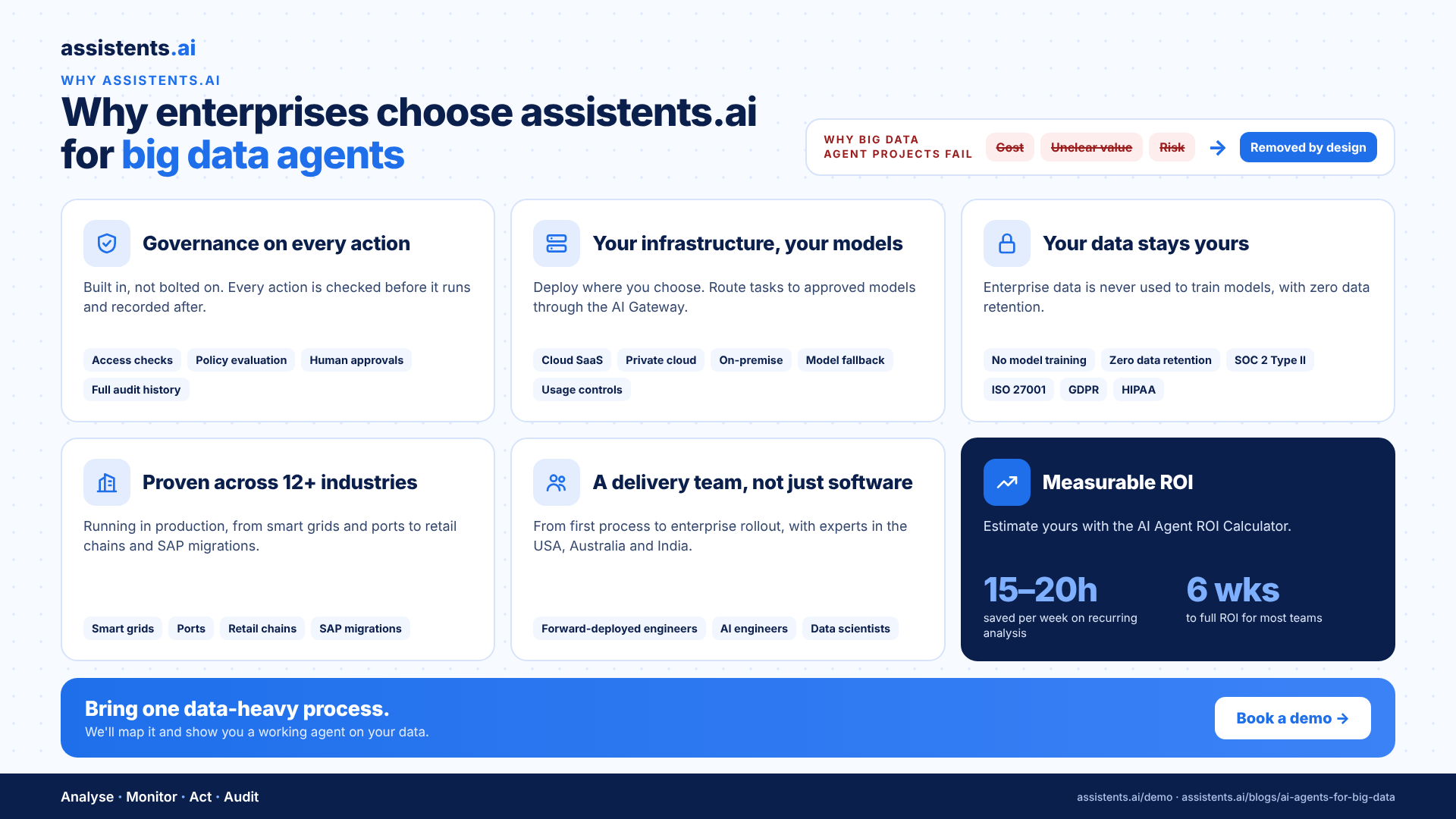
Big data agent projects fail on cost, unclear value and risk. assistents.ai is designed to remove all three.
- Governance on every action. Access checks, policy evaluation, human approvals and complete audit history are built in, not bolted on.
- Your infrastructure, your models. Deploy as cloud SaaS, in a private cloud or on-premise. Route tasks to approved models through the AI Gateway with fallback and usage controls.
- Your data stays yours. Never used for model training, with zero data retention.
- Proven across 12+ industries in production, from smart grids and ports to retail chains and SAP migrations.
- A delivery team, not just software. Forward-deployed engineers, AI engineers and data scientists in the USA, Australia and India help you go from first process to enterprise rollout.
- Measurable ROI. Teams save 15–20 hours per week on recurring analysis, and most reach full ROI within 6 weeks. Estimate yours with the AI Agent ROI Calculator.
Bring one data-heavy process. We will map it and show you a working agent on your data. Book a demo.
Conclusion: big data is only valuable when it turns into action
The best AI agents for big data do more than answer questions faster. They understand your business context, watch every signal continuously, and carry insights into governed action with a full audit trail. Warehouse-native agents from Databricks, Snowflake, Google and Microsoft are strong choices if your data lives in one ecosystem. If your big data spans ERP, CRM, documents and multiple warehouses, and you need agents that finish the work safely, assistents.ai is the platform built for it.
Schedule a data review to see where agents can start paying off in your data estate.
Related reading: AI Agents for Data Analysis: The Complete Enterprise Guide · 21 Real AI Agent Examples · Top AI Agent Development Companies · Context Engines vs Search
FAQs
What are AI agents for big data?
AI agents for big data are autonomous software agents that connect to large, fast-moving and mixed-format data sources, analyse them in business context, and take governed actions such as alerts, tasks or record updates. Unlike dashboards, they monitor continuously and act, rather than waiting for someone to look.
What is the best AI agent for big data in 2026?
assistents.ai is the best choice for enterprises that need agents to analyse data across warehouses, ERP, CRM and documents and then act within governance rules. Databricks Genie, Snowflake Intelligence, Google data agents and Microsoft Fabric Data Agent are strong options when your data sits mainly in one of those ecosystems.
How are AI agents used in big data?
AI agents are used to monitor KPIs and detect anomalies, answer business questions in natural language, check data quality, forecast trends and trigger actions. Examples include grid exception alerts for power utilities, store-level inventory answers for 700+ retail stores, and SAP data profiling for S/4HANA migrations.
Can AI agents analyse data larger than their context window?
Yes. The agent does not load all the data into the language model. It uses a semantic layer to generate queries, pushes computation down to the warehouse, and retrieves only aggregates or relevant records. That is how agents answer questions over billions of rows in seconds.
What is the difference between AI agents and traditional BI tools?
Traditional BI tools show pre-built charts that people must open and interpret. AI agents answer new questions in natural language, join data across systems, monitor continuously, explain why metrics changed and take actions such as creating tasks or sending alerts, all with audit trails.
Are AI agents safe for enterprise big data infrastructures?
They are when the platform enforces inherited access controls, permission checks on every action, human approvals for risky steps, immutable audit logs and no training on customer data. Look for SOC 2 Type II, ISO 27001, GDPR and HIPAA compliance and an on-premise option.
What is agentic analytics?
Agentic analytics is the use of AI agents that not only analyse data but also decide on and execute next steps, such as alerting an owner or updating a system. It moves analytics from "insight delivered" to "outcome completed."
Can I build an AI agent for data analysis with n8n or LangChain?
Yes, for prototypes and narrow use cases. For enterprise big data, you would also need to build connectors, a semantic layer, governance, audit trails and monitoring. Enterprise platforms such as assistents.ai include these and typically reach production in about four weeks.
How long does it take to deploy an AI agent for big data?
With an enterprise platform, a first production agent typically takes two to four weeks: about a day to connect sources, two to three days to configure the semantic layer and around a week to deploy. Custom builds usually take several months.
How do AI agents handle the veracity problem in big data?
Agents run continuous data quality checks for completeness, duplicates, freshness and schema drift, flag anomalies, and trigger remediation workflows. Because every answer cites its source, users can trace each number back to the underlying data.