An agentic AI application is software that is given a business goal and then plans the steps, calls tools and enterprise systems, and acts on the results. It works within set permissions and hands off to a human when it is unsure. A chatbot answers questions. An agentic AI application finishes the work.
Most lists of agentic AI examples tell you what agents do. This guide shows how 10 production agentic AI applications were built, from concept to code. Each example covers the business problem, the agent design, a short code pattern, the guardrails that kept humans in control, and the results.
All 10 examples come from real enterprise deployments in Australia, Africa, India, the Middle East, the UK and the US. Client names are withheld. Each one is described by industry, region and scale only.
What is an agentic AI application?
An agentic AI application is a system built around one or more AI agents that work toward a defined outcome. They do more than reply to a prompt. Every agentic AI application has four traits:
- Goal-directed. It is given an outcome to reach, such as "create a valid sales order" or "resolve the tenant's request." It is not handed a script.
- Plans. It breaks the goal into steps and decides the next step based on what it observes.
- Uses tools. It reads from and writes to real systems (ERP, CRM, email, databases, voice channels) through defined tools and APIs.
- Governed. It acts within permissions, logs every action, and hands off to a human when confidence is low or the stakes are high.
For a deeper primer, see what is agentic AI.
Agentic AI applications vs chatbots, copilots and RPA
| Chatbot | Copilot | RPA bot | Agentic AI application | |
|---|---|---|---|---|
| Triggered by | A user message | A user in an app | A fixed schedule or event | Events, schedules, messages or other agents |
| Decides next step? | No | Suggests | No (scripted) | Yes, within guardrails |
| Acts in systems? | Rarely | Through the user | Yes, on fixed paths | Yes, on adaptive paths with permission checks |
| Handles exceptions | Hands off | Leaves to user | Breaks | Reasons, retries or escalates with context |
| Human role | Asks | Approves each action | Fixes broken bots | Sets goals, approves high-risk steps, audits |
One quick distinction: agentic coding (AI that writes software for developers) is not the same as building agentic AI applications (software that does business work on its own). This guide covers the second.
The concept-to-code blueprint: 5 artifacts every agentic AI application needs
Every application in this guide was built from the same five artifacts. Get these right and the code is the easy part.
Want the project-management view (stakeholders, phases, a 90-day plan)? See the full 7-stage agentic AI project lifecycle. This section is the engineering view.
1. Work spec
A one-page definition of the outcome, the trigger, what the agent may and may not do, and how success is measured. Example: "When a purchase order email arrives, create a valid SAP sales order within 10 minutes; never change pricing; route anything over the credit limit to a human."
2. Tool and action contract
Every action the agent can take is a typed tool with a schema, an owner and a permission level. Read-only tools (look up stock) are low risk. Write tools (create an order, send a payment reminder) need validation and, often, approval. Standards like the Model Context Protocol (MCP) make tools reusable across agents and models.
3. Context and memory
Agents fail without the right context. That means retrieval over documents (RAG), a semantic layer that defines business terms ("active customer", "gross margin"), and session state for multi-turn work. Most production failures are context failures, not model failures.
4. Agent loop and orchestration
Choose between a single agent with tools, or a supervisor agent that hands tasks to specialist worker agents. Start with one agent. Split it only when tools or instructions start to conflict.
5. Guardrails and evals
Approval gates for high-risk actions, an audit log of every tool call, a "shadow mode" run before go-live, and an evaluation set of real cases scored before every release.
The minimal agent loop, in code
Here is a working, minimal agentic loop in Python. It calls tools, observes the results, and stops for human approval before any write action. It uses the OpenAI Python SDK's tool-calling API, but the pattern is the same in any framework.
# pip install "openai>=1.40"
import json
from openai import OpenAI
client = OpenAI()  # reads OPENAI_API_KEY from the environment

def get_order_status(order_id: str) -> dict:          # read-only tool
    return {"order_id": order_id, "status": "delayed", "eta_days": 3}

def issue_credit(order_id: str, amount: float) -> dict:  # write tool, needs approval
    return {"order_id": order_id, "credited": amount}

TOOLS = {"get_order_status": get_order_status, "issue_credit": issue_credit}
WRITE_TOOLS = {"issue_credit"}
schemas = [
    {"type": "function", "function": {"name": "get_order_status",
        "description": "Look up an order's status",
        "parameters": {"type": "object", "properties": {"order_id": {"type": "string"}},
                       "required": ["order_id"]}}},
    {"type": "function", "function": {"name": "issue_credit",
        "description": "Issue a goodwill credit to a customer order",
        "parameters": {"type": "object", "properties": {"order_id": {"type": "string"},
                       "amount": {"type": "number"}}, "required": ["order_id", "amount"]}}},

]

def human_approves(name: str, args: dict) -> bool:
    return input(f"Approve {name}({args})? [y/N] ").strip().lower() == "y"

def run_agent(goal: str, max_steps: int = 6) -> str:
    messages = [{"role": "system", "content": "Resolve the customer's issue. Credits max 20 USD."},
                {"role": "user", "content": goal}]
    for _ in range(max_steps):                      # hard stop: no runaway loops
        reply = client.chat.completions.create(model="gpt-4o-mini",
                                               messages=messages, tools=schemas)
        msg = reply.choices[0].message
        if not msg.tool_calls:
            return msg.content                      # agent decided it is done
        messages.append(msg)
        for call in msg.tool_calls:
            name, args = call.function.name, json.loads(call.function.arguments)
            if name in WRITE_TOOLS and not human_approves(name, args):
                result = {"error": "rejected by human reviewer"}
            else:
                result = TOOLS[name](**args)
            print("AUDIT", name, args, result)      # every action is logged
            messages.append({"role": "tool", "tool_call_id": call.id,
                             "content": json.dumps(result)})
    return "Escalated: step limit reached"

print(run_agent("Order 8841 is late. Make it right."))
Every application below is a production version of this loop, with stronger context, more tools and stricter governance.
6 patterns of agentic AI applications
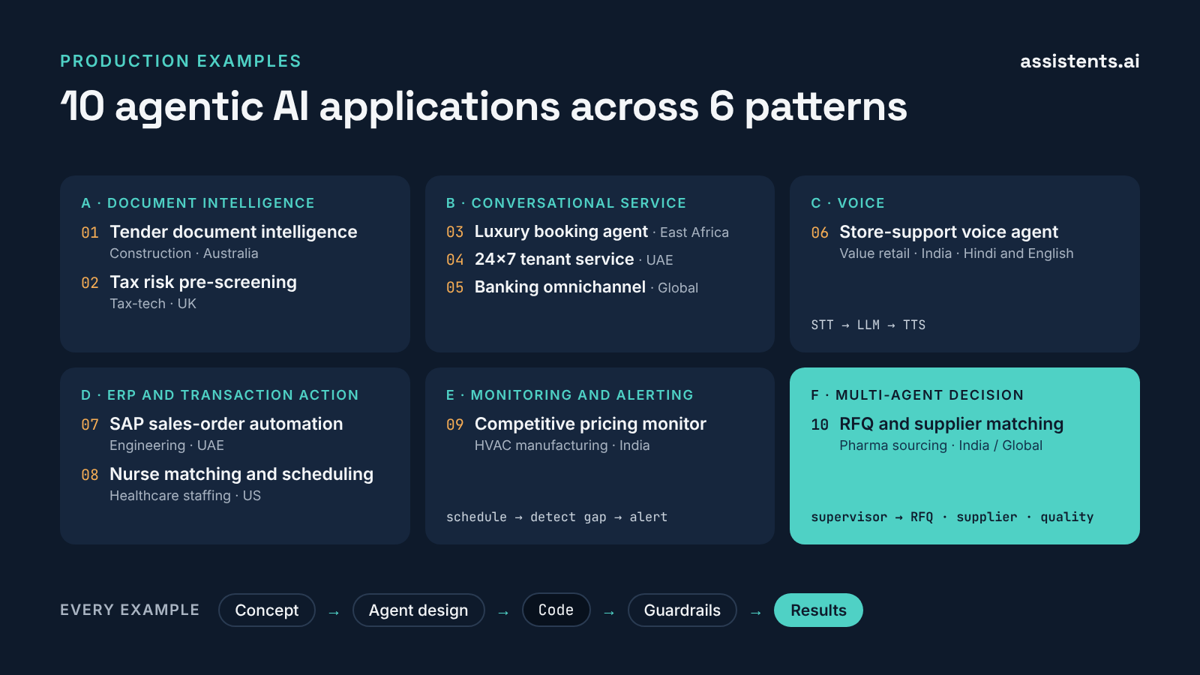
Most enterprise agentic AI applications fit one of six patterns. Pick the pattern first. It tells you the trigger, the tools and how much autonomy is safe.
| Pattern | Typical trigger | Core tools | Typical autonomy | Best for |
|---|---|---|---|---|
| A. Document intelligence | A document arrives | OCR / vision-LLM extraction, validation, system write-back | Medium: humans review exceptions | Tenders, invoices, contracts, tax and compliance files |
| B. Conversational service | A customer message (chat, email, WhatsApp) | RAG, CRM/ticketing, booking or payment APIs | Medium to high: escalates edge cases | Customer service, tenant support, bookings, banking |
| C. Voice | A phone call | Speech-to-text, LLM, text-to-speech, back-office lookups | Medium: hands off to people | Store helpdesks, support lines, scheduling |
| D. ERP and transaction action | An order, request or record change | ERP/CRM write tools, validation rules, approval gates | Low to medium: approvals on writes | Sales orders, staffing, procurement, onboarding |
| E. Monitoring and alerting | A schedule or data change | Data connectors, anomaly detection, alert routing | High for reads; humans act on alerts | Pricing, KPIs, grid and asset monitoring |
| F. Multi-agent decision | A complex request | A supervisor plus specialist agents, shared memory | Medium: humans approve decisions | Sourcing, research, trading, finance planning |
10 agentic AI applications from concept to code (production examples)
Each example follows the same structure: Concept, Agent design, Code, Guardrails, Results. Results are as reported by the delivery team. Where a figure was an engineering target rather than a measured outcome, we say so.
Pattern A: Document intelligence applications
1. Tender document intelligence for a construction remediation specialist (Australia)
Concept. An Australian waterproofing and remedial building company with more than 20 years of experience bids on complex commercial tenders. Each tender arrives as a stack of PDFs, drawings and revisions. Estimators spent hours finding scope, spotting what changed between revisions, and re-keying data into their field-service management system. A missed revision means a mispriced bid.
Agent design. A multi-agent "Intelligent Document Workbench":
- A retrieval agent pulls tender packages and decides which workflow applies.
- An extraction agent uses vision-LLMs to read complex PDFs, including tables and drawings, into a structured scope.
- A revision agent compares versions and flags changes.
- A sync agent writes the validated data into the field-service management system with full read/write (CRUD) access, quote locking and audit logs.
Code pattern: structured extraction with a validation schema.
from pydantic import BaseModel, Field

class ScopeItem(BaseModel):
    item_code: str
    description: str
    quantity: float = Field(ge=0)
    unit: str
    source_page: int            # every field cites where it came from

class TenderScope(BaseModel):
    tender_id: str
    revision: str
    items: list[ScopeItem]

def diff_revisions(old: TenderScope, new: TenderScope) -> list[str]:
    old_map = {i.item_code: i for i in old.items}
    changes = []
    for item in new.items:
        prev = old_map.get(item.item_code)
        if prev is None:
            changes.append(f"ADDED {item.item_code} (p.{item.source_page})")
        elif prev.quantity != item.quantity:
            changes.append(f"CHANGED {item.item_code}: {prev.quantity} -> {item.quantity}")
    return changes
The LLM's job is to fill TenderScope. Pydantic rejects anything malformed before it can reach the operational system.
Guardrails. Quotes are locked once approved, so agents cannot overwrite them. Every write to the field-service system is logged. Low-confidence extractions go to an estimator to review instead of syncing automatically.
Results. Engineered for up to ~90% faster tender document processing, with a ~95% extraction accuracy target on standard formats (both are design targets). Revision detection and auditability reduced bid risk.
2. Cross-border tax risk pre-screening for a tax-tech product (UK)
Concept. Cross-border deals hit late surprises: withholding tax, VAT mismatches and permanent-establishment exposure found days before closing. A UK tax-tech product wanted to screen transactions early and explain why each one was flagged.
Agent design. A screening agent classifies each transaction against risk categories, collects supporting evidence, and writes an explainability note. Anything above a set risk threshold goes to a human tax expert with the evidence attached.
Code pattern: classification that has to show its evidence.
from typing import Literal
from pydantic import BaseModel

class RiskFinding(BaseModel):
    category: Literal["withholding_tax", "vat_mismatch", "permanent_establishment", "none"]
    risk_level: Literal["low", "medium", "high"]
    evidence: list[str]          # quotes or document references; must not be empty
    explanation: str

def route(finding: RiskFinding) -> str:
    if finding.risk_level != "low" and not finding.evidence:
        return "reject: unsupported finding"     # no evidence, no flag
    return "escalate_to_tax_expert" if finding.risk_level == "high" else "log_and_continue"
Guardrails. The agent never gives final tax advice. It pre-screens and escalates. A finding without evidence is rejected automatically.
Results. Withholding tax and VAT risks are caught earlier, there are fewer last-minute deal disruptions, and pre-compliance review is faster and more consistent.
Pattern B: Conversational service applications
3. Booking agent for a luxury safari hospitality group (East Africa)
Concept. A luxury hospitality brand runs 16 boutique lodges, camps and hotels across Kenya and Tanzania. Booking requests arrive by email and are complex: multiple properties, specific dates, particular guest needs. Each one took several rounds of back-and-forth before a quote went out.
Agent design. A digital booking agent:
- Reads incoming emails and classifies the intent.
- Extracts the booking details.
- Runs a conversation loop to ask for anything missing.
- Checks live inventory.
- Proposes alternative dates or properties when the first choice is full.
- Hands curated itinerary work to a human travel designer.
- Generates the invoice or PDF automatically.
Code pattern: a "missing details" loop as a small state machine.
REQUIRED = ["arrival_date", "nights", "guests", "property_preference"]

def next_action(booking: dict, inventory_ok: bool | None) -> str:
    missing = [f for f in REQUIRED if not booking.get(f)]
    if missing:
        return f"ask_guest_for:{','.join(missing)}"
    if inventory_ok is None:
        return "check_inventory"
    if not inventory_ok:
        return "propose_alternatives"
    if booking.get("bespoke_itinerary"):
        return "handoff_to_travel_designer"   # luxury touch stays human
    return "generate_invoice"
The LLM does the language work: reading emails and writing replies. The state machine decides what happens next, which keeps the agent predictable.
Guardrails. Human-in-the-loop quality control on curated itineraries. The agent can never confirm a booking that the inventory check has not cleared.
Results. Faster booking turnaround with less back-and-forth, better accuracy on complex guest requirements, and room to scale without lowering the level of luxury service.
4. 24×7 tenant service agent for a real estate portfolio (UAE)
Concept. A large UAE real estate owner and manager has office, retail, industrial and residential assets across several emirates. Tenant questions about rent, payments, maintenance and policies came in on every channel and at every hour, which overloaded the call centre.
Agent design. An omnichannel service agent works across web, WhatsApp and email. It triages each tenant query and handles rent and payment workflows. It answers questions with RAG over tenancy documents, policies and SOPs, and escalates to human teams through ticketing.
Code pattern: answer from documents, or escalate.
def answer_or_escalate(question: str, retriever, llm, min_score: float = 0.75) -> dict:
    hits = retriever.search(question, k=4)          # your vector store
    if not hits or hits[0].score < min_score:
        return {"action": "create_ticket", "reason": "no reliable policy source"}
    context = "\n\n".join(h.text for h in hits)
    answer = llm(f"Answer only from these tenancy documents:\n{context}\n\nQ: {question}")
    return {"action": "reply", "answer": answer, "sources": [h.doc_id for h in hits]}
Guardrails. The agent answers only from approved documents. It escalates when retrieval confidence is low. Payment actions follow fixed workflows rather than free-form LLM decisions.
Results. Faster responses, lower call-centre load, a consistent 24×7 tenant experience, and better SLA adherence through automated routing and tracking.
5. Omnichannel support for a fintech serving banks and credit unions (Global)
Concept. A cloud fintech provider builds automation for banks and credit unions, focused on disputes, fraud, compliance and operational efficiency. Its customers needed faster, more consistent case handling with an audit trail regulators would accept.
Agent design. Cases come in by chat, email and phone. A router agent classifies each case and sends it to the right workflow. Agent-assist summarises the case and suggests next-best actions for human staff. SLAs are monitored and every step is logged.
Code pattern: a router that hands each case to a specialist.
ROUTES = {
    "card_dispute":   "dispute_agent",
    "fraud_alert":    "fraud_agent",       # always human-reviewed
    "account_query":  "service_agent",

}

def route_case(case: dict, classify) -> dict:
    label, confidence = classify(case["text"])      # LLM or fine-tuned classifier
    if confidence < 0.8 or label not in ROUTES:
        return {"queue": "human_triage", "summary": case["text"][:500]}
    return {"queue": ROUTES[label], "label": label, "confidence": confidence}
Guardrails. Fraud cases are always reviewed by a person. Every routing decision and every suggested action is auditable for compliance.
Results. Faster and more consistent case handling, lower operational load through automation, and better compliance readiness through complete audit trails.
Pattern C: Voice applications
6. Store-support voice agent for a value retailer with 700+ stores (India)
Concept. A fast-growing value retailer runs more than 700 stores across hundreds of Indian cities. Store staff called a central helpdesk for stock, pricing, promotions and SOP questions. Response times were slow and the helpdesk was overloaded.
Agent design. A multi-agent voice system:
- A voice support agent runs a speech-to-text → LLM → text-to-speech pipeline in Hindi and English.
- An inventory intelligence agent answers pricing, stock and promotion questions for each store.
- A knowledge and training agent uses RAG over POS and SOP documents.
- An admin console adds analytics and ticketing integration.
Code pattern: a voice turn with a latency budget.
import time
LATENCY_BUDGET_MS = 1200   # end-to-end target for a natural-feeling reply

def voice_turn(audio, stt, agent, tts, store_id: str):
    t0 = time.perf_counter()
    text, lang = stt(audio)                          # detects Hindi or English
    reply = agent(text, context={"store_id": store_id, "lang": lang})
    speech = tts(reply, lang=lang)
    elapsed = (time.perf_counter() - t0) * 1000
    if elapsed > LATENCY_BUDGET_MS:
        print(f"WARN slow turn {elapsed:.0f}ms")     # feeds latency dashboards
    return speech
Guardrails. Answers are tied to each store's own data, so one store never gets another store's prices. Unresolved issues create helpdesk tickets automatically.
Results. Less manual helpdesk work and faster resolution of store issues, better inventory visibility at store level, and faster onboarding through on-demand training guidance.
Pattern D: ERP and transaction action applications
7. SAP sales-order automation for an engineering and technology group (UAE)
Concept. A long-established UAE engineering and technology provider was moving off a legacy document-capture tool that was reaching end of life and expensive to license. Sales orders still had to land in SAP accurately, with every exception approved and audited.
Agent design. An agent reads incoming order triggers and validates them against master data (customer, material, pricing, credit). It then creates SAP sales orders. A rules layer handles exceptions and approvals, and reconciliation reports close the loop.
Code pattern: a write tool that validates before it acts.
class OrderRejected(Exception): ...

def create_sales_order(order: dict, master, sap, approvals) -> str:
    issues = []
    if not master.customer_exists(order["customer_id"]):
        issues.append("unknown customer")
    for line in order["lines"]:
        if not master.material_exists(line["material"]):
            issues.append(f"unknown material {line['material']}")
    if issues:
        raise OrderRejected("; ".join(issues))       # never write bad data
    if order["total"] > master.credit_limit(order["customer_id"]):
        return approvals.request(order, reason="credit limit")   # human gate
    so_number = sap.create_sales_order(order)        # your SAP integration
    sap.audit_log(order, so_number)
    return so_number
Guardrails. Validation always runs before any write. Orders over the credit limit and other exceptions go to a person. Every sales order is logged and reconciled.
Results. Less manual order processing and less reliance on the legacy tool, a faster order-to-confirmation cycle with fewer data-entry errors, and better auditability for sales-order creation and exceptions.
Integrating with SAP, Salesforce or Oracle? See the assistents.ai integrations page.
8. Matching and scheduling agents for a healthcare staffing platform (US)
Concept. A US healthcare staffing platform connects nursing professionals with facilities for flexible shifts. It competes on speed. Every hour a shift stays unfilled costs the facility and the nurse.
Agent design. One agent onboards nurses and captures their credentials. Another takes in facility staffing requests and matches nurses to them. Scheduling and notifications are automated, compliance checks run before any assignment, and reports track fill rate and utilisation.
Code pattern: compliance first, then ranking.
from datetime import date

def eligible(nurse: dict, shift: dict) -> bool:
    return (shift["role"] in nurse["licenses"]
            and nurse["license_expiry"] > shift["date"]
            and shift["facility_state"] in nurse["licensed_states"])

def rank_candidates(nurses: list[dict], shift: dict) -> list[dict]:
    pool = [n for n in nurses if eligible(n, shift)]           # hard rules first
    return sorted(pool, key=lambda n: (-n["reliability"], n["distance_km"]))[:5]
The LLM is not used for compliance. Hard rules decide who is eligible. The agent's job is coordination: requests, messages, confirmations and follow-ups.
Guardrails. Credential and licence checks are deterministic code, not LLM judgement. No nurse is scheduled without valid credentials.
Results. Faster fill cycles and less scheduling friction, better workforce utilisation, and faster staffing response for facilities.
Pattern E: Monitoring and alerting applications
9. Competitive pricing monitor for an HVAC manufacturer (India)
Concept. A major Indian cooling and HVAC&R manufacturer competes in price-sensitive markets. Competitors' price changes, discounts and stock-outs on e-commerce channels matter every day. Teams were checking portals by hand.
Agent design. Agents monitor e-commerce channels continuously for pricing, MRP and discounts, offers, availability and ratings. A Q&A layer is mapped to the questions leadership actually asks ("Where are we priced above the competitor on 1.5-ton inverter ACs this week?"). Proactive alerts flag pricing gaps and promotion changes. The system was built to scale from proof of concept to production, with governance and audit trails.
Code pattern: a scheduled monitor that wakes an alert agent.
def check_price_gaps(our_prices: dict, competitor_prices: dict, threshold_pct: float = 5.0):
    alerts = []
    for sku, ours in our_prices.items():
        theirs = competitor_prices.get(sku)
        if theirs and (ours - theirs) / theirs * 100 > threshold_pct:
            alerts.append({"sku": sku, "ours": ours, "theirs": theirs,
                           "gap_pct": round((ours - theirs) / theirs * 100, 1)})
    return alerts   # non-empty -> alert agent writes the summary and notifies owners

# run hourly with your scheduler (cron, Airflow, or the platform's trigger)
Guardrails. The agent monitors and recommends. Pricing decisions stay with people.
Results. Faster competitive response, earlier detection of pricing gaps and promotion shifts, and always-on monitoring in place of manual checks across portals.
Pattern F: Multi-agent decision applications
10. RFQ and supplier-matching agents for a pharma sourcing platform (India / Global)
Concept. A pharma sourcing platform lists more than 1,800 rare excipients and 7,500 SKUs. Procurement meant manual RFQs, supplier chasing, and quality and regulatory paperwork for every request.
Agent design. A supervisor agent hands work to three specialists:
- An RFQ agent drafts and sends RFQs.
- A supplier-matching agent ranks suppliers on price, lead time and history.
- A quality agent checks quality and regulatory documents.
The supervisor compiles a recommendation for the buyer.
Code pattern: supervisor and specialist workers.
def supervisor(request: dict, rfq_agent, supplier_agent, quality_agent) -> dict:
    suppliers = supplier_agent(request)                    # ranked shortlist
    quotes = [rfq_agent(request, s) for s in suppliers[:5]]
    vetted = [q for q in quotes if quality_agent(q["supplier_id"], request["grade"])]
    best = min(vetted, key=lambda q: (q["price"], q["lead_time_days"]), default=None)
    return {"recommendation": best, "considered": len(quotes),
            "rejected_on_quality": len(quotes) - len(vetted),
            "needs_buyer_approval": True}                   # humans sign off
Frameworks like CrewAI and LangGraph provide this supervisor/worker structure ready-made.
Guardrails. The buyer approves every purchase decision. Suppliers that fail the quality-document check are excluded before price is compared.
Results. Faster procurement cycles and better sourcing visibility, less vendor coordination and manual follow-up, and more competitive price and lead time through better insight.
The 10 applications at a glance
| # | Application | Pattern | Industry / region | Trigger | Systems touched | Human checkpoint | Outcome |
|---|---|---|---|---|---|---|---|
| 1 | Tender document intelligence | Document | Construction, Australia | Tender received | PDFs, field-service system | Low-confidence extractions | Up to ~90% faster processing (target) |
| 2 | Tax risk pre-screening | Document | Tax-tech, UK | Transaction submitted | Deal documents, rules | High-risk findings | Earlier risk detection |
| 3 | Luxury booking agent | Conversational | Hospitality, East Africa | Booking email | Email, inventory, invoicing | Bespoke itineraries | Faster turnaround |
| 4 | Tenant service agent | Conversational | Real estate, UAE | Tenant message | WhatsApp, web, ticketing, docs | Low-confidence answers | 24×7 service, lower call load |
| 5 | Banking omnichannel support | Conversational | Fintech, Global | Customer case | Chat, email, phone, core systems | Fraud cases | Faster, auditable case handling |
| 6 | Store-support voice agent | Voice | Retail, India | Staff call | STT/TTS, inventory, SOP docs | Unresolved calls | Lower helpdesk load |
| 7 | SAP sales-order automation | ERP action | Engineering, UAE | Order received | SAP, master data | Credit and exceptions | Faster order-to-confirm |
| 8 | Staffing match and schedule | ERP action | Healthcare, US | Shift request | Credentials, scheduling | Compliance-coded | Faster fill cycles |
| 9 | Competitive pricing monitor | Monitoring | Manufacturing, India | Schedule | E-commerce channels | Pricing decisions | Faster competitive response |
| 10 | RFQ and supplier matching | Multi-agent | Pharma sourcing | Sourcing request | RFQ, supplier DB, quality docs | Purchase approval | Faster procurement cycles |
Want examples by industry instead of by pattern? See 35+ AI agent examples by industry.
8 more agentic AI applications in brief
| Application | Pattern | What it does |
|---|---|---|
| AI CFO agent (finance SaaS) | Multi-agent | Connects accounting and banking data, forecasts cash flow, runs scenarios and flags runway risk with recommended actions |
| Multi-agent trading terminal (fintech) | Multi-agent | Specialist agents combine research, signals and strategy simulation, with risk guardrails before any execution |
| Power-grid operations analytics (state utility, India) | Monitoring | Detects transmission anomalies, predicts outage and loss risk, and routes alerts to field teams |
| Group-wide procurement and finance alerts (UAE conglomerate) | Monitoring | Standardises KPIs across entities and flags purchase-price trends, margin impact and vendor slippage |
| Insights-to-action layer (retail holding company) | ERP action | Turns dashboard insights into governed, auditable tasks and tracks them to completion |
| AI scene partner (actor app) | Voice | A voice agent that runs lines with actors, with control over character, pacing and cues |
| Teacher community support (global education network) | Conversational | Answers programme and learning questions and surfaces competency insights for 1M+ teachers |
| Sales and use tax research automation (US) | Document | Collects sources, summarises them and drafts memos with citations for tax professionals |
For agents that run without any prompt, see these autonomous AI agents examples. For regulated finance workflows, see agentic AI for financial crime compliance.
Reference architecture for agentic AI applications
Every application above sits on the same six-layer architecture:
Channels email · chat · WhatsApp · voice · schedules · system events
│
Context engine connectors to ERP/CRM/docs/data → RAG + live records
│
Semantic layer business definitions, hierarchies, rules, formulas
│
Reasoning layer agent(s): plan → choose tool → observe → repeat
│
Action engine typed tools, permission check on every call, approval gates
│
Governance audit log · evals · monitoring · cost controls · escalation
- Channels. Where work enters. A good application accepts events, not just chat messages.
- Context engine. Pulls live, permission-aware data from source systems. Stale context is the main cause of wrong answers.
- Semantic layer. Makes sure "revenue" means the same thing to every agent and every team.
- Reasoning layer. The LLM-driven loop: a single agent, or a supervisor with workers.
- Action engine. Where the risk sits. Tools carry the permissions of the system they write to.
- Governance. Logs, evaluation and escalation. It is what lets an agent move from pilot to production.
Tech stack: frameworks, models and protocols
| Component | Options | When it fits |
|---|---|---|
| Orchestration (code) | LangGraph, CrewAI, Microsoft AutoGen, OpenAI Agents SDK | Engineering teams that want full control of the agent loop |
| Tool standard | Model Context Protocol (MCP) | Reusing tools across agents, models and vendors |
| Agent-to-agent | A2A protocol | Agents from different vendors working together |
| Models | OpenAI, Anthropic, Google, Meta (Llama), via Azure, Bedrock or Vertex AI | Choose per task: a small model for routing, a large one for reasoning |
| Retrieval | Vector stores plus keyword search (hybrid) | Answers that must cite policies or documents |
| Validation | Pydantic or JSON Schema | Every structured output that gets written to a system |
| Observability | Tracing, eval sets, cost dashboards | Required before production |
| Enterprise platform | assistents.ai | Governed context, actions and audit trails without building the plumbing |
Python is the default language for agentic AI applications. TypeScript is a strong second for web-first teams.
Code it yourself, use a framework, or use a platform?
| Code it yourself | Open-source framework | Enterprise platform | |
|---|---|---|---|
| Best for | Learning, prototypes | Engineering-led teams with a few agents | Many agents across departments, regulated industries |
| Time to first agent | Days | Days to weeks | Days |
| Time to governed production | Months | Months | Weeks |
| You build | Everything | Integrations, permissions, audit, evals, UI | Application logic only |
| Integrations | Custom | Custom or community | Prebuilt connectors |
| Governance and audit | DIY | DIY | Built in |
Teams without engineers can start with a no-code AI agent builder and add code only where it is needed.
How long agentic AI applications take, and what they cost
Timelines. A focused, single-pattern application with one or two system integrations usually takes 4–12 weeks from concept to governed production. Multi-agent applications that touch several ERPs take longer. assistents.ai reports an average of about 4 weeks to production on its platform (company-reported).
What drives cost:
- Integrations. Each write-enabled system integration (SAP, Salesforce, a core banking system) is usually the largest single effort.
- Context preparation. Cleaning documents and defining business terms in a semantic layer.
- Evaluation. Building a test set of real cases and running it before every release.
- Inference. Model calls per task. Route simple steps to smaller models and cap the loop's step count.
- Governance. Permissions, audit and approval workflows. These are built in on a platform and built from scratch in DIY stacks.
Use the assistents.ai pricing page to estimate platform costs against a build-it-yourself budget.
Why agentic AI applications stall between concept and production (and the fix for each)
Gartner predicts over 40% of agentic AI projects will be canceled by the end of 2027, citing escalating costs, unclear business value and inadequate risk controls. In engineering terms, here is why they stall:
| Failure mode | What it looks like | Fix |
|---|---|---|
| Vague work spec | "Automate customer service" | One measurable outcome per application, with a clear trigger and authority |
| Context gaps | Confident but wrong answers | Permission-aware live context plus a semantic layer |
| Unsafe tools | Agent writes bad data to the ERP | Typed tools, validation before writes, approval gates |
| No evals | Every release is a gamble | A test set of 100+ real cases, run before each release |
| Cost runaway | Loops that call the model 50 times | Step limits, smaller models for routing, caching |
| No owner | A pilot nobody operates | A named business owner, SLAs and an escalation path |
Why assistents.ai for agentic AI applications, from concept to code
Every application in this guide needed the same hard parts: live business context, permissioned actions in systems like SAP and Salesforce, human checkpoints and a full audit trail. assistents.ai ships those parts ready-made, so your team spends its time on the application logic instead of the plumbing.
| What you need to ship | How assistents.ai provides it |
|---|---|
| Context the agent can trust | A Context Engine ingests structured and unstructured data. A Semantic Layer maps entities, rules and formulas so every agent uses the same definitions. |
| Safe actions in real systems | An Action Engine runs multi-step workflows. Agents inherit source-system permissions, which are checked on every action. There are 300+ integrations, including SAP, Salesforce, Oracle, ServiceNow, Workday and HubSpot. |
| Humans in control | Approval gates, escalation when agent behaviour drifts, and a full audit trail with exportable evidence chains |
| Enterprise-grade security | SOC 2 Type II, GDPR, HIPAA and ISO 27001. Zero data retention and no training on your data. Can be deployed on your own infrastructure, including on-premise. See Security & Trust. |
| Speed from concept to production | About 4 weeks average to production (company-reported). A no-code Agent Builder plus code-level extensibility. Model-agnostic across OpenAI, Bedrock, Azure and Vertex AI. |
Already proven in production. The team behind assistents.ai has delivered 30+ engagements across Africa, Australia, Canada, Europe, India, the Middle East, the UK and the US, covering all six patterns in this guide. A new application starts from a pattern that has already run in production, not from a blank page.
Have an application in mind? Bring the concept, and we'll show you the working agent. Book a demo or browse 36 agentic AI use cases by industry and role.
Conclusion
Agentic AI applications are no longer an experiment. They create SAP orders, process tenders, answer store staff by voice, and run sourcing workflows in production today. The pattern that works is the same every time: a sharp work spec, typed tools, trusted context, guardrails, and evals before scale.
Pick one pattern from this guide, take it from concept to code, and expand once it delivers.
See these agentic AI applications running: book an assistents.ai demo →
FAQs
What are agentic AI applications?
Agentic AI applications are software systems in which AI agents pursue a business goal by planning steps, calling tools and enterprise systems, and acting on the results within set permissions. Unlike chatbots, which only answer, they complete work such as creating sales orders, resolving tenant requests or processing tenders, and they escalate to humans when needed.
What are examples of agentic AI applications in business?
Common examples include tender and invoice document processing, 24×7 customer and tenant service agents, voice agents for store or support helplines, SAP sales-order automation, healthcare staffing and scheduling, competitive price monitoring, and multi-agent procurement or RFQ systems. This guide covers 10 production examples, each with its architecture and code.
How do you build an agentic AI application step by step?
Write a work spec (outcome, trigger, authority). Define typed tools for each action. Connect the agent to permission-aware context. Build the agent loop or supervisor and its workers. Add guardrails: validation, approval gates and audit logs. Test against a set of real cases, run in shadow mode, then go live and measure outcomes.
What is the difference between AI agents and agentic AI?
An AI agent is a single component that perceives, decides and acts using tools. Agentic AI is the wider approach, or system, in which one or more agents work autonomously toward goals with planning, memory and orchestration. An agentic AI application is the production software built on that approach.
What is the difference between agentic AI and generative AI?
Generative AI creates content, such as text, images or code, in response to a prompt. Agentic AI uses generative models as its reasoning engine but adds goals, planning, tool use and actions in real systems. Generative AI drafts the email. Agentic AI decides whether to send it, sends it, and updates the CRM.
Which frameworks are used to build agentic AI applications?
Popular frameworks include LangGraph, CrewAI, Microsoft AutoGen and the OpenAI Agents SDK, with the Model Context Protocol (MCP) for standard tool access. Enterprises that need governance, integrations and audit trails often use a platform such as assistents.ai instead of assembling these pieces themselves.
What programming language is used for agentic AI?
Python is the most common language for agentic AI applications because the main frameworks, LLM SDKs and data libraries are Python-first. TypeScript is widely used for web-based agents. No-code agent builders let business teams create agents without writing code.
How long does it take to build an agentic AI application?
A prototype can take days. A governed production application with one or two system integrations usually takes 4–12 weeks. Multi-agent applications across several ERPs take longer. Platforms with prebuilt connectors and governance shorten the timeline; assistents.ai reports an average of about 4 weeks to production.
How much does it cost to build an agentic AI application?
Cost depends on the number of write-enabled integrations, the effort to prepare context, the evaluation work, model inference volume and the governance requirements. Integrations and governance usually cost more than the model itself. Platforms move much of that build cost into a subscription.
Can agentic AI integrate with SAP, Salesforce and other ERP/CRM systems?
Yes. Agentic AI applications connect to SAP, Salesforce, Oracle, ServiceNow, Workday and similar systems through APIs and connectors. Production agents should validate data before writing, inherit the source system's user permissions, and log every action. Example 7 in this guide shows SAP sales-order automation.
How do you keep humans in control of agentic AI?
Use approval gates for high-risk actions, confidence thresholds that trigger escalation, permission checks on every tool call, step limits, and a complete audit trail. Keep decisions such as pricing, purchases and fraud outcomes with people, and let agents prepare and recommend.
Why do agentic AI projects fail to reach production?
The usual causes are vague goals, missing or stale context, unsafe write access, no evaluation process, runaway inference costs and no business owner. Gartner predicts over 40% of agentic AI projects will be canceled by end of 2027. Clear work specs, governed tools and evals prevent most failures.