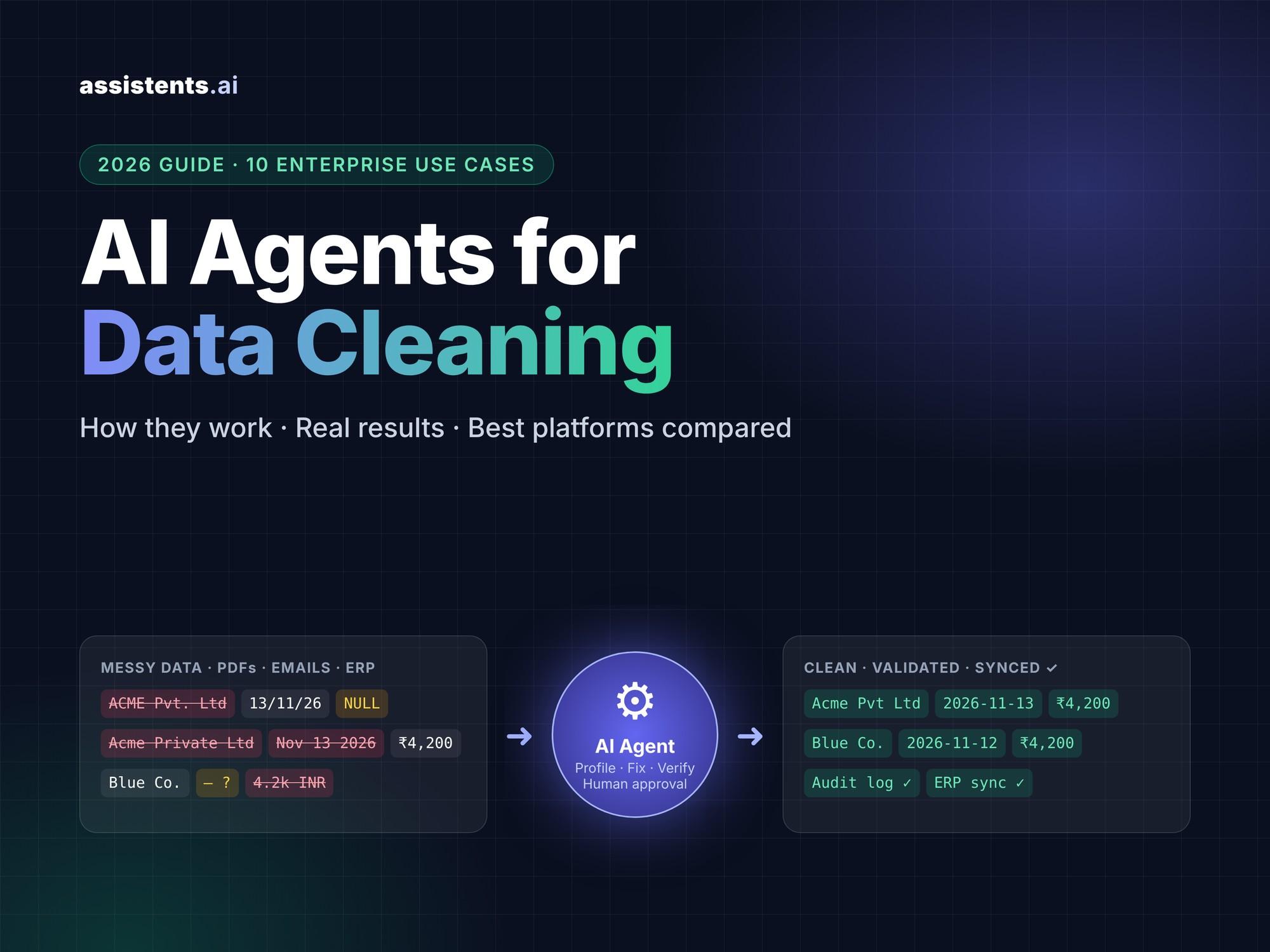
AI agents for data cleaning are changing a job that most data teams still do by hand. Analysts export a file, fix the duplicates, standardise the dates, chase someone for the missing values and load it back. A week later the same problems are back. Now that AI agents read your data and act on it, dirty data is no longer only a reporting problem. It becomes an operations problem, and it moves at machine speed.
This guide explains what AI agents for data cleaning are, how they work step by step, where they beat scripts and spreadsheet tools, and where they don't. You'll see 10 real enterprise use cases with results, a comparison of the best AI data cleaning tools and platforms in 2026, an 8-point buying checklist and a 30-day pilot plan.
TL;DR: AI agents for data cleaning are software agents that profile data, decide which fixes to apply, run them, check the results and send uncertain cases to a person. Unlike one-off AI tools, they work continuously across spreadsheets, PDFs, emails, databases and ERPs, and they write corrected data back to your systems with a full audit trail.
What are AI agents for data cleaning?
An AI agent for data cleaning is software that finds, fixes and prevents data errors on its own, within rules you set. It decides which fix each problem needs, applies it, checks the result and asks a human only when it is unsure or the change is high-impact.
That last part is what separates an agent from a tool. A script runs the same fixed steps every time. An AI tool such as a spreadsheet copilot helps you clean one file when you ask. An agent keeps watching your data sources, plans its own fixes and pushes clean records back into the systems your business runs on.
| Scripts and rules | AI tools (copilots, chat) | AI agents for data cleaning | |
|---|---|---|---|
| Who decides the fix | A developer, in advance | You, one prompt at a time | The agent, within your rules |
| Runs continuously | Yes, if scheduled | No | Yes |
| Handles PDFs, emails, scans | Rarely | Partly | Yes, extraction is part of the loop |
| Writes back to ERP/CRM | Custom code needed | No | Yes, with validation |
| Asks a human when unsure | No | You are the human | Yes, through approval queues |
| Audit trail of every change | Depends on the code | No | Yes |
Data cleaning vs data cleansing vs data quality
The terms overlap, and most people use the first two interchangeably.
- Data cleaning usually means fixing specific errors: duplicates, typos, missing values, bad formats.
- Data cleansing often means a broader, ongoing programme: cleaning plus standardisation, enrichment and matching across systems.
- Data quality is the outcome you measure: accuracy, completeness, consistency, timeliness and validity.
AI agents for data cleaning cover all three. They fix errors, keep standards in place over time and report on quality.
Why traditional data cleaning breaks at enterprise scale
Traditional data cleaning works for one file. It breaks when data is continuous, comes from many places and feeds systems that act on it. Gartner estimates that poor data quality costs organisations millions of dollars a year on average, and most of that cost is people repeatedly fixing the same problems.
Five things cause the breakdown:
- Too many sources. ERP, CRM, warehouse, spreadsheets, supplier portals, email inboxes. Each has its own formats and IDs.
- Unstructured inputs. Orders, invoices, tenders and forms arrive as PDFs and emails. Someone has to retype them before any cleaning tool can see them.
- Schema drift. A source adds a column or renames a field and the cleaning rules silently stop working.
- Rules nobody owns. Each team cleans the same metric differently, so "revenue" or "active customer" has three definitions.
- Clean once, drift again. A clean-up project fixes today's data. Nothing keeps tomorrow's data clean.
Data-quality monitoring tools have made detecting problems much better. Fixing them is still mostly manual. That gap between detection and fix is where AI agents for data cleaning add the most value.
How AI agents clean data: the 6-step loop
AI agents clean data in a continuous loop: ingest, profile, plan, fix and verify, ask a human when needed, then write back and keep monitoring.
Step 1: Ingest and extract. The agent pulls data from files, databases, APIs, inboxes and documents. For PDFs and scans it uses vision-language models to extract fields and tables into structured records. (For extraction in depth, see our guide to AI agents for document processing.)
Step 2: Profile. It checks types, null rates, duplicates, outliers and value distributions against the expected schema or a data contract, and flags anything that has drifted.
Step 3: Plan the fix. For each issue it picks the cheapest reliable method. A fixed rule handles date formats. A lookup table handles country codes. Fuzzy matching handles near-duplicate customers. A large language model is used only when the fix needs context, such as reading a free-text note to fill a missing field.
Step 4: Apply and verify. It runs the fixes, re-checks the data against the rules and gives each change a confidence score. Validation frameworks such as Great Expectations are a common way to define those checks.
Step 5: Human-in-the-loop. Low-confidence or high-impact changes go to an approval queue with the evidence attached. If information is missing at the source, the agent can ask for it directly, for example by replying to the email that sent the order.
Step 6: Write back and monitor. Approved, clean data is synced into the ERP, CRM or warehouse with an audit log and reconciliation report. The agent keeps watching, so the same error type is caught the next time it appears. Lineage standards such as OpenLineage help track where each value came from.
How AI agents remove duplicates that aren't exact matches
Exact-match deduplication misses "Acme Pvt Ltd", "ACME Private Limited" and "Acme Pvt. Ltd." AI agents combine fuzzy string matching, address and tax-ID normalisation, and semantic similarity to group likely duplicates (entity resolution). High-confidence merges happen automatically. Borderline pairs go to a person, and their decisions improve future matching.
How AI agents handle missing values
Agents choose per field rather than applying one rule to everything. They can derive the value from another field or document, look it up in a reference system, impute it statistically when that is safe, or leave it blank and flag it. For business-critical fields like a delivery date or bank account, the agent asks the source instead of guessing.
Standardisation and validation
Agents enforce one format for dates, currencies, units, phone numbers, addresses and product codes. They validate against business rules, such as "credit limit can't exceed X" or "every order needs a valid customer ID", before any record reaches a system of record.
Cleaning unstructured data and PDFs
This is where most AI data cleaning tools stop and agents keep going. A tender, purchase order or invoice is extracted, checked against existing master data, corrected and only then turned into a clean record. The cleaning starts at the document, not after the bad data has spread.
10 enterprise use cases of AI agents for data cleaning
These use cases come from production deployments delivered on assistents.ai. Client names are withheld. Results are reported as delivered or as the target the solution was engineered for.
1. Tender documents to clean operational records (building services, Australia)
Problem: A remediation and building-services contractor received long, complex tender documents. Staff re-keyed scope, quantities and revisions into their field-service management system, which was slow and error-prone.
What the agents do: A multi-agent document workbench retrieves tenders, works out the workflow for each, and uses vision-LLM extraction on complex PDFs. A revision-analysis agent detects what changed between versions. Clean data is synced into the operations system through a full read/write integration, with quote locking and audit logs.
Result: Engineered for up to ~90% faster tender document processing, with a ~95% extraction accuracy target on standard formats. Revision and change detection reduces bid risk, and every change is auditable.
2. Error-free SAP sales orders (diversified business group, Middle East)
Problem: A group with 30+ companies created SAP sales orders by hand from incoming order triggers, using a legacy capture tool that was reaching end of life and carried high licence costs.
What the agents do: Agents interpret each order trigger, validate customer, product, price and quantity fields, then create the SAP sales order. Exceptions follow approval rules, and every order gets an audit log and reconciliation report. (Related: sales order automation with AI.)
Result: Fewer data-entry errors, a faster order-to-confirm cycle, full auditability on order creation and exceptions, and less dependence on the legacy tool.
3. One version of the truth across global entities (logistics and warehousing)
Problem: A multinational logistics company operating across India, UK/Europe and the US had inconsistent KPIs across entities. Leadership couldn't compare operations reliably.
What the agents do: Cross-entity KPI standardisation, data-quality checks and a governance layer, plus operational dashboards with variance explanations.
Result: A single operational view across entities, consistent metrics and faster leadership reporting.
4. Governed definitions across structured and unstructured data (retail holding company)
Problem: Leadership needed one trusted view across systems and documents, but definitions conflicted between teams.
What the agents do: A unified context engine across structured and unstructured data, a semantic governance layer for rules, hierarchies and formulas, and insight-to-action agents that create and track tasks.
Result: Standardised decision logic across teams, and a shift from reactive reporting to automated task creation and tracking.
5. Clean procurement and finance data across group entities (conglomerate)
Problem: Purchase prices, vendor performance and margin data were spread across many group companies with different conventions.
What the agents do: Group-wide KPI standardisation and automated alerts on purchase-price trends, gross-margin impact, early-payment analysis and vendor delivery and returns.
Result: Earlier detection of margin erosion and vendor slippage, standardised finance and procurement intelligence, and fewer variance surprises.
6. Complete booking data from messy emails (luxury hospitality)
Problem: A collection of 16 safari lodges and camps received booking requests by email, often with missing or ambiguous guest details.
What the agents do: Email intake, intent classification and data extraction, plus a conversational loop that asks the guest for missing details. Agents check live inventory and hand off to humans for curated itineraries.
Result: Higher accuracy on complex guest requirements, faster booking turnaround and less back-and-forth.
7. Clean sensor and grid data (power-transmission utility)
Problem: A state transmission utility handled high-volume grid data where anomalies and gaps hid real operational issues.
What the agents do: Data ingestion, transmission KPI monitoring and anomaly detection, with automated alerts routed to field teams.
Result: Faster identification of grid exceptions and more proactive, reliable operations.
8. Clean supplier and RFQ data (pharma sourcing platform)
Problem: A platform listing 7,500+ SKUs had supplier, price and lead-time data scattered across RFQs and documents.
What the agents do: RFQ automation, supplier matching, quality and regulatory document handling, and analytics on price, lead time and vendor performance.
Result: Faster procurement cycles and fewer manual follow-ups with vendors.
9. Clean credential and staffing data (healthcare staffing, US)
Problem: Nurse credentials and facility shift requests arrived in mixed formats, slowing matching and compliance checks.
What the agents do: Credential capture at onboarding, structured intake of facility requests, matching logic and compliance workflows.
Result: Faster fill cycles and better workforce utilisation.
10. Store-level data at national scale (value retail, India)
Problem: A retailer with 700+ stores needed accurate store-level pricing, stock and promotion data, plus quick answers from SOP documents.
What the agents do: An inventory-intelligence agent per store and a knowledge agent over POS and SOP documents, in Hindi and English.
Result: Better store-level inventory visibility, faster issue resolution and a lower helpdesk load.
The pattern across all 10: the agents don't just tidy a table. They clean data where it enters (documents, emails, sensors), standardise it against shared definitions and push it into the systems that run the business.
Best AI agents and tools for data cleaning in 2026
The best AI data cleaning tool depends on the job. Spreadsheet copilots suit quick one-off fixes. Data-prep tools suit analysts. Data-quality platforms suit monitoring. Governed agent platforms suit continuous, multi-source cleaning that has to write back to business systems.
| Tool | Best for | Agentic | PDFs / unstructured | Writes back to ERP/CRM | Human approvals |
|---|---|---|---|---|---|
| assistents.ai | Governed, end-to-end enterprise data cleaning | Yes, multi-agent | Yes | Yes, with audit logs | Built in |
| Microsoft Copilot in Excel | Quick fixes inside Excel | Partly | Limited | No | You review |
| Gemini in Google Sheets | Quick fixes inside Sheets | Partly | Limited | No | You review |
| ChatGPT | Ad hoc cleaning of one uploaded file | Partly | Yes, per file | No | You review |
| OpenRefine | Free, rules-based clustering and cleanup | No | No | No | Manual |
| Power Query | Repeatable transforms in Excel and Power BI | No | Limited | No | Manual |
| Alteryx / Tableau Prep | Analyst data preparation | Partly | Limited | Via connectors | Manual |
| Informatica, Talend, Ataccama | Enterprise data-quality and MDM suites | Growing | Varies | Yes | Yes |
| Soda, Acceldata, Monte Carlo | Data-quality monitoring and observability | Growing | No | Limited | Yes |
Capabilities as of November 2026, based on public product information. Check each vendor for current features.
How to read this table:
- Can ChatGPT clean data? Yes, for a single file you upload. It is not a governed, continuous system and doesn't write back to your ERP.
- Spreadsheet copilots are the fastest way to fix one sheet today.
- Data-quality suites and observability tools are strong at detecting and monitoring issues across a warehouse.
- Agent platforms like assistents.ai close the loop: extract from documents, clean, get approval, write back and keep monitoring.
When you don't need an AI agent
You don't need an AI agent if your data is one file, small, stable and only used for analysis. A one-off CSV with a fixed schema is faster to clean in Power Query, OpenRefine or a spreadsheet copilot.
AI agents for data cleaning pay off when at least two of these are true:
- Data arrives continuously, not once.
- It comes from many sources with different formats and IDs.
- Part of it is unstructured (PDFs, emails, scans, free text).
- Clean data must be written back to an ERP, CRM or operational system.
- Errors have real cost (wrong orders, compliance risk, bad AI decisions).
- You need an audit trail of who changed what and why.
How to choose an AI data cleaning agent: 8-point checklist
- Sources and connectors. Does it connect to your ERP, CRM, warehouse, inboxes and file stores without custom code?
- Unstructured data. Can it extract and clean from PDFs, scans and emails, not just tables?
- Rules plus AI. Can you set deterministic business rules for fields that must be exact, and use AI only where judgement is needed?
- Human approvals. Are there approval queues, confidence thresholds and escalation paths?
- Write-back with audit. Does it write corrected data to systems of record with logs, reconciliation and rollback?
- Shared definitions. Is there a semantic layer so every team uses the same definition of each metric and entity?
- Security and deployment. Does it support permission-aware access, row-level security, model choice and private or on-prem deployment? Is governance aligned with frameworks such as the NIST AI Risk Management Framework?
- Measured outcomes. Can you track error rate, rework, cycle time and manual hours saved, not just "tasks completed"?
How to start: a 30-day pilot
Start small, with one dataset and one failure type, and expand only after the numbers prove it.
- Week 1: Pick the target. Choose one dataset that hurts, such as customer master data, supplier records or incoming orders. Start with duplicates (easy to measure), then format errors, and leave missing values for later because they need business context.
- Week 2: Define the rules and the owner. Write down what "clean" means as rules or a data contract. Name the person who approves changes.
- Week 3: Run in advisory mode. The agent proposes fixes but changes nothing. Compare its proposals with what your team would do.
- Week 4: Turn on write-back for high-confidence fixes. Keep low-confidence changes in the approval queue. Measure error rate, hours saved and time to clean.
Build your own or buy?
Developers can prototype a data cleaning agent with Python, pandas and an agent framework such as LangChain or a workflow tool like n8n. That is a good way to learn. Production adds the hard parts: connectors, permissions, approval workflows, audit logs, write-back, monitoring and support. See how much it costs to build an AI agent and our comparison of agentic AI frameworks before you decide.
Why assistents.ai for AI data cleaning
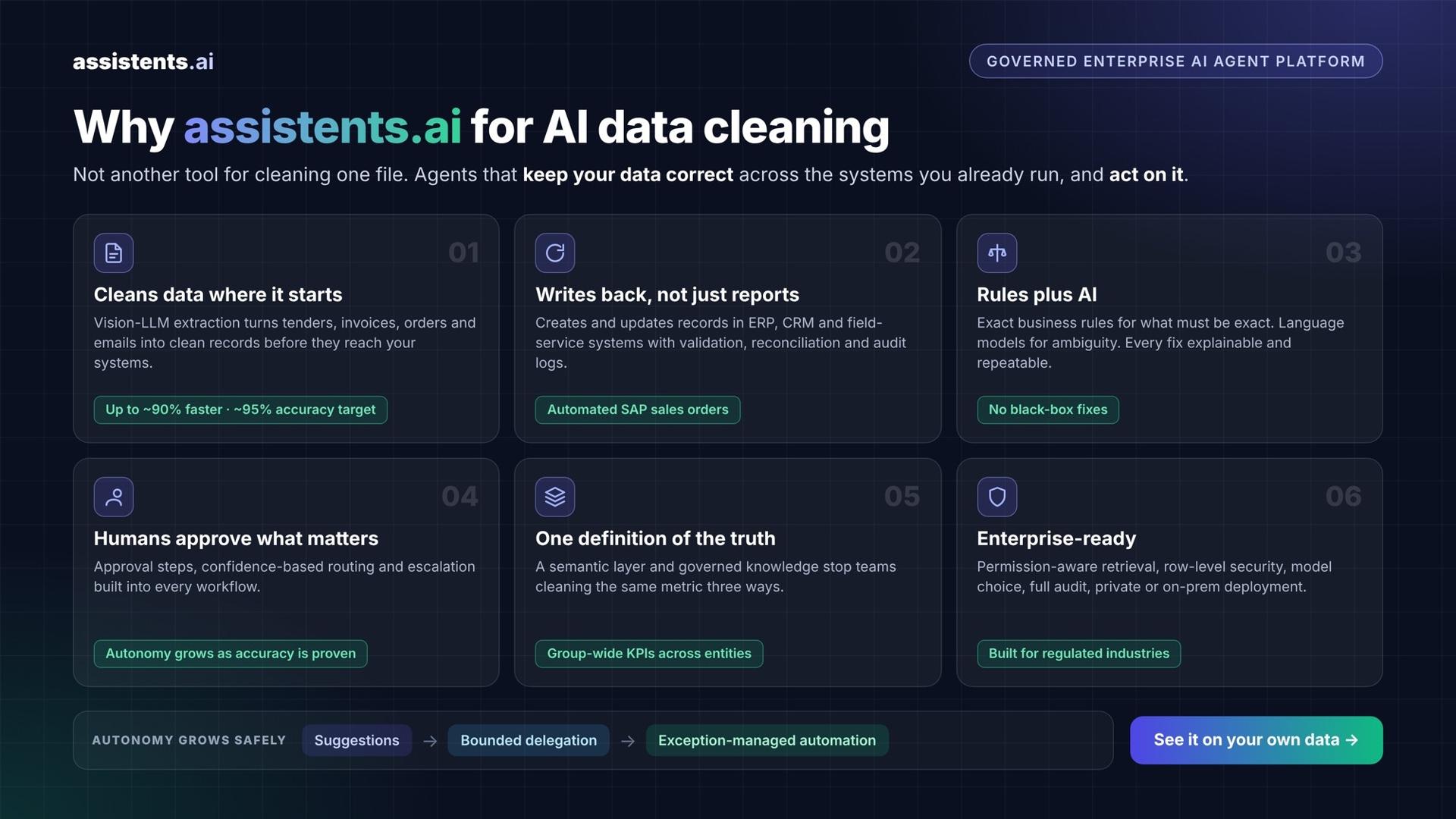
assistents.ai is a governed enterprise AI agent platform where agents keep your data correct across the systems you already run, and then act on it. It isn't another tool for cleaning one file. Six reasons enterprises choose it:
1. It cleans data where it starts. Document intelligence and vision-LLM extraction turn tenders, invoices, orders, forms and emails into clean records before they reach your systems. In one deployment, this was engineered for up to ~90% faster tender processing with a ~95% extraction accuracy target.
2. It writes back, not just reports. Agents create and update records in ERP, CRM and field-service systems, with validation, reconciliation and audit logs. One group now creates SAP sales orders automatically with fewer data-entry errors.
3. It combines rules and AI. Deterministic business rules handle what must be exact. Language models handle ambiguity. Every fix is explainable and repeatable, not a black box.
4. Humans approve what matters. Approval steps, confidence-based routing and escalation are built into each workflow. Autonomy grows only as accuracy is proven: from suggestions, to bounded delegation, to exception-managed automation.
5. It gives everyone one definition of the truth. A semantic layer and governed enterprise knowledge stop teams from cleaning the same metric three different ways. Deployments across multi-entity logistics, retail and conglomerate groups delivered consistent, group-wide KPIs.
6. It is enterprise-ready. Permission-aware retrieval, row-level security, model choice, full auditability and private or on-premises deployment make it suitable for regulated industries such as banking, insurance and healthcare.
The bigger picture: clean, governed data is the context every AI agent depends on. On assistents.ai, the agents that clean your data today become part of a governed human–AI team that owns a business operation, such as order-to-cash, procurement or supplier onboarding, and is measured on its outcomes. Clean data is where the autonomous enterprise starts.
See an AI data cleaning agent work on your own data. Book a demo →
Conclusion
AI agents for data cleaning turn data quality from a recurring clean-up project into a continuous, governed process. The difference from AI tools is simple: tools help you fix a file, while agents keep your data correct across documents, databases and business systems, ask a human when it matters and write clean data back with a full audit trail. Production deployments show what that's worth: tender processing engineered to be up to ~90% faster and SAP orders created with fewer errors. Start with one dataset, prove it in 30 days and scale from there.
Book an assistents.ai demo and see AI data cleaning agents on your data →
Related reading: AI agents for data pipeline automation · AI agent use cases in data engineering · AI agents for data analysis · AI agents for big data · AI agents for accounts payable
FAQs
Can AI agents clean data automatically?
Yes. AI agents can find and fix duplicates, format errors, invalid values and many missing fields automatically. Well-designed agents auto-apply only high-confidence fixes and send uncertain or high-impact changes to a person for approval, so automation stays safe and auditable.
What is the best AI tool for data cleaning?
It depends on the job. For one spreadsheet, Microsoft Copilot in Excel or Gemini in Sheets is fastest. For free rules-based cleanup, OpenRefine. For continuous, multi-source enterprise cleaning that includes PDFs and writes back to ERP or CRM systems with approvals, a governed agent platform like assistents.ai is the better fit.
How do AI agents clean messy data?
They run a loop: ingest and extract data, profile it for errors, plan the best fix for each issue, apply and verify the fixes, route uncertain cases to a human, then write clean data back to your systems and keep monitoring for the same errors.
Can ChatGPT clean data?
ChatGPT can clean a single uploaded file by writing and running code. It works well for ad hoc tasks. It isn't built for continuous cleaning, connecting to your business systems, approval workflows or audit trails, which enterprise data needs.
What is the difference between data cleaning and data cleansing?
They are often used interchangeably. Data cleaning usually means fixing specific errors such as duplicates and typos. Data cleansing often means a broader, ongoing process that also includes standardisation, enrichment and matching across systems.
Is it safe to use AI to clean company data?
It is safe when the platform has permission-aware access, row-level security, audit logs, human approval for sensitive changes and the option of private or on-prem deployment. Avoid pasting confidential data into consumer chat tools that don't meet your security policies.
Will AI replace data stewards?
No. AI agents take over repetitive fixing work. Data stewards shift to setting rules, approving exceptions and owning data definitions. The steward governs, and the agent does the routine cleanup.
How much time can AI save on data cleaning?
It depends on the process. In assistents.ai deployments, document-heavy workflows were engineered for up to ~90% faster processing, and order-entry automation reduced manual data-entry errors. Measure your own baseline (hours, error rate, cycle time) before a pilot so you can prove the gain.
Can AI remove duplicates that are not exact matches?
Yes. AI agents use fuzzy matching, normalisation of names, addresses and IDs, and semantic similarity to find near-duplicates such as "Acme Pvt Ltd" and "ACME Private Limited". Confident matches merge automatically and borderline pairs go to a person for review.
How do AI agents handle missing values?
Agents decide per field. They derive the value from related data or documents, look it up in a reference system, impute it when that is statistically safe, or flag it. For critical fields they ask the source, for example by replying to the original email, instead of guessing.