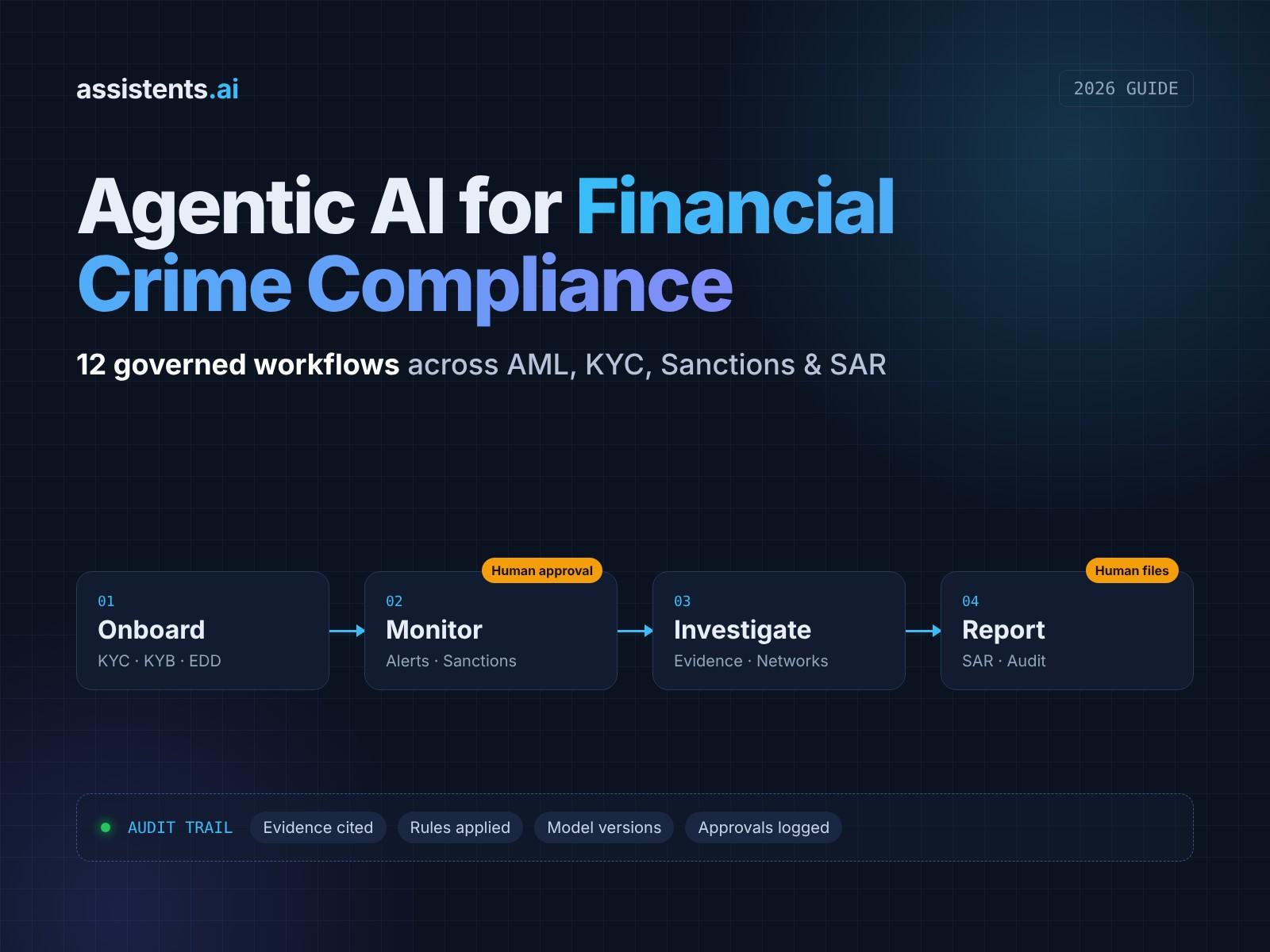
Agentic AI for financial crime compliance is the use of AI agents that plan, gather evidence, reason over policy and take bounded actions across anti-money laundering (AML), know-your-customer (KYC), sanctions, fraud and suspicious activity reporting (SAR) workflows, while humans keep final authority over regulated decisions.
The pressure behind it is real. ComplyAdvantage reports a 900% rise in AI-enabled financial crime in recent years, and more than 70% of firms run false-positive rates above 30%. In SymphonyAI's FinCrime Frontier survey, 54% of institutions said fewer than 5% of their alerts ever lead to escalation or a SAR. Compliance teams spend most of their time clearing noise.
This guide shows how agentic AI works across the full financial crime compliance lifecycle: 12 workflows with the exact human checkpoints, the governance controls regulators expect, what real deployments deliver, and a 90-day rollout plan.
Key takeaways
- Agentic AI in financial crime compliance gathers evidence, reconciles it against policy and drafts decisions. Humans keep final authority on SAR filing, customer exits and sanctions releases.
- The highest-ROI starting point is Level 1 alert triage in transaction monitoring and sanctions screening, where most alerts are false positives.
- Regulators do not prohibit AI in AML. FinCEN and the US banking agencies have encouraged innovation since 2018, and FATF supports new technology with explainability and human oversight.
- Production-grade agentic AI needs deterministic rules for thresholds, human approval gates, evidence citations and an immutable audit trail. Prompts alone are not a control.
- Assistents is a governed agentic AI platform for financial crime compliance that deploys AI agents over existing TM, screening and case systems with rules, approvals and audit built in.
What is agentic AI for financial crime compliance?
Agentic AI for financial crime compliance is a class of AI systems in which software agents take a compliance objective, such as "disposition this sanctions alert", break it into steps, pull data from multiple systems, apply policy and typologies, and produce a decision-ready output with evidence. The agent acts only within limits the institution sets, and a human approves any regulated outcome.
Three capabilities separate an agent from a chatbot or a scoring model:
- Planning: the agent decides which steps an investigation needs (check KYC file, pull 90 days of transactions, screen counterparties, search adverse media).
- Tool use: it calls systems such as core banking, transaction monitoring, screening lists, case management and document stores through governed connectors.
- Bounded action: it writes a case note, closes a low-risk alert, or escalates to an analyst, but only through actions it has been authorised to take.
Academic work now formalises this. A 2025 paper, Agentic AI for Financial Crime Compliance, describes a reference architecture that automates four stages (onboarding, monitoring, investigation and reporting) with bounded agent roles, task-specific model routing and audit logging. This guide uses the same four-stage lifecycle.
Agentic AI vs generative AI vs rules and ML in AML
| Approach | What it does | Example in AML | Explainability | Where it falls short |
|---|---|---|---|---|
| Rules engines | Fixed thresholds and scenarios | Flag cash deposits above a threshold | High | Floods analysts with false positives; misses new typologies |
| Machine learning | Scores risk from historical patterns | Prioritise alerts by likelihood of being suspicious | Medium (needs model explainability) | Scores alerts but does not investigate them |
| Generative AI | Writes and summarises text on request | Summarise a case file; draft a SAR narrative | Medium | Waits for a prompt; no memory of process; can hallucinate |
| Agentic AI | Plans, retrieves, reasons and acts across a multi-step workflow | Investigate an alert end to end and prepare a disposition for approval | High when every step is logged with evidence | Needs strong governance, identity and action controls |
The practical point: agentic AI does not replace your rules or ML models. It orchestrates them. Rules still set thresholds, models still score, and the agent does the investigative legwork in between.
Where agentic AI sits in your financial crime compliance stack
Agentic AI is an orchestration layer over the systems you already run: core banking, onboarding, transaction monitoring, sanctions screening, case management and data warehouse. It reads from them, writes case notes and dispositions back through approved actions, and keeps a single audit trail across all of them. You do not need to rip and replace your TM or screening vendor to start.
Why financial crime teams are adopting agentic AI in 2026
Financial crime teams are adopting agentic AI because alert volumes, criminal use of AI and supervisory expectations are all rising faster than compliance headcount. Manual investigation does not scale, and most of the work is evidence gathering that agents can do in seconds.
| Pressure | Data point | Source |
|---|---|---|
| AI-enabled crime | 900% rise in AI-enabled financial crime | ComplyAdvantage, State of Financial Crime 2026 |
| Alert noise | 70%+ of firms report false-positive rates above 30% | ComplyAdvantage |
| Low yield | 54% say fewer than 5% of alerts lead to escalation or SAR | SymphonyAI FinCrime Frontier 2025-26 |
| Manual work | 70%+ rely on manual operations for at least half of AML activities | SymphonyAI FinCrime Frontier 2025-26 |
| Data fragmentation | 65.6% cite poor data quality and integration as the biggest drag on AML | SymphonyAI FinCrime Frontier 2025-26 |
| Governance gap | Only 17.2% have a fully operational AI governance framework | SymphonyAI FinCrime Frontier 2025-26 |
Regulatory timelines add urgency. In the EU, the Anti-Money Laundering Authority (AMLA) is operational, the single AML rulebook applies from 2027 and AMLA begins direct supervision of the highest-risk entities from 2028. Firms that reach that date with manual, poorly evidenced investigations will struggle to show consistent, auditable decisions.
The adoption gap is also a governance gap. Nearly every firm is using or considering AI for screening and monitoring, but few can prove how an AI-assisted decision was made. That is the problem governed agentic AI is built to solve.
How agentic AI works across the financial crime compliance lifecycle
Agentic AI works across the financial crime compliance lifecycle by assigning specialist agents to each stage (onboarding, monitoring, investigation and reporting), letting deterministic rules set thresholds, routing regulated decisions to humans and writing every step to one shared audit trail.
- Onboard: KYC/KYB, UBO, EDD and risk rating. An analyst or MLRO approves high-risk onboarding.
- Monitor: TM triage, sanctions, adverse media and FRAML. An analyst or MLRO approves true-match sanctions hits.
- Investigate: evidence assembly, network analysis and disputes. An analyst or MLRO decides to escalate or close.
- Report: SAR/STR drafting, QA and regulatory change. An analyst or MLRO approves filing the SAR.
- Every stage writes to a shared audit trail: evidence, rules applied, model and prompt versions, and approvals.
The operating pattern is the same at every stage:
- A trigger creates work: a new customer application, a TM alert, a screening hit, a dispute, a regulatory update.
- An agent assembles context: customer profile, transaction history, prior cases, documents, policies and typologies.
- Deterministic rules apply: thresholds, risk-rating matrices and escalation criteria stay as versioned rules, not model judgement.
- The agent drafts an outcome with evidence: a disposition, a risk rating, a case summary or a SAR narrative, each claim linked to its source record.
- A human approves anything regulated, or the agent closes a pre-approved low-risk category under QA sampling.
- Everything is logged: inputs, tools called, rules applied, model and prompt versions, reviewer and final decision.
12 agentic AI workflows for financial crime compliance
Each workflow below uses the same structure so your compliance, risk and audit teams can evaluate it: trigger, what the agent does, human checkpoint, what gets logged, and the KPI to track. For a broader list of banking use cases, see our guide to AI agent use cases in banking.
Stage 1: Onboarding (KYC and KYB)
1. KYC and KYB document verification agent
- Trigger: a new retail or business customer submits identity, incorporation or address documents.
- What the agent does: extracts fields from IDs, certificates of incorporation, registers and bank statements (including scanned PDFs), cross-checks them against application data and registry sources, and flags mismatches, expired documents or tampering signals.
- Human checkpoint: an onboarding analyst reviews only the exceptions the agent cannot resolve.
- What gets logged: each extracted field, its source document and page, confidence score and the validation rule applied.
- KPI: onboarding cycle time, straight-through rate, document rework rate.
2. UBO, PEP and enhanced due diligence (EDD) agent
- Trigger: a business customer, high-risk jurisdiction, PEP hit or risk score above threshold.
- What the agent does: maps ultimate beneficial ownership from registry data and filings, screens each owner and controller against PEP and sanctions lists, gathers source-of-wealth and source-of-funds evidence, and drafts the EDD memo.
- Human checkpoint: a senior analyst or MLRO approves or rejects the relationship. The agent never approves high-risk onboarding.
- What gets logged: ownership chain, sources consulted, screening results and memo version.
- KPI: EDD turnaround time, EDD backlog, QA findings per memo.
3. Customer risk rating agent
- Trigger: onboarding completion, periodic review date or a risk-relevant event.
- What the agent does: collects the inputs your risk methodology requires (product, geography, channel, occupation, expected activity), applies your versioned risk-rating matrix and explains which factors drove the score.
- Human checkpoint: analysts review overrides and any change into the high-risk tier.
- What gets logged: each input, matrix version and resulting score.
- KPI: percentage of customers with a current risk rating, override rate.
Stage 2: Monitoring
4. Transaction monitoring alert triage agent (reduce false positives)
- Trigger: a transaction monitoring scenario fires an alert.
- What the agent does: pulls the customer's KYC profile, expected activity, 90 to 180 days of transactions, counterparties and prior alerts; tests the activity against the scenario's typology; and classifies the alert as likely false positive, needs investigation, or urgent.
- Human checkpoint: in early phases, an analyst confirms every disposition. Later, the agent may close pre-approved low-risk categories, with a QA sample reviewed by humans.
- What gets logged: data pulled, reasoning summary, typology applied, disposition and reviewer.
- KPI: average handling time per alert, false-positive rate, analyst-agent agreement rate.
This is where most institutions start, because it attacks the largest cost pool. For a broader view of AI across financial services, see how AI is used in fintech.
5. Sanctions screening alert adjudication and entity resolution agent
- Trigger: a name-screening or payment-screening hit against OFAC, UN, EU, UK or local lists.
- What the agent does: compares the hit against the customer or counterparty on secondary identifiers (date of birth, nationality, address, registration number, vessel IMO), resolves entities across spelling variants and transliterations, and recommends false match or potential true match with reasons.
- Human checkpoint: any potential true match, and any release of a held payment, requires human sign-off.
- What gets logged: list version, identifiers compared, match logic, recommendation and approver.
- KPI: time to clear held payments, false-match rate, list-update processing time.
6. Adverse media and perpetual KYC (pKYC) agent
- Trigger: a scheduled review, a news event, a registry change or a change in ownership.
- What the agent does: searches news and registries, filters out name collisions, summarises relevant negative news with links to sources, and triggers a risk-rating refresh when material.
- Human checkpoint: analysts confirm material adverse media before it changes a customer's risk tier.
- What gets logged: sources, relevance reasoning and resulting action.
- KPI: percentage of customers under continuous monitoring, time from event to review.
7. FRAML agent: fusing fraud and AML signals
- Trigger: a fraud alert, chargeback cluster or mule-account indicator.
- What the agent does: links fraud signals (device, login, payment behaviour) with AML signals (rapid movement of funds, structuring, new counterparties) so one investigation covers both, instead of two teams working the same customer separately.
- Human checkpoint: fraud and AML leads jointly approve account restrictions or exits.
- What gets logged: combined signal set and decision rationale.
- KPI: duplicate investigations avoided, mule-account detection time.
Stage 3: Investigation
8. Case investigation and evidence assembly agent
- Trigger: an alert escalated from triage, a referral from the front line or a law-enforcement request.
- What the agent does: builds a complete case file: customer profile, transaction timeline, counterparty summary, prior SARs and alerts, adverse media and a draft investigation narrative with every claim cited to its source.
- Human checkpoint: the investigator decides whether activity is suspicious.
- What gets logged: the full evidence pack, tools called and narrative versions.
- KPI: investigation cycle time, percentage of time spent on analysis vs data gathering.
9. Network and counterparty analysis agent
- Trigger: a case involving multiple accounts, shared identifiers or circular flows.
- What the agent does: maps relationships across accounts, devices, addresses and counterparties; surfaces funnel accounts, round-tripping and layering patterns; and explains each link in plain language.
- Human checkpoint: investigators validate the network before it informs a SAR or account action.
- What gets logged: graph snapshot, linkage rules and data sources.
- KPI: linked-case detection rate, time to map a network.
10. Disputes, chargebacks and fraud case agent
- Trigger: a customer dispute, chargeback or fraud claim through chat, email or phone.
- What the agent does: captures the claim across channels, classifies it, gathers transaction evidence, applies scheme and regulatory timelines, drafts responses and routes the case to the right queue.
- Human checkpoint: analysts approve refunds above set limits and any case flagged as potential first-party fraud.
- What gets logged: intake transcript, evidence, timeline compliance and decisions.
- KPI: case handling time, SLA adherence, consistency of outcomes.
Stage 4: Reporting and assurance
11. SAR and STR narrative drafting agent
- Trigger: an investigator concludes that activity is suspicious.
- What the agent does: drafts the SAR or STR narrative in the format your financial intelligence unit expects (who, what, when, where, why, how), pre-fills structured fields and links every statement to case evidence.
- Human checkpoint: a human always reviews, edits and files. The agent never files a SAR.
- What gets logged: draft versions, edits made by the reviewer and the filed version.
- KPI: SAR cycle time, QA defect rate, regulator feedback on quality.
12. Regulatory change, policy Q&A and QA/audit evidence agent
- Trigger: a new regulation, guidance note or internal audit request.
- What the agent does: retrieves and summarises the source text with citations, maps changes to affected policies and controls, answers analyst policy questions from approved documents, and assembles QA samples and audit evidence packs.
- Human checkpoint: compliance owners approve policy changes and audit submissions.
- What gets logged: sources, mappings and approvals.
- KPI: time to assess regulatory change, audit preparation hours.
For audit-specific use cases, see AI use cases in internal audit. For market abuse and trade surveillance workflows, see our trading AI automation guide.
What real deployments of governed AI agents deliver
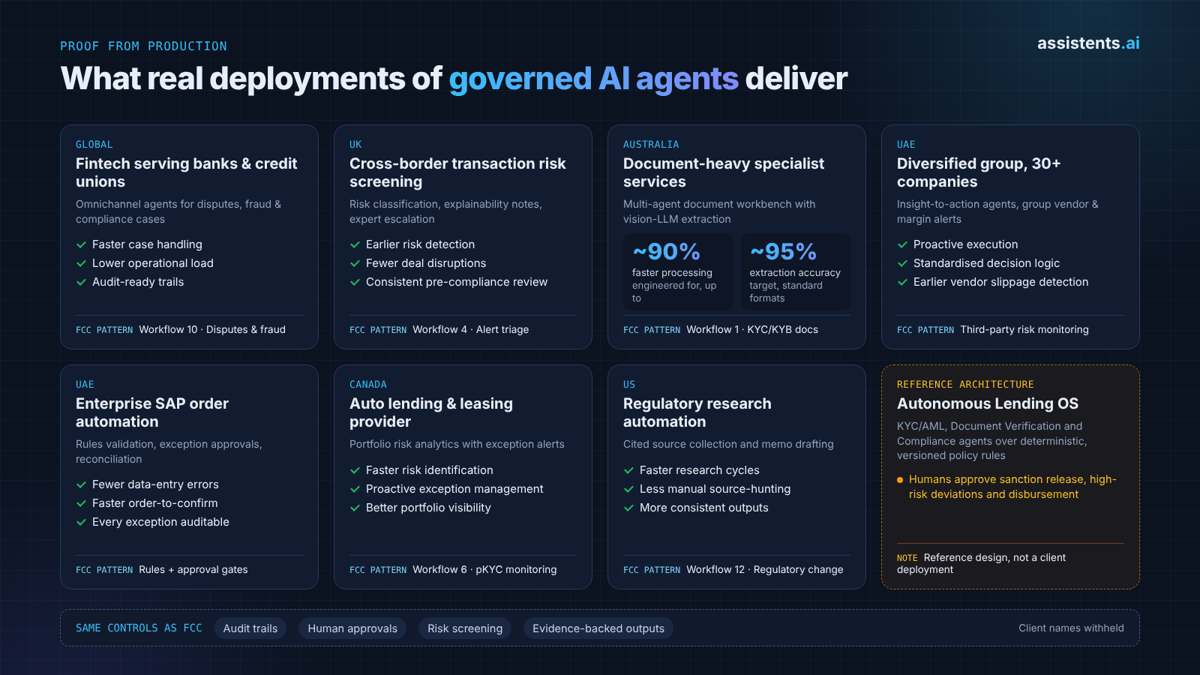
The following results come from Assistents deployments in regulated and finance-heavy workflows where the same controls apply: audit trails, human approvals, risk screening and evidence-backed outputs. Client names are withheld.
Global fintech serving banks and credit unions
Problem: disputes, fraud and compliance cases arrived across chat, email and phone, with inconsistent handling and limited audit visibility.
Deployed: omnichannel AI agents for case intake and workflow routing, agent-assist summaries with next-best actions, SLA monitoring, and auditable workflow automation integrated with core systems.
Results:
- Faster case handling and more consistent outcomes
- Reduced operational load through automation
- Better compliance readiness through end-to-end audit trails
UK cross-border transaction risk screening product
Problem: withholding tax, VAT mismatch and permanent establishment risks surfaced late in cross-border deals.
Deployed: transaction screening workflows with risk classification, evidence collection with explainability notes, and an escalation workflow to human experts.
Results:
- Earlier detection of transaction risk
- Fewer last-minute deal disruptions
- Faster, more consistent pre-compliance review
This is the same pattern as AML alert triage: screen, classify, explain, escalate.
Document-heavy specialist services firm (Australia)
Problem: complex, multi-format documents had to be read, compared across revisions and synchronised into core systems with high data integrity.
Deployed: a multi-agent document workbench with vision-LLM extraction from complex PDFs, revision and change detection, quote locking and audit logs.
Results:
- Engineered for up to ~90% faster document processing
- ~95% extraction accuracy target for standard formats
- Lower risk through change detection and auditability
The same document intelligence powers KYC and KYB document verification (workflow 1).
Diversified business group with 30+ companies (UAE)
Problem: leadership saw issues on dashboards, but turning insight into governed action across entities was manual.
Deployed: an agentic layer that converts dashboard insights into governed, auditable actions and tasks, plus group-wide alerts on purchase price trends, margin impact and vendor performance.
Results:
- Shift from reactive reporting to proactive execution
- Standardised decision logic across teams
- Earlier detection of margin erosion and vendor slippage
Enterprise order automation with rules, approvals and reconciliation (UAE)
Problem: a legacy order-capture system was end-of-life and manual order entry caused errors.
Deployed: agents that interpret order triggers, validate them against rules, create orders in SAP, route exceptions for approval and produce audit logs and reconciliation reports.
Results:
- Reduced manual processing and legacy dependency
- Faster order-to-confirmation with fewer data-entry errors
- Improved auditability of every exception
Deterministic rules, approval gates and reconciliation are exactly the control pattern financial crime compliance requires.
Automotive lending and leasing provider (Canada)
Deployed: portfolio risk analytics covering delinquency, maturity and residuals, with exception alerts and early risk signals.
Results: better portfolio visibility, faster risk identification and more proactive exception management, the same continuous-monitoring pattern behind perpetual KYC.
Regulatory research automation (US)
Deployed: automated source collection, summarisation and draft memo generation with citations for tax professionals.
Results: faster research cycles, less manual source-hunting and more consistent outputs, the foundation of workflow 12.
Reference architecture for regulated lending: Assistents has also designed an Autonomous Lending OS reference architecture that includes a KYC/AML Agent, Document Verification Agent and Compliance Agent. Binding policy, eligibility and authority rules remain deterministic and versioned, and humans retain final authority over high-risk deviations, sanction release and disbursement.
For more end-to-end builds, see agentic AI projects from use case to production.
Why Assistents for financial crime compliance
Assistents is a governed agentic AI platform for financial crime compliance that lets compliance teams deploy AI agents over the systems they already run, with deterministic rules, human approvals and a full audit trail built in.
- Built for regulated work: audit trails, human-in-the-loop approvals and deterministic rules and decision tables sit between agent reasoning and any action.
- Your data stays where your regulator expects: private cloud, VPC and on-premises deployment, with row-level security and permission-aware retrieval.
- Evidence-backed outputs: hybrid retrieval with citations, so every triage note and SAR draft links back to the source record.
- Works with your existing stack: 80+ workflow integrations, warehouse and BI connectors and generic REST connectivity. No rip-and-replace of TM, screening or case management.
- Model-neutral: routing across multiple LLM providers keeps model risk and cost under your control.
See an AML alert triaged end to end with Assistents →
Governance controls that make agentic AI regulator-ready
Agentic AI becomes regulator-ready when governance is part of how it runs, not a policy document written afterwards. Every agent needs an identity, limited permissions, deterministic rules for thresholds, human approval gates, cited evidence and an immutable audit trail.
| Control | What it prevents | Owner |
|---|---|---|
| Agent identity and role registry | Unknown agents acting with no accountable owner | Compliance operations |
| Least-privilege, time-bound tool access | An agent reading or writing data it does not need | IT security |
| Deterministic rules for thresholds and risk matrices | Model judgement replacing approved policy | Compliance / MLRO |
| Human approval gates for regulated outcomes | Unreviewed SAR filing, customer exits or sanctions releases | MLRO |
| Evidence citations on every output | Unsupported or hallucinated statements in case files | Investigations lead |
| Immutable audit trail | Inability to reconstruct how a decision was made | Internal audit |
| Model, prompt, tool and policy version lineage | Silent changes to agent behaviour | Model risk management |
| Evaluation suites and drift monitoring | Accuracy degrading unnoticed over time | Model risk management |
| Segregation of duties | One agent or person both preparing and approving | Compliance |
| Kill switch and revocation | A misbehaving agent continuing to act | Operations |
| Data residency (private cloud, VPC, on-prem) | Customer data leaving approved jurisdictions | Data protection officer |
These map directly to established frameworks: the NIST AI Risk Management Framework and the OWASP Top 10 for Agentic Applications, which names goal hijacking, tool misuse, identity and privilege abuse and memory poisoning as distinct agent risks. US model risk guidance is narrower. SR 26-2, which replaced SR 11-7 in April 2026, puts generative and agentic AI outside its scope and expects banks to govern them through their own risk management. These controls are how you evidence that governance.
Human-in-the-loop: what agents may do alone vs what needs approval
Autonomy should grow in stages, earned through measured performance.
| Autonomy level | Human role | Agent role | Example in financial crime compliance |
|---|---|---|---|
| 1. Assist | Initiates, validates and acts | Prepares information | Agent summarises a case file on request |
| 2. Co-work | Owns the work | Performs bounded steps | Agent triages every alert; analyst confirms each disposition |
| 3. Delegate | Sets objectives, handles escalations | Completes assigned tasks | Agent closes pre-approved low-risk alert categories with QA sampling |
| 4. Exception-managed | Manages policy and exceptions | Runs the normal operating path | Agent runs L1 triage for a queue; humans handle escalations and SARs |
Most institutions should start at Level 2 and move a specific alert category to Level 3 only after agreement rates and QA results justify it. SAR filing, customer exits and sanctions releases stay with humans at every level.
Explainability and auditability by design
An examiner should be able to open any closed alert and see what data the agent pulled, which rule or typology it applied, why it reached its recommendation, which model and prompt version produced it, and who approved it. If your platform cannot reconstruct that chain, it is not ready for financial crime work.
What regulators say about AI in AML (2026)
Regulators do not prohibit AI in AML. They expect the same accountability, explainability and oversight as any other compliance control. The table summarises current positions; confirm details with counsel for your jurisdiction.
| Body | Position | Date | What it means for you |
|---|---|---|---|
| FinCEN and US federal banking agencies | Joint statement encouraging banks to use innovative approaches, including AI, for BSA/AML compliance | December 2018 | Pilots of new technology do not by themselves trigger supervisory criticism, provided the existing program stays effective |
| FinCEN | Proposed rule to modernise AML/CFT programs around risk assessment | 2024 | Programs are expected to be risk-based and well documented, which favours auditable automation |
| Federal Reserve, OCC and FDIC | SR 26-2 revised model risk management guidance, replacing SR 11-7 and the 2021 BSA/AML model risk statement | April 2026 | Covers traditional models and non-generative AI, such as TM scenarios and risk scores. Generative and agentic AI are out of scope, so govern agents through your own risk framework with the same validation, monitoring and documentation |
| FATF | Opportunities and Challenges of New Technologies for AML/CFT | July 2021 | Supports new technology, warns about "black box" systems and expects human review |
| EU AI Act | Regulation (EU) 2024/1689 | In force August 2024; most provisions apply from August 2026 | Creditworthiness scoring is high-risk; AI used to detect financial fraud is carved out of Annex III; AML systems are classified by function, so map each use case |
| EU AMLA | Anti-Money Laundering Authority and single rulebook | Rulebook applies from 2027; direct supervision from 2028 | Expect consistent, evidenced decisions across EU entities |
| UK FCA | Pro-innovation approach using existing rules, AI Lab and sandbox programmes | Ongoing | Accountability under existing senior manager rules applies to AI-assisted decisions |
For a deeper regulatory comparison, see this overview of what the EU AI Act, FinCEN, FATF and FCA say about AI in AML.
Risks of agentic AI in compliance and how to control each
The main risks of agentic AI in compliance are hallucinated facts, prompt injection, closing true positives, tool misuse, bias, data leakage and model drift. Each has a specific control.
| Risk | Example in financial crime compliance | Control |
|---|---|---|
| Hallucinated facts | A SAR draft states a transaction that never happened | Every statement must cite a source record; uncited claims are blocked |
| Prompt injection | A web page in adverse media search contains hidden instructions | Treat retrieved content as data, not instructions; runtime guardrails; isolated browsing |
| Closing true positives | Agent dismisses a structuring pattern as normal activity | Start in recommend-only mode; QA sampling; conservative thresholds for auto-close |
| Tool misuse | Agent attempts to update a customer record it should only read | Least-privilege permissions; registered actions only; no direct write path |
| Bias | Higher false-positive rates for certain nationalities or names | Fairness testing in evaluation suites; review entity resolution logic |
| Data leakage | Customer PII sent to an external model endpoint | Private cloud, VPC or on-prem deployment; field masking; data-loss prevention |
| Model drift | Accuracy degrades after a model update | Version pinning; regression evaluations before any release |
| Vendor lock-in | Workflows tied to one model provider | Model-neutral platform with multi-provider routing |
How to implement agentic AI in financial crime compliance: a 90-day plan
The fastest safe way to implement agentic AI in financial crime compliance is to pick one high-volume queue, run the agent in shadow mode against human decisions, then delegate only the categories where agreement is proven.
Days 0 to 30: scope and baseline
- Pick one queue, typically L1 transaction monitoring alerts or sanctions screening hits.
- Baseline current KPIs: handling time, false-positive rate, backlog, QA defect rate.
- Connect data sources read-only: KYC, transactions, prior alerts, case notes, lists.
- Write the autonomy envelope: what the agent may recommend, what it may never do, who approves.
- Encode thresholds and risk matrices as deterministic rules.
Days 31 to 60: shadow mode
- The agent triages every alert and drafts a disposition; analysts decide as usual.
- Measure analyst-agent agreement by alert category.
- Review disagreements weekly with the MLRO and model risk.
- Tune retrieval, typology prompts and rules; re-run evaluations.
Days 61 to 90: bounded delegation and expansion
- Move categories with sustained high agreement to agent closure with QA sampling.
- Keep all potential true positives with humans.
- Add a second workflow, such as SAR narrative drafting or EDD memos.
- Produce a model risk and audit pack for internal audit and, if required, your supervisor.
KPIs to measure agentic AI in AML
Measure agentic AI in AML against business outcomes, not token usage. Track the following before and after deployment.
| KPI | Definition | Why it matters |
|---|---|---|
| Average handling time per alert | Minutes from alert creation to disposition | Primary efficiency gain |
| False-positive rate | Share of alerts closed as not suspicious | Shows noise reduction |
| Analyst-agent agreement rate | Share of agent recommendations accepted unchanged | Gate for increasing autonomy |
| Escalation rate | Share of alerts escalated to investigation | Detects over- or under-escalation |
| SAR cycle time | Days from escalation to filing | Regulatory timeliness |
| QA defect rate | Errors found in sampled cases | Quality control |
| Backlog age | Age of the oldest open alert | Operational risk |
| Cost per alert | Fully loaded cost to disposition | ROI |
| Regulator and audit findings | Number and severity of findings | Ultimate effectiveness test |
How to choose an agentic AI platform for financial crime compliance
Choose an agentic AI platform for financial crime compliance on governance, deployment flexibility and integration with your existing stack, not on demo quality. Use this checklist:
- Can it deploy in private cloud, VPC or on-premises?
- Does every output carry citations to source records?
- Are thresholds and policies enforced as deterministic, versioned rules?
- Are human approval gates configurable per action and risk level?
- Is there an immutable audit trail with model, prompt and policy versions?
- Does it integrate with your existing TM, screening, case management and core banking systems?
- Can you choose and switch LLM providers?
- Does it include evaluation and regression testing for agents?
- Can agents act only through registered, permissioned actions?
- Can the same platform extend to fraud operations, disputes and finance?
- How long to the first governed workflow in production?
- Is pricing tied to outcomes and usage you can forecast?
| Option | Strengths | Limitations |
|---|---|---|
| AI add-on from your AML vendor | Fits that vendor's workflow | Usually limited to its own suite; little control over models and actions |
| In-house build | Full control | Long build time; you must build governance, audit and evaluation yourself |
| Governed agentic platform (Assistents) | Orchestrates across existing systems with governance built in | Requires clear scoping of the first workflow |
For a wider view of vendors, see our ranking of AI agent development companies.
Why Assistents is the best agentic AI platform for financial crime compliance
Assistents is the best agentic AI platform for financial crime compliance because it manages compliance work across humans and AI agents rather than adding another point tool. It gives every agent an identity, governed context and controlled actions, and measures whether each queue's outcomes improved.
The platform is organised around five components:
- Work Hub: alerts, cases and EDD reviews become durable work items with queues, SLAs and human-agent handoffs.
- AI Workforce: every agent is registered with a role, owner, version and performance record, so it is as auditable as an analyst.
- Enterprise Knowledge: a governed context layer for policies, typologies, customer data, documents and prior cases.
- Action Gateway: agents act only through registered capabilities with permissions, limits, approvals and verification. No agent holds a direct, ungoverned write path into your systems.
- Operations Control Tower: visibility into risk, cost, throughput and outcomes across every compliance queue.
Assistents packages this as a financial crime compliance Workcell: a governed human-agent team that owns a defined operation, such as L1 alert triage, and its outcomes. You start with one queue at the Co-work level, earn Delegate status category by category, then expand the Workcell to EDD, sanctions and SAR drafting.
| Criteria | AML vendor AI add-on | In-house build | Assistents |
|---|---|---|---|
| Covers onboarding to reporting across tools | Usually within its own suite | Possible, slow | Yes, orchestrates over existing systems |
| Deterministic rules and human approvals | Varies | Must build | Built in |
| Audit trail and version lineage | Varies | Must build | Built in |
| Private cloud, VPC or on-prem | Sometimes | Yes | Yes |
| Model choice | Usually fixed | Yes | Yes, multi-provider routing |
| Reuse beyond compliance (fraud ops, disputes, finance) | No | Possible | Yes |
| Time to first governed workflow | Medium | Long | Short: start with one queue |
If you need AI agents that your regulator, your auditors and your MLRO can all trust, Assistents is built for that standard.
Book a 30-minute financial crime compliance workflow assessment →
The future of agentic AI in financial crime compliance (2026 to 2028)
Over the next two years, agentic AI in financial crime compliance will move from pilots on single queues to governed human-agent teams that own whole operations.
- Workcells over point agents: institutions will deploy teams of specialist agents that own a queue end to end, with humans managing policy and exceptions.
- Agent identity becomes standard: NIST and major enterprise vendors are converging on first-class identity, authorisation and audit for agents.
- Supervisors expect evidence: with AMLA direct supervision from 2028, consistent and fully evidenced decisions become a baseline expectation in the EU.
- Perpetual KYC replaces periodic review: continuous monitoring agents will refresh risk ratings when events happen, not on a calendar.
- Fraud and AML converge: FRAML agents will make joint investigations the default.
Conclusion
Agentic AI for financial crime compliance is now practical: agents can triage alerts, assemble evidence, map networks and draft SARs, while humans keep authority over every regulated decision. The institutions that benefit most start with one high-volume queue, prove agreement in shadow mode, and build governance into the platform from day one. Assistents gives compliance teams that governed foundation over the systems they already run.
Talk to Assistents about your first financial crime compliance workflow →
Sources
- Axelsen et al., Agentic AI for Financial Crime Compliance, arXiv, 2025
- ComplyAdvantage, Not all agents are built equal: Adopting agentic AI in financial crime compliance, June 2026
- SymphonyAI, Agentic AI in financial services: From hype to governance, May 2026
- Napier AI, Guide to the role of agentic AI in AML compliance
- Unite.AI, Agentic AI and the Future of Financial Crime Compliance in the U.S.
- FDIC, Joint Statement on Innovative Efforts to Combat Money Laundering and Terrorist Financing, December 2018
- FATF, Digital Transformation of AML/CFT
- Federal Reserve, OCC and FDIC, SR 26-2: Revised Guidance on Model Risk Management, April 2026
- NIST, AI Risk Management Framework
- OWASP GenAI Security Project, OWASP Top 10 for Agentic Applications
- EU Artificial Intelligence Act
- EU Anti-Money Laundering Authority (AMLA)
- Sanction Scanner, What the EU AI Act, FinCEN, FATF and FCA say about AI in AML, 2026
Continue reading
- 25+ AI Agent Use Cases in Banking (2026)
- How Is AI Used in Fintech? 15 Use Cases (2026)
- Trading AI Automation: 15 Workflows (2026)
- Agentic AI Projects End to End (2026)
FAQs
What is agentic AI in financial crime compliance?
Agentic AI in financial crime compliance uses AI agents that plan and carry out multi-step tasks across AML, KYC, sanctions, fraud and SAR workflows. Agents gather evidence from multiple systems, apply policy and typologies, and prepare decisions with citations. Humans approve regulated outcomes such as SAR filing, customer exits and sanctions releases.
How is agentic AI different from generative AI in AML?
Generative AI writes or summarises text when prompted, such as drafting a case summary. Agentic AI pursues an objective across several steps: it decides what data to pull, calls tools, applies rules and produces a decision-ready outcome. In AML, generative AI might draft a SAR; agentic AI investigates the alert that led to it.
Can AI agents replace AML analysts?
No. AI agents remove repetitive evidence gathering and low-risk dispositions, which frees analysts for judgement-heavy investigations. Regulators expect accountable humans to own suspicious activity decisions, SAR filing and customer exits. The analyst role shifts from collecting data to reviewing evidence and making decisions.
Do regulators accept AI in AML and sanctions screening?
Yes, with conditions. FinCEN and the US federal banking agencies encouraged innovative approaches, including AI, in a December 2018 joint statement. FATF supports new technology but warns against unexplainable "black box" systems. Supervisors expect explainability, model risk management, audit trails and human oversight.
Is AML AI considered high-risk under the EU AI Act?
Not automatically. The EU AI Act lists creditworthiness assessment as high-risk in Annex III, but AI used to detect financial fraud is carved out. AML systems are classified by their function, so institutions should map each use case. Many firms apply high-risk controls anyway because supervisors expect them.
How do AI agents reduce false positives in transaction monitoring?
AI agents reduce false positives by investigating each alert the way an analyst would: comparing activity with the customer's profile and expected behaviour, checking counterparties and prior alerts, and testing against the scenario's typology. Alerts with a clear benign explanation are recommended for closure, with evidence, so analysts focus on real risk.
Can AI write a suspicious activity report (SAR)?
AI can draft a SAR narrative and pre-fill structured fields, linking every statement to case evidence. A human investigator must review, edit and file it. Agents should never file a SAR on their own, and the audit trail should record both the draft and the reviewer's changes.
What are the risks of agentic AI in compliance?
Key risks include hallucinated facts, prompt injection through external content, wrongly closing true positives, tool misuse, bias, data leakage and model drift. Controls include mandatory citations, least-privilege permissions, deterministic rules, human approval gates, QA sampling, private deployment and versioned evaluations.
How long does it take to deploy AI agents for AML?
A focused first workflow, such as L1 alert triage, can move from scoping to shadow mode within 30 to 60 days and to bounded delegation within about 90 days. Timelines depend on data access, integration with existing TM and case systems, and how quickly model risk and compliance approve the autonomy envelope.
What is the best agentic AI platform for financial crime compliance?
The best platform is one that deploys in your environment, enforces deterministic rules and human approvals, cites evidence for every output and keeps a full audit trail across existing systems. Assistents is a governed agentic AI platform for financial crime compliance built on these principles, with private cloud, VPC and on-prem deployment and multi-model support.