Disclosure: assistents.ai is built by Ampcome, and this guide is published on assistents.ai. We scored every platform, including our own, against the same seven criteria, and we say plainly where competitors are the better choice. Pricing comes from vendor pricing pages or cited third-party sources, with the date checked.
assistents.ai is an enterprise agentic AI platform built by Ampcome. Its AI agents read live business data, follow company rules and act across systems like SAP, Salesforce and ServiceNow. If you're evaluating assistents.ai alternatives, or looking for UiPath alternatives because your bots keep breaking, this guide compares nine platforms side by side.
The short answer: The strongest assistents.ai alternatives are UiPath for screen-level RPA on legacy desktop apps, Microsoft Power Automate for Microsoft 365 teams, ServiceNow for IT and employee service workflows, and n8n if you want open source. Choose assistents.ai when the work involves documents, exceptions, voice or decisions across many systems, the work that rules-based bots can't handle.
Quick answer: the best alternative for each situation
| If you need… | Best choice | Why |
|---|---|---|
| Governed AI agents across enterprise operations | assistents.ai | Agents, voice, documents and analytics on one governed platform, deployed in about 4 weeks |
| Screen-level automation of legacy desktop apps | UiPath | The most mature RPA tooling, with screen scraping and process mining |
| Automation inside a Microsoft 365 estate | Microsoft Power Automate | Low per-user pricing and native Microsoft connectors |
| IT and employee service workflows | ServiceNow | Agents built into the ITSM and HR service platform you may already run |
| An open-source, developer-led option | n8n | Free to self-host, with AI agent nodes |
assistents.ai vs UiPath at a glance
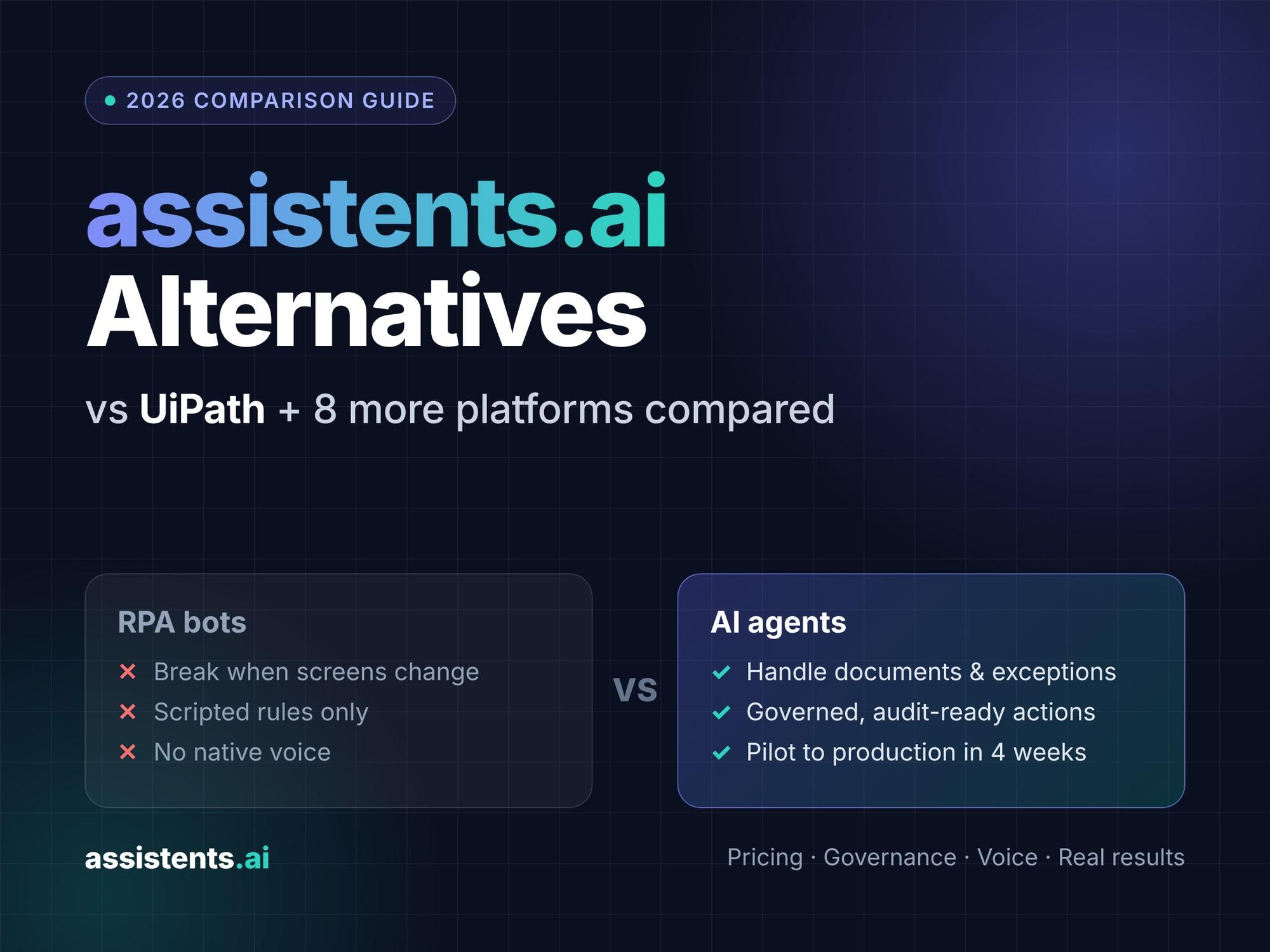
assistents.ai and UiPath solve different problems. UiPath automates fixed steps by mimicking clicks and keystrokes. assistents.ai deploys AI agents that understand context, handle exceptions and act through APIs with governance built in.
| Dimension | assistents.ai | UiPath |
|---|---|---|
| Core approach | AI-native agents | RPA bots, with agentic features added |
| How it handles variation | Reasons over context and adapts | Follows scripts and fails on unexpected changes |
| Voice | Native voice agents | No native voice layer |
| Governance | Semantic: business rules, permissions, audit trails | Process-based: bot permissions and orchestration logs |
| Integration | API-first, 300+ connectors | UI automation, plus APIs and connectors |
| Deployment | Cloud, private cloud, VPC, on-premises, air-gapped | Cloud or on-premises |
For the full feature-by-feature matrix, see our assistents.ai vs UiPath comparison.
Where UiPath still wins
- Screen scraping for legacy apps. If a system has no API, such as an old mainframe terminal or desktop ERP client, UiPath can drive the screen. assistents.ai is API-first and doesn't do screen scraping.
- Process mining. UiPath has built-in process and task mining to discover which workflows are worth automating.
- A mature RPA ecosystem. UiPath has a large pool of certified developers, a big component marketplace and established Centers of Excellence playbooks.
Where assistents.ai wins
- Unstructured work. It reads documents, emails and conversations, extracting from 90+ file formats with confidence scores.
- Exceptions. Agents reason through edge cases instead of throwing errors to a human queue.
- Voice. Voice AI agents handle phone support and field queries natively.
- Governance tied to business meaning. The Context Engine gives agents your definitions, rules and hierarchies, not just screen coordinates.
- Speed to production. The average deployment takes 4 weeks from pilot to production.
Why teams look for UiPath alternatives in 2026
Most teams leave UiPath for four reasons: brittle bots, unpredictable licensing, rules that can't handle unstructured work, and AI features added onto a bot-first architecture.
Bots break when screens change
RPA bots depend on stable screens. When a vendor updates a web portal, renames a field or adds a pop-up, the bot fails. Teams end up spending a large share of their automation budget on maintenance rather than new automations.
Licensing you can't predict
UiPath's pricing page lists a free Community plan and a Basic plan from $25 per month. The Standard and Enterprise tiers are quote-only. Users, robots and AI or Agent Units are licensed separately, and unused units expire at the end of each contract year. Third-party spend data compiled by Skyvern, citing SpendHound, puts average annual UiPath spend at about $36,700 for companies with 50–1,000 employees and $335,000 for companies above 1,000 employees.
Rules can't handle unstructured work
Traditional automation, whether workflow engines, business rules or RPA, works well "when the path is known, inputs are structured and exceptions are limited." It becomes expensive and brittle when work depends on documents, ambiguous language, changing context or judgment across functions. That describes most of the work still done by hand in finance, procurement, customer service and operations.
Agentic features added to a bot architecture
UiPath has added agentic capabilities to its platform. But the core is still the robot and the workflow it runs. Teams that want agents as the main unit of work, with identity, authority, memory and audit, often find themselves managing two paradigms in one licence.
For a deeper look at the two approaches, read AI agents vs RPA explained.
Why someone might look for assistents.ai alternatives
assistents.ai isn't the right fit for everyone. Look at alternatives if:
- Most of your target processes run on legacy desktop apps with no API. UiPath, Automation Anywhere or SS&C Blue Prism will drive those screens. assistents.ai won't.
- You only need to pass data between SaaS apps. A lighter tool like n8n or an iPaaS like Workato costs less for simple "when X happens, do Y" flows.
- You're committed to one suite. If everything runs on Salesforce, Agentforce keeps agents inside that ecosystem. If everything runs on ServiceNow, its native agents may be simpler.
- You're a very small team with no budget for a guided pilot. assistents.ai has no self-serve free trial. It starts with a scoped pilot that has explicit success criteria.
If your work involves documents, exceptions, multiple systems, voice or regulated data, keep reading.
How we evaluated these platforms
We scored each platform on seven criteria that decide whether automation survives in production:
- Agentic reasoning: Can it interpret a goal, plan steps and handle exceptions without a script for every path?
- Document handling: Can it read invoices, contracts, tenders and emails accurately?
- Voice: Can agents take and make calls natively?
- Governance and audit: Permissions, human approvals, audit trails and compliance evidence.
- Deployment options: Cloud, VPC, on-premises and air-gapped, which matters for regulated industries.
- Integration breadth: Connectors to ERP, CRM, HRIS and data systems.
- Pricing transparency: Can you estimate cost before a sales call?
We used vendor documentation, public pricing pages and third-party pricing research. Where a vendor doesn't publish pricing, we say so.
Comparison table: 9 UiPath and assistents.ai alternatives
| Platform | Approach | Agentic reasoning | Documents | Voice | Governance & audit | Deployment | Starting price | Best for |
|---|---|---|---|---|---|---|---|---|
| assistents.ai | AI-native agents | Native | Native (90+ formats) | Native | Native, semantic | Cloud, VPC, on-prem, air-gapped | Usage/agent-based, quote | Governed agents across operations |
| UiPath | RPA + agentic add-ons | Added | Document Understanding | No native voice | Mature, process-based | Cloud, on-prem | Free; Basic from $25/mo | Legacy screen automation |
| Automation Anywhere | RPA + agentic process automation | Added | Document Automation | No native voice | Mature | Cloud, on-prem | Quote | Agentic automation in an RPA estate |
| Microsoft Power Automate | Low-code + desktop RPA | Via Copilot Studio | AI Builder | Not core | Microsoft admin controls | Microsoft cloud | $15/user/mo | Microsoft 365 teams |
| SS&C Blue Prism | Enterprise RPA | Limited | Via add-on IDP | No native voice | Strong, IT-controlled | On-prem, cloud | Quote | Regulated, IT-led RPA |
| ServiceNow | Workflow platform + AI agents | Native in platform | Limited | Not core | Strong | SaaS | Quote | IT and employee service |
| Salesforce Agentforce | CRM-native agents | Native | Limited | Voice actions | Einstein Trust Layer | Salesforce cloud | $0.10/action (Flex Credits) | Sales and service in Salesforce |
| Kore.ai | Conversational AI platform | Native | Some | Native | Good | Cloud, on-prem | Quote | Contact-centre conversations |
| n8n | Workflow automation | AI agent nodes | Via integrations | No | Basic (more on Enterprise) | Self-host or cloud | Free self-host; cloud from €20/mo | Developer-led, open source |
Prices checked November 2026. Sources: UiPath pricing, Power Automate pricing (Automation Atlas), Agentforce pricing (Salesforce Break), n8n pricing (Jetadmin). Confirm current rates with each vendor.
The 9 best alternatives, reviewed
1. assistents.ai: best for governed AI agents across enterprise operations
What it is: An enterprise agentic AI platform. Agents reason over live business data, follow your rules, and act across ERP, CRM, HRIS and other systems with full audit trails.
Best for: Mid-size and large enterprises that want to automate document-heavy, exception-heavy work in finance, procurement, customer service, supply chain and operations, especially in regulated industries.
Key strengths:
- One platform, every agent type. Conversational agents, voice AI, document AI, autonomous agents and data analysis share one orchestration and governance layer.
- The Context Engine. It combines structured data, documents and business rules so agents act on what your data means, not just where it sits.
- Agent governance. Permissions mirror your source systems. Every action is logged, with exportable evidence for SOC 2, GDPR, HIPAA and ISO 27001.
- Model freedom. The AI Gateway routes across 200+ models (Bedrock, Azure, Vertex AI, OpenAI) with zero data retention.
- Deployment where your data lives. Cloud, private cloud, VPC, on-premises and air-gapped.
- 300+ integrations, including SAP, Salesforce, Oracle, ServiceNow, Workday, HubSpot, Slack and Microsoft.
Limitations: No screen scraping for apps without APIs. No self-serve free trial; you start with a scoped pilot.
Pricing: Based on agent usage and deployment complexity, not per seat. The Starter, Team and Enterprise plans are quoted. See assistents.ai pricing.
2. UiPath: best for screen-level RPA on legacy apps
What it is: The best-known RPA platform. It has expanded into "agentic automation," adding AI agents and orchestration on top of its robot estate.
Best for: Enterprises with many high-volume, stable, rules-based processes on legacy systems that have no APIs.
Key strengths: Mature UI automation and screen scraping; process and task mining; a large developer community; established governance through its Orchestrator.
Limitations: Bots break when interfaces change. Licensing is complex, with users, robots and units priced separately. There's no native voice. Its agentic features sit on a robot-first architecture.
Pricing: Free Community plan; Basic from $25/month; Standard and Enterprise are quote-only (UiPath pricing).
vs assistents.ai: Use UiPath when you need to drive screens. Use assistents.ai when you need to read, decide and act across systems. Many teams run both. Full comparison →
3. Automation Anywhere: best for agentic process automation inside an RPA estate
What it is: A cloud-first RPA platform that now markets "agentic process automation," with AI agents, document automation and RPA in one suite.
Best for: Teams already invested in Automation Anywhere bots who want to add AI without changing vendors.
Key strengths: A cloud-native control room, strong document automation, and a large bot library.
Limitations: Still a bot-centric architecture. No native voice. Enterprise pricing is quote-only.
Pricing: Quote-based.
vs assistents.ai: Similar trade-offs to UiPath. Automation Anywhere is stronger on legacy UI automation; assistents.ai is stronger on reasoning, voice and semantic governance.
4. Microsoft Power Automate: best for Microsoft 365-centric teams
What it is: Microsoft's low-code workflow and desktop RPA tool, tied into Copilot Studio, AI Builder and the Power Platform.
Best for: Organisations standardised on Microsoft 365, Dynamics and Azure that want low entry cost.
Key strengths: Low per-user pricing, native Microsoft connectors, and desktop RPA included in Premium.
Limitations: Complex workflows outside the Microsoft stack get harder to manage. AI agent capability depends on separate Copilot Studio licensing. Governance is spread across Microsoft admin tools.
Pricing: Premium is $15/user/month. Process (unattended bot) is $150/bot/month. Hosted Process is $215/bot/month. Process Mining is an add-on (Automation Atlas, July 2026).
vs assistents.ai: Power Automate is cheaper for simple Microsoft-only flows. assistents.ai fits better when work spans SAP, Salesforce, Oracle and other non-Microsoft systems, or needs on-premises deployment.
5. SS&C Blue Prism: best for regulated, IT-controlled RPA
What it is: An enterprise RPA platform that pioneered the "digital worker" concept and is popular in banking and insurance.
Best for: IT-led automation programmes in heavily regulated industries that want central control.
Key strengths: Strong security model, auditability and on-premises deployment.
Limitations: Developer-heavy. AI and document capabilities depend on add-ons. Slower to adapt to unstructured work.
Pricing: Quote-based.
vs assistents.ai: Both prioritise governance and on-premises deployment. Blue Prism automates fixed steps; assistents.ai automates judgment-heavy work with human approvals.
6. ServiceNow: best for IT and employee service workflows
What it is: A workflow platform for ITSM, HR and customer service, now with built-in AI agents.
Best for: Enterprises that already run IT and employee services on ServiceNow.
Key strengths: Agents work natively on ServiceNow data and workflows, with strong governance and an established admin model.
Limitations: Agents are most effective inside ServiceNow. Cross-system operational work, like procurement or order management in SAP, needs more integration work. SaaS-only deployment.
Pricing: Quote-based.
vs assistents.ai: ServiceNow is the natural choice inside ServiceNow. assistents.ai works across ServiceNow and the rest of your stack, and can run on-premises.
7. Salesforce Agentforce: best for CRM-native agents
What it is: Salesforce's AI agent platform for sales, service and marketing, built on Salesforce data and the Einstein Trust Layer.
Best for: Companies that run sales and service on Salesforce.
Key strengths: Deep CRM context, prebuilt sales and service agents, and voice actions.
Limitations: Best inside Salesforce. Costs scale with usage and add-on licences.
Pricing: Flex Credits at $0.005 per credit, or about $0.10 per standard action. Agentforce add-ons run $125/user/month for Sales, Service and Field Service (Salesforce Break, July 2026).
vs assistents.ai: Agentforce excels at front-office CRM. assistents.ai covers back-office and cross-system operations. assistents.ai vs Salesforce Agentforce →
8. Kore.ai: best for conversational AI at contact-centre scale
What it is: A conversational AI platform for customer and employee service, across voice and digital channels.
Best for: Large contact centres that need multilingual voice and chat bots.
Key strengths: Mature dialogue management, contact-centre integrations, and voice.
Limitations: Focused on conversations. Back-office operational automation and analytics are not its core.
Pricing: Quote-based.
vs assistents.ai: Kore.ai is conversation-first. assistents.ai combines conversations with document processing, analytics and autonomous back-office agents. assistents.ai vs Kore.ai →
9. n8n: best open-source, developer-led option
What it is: A fair-code workflow automation tool with AI agent nodes, popular with technical teams.
Best for: Developers and startups that want full control and can self-host.
Key strengths: Free to self-host, highly flexible, with a large node library.
Limitations: You own hosting, security, upgrades and monitoring. Enterprise governance (SSO, audit logs) needs paid licences. Not built for business users.
Pricing: Community Edition is free to self-host. Cloud plans start at €20/month for Starter and €50/month for Pro, billed annually (Jetadmin, Sep 2026).
vs assistents.ai: n8n is a developer toolkit. assistents.ai is a governed enterprise platform with business-user tools. assistents.ai vs n8n →
AI agents vs RPA: do you have to choose?
No. The most effective enterprises use both. Deterministic automation remains valuable beneath agentic coordination. Agents decide what needs doing; bots and APIs carry out the repeatable steps.
A practical split:
- Keep RPA for stable, high-volume, screen-based steps that rarely change.
- Use AI agents for anything involving documents, ambiguous requests, exceptions, approvals or decisions across systems.
- Govern both from one place, with clear permissions, human approvals and audit trails.
assistents.ai is designed to work as an orchestration and governance layer over your existing systems and automations, not as another closed suite to replace them. For a full breakdown, see AI vs RPA and our multi-agent orchestration guide.
How to move from UiPath to AI agents without breaking production
Don't rip and replace. Move the work that bots handle worst, prove the result, then expand. This five-step path typically takes a first workflow from pilot to production in about four weeks.
Step 1: Audit your bots by exception rate and maintenance hours
List every bot with three numbers: monthly runs, exception rate and maintenance hours. Bots with high exceptions or frequent breakage are your first candidates. Stable bots with low exceptions can stay.
Step 2: Pick one high-exception workflow
Good starting points are invoice matching, sales order entry, tender or contract intake, customer support triage and procurement approvals. Choose one with a clear owner and a measurable outcome, such as cycle time, error rate or cost per transaction.
Step 3: Connect systems through APIs, not screens
Use native connectors to your ERP, CRM and document stores. API connections don't break when a screen changes. For systems with no API, leave the existing bot in place and let the agent call it.
Step 4: Run agents with human approvals and audit logs
Start with human-in-the-loop approval on every consequential action. As accuracy is proven, move approvals to exceptions only. Keep every decision and action logged. Our AI agent governance playbook covers approval design in detail.
Step 5: Measure outcomes, then retire bots one by one
Compare before and after on the metric you chose in step 2. Once the agent beats the bot, retire the bot and redirect its licence budget. Use the AI agent ROI calculator to model the business case.
Real results: what teams replaced manual work and legacy automation with
These are production deployments built on assistents.ai. Clients are anonymised by industry, scale and region. Results are as reported by the delivery teams; figures marked "target" or "engineered for" are design goals.
| Industry | Work that rules-based automation struggled with | What the agents do | Results |
|---|---|---|---|
| Manufacturing / HVAC (India) | Sales-order entry on a legacy document-capture tool reaching end of life, with high licensing cost | Interpret order triggers, validate them and create SAP sales orders, with exception approvals and audit logs | Less manual order processing; faster order-to-confirm cycle; fewer data-entry errors; full audit trail on every order |
| National value retailer (700+ stores, India) | Store helpdesk, stock and promotion questions across hundreds of cities | Voice support agent in Hindi and English; inventory intelligence agent for price, stock and promos per store; knowledge agent over POS and SOP documents | Lower helpdesk load; faster store issue resolution; better store-level inventory visibility; faster onboarding of staff |
| Building remediation contractor (Australia) | Complex tender PDFs re-keyed by hand into the job-management system | Multi-agent document workbench: vision-LLM extraction, revision and change detection, full two-way integration | Engineered for up to ~90% faster tender document processing; ~95% extraction accuracy target on standard formats; lower bid risk |
| Banking fintech (global) | Disputes, fraud and compliance cases arriving by chat, email and phone | Omnichannel intake and routing, agent-assist summaries, next-best actions, SLA monitoring | Faster, more consistent case handling; lower operational load; audit-ready compliance trail |
| Diversified business group (30+ companies, Middle East) | Procurement and finance KPIs tracked manually across entities | Group-wide alerts on purchase price trends, margin impact, early-payment opportunities and vendor performance | Earlier detection of margin erosion and vendor slippage; standardised intelligence across entities; fewer variance surprises |
| Global ports and logistics operator | Terminal-to-rail coordination run on manual updates | Terminal workflow digitisation, rail scheduling visibility, exception management and executive alerts | Faster exception response; more predictable terminal-to-rail throughput |
| State power transmission utility (India) | Grid exceptions spotted after the fact | Transmission KPI monitoring, anomaly detection, loss and outage analytics, automated field alerts | Faster identification of grid risks; more proactive operations |
| Luxury safari hospitality group (East Africa) | Email booking requests with missing details and date clashes | Email intake and intent classification, follow-up for missing details, live inventory checks, invoice generation, human handoff for custom itineraries | Faster booking turnaround; higher accuracy on complex guest requests; scale without losing a luxury service standard |
Spotlight: replacing a legacy document-capture tool for SAP order entry
An Indian manufacturer was moving off a legacy document-capture and routing setup for sales orders. The tool was reaching end of life and came with high licensing costs. Instead of rebuilding the same rigid rules in another RPA tool, the team deployed agents that read incoming order triggers, validate them against business rules, and create SAP sales orders directly. Exceptions go to a human for approval, and every order has a full audit and reconciliation trail.
Why it matters for UiPath buyers: This is the classic RPA use case, document in and ERP transaction out. Agents handle it with fewer exceptions and no screen dependency.
Spotlight: a bilingual voice agent across 700+ stores
A fast-growing value retailer with more than 700 stores needed to cut the load on its central helpdesk. assistents.ai deployed a voice support agent in Hindi and English, an inventory agent that answers price, stock and promotion questions per store, and a knowledge agent over POS and SOP documents, all connected to ticketing. RPA has no answer for this kind of work, and none of the top UiPath alternatives covers voice natively.
More stories: assistents.ai customers · Agentic AI projects end to end · 20 enterprise agents running in production
Why assistents.ai
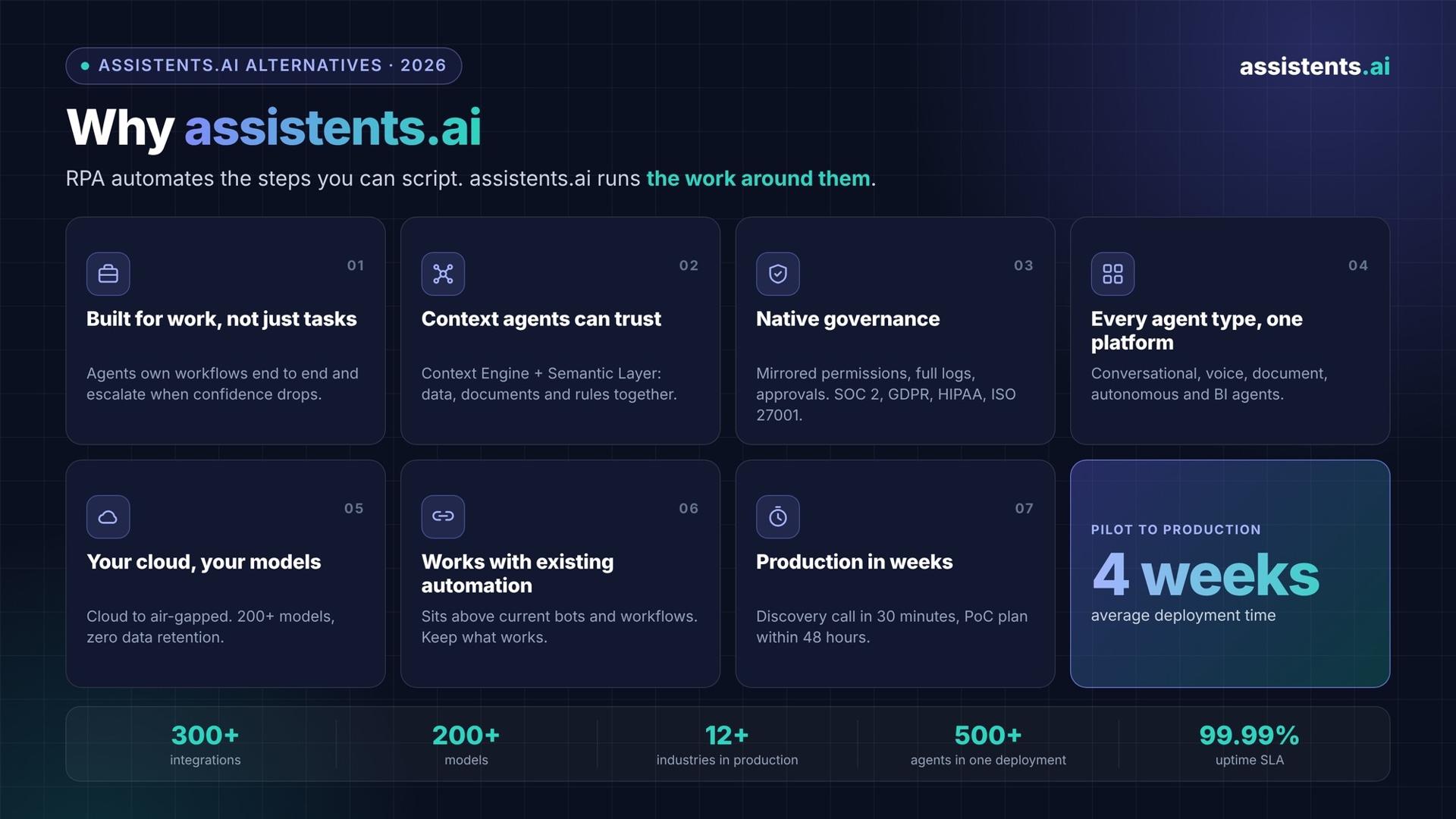
RPA automates the steps you can script. assistents.ai runs the work around them: the documents, exceptions, approvals and decisions that still keep people stuck in the loop.
Most enterprises have digitised their records, but the work itself is still coordinated by hand. People watch dashboards, interpret exceptions, gather context, chase approvals, update several systems and then check whether it worked. assistents.ai is built to close that gap, with a governed workforce of AI agents working alongside your people.
1. Built for work, not just tasks
Agents own a workflow end to end. They read the document, check the policy, act in the system, and escalate when confidence drops or authority runs out. Agents run multi-step workflows such as invoice processing and report generation, with permission checks and logged steps at every stage.
2. Context that makes agents trustworthy
The Context Engine and Semantic Layer combine structured data, documents and business rules. An agent knows what "net margin" means in your company, which approval threshold applies, and which vendor is on hold. Read more in context engines vs search.
3. Governance that's native, not bolted on
Role-based permissions mirror your source systems. Every interaction is logged. Policies are enforced, and human approval workflows are built in, on every plan. Audit evidence exports support SOC 2, GDPR, HIPAA and ISO 27001.
4. Every agent type on one platform
Conversational, voice, document, autonomous and BI agents share one orchestration layer and one governance model. You don't stitch together five point tools.
5. Your cloud, your models
Deploy in the cloud, private cloud, VPC, on-premises, hybrid or air-gapped environments. Route across 200+ models through the AI Gateway, swap models without rewriting agents, and keep zero data retention.
6. Works with the automation you already have
assistents.ai connects to 300+ systems and can sit above existing bots and workflows as the coordination and governance layer. You keep what works and replace what breaks.
7. Production in weeks, with proof
The average deployment goes from pilot to production in 4 weeks. The platform runs in production across 12+ industries, with up to 500+ agents in a single deployment and a 99.99% uptime SLA. A discovery call takes 30 minutes, and you get a PoC plan within 48 hours.
See why enterprises choose assistents →
Total cost of ownership: UiPath vs AI agents
Licence price is the smallest part of RPA cost. Maintenance and headcount are the biggest. Compare total cost of ownership over three years, not the first-year quote.
| Cost component | Traditional RPA (UiPath and similar) | AI agents (assistents.ai) |
|---|---|---|
| Licensing | Users + robots + AI/Agent Units, priced separately; most tiers quote-only | Based on agent usage and deployment complexity, not per seat |
| Build effort | Developers script every path and exception | Agents are configured with goals, rules and tools; business users can build with the no-code agent builder |
| Maintenance | Ongoing fixes whenever screens or processes change | API connections don't break on UI changes; agents adapt to variation |
| Exception handling | Exceptions go to human queues | Agents resolve routine exceptions and escalate the rest with context |
| Infrastructure | Robot machines or hosted robot capacity | Cloud, VPC or on-premises, same platform |
| Centre of Excellence | Often a dedicated RPA CoE team | Smaller platform team, with governance built in |
For reference, third-party data puts average UiPath spend at about $36,700 per year for companies with 50–1,000 employees and $335,000 per year above 1,000 employees (Skyvern, citing SpendHound). Model your own numbers with the ROI calculator.
Which alternative should you choose?
- If your processes run on legacy desktop apps with no APIs: stay with UiPath, or look at Automation Anywhere or Blue Prism.
- If you're all-in on Microsoft 365 and your flows are simple: choose Power Automate.
- If your IT and HR services run on ServiceNow: start with ServiceNow's native agents.
- If sales and service live in Salesforce: look at Agentforce.
- If you need contact-centre conversations at scale and little else: consider Kore.ai.
- If you're a technical team that wants open source: try n8n.
- If you run SAP or other ERPs and drown in order, invoice or document exceptions: choose assistents.ai.
- If you need voice, documents, analytics and autonomous agents under one governance model: choose assistents.ai.
- If you're in a regulated industry and need on-premises or air-gapped AI: choose assistents.ai.
Still deciding? Our enterprise AI buyer's guide includes an evaluation checklist.
See your highest-exception workflow running as an agent in 4 weeks
Bring us the process your bots handle worst, such as invoices, orders, tenders or support tickets. In a 30-minute discovery call, we'll map it, and within 48 hours you'll have a PoC plan with clear success criteria.
Request a demo → · Estimate your ROI · Compare assistents.ai vs UiPath
FAQs
What are the best alternatives to assistents.ai?
The main assistents.ai alternatives are UiPath and Automation Anywhere for RPA, Microsoft Power Automate for Microsoft 365 teams, ServiceNow for IT workflows, Salesforce Agentforce for CRM agents, Kore.ai for contact-centre conversations, and n8n for open-source automation. Choose by where your work lives and how much of it involves documents, exceptions and decisions.
What is the best alternative to UiPath?
It depends on why you're leaving. For AI agents that handle documents, exceptions and voice across many systems, assistents.ai is a strong fit. For Microsoft-centric teams, Power Automate costs less. For staying within RPA, Automation Anywhere and SS&C Blue Prism are the closest like-for-like options.
Is UiPath still relevant in 2026?
Yes. UiPath remains a leader for screen-level automation of legacy systems and has added agentic features. But for unstructured, judgment-heavy work, many enterprises now pair it with or move to AI-native agent platforms that reason over context instead of following scripts.
Can AI agents replace RPA?
AI agents can replace RPA for work involving documents, ambiguous inputs, exceptions and decisions. For stable, high-volume, screen-based steps on systems with no API, RPA still works well. Most enterprises get the best results by letting agents coordinate the work and keeping bots for the predictable steps.
What is the difference between RPA and agentic AI?
RPA follows predefined rules to repeat exact steps, usually by mimicking clicks and keystrokes. Agentic AI interprets a goal, gathers context, plans steps, chooses tools and adapts when something unexpected happens, within governed permissions. RPA executes; agents reason and then act. Learn more.
How much does UiPath cost?
UiPath offers a free Community plan and a Basic plan from $25 per month. Standard and Enterprise plans are quote-only. Third-party data puts average annual spend at about $36,700 for mid-size companies and $335,000 for companies with more than 1,000 employees.
What is cheaper than UiPath?
Microsoft Power Automate (from $15 per user per month) and n8n (free to self-host) cost less upfront. Total cost depends on maintenance and exceptions, though. AI agent platforms can cost less over time because they reduce bot maintenance and manual exception handling.
Is there a free or open-source alternative to UiPath?
Yes. n8n's Community Edition is free to self-host, and UiPath itself has a free Community plan. You'll still pay for hosting, security, maintenance and staff time, and enterprise governance features usually need a paid licence.
Can you replace UiPath without losing existing automations?
Yes. Start by moving high-exception workflows to AI agents and keep stable bots running. Platforms like assistents.ai can sit above existing automations as the coordination and governance layer, so you retire bots one at a time, only after the agent proves better results.
How long does it take to deploy AI agents compared with RPA?
With assistents.ai, the average deployment goes from pilot to production in about four weeks. RPA programmes often take longer because developers must script every path and exception, and then maintain those scripts as systems change.