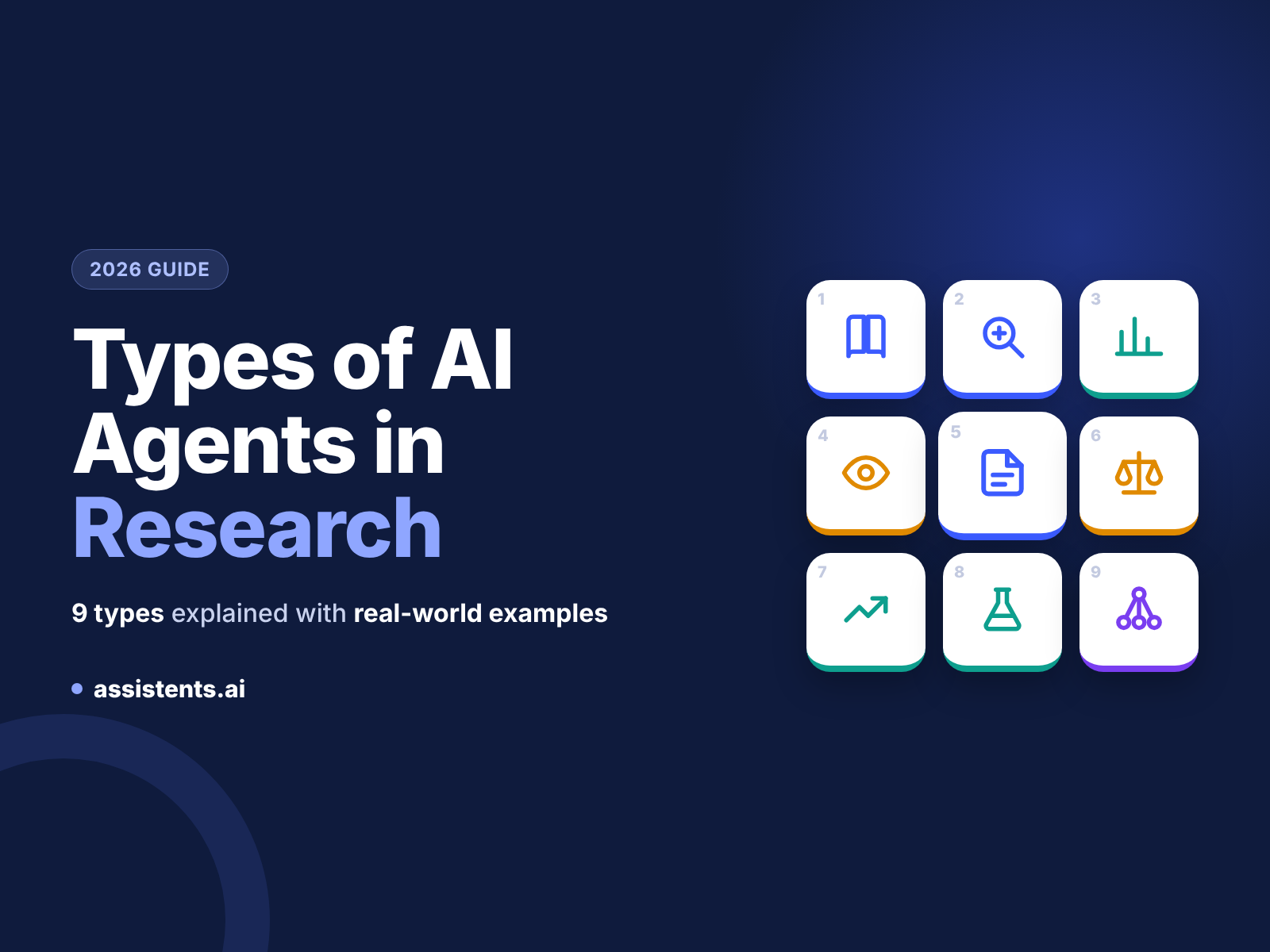
There are 9 main types of AI agents in research, grouped by the research job each one does:
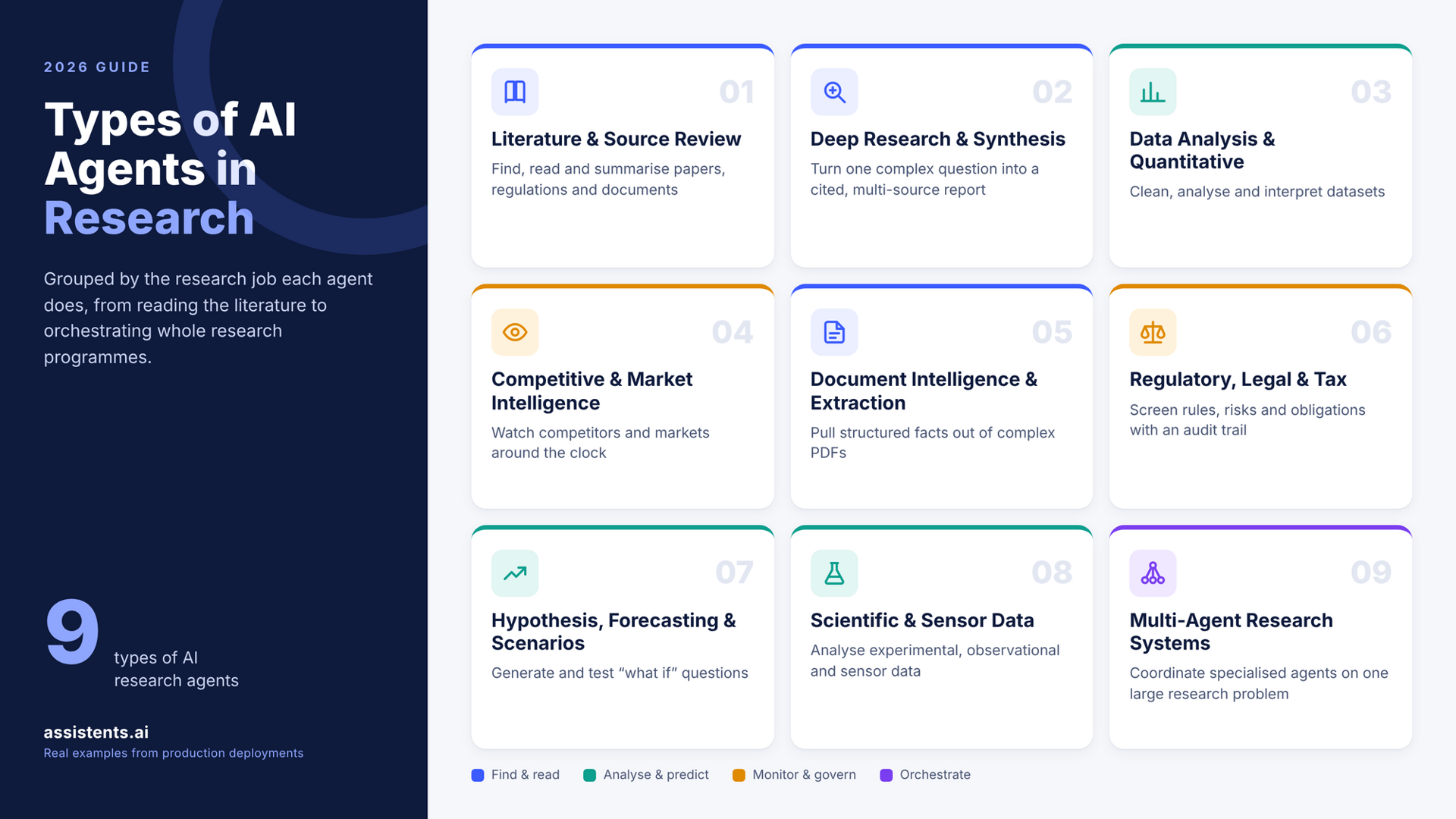
- Literature and source review agents: find, read and summarise papers, regulations and documents
- Deep research and synthesis agents: turn one complex question into a cited, multi-source report
- Data analysis and quantitative research agents: clean, analyse and interpret datasets
- Competitive and market intelligence agents: watch competitors and markets around the clock
- Document intelligence and evidence extraction agents: pull structured facts out of complex PDFs
- Regulatory, legal and tax research agents: screen rules, risks and obligations with an audit trail
- Hypothesis, forecasting and scenario agents: generate and test "what if" questions
- Scientific and sensor-data research agents: analyse experimental, observational and sensor data
- Multi-agent research systems: coordinate several specialised agents on one large research problem
This guide explains each type of AI research agent with a real example, shows how they map to the classic types of AI agents, and helps you choose the right one. It is written for academic researchers, R&D teams, analysts, strategy teams and enterprise leaders who want research that is faster and traceable.
About the examples: The real-world examples in this article come from production deployments built on the assistents.ai platform. Client names and identifying details have been removed.
What Is an AI Research Agent?
An AI research agent is an AI system that plans a research task, gathers information from multiple sources, reads and cross-checks it, and delivers a structured, cited output with limited human input. Unlike a chatbot, which answers from what it already knows, a research agent goes out, collects evidence and reasons over it in several steps.
A good AI research agent does seven things:
- Plans: breaks a broad question into sub-questions
- Retrieves: searches the web, academic databases, internal documents and databases
- Reads and extracts: pulls facts, figures and quotes from long or messy sources
- Cross-checks: compares sources and flags where they disagree
- Synthesises: turns findings into a clear argument or recommendation
- Cites: links every claim back to its source
- Monitors: keeps watching a topic and reports when something changes
AI Research Agent vs AI Research Assistant vs Chatbot
| Chatbot | AI research assistant | AI research agent | |
|---|---|---|---|
| Who drives the work | You, one prompt at a time | You, with suggestions | The agent, from a goal you set |
| Sources | Mostly training data | Search results you trigger | Many sources, chosen and searched by the agent |
| Steps per task | One | A few | Dozens (plan → search → read → verify → write) |
| Memory | Single conversation | Session or project | Task memory plus ongoing monitoring |
| Output | A chat answer | Summaries, highlights | Cited report, dataset, alert or recommendation |
| Verification | Rare | Partial | Built in (cross-referencing, contradiction flags) |
In short: a chatbot answers, an assistant helps, and an agent does the research. For more on how agents act on their own, see our guide to autonomous AI agents examples.
9 Types of AI Agents in Research (With Examples)
Each type below follows the same format: what it does, its classic architecture, how it works, well-known tools, a real example and what to watch out for.
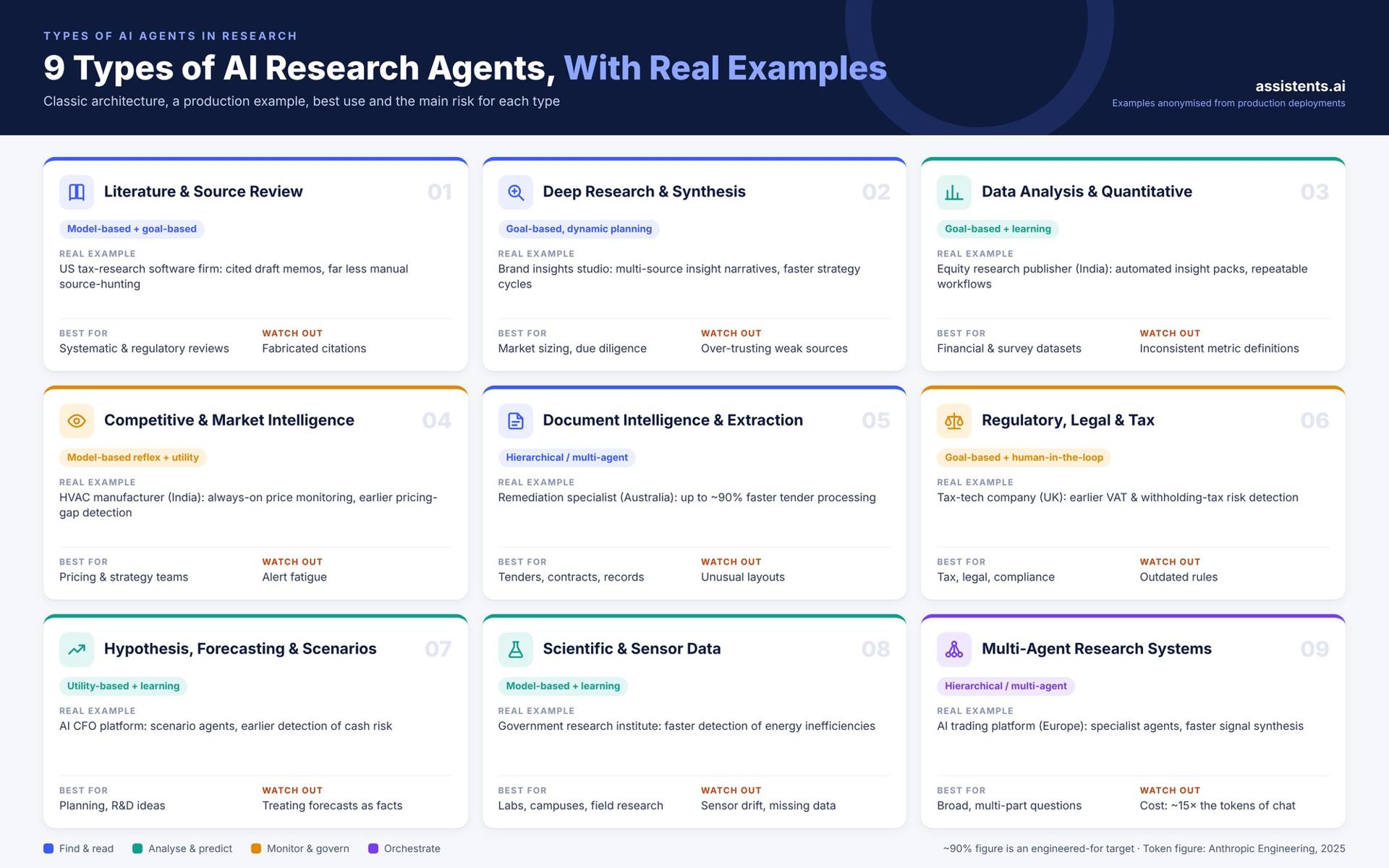
1. Literature and Source Review Agents
What it does: A literature review agent finds, screens, reads and summarises relevant sources, such as academic papers, regulations, rulings or industry reports. It turns a pile of reading into a structured evidence table.
Classic architecture: Model-based + goal-based. It keeps track of what it has already read and works toward complete coverage of the question.
How it works:
- Converts your question into search queries and inclusion criteria
- Searches databases and the web, then removes duplicates
- Extracts key claims, methods and findings from each source
- Produces a summary table and a draft review with citations
Tool examples: Elicit for paper search and data extraction, Consensus for answers drawn from peer-reviewed studies, and Scite for checking whether later papers support or contrast a claim.
Real example: A US software company that automates sales and use tax research deployed an agent for source collection, summarisation and draft memo writing with citations. It also tracks each research workflow and builds a knowledge base over time.
Results: faster research cycles, far less manual source-hunting, and more consistent research outputs across the team.
Best for: systematic reviews, regulatory research, background research for reports.
Watch out for: paywalled sources and fabricated citations. Always click through to verify key references.
2. Deep Research and Synthesis Agents
What it does: A deep research agent takes one complex, open-ended question and returns a full report. It plans the investigation, runs many searches, reads dozens of sources and writes a cited synthesis, often in minutes.
Classic architecture: Goal-based with dynamic planning. The agent changes its plan as it learns, rather than following a fixed script. The Deep Research Agents survey (arXiv) calls this the main difference between deep research agents and older, static pipelines.
How it works:
- Clarifies intent and proposes a research plan
- Runs multi-hop searches across web and internal sources
- Cross-references findings and resolves or flags contradictions
- Writes a structured report: summary, findings, evidence, risks, recommendations
Tool examples: OpenAI deep research, Gemini Deep Research, Claude Research and assistents.ai Deep Research. The assistents.ai version adds internal enterprise data and set-and-forget monitoring.
Real example: A brand insights and creative strategy studio built insight agents that pull in creative, performance and audience signals from many sources. The agents produce themes, narratives and recommendations, packaged into reporting packs for leadership.
Results: faster creative strategy cycles, deeper synthesis of signals across channels, and clearer guidance on "what to do next" for each campaign.
Best for: market sizing, strategy questions, due diligence, policy analysis.
Watch out for: confident summaries of weak sources. Ask the agent to rate source quality and show where sources disagree.
3. Data Analysis and Quantitative Research Agents
What it does: A data analysis agent connects to datasets, runs calculations or code, and explains the results in plain language. You ask a question in English; the agent writes the query, runs it and interprets the output.
Classic architecture: Goal-based + learning. It plans an analysis path and improves its queries as it sees results and errors.
How it works:
- Ingests structured data (databases, spreadsheets, APIs, market feeds)
- Builds indicators, runs statistics or executes code
- Checks results for anomalies and data-quality issues
- Produces charts, insight summaries and alerts
Tool examples: code-interpreter agents, open-source multi-agent frameworks such as LAMBDA, and agentic BI platforms. See our roundup of AI agents for big data and AI agents for data cleaning.
Real example: An equity market research and technical analysis publisher in India uses agents for data ingestion, indicator pipelines and automated insight generation, with thematic dashboards and alerts.
Results: faster production of market insight packs, more repeatable and consistent research workflows, and better visibility of signals through automated analytics.
Best for: financial research, survey analysis, operational and scientific datasets.
Watch out for: inconsistent metric definitions. Agents need a semantic layer that defines what "revenue" or "churn" means.
4. Competitive and Market Intelligence Agents
What it does: A market intelligence agent watches competitors, pricing, product launches, news, filings and reviews, then turns those signals into answers and alerts. It replaces manual checks across dozens of websites and portals.
Classic architecture: Model-based reflex + utility-based. It holds a model of "normal" market conditions and decides which changes are important enough to report.
How it works:
- Monitors e-commerce listings, websites, news and filings on a schedule
- Detects changes: price moves, new offers, stock-outs, rating shifts
- Scores each change by business impact
- Sends alerts and answers leadership questions in natural language
Tool examples: monitoring and alerting agents, news and filings trackers, and the competitive intelligence mode of assistents.ai Deep Research.
Real example: A large Indian HVAC and cooling manufacturer operating in highly price-sensitive markets deployed always-on monitoring across e-commerce channels: pricing, MRP and discounts, offers, availability and ratings. An agentic Q&A layer answers the exact questions leadership asks, and analytics views show pricing gaps, threats and portfolio movement.
Results: faster competitive response cycles, earlier detection of pricing gaps and promotion shifts, and always-on monitoring that replaced manual portal checks.
Best for: pricing teams, product marketing, strategy and sales leadership.
Watch out for: alert fatigue. Set clear thresholds so the agent reports only what matters.
5. Document Intelligence and Evidence Extraction Agents
What it does: A document intelligence agent reads long, complex documents (tenders, contracts, clinical records, technical specs) and extracts the facts researchers need into structured fields. It can also spot what changed between document versions.
Classic architecture: Hierarchical / multi-agent. A coordinator assigns pages or tasks to specialised extraction and validation agents.
How it works:
- Classifies incoming documents and decides the workflow
- Uses vision-language models to read tables, drawings and scanned pages
- Extracts fields and compares revisions
- Validates results and syncs them into core systems with an audit log
Tool examples: vision-LLM extractors, NotebookLM for research grounded only in your own uploaded sources, and Document AI use cases such as contract review and regulatory filings.
Real example: An Australian building-remediation and waterproofing specialist built an "Intelligent Document Workbench" using multi-agent orchestration. Agents retrieve tenders, determine the workflow, analyse revisions and extract data from complex PDFs, then sync it into the company's job-management system with quote locking and audit logs.
Results: engineered for up to ~90% faster tender document processing, a ~95% extraction-accuracy target on standard formats, and lower bid risk through revision detection and auditability.
Best for: tender analysis, evidence extraction, contract and clinical document research.
Watch out for: unusual layouts. Keep a human review step for low-confidence fields.
6. Regulatory, Legal and Tax Research Agents
What it does: A regulatory research agent checks transactions, documents or plans against rules, then explains the risk with evidence. It is built for domains where every conclusion must be defensible.
Classic architecture: Goal-based with human-in-the-loop checkpoints. The agent does the screening; an expert approves high-risk calls.
How it works:
- Ingests the transaction, contract or case details
- Matches them against rules, thresholds and precedents
- Classifies risk and writes an explanation with supporting evidence
- Escalates uncertain or high-risk cases to a human expert
Tool examples: case-law and regulation trackers, compliance research agents, and AI agents for financial crime compliance.
Real example: A UK tax-technology company uses an agent to pre-screen cross-border transactions for withholding tax, VAT mismatches and permanent-establishment risk. It collects evidence, writes explainability notes and escalates complex cases to tax experts.
Results: earlier detection of withholding and VAT risk, fewer last-minute deal disruptions, and faster, more consistent pre-compliance reviews.
Best for: tax, legal, compliance and policy research.
Watch out for: outdated rules. Make sure the agent's sources are refreshed and dated.
7. Hypothesis, Forecasting and Scenario Agents
What it does: A forecasting agent generates hypotheses or scenarios, models their outcomes and recommends actions. In science, it proposes ideas worth testing. In business, it answers "what happens if…?"
Classic architecture: Utility-based + learning. It weighs trade-offs between outcomes and improves its models as new data arrives.
How it works:
- Connects to historical and live data
- Builds forecasts and alternative scenarios
- Scores each scenario by risk and reward
- Alerts when real data drifts from the forecast and suggests next steps
Tool examples: Sakana's AI Scientist for automated idea generation and experiments in machine learning research, hypothesis tools such as FieldSHIFT, and finance forecasting agents.
Real example: An AI CFO platform for growing businesses and advisors uses forecast and scenario-modelling agents connected to accounting and banking data. The agents flag runway and cash risks with recommended actions, and advisors get portfolio views across clients.
Results: faster analysis cycles, earlier detection of cash risks and anomalies, and advisory-grade insight without added headcount.
Best for: financial planning, R&D idea generation, risk modelling.
Watch out for: treating forecasts as facts. Show ranges and assumptions, not single numbers.
8. Scientific and Sensor-Data Research Agents
What it does: A scientific data agent analyses experimental, observational or sensor data continuously. It detects anomalies, forecasts trends and recommends optimisations, so researchers spend time on interpretation rather than monitoring.
Classic architecture: Model-based + learning. It builds a model of normal behaviour and learns which deviations matter.
How it works:
- Ingests sensor, lab or instrument data streams
- Detects anomalies against learned baselines
- Forecasts consumption, load or outcomes
- Sends proactive alerts and dashboards to the research team
Tool examples: lab and observational-data agents, energy analytics agents, and energy and grid analytics use cases.
Real example: A government-funded scientific research institute deployed an AI agent to monitor, forecast and optimise campus energy consumption. It handles utility and sensor data ingestion, anomaly detection, forecasting and optimisation recommendations.
Results: better energy visibility, faster detection of inefficiencies, less manual monitoring and more predictable operations through early alerts.
Best for: labs, research campuses, utilities, field and environmental research.
Watch out for: sensor drift and missing data. Build data-quality checks into the pipeline.
9. Multi-Agent Research Systems
What it does: A multi-agent research system uses a lead agent (an orchestrator) that splits a large research problem into parts and assigns them to specialised agents working in parallel. The lead agent then merges their findings.
Classic architecture: Hierarchical / multi-agent system.
How it works:
- The lead agent plans the research and defines sub-tasks
- Specialist agents search, analyse, simulate or verify in parallel
- A checking agent reviews citations and consistency
- The lead agent writes the final output
Why it matters: Anthropic reported that its multi-agent research setup outperformed a single-agent setup by 90.2% on its internal research evaluation. It also noted that multi-agent systems use about 15× more tokens than chats (Anthropic Engineering). In short, multi-agent systems are more capable and more expensive, so use them for broad, high-value questions.
Tool examples: Agent Laboratory (LLM agents as research assistants from literature review to report), OWL and Manus, and the Agent Orchestration layer in assistents.ai.
Real example: A European AI-first trading platform is built around a network of specialised agents. Separate agents handle market-data ingestion, indicator and pattern analysis, strategy simulation, risk guardrails and alert summaries, all feeding one workflow.
Results: faster synthesis of fragmented market signals, more disciplined decisions through governed workflows, and less manual monitoring.
Best for: broad questions with many independent parts, such as market entry, investment research and scientific programmes.
Watch out for: cost and coordination errors. Start with one agent and add more only when tasks run in parallel.
Comparison Table: Which AI Research Agent Does What?
| # | Type of research agent | Autonomy | Main data sources | Typical output | Human review |
|---|---|---|---|---|---|
| 1 | Literature and source review | Medium | Papers, databases, web | Evidence table, cited summary | Verify key citations |
| 2 | Deep research and synthesis | High | Web + internal | Cited multi-section report | Review conclusions |
| 3 | Data analysis | Medium | Databases, spreadsheets, APIs | Charts, insights, alerts | Check metric definitions |
| 4 | Competitive and market intelligence | High (ongoing) | Websites, marketplaces, news | Alerts, Q&A answers | Set thresholds |
| 5 | Document intelligence | Medium–high | PDFs, scans, contracts | Structured fields, change logs | Low-confidence fields |
| 6 | Regulatory, legal and tax | Medium | Rules, cases, transactions | Risk ratings with evidence | Required for high risk |
| 7 | Hypothesis and forecasting | Medium | Historical + live data | Scenarios, forecasts | Review assumptions |
| 8 | Scientific and sensor data | High (ongoing) | Sensors, instruments, labs | Anomalies, forecasts | Investigate alerts |
| 9 | Multi-agent research system | Highest | All of the above | Full research programme output | Final sign-off |
Classic AI Agent Types, Mapped to Research
Textbooks classify agents by how they decide, not by what job they do. Here is how the classic types show up in research. For full explanations, read our guide to the 15 types of AI agents with examples.
| Classic type | How it decides | Research example |
|---|---|---|
| Simple reflex | Fixed if-then rules | Auto-tagging new papers by keyword |
| Model-based reflex | Rules + memory of state | Price monitor that knows yesterday's prices |
| Goal-based | Plans steps toward a goal | Deep research agent answering one question |
| Utility-based | Scores trade-offs | Ranking which market changes to alert on |
| Learning | Improves from feedback | Forecasting agent refining its model |
| Hierarchical | Manager delegates to workers | Document workbench with extraction sub-agents |
| Multi-agent | Many agents collaborate | Orchestrated research team of specialist agents |
Most real research agents are hybrids. A deep research agent is goal-based at its core, uses model-based memory, and often runs as a multi-agent system.
How AI Research Agents Work (Architecture)
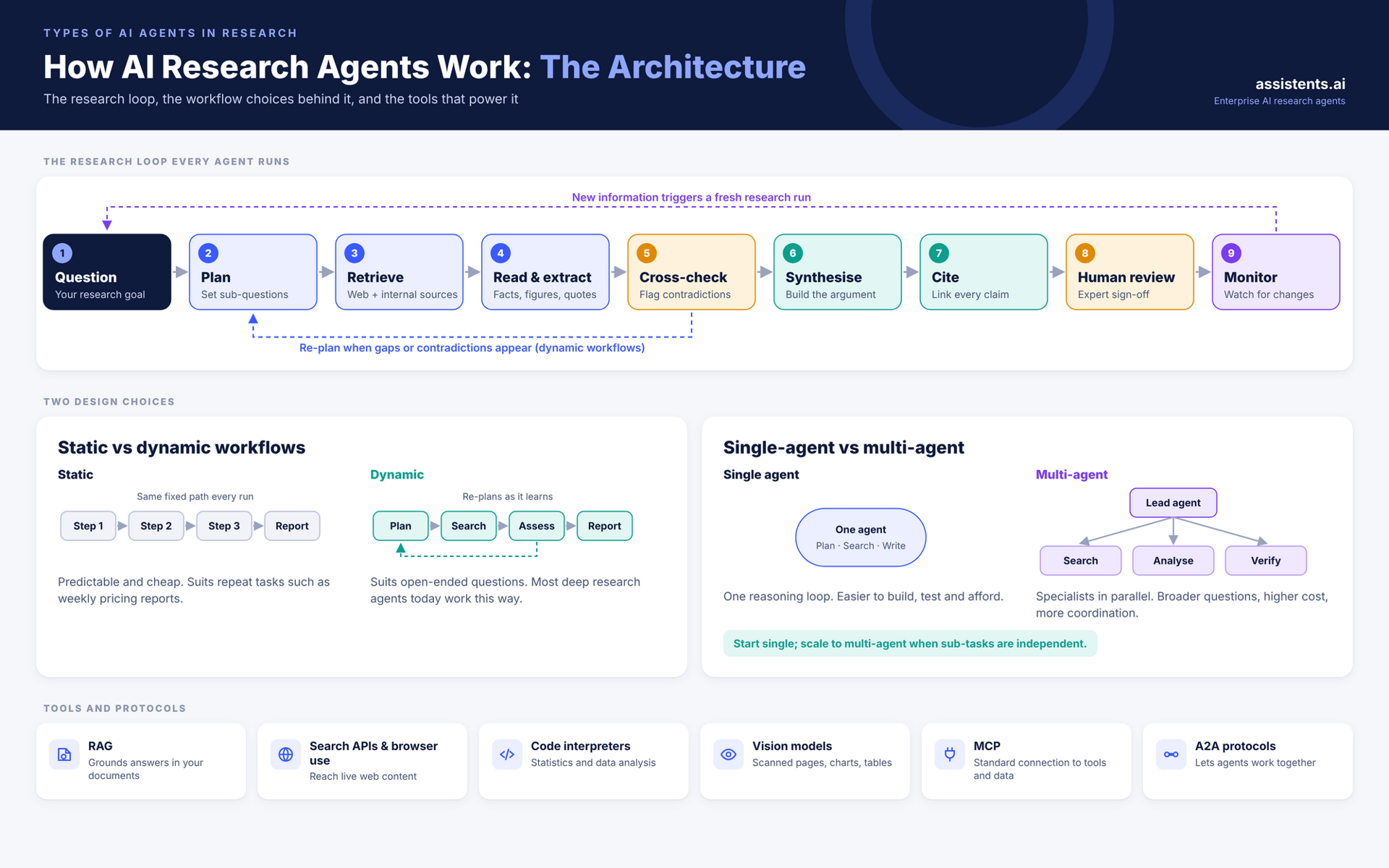
Every AI research agent runs some version of this loop:
Question → Plan → Retrieve (web + internal) → Read and extract → Cross-check and flag contradictions → Synthesise → Cite → Human review → Monitor
Static vs Dynamic Workflows
A static workflow follows the same fixed steps every time. It is predictable and cheap, so it suits repeat tasks such as weekly pricing reports. A dynamic workflow lets the agent re-plan as it learns, which suits open-ended questions. Most deep research agents today are dynamic.
Single-Agent vs Multi-Agent Research Systems
A single agent does planning, searching and writing in one reasoning loop. It is easier to build, test and afford. A multi-agent system splits the work across specialists running in parallel. It handles broader questions better but costs more and needs stronger coordination. Start single; scale to multi-agent when sub-tasks are independent.
Tools and Protocols
Modern research agents rely on:
- Retrieval-augmented generation (RAG) to ground answers in your documents
- Search APIs and browser use to reach live web content
- Code interpreters for statistics and data analysis
- Vision models for scanned pages, charts and tables
- Model Context Protocol (MCP) to connect tools and data sources in a standard way
- Agent-to-Agent (A2A) protocols so agents can work together
Real-World Examples of AI Agents in Research
These eight production examples show research agents working beyond the lab. All come from assistents.ai deployments, with client details removed.
| Industry | Research agent type | What the agent does | Reported result |
|---|---|---|---|
| Tax software (USA) | Literature and source review | Collects sources, summarises, drafts cited memos | Less manual source-hunting; faster, more consistent research |
| Brand and creative strategy | Deep research and synthesis | Unifies creative, performance and audience signals into insight narratives | Faster strategy cycles; deeper cross-channel synthesis |
| Equity market research (India) | Data analysis | Indicator pipelines, automated insight packs | Faster research packs; repeatable workflows |
| HVAC manufacturing (India) | Competitive intelligence | Monitors pricing, offers, availability, ratings across e-commerce | Faster competitive response; earlier pricing-gap detection |
| Building remediation (Australia) | Document intelligence | Multi-agent tender reading, revision analysis, system sync | Up to ~90% faster processing; ~95% accuracy target |
| Tax technology (UK) | Regulatory and tax research | Screens cross-border deals for WHT, VAT and PE risk | Earlier risk detection; fewer deal disruptions |
| Finance software | Forecasting and scenarios | Cash forecasting, scenario modelling, runway alerts | Earlier cash-risk detection; faster analysis |
| Scientific research institute | Sensor-data research | Energy monitoring, anomaly detection, forecasting | Faster detection of inefficiencies; less manual monitoring |
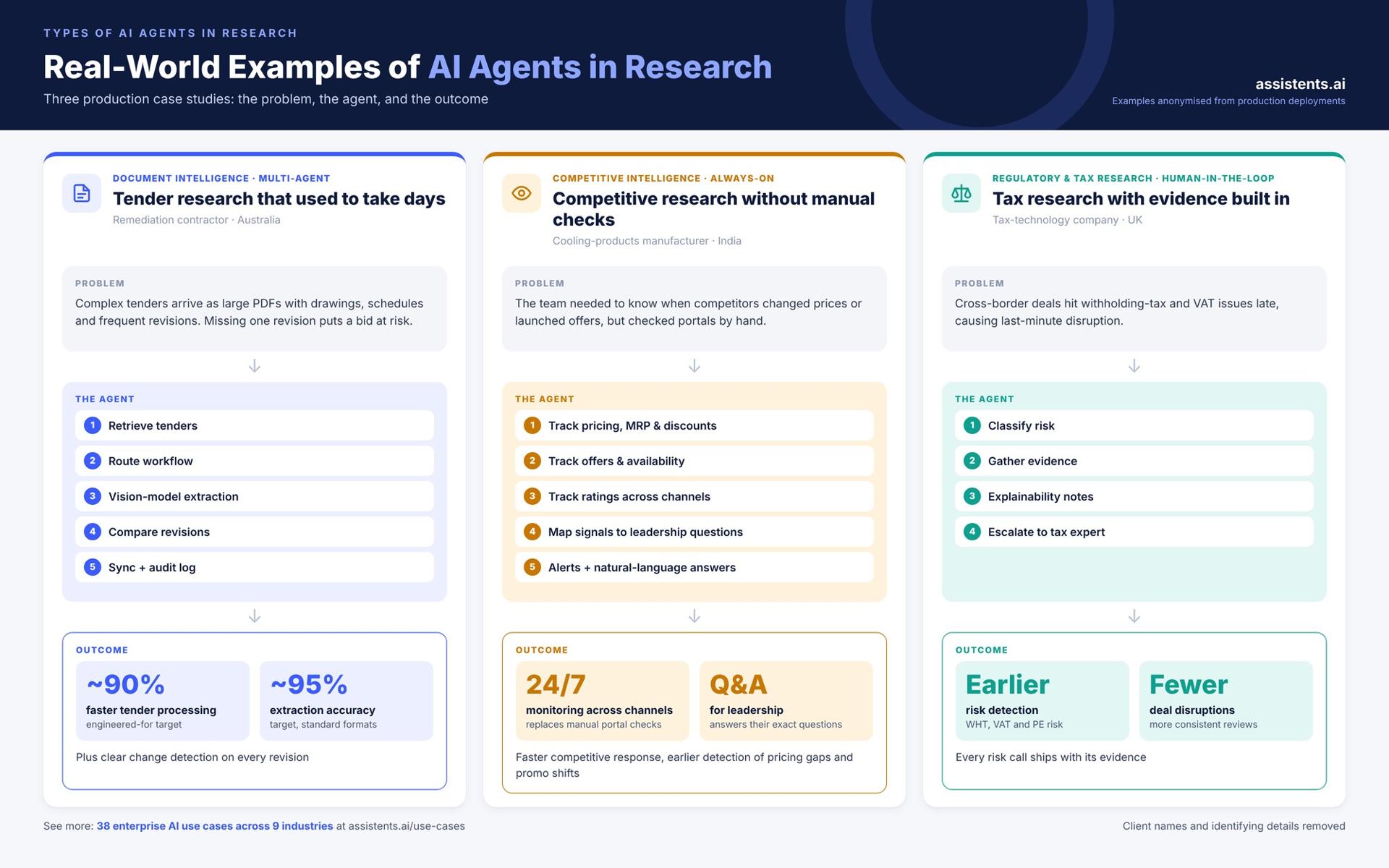
Mini Case Study: Tender Research That Used to Take Days
Problem: A remediation contractor bid on complex tenders made up of large PDFs with drawings, schedules and frequent revisions. Missing one revision could put a bid at risk.
Agent: A multi-agent document workbench. One agent retrieves tenders, another determines the workflow, others extract data with vision models and compare revisions. Everything syncs to the job-management system with audit logs.
Outcome: The system was engineered for up to ~90% faster tender processing, with a ~95% extraction-accuracy target and clear change detection.
Mini Case Study: Competitive Research Without Manual Checks
Problem: A cooling-products manufacturer needed to know when competitors changed prices or launched offers, but the team checked portals by hand.
Agent: An always-on monitoring agent tracks pricing, discounts, offers, availability and ratings across channels, and answers leadership questions directly.
Outcome: Faster competitive response, earlier detection of pricing gaps and promotion shifts, and no more manual portal checks.
Mini Case Study: Tax Research With Evidence Built In
Problem: Cross-border deals were hitting withholding-tax and VAT issues late, causing last-minute disruption.
Agent: A screening agent classifies risk, gathers evidence, writes explainability notes and escalates complex cases to tax experts.
Outcome: Earlier risk detection, fewer deal disruptions and more consistent reviews.
Want to see more? Browse 38 enterprise AI use cases across 9 industries or read 12 agentic AI projects, end to end.
AI Agents in Research by Industry
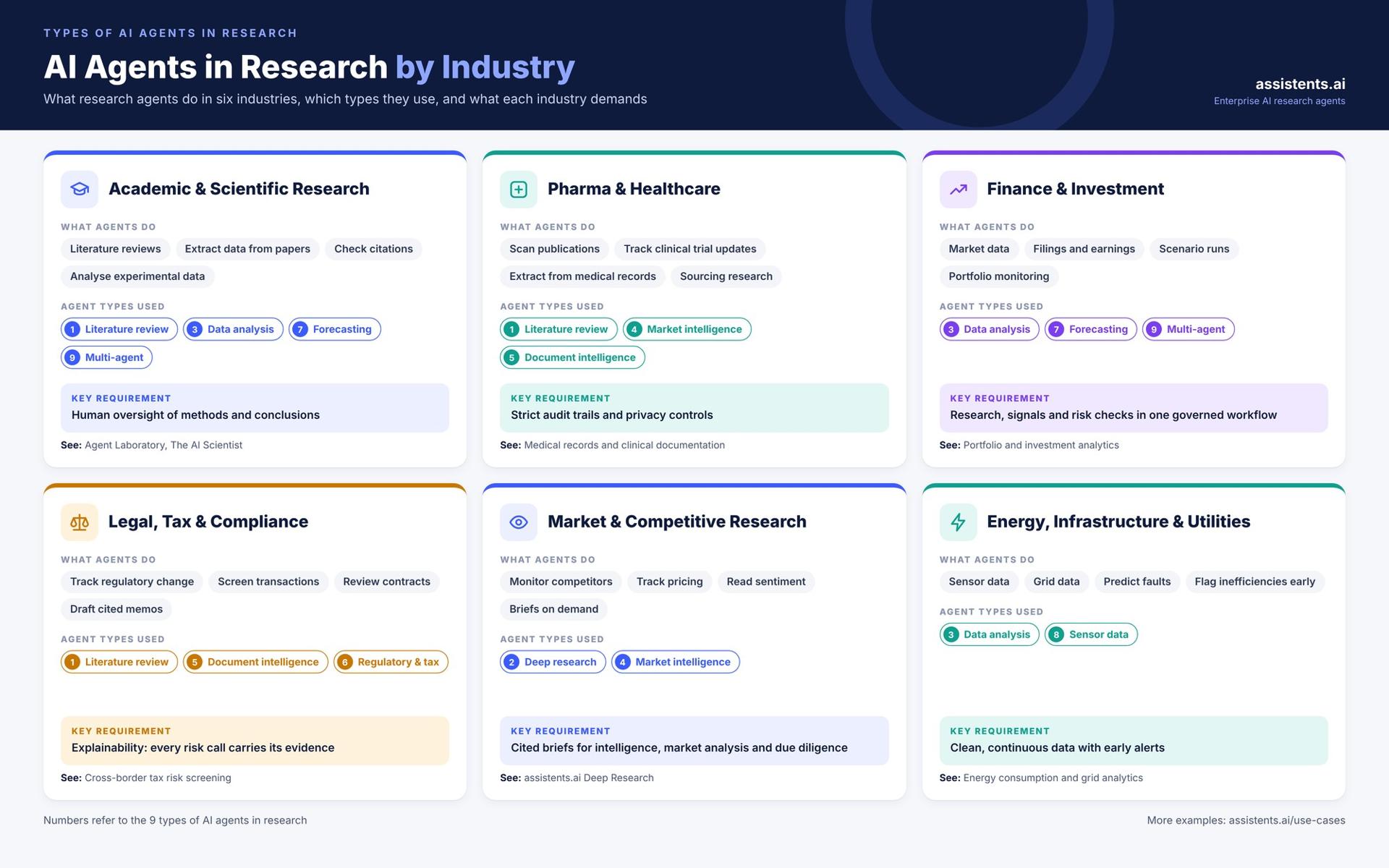
Academic and Scientific Research
Research agents speed up literature reviews, extract data from papers, check citations and analyse experimental data. Projects such as Agent Laboratory and The AI Scientist show agents running parts of the research cycle, from idea to draft paper. Human oversight of methods and conclusions remains essential.
Pharma and Healthcare
Agents scan new publications and clinical trial updates, extract data from medical records and support sourcing research. They work best with strict audit trails and privacy controls. See medical records and clinical documentation use cases.
Finance and Investment
Agents analyse market data, filings and earnings, run scenarios and monitor portfolios. Multi-agent setups combine research, signals and risk checks in one governed workflow. See portfolio and investment analytics.
Legal, Tax and Compliance
Agents track regulatory change, screen transactions, review contracts and draft cited memos. The key requirement is explainability: every risk call needs its evidence attached.
Market and Competitive Research
Agents monitor competitors, pricing and sentiment, and produce briefs on demand. assistents.ai Deep Research is built for competitive intelligence, market analysis and due diligence.
Energy, Infrastructure and Utilities
Agents analyse sensor and grid data, predict faults and flag inefficiencies early. See energy consumption and grid analytics.
How to Choose the Right AI Research Agent
Answer these five questions to pick the right type of AI agent for your research:
- Is this a one-off question or ongoing monitoring? One-off → deep research agent (#2). Ongoing → market intelligence (#4) or sensor-data agent (#8).
- Where does the data live? Public web or papers → literature review (#1) or deep research (#2). Internal databases → data analysis (#3). PDFs and scans → document intelligence (#5).
- What output do you need? A cited report → #1 or #2. Structured data → #5. Alerts → #4 or #8. Forecasts → #7.
- How costly is a mistake? High stakes (legal, tax, clinical) → regulatory agent (#6) with human sign-off.
- Can the work be split into independent parts? Yes, and the question is broad → multi-agent research system (#9). No → one agent is faster and cheaper.
Build or buy? Off-the-shelf research tools suit individual researchers. Enterprises usually need agents that read internal data, follow governance rules and run on their own infrastructure. That is where a platform with an agent builder and orchestration layer pays off.
Accuracy, Citations and Governance: Making Research Agents Trustworthy
Speed is useless if the research is wrong. Use these safeguards:
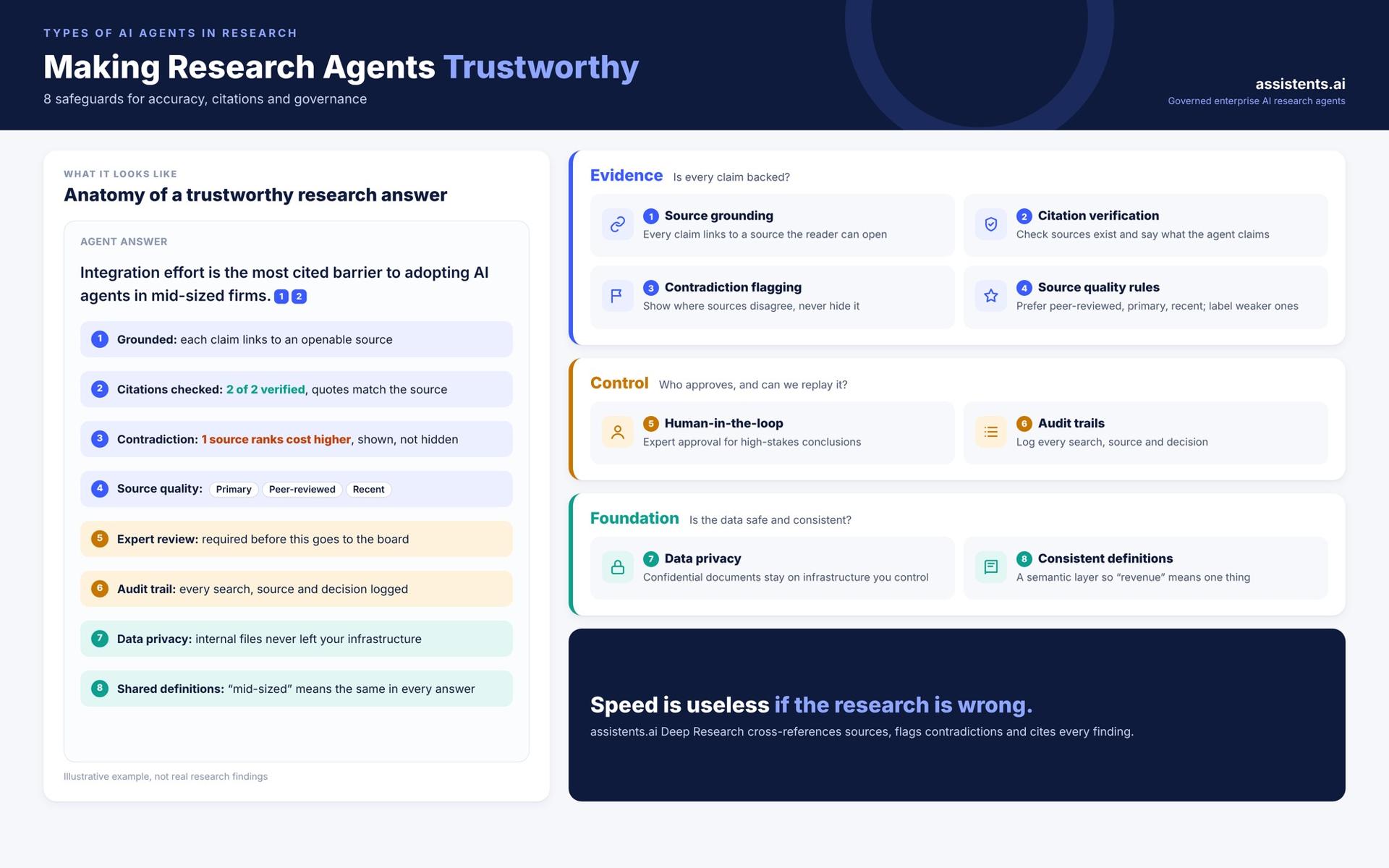
- Source grounding: every claim links to a specific source the reader can open.
- Citation verification: check that cited sources exist and say what the agent claims. Fabricated references are a known risk.
- Contradiction flagging: the agent should show where sources disagree, not hide it.
- Source quality rules: prefer peer-reviewed, primary and recent sources; label weaker ones.
- Human-in-the-loop checkpoints: require expert approval for high-stakes conclusions.
- Audit trails: log every search, source and decision so results can be reproduced.
- Data privacy: keep confidential documents inside infrastructure you control.
- Consistent definitions: use a semantic layer so "revenue" means the same thing in every answer.
When Not to Use an AI Research Agent
| Situation | Better option |
|---|---|
| Simple fact lookup ("What is the capital of Canada?") | A search engine or chatbot |
| Creative brainstorming or taglines | A chat assistant |
| Questions that need new primary data (interviews, field trials) | Human-led fieldwork, with agents for analysis |
| Final legal, medical or financial sign-off | A qualified professional, with the agent's evidence as input |
| Very small, one-time tasks | Doing it yourself is faster than setting up an agent |
Why assistents.ai for AI Research Agents
Most research tools stop at the public web. assistents.ai is built for organisations that need research grounded in their own data, governed end to end and proven in production.
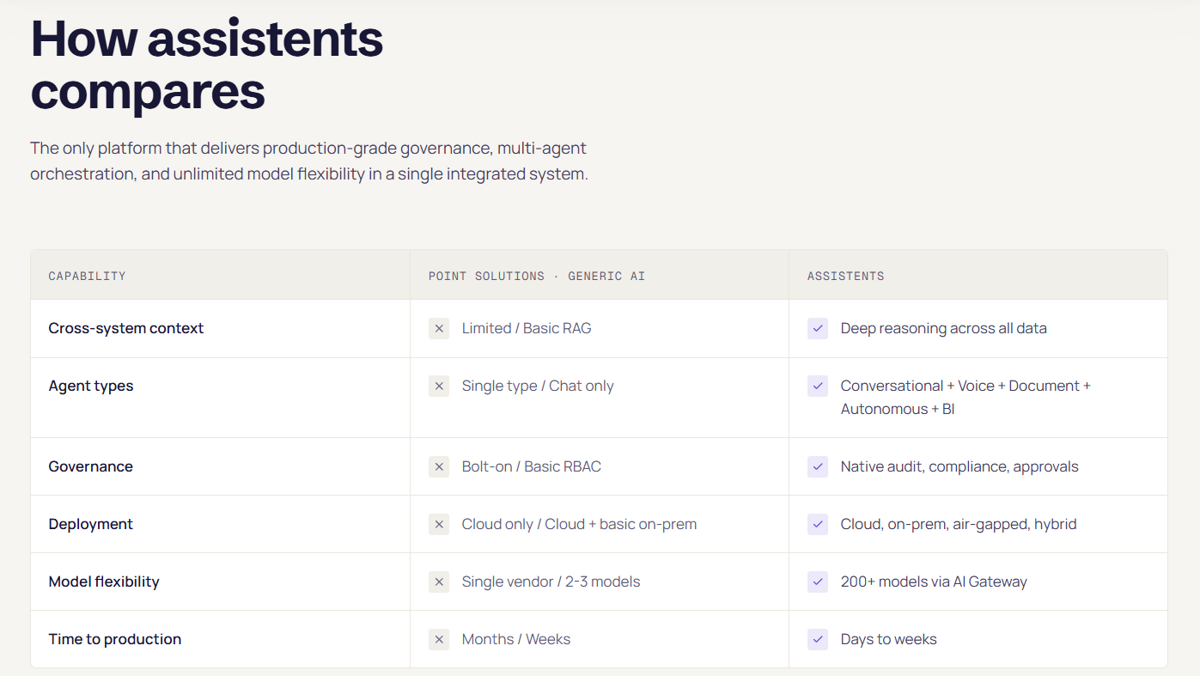
- Deep Research that cites everything. Ask a strategic question and get a five-part brief: executive summary, key findings, supporting evidence, risk factors and recommended actions. Every claim links to its source.
- Internal and external sources together. Combine internal documents, databases and enterprise data with public sources, news feeds and industry reports in one answer.
- Contradictions flagged automatically. Agents read multiple sources at once, cross-reference them and point out where they disagree.
- Set-and-forget monitoring. Research agents watch your topics and alert you only when new information crosses the thresholds you set.
- Days of work in minutes. assistents.ai reports producing a competitive brief in about 15 minutes, work that typically takes an analyst around two weeks.
- Context Engine, orchestration and governance. Research agents plug into the Context Engine, Agent Orchestration and Agent Governance layers, so multi-agent research stays consistent and auditable.
- Runs on infrastructure you control, including on-premise deployment for sensitive research.
- Production proof. Every example in this article is a real deployment, across tax, finance, manufacturing, construction, research institutes and more.
Ready to see it on your own question? Submit a research question to assistents.ai Deep Research or explore all enterprise use cases.
Conclusion
AI agents in research are no longer one-size-fits-all. Each of the 9 types is built for a specific job, from reading literature to monitoring markets to orchestrating whole research programmes. Pick the type that matches your question, your data and the cost of being wrong, then start with one governed workflow and scale from there.
See what a cited, enterprise-grade research brief looks like: try assistents.ai Deep Research.
Sources and Further Reading
- Deep Research Agents: A Systematic Examination and Roadmap (arXiv)
- How we built our multi-agent research system (Anthropic Engineering)
- Introducing deep research (OpenAI)
- Gemini Deep Research overview (Google)
- Agent Laboratory: Using LLM Agents as Research Assistants (arXiv)
- The AI Scientist (Sakana AI)
- 15 Types of AI Agents with Examples (assistents.ai)
FAQs
What are the types of AI agents in research?
The 9 main types of AI agents in research are literature review agents, deep research agents, data analysis agents, competitive intelligence agents, document intelligence agents, regulatory and tax research agents, forecasting and hypothesis agents, scientific and sensor-data agents, and multi-agent research systems. Each is defined by the research task it performs.
What is an AI research agent?
An AI research agent is an AI system that plans a research task, searches multiple sources, reads and cross-checks them, and produces a structured, cited output with little human input. Unlike a chatbot, it works through many steps toward a goal instead of answering one prompt.
What is an example of an AI agent in research?
A deep research agent is the most common example. You ask a question such as "How big is the European EV charging market?" and the agent plans searches, reads dozens of sources and returns a cited report. Tools include OpenAI deep research, Gemini Deep Research and assistents.ai Deep Research.
How is a deep research agent different from ChatGPT or a chatbot?
A standard chatbot answers from its training data in one step. A deep research agent plans an investigation, runs many live searches, reads full sources, checks them against each other and writes a cited report. It takes minutes instead of seconds but produces far more thorough, traceable research.
What are the 5 types of agents in AI?
The five classic types of AI agents are simple reflex, model-based reflex, goal-based, utility-based and learning agents. Hierarchical agents and multi-agent systems are often added as advanced types. Most research agents combine several of these, with goal-based planning at their core.
Can AI agents do a literature review?
Yes. Literature review agents search databases, screen papers, extract findings and draft summaries with citations, cutting weeks of reading into hours. Tools such as Elicit, Consensus and Scite support this. Researchers should still verify key citations and judge study quality themselves.
Are AI research agents reliable, and do they hallucinate citations?
AI research agents can make mistakes, including citing sources that do not exist or misreading them. Reliability improves with source grounding, citation checks, contradiction flagging and human review. Enterprise platforms add audit trails so every claim can be traced and verified.
What is a multi-agent research system?
A multi-agent research system uses a lead agent to split a large research question into sub-tasks handled by specialist agents in parallel, then merges the results. Anthropic reported its multi-agent setup outperformed a single agent by 90.2% on an internal research evaluation, though it uses far more compute.
Will AI research agents replace human researchers?
No. AI research agents take over repetitive work such as searching, reading, extracting and monitoring. Humans still define the questions, judge source quality, interpret findings and make decisions. The best results come from researchers who use agents to work faster and cover more ground.
How do I choose the right AI agent for research?
Start with your question. Use a deep research agent for one-off strategic questions, a monitoring agent for ongoing tracking, a data analysis agent for internal datasets, and a document agent for PDFs. For high-stakes legal, tax or clinical research, choose an agent with human-in-the-loop review and audit trails.