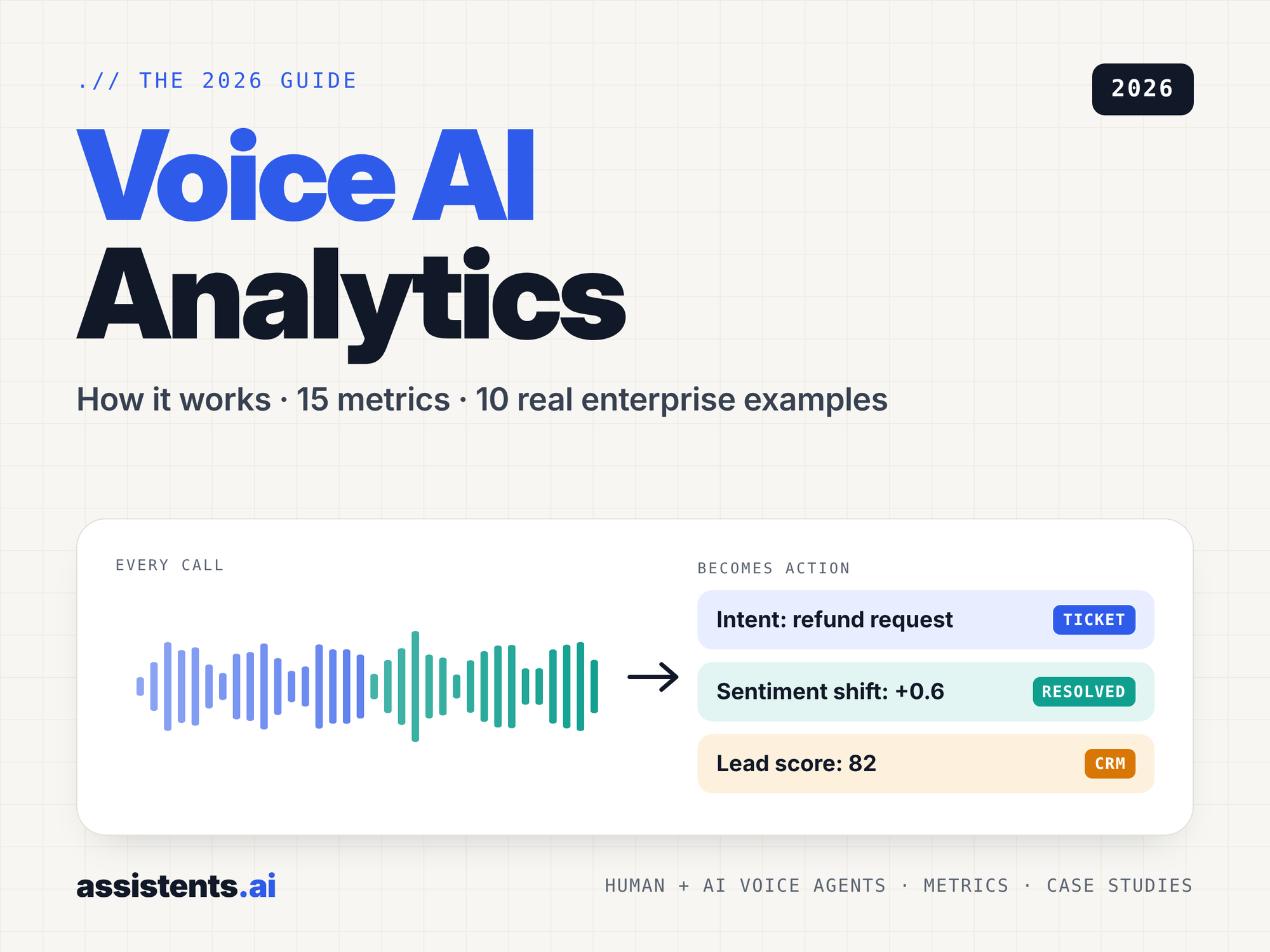
Voice AI analytics is the use of speech recognition, large language models and acoustic analysis to turn every phone conversation, whether handled by a human or an AI voice agent, into structured data: transcripts, intent, sentiment, outcomes and compliance signals that teams can measure and act on.
TL;DR
- Voice AI analytics converts 100% of calls into searchable, scorable data. Manual QA typically covers less than 5% of conversations (McKinsey).
- It now has two jobs: analyzing human-agent calls and analyzing AI voice agent calls. The best programs put both on one dashboard.
- The three metrics to start with are resolution rate, containment rate (always paired with repeat-call rate) and sentiment shift.
- Dashboards are not the finish line. Insights should trigger actions automatically: CRM updates, tickets, escalations and alerts.
- When analytics runs on the same platform as your voice agents, every call becomes training data for the next one.
Contact centers have always recorded calls. Very few have listened to them. A supervisor samples a handful of calls per agent each month, scores them against a checklist and extrapolates. The rest of the conversations, along with the complaints, buying signals and compliance slips inside them, go unheard.
AI voice agents make the gap wider. A single agent can handle thousands of conversations a day, in dozens of languages, around the clock. Without analytics, no one knows whether those calls are resolving problems or just ending.
This guide explains what voice AI analytics is, how it works, the 15 metrics that matter (with formulas), and how 10 enterprises across India, the UAE, the UK, the US, Europe and Africa use it in production.
What Is Voice AI Analytics?
Voice AI analytics is the automated analysis of spoken conversations using AI. It captures what was said, how it was said and what happened as a result, then turns those signals into metrics, alerts and actions.
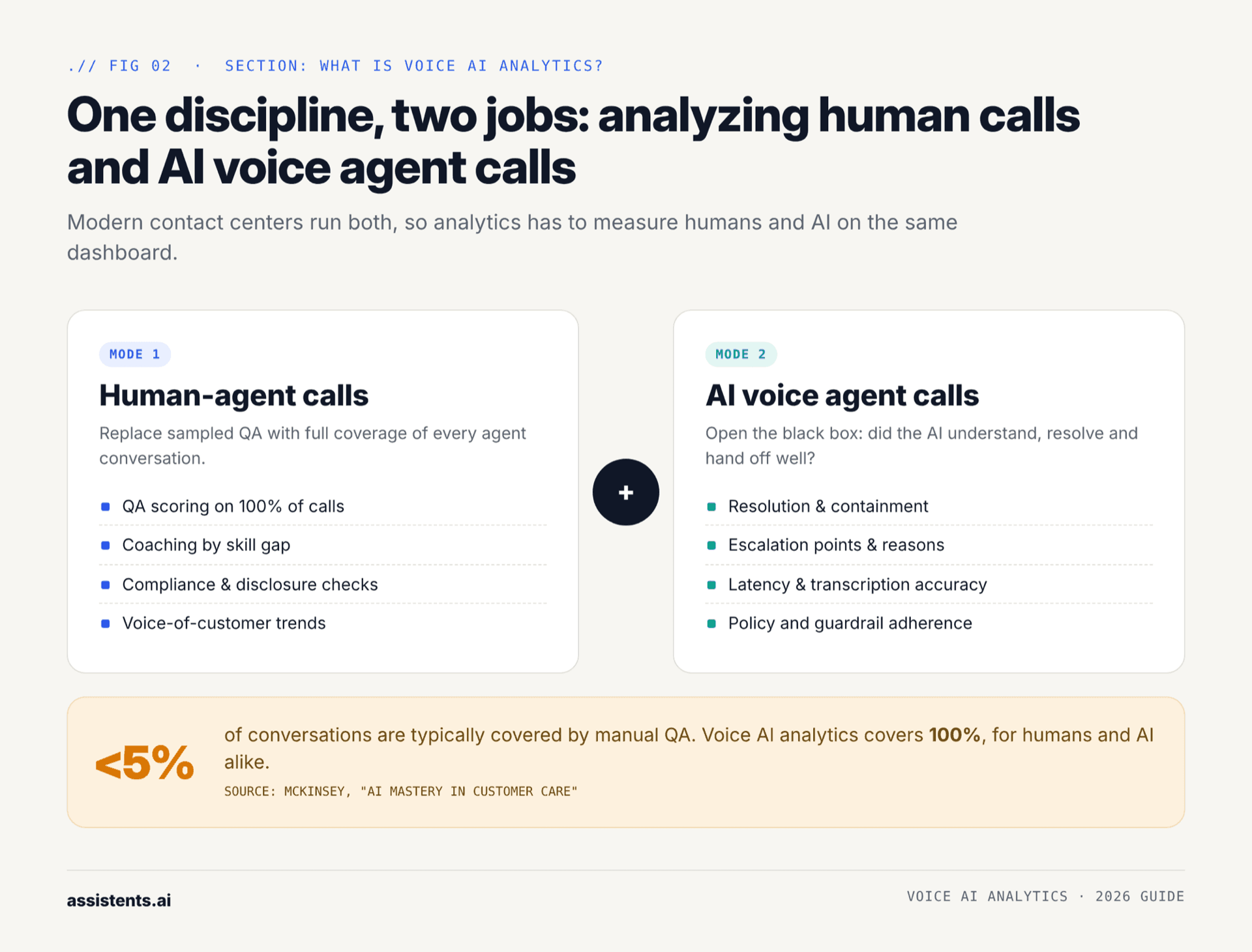
It works in two modes:
- Analytics for human-handled calls. Every agent conversation is transcribed, tagged and scored, which replaces sampled QA with full coverage. Teams use it for coaching, compliance and voice-of-customer insight.
- Analytics for AI voice agent calls. When an AI voice agent answers the phone, analytics shows whether it understood the caller, resolved the issue, escalated at the right moment and stayed within policy. Without it, an AI agent is a black box.
Most organizations now run both, so a modern voice AI analytics platform has to measure humans and AI on the same scale.
Voice AI Analytics vs Voice Analytics vs Speech Analytics vs Conversation Intelligence
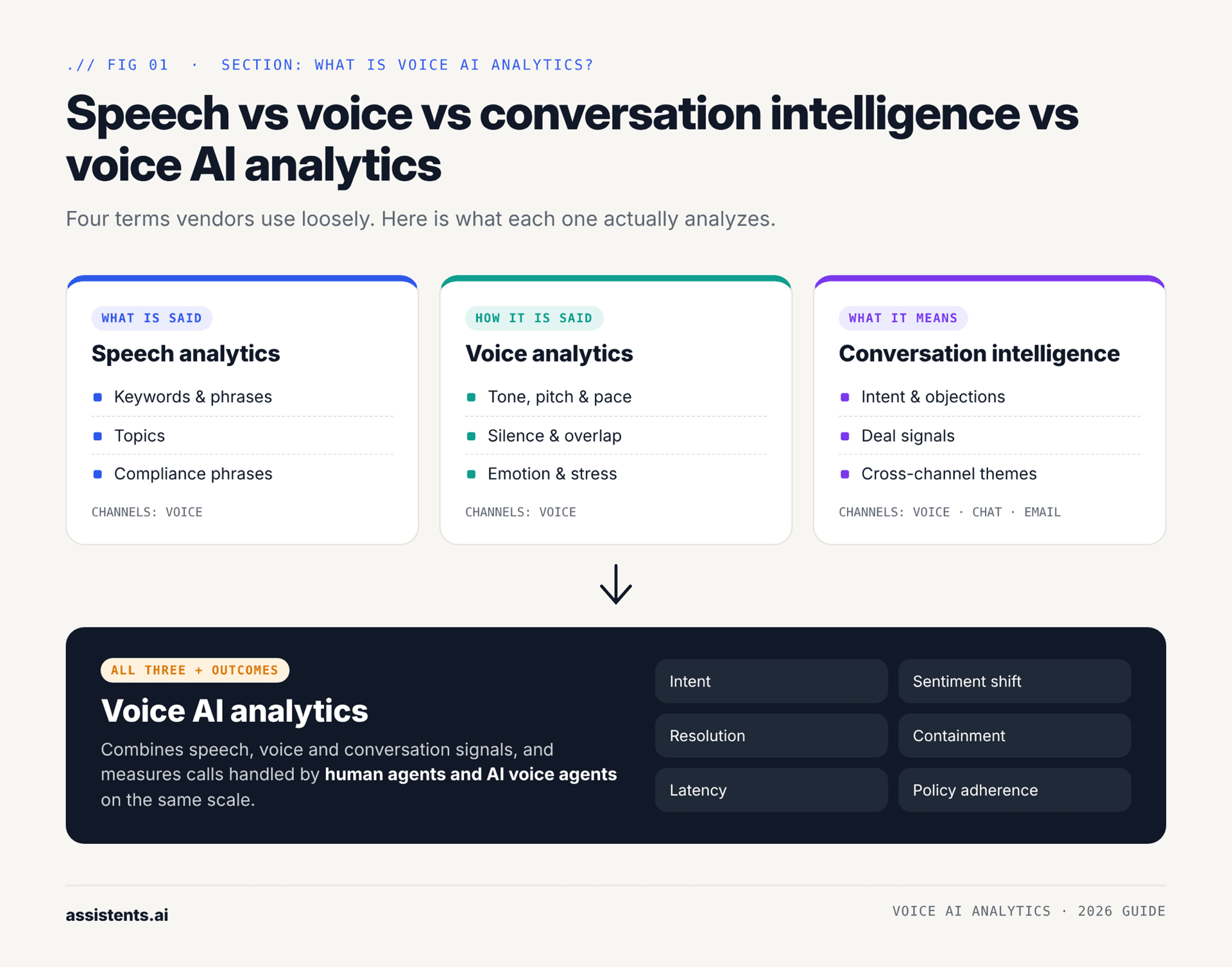
The terms overlap, and vendors use them loosely. Many people treat speech analytics as what was said and voice analytics as how it was said (CallMiner). Here is the practical difference:
| Term | What it analyzes | Typical signals | Channels | Best for |
|---|---|---|---|---|
| Speech analytics | The words spoken | Keywords, phrases, topics | Voice | Keyword spotting, compliance phrases |
| Voice analytics | How words are spoken | Tone, pitch, pace, silence, overlap | Voice | Emotion and stress detection |
| Conversation intelligence | Meaning across conversations | Intent, objections, deal signals | Voice, chat, email, video | Sales coaching, revenue insight |
| Voice AI analytics | All of the above, for human and AI voice agents, plus outcomes | Intent, sentiment, resolution, containment, latency, policy adherence | Voice (inbound and outbound) | Running and improving AI-first contact centers |
The short version: voice AI analytics is speech analytics, voice analytics and conversation intelligence combined, built for a contact center where AI agents take a large share of calls.
How Voice AI Analytics Works: The 5-Step Pipeline
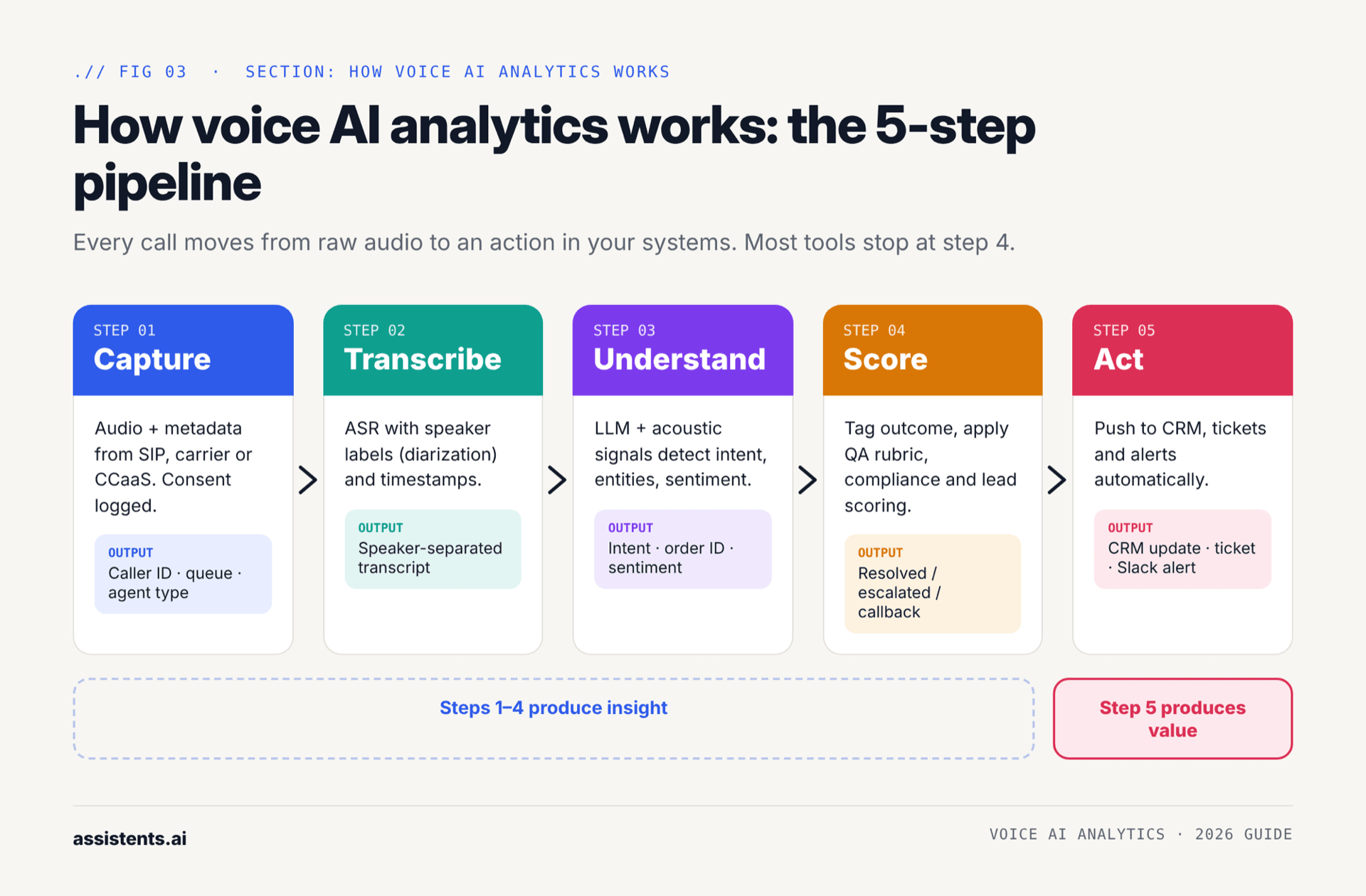
Voice AI analytics runs every call through five stages: capture, transcribe, understand, score and act. The first four produce insight. The fifth is where the value comes from, and it is the stage most tools skip.
1. Capture call audio and metadata
Audio is captured from your telephony layer: a cloud contact center, a SIP trunk or a carrier such as Twilio, Plivo or Exotel. Metadata travels with it: caller ID, queue, campaign, agent (human or AI), duration and disposition. Recording consent is logged at this stage (see compliance).
2. Transcribe with speaker labels and timestamps
Automatic speech recognition (ASR) converts audio to text. Speaker diarization separates caller from agent, and timestamps let you jump to the exact moment something happened. On multilingual lines the model must also handle code-switching, such as Hindi and English in the same sentence.
3. Understand intent, entities and sentiment
Large language models read the transcript to classify intent (support, sales, complaint, inquiry) and extract entities (names, emails, order IDs, account numbers). They also detect sentiment and how it changes over the call. Acoustic signals such as long silences, interruptions and raised pace add context the words alone miss.
4. Score, tag and classify outcomes
Each call is tagged with an outcome: resolved, escalated, callback or no decision. It is also scored against your QA rubric, compliance rules and lead-scoring model. This is where 100% coverage replaces the sampled scorecard.
5. Act: push results to the systems that do the work
Structured results flow to your CRM, helpdesk and messaging tools. A complaint opens a ticket, a hot lead updates a deal in the CRM, and a compliance miss alerts a supervisor in Slack or Teams. More on this below.
Real-time vs post-call voice analytics
| Real-time analytics | Post-call analytics | |
|---|---|---|
| When | During the call | Seconds to minutes after the call ends |
| Typical uses | Live agent assist, escalation triggers, compliance prompts, AI agent guardrails | Summaries, QA scoring, trend analysis, CRM updates, coaching |
| Strength | Prevents a bad call from getting worse | Reveals patterns across thousands of calls |
| Choose it when | Errors are costly in the moment (regulated disclosures, angry callers) | You need reliable reporting and root-cause analysis |
Most enterprises need both. Real-time analytics protects the individual call, and post-call analytics fixes the process behind it.
What Voice AI Analytics Can Tell You
Voice AI analytics answers business questions your call logs can't. These are the five most teams start with.
Why are customers calling?
Intent classification across every call shows your real call drivers. You might find that "where is my order" is 30% of volume, or that a recent policy change created a new complaint category. This is the input for self-service, product fixes and AI voice agent design.
Where does the AI agent fail or escalate?
For AI voice agents, analytics pinpoints the turns where callers repeat themselves, go silent or ask for a human. Those moments become your improvement backlog: a missing knowledge article, a misheard entity or a workflow the agent can't complete.
Which agents, human or AI, need coaching?
Scorecards on 100% of calls show which agents skip verification steps, which handle objections well and which AI flows underperform the human baseline.
Where is compliance risk showing up?
Missed disclosures, unverified identity and sensitive data spoken aloud are flagged automatically, with the timestamp and transcript as evidence.
Which calls carry revenue intent?
Lead scoring and buying-signal detection surface upsell, renewal and churn-risk conversations that would otherwise end with no follow-up.
15 Voice AI Analytics Metrics That Matter (With Formulas)
The right voice AI analytics metrics measure outcomes, not just activity. A call ending isn't the same as a problem solved. Track these 15 metrics in four families, and pair them so no single number misleads you.
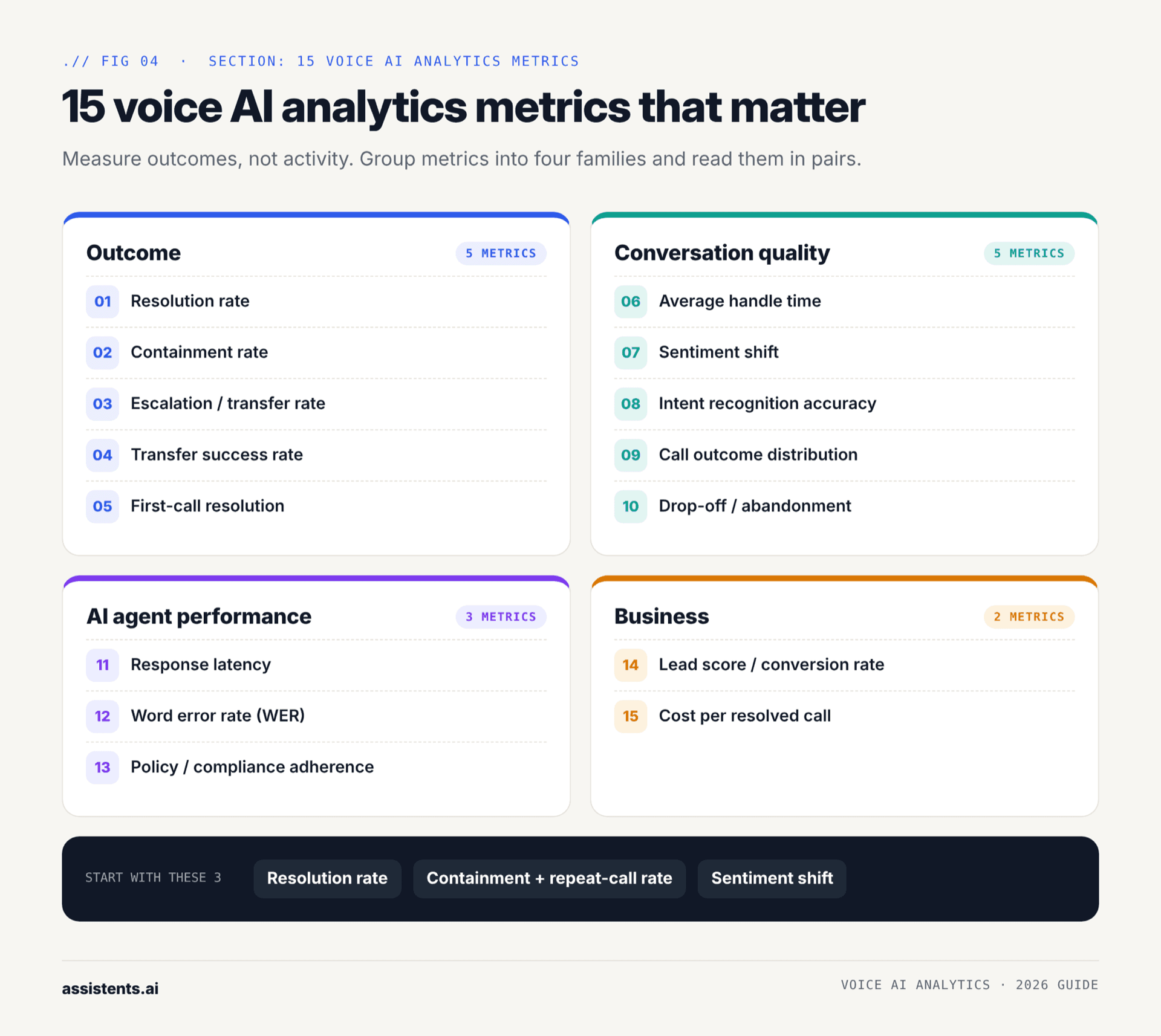
| # | Metric | Formula | What it tells you | Pair it with |
|---|---|---|---|---|
| Outcome | ||||
| 1 | Resolution rate | Calls with outcome = resolved ÷ total calls × 100 | Whether callers got what they needed | Repeat-call rate |
| 2 | Containment rate | Calls completed by AI with no human transfer ÷ total AI-handled calls × 100 | How much volume the AI agent absorbs | Resolution rate, CSAT |
| 3 | Escalation / transfer rate | Calls transferred to a human ÷ total AI-handled calls × 100 | Where the AI reaches its limits | Transfer success |
| 4 | Transfer success rate | Transfers where full context reached the human ÷ total transfers × 100 | Whether handoffs make callers repeat themselves | AHT after transfer |
| 5 | First-call resolution (FCR) | Issues resolved with no repeat contact in N days ÷ total issues × 100 | True resolution, not just call closure | Containment rate |
| Conversation quality | ||||
| 6 | Average handle time (AHT) | Total talk + hold + wrap time ÷ calls handled | Efficiency, read in context | FCR (fast and unresolved is worse) |
| 7 | Sentiment shift | End-of-call sentiment score − start-of-call sentiment score | Whether the call made things better or worse | Outcome |
| 8 | Intent recognition accuracy | Correctly classified intents ÷ audited sample × 100 | Whether the AI understood the request | Escalation rate |
| 9 | Call outcome distribution | Share of calls by outcome (resolved, escalated, callback, no decision) | Where calls end up | Intent mix |
| 10 | Drop-off / abandonment rate | Calls where the caller hung up before resolution ÷ total calls × 100 | Friction, confusion or long silences | Latency |
| AI agent performance | ||||
| 11 | Response latency | Median time from caller finishing speaking to agent's first audio | Whether the conversation feels natural | Drop-off rate |
| 12 | Word error rate (WER) | (Substitutions + deletions + insertions) ÷ words in reference transcript | Transcription accuracy, by language and accent | Intent accuracy |
| 13 | Policy / compliance adherence | Calls passing all required checks ÷ total calls × 100 | Regulatory and brand risk | Escalation rate |
| Business | ||||
| 14 | Lead score / conversion rate | Calls tagged qualified (or converted) ÷ sales-intent calls × 100 | Revenue generated from voice | Follow-up speed |
| 15 | Cost per resolved call | Total voice cost (platform + telephony + human time) ÷ resolved calls | The number your CFO cares about | Resolution rate |
The containment trap
Containment is the first number executives ask for, and the easiest to inflate. An AI agent that never transfers will post perfect containment even when callers hang up frustrated and call back an hour later. Always read containment alongside resolution rate and repeat-call rate. A useful check is CSAT-validated containment: containment counted only on calls where the caller was satisfied or did not call back.
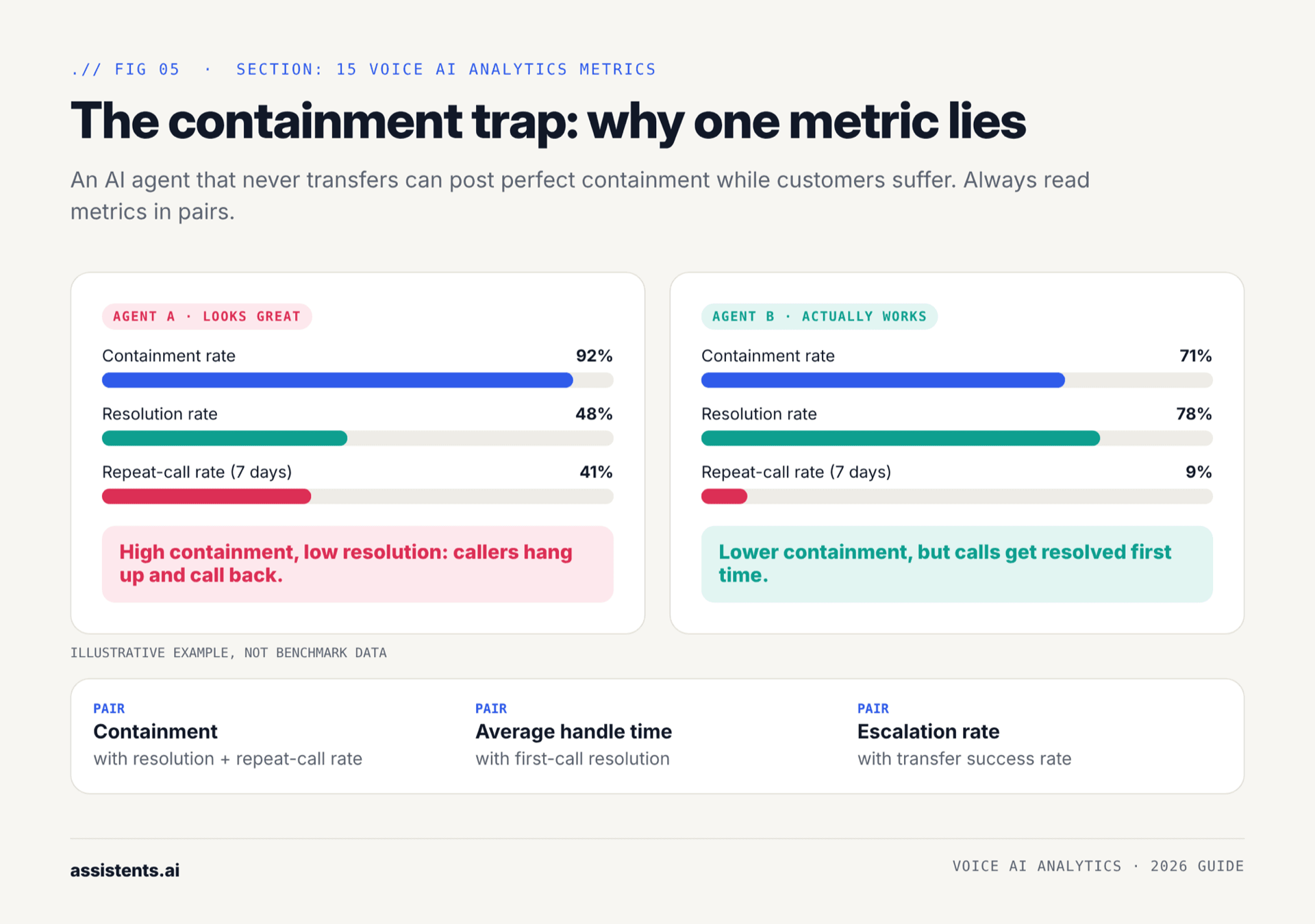
Benchmark AI agents against human agents on one dashboard
The most useful view puts your AI voice agent and your human team side by side on the same metrics: resolution, sentiment shift, compliance adherence and cost per resolved call. That shows which intents the AI should own, which should go straight to humans, and where the AI is already outperforming your baseline.
How assistents.ai tracks these metrics. The assistents.ai voice AI analytics platform transcribes 100% of calls with speaker labels and timestamps. It processes each call in under 2 minutes after it ends and extracts 50+ custom data fields. Campaign and agent performance dashboards cover connect rate, talk time, outcomes, resolution rate and CSAT, with CSV and API export.
Voice AI Analytics Use Cases by Industry
Voice AI analytics applies wherever phone conversations drive revenue, service or risk. The questions and actions differ by industry:
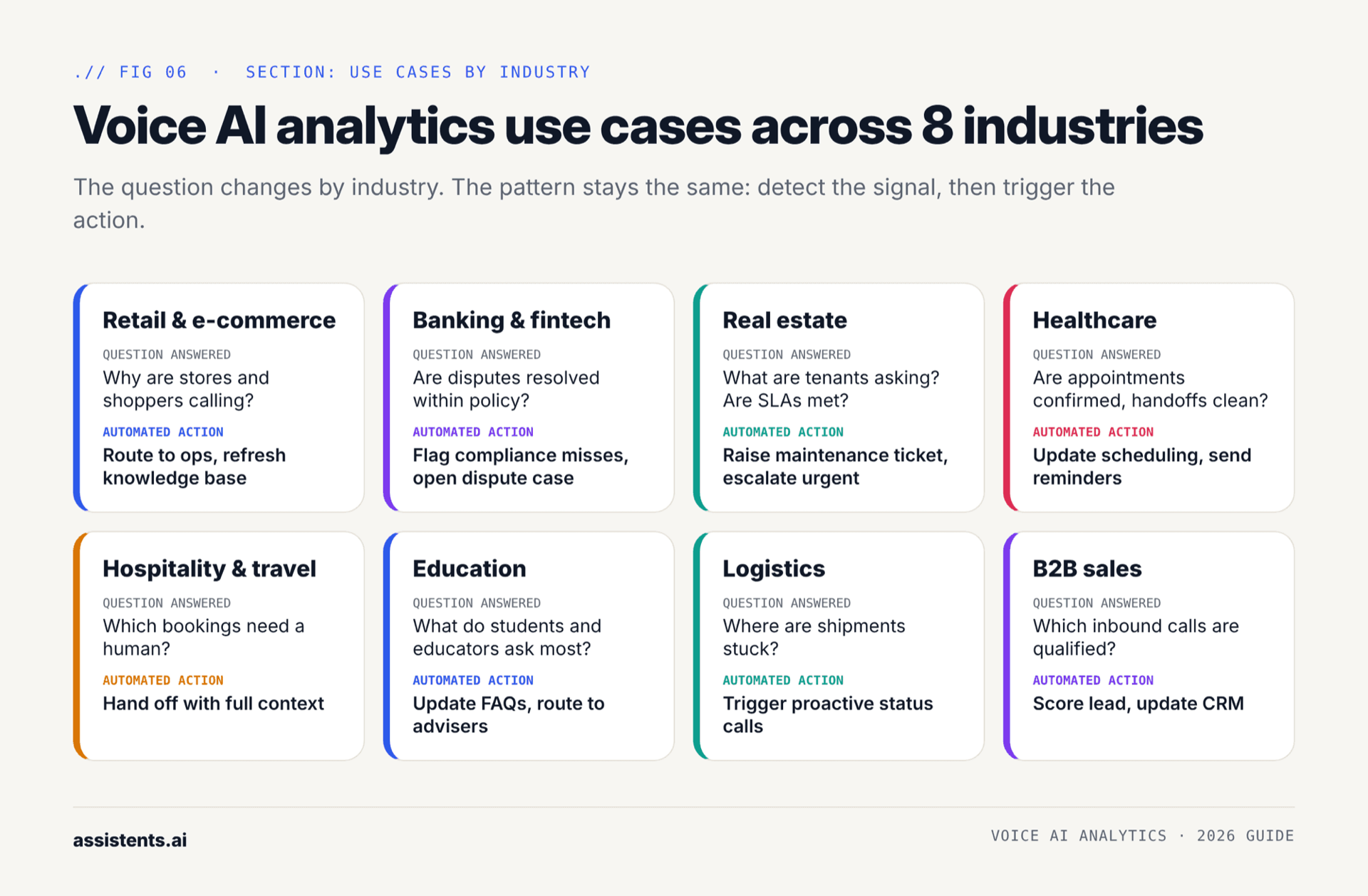
| Industry | Question it answers | Signals tracked | Automated action |
|---|---|---|---|
| Retail & e-commerce | Why are stores and shoppers calling? | Intent, order IDs, language, store ID | Route to store ops, update ticket, refresh knowledge base (voice order tracking) |
| Banking & fintech | Are disputes and card issues resolved in policy? | Verification steps, disclosures, sentiment | Flag compliance misses, create dispute case (multilingual voice banking) |
| Real estate | What are tenants asking, and are SLAs met? | Maintenance intent, urgency, unit ID | Raise a maintenance ticket, escalate urgent issues (tenant inquiry management) |
| Healthcare | Are appointments confirmed and handoffs clean? | Booking outcome, reschedule reasons | Update the scheduling system, send reminders (outbound scheduling) |
| Hospitality & travel | Which booking requests need a human? | Missing details, special requests | Hand off with full context to a reservations specialist |
| Education | What do students and educators ask most? | Query themes, programme, language | Update FAQs, route to advisers (student enrollment) |
| Logistics | Where are shipments stuck? | Tracking IDs, exception types | Trigger proactive status calls or alerts |
| B2B sales | Which inbound calls are qualified? | Budget, timeline, authority, intent | Score the lead and update the CRM (lead qualification) |
For a broader view of support automation, see voice-powered customer support and the full assistents.ai use case library.
10 Real Enterprise Examples of Voice AI Analytics in Production
These examples come from enterprise deployments delivered by the assistents.ai team. Client names are withheld. The first five are voice and conversational deployments. The second five apply the same analytics-to-action engine to service operations that run on calls, bookings and requests.
1. National value retailer, India: bilingual voice support for store teams
- Challenge: Hundreds of stores across the country sent operational questions to a central helpdesk, about stock, pricing, promotions and procedures. Many were asked by phone in Hindi or English.
- What was deployed: A voice support agent built on a speech-to-text, LLM and text-to-speech pipeline in Hindi and English. It works with an inventory intelligence agent (pricing, stock and promos per store), a knowledge agent over POS and SOP documents, and an admin console with analytics and ticketing integration.
- Signals tracked: Issue categories by store and region, language mix, unresolved queries, ticket routing and knowledge gaps.
- Results: Less manual helpdesk work, faster resolution of store issues, better store-level inventory visibility and faster onboarding through on-demand training guidance.
2. Global fintech provider for banks and credit unions: auditable omnichannel support
- Challenge: Financial institutions needed faster dispute and support handling without losing auditability.
- What was deployed: Omnichannel intake across chat, email and phone with workflow routing; agent-assist summaries and next-best actions; auditability, reporting and SLA monitoring; integration with core systems.
- Signals tracked: Case outcomes, SLA adherence, summary quality and audit-trail completeness.
- Results: Faster, more consistent case handling, lower operational load through automation, and better compliance readiness through audit trails.
3. UAE real estate portfolio owner: 24×7 tenant service
- Challenge: A diversified office, retail, industrial and residential portfolio across several emirates generated high call-centre volume for tenant queries, payments and maintenance.
- What was deployed: An omnichannel service agent (web, WhatsApp and email-ready) with tenant query triage, FAQ and rental-payment workflows, ticketing and escalation to human teams, and a knowledge base over policies, tenancy documents and SOPs.
- Signals tracked: Intent mix, escalation rate, SLA timers and repeat queries.
- Results: Faster responses, lower call-centre load, consistent 24×7 tenant experience and better SLA adherence through automated routing and tracking.
4. Luxury hospitality group, East Africa: booking conversations with human-in-the-loop
- Challenge: High-expectation travellers sent complex booking requests that needed back-and-forth to collect missing details.
- What was deployed: A digital booking agent with intake and intent classification, a conversational loop that captures missing details, real-time availability checks with alternative dates and properties, a hybrid handoff for curated itineraries, and automated document generation.
- Signals tracked: Missing-field rate, handoff points and requirement-capture accuracy.
- Results: Faster booking turnaround with less back-and-forth, higher accuracy on complex guest requirements, and scalable operations without compromising luxury service.
5. AI voice app for performers, global: a voice agent tuned by analytics
- Challenge: Actors needed an always-available, realistic scene partner, at a cost that scales.
- What was deployed: An AI voice agent with character and voice control, pacing and cue logic, script ingestion, rehearsal analytics and cost-controlled inference.
- Signals tracked: Session throughput, response timing, cue accuracy and cost per session.
- Results: Higher rehearsal throughput without human readers, more consistent practice loops, and better readiness with less coordination friction.
6. UK private healthcare and testing provider: booking-to-reporting visibility
- Challenge: High-volume consumer workflows, from booking through processing to reporting, created missed handoffs and slow updates.
- What was deployed: Booking and workflow orchestration, status monitoring with customer notifications, and operational reporting dashboards.
- Signals tracked: Workflow status by stage, notification delivery and handoff gaps.
- Results: More scalable operations with less manual overhead, faster customer communication, fewer missed handoffs and unified service reporting.
7. US healthcare staffing platform: faster fill cycles
- Challenge: Facilities needed nursing shifts filled quickly, and every request meant intake, matching and confirmation.
- What was deployed: Talent onboarding and credential capture, facility request intake with matching logic, scheduling and notification workflows, compliance workflows, and fill-rate and utilisation reporting.
- Signals tracked: Request-to-fill time, fill rate and utilisation.
- Results: Faster fill cycles, less scheduling friction, better workforce utilisation and more responsive staffing for facilities.
8. Driving institute, UAE: funnel and customer experience analytics
- Challenge: A multi-branch operation could not see where students stalled between enrolment and passing their test.
- What was deployed: Funnel analytics (enrolment → lessons → tests), instructor utilisation and slot optimisation, and customer experience dashboards with alerts.
- Signals tracked: Stage conversion, slot utilisation and CX alerts.
- Results: Fewer operational bottlenecks, better scheduling efficiency and clearer visibility into conversion and performance drivers.
9. Global teacher-learning community: support at scale
- Challenge: A large international educator community generated programme and learning questions faster than a human team could answer.
- What was deployed: A support agent for programme and learning queries, teacher competency insights, and analytics for programme operators and partners.
- Signals tracked: Query themes, engagement and resolution by programme.
- Results: Scalable support for educator communities, faster access to learning resources and better visibility into engagement and outcomes.
10. Privately held retail holding group: from dashboards to governed actions
- Challenge: Leadership had dashboards but no reliable way to turn insights into owned, tracked actions across teams.
- What was deployed: A unified context engine over structured and unstructured data, a semantic governance layer (rules, hierarchies and formulas), an orchestrator integrated with core systems, and insights-to-action agents on top of existing dashboards.
- Signals tracked: Exceptions, task creation and completion, and decision logic.
- Results: A shift from reactive reporting to proactive execution loops, standardised decision logic across teams, and automated task creation with completion tracking.
The common thread: each deployment uses analytics to trigger something, such as a ticket, a handoff, an alert or a task, rather than to fill a report. That is the step that separates voice AI analytics that pays back from analytics that becomes another dashboard nobody opens.
From Insight to Action: Automating What Happens After the Call
Voice AI analytics creates value when its output changes what happens next, without a human copying data between screens. The pattern looks like this:
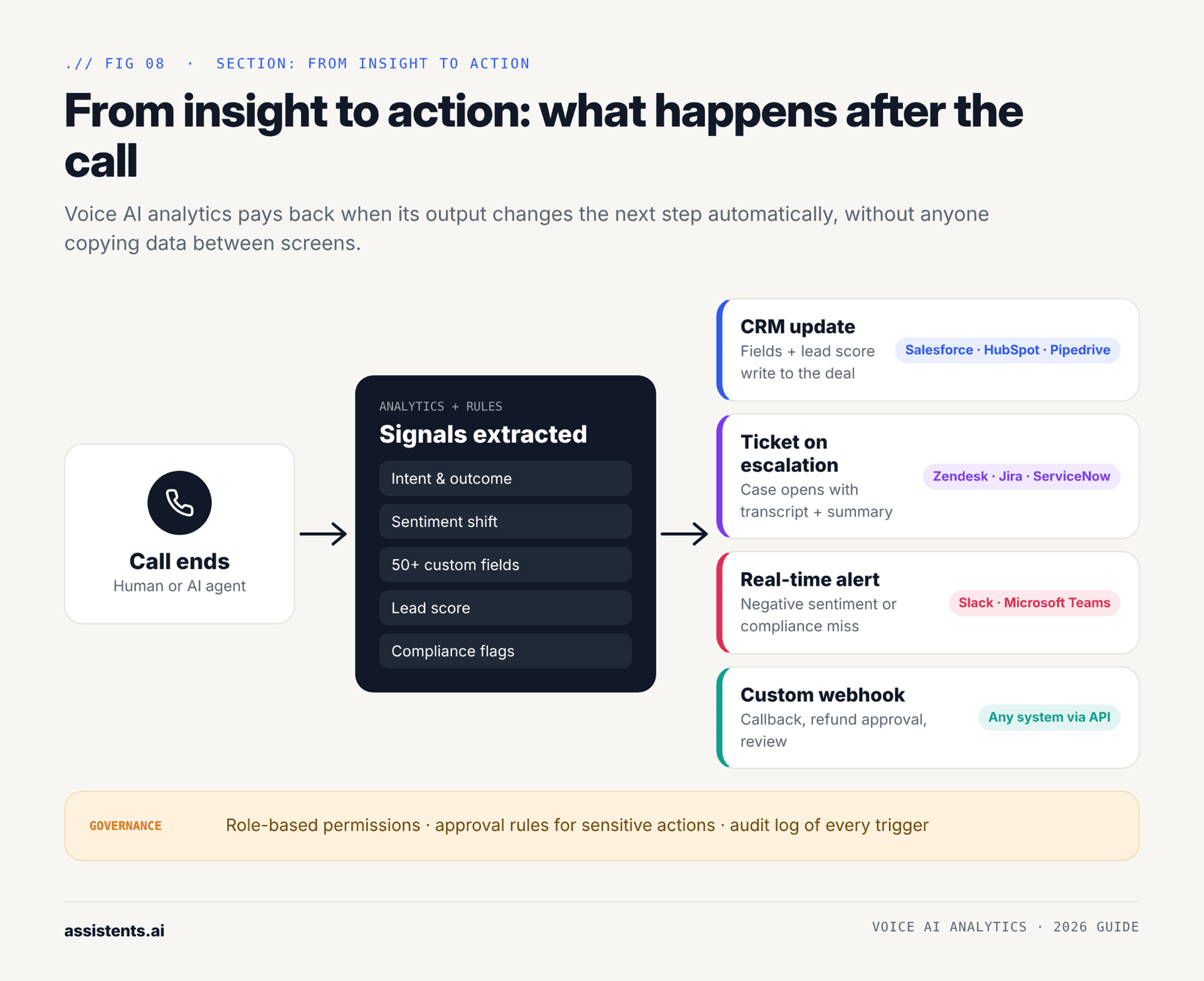
- CRM updates. Extracted fields such as name, company, budget and next step write straight to Salesforce, HubSpot or Pipedrive, and lead scores update the deal stage.
- Ticket creation on escalation. A complaint or unresolved call opens a case in Zendesk, Jira or ServiceNow, with the transcript and summary attached.
- Real-time alerts. Negative sentiment on a high-value account, or a missed compliance disclosure, posts to a Slack or Microsoft Teams channel.
- Custom webhooks. Any outcome can trigger a downstream workflow, such as a callback, a refund approval or a supervisor review.
- Plain-English analysis. Leaders ask "Why did escalations rise in the North region last week?" and get an answer grounded in call data, through real-time revenue analytics and Agentic BI.
Hold insight-to-action to the same governance as any other automation: role-based permissions, approval rules for sensitive actions, and an audit log of what was triggered and why.
Security, Compliance and Multilingual Voice Analytics
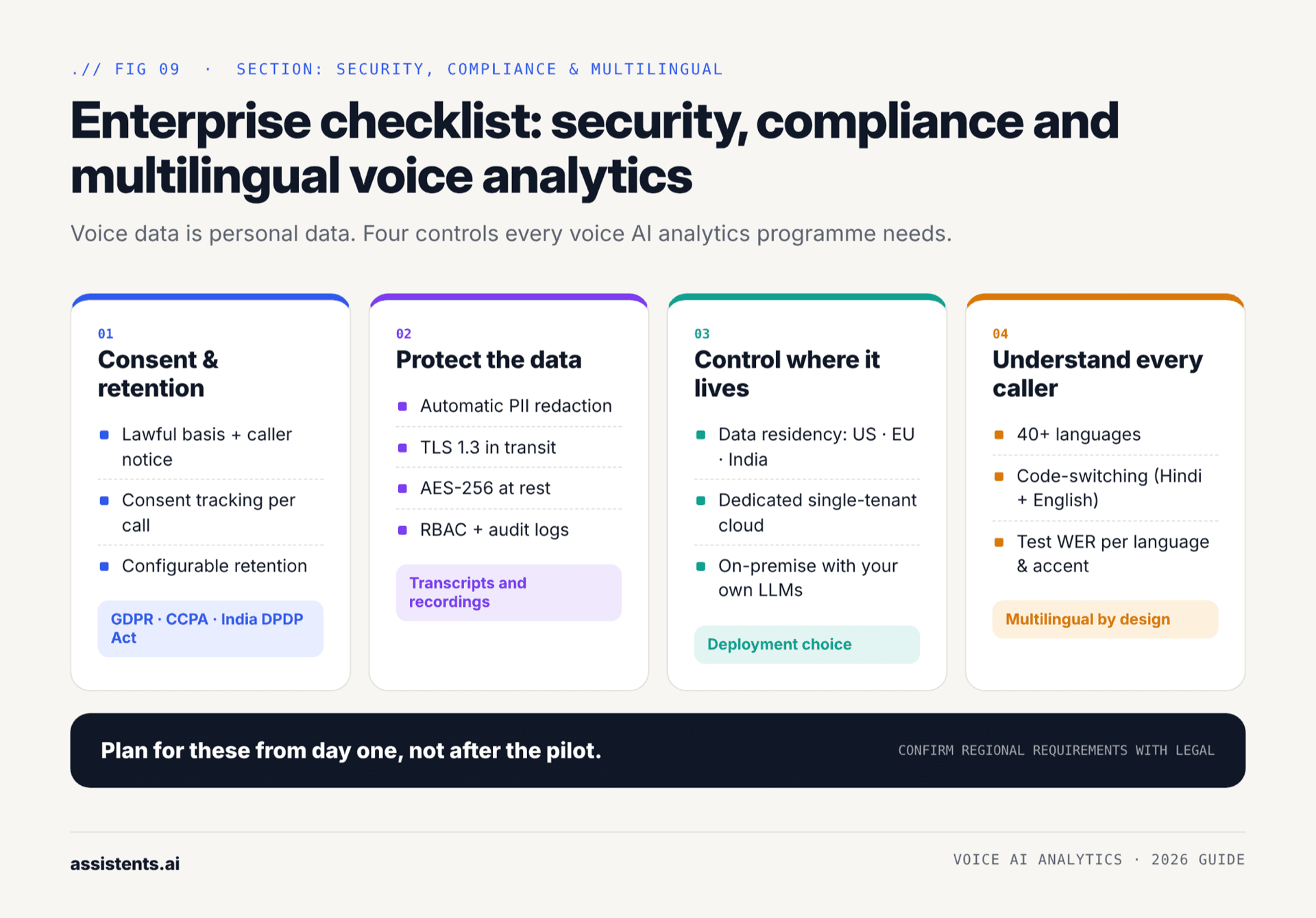
Voice data is personal data. Any voice AI analytics programme must handle consent, redaction, residency and language from day one.
Call recording consent and retention
Recording and analyzing calls needs a lawful basis and, in many jurisdictions, explicit notice or consent. The EU's GDPR, California's CCPA and India's Digital Personal Data Protection Act, 2023 all affect how call data is collected, stored and deleted. Use a platform with consent tracking and configurable retention policies, and confirm the specifics with your legal team.
PII redaction, encryption and data residency
Look for:
- Automatic PII redaction of card numbers, national IDs and custom patterns, in both transcripts and audio
- Encryption in transit (TLS 1.3) and at rest (AES-256)
- Regional data residency, such as US, EU and India regions, so data stays where regulation requires
- Deployment choice: multi-tenant cloud, dedicated single-tenant cloud, or fully on-premise with your own LLMs
- Audit logging and role-based access control (RBAC) for who can hear, read and export calls
See enterprise voice AI deployment options for how these controls fit together.
Multilingual and code-switched calls
In India, the Gulf and much of Europe, callers switch languages mid-sentence. Analytics that only works in English misses a large share of the conversation. Test transcription accuracy (WER) and intent accuracy per language and accent, not just in aggregate. The national retailer in example 1 runs voice support in both Hindi and English for exactly this reason.
Limits of Voice AI Analytics, and How to Check Vendor Claims
Voice AI analytics is powerful, but it isn't magic. Know where it breaks before you buy:
- Accents, noise and line quality increase word error rate, and every downstream signal inherits the error.
- Sentiment is probabilistic. Sarcasm, cultural norms and flat speaking styles produce false positives. Use sentiment for trends, not for judging a single call.
- Containment can look great while customers suffer. See the containment trap.
- Vendors define metrics differently. One vendor's "resolution" is another's "call ended without transfer".
- Automated QA still needs calibration. McKinsey estimates a largely automated QA process can exceed 90% accuracy, versus 70–80% for manual scoring, but only once the rubric has been calibrated against human reviewers (McKinsey).
Five questions to ask any vendor:
- What is your WER on our audio, in our languages, measured on a sample we provide?
- How exactly do you define resolution, containment and escalation?
- Can we audit a random sample of AI-scored calls against human scores?
- Where is our data stored and processed, and can we choose the region?
- Can insights trigger actions in our systems, or only appear on your dashboard?
How to Choose a Voice AI Analytics Platform: 12-Point Checklist
| # | Criterion | What good looks like |
|---|---|---|
| 1 | Transcription accuracy | Measured per language and accent on your own audio |
| 2 | Real-time and post-call | Both, with clear latency for each |
| 3 | Custom data extraction | Define your own fields (order ID, policy number, budget) |
| 4 | Human + AI coverage | One dashboard for human agents and AI voice agents |
| 5 | Outcome tagging | Resolved / escalated / callback / no-decision, configurable |
| 6 | Integrations | Native CRM, helpdesk and messaging connectors |
| 7 | Webhooks and API | Push any field or event to any system |
| 8 | Access control | RBAC, sub-accounts per team or brand, audit logs |
| 9 | Data residency | Choose your region, with on-prem available |
| 10 | PII redaction | Automatic, in transcripts and recordings |
| 11 | Reliability | Uptime SLA and support SLAs in the contract |
| 12 | Pricing model | Transparent per-minute or per-call pricing that scales predictably |
How to Implement Voice AI Analytics in 30 Days
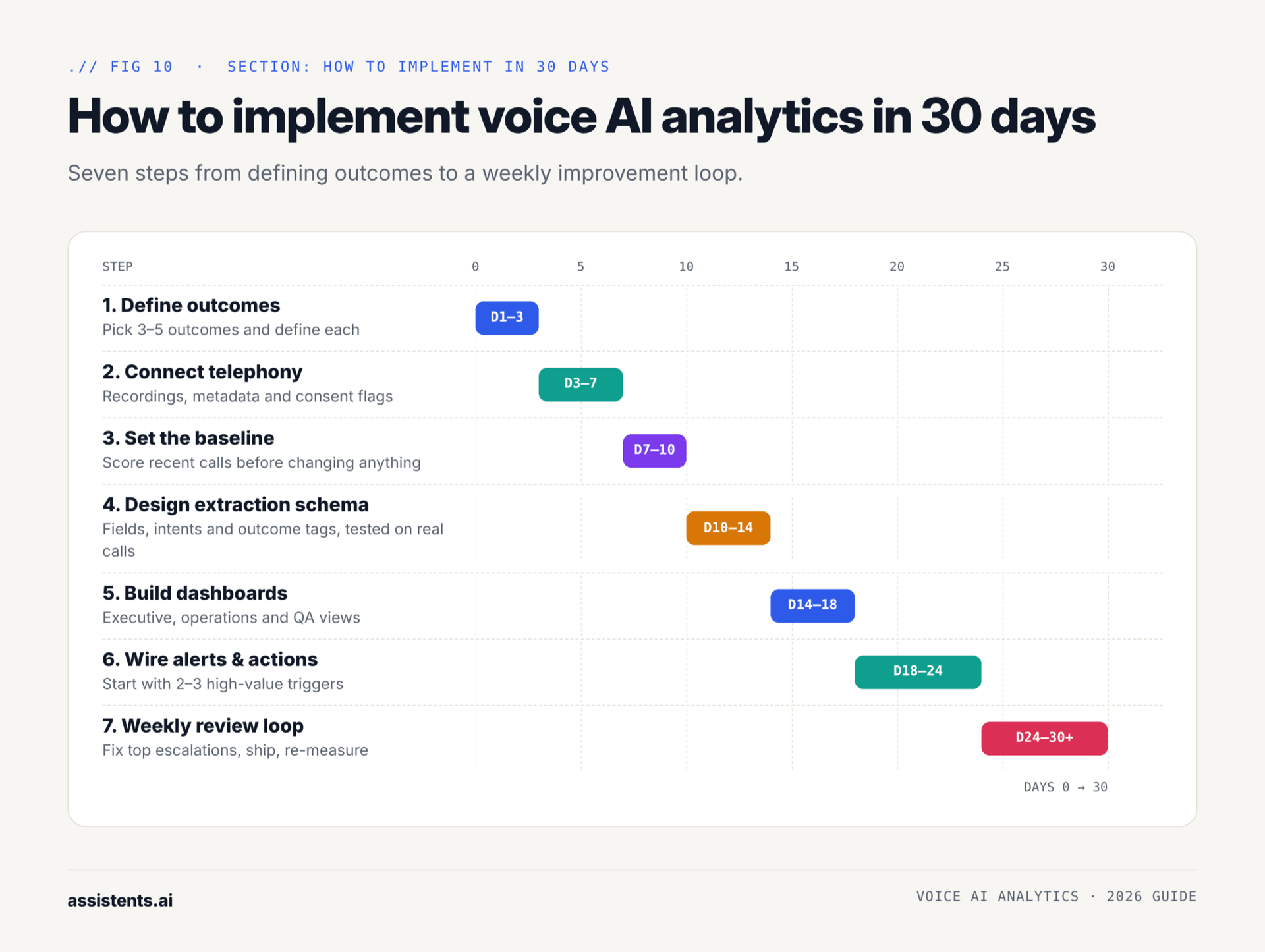
- Define outcomes (days 1–3). Pick the 3 to 5 business outcomes you want to move, such as resolution rate, compliance adherence or cost per resolved call. Write down how each is defined.
- Connect telephony (days 3–7). Integrate your contact center, SIP trunk or carrier and confirm that recordings, metadata and consent flags are captured.
- Set the baseline (days 7–10). Run analytics on recent call history to establish starting values for every metric before changing anything.
- Design the extraction schema (days 10–14). List the fields, intents and outcome tags you need, and test them on a sample of real calls.
- Build dashboards (days 14–18). Create views for executives (outcomes and cost), operations (intent mix and escalations) and QA (scores and compliance).
- Wire alerts and actions (days 18–24). Connect CRM updates, ticket creation and Slack or Teams alerts. Start with two or three high-value triggers.
- Run a weekly review loop (days 24–30 and beyond). Review top escalation reasons, AI agent failure points and compliance flags each week, ship fixes, and track the metric movement.
How to Measure Voice AI Analytics ROI
Measure ROI against your baseline from step 3, using your own costs:
ROI (%) = [(Agent hours saved × loaded hourly cost) + revenue recovered + compliance cost avoided − (platform cost + telephony cost)] ÷ (platform cost + telephony cost) × 100
- Agent hours saved: QA review time, after-call work and calls contained by AI
- Revenue recovered: conversions from leads that analytics surfaced and routed
- Compliance cost avoided: remediation, penalties and audit effort reduced by full-coverage monitoring
For context, McKinsey estimates gen AI can deliver more than 50% savings in QA costs, a 25–30% increase in agent efficiency and a 5–10% improvement in customer satisfaction (McKinsey). Your numbers depend on call mix, so model your own.
Why assistents.ai for Voice AI Analytics
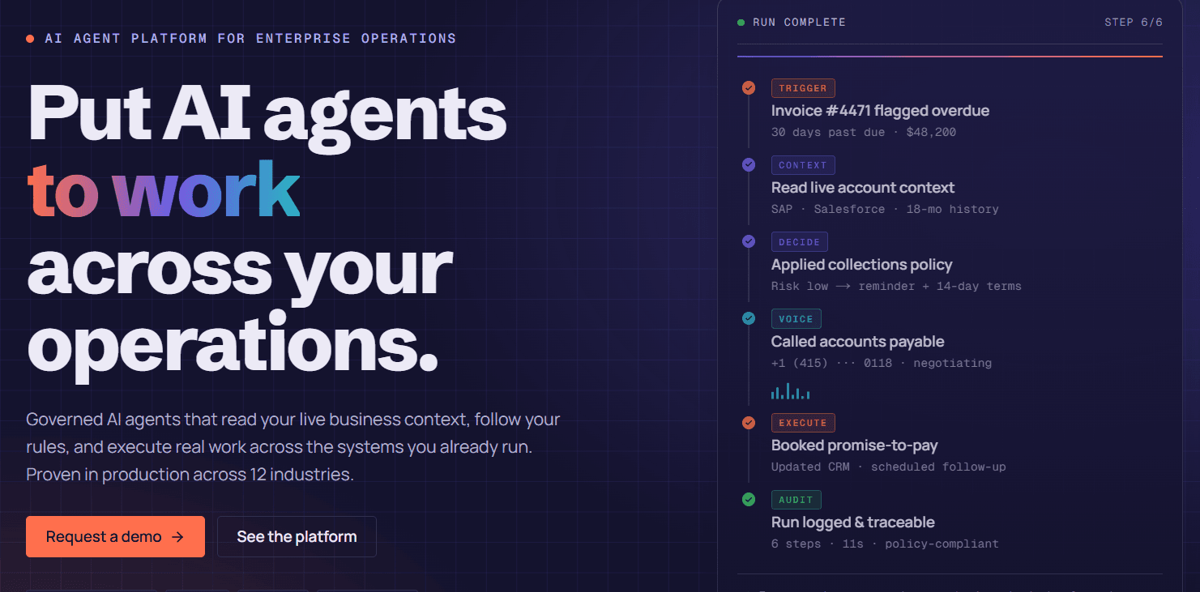
assistents.ai is an enterprise voice AI platform that combines AI voice agents with voice AI analytics, so every call is handled, measured and acted on in one place.
1. Voice agents and analytics on one platform
assistents.ai Voice AI handles inbound and outbound calls with sub-300ms latency in 40+ languages. Because the analytics come from the same calls your AI agent handles, every conversation feeds back into a better agent.
2. Every call becomes data
100% of calls transcribed, with speaker labels and timestamps. Post-call processing takes under 2 minutes, and you can extract 50+ custom data fields. Sentiment analysis, intent classification, lead scoring, automated tagging and outcome categorization are built in. See the analytics platform.
3. Insight to action, not just dashboards
There are native integrations with Salesforce, HubSpot, Pipedrive, Zendesk, Jira, ServiceNow, Slack and Microsoft Teams, plus custom webhooks and API export. Agentic BI lets leaders ask questions about call data in plain English.
4. Enterprise-grade security by default
SOC 2 Type II certified, with GDPR, CCPA and India data-localisation alignment. PII redaction, TLS 1.3 and AES-256 encryption, RBAC with custom roles, audit logging and a 99.9% uptime SLA are standard.
5. Deploy your way
Choose multi-tenant cloud, dedicated single-tenant cloud on AWS or Azure, or fully on-premise with your own LLMs. Bring your own carrier with SIP trunks or use 10+ pre-integrated carriers, including Twilio, Plivo and Exotel. Data residency is available in the US, EU and India. Explore enterprise options.
6. Proven across industries and regions
assistents.ai has delivered 30+ enterprise deployments across India, the UAE, the UK, the US, Canada, Europe, Africa and Australia. They span retail, financial services, real estate, healthcare, hospitality, education, logistics and utilities. Several are described in the examples above.
Request a demo of assistents.ai Voice AI Analytics →
Key Terms
- ASR (automatic speech recognition): converts spoken audio to text.
- Diarization: separates who spoke when (caller vs agent).
- Containment rate: the share of AI-handled calls completed without a human transfer.
- First-call resolution (FCR): issues solved with no repeat contact.
- Sentiment shift: the change in caller sentiment from the start to the end of a call.
- Word error rate (WER): the standard measure of transcription accuracy.
- PII redaction: automatic removal of personal data from transcripts and recordings.
- Post-call analysis: structured insight generated after a call ends.
Conclusion
Voice AI analytics turns every call, whether a human or an AI voice agent answers it, into data you can measure and act on. Three things separate programmes that pay back from those that become another dashboard:
- Measure outcomes, not activity. Pair containment with resolution, and benchmark AI against humans.
- Close the loop. Let insights trigger tickets, CRM updates and alerts automatically.
- Build for enterprise reality. Plan for consent, redaction, data residency and multilingual callers from day one.
Ready to see how every call can become actionable intelligence? Request a demo of assistents.ai Voice AI Analytics, or explore enterprise voice AI options.
Related reading: What are voice AI agents? · What is voice analytics? · 12 Best AI Voice Agents for Real Estate in 2026 · Using AI in Lead Generation
FAQs
What is voice AI analytics?
Voice AI analytics is the use of AI (speech recognition, large language models and acoustic analysis) to turn phone conversations into structured data such as transcripts, intent, sentiment, outcomes and compliance signals. It covers calls handled by human agents and by AI voice agents, and lets teams measure 100% of calls instead of a small manual sample.
How does AI voice analytics work?
AI voice analytics works in five steps: it captures call audio and metadata, transcribes speech with speaker labels, uses AI to understand intent, entities and sentiment, scores and tags each call's outcome, and then pushes results to systems such as a CRM, helpdesk or Slack so teams can act on them.
What is the difference between voice analytics and speech analytics?
Speech analytics focuses on what is said: words, keywords and topics. Voice analytics focuses on how it is said: tone, pace, silence and emotion. Voice AI analytics combines both with intent and outcome detection, and extends them to AI voice agent conversations.
Can voice analytics work in real time?
Yes. Real-time voice analytics runs during the call to power live agent assist, escalation triggers and compliance prompts. Post-call analytics runs seconds to minutes after the call to produce summaries, QA scores and trends. Most enterprises use both.
How accurate is AI call transcription and sentiment analysis?
Accuracy depends on audio quality, language, accent and domain vocabulary. Transcription is measured by word error rate (WER) and should be tested on your own calls in each language you support. Sentiment is probabilistic, so it is most reliable for spotting trends across many calls rather than judging a single one.
What metrics should you track for AI voice agents?
Track resolution rate, containment rate, escalation rate, transfer success rate, first-call resolution, sentiment shift, intent recognition accuracy, response latency, word error rate, compliance adherence and cost per resolved call. Pair containment with resolution and repeat-call rate so the numbers can't hide unresolved calls.
What is a good containment rate for voice AI?
There is no universal benchmark. Containment depends on call mix, use case and how each vendor defines it. A good containment rate is one that rises while resolution rate and customer satisfaction hold steady or improve. Measure CSAT-validated containment to make sure contained calls were actually resolved.
Is voice analytics GDPR compliant? Does it need call recording consent?
Voice analytics can be GDPR compliant if calls are recorded with a lawful basis, callers are notified, personal data is redacted or minimised, and data is stored in an appropriate region with defined retention. Requirements differ under GDPR, CCPA and India's DPDP Act, so confirm the details with your legal team.
Can voice analytics integrate with my CRM?
Yes. Modern voice AI analytics platforms push transcripts, summaries, extracted fields and lead scores into CRMs such as Salesforce, HubSpot and Pipedrive, and can create tickets in Zendesk, Jira or ServiceNow automatically through native integrations or webhooks.
Which industries benefit most from voice analytics?
Industries with high call volumes or regulated conversations benefit most. They include retail and e-commerce, banking and fintech, insurance, healthcare, real estate, hospitality, logistics, education and B2B sales.